

Semester V DSE-3b Understanding Ambedkar
Unit I · 22 min read · Updated 24 Nov 2026
As per the University of Delhi (DU) BA (Hons) Political Science syllabus
Contents
- 1.1 Ambedkar’s Life and Work
- Education and Early Scholarship
- Struggle and Leadership
- Ambedkar’s Major Writings
- 1.2 The Anti-Caste Tradition: Phule and Begumpura
- Omvedt: Seeking Begumpura
- Phule: Remembering the Kingdom of Bali
- Women in the Anti-Caste Tradition
- 1.3 Ambedkar’s Approach and Annihilation of Caste
- Gore: The Social Context of an Ideology
- Annihilation of Caste
- Approach to Polity, History, Economy, Religion and Society
- Ambedkar and Dewey
- 1.4 Important Questions
- Discuss Ambedkar’s approach to the study of polity, history, economy, religion and society.
- Discuss the main arguments of Ambedkar’s Annihilation of Caste.
- Discuss the anti-caste tradition that shaped Ambedkar with reference to Gail Omvedt’s Seeking Begumpura.
- Discuss M. S. Gore’s analysis of the social context of Ambedkar’s ideology.
- Short Notes
आपको मेरी अंतिम सलाह है: शिक्षित बनो, आंदोलन करो और संगठित हो; अपने आप पर विश्वास रखो।
My final words of advice to you are educate, agitate and organize; have faith in yourself.
— B. R. Ambedkar, All India Depressed Classes Conference, Nagpur, July 1942
BBHIMRAO RAMJI AMBEDKAR (1891–1956) was born into the Mahar caste, then treated as untouchable, and rose to become an economist, lawyer, historian, philosopher, leader of the Dalit movement and chairman of the Drafting Committee of India’s Constitution. He wrote on caste, religion, democracy, women, economics, labour and history, and he combined scholarship with struggle. This chapter introduces Ambedkar: his life and work, the anti-caste tradition from Phule that shaped him, the social context of his ideology as analysed by M. S. Gore, his classic text Annihilation of Caste, and his distinctive approach to the study of polity, history, economy, religion and society.

1.1 Ambedkar’s Life and Work
Education and Early Scholarship
Ambedkar faced untouchability from childhood: at school he had to sit apart and could not drink water from the common tap. With the support of the Maharaja of Baroda, he studied at Columbia University in New York, where he was taught by the philosopher John Dewey, whose ideas of democracy as a way of associated living deeply influenced him. In 1916 he presented the paper Castes in India: Their Mechanism, Genesis and Development, arguing that caste is maintained by endogamy, i.e. marriage within the group. He later studied at the London School of Economics and qualified as a barrister. His early economic works, The Evolution of Provincial Finance in British India (1925) and The Problem of the Rupee (1923), made him one of the first Indian economists trained abroad.
Struggle and Leadership
- 1920 and 1924. He started the newspaper Mooknayak (Leader of the Voiceless) and founded the Bahishkrit Hitakarini Sabha to promote education and welfare among the depressed classes.
- 1927. He led the Mahad Satyagraha to assert the right of untouchables to draw water from the Chavdar tank, and on 25 December publicly burned the Manusmriti.
- 1930–32. At the Round Table Conferences he demanded separate electorates; after Gandhi’s fast against the Communal Award, the Poona Pact of September 1932 gave reserved seats in joint electorates instead.
- 1935–36. At Yeola in 1935 he declared that he would not die a Hindu; in 1936 he founded the Independent Labour Party and published Annihilation of Caste.
- 1942–46. He founded the Scheduled Castes Federation and served as Labour Member in the Viceroy’s Executive Council.
- 1947–51. As Law Minister and chairman of the Drafting Committee, he guided the making of the Constitution; he resigned in 1951 when the Hindu Code Bill was stalled.
- 1956. He embraced Buddhism and completed The Buddha and His Dhamma, published in 1957.
Ambedkar’s Major Writings
- Castes in India (1916) and The Problem of the Rupee (1923): his early scholarly work on caste and on currency.
- Annihilation of Caste (1936): his classic attack on caste and its religious sanction.
- Thoughts on Pakistan (1940): a study of the demand for Pakistan and the Hindu-Muslim question.
- What Congress and Gandhi Have Done to the Untouchables (1945): a critique of the Congress approach to untouchability.
- Who Were the Shudras? (1946) and The Untouchables (1948): historical studies of caste and untouchability.
- States and Minorities (1947): his proposal for a constitution with fundamental rights, safeguards and state socialism.
- The Buddha and His Dhamma (1957): his reinterpretation of Buddhism, published after his death.
- Riddles in Hinduism: a critique of Hindu scriptures, published in his collected Writings and Speeches in 1987.
1.2 The Anti-Caste Tradition: Phule and Begumpura
Omvedt: Seeking Begumpura
Gail Omvedt, in Seeking Begumpura: The Social Vision of Anticaste Intellectuals (2008), traces a long tradition of anti-caste thought in India. The title comes from the fifteenth-century poet-saint Ravidas, who imagined Begumpura, a city without sorrow, where there is no tax, no fear and no hierarchy, and all are equal. Omvedt shows how this utopian vision runs through the Bhakti saints, through Jotirao Phule and Periyar, to Ambedkar. These thinkers rejected Brahmanical claims to superiority and imagined an egalitarian society, often by rereading history and religion.
Phule: Remembering the Kingdom of Bali
In her chapter Phule: Remembering the Kingdom of Bali, Omvedt explains how Jotirao Phule (1827–1890) reinterpreted Indian history. In Gulamgiri (Slavery, 1873), dedicated to those who fought slavery in the United States, Phule argued that the Brahmans were Aryan invaders who conquered the original inhabitants, the Shudras and Atishudras, and enslaved them through religion and caste. He retold the myth of King Bali, a just and generous ruler of the farmers, who was tricked and pushed into the underworld by Vamana, the Brahman dwarf avatar of Vishnu. For Phule, Bali stood for the lost kingdom of equality and prosperity of the toiling masses, and the popular Maharashtrian saying wishing for the return of Bali’s kingdom expressed the hope of the oppressed. Phule founded the Satyashodhak Samaj in 1873 and, with Savitribai Phule, opened schools for girls and untouchables from 1848.
Ambedkar called the Buddha, Kabir and Phule his three gurus. From Phule he took the idea that education and a critical reading of history were weapons of liberation, though he rejected the racial theory of Aryan invasion in his own historical work. Omvedt argues that Ambedkar carried the Begumpura vision further by linking it to modern democracy, rights and Buddhism.

Women in the Anti-Caste Tradition
The anti-caste tradition also challenged patriarchy. Savitribai Phule taught in the schools for girls opened in Pune from 1848, faced abuse for doing so, and wrote poetry against caste and gender oppression. Tarabai Shinde, in Stree Purush Tulna (1882), compared men and women and exposed double standards of morality. Mukta Salve, a student of the Phules, wrote in 1855 an essay on the grief of the Mang and Mahar communities, one of the earliest Dalit writings. Ambedkar later built on this tradition when he linked caste with the control of women, as Chapter 3 explains.
1.3 Ambedkar’s Approach and Annihilation of Caste
Gore: The Social Context of an Ideology
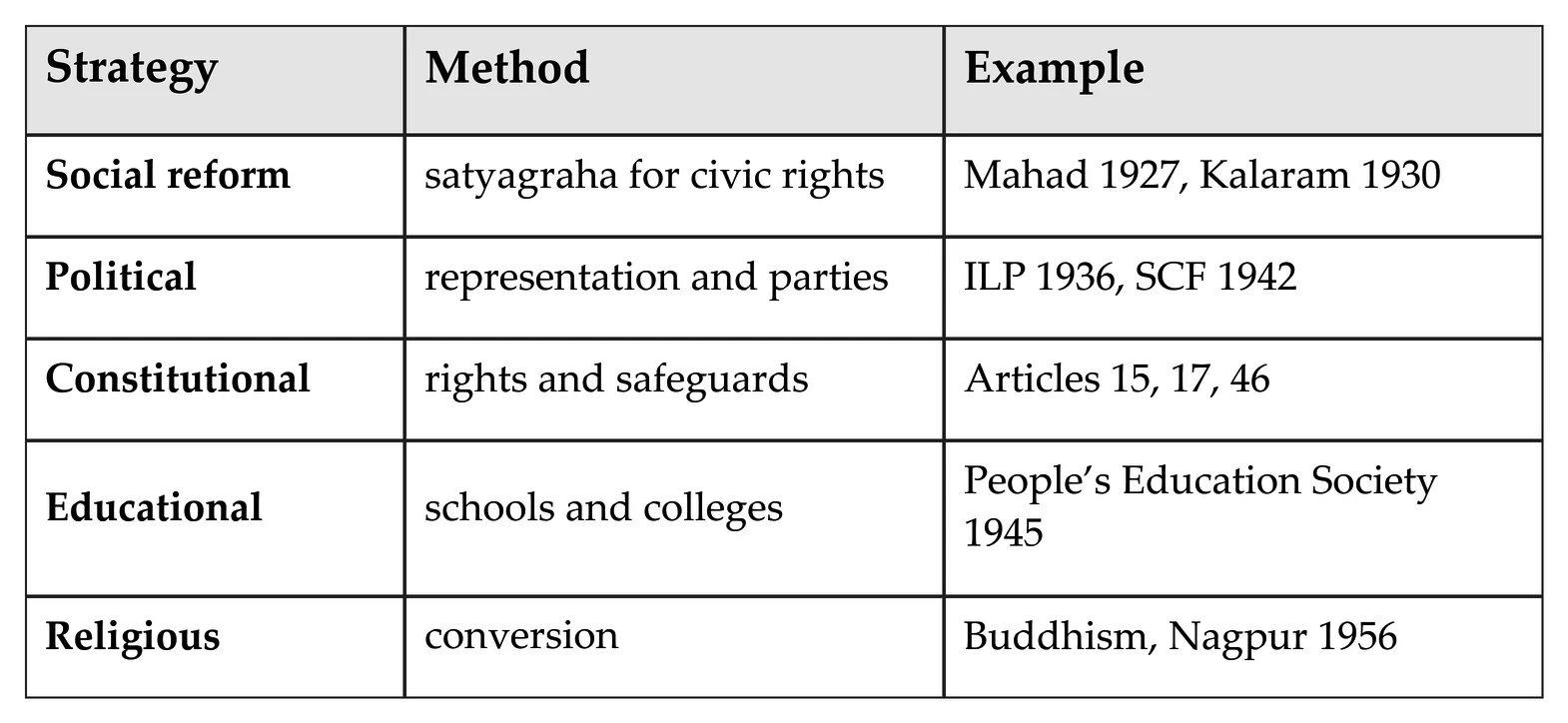
M. S. Gore, in The Social Context of an Ideology: Ambedkar’s Political and Social Thought (1993), studies how Ambedkar’s ideas grew out of the experience of untouchables, especially the Mahars of Maharashtra, and the wider social movements of his time. Gore shows that Ambedkar’s ideology had several strands: a critique of the Hindu social order as based on graded inequality; a commitment to liberal democracy, rights and constitutional methods; a belief in reason and modern education; and finally a search for an ethical religion, which ended in Buddhism. Gore analyses Ambedkar’s changing strategies: social reform through satyagraha, political organisation and demands for separate representation, constitutional safeguards, and religious conversion. He argues that Ambedkar’s thought cannot be separated from his role as the leader of a movement seeking dignity and power for a stigmatised community.
Annihilation of Caste
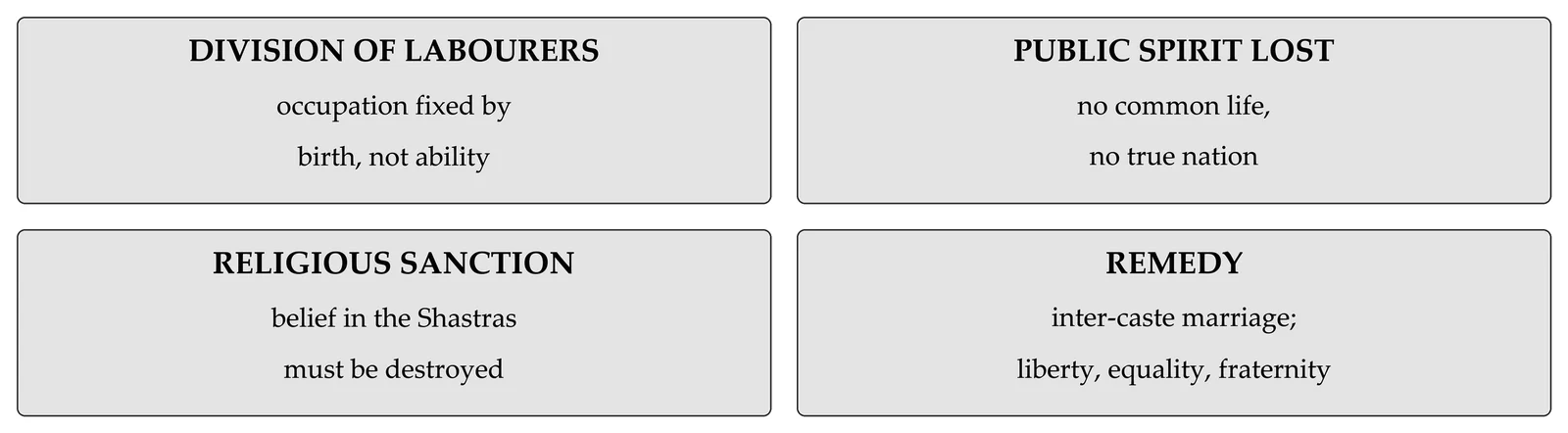
Annihilation of Caste (1936) was written as the presidential address for the Jat-Pat Todak Mandal of Lahore, a Hindu reform group. When the organisers objected to its attack on the Hindu scriptures, the conference was cancelled, and Ambedkar published the speech himself. Its main arguments are:
- Social reform first. Political reform without social reform is hollow; the Congress and the Social Conference debate showed that political reformers ignored caste.
- Division of labourers. Caste is not merely a division of labour but a division of labourers, fixed by birth and arranged in a hierarchy, which destroys efficiency and freedom of occupation.
- No racial or eugenic basis. Caste has no scientific basis; it is a social system that prevents the mixing of groups.
- Destroys public spirit. Caste has made Hindus unable to form a society or nation; it has killed public spirit, charity and public opinion.
- Religious sanction. Caste rests on the authority of the Shastras, so people must be freed from belief in their sanctity; inter-caste dining and marriage alone will not work unless that belief is destroyed.
- Ideal society. He proposed a society based on liberty, equality and fraternity, which he later said he took from the Buddha rather than the French Revolution.
Gandhi replied in his journal Harijan, defending varna as a division of duties without hierarchy and arguing that the scriptures should be judged by the conduct of saints. Ambedkar’s Reply to the Mahatma rejected this, arguing that varna inevitably produces caste and that a religion must be judged by its principles, not by a few good men.
Approach to Polity, History, Economy, Religion and Society
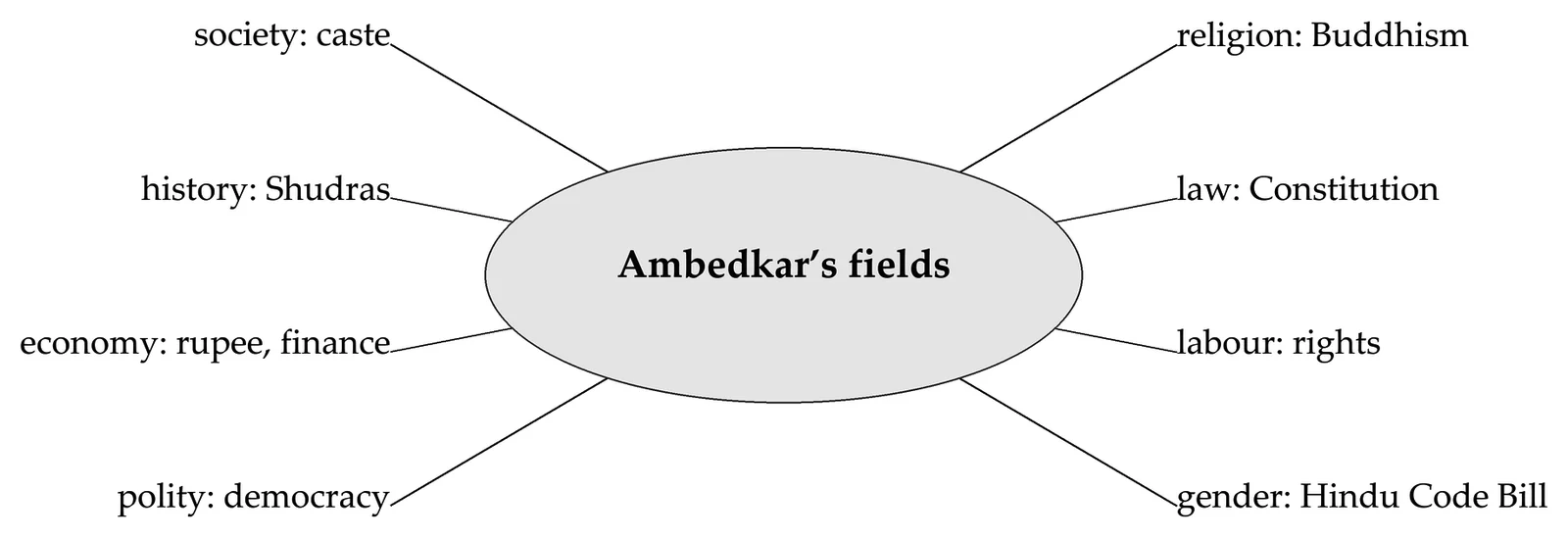
- Society. He analysed caste as a system of graded inequality, in which each caste is above some and below others, which divides the oppressed and prevents united revolt.
- History. In Who Were the Shudras? (1946) and The Untouchables (1948), he used historical evidence to argue that Shudras were once Kshatriyas and that untouchability arose from contempt for Buddhists and beef-eating, rejecting racial theories.
- Economy. As an economist he wrote on currency, public finance, small landholdings (1918) and state socialism, linking economic and social democracy.
- Polity. He saw democracy not only as a form of government but, following Dewey, as a mode of associated living and a way of bringing revolutionary change without bloodshed.
- Religion. He judged religions by whether they promote liberty, equality and fraternity, and found these in Buddhism, which he presented as a rational, ethical religion.
His approach was critical, empirical and emancipatory: he used evidence and reason, but always with the aim of freeing the oppressed. He combined Western liberal and pragmatist ideas with Indian traditions of dissent, which makes him one of the most original modern Indian thinkers.
Ambedkar and Dewey
Ambedkar studied under John Dewey at Columbia, and scholars such as Arun Mukherjee have shown Dewey’s deep influence on him. From Dewey’s pragmatism he took the idea that knowledge should help solve social problems and that institutions must be judged by their consequences for human growth. In Annihilation of Caste he wrote that democracy is not merely a form of government but primarily a mode of associated living, of conjoint communicated experience, an idea drawn from Dewey’s Democracy and Education (1916). Ambedkar adapted it to India, arguing that caste blocks the free communication and shared experience on which democracy depends.
1.4 Important Questions
- Question 1 Discuss Ambedkar’s approach to the study of polity, history, economy, religion and society.
- Question 2 Discuss the main arguments of Ambedkar’s Annihilation of Caste.
- Question 3 Discuss the anti-caste tradition that shaped Ambedkar with reference to Gail Omvedt’s Seeking Begumpura.
- Question 4 Discuss M. S. Gore’s analysis of the social context of Ambedkar’s ideology.
DU asks the same idea in different words. So learn one broad answer for each question below; the same answer works for every question joined by OR.
Important Question 1
Discuss Ambedkar’s approach to the study of polity, history, economy, religion and society.
OR
Examine Ambedkar as a social scientist.
OR
Discuss the main influences on Ambedkar’s thought.
Model Answer
“Caste in India means an artificial chopping off of the population into fixed and definite units, each one prevented from fusing into another through the custom of endogamy.”
— B. R. Ambedkar, Castes in India (1916)
Introduction. Ambedkar was not only a political leader but a scholar trained in economics, law, history and philosophy. He studied caste, history, the economy, democracy and religion with the aim of understanding and ending injustice. His approach combined evidence and reason with a commitment to liberty, equality and fraternity.
1. Scholar and Leader
Ambedkar earned doctorates from Columbia and the LSE and used his learning in the struggle against caste.
2. Dewey’s Influence
At Columbia, John Dewey taught him to see democracy as a way of associated living and knowledge as a tool for change.
3. Castes in India
In 1916 he argued that caste is maintained by endogamy, which chops the population into closed units.
4. Society as Graded Inequality
He analysed caste as graded inequality, which divides the oppressed and prevents united resistance.
5. History
In Who Were the Shudras? and The Untouchables, he used evidence to explain the origins of caste and untouchability.
6. Rejecting Racial Theories
He rejected the racial explanation of caste, arguing that it was a social, not a biological, division.
7. Economy
His works on the rupee, provincial finance and small landholdings made him a pioneering Indian economist.
8. Economic and Social Democracy
He linked economic justice to social democracy, proposing state ownership of key industries and land.
9. Polity and Democracy
He saw democracy as a means of revolutionary change without bloodshed, depending on social equality.
10. Religion
He judged religions by whether they promote liberty, equality and fraternity, and chose Buddhism on that basis.
11. Law and Constitution
As chairman of the Drafting Committee, he turned his ideas into constitutional rights and safeguards.
12. Influence of Phule
From Phule he took the belief that education and critical history were weapons of liberation.
13. Influence of the Buddha and Kabir
He called the Buddha, Kabir and Phule his three gurus, combining reason, devotion beyond caste and social reform.
14. Critical and Empirical Method
His method used evidence and reason, but always to free the oppressed, making it emancipatory.
15. Gore’s Social Context
M. S. Gore shows that his ideas grew from the experience of untouchables and the movements he led.
16. Criticism
Critics say some of his historical claims are speculative, though his questions remain powerful.
17. Ambedkar on Method
Ambedkar insisted on testing claims against evidence and reason, and he often quoted ancient texts against themselves, showing contradictions in the Shastras to undermine their authority.
18. Journalism and Public Reason
Through newspapers such as Mooknayak, Bahishkrit Bharat and Janata, Ambedkar carried his scholarship to ordinary people, making public reasoning part of his method.
19. Comparative Outlook
Ambedkar often compared caste with slavery in America and with the treatment of Jews and Black people, placing the Indian problem within a global history of oppression.
20. Evaluation
Ambedkar’s many-sided scholarship makes him a unique social scientist who joined knowledge with liberation.
Conclusion. Thus, Ambedkar studied society, history, economy, polity and religion with a single aim: ending caste injustice. His analysis of caste as an artificial chopping off of the population through endogamy shows his scientific approach, which he joined to the values of liberty, equality and fraternity.
Important Question 2
Discuss the main arguments of Ambedkar’s Annihilation of Caste.
OR
Explain Ambedkar’s view that caste is a division of labourers and not merely a division of labour.
OR
Examine the debate between Ambedkar and Gandhi on caste and varna.
Model Answer
“Caste System is not merely division of labour. It is also a division of labourers.”
— B. R. Ambedkar, Annihilation of Caste (1936)
Introduction. Annihilation of Caste (1936) is Ambedkar’s most famous text. Prepared as a speech for a reform group in Lahore and then self-published, it attacks caste and the religious authority that sustains it. It argues that India needs social reform before political reform and proposes a society based on liberty, equality and fraternity. Gandhi’s reply led to a famous debate.
1. Background
The Jat-Pat Todak Mandal of Lahore invited Ambedkar to preside over its 1936 conference but cancelled it after reading his speech.
2. Social Reform First
Ambedkar argued that political reform without social reform is hollow, and that reformers had ignored caste.
3. Division of Labourers
Caste is not merely a division of labour but a division of labourers into hierarchical groups fixed by birth.
4. Economic Inefficiency
By fixing occupation by birth rather than ability, caste causes inefficiency and unemployment.
5. No Scientific Basis
Caste has no racial or eugenic basis; it is a social system that prevents the mixing of groups.
6. Destroying Public Spirit
Caste has made Hindus unable to form a society; it has destroyed public spirit, charity and public opinion.
7. Caste and Nation
A people divided into castes cannot form a true nation, since there is no sense of common life.
8. Religious Sanction
Caste rests on the authority of the Shastras, which people believe to be sacred.
9. Destroying Belief in the Shastras
Inter-caste dining and marriage will not end caste unless the belief in the sanctity of the Shastras is destroyed.
10. Inter-Caste Marriage
He saw inter-caste marriage as the real remedy, since only fusion of blood can create kinship.
11. The Ideal Society
He proposed a society based on liberty, equality and fraternity, which he called democracy as a mode of associated living.
12. Gandhi’s Reply
Gandhi defended varna as a division of duties without superiority and said scriptures should be judged by saints.
13. Ambedkar’s Reply to the Mahatma
Ambedkar answered that varna inevitably produces caste and that a religion must be judged by its principles.
14. Conversion
He declared that he would leave Hinduism, a resolve fulfilled in 1956 when he embraced Buddhism.
15. Relevance Today
Honour killings over inter-caste marriage and caste discrimination show the continuing relevance of the text.
16. Criticism
Critics argue that he underestimated reform from within Hinduism and the role of economic change in weakening caste.
17. Caste among Non-Hindus
Ambedkar noted that caste also existed among Muslims, Sikhs and Christians in India, but argued that among Hindus it had religious sanction, which made it harder to remove.
18. Democracy and Fraternity
For Ambedkar, fraternity, i.e. a sense of common brotherhood, is the root of democracy; caste destroys fraternity and so makes real democracy impossible.
19. A Text for Today
The text has been translated into many languages and republished widely, including an annotated edition in 2014, showing its continuing importance in debates on caste.
20. Evaluation
Annihilation of Caste remains the most powerful critique of caste and a charter for an egalitarian society.
Conclusion. Thus, Ambedkar argued that caste is not merely a division of labour but a division of labourers, sanctioned by the Shastras, which destroys public spirit and nationhood. His call to annihilate caste, against Gandhi’s defence of varna, remains a foundation of the struggle for social democracy.
Important Question 3
Discuss the anti-caste tradition that shaped Ambedkar with reference to Gail Omvedt’s Seeking Begumpura.
OR
Examine Phule’s reinterpretation of history in the myth of King Bali.
OR
Discuss the influence of Jotirao Phule on Ambedkar.
Model Answer
“Dedicated to the good people of the United States as a token of admiration for their sublime disinterested and self-sacrificing devotion in the cause of Negro Slavery.”
— Jotirao Phule, Gulamgiri (1873), dedication
Introduction. Ambedkar did not emerge from nowhere. Gail Omvedt shows that a long anti-caste tradition, from the Bhakti saints to Jotirao Phule, imagined an egalitarian society she calls Begumpura. Phule’s rereading of history, especially the myth of King Bali, gave the oppressed a new identity, and Ambedkar called Phule one of his three gurus.
1. Omvedt’s Project
Gail Omvedt traces the social vision of anti-caste intellectuals from the medieval saints to modern leaders.
2. Ravidas and Begumpura
The poet-saint Ravidas imagined Begumpura, a city without sorrow, fear, tax or hierarchy.
3. The Bhakti Saints
Saints such as Kabir and Ravidas rejected caste and ritual, stressing devotion and equality.
4. Phule’s Gulamgiri
In Gulamgiri (1873), Phule compared caste with slavery and dedicated the book to those who fought slavery in America.
5. Rereading History
Phule argued that Brahmans conquered the original inhabitants and enslaved them through religion and caste.
6. The Myth of King Bali
He retold the story of King Bali, a just ruler of the farmers tricked by Vamana, as the lost kingdom of equality.
7. Bali as Symbol
For Phule, Bali stood for the toiling masses, and the hope for the return of Bali’s kingdom was the hope of the oppressed.
8. The Satyashodhak Samaj
Phule founded the Satyashodhak Samaj in 1873 to seek truth and free the lower castes from Brahmanical domination.
9. Education
Jotirao and Savitribai Phule opened schools for girls and untouchables from 1848.
10. Phule as Ambedkar’s Guru
Ambedkar called the Buddha, Kabir and Phule his three gurus and dedicated Who Were the Shudras? to Phule.
11. Continuity
Ambedkar shared Phule’s view that education and critical history are weapons of liberation.
12. Difference
Ambedkar rejected the racial theory of Aryan invasion that Phule used, preferring social explanations.
13. Periyar and the South
Omvedt also shows the Self-Respect Movement of Periyar as part of the same anti-caste tradition.
14. From Utopia to Democracy
Omvedt argues that Ambedkar carried the Begumpura vision into modern democracy, rights and Buddhism.
15. Women in the Tradition
Savitribai Phule and Tarabai Shinde show that the anti-caste tradition also challenged patriarchy.
16. Criticism
Some historians question Phule’s historical claims, but the political power of his myths is widely recognised.
17. Bhakti and Its Limits
Ambedkar respected the Bhakti saints but argued that they preached equality before God without attacking caste in society, which is why their movement did not end caste.
18. Phule and the Peasantry
Phule’s Shetkaryacha Asud (The Cultivator’s Whipcord, 1883) described the exploitation of peasants by officials, moneylenders and priests, linking caste with economic oppression.
19. Kabir’s Influence
Ambedkar’s family followed the Kabir panth, and Kabir’s rejection of ritual and caste shaped his early religious outlook before he turned to Buddhism.
20. Evaluation
The anti-caste tradition gave Ambedkar a vision of equality and a method of rereading history for liberation.
Conclusion. Thus, Omvedt’s Seeking Begumpura shows that Ambedkar inherited a long anti-caste tradition. Phule, who dedicated Gulamgiri to those who fought slavery, reread history through King Bali, and Ambedkar transformed this vision of equality into a modern democratic programme.
Important Question 4
Discuss M. S. Gore’s analysis of the social context of Ambedkar’s ideology.
OR
Examine the main features of Ambedkar’s social and political thought.
OR
Discuss the strategies Ambedkar adopted for the emancipation of the Dalits.
Model Answer
“I solemnly assure you that I will not die as a Hindu.”
— B. R. Ambedkar, Yeola Conference (13 October 1935)
Introduction. M. S. Gore studies how Ambedkar’s ideology grew out of the social experience of untouchables and the movements he led. Ambedkar’s thought combined a critique of the Hindu social order, liberal democracy, rationalism and finally Buddhism, and his strategies shifted from reform to politics, constitutional safeguards and conversion.
1. Ideology and Social Context
Gore argues that ideas must be understood in relation to the social conditions and groups that produce them.
2. The Experience of Untouchability
Ambedkar’s own humiliations and those of the Mahar community shaped his concern with dignity and rights.
3. Critique of the Hindu Social Order
He saw the Hindu social order as based on graded inequality, sanctioned by religion.
4. Liberal Democracy
He was committed to liberal democracy, rights, rule of law and constitutional methods.
5. Reason and Education
He believed in reason, science and modern education as means of liberation.
6. Search for Religion
He sought an ethical religion based on liberty, equality and fraternity, finally choosing Buddhism.
7. Social Reform Strategy
In the 1920s he led satyagrahas such as Mahad (1927) and the Kalaram temple entry (1930) to claim civic rights.
8. Political Strategy
He demanded separate electorates, accepted the Poona Pact, and formed the Independent Labour Party and the Scheduled Castes Federation.
9. Constitutional Strategy
He secured the abolition of untouchability, fundamental rights and reservations in the Constitution.
10. Religious Strategy
He declared in 1935 that he would not die a Hindu and embraced Buddhism in 1956.
11. Education as Strategy
He founded the People’s Education Society in 1945 and colleges such as Siddharth College in Bombay.
12. Labour and Class
Through the Independent Labour Party, he linked the struggles of untouchables with those of workers.
13. Leader of a Movement
Gore stresses that Ambedkar’s thought cannot be separated from his role as leader of a stigmatised community.
14. Changing Strategies
His strategies shifted as he judged what would bring dignity and power, showing pragmatism.
15. Legacy
His ideas inspired Dalit movements, parties and literature, and shaped Indian democracy.
16. Criticism
Critics argue that his strategies sometimes conflicted, for example between political integration and religious separation.
17. Mahar Watan
The Mahars served villages under the hereditary watan system, doing menial duties for small land grants; Ambedkar campaigned to abolish it, seeing it as a form of bondage.
18. Ideology and Organisation
Gore shows that Ambedkar built organisations, newspapers, schools and parties, turning ideas into an organised movement that outlived him.
19. The Army Connection
Many Mahars, including Ambedkar’s father, served in the British Indian Army, which gave the community education and confidence, an important part of the social context Gore describes.
20. Evaluation
Gore’s analysis shows Ambedkar as a thinker whose ideology grew from and served a movement for dignity.
Conclusion. Thus, Gore shows that Ambedkar’s ideology grew from the experience of untouchability and combined critique of the Hindu order, democracy, reason and Buddhism. His resolve not to die a Hindu marks the culmination of strategies that moved from reform to politics, constitution and conversion.
Short Notes
(a) Mahad Satyagraha
The 1927 struggle led by Ambedkar to assert the right of untouchables to draw water from the Chavdar tank at Mahad, during which the Manusmriti was burned on 25 December.
(b) Graded inequality
Ambedkar’s description of the caste system, in which each caste is placed above some and below others, dividing the oppressed and preventing united revolt.
(c) Begumpura
The city without sorrow imagined by the poet-saint Ravidas, used by Gail Omvedt as a symbol of the egalitarian vision of anti-caste thinkers.
More notes: DSE-3b Understanding Ambedkar
These notes are prepared by PADHO TO AISE for study help. They are not an official University of Delhi publication.