
Semester V DSE-3b Understanding Ambedkar
Unit VI · 21 min read · Updated 24 Nov 2026
As per the University of Delhi (DU) BA (Hons) Political Science syllabus
Contents
- 6.1 Ambedkar as Economist: Currency, Finance and Small Holdings
- Currency and Public Finance
- Small Holdings in India and Their Remedies
- Ambedkar on Taxation
- 6.2 Planning, Development and State Socialism
- Thorat: Ambedkar’s Economic System and Planning
- Water and Power Policy
- Economic Justice in the Constitution
- 6.3 Land, Labour and the Caste-Class Question
- Land and Agrarian Relations
- Labour and Parliamentary Democracy
- Labour Member, 1942–46
- Caste and Class
- Ambedkar’s Economic Legacy
- 6.4 Important Questions
- Discuss Ambedkar’s views on economic planning and development.
- Discuss Ambedkar’s views on land and agrarian relations.
- Discuss Ambedkar’s contribution to labour welfare and labour rights.
- Discuss Ambedkar’s views on the relationship between caste and class.
- Short Notes
मेरे विचार में इस देश के मज़दूरों को दो शत्रुओं से निपटना है। ये दो शत्रु हैं ब्राह्मणवाद और पूंजीवाद।
There are in my view two enemies which the workers of this country have to deal with. The two enemies are Brahmanism and Capitalism.
— B. R. Ambedkar, G. I. P. Railway Depressed Classes Workers’ Conference, Manmad, February 1938
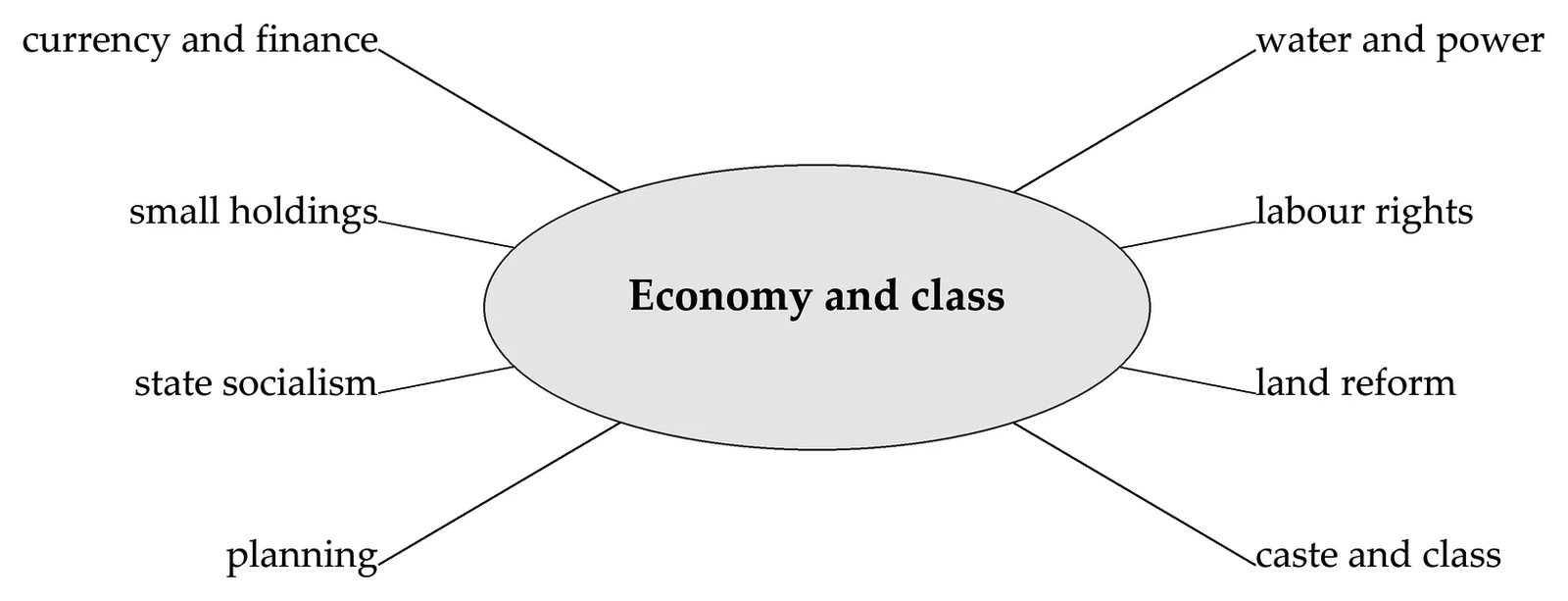
AAMBEDKAR was trained as an economist before he became a lawyer and political leader, and economic justice was central to his vision. He wrote on currency, public finance and the problem of small landholdings; he proposed state socialism and planned industrialisation; as Labour Member of the Viceroy’s Executive Council he introduced major labour reforms and laid the foundations of India’s water and power policy; and he insisted that caste is an economic as well as a social system. This chapter studies Unit VI of the syllabus: economy and the class question, with a focus on planning and development and on land and labour.
6.1 Ambedkar as Economist: Currency, Finance and Small Holdings
Currency and Public Finance
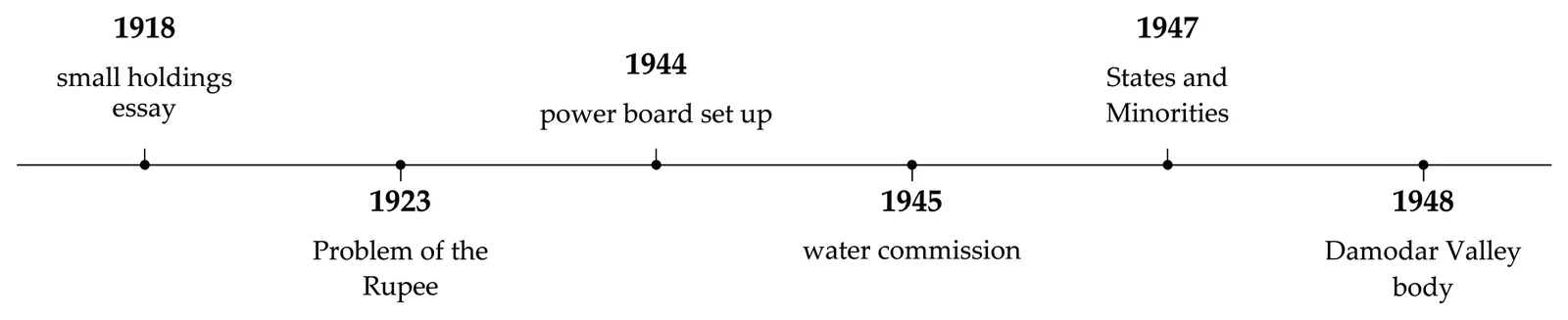
Ambedkar’s early economic works were among the first by an Indian economist trained in Western universities. In The Evolution of Provincial Finance in British India (1925), based on his Columbia doctorate, he studied how the colonial state centralised revenue and starved the provinces of funds. In The Problem of the Rupee (1923), his London thesis, he examined the Indian currency system. He criticised the gold exchange standard, under which the rupee’s value was managed by the colonial government, arguing that it allowed inflation that hurt the poor, and he favoured a stable currency with limits on the government’s power to issue money. He gave evidence on these lines before the Hilton Young Commission on Indian currency in 1925–26. These writings show his concern with how monetary and fiscal policies affect ordinary people.
Small Holdings in India and Their Remedies
In his 1918 essay Small Holdings in India and Their Remedies, Ambedkar challenged the common view that India’s agricultural problem was caused by small and scattered plots, to be solved by consolidating them. He argued that a holding is economic or uneconomic not because of its size alone but because of the balance between land, labour and capital. India’s real problem was a huge surplus of labour on the land and a shortage of capital. Enlarging holdings without providing other work would only push more people into idleness. The remedy, therefore, was industrialisation, which would draw surplus labour off the land, raise capital and make agriculture productive. This insight anticipated later development economics, which also saw the transfer of labour from agriculture to industry as the key to growth.

Ambedkar on Taxation
Ambedkar applied his training in public finance to the problems of the poor. He argued that taxes should be based on the ability to pay, that the burden should fall more on the rich than on the poor, and that land revenue, which weighed heavily on small farmers, should be assessed more like income tax, with relief for the poorest cultivators. In his view, the colonial tax system was regressive, since it took a large share from peasants while leaving the incomes of the wealthy lightly taxed.
6.2 Planning, Development and State Socialism
Thorat: Ambedkar’s Economic System and Planning
Sukhadeo Thorat, in Economic System, Development and Economic Planning (2007), in Ambedkar in Retrospect, explains Ambedkar’s economic vision. Ambedkar rejected both unregulated capitalism, which he saw as producing exploitation and inequality, and communist dictatorship, which destroyed liberty. He proposed state socialism within parliamentary democracy: the state would own key industries and agricultural land and plan the economy, while political freedoms were preserved. Thorat stresses that Ambedkar saw caste as an economic system as well as a social one: by fixing occupations by birth, it caused immobility of labour and capital, waste of talent and exclusion of the lowest castes from land, education and business. Development, therefore, required both economic planning and the destruction of caste-based restrictions.
- State ownership. Key and basic industries, insurance and agricultural land to be owned by the state, as proposed in States and Minorities (1947).
- Collective farming. Land to be cultivated by village families collectively, with the state providing capital, water and inputs.
- Industrialisation. Rapid industrialisation to absorb surplus labour and raise productivity.
- Role of the state. The state must actively promote development and equity, rather than leave them to the market.
- Safeguards for the excluded. Planning must ensure that Scheduled Castes share in land, education and employment.
Water and Power Policy
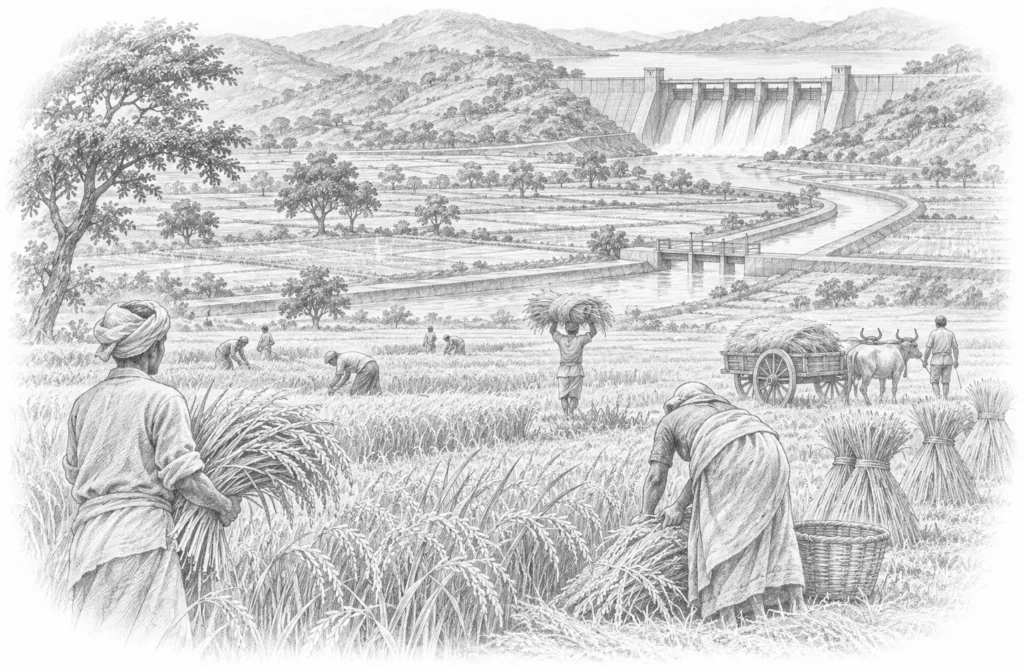
As Labour Member (1942–46), Ambedkar was in charge of irrigation, power and public works, and Thorat has shown that he laid the foundations of India’s water and power policy. He promoted the idea of multipurpose river valley projects combining irrigation, flood control, navigation and hydroelectric power. Under his leadership the Central Technical Power Board (1944) and the Central Waterways, Irrigation and Navigation Commission (1945) were created, and projects such as the Damodar Valley scheme, the Hirakud dam on the Mahanadi and projects on the Sone were planned. He argued that water resources should be developed by the Centre in cooperation with provinces, and that cheap electricity was essential for industrialisation and for freeing labour from drudgery.
Economic Justice in the Constitution
- Article 38. The state shall strive to promote a social order in which social, economic and political justice informs all institutions.
- Article 39. Equal right to livelihood, distribution of resources for the common good, prevention of concentration of wealth, and equal pay for equal work.
- Article 41. Right to work, to education and to public assistance in unemployment, old age and sickness, within the state’s capacity.
- Article 43. A living wage and decent conditions of work for all workers.
- Article 46. Promotion of the educational and economic interests of the weaker sections, especially SCs and STs.
6.3 Land, Labour and the Caste-Class Question
Land and Agrarian Relations
Ambedkar attacked landlordism and the exploitation of tenants and agricultural labourers. In the Bombay Legislative Assembly in 1937 he introduced a bill to abolish the Khoti system of the Konkan, under which landlords (khots) extracted heavy rents and forced labour from tenants. He also campaigned against the Mahar watan, the hereditary village service that bound Mahars to menial duties for tiny land grants. His proposal of state ownership of land and collective farming aimed to end both landlordism and landless labour. After his death, his followers led land satyagrahas in the 1950s and 1960s demanding land for the landless.
Labour and Parliamentary Democracy
Ambedkar founded the Independent Labour Party in 1936 with a programme for workers and peasants. He joined the communists in a strike in Bombay in November 1938 against the Industrial Disputes Bill, which restricted the right to strike. In his speech Labour and Parliamentary Democracy (1943), he argued that parliamentary democracy, as it had developed, had given workers political equality but left them economically unequal, because it was tied to free contract and laissez-faire. Labour should not reject parliamentary democracy but organise politically to capture it and use it for social and economic justice.
Labour Member, 1942–46
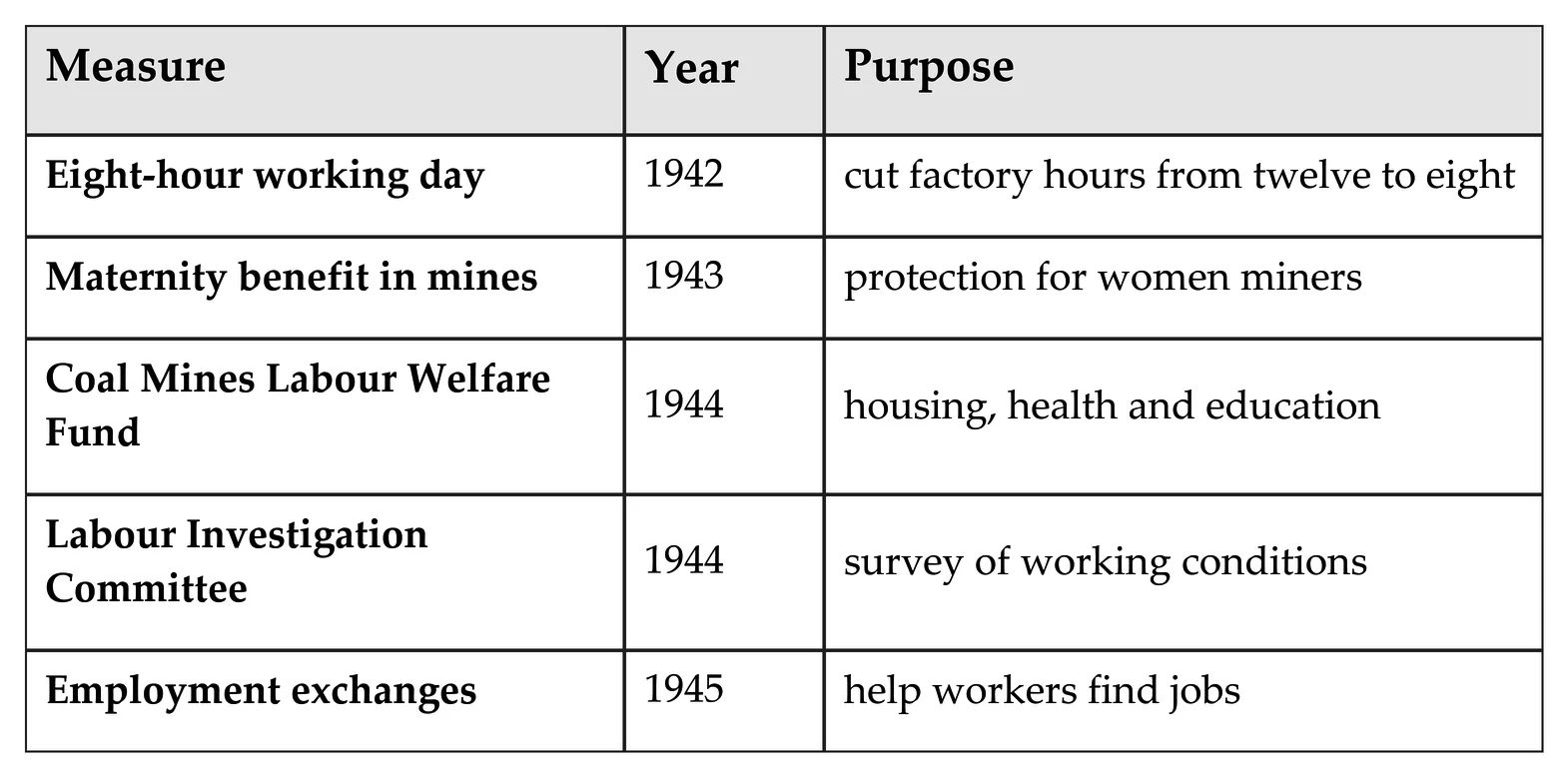
- Eight-hour day. At the Indian Labour Conference in November 1942, he reduced factory working hours from twelve to eight.
- Maternity benefit. He supported maternity benefit for women working in coal mines.
- Welfare funds. The Coal Mines Labour Welfare Fund (1944) financed housing, health and education for miners.
- Labour Investigation Committee (1944). It surveyed working conditions and prepared the ground for post-war labour laws.
- Employment exchanges. He set up employment exchanges to help demobilised soldiers and workers find jobs.
- Tripartism. He strengthened tripartite consultation among government, employers and workers through the Indian Labour Conference.
Caste and Class
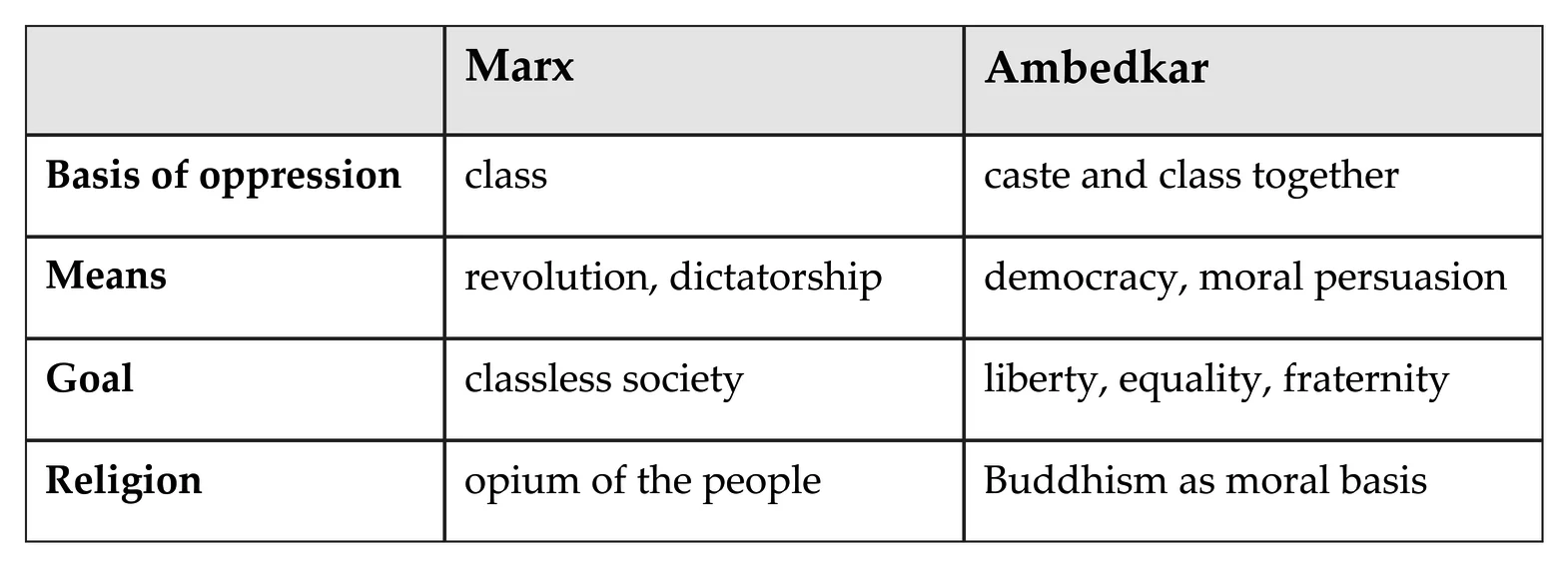
Ambedkar engaged with Marxism but disagreed with Indian communists who treated caste as a mere superstructure that would disappear with economic change. He argued that workers in India were divided by caste and that untouchable workers faced discrimination even from fellow workers, for example exclusion from weaving departments in Bombay mills. Hence Brahmanism and capitalism were twin enemies of labour, and no economic revolution could succeed without a social revolution against caste. In Buddha or Karl Marx (written in 1956), he compared the two: both sought to end exploitation and suffering, but Marx relied on violence and the dictatorship of the proletariat, while the Buddha relied on moral persuasion and democracy. Ambedkar preferred the Buddha’s way, combining economic equality with liberty and fraternity.
Ambedkar’s Economic Legacy
Ambedkar’s economic ideas continue to inspire policy and research. Sukhadeo Thorat and Katherine Newman, in Blocked by Caste (2010), documented discrimination against Dalits in urban labour markets. The Dalit Indian Chamber of Commerce and Industry, founded in 2005, promotes Dalit entrepreneurship, and schemes such as Stand-Up India (2016) provide loans to SC, ST and women entrepreneurs. Debates on reservation in the private sector, land for the landless and the rights of informal workers all draw on his insistence that economic justice is inseparable from the end of caste.
6.4 Important Questions
- Question 1 Discuss Ambedkar’s views on economic planning and development.
- Question 2 Discuss Ambedkar’s views on land and agrarian relations.
- Question 3 Discuss Ambedkar’s contribution to labour welfare and labour rights.
- Question 4 Discuss Ambedkar’s views on the relationship between caste and class.
DU asks the same idea in different words. So learn one broad answer for each question below; the same answer works for every question joined by OR.
Important Question 1
Discuss Ambedkar’s views on economic planning and development.
OR
Examine Ambedkar’s idea of state socialism within parliamentary democracy.
OR
Discuss Ambedkar’s contribution to India’s water and power policy.
Model Answer
“That the ownership and control of the material resources of the community are so distributed as best to subserve the common good.”
— Constitution of India, Article 39(b)
Introduction. Ambedkar was a trained economist who saw economic justice as essential to democracy. He proposed state socialism within parliamentary democracy, planned industrialisation and state ownership of key resources. As Labour Member he laid the foundations of India’s water and power policy. Sukhadeo Thorat shows how his economic vision joined planning with the destruction of caste-based barriers.
1. Ambedkar the Economist
Ambedkar studied economics at Columbia and the LSE and wrote on currency and public finance. His training shaped his approach to social problems.
2. Rejecting Laissez-Faire
He argued that unregulated capitalism produces exploitation and inequality. Free contract between unequal parties is not real freedom.
3. Rejecting Dictatorship
He also rejected communist dictatorship, which destroys liberty. Economic equality must not be bought at the cost of freedom.
4. State Socialism
He proposed state ownership of key industries, insurance and agricultural land. This would ensure that resources served the common good.
5. Within Parliamentary Democracy
State socialism would operate within parliamentary democracy, preserving rights and elections. He sought socialism with freedom.
6. Constitutional Fixing
In States and Minorities he wanted these provisions in the Constitution itself. A legislative majority could not then reverse them.
7. Industrialisation
He saw rapid industrialisation as essential to absorb surplus labour from agriculture. It would raise productivity and incomes.
8. Caste as an Economic System
Thorat shows that Ambedkar saw caste as causing immobility of labour and capital. Development required breaking these caste barriers.
9. Exclusion from Resources
Caste excluded the lowest groups from land, education and business. Planning had to correct this exclusion.
10. Multipurpose Projects
As Labour Member, he promoted multipurpose river valley projects for irrigation, power and flood control.
11. New Institutions
He created the Central Technical Power Board (1944) and the Central Waterways, Irrigation and Navigation Commission (1945).
12. Damodar and Hirakud
Projects such as the Damodar Valley scheme and the Hirakud dam were planned under his leadership.
13. Cheap Electricity
He saw cheap electricity as essential for industry and for freeing workers from drudgery.
14. Influence on Planning
His ideas fed into India’s Five-Year Plans and the Directive Principles, such as Article 39(b).
15. Relevance
Debates on public investment, inequality and Dalit entrepreneurship draw on his economic ideas.
16. Criticism
Critics argue that state ownership led to inefficiency in India. Supporters reply that his plan aimed at equity, not bureaucratic control.
17. Fiscal Federalism
In his study of provincial finance, Ambedkar showed how the colonial centre starved the provinces of revenue, an insight relevant to later debates on Centre-state financial relations.
18. Education and Development
He saw education as an economic investment as well as a right, since an educated workforce was essential for industrialisation.
19. Evaluation
Ambedkar’s economic vision joined planning, democracy and the end of caste in a distinctive model of development.
Conclusion. Thus, Ambedkar proposed state socialism within parliamentary democracy, planned industrialisation and multipurpose development of water and power. His vision, reflected in Article 39(b)’s aim that resources serve the common good, linked economic planning with social justice.
Important Question 2
Discuss Ambedkar’s views on land and agrarian relations.
OR
Examine Ambedkar’s analysis of small holdings in India.
OR
Discuss Ambedkar’s proposals for land reform and collective farming.
Model Answer
“Agriculture shall be State Industry.”
— B. R. Ambedkar, States and Minorities (1947)
Introduction. Land was central to the exclusion of the untouchables, most of whom were landless labourers. Ambedkar analysed the problem of small holdings, attacked landlordism and the Khoti system, campaigned against the Mahar watan and proposed state ownership of land with collective farming. His agrarian thought linked land reform with industrialisation and the end of caste.
1. Land and Caste
Most untouchables were landless labourers working for caste Hindu landowners. Land ownership was tied to caste status.
2. Small Holdings Essay
In 1918 Ambedkar examined the common view that small and scattered holdings caused low productivity.
3. Size Is Not the Problem
He argued that a holding is economic or not because of the balance of land, labour and capital, not size alone.
4. Surplus Labour
India’s real problem was a huge surplus of labour on the land and a shortage of capital.
5. Industrialisation as Remedy
Industrialisation would draw surplus labour off the land and make agriculture productive.
6. Anticipating Development Economics
His argument anticipated later theories that saw the transfer of labour from farm to factory as the key to growth.
7. The Khoti System
In 1937 he introduced a bill to abolish the Khoti system of the Konkan, under which landlords exploited tenants.
8. The Mahar Watan
He campaigned against the Mahar watan, which bound Mahars to menial village service for tiny land grants.
9. Against Landlordism
He saw landlordism as a source of both economic exploitation and caste domination in villages.
10. State Ownership of Land
In States and Minorities he declared that agriculture shall be a state industry, with land owned by the state.
11. Collective Farming
Land would be leased to village families for collective cultivation, with the state providing capital and inputs.
12. No Landlords, No Landless
His plan aimed at a rural society with neither landlords nor landless labourers.
13. Separate Settlements
He proposed new settlements for untouchables with their own land, free from caste Hindu domination.
14. Land Satyagrahas
After his death, his followers led land satyagrahas demanding land for the landless in Maharashtra and elsewhere.
15. Land Reforms after Independence
Zamindari abolition and ceiling laws were passed, but Dalits gained little land, confirming his concerns.
16. Criticism
Critics say collective farming had failed elsewhere and would not have suited India. Supporters stress his aim of ending landlessness.
17. Land Revenue
He argued that land revenue weighed heavily on small farmers and should be assessed like income tax, with relief for the poorest cultivators.
18. Land and Dignity
For Ambedkar, owning land gave Dalits economic independence and freedom from the daily humiliation of working for caste Hindu landlords.
19. Irrigation and Agriculture
His work on multipurpose river projects as Labour Member aimed to bring irrigation to farmers, linking his agrarian thought with planning for water.
20. Agricultural Labourers Today
Dalits remain heavily concentrated among agricultural labourers with little land, which shows that the agrarian question Ambedkar raised is still unresolved.
21. Evaluation
Ambedkar’s agrarian thought linked land, labour and caste, seeing land reform as part of social liberation.
Conclusion. Thus, Ambedkar argued that small holdings reflected surplus labour and lack of capital, to be cured by industrialisation, and proposed that agriculture shall be a state industry with collective farming. His aim was a rural society free of both landlordism and caste domination.
Important Question 3
Discuss Ambedkar’s contribution to labour welfare and labour rights.
OR
Examine Ambedkar’s views on labour and parliamentary democracy.
OR
Discuss Ambedkar’s work as Labour Member of the Viceroy’s Executive Council.
Model Answer
“Labour is not a commodity.”
— ILO Declaration of Philadelphia (1944)
Introduction. Ambedkar saw workers, especially untouchable workers, as victims of both capitalism and caste. He founded the Independent Labour Party, joined strikes against anti-labour laws and argued that labour must capture parliamentary democracy. As Labour Member from 1942 to 1946, he introduced reforms that shaped India’s labour laws.
1. Workers and Caste
Untouchable workers faced exploitation by employers and discrimination by fellow workers. Ambedkar fought on both fronts.
2. Independent Labour Party
He founded the ILP in 1936 with a programme for workers and peasants. It won seats in the Bombay elections of 1937.
3. Two Enemies
At Manmad in 1938 he named Brahmanism and capitalism as the two enemies of workers. Caste and class oppression worked together.
4. Strike of 1938
He joined communists in a strike in Bombay against the Industrial Disputes Bill, which restricted the right to strike.
5. Labour and Parliamentary Democracy
In 1943 he argued that parliamentary democracy gave workers political but not economic equality. It was tied to free contract and laissez-faire.
6. Capturing Democracy
Labour should not reject parliamentary democracy but organise to capture it. Political power could secure economic justice.
7. Labour Member
He served as Labour Member of the Viceroy’s Executive Council from 1942 to 1946, responsible for labour, irrigation and power.
8. Eight-Hour Day
In November 1942 he reduced factory working hours from twelve to eight a day, a landmark reform.
9. Women Workers
He supported maternity benefit for women in coal mines and the principle of equal pay.
10. Welfare Funds
The Coal Mines Labour Welfare Fund (1944) financed housing, health and education for miners.
11. Labour Investigation Committee
The 1944 committee surveyed working conditions and prepared the ground for post-war labour laws.
12. Employment Exchanges
He set up employment exchanges to help workers and demobilised soldiers find jobs.
13. Tripartism
He strengthened tripartite consultation among government, employers and workers through the Indian Labour Conference.
14. Constitutional Provisions
Articles 23, 24, 39 and 43 on forced labour, child labour, equal pay and a living wage reflect his concerns.
15. Relevance
Debates on the new labour codes and on informal workers show the continuing importance of his ideas.
16. Criticism
Some argue that his reforms helped mainly organised workers. Yet they set standards later extended to others.
17. Social Security
Proposals developed during his tenure, including the Adarkar report on health insurance (1944), led to the Employees’ State Insurance Act of 1948.
18. Dearness Allowance
He supported dearness allowance to protect workers’ wages from wartime inflation, showing his concern with real incomes.
19. Evaluation
Ambedkar was one of the founders of labour welfare in India, linking workers’ rights with democracy and anti-caste struggle.
Conclusion. Thus, Ambedkar treated labour as human beings with rights, in the spirit that labour is not a commodity. Through the ILP, his critique of parliamentary democracy and his reforms as Labour Member, he laid foundations of labour welfare in India.
Important Question 4
Discuss Ambedkar’s views on the relationship between caste and class.
OR
Examine Ambedkar’s comparison of the Buddha and Karl Marx.
OR
Discuss the economic dimensions of caste in Ambedkar’s thought.
Model Answer
“You cannot have political reform, you cannot have economic reform, unless you kill this monster.”
— B. R. Ambedkar, Annihilation of Caste (1936)
Introduction. Ambedkar engaged seriously with Marxism but rejected the view that caste is merely a superstructure of class. He argued that caste is itself an economic system that divides workers and blocks revolution, so economic reform requires the destruction of caste. In Buddha or Karl Marx, he compared the two thinkers and preferred the Buddha’s path of moral persuasion and democracy.
1. The Marxist View
Indian communists often treated caste as part of the superstructure that would disappear with economic change.
2. Ambedkar’s Disagreement
Ambedkar argued that caste was not a mere superstructure but a basic structure of Indian society.
3. Caste as an Economic System
Caste fixes occupations by birth, causing immobility of labour and capital and waste of talent.
4. Division of Labourers
Caste divides workers into graded groups, preventing class solidarity among them.
5. Discrimination in Workplaces
Untouchable workers were excluded from some mill departments, showing that caste divided even the working class.
6. Brahmanism and Capitalism
He named Brahmanism and capitalism as the twin enemies of Indian workers.
7. Social Revolution First
No economic revolution could succeed without a social revolution against caste, since workers would not unite.
8. Killing the Monster
In Annihilation of Caste, he said there could be no political or economic reform without killing the monster of caste.
9. Buddha or Karl Marx
In 1956 he compared the Buddha and Marx, finding that both sought to end exploitation and suffering.
10. Means Differ
Marx relied on violence and the dictatorship of the proletariat, while the Buddha relied on moral persuasion.
11. Rejecting Dictatorship
Ambedkar rejected dictatorship as destroying liberty and fraternity, which he saw as essential.
12. Religion and Morality
Unlike Marx, he saw religion, in the form of Buddhism, as a source of the morality that equality needs.
13. Class Struggle and Caste
He sometimes described the conflict between touchables and untouchables as a class struggle, showing a broad idea of class.
14. Independent Labour Party
His ILP addressed both caste and class, organising workers and peasants across castes.
15. Later Debates
Scholars and movements continue to debate how to combine anti-caste and class politics, building on his ideas.
16. Criticism
Marxist critics argued that his focus on caste divided the working class. He replied that caste already divided it.
17. Caste in Labour Markets Today
Studies by Thorat and Newman (2010) show that job applicants with Dalit names receive fewer interview calls, confirming that caste still shapes economic opportunity.
18. Graded Inequality and Class
Graded inequality, he argued, made each caste value its place above others, weakening the class solidarity that Marxists expected.
19. Occupation and Stigma
Occupations such as manual scavenging remain tied to caste, showing how economic roles and social stigma reinforce each other, as Ambedkar argued.
20. Evaluation
Ambedkar’s analysis of caste and class remains central to understanding inequality in India.
Conclusion. Thus, Ambedkar argued that caste is an economic as well as a social system and that there can be no economic reform without killing the monster of caste. His comparison of the Buddha and Marx shows his search for equality through democracy and morality rather than dictatorship.
Short Notes
(a) Small holdings
Ambedkar’s 1918 analysis that India’s agricultural problem was surplus labour and lack of capital, not the size of plots, and that industrialisation was the remedy.
(b) Khoti system
A landlord system of the Konkan under which khots extracted heavy rents and forced labour from tenants; Ambedkar introduced a bill to abolish it in 1937.
(c) Buddha or Karl Marx
Ambedkar’s essay comparing the two, concluding that both sought to end exploitation but that the Buddha’s way of moral persuasion and democracy was preferable to Marx’s violence and dictatorship.
More notes: DSE-3b Understanding Ambedkar
These notes are prepared by PADHO TO AISE for study help. They are not an official University of Delhi publication.