
Generic Electives (GE) GE-13 Introduction to Human Rights
Unit 2 · 25 min read · Updated 27 Nov 2026
As per the University of Delhi (DU) Generic Elective (GE) syllabus offered by the Department of Political Science
Contents
- 2.1 The Universal Declaration of Human Rights
- Adoption and Historical Significance
- The Structure of the Declaration
- 2.2 Major UN Human Rights Conventions
- The Two Covenants of 1966
- Other Core Conventions
- 2.3 UN Human Rights Bodies
- From the Commission to the Human Rights Council
- Features of the Human Rights Council
- The Office of the High Commissioner for Human Rights
- Regional Systems and Limits
- 2.4 Important Questions
- Discuss the historical significance and main provisions of the Universal Declaration of Human Rights.
- Discuss the International Covenant on Civil and Political Rights and the International Covenant on Economic, Social and Cultural Rights.
- Examine the major UN human rights conventions: CEDAW, CRC, CAT and CERD.
- Discuss the role of the UN Human Rights Council and the Office of the High Commissioner for Human Rights.
- Short Notes
मौलिक मानव अधिकारों में, मानव व्यक्ति की गरिमा और मूल्य में, तथा पुरुषों और स्त्रियों के और छोटे-बड़े राष्ट्रों के समान अधिकारों में आस्था की पुनः पुष्टि करना।
To reaffirm faith in fundamental human rights, in the dignity and worth of the human person, in the equal rights of men and women and of nations large and small.
— Charter of the United Nations, Preamble (1945)
AAFTER the horrors of the Second World War and the Holocaust, the nations of the world decided that the treatment of individuals could no longer be left entirely to their own governments. The United Nations, founded in 1945, made the promotion of human rights one of its purposes. This chapter studies the international human rights framework that has developed since then: the Universal Declaration of Human Rights of 1948, the major UN conventions that turned its principles into binding law, such as the ICCPR, the ICESCR, CEDAW, the CRC, CAT and CERD, and the main UN bodies, the Human Rights Council and the Office of the High Commissioner for Human Rights.

2.1 The Universal Declaration of Human Rights
The UN Charter, signed at San Francisco on 26 June 1945, reaffirmed faith in fundamental human rights and made their promotion a purpose of the organisation (Articles 1, 55 and 56), but it did not list the rights. In 1946, the UN set up a Commission on Human Rights, chaired by Eleanor Roosevelt, the widow of President Franklin Roosevelt, to draft an international bill of rights. The drafting was a genuinely international effort: John Humphrey of Canada prepared the first draft for the UN Secretariat, the French jurist René Cassin shaped its structure, P.C. Chang of China brought Confucian ideas of humaneness, Charles Malik of Lebanon served as rapporteur, and Hansa Mehta of India insisted that the declaration speak of all human beings rather than all men.
Adoption and Historical Significance
The Universal Declaration of Human Rights (UDHR) was adopted by the UN General Assembly at the Palais de Chaillot in Paris on 10 December 1948, now observed as Human Rights Day. Forty-eight states voted in favour, none against, and eight abstained: six Soviet bloc states, Saudi Arabia and South Africa. Its significance lies in several achievements:
- First universal statement of rights. For the first time, the international community agreed on a list of rights belonging to every person everywhere.
- Response to the Holocaust. It expressed the determination that the barbarous acts of the Second World War should never be repeated.
- Foundation of later law. It inspired the two International Covenants of 1966, many other treaties, regional conventions and national constitutions, including India’s.
- Moral and legal authority. Though adopted as a resolution and not legally binding, many of its provisions are now regarded as customary international law.
- Global reach. It has been translated into more than five hundred languages, making it one of the most translated documents in the world.
- Standard for struggles. Anti-colonial, anti-apartheid, civil rights and women’s movements have invoked it.
The Structure of the Declaration
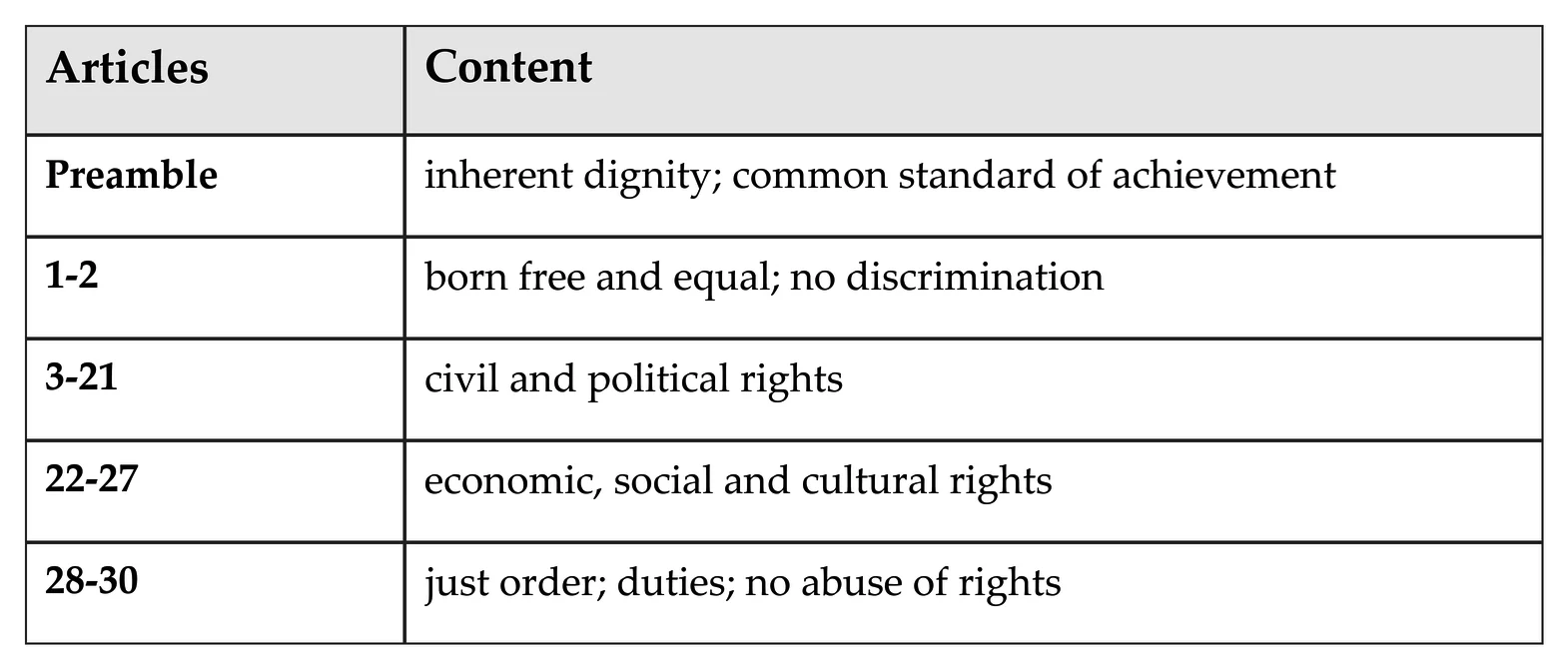
- Preamble. It recognises the inherent dignity and equal and inalienable rights of all members of the human family as the foundation of freedom, justice and peace.
- Articles 1–2: foundational principles. All human beings are born free and equal in dignity and rights and are entitled to all rights without distinction of any kind.
- Articles 3–21: civil and political rights. Life, liberty and security (3); freedom from slavery (4) and torture (5); equality before law (7); remedies (8); freedom from arbitrary arrest (9); fair trial (10); presumption of innocence (11); privacy (12); movement (13); asylum (14); nationality (15); marriage and family (16); property (17); thought, conscience and religion (18); opinion and expression (19); assembly and association (20); and participation in government and periodic elections (21).
- Articles 22–27: economic, social and cultural rights. Social security (22); work, just pay and trade unions (23); rest and leisure (24); an adequate standard of living including food, clothing, housing and medical care (25); education (26); and cultural life (27).
- Articles 28–30: order, duties and limits. A social and international order in which rights can be realised (28), duties to the community and lawful limits on rights (29), and a prohibition on using the declaration to destroy any rights (30).
2.2 Major UN Human Rights Conventions
Because the UDHR was not binding, the UN prepared treaties, called conventions or covenants, which bind the states that ratify them. Each core treaty has a treaty body, a committee of independent experts that examines reports submitted by states and, where states accept it, individual complaints. The UDHR and the two Covenants of 1966 together are called the International Bill of Human Rights.
The Two Covenants of 1966
- ICCPR. The International Covenant on Civil and Political Rights was adopted on 16 December 1966 and came into force in 1976. It protects the rights to life, freedom from torture and slavery, liberty and security, fair trial, privacy, thought, religion, expression, assembly, association, participation and minority rights, and allows some rights to be suspended in public emergencies, except non-derogable rights such as life and freedom from torture. The Human Rights Committee of eighteen experts monitors it; the First Optional Protocol (1966) allows individual complaints and the Second (1989) aims at abolishing the death penalty.
- ICESCR. The International Covenant on Economic, Social and Cultural Rights, also adopted in 1966 and in force from 1976, protects the rights to work, just conditions of work, trade unions, social security, family protection, an adequate standard of living, health, education and culture. Under Article 2, states must take steps to the maximum of their available resources to achieve these rights progressively. It is monitored by the Committee on Economic, Social and Cultural Rights (1985).
- Why two covenants. During the Cold War, Western states stressed civil and political rights while socialist states stressed economic and social rights, so the UDHR’s rights were divided into two treaties with different methods of implementation.
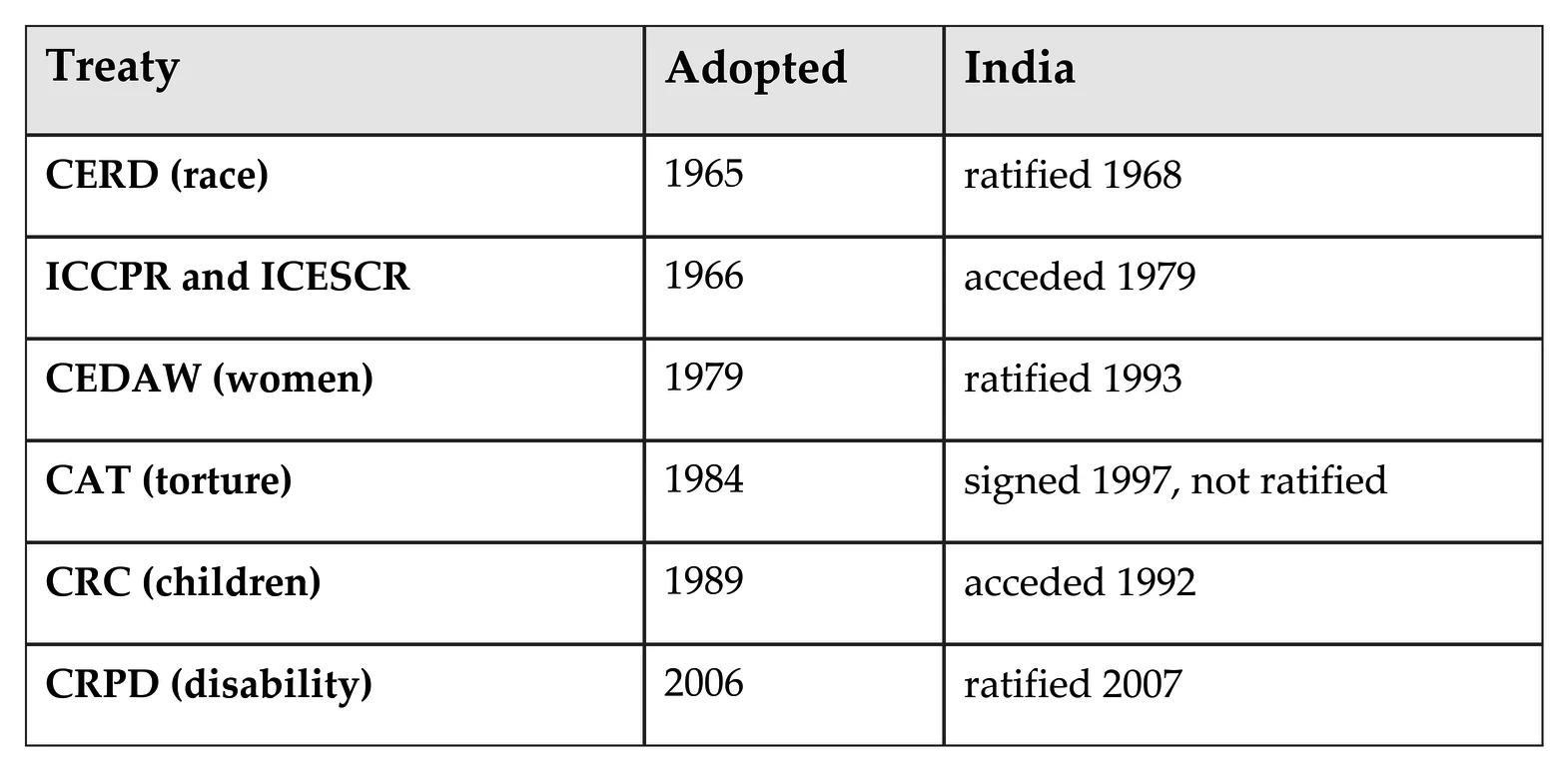
- India. India acceded to both Covenants in 1979, after the Emergency, but has not accepted the optional protocols on individual complaints.
Other Core Conventions
- CERD (1965). The International Convention on the Elimination of All Forms of Racial Discrimination, the first core treaty, came into force in 1969, reflecting the struggles against colonialism and apartheid; India ratified it in 1968.
- CEDAW (1979). The Convention on the Elimination of All Forms of Discrimination against Women, often called the international bill of rights for women, defines discrimination against women and requires states to remove it in political, economic, social and family life; it came into force in 1981, and India ratified it in 1993.
- CAT (1984). The Convention against Torture and Other Cruel, Inhuman or Degrading Treatment or Punishment prohibits torture absolutely, even in war or emergency, and forbids sending people to countries where they face torture; India signed it in 1997 but has not ratified it.
- CRC (1989). The Convention on the Rights of the Child, adopted on 20 November 1989, protects the rights of children to survival, development, protection and participation, guided by the best interests of the child; it is the most widely ratified human rights treaty, and India acceded in 1992.
- Later treaties. They include conventions on migrant workers (1990), persons with disabilities (2006), which India ratified in 2007, and enforced disappearance (2006).
2.3 UN Human Rights Bodies
From the Commission to the Human Rights Council
The Commission on Human Rights (1946–2006) drafted the UDHR and many treaties, but it was increasingly criticised for politicisation, since states with poor human rights records sought membership to shield themselves from criticism. In 2005, Secretary-General Kofi Annan, in his report In Larger Freedom, said that its declining credibility had cast a shadow over the whole UN system. On 15 March 2006, the General Assembly replaced it with the Human Rights Council.
Features of the Human Rights Council
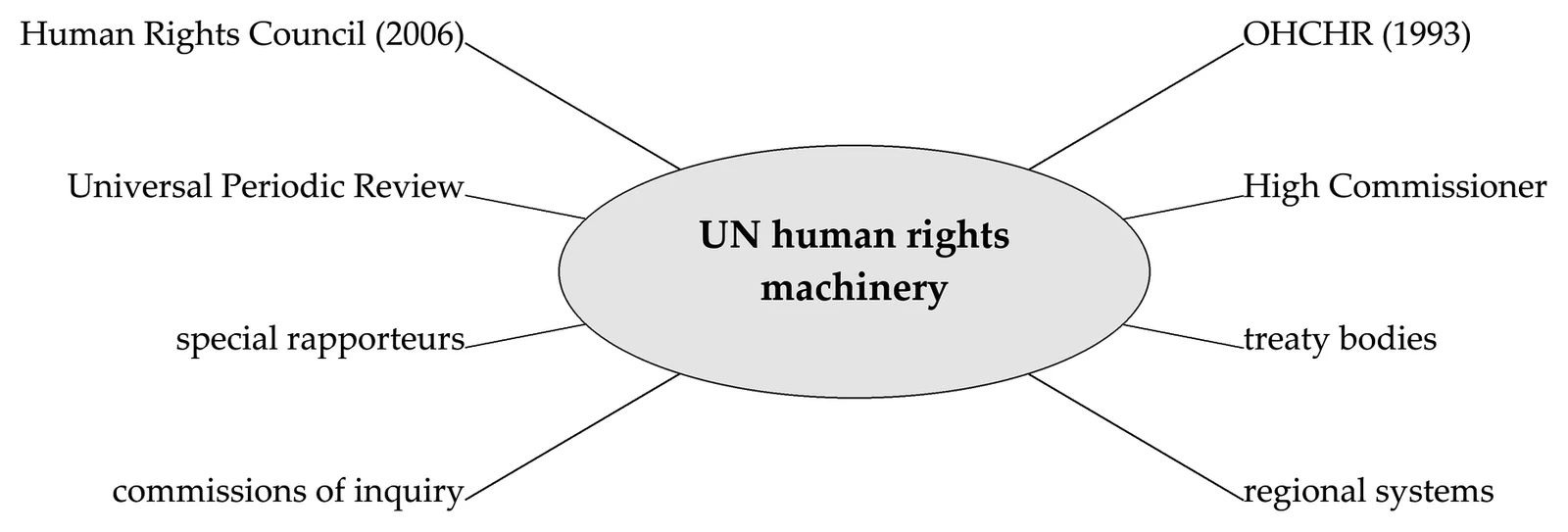
- Membership. It has forty-seven member states elected by the General Assembly for three-year terms, distributed among regions: Africa and Asia-Pacific thirteen each, Latin America and the Caribbean eight, Western Europe and others seven and Eastern Europe six.
- Suspension. Members that commit gross violations can be suspended by a two-thirds vote of the General Assembly, as happened to Libya in 2011 and Russia in 2022.
- Universal Periodic Review. Since 2008, the human rights record of every UN member state is reviewed every four to five years, giving all states, large and small, the same scrutiny.
- Special procedures. Independent experts, called special rapporteurs and working groups, investigate themes such as torture, freedom of expression and the right to food, and situations in particular countries.
- Complaint procedure and inquiries. The Council receives communications on consistent patterns of gross violations and can set up commissions of inquiry, as for Syria from 2011.
- Location. It meets in Geneva at least three times a year.
The Office of the High Commissioner for Human Rights
The World Conference on Human Rights in Vienna in 1993 recommended a single official responsible for human rights, and the General Assembly created the post of UN High Commissioner for Human Rights in December 1993. The first High Commissioner was José Ayala Lasso of Ecuador (1994); later holders include Mary Robinson of Ireland, Navanethem Pillay of South Africa, Michelle Bachelet of Chile and, since 2022, Volker Türk of Austria. The Office of the High Commissioner (OHCHR), based in Geneva, leads the UN’s human rights work: it supports the Human Rights Council and the treaty bodies, runs field offices, provides technical assistance to states, reports on violations and promotes human rights education.
Regional Systems and Limits
Alongside the UN, regional systems protect human rights, such as the European Convention on Human Rights (1950) with its court at Strasbourg, the American Convention on Human Rights (1969) and the African Charter on Human and Peoples’ Rights (1981). Asia has no comparable regional system. The international framework has limits: it depends on the cooperation of states, treaty bodies cannot enforce their views, powerful states often resist scrutiny, and the Human Rights Council remains politicised; the United States, for example, withdrew from it in 2018, returned in 2021 and withdrew again in 2025. Yet the framework has created shared standards, regular monitoring and a forum where victims and civil society can be heard.
2.4 Important Questions
- Question 1 Discuss the historical significance and main provisions of the Universal Declaration of Human Rights.
- Question 2 Discuss the International Covenant on Civil and Political Rights and the International Covenant on Economic, Social and Cultural Rights.
- Question 3 Examine the major UN human rights conventions: CEDAW, CRC, CAT and CERD.
- Question 4 Discuss the role of the UN Human Rights Council and the Office of the High Commissioner for Human Rights.
DU asks the same idea in different words. So learn one broad answer for each question below; the same answer works for every question joined by OR.
Important Question 1
Discuss the historical significance and main provisions of the Universal Declaration of Human Rights.
OR
Examine the Universal Declaration of Human Rights, 1948 as the foundation of international human rights.
OR
Why is the UDHR called the Magna Carta of humanity? Discuss.
Model Answer
“It may well become the international Magna Carta for all men everywhere.”
— Eleanor Roosevelt, UN General Assembly (December 1948)
Introduction. The Universal Declaration of Human Rights, adopted by the UN General Assembly on 10 December 1948, is the foundation of the modern international human rights system. Drafted after the Second World War by a commission chaired by Eleanor Roosevelt, it set out for the first time a common standard of rights for all peoples and nations. Though not a treaty, it has shaped international law, national constitutions and human rights movements across the world.
1. Background
The atrocities of the Second World War, especially the Holocaust, convinced the world that human rights could not be left to states alone. The UN Charter of 1945 reaffirmed faith in fundamental human rights but did not list them, so the UN set up a Commission on Human Rights in 1946 to draft a declaration.
2. Drafting
The drafting was international: John Humphrey of Canada prepared the first draft, René Cassin of France shaped its structure, P.C. Chang of China and Charles Malik of Lebanon contributed philosophical ideas, and Hansa Mehta of India secured gender-neutral language, so that Article 1 speaks of all human beings.
3. Adoption
The General Assembly adopted the UDHR in Paris on 10 December 1948 by forty-eight votes to none, with eight abstentions from the Soviet bloc, Saudi Arabia and South Africa. The date is now observed every year as Human Rights Day.
4. The Preamble
The Preamble recognises the inherent dignity and equal, inalienable rights of all members of the human family as the foundation of freedom, justice and peace, and presents the declaration as a common standard of achievement for all peoples and nations.
5. Foundational Principles
Article 1 declares that all human beings are born free and equal in dignity and rights, and Article 2 that everyone is entitled to all the rights without distinction of race, colour, sex, language, religion, political opinion, origin, property or birth.
6. Civil and Political Rights
Articles 3 to 21 protect life, liberty and security, freedom from slavery and torture, equality before law, fair trial, privacy, movement, asylum, nationality, marriage, property, freedom of thought, religion, expression, assembly and participation in government through periodic elections.
7. Economic, Social and Cultural Rights
Articles 22 to 27 protect social security, work and fair pay, trade unions, rest and leisure, an adequate standard of living including food, housing and medical care, education and participation in cultural life, showing that the declaration included both liberty and welfare.
8. Duties and Limits
Article 29 recognises that everyone has duties to the community and that rights may be limited by law to secure the rights of others and meet the requirements of morality, public order and general welfare in a democratic society.
9. Legal Status
The UDHR was adopted as a General Assembly resolution and is not legally binding as a treaty. However, many of its provisions are now considered customary international law, and it inspired binding treaties such as the two Covenants of 1966.
10. A Magna Carta for Humanity
Eleanor Roosevelt said that it might become the international Magna Carta for all men everywhere, because, like the charter of 1215, it set limits on power, but now for all people and all governments.
11. Influence on Constitutions
The UDHR influenced many national constitutions adopted after 1948, including India’s Fundamental Rights and Directive Principles, and the constitutions of newly independent states in Asia and Africa.
12. Influence on Movements
Anti-colonial, anti-apartheid, civil rights and women’s movements invoked the UDHR to demand equality and freedom, making it a source of moral power for the oppressed.
13. Criticisms
Critics argue that the UDHR reflects mainly Western liberal values, that it lacks enforcement mechanisms and that it says little about the rights of groups and the environment. Others note that colonial peoples were not represented when it was drafted.
14. Evaluation
Despite its limits, the UDHR remains the most influential human rights document in history, setting a common standard that continues to guide law, politics and activism worldwide.
Conclusion. Thus, the Universal Declaration of Human Rights, adopted in 1948 after the Second World War, set out a common standard of civil, political, economic, social and cultural rights for all people. Though not legally binding, it became the foundation of international human rights law, national constitutions and movements, justifying its description as the Magna Carta of humanity.
Important Question 2
Discuss the International Covenant on Civil and Political Rights and the International Covenant on Economic, Social and Cultural Rights.
OR
What is the International Bill of Human Rights? Discuss its components.
OR
Why were two separate covenants adopted in 1966? Compare them.
Model Answer
“Every human being has the inherent right to life. This right shall be protected by law.”
— International Covenant on Civil and Political Rights (1966), Article 6(1)
Introduction. To give the Universal Declaration binding legal force, the UN General Assembly adopted two treaties on 16 December 1966: the International Covenant on Civil and Political Rights (ICCPR) and the International Covenant on Economic, Social and Cultural Rights (ICESCR). Together with the UDHR, they form the International Bill of Human Rights. Their separation reflected Cold War divisions, but both are now regarded as equally important.
1. The International Bill of Human Rights
The International Bill of Human Rights consists of the Universal Declaration of 1948, the ICCPR, the ICESCR and their optional protocols. It is the core of the international human rights system, combining a statement of principles with binding treaty obligations.
2. Why Two Covenants
During the Cold War, Western states emphasised civil and political rights, seen as immediately enforceable, while socialist states emphasised economic and social rights, seen as requiring resources and gradual realisation. The UN therefore divided the rights of the UDHR into two treaties.
3. The ICCPR: Rights Protected
The ICCPR, in force from 1976, protects the rights to life, freedom from torture and slavery, liberty and security, fair trial, privacy, thought, conscience and religion, expression, assembly and association, family life, participation in public affairs and equality before law, as well as the rights of minorities.
4. The ICCPR: Derogation
Article 4 allows states to suspend some rights in a public emergency that threatens the life of the nation, but certain rights are non-derogable, such as the right to life, freedom from torture and slavery and freedom of thought and religion.
5. The Human Rights Committee
The ICCPR is monitored by the Human Rights Committee of eighteen independent experts, which examines state reports, issues general comments and, under the First Optional Protocol, hears complaints from individuals in states that accept it.
6. The Second Optional Protocol
The Second Optional Protocol of 1989 commits states that ratify it to abolish the death penalty. India has not ratified it and retains capital punishment for the rarest of rare cases.
7. The ICESCR: Rights Protected
The ICESCR, in force from 1976, protects the rights to work, just and favourable conditions of work, trade unions, social security, protection of the family, an adequate standard of living including food, clothing and housing, the highest attainable standard of health, education and cultural life.
8. Progressive Realisation
Under Article 2(1), states must take steps to the maximum of their available resources to achieve these rights progressively. The Committee on Economic, Social and Cultural Rights has stressed that states must still guarantee minimum core obligations immediately, such as basic food and primary education.
9. The CESCR and Optional Protocol
The ICESCR is monitored by the Committee on Economic, Social and Cultural Rights, created in 1985, and an Optional Protocol of 2008, in force from 2013, allows individual complaints, showing that these rights are increasingly treated as justiciable.
10. Comparing the Two Covenants
The ICCPR mainly requires states to refrain from violations and has immediate obligations, while the ICESCR requires positive action and allows progressive realisation. Yet both protect human dignity and depend on each other.
11. Indivisibility
The Vienna Declaration of 1993 affirmed that all human rights are universal, indivisible and interdependent, rejecting the Cold War idea that one set of rights was more important than the other.
12. India and the Covenants
India acceded to both Covenants in 1979, after the Emergency, with some declarations. Indian courts have used them to interpret the Constitution, and the Protection of Human Rights Act of 1993 includes the covenants in its definition of human rights.
13. Limitations
The covenants depend on state reporting and cooperation, the committees cannot enforce their views, and many states, including India, have not accepted individual complaints procedures.
14. Evaluation
The two Covenants transformed the principles of the UDHR into binding law and created monitoring bodies, making them the backbone of the international human rights framework despite weak enforcement.
Conclusion. Thus, the ICCPR and ICESCR of 1966, with the UDHR, form the International Bill of Human Rights. The ICCPR protects civil and political rights with immediate obligations, the ICESCR protects economic, social and cultural rights through progressive realisation, and though separated by the Cold War, both are now seen as indivisible parts of human dignity.
Important Question 3
Examine the major UN human rights conventions: CEDAW, CRC, CAT and CERD.
OR
Discuss the significance of CEDAW for women’s rights.
OR
Explain the main provisions of the Convention on the Rights of the Child.
Model Answer
“In all actions concerning children, whether undertaken by public or private social welfare institutions, courts of law, administrative authorities or legislative bodies, the best interests of the child shall be a primary consideration.”
— Convention on the Rights of the Child (1989), Article 3(1)
Introduction. Besides the two Covenants, the UN has adopted conventions that protect particular groups or prohibit particular violations. Among the most important are the International Convention on the Elimination of All Forms of Racial Discrimination (CERD, 1965), the Convention on the Elimination of All Forms of Discrimination against Women (CEDAW, 1979), the Convention against Torture (CAT, 1984) and the Convention on the Rights of the Child (CRC, 1989). Each has a committee of experts to monitor its implementation.
1. Why Specialised Conventions
General rights did not adequately protect groups facing specific forms of discrimination or violence. Specialised conventions spell out the obligations of states towards these groups and create dedicated monitoring bodies.
2. CERD: Background
CERD, adopted in 1965 and in force from 1969, was the first core UN human rights treaty. It reflected the struggles against colonialism, apartheid in South Africa and racial segregation in the United States.
3. CERD: Provisions
CERD defines racial discrimination broadly, including discrimination based on descent, and requires states to eliminate it in law and practice and to prohibit racist propaganda. Its committee has discussed caste discrimination as descent-based discrimination, a view India has contested.
4. CEDAW: Background
CEDAW, adopted on 18 December 1979 and in force from 1981, is often called the international bill of rights for women. It grew out of the UN Decade for Women and the women’s movements of the 1970s.
5. CEDAW: Provisions
CEDAW defines discrimination against women and requires states to eliminate it in political and public life, nationality, education, employment, health, economic life and marriage and family. Article 4 allows temporary special measures, such as reservations, to speed up equality.
6. CEDAW and India
India ratified CEDAW in 1993 with declarations on non-interference in personal laws. The Supreme Court relied on CEDAW in Vishaka (1997) to frame guidelines against sexual harassment at the workplace.
7. CAT: Provisions
CAT, adopted in 1984 and in force from 1987, prohibits torture absolutely, even in war or emergency, requires states to criminalise torture, investigate allegations and compensate victims, and forbids returning people to countries where they risk torture.
8. CAT and India
India signed CAT in 1997 but has not ratified it. A Prevention of Torture Bill was passed by the Lok Sabha in 2010 but lapsed, and human rights groups continue to call for ratification given reports of custodial deaths.
9. CRC: Background
The CRC was adopted on 20 November 1989, thirty years after the Declaration of the Rights of the Child, and came into force in 1990. It is the most widely ratified human rights treaty in the world.
10. CRC: Principles
The CRC rests on four principles: non-discrimination, the best interests of the child, the right to life, survival and development, and respect for the views of the child. It recognises children as rights-holders, not merely objects of protection.
11. CRC: Rights
It protects children’s rights to a name and nationality, family, education, health, play, protection from abuse, exploitation and child labour, and special protection in armed conflict. Optional protocols deal with child soldiers and the sale of children.
12. CRC and India
India acceded to the CRC in 1992. Laws such as the Juvenile Justice Act (2015), the Right to Education Act (2009) and the Protection of Children from Sexual Offences Act (2012) reflect its influence.
13. Limitations
The conventions depend on state reports and goodwill, many states enter reservations that weaken them, and the committees cannot enforce their recommendations, so implementation remains uneven.
14. Evaluation
CERD, CEDAW, CAT and the CRC have extended human rights protection to groups and issues neglected by general rights, creating standards that guide laws and courts, including in India.
Conclusion. Thus, CERD prohibits racial discrimination, CEDAW protects women’s equality, CAT prohibits torture absolutely and the CRC recognises children as rights-holders guided by their best interests. India has ratified CERD, CEDAW and the CRC but not CAT, and these conventions have shaped Indian law and judgments such as Vishaka.
Important Question 4
Discuss the role of the UN Human Rights Council and the Office of the High Commissioner for Human Rights.
OR
Evaluate the UN machinery for the protection of human rights.
OR
Why was the Commission on Human Rights replaced by the Human Rights Council? Discuss.
Model Answer
“We have reached a point at which the Commission’s declining credibility has cast a shadow on the reputation of the United Nations system as a whole.”
— Kofi Annan, address to the Commission on Human Rights (2005)
Introduction. The UN protects human rights not only through declarations and treaties but also through institutions. The two most important today are the Human Rights Council, an intergovernmental body created in 2006 to replace the Commission on Human Rights, and the Office of the High Commissioner for Human Rights (OHCHR), the UN’s main human rights secretariat, created in 1993. Together with the treaty bodies, they form the UN human rights machinery.
1. The Commission on Human Rights
The Commission on Human Rights, set up in 1946, drafted the UDHR and many treaties. Over time, however, it was criticised because states with poor human rights records joined it to protect themselves, and its work became politicised.
2. Creation of the Council
In 2005, Kofi Annan warned that the Commission’s declining credibility was damaging the UN. On 15 March 2006, the General Assembly created the Human Rights Council, based in Geneva, to replace it.
3. Membership of the Council
The Council has forty-seven members elected by the General Assembly by secret ballot for three-year terms, distributed among regional groups, with members expected to uphold high human rights standards.
4. Suspension of Members
The General Assembly can suspend a member that commits gross and systematic violations by a two-thirds vote. Libya was suspended in 2011 and Russia in 2022 after its invasion of Ukraine.
5. Universal Periodic Review
The Universal Periodic Review, begun in 2008, examines the human rights record of every UN member state every few years. India has been reviewed several times and has accepted many recommendations while rejecting others.
6. Special Procedures
Independent experts, known as special rapporteurs and working groups, study themes such as torture, freedom of expression and the right to food, and situations in particular countries, reporting publicly to the Council.
7. Commissions of Inquiry
The Council can set up commissions of inquiry and fact-finding missions to investigate serious violations, as it did for Syria from 2011 and Myanmar in 2017.
8. Creation of OHCHR
The World Conference on Human Rights in Vienna in 1993 recommended a High Commissioner for Human Rights, and the General Assembly created the post in December 1993. The first High Commissioner, José Ayala Lasso, took office in 1994.
9. Functions of OHCHR
OHCHR supports the Human Rights Council and treaty bodies, runs field offices, provides technical assistance and training to states, monitors and reports on violations and promotes human rights education worldwide.
10. The High Commissioners
High Commissioners such as Mary Robinson, Navanethem Pillay, Michelle Bachelet and, since 2022, Volker Türk have used their position to speak out on violations, sometimes drawing criticism from powerful states.
11. Treaty Bodies
Committees of independent experts monitor each core treaty, examining state reports and individual complaints, and complement the political work of the Council with expert legal review.
12. Achievements
The UN machinery has created universal scrutiny through the UPR, drawn attention to violations through special procedures and inquiries, and given victims and civil society a voice in international forums.
13. Criticisms
Critics argue that the Council remains politicised, with states forming blocs to protect allies, that its resolutions are not binding and that powerful states ignore it; the United States has withdrawn from it more than once.
14. Evaluation
The UN human rights machinery cannot enforce rights like a national court, but through monitoring, reporting and public pressure it has strengthened accountability and kept human rights on the global agenda.
Conclusion. Thus, the Human Rights Council, created in 2006 to replace the discredited Commission, reviews all states through the Universal Periodic Review and investigates violations through special procedures and inquiries, while OHCHR, created in 1993, leads and supports the UN’s human rights work. Despite politicisation and weak enforcement, they remain central to international human rights protection.
Short Notes
(a) International Bill of Human Rights
The collective name for the Universal Declaration of Human Rights (1948), the ICCPR and ICESCR (1966) and their optional protocols.
(b) Universal Periodic Review
A process of the UN Human Rights Council, begun in 2008, through which the human rights record of every UN member state is reviewed by other states every few years.
(c) CEDAW
The Convention on the Elimination of All Forms of Discrimination against Women, adopted in 1979 and ratified by India in 1993, often called the international bill of rights for women.
More notes: GE-13 Introduction to Human Rights
These notes are prepared by PADHO TO AISE for study help. They are not an official publication.