
Generic Electives (GE) GE-13 Introduction to Human Rights
Unit 3 · 24 min read · Updated 27 Nov 2026
As per the University of Delhi (DU) Generic Elective (GE) syllabus offered by the Department of Political Science
Contents
- 3.1 Constitutional Protection: Fundamental Rights and Directive Principles
- Fundamental Rights as Civil and Political Rights
- Directive Principles as Economic and Social Rights
- The Expanding Right to Life
- 3.2 The Judiciary, PIL and the Human Rights Commissions
- Constitutional Remedies and Public Interest Litigation
- Landmark Human Rights Judgments
- The Protection of Human Rights Act, 1993
- Structure of the NHRC
- Functions, Powers and Limits
- 3.3 Civil Society and the Media
- Civil Society Organisations
- The Role of the Media
- Challenges
- 3.4 Important Questions
- Discuss the protection of human rights under the Indian Constitution.
- Examine the role of the judiciary and public interest litigation in protecting human rights in India.
- Discuss the structure, functions and powers of the National Human Rights Commission under the Protection of Human Rights Act, 1993. Evaluate its performance.
- Discuss the role of civil society and the media in the promotion of human rights in India.
- Short Notes
मानव अधिकार से अभिप्राय है व्यक्ति के जीवन, स्वतंत्रता, समानता और गरिमा से संबंधित वे अधिकार जो संविधान द्वारा प्रत्याभूत हैं या अंतरराष्ट्रीय प्रसंविदाओं में सन्निहित हैं।
Human rights means the rights relating to life, liberty, equality and dignity of the individual guaranteed by the Constitution or embodied in the International Covenants and enforceable by courts in India.
— Protection of Human Rights Act, 1993, Section 2(1)(d)
IINDIA protects human rights through several institutions working together. The Constitution guarantees Fundamental Rights and sets out Directive Principles; the judiciary, through its writ jurisdiction and public interest litigation, enforces and expands these rights; the Protection of Human Rights Act, 1993 created the National and State Human Rights Commissions; and civil society and the media expose violations and press for justice. This chapter studies each of these, the ways in which they have strengthened human rights in India, and the limitations they continue to face.
3.1 Constitutional Protection: Fundamental Rights and Directive Principles
The Indian Constitution was drafted at the same time as the Universal Declaration of Human Rights, and the two documents share many ideas. Members of the Constituent Assembly, including Hansa Mehta, who also helped draft the UDHR, were aware of the international debates. The Constitution divided human rights into two parts, following the distinction later made by the two International Covenants of 1966.
Fundamental Rights as Civil and Political Rights
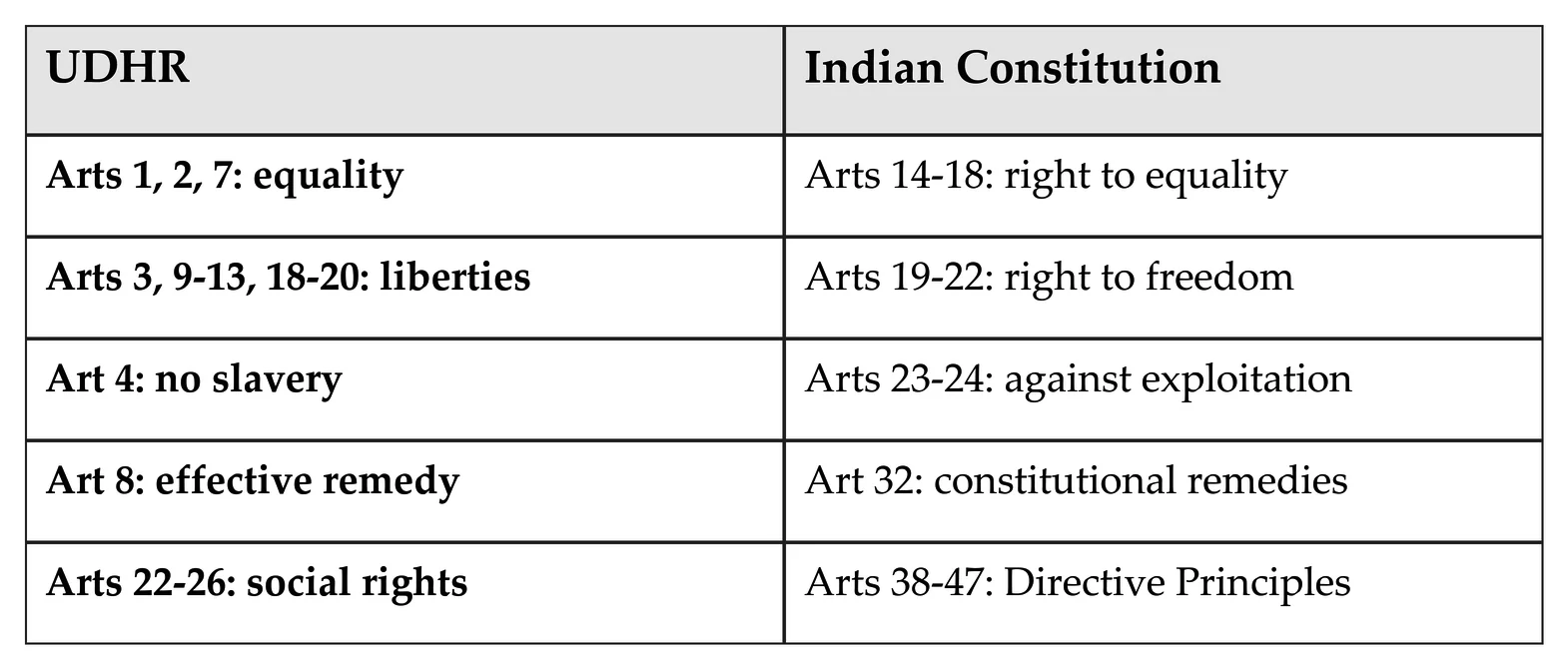
- Right to equality (Articles 14–18). Equality before law, prohibition of discrimination, equal opportunity in public employment and the abolition of untouchability correspond to Articles 1, 2 and 7 of the UDHR.
- Right to freedom (Articles 19–22). Freedoms of speech, assembly, association, movement, residence and profession, protection against retrospective punishment, double jeopardy and self-incrimination, the right to life and personal liberty, the right to education and safeguards against arbitrary arrest correspond to Articles 3, 9 to 13 and 18 to 20 of the UDHR.
- Right against exploitation (Articles 23–24). The prohibition of trafficking, forced labour and hazardous child labour corresponds to Article 4 of the UDHR against slavery.
- Freedom of religion (Articles 25–28). It corresponds to Article 18 of the UDHR.
- Cultural and educational rights (Articles 29–30). They protect minorities, as Article 27 of the ICCPR later required.
- Constitutional remedies (Article 32). It corresponds to Article 8 of the UDHR, the right to an effective remedy.
Directive Principles as Economic and Social Rights
The Directive Principles (Articles 36–51) correspond largely to the economic and social rights of Articles 22 to 26 of the UDHR and to the ICESCR: adequate livelihood and equal pay (Article 39), free legal aid (39A), the right to work, education and public assistance (41), just and humane conditions of work and maternity relief (42), a living wage (43), early childhood care (45), the interests of weaker sections (46) and nutrition and public health (47). They are not enforceable in court, but the Supreme Court has read many of them into Article 21. Article 51(c) also directs the state to foster respect for international law and treaty obligations, which courts have used to apply international human rights norms where Indian law is silent.
The Expanding Right to Life
Article 21, which protects life and personal liberty, has become the main source of new human rights in India. After Maneka Gandhi (1978) held that any procedure depriving a person of liberty must be just, fair and reasonable, the Supreme Court read into it the rights to live with dignity, livelihood, shelter, health, a clean environment, speedy trial, legal aid, privacy (Puttaswamy, 2017), and protection against custodial violence. In this way, the Constitution’s civil rights have absorbed many economic and social rights.
3.2 The Judiciary, PIL and the Human Rights Commissions
Constitutional Remedies and Public Interest Litigation
Articles 32 and 226 allow citizens to approach the Supreme Court and High Courts for writs such as habeas corpus to enforce their rights. From the late 1970s, judges such as P.N. Bhagwati and V.R. Krishna Iyer developed public interest litigation (PIL), allowing any public-spirited person to seek remedies for those unable to approach the courts and treating letters and newspaper reports as petitions. Upendra Baxi called this social action litigation, since it brought the suffering of the poor before the courts.
Landmark Human Rights Judgments
- Hussainara Khatoon (1979). It exposed the plight of thousands of undertrials in Bihar and recognised the right to a speedy trial and free legal aid.
- Sunil Batra (1978 and 1980). Acting on a letter from a prisoner, the Court protected prisoners against torture and inhuman treatment.
- Bandhua Mukti Morcha (1984). It ordered the release and rehabilitation of bonded labourers.
- Nilabati Behera (1993). It awarded compensation for a custodial death, holding that the state is liable for violating the right to life.
- D.K. Basu (1997). It laid down guidelines for arrest and detention, such as informing relatives and medical examination, to prevent custodial violence.
- Vishaka (1997). Relying on CEDAW, it framed guidelines against sexual harassment at the workplace.
- NALSA (2014) and Navtej Singh Johar (2018). They recognised the rights of transgender persons and decriminalised consensual same-sex relations.

The Protection of Human Rights Act, 1993
In response to criticism of human rights violations in Punjab, Kashmir and the North-east, and to the Paris Principles on national human rights institutions adopted by the UN in 1993, Parliament passed the Protection of Human Rights Act, 1993, which created the National Human Rights Commission (NHRC), State Human Rights Commissions (SHRCs) and Human Rights Courts at the district level. The NHRC was set up on 12 October 1993, with Justice Ranganath Misra, a former Chief Justice of India, as its first chairperson. The Act was amended in 2006 and 2019.
Structure of the NHRC
- Chairperson. A former Chief Justice of India or, since 2019, a former judge of the Supreme Court.
- Members. A former judge of the Supreme Court, a former Chief Justice or judge of a High Court and three members with knowledge of human rights, at least one of whom must be a woman.
- Ex officio members. The chairpersons of the national commissions for Scheduled Castes, Scheduled Tribes, Women, Minorities, Backward Classes and Protection of Child Rights, and the Chief Commissioner for Persons with Disabilities.
- Appointment. The President appoints members on the recommendation of a committee headed by the Prime Minister, including the Speaker, the Home Minister, the Leaders of the Opposition in both Houses and the Deputy Chairman of the Rajya Sabha.
- Term. Members serve for three years or until the age of seventy, and are eligible for reappointment.
Functions, Powers and Limits
The NHRC can inquire into violations of human rights by public servants, on its own motion or on a petition; intervene in court proceedings; visit jails and other institutions; review constitutional and legal safeguards; study international treaties; promote research and human rights literacy; and encourage NGOs. It has the powers of a civil court to summon witnesses and require documents, and its own investigation team. However, its recommendations, such as compensation or prosecution, are not binding; it cannot inquire into complaints more than one year old; and over the armed forces it can only seek a report from the central government. Critics have described it as a toothless tiger, and in 2023 the Global Alliance of National Human Rights Institutions deferred the review of its accreditation, citing concerns about independence and diversity.

3.3 Civil Society and the Media
Civil Society Organisations
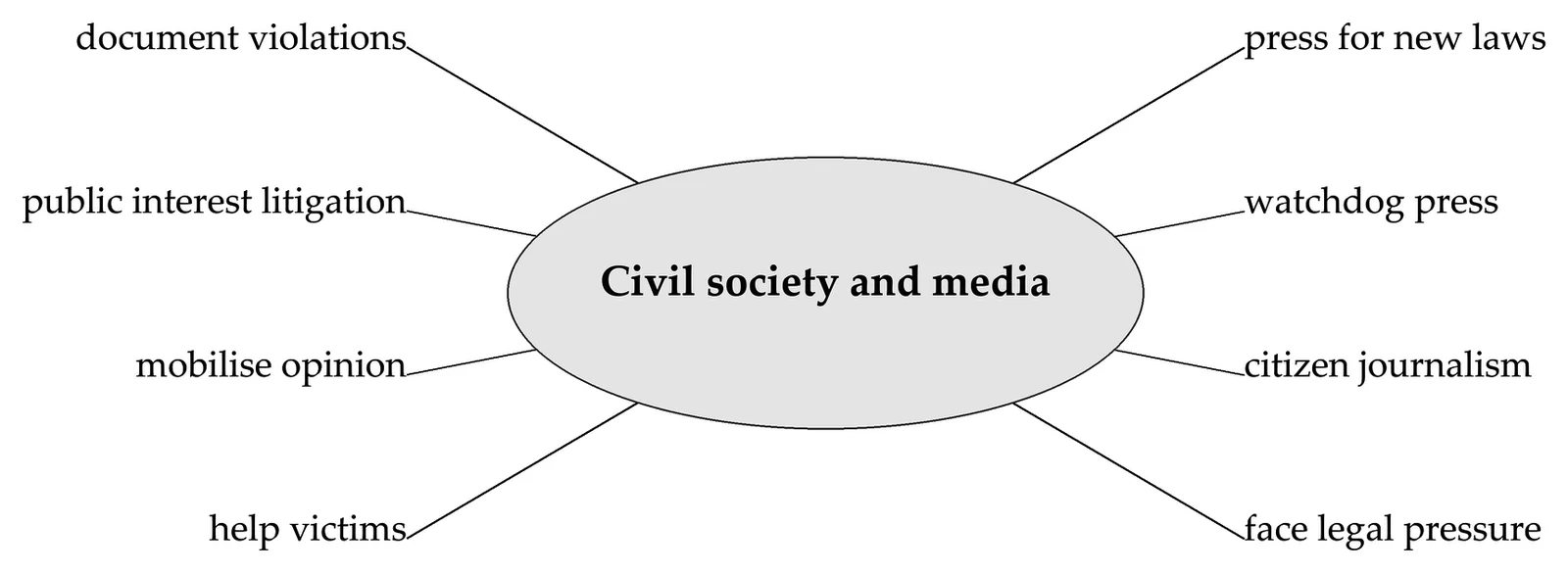
- Civil liberties groups. The People’s Union for Civil Liberties, which grew out of a forum founded by Jayaprakash Narayan in 1976 during the Emergency, and the People’s Union for Democratic Rights in Delhi document violations such as custodial deaths and fake encounters.
- Grassroots movements. The Mazdoor Kisan Shakti Sangathan campaigned for the right to information, leading to the RTI Act of 2005, and the Right to Food Campaign pursued the PUCL case on food security.
- Movements of the affected. The Narmada Bachao Andolan raised the rights of people displaced by dams, and Dalit, Adivasi, women’s and disability rights groups have claimed rights for their communities.
- International NGOs. Amnesty International and Human Rights Watch publish reports on India, though Amnesty halted its Indian operations in 2020.
- Legal activism. Lawyers and organisations such as the Human Rights Law Network file PILs on behalf of marginalised groups.
The Role of the Media
A free press is essential to human rights because it exposes violations that governments may wish to hide. Indian newspapers and television have reported custodial deaths, communal violence, bonded labour and the treatment of women and Dalits, often prompting courts and commissions to act; the Supreme Court has repeatedly taken suo motu notice of news reports. The protests after the gang rape in Delhi in December 2012, amplified by the media, led to the Justice J.S. Verma Committee and the Criminal Law (Amendment) Act of 2013. Social media now allows citizens to document abuses directly.
Challenges
Civil society and the media face serious challenges. Restrictions on foreign funding under the Foreign Contribution (Regulation) Act, tightened in 2020, have affected many NGOs; activists and journalists have been prosecuted under laws such as the Unlawful Activities (Prevention) Act; and international press freedom rankings have placed India low in recent years. At the same time, sensational or biased reporting can violate the rights of the accused and of victims, and misinformation on social media has fuelled violence. Protecting human rights therefore requires both a free media and responsible journalism.
3.4 Important Questions
- Question 1 Discuss the protection of human rights under the Indian Constitution.
- Question 2 Examine the role of the judiciary and public interest litigation in protecting human rights in India.
- Question 3 Discuss the structure, functions and powers of the National Human Rights Commission under the Protection of Human Rights Act, 1993. Evaluate its performance.
- Question 4 Discuss the role of civil society and the media in the promotion of human rights in India.
DU asks the same idea in different words. So learn one broad answer for each question below; the same answer works for every question joined by OR.
Important Question 1
Discuss the protection of human rights under the Indian Constitution.
OR
How do the Fundamental Rights and Directive Principles reflect international human rights standards?
OR
Examine the relationship between the Indian Constitution and the Universal Declaration of Human Rights.
Model Answer
“Foster respect for international law and treaty obligations in the dealings of organised peoples with one another.”
— Constitution of India, Article 51(c)
Introduction. The Constitution of India, which came into force in 1950, is the main source of human rights protection in the country. Drafted at the same time as the Universal Declaration of Human Rights of 1948, it guarantees civil and political rights as justiciable Fundamental Rights and economic and social rights as Directive Principles. Through judicial interpretation, the two parts have together given India one of the most extensive systems of rights protection in the world.
1. The Constitution and the UDHR
The Constitution and the UDHR were drafted in the same years and share a common vision of dignity, liberty and equality. Hansa Mehta, a member of the Constituent Assembly, also took part in drafting the UDHR, and many Indian provisions closely resemble its articles.
2. The Preamble
The Preamble promises justice, liberty, equality and fraternity, assuring the dignity of the individual, which mirrors the UDHR’s recognition of inherent dignity and equal rights as the foundation of freedom, justice and peace.
3. Right to Equality
Articles 14 to 18 guarantee equality before law and equal protection of laws, prohibit discrimination on grounds of religion, race, caste, sex or place of birth, ensure equality of opportunity in public employment and abolish untouchability, reflecting Articles 1, 2 and 7 of the UDHR.
4. Right to Freedom
Article 19 guarantees six freedoms, Articles 20 and 22 protect accused and detained persons, and Article 21 protects life and personal liberty, corresponding to the civil rights of the UDHR and the ICCPR.
5. Right against Exploitation
Articles 23 and 24 prohibit trafficking, forced labour and the employment of children in hazardous work, reflecting the UDHR’s prohibition of slavery and servitude and the protection of children.
6. Religious and Minority Rights
Articles 25 to 30 guarantee freedom of conscience and religion and protect the cultural and educational rights of minorities, reflecting Article 18 of the UDHR and Article 27 of the ICCPR.
7. Constitutional Remedies
Article 32 guarantees the right to move the Supreme Court for enforcement of Fundamental Rights, giving effect to the UDHR’s right to an effective remedy and making rights enforceable rather than merely declared.
8. Directive Principles
The Directive Principles reflect economic and social rights: livelihood, equal pay, legal aid, work, education, public assistance, humane conditions of work, a living wage and public health, corresponding to the UDHR’s Articles 22 to 26 and the ICESCR.
9. Expanding Article 21
Since Maneka Gandhi (1978), the Supreme Court has read into Article 21 rights to dignity, livelihood, shelter, health, a clean environment, speedy trial, legal aid and privacy, making many economic and social rights enforceable.
10. International Law in Indian Courts
Using Article 51(c), the courts have applied international human rights treaties where Indian law is silent, as in Vishaka (1997), which relied on CEDAW to frame guidelines against sexual harassment.
11. Fundamental Duties
Part IVA, added in 1976, lists duties of citizens, such as promoting harmony and renouncing practices derogatory to the dignity of women, reflecting the UDHR’s recognition in Article 29 that everyone has duties to the community.
12. Limitations
Fundamental Rights are subject to reasonable restrictions, preventive detention and suspension during emergencies, as the Emergency of 1975–77 showed, and Directive Principles are not directly enforceable.
13. Gap between Law and Practice
Despite strong constitutional protection, violations such as custodial deaths, caste atrocities, violence against women and the denial of rights to the poor continue, showing the gap between constitutional promises and reality.
14. Evaluation
The Constitution provides a comprehensive framework of human rights, strengthened by judicial interpretation, but its promise depends on effective implementation, independent institutions and an aware citizenry.
Conclusion. Thus, the Indian Constitution protects civil and political rights as justiciable Fundamental Rights and economic and social rights as Directive Principles, closely reflecting the Universal Declaration. Expanded by judicial interpretation of Article 21 and Article 51(c), it provides a strong framework for human rights, though implementation remains a challenge.
Important Question 2
Examine the role of the judiciary and public interest litigation in protecting human rights in India.
OR
How has public interest litigation expanded human rights in India? Discuss with examples.
OR
Discuss the role of the Supreme Court in protecting the rights of prisoners and the poor.
Model Answer
“Custodial violence, including torture and death in the lock ups, strikes a blow at the Rule of Law.”
— Supreme Court of India, D.K. Basu v. State of West Bengal (1997)
Introduction. The Indian judiciary, especially the Supreme Court, has been one of the most important protectors of human rights in India. Using its writ jurisdiction under Articles 32 and 226 and the innovation of public interest litigation (PIL) from the late 1970s, it has enforced Fundamental Rights, expanded their meaning and given the poor and marginalised access to justice. This activism has been praised but also criticised.
1. Writ Jurisdiction
Articles 32 and 226 empower the Supreme Court and High Courts to issue writs such as habeas corpus, mandamus and certiorari to enforce Fundamental Rights, making the judiciary the guardian of rights.
2. The Emergency and After
During the Emergency, in ADM Jabalpur (1976), the Supreme Court refused to protect detainees, a decision later regretted. After 1977, the Court sought to restore its legitimacy by becoming a champion of the rights of the poor.
3. The Birth of PIL
Judges such as P.N. Bhagwati and V.R. Krishna Iyer relaxed the rule of standing, allowing any public-spirited person to file petitions for those unable to approach the courts, and treated letters and newspaper reports as petitions, an approach called epistolary jurisdiction.
4. Rights of Undertrials and Prisoners
In Hussainara Khatoon (1979), the Court found thousands of undertrials languishing in Bihar’s jails and recognised the right to speedy trial and legal aid. In Sunil Batra, it protected prisoners against torture and solitary confinement.
5. Bonded and Exploited Labour
In Bandhua Mukti Morcha (1984), the Court ordered the release and rehabilitation of bonded labourers in stone quarries near Delhi, reading Article 21 with the Directive Principles.
6. Custodial Violence
In Nilabati Behera (1993), the Court awarded compensation for a custodial death, and in D.K. Basu (1997), it laid down guidelines for arrest and detention, such as preparing an arrest memo and informing relatives, to prevent torture.
7. Women’s Rights
In Vishaka (1997), relying on CEDAW, the Court framed guidelines against sexual harassment at the workplace, later enacted as a law in 2013, showing the use of international human rights law.
8. Socio-Economic Rights
Through cases such as Olga Tellis (1985) on livelihood and the PUCL right to food case from 2001, the Court made economic and social rights enforceable by linking them with Article 21.
9. Rights of Sexual Minorities
In NALSA (2014), the Court recognised transgender persons as a third gender, and in Navtej Singh Johar (2018) it decriminalised consensual same-sex relations, expanding equality and dignity.
10. Privacy
In Puttaswamy (2017), a nine-judge bench held privacy to be a Fundamental Right, protecting individuals against surveillance and intrusion in the digital age.
11. New Remedies
The Court developed new remedies such as compensation for rights violations, continuing mandamus to monitor implementation and the appointment of commissioners to supervise welfare schemes.
12. Criticisms of PIL
Critics argue that PIL has led to judicial overreach into executive functions, frivolous petitions, delays and, in some cases, judgments against slum dwellers and workers, as Prashant Bhushan argued in 2004.
13. Limits of Judicial Protection
Court orders are often poorly implemented, litigation is slow and costly, and access to courts remains difficult for many poor people despite legal aid.
14. Environmental Rights
Through cases filed by M.C. Mehta from the 1980s, the Court read the right to a clean environment into Article 21, ordering the closure or relocation of polluting industries, the shift of Delhi’s public transport to compressed natural gas and the protection of the Taj Mahal from pollution.
15. Right to Food and Livelihood
In the PUCL right to food case begun in 2001, the Court turned food schemes into legal entitlements, ordered cooked mid-day meals in schools and appointed commissioners to monitor implementation, giving economic rights practical force.
16. Evaluation
Despite its limitations, the judiciary has been a crucial protector of human rights in India, using PIL to extend rights to prisoners, workers, women, the poor and minorities.
Conclusion. Thus, the Indian judiciary, through writ jurisdiction and public interest litigation, has protected the rights of undertrials, prisoners, bonded labourers, women, the poor and sexual minorities, developed new remedies and expanded Article 21. Though criticised for overreach and weak implementation, it remains a key guardian of human rights in India.
Important Question 3
Discuss the structure, functions and powers of the National Human Rights Commission under the Protection of Human Rights Act, 1993. Evaluate its performance.
OR
Is the NHRC a toothless tiger? Discuss.
OR
Discuss the role of the NHRC and State Human Rights Commissions in protecting human rights.
Model Answer
“Inquire, suo motu or on a petition presented to it by a victim or any person on his behalf, into complaint of violation of human rights or abetment thereof.”
— Protection of Human Rights Act, 1993, Section 12(a)
Introduction. The National Human Rights Commission (NHRC) is India’s main national human rights institution. It was created under the Protection of Human Rights Act, 1993, in response to domestic and international criticism of human rights violations and to the UN’s Paris Principles on national institutions. The Act also created State Human Rights Commissions and Human Rights Courts. The NHRC has done valuable work, but its limited powers have led critics to call it a toothless tiger.
1. Background
In the late 1980s and early 1990s, violations in Punjab, Kashmir and the North-east drew international criticism. The UN adopted the Paris Principles in 1993, setting standards for independent national human rights institutions, and India responded by setting up the NHRC on 12 October 1993.
2. The Protection of Human Rights Act
The Act defines human rights as rights relating to life, liberty, equality and dignity guaranteed by the Constitution or embodied in the International Covenants and enforceable by Indian courts, and provides for the NHRC, SHRCs and Human Rights Courts.
3. Composition
The NHRC consists of a chairperson who has been Chief Justice or a judge of the Supreme Court, a former Supreme Court judge, a former Chief Justice or judge of a High Court, three members with knowledge of human rights including at least one woman, and the chairpersons of the national commissions as ex officio members.
4. Appointment and Tenure
Members are appointed by the President on the recommendation of a committee headed by the Prime Minister, including the Speaker, the Home Minister, the Leaders of the Opposition and the Deputy Chairman of the Rajya Sabha. Since 2019, they serve for three years or until seventy and may be reappointed.
5. Inquiry into Violations
The NHRC can inquire into complaints of human rights violations by public servants, or negligence in preventing them, either on its own motion or on a petition from a victim or any person on his behalf.
6. Other Functions
It can intervene in court cases involving human rights, visit jails and institutions, review legal safeguards, study treaties, promote research and human rights education and encourage NGOs working in the field.
7. Powers
While inquiring, the NHRC has the powers of a civil court, including summoning witnesses and requiring documents, and can use its own investigation staff or government agencies.
8. Recommendations
After inquiry, the NHRC can recommend compensation, prosecution or other action and approach courts, but its recommendations are not binding on governments.
9. State Human Rights Commissions
States can set up SHRCs with similar functions for matters in the State List and Concurrent List, and the Act provides for Human Rights Courts in each district to try offences arising from violations.
10. Achievements
The NHRC has investigated custodial deaths, issued guidelines on encounter killings, worked on bonded labour, manual scavenging and the right to food, intervened after the Gujarat violence of 2002 and spread human rights awareness.
11. Limitations
Its recommendations are not binding, it cannot inquire into complaints more than a year old, it has limited powers over the armed forces, it depends on government for staff and funds, and it is overburdened with complaints.
12. Questions of Independence
Critics argue that appointments are dominated by the government, that most members are retired judges and that it rarely confronts the state firmly. In 2023, the Global Alliance of National Human Rights Institutions deferred the review of its accreditation over such concerns.
13. Reforms Suggested
Suggested reforms include making its recommendations binding, giving it its own investigation agency, widening its powers over the armed forces, removing the one-year limit and diversifying its membership with activists and experts.
14. Evaluation
The NHRC has given victims a forum and drawn attention to violations, but its limited powers and dependence on government mean that it complements rather than replaces the courts.
Conclusion. Thus, the NHRC, created by the Protection of Human Rights Act of 1993, inquires into violations, intervenes in courts, visits institutions and promotes awareness, with civil court powers but non-binding recommendations. Its achievements are real, but its limited powers and questions about independence have led critics to call it a toothless tiger in need of reform.
Important Question 4
Discuss the role of civil society and the media in the promotion of human rights in India.
OR
Examine the contribution of human rights movements and NGOs in India.
OR
How does a free press help protect human rights? Discuss with Indian examples.
Model Answer
“Were it left to me to decide whether we should have a government without newspapers, or newspapers without a government, I should not hesitate a moment to prefer the latter.”
— Thomas Jefferson, letter to Edward Carrington (1787)
Introduction. Human rights are not protected by laws and institutions alone. Civil society, i.e. voluntary organisations, movements and citizens’ groups outside the state and market, and the media play a vital role in exposing violations, mobilising public opinion, assisting victims and pressing governments and courts to act. In India, civil society and the media have been central to many human rights struggles, though they also face growing pressures.
1. Meaning of Civil Society
Civil society includes NGOs, social movements, trade unions, professional associations, religious and community groups and independent citizens who organise to pursue common goals, including the protection of human rights.
2. The Civil Liberties Movement
The Emergency of 1975–77 gave rise to the civil liberties movement. The People’s Union for Civil Liberties, which grew out of a forum founded by Jayaprakash Narayan in 1976, and the People’s Union for Democratic Rights document custodial deaths, fake encounters and violations of free speech.
3. Grassroots Movements
Movements such as the Mazdoor Kisan Shakti Sangathan, which campaigned for the right to information, and the Right to Food Campaign have turned human rights into practical entitlements for the poor through laws such as the RTI Act of 2005 and the National Food Security Act of 2013.
4. Movements of the Marginalised
Dalit, Adivasi, women’s, disability and LGBTQ+ movements have claimed rights for their communities, from the Dalit Panthers of 1972 to the campaigns that led to the decriminalisation of homosexuality in 2018.
5. Environmental and Displacement Struggles
The Narmada Bachao Andolan and other movements raised the rights of people displaced by dams, mines and development projects, linking human rights with environmental justice.
6. Legal Activism
NGOs and activist lawyers have filed public interest litigation on behalf of prisoners, workers and the poor, using the courts to enforce and expand rights.
7. International NGOs
Organisations such as Amnesty International and Human Rights Watch publish reports on India and bring international attention to violations, though Amnesty halted its operations in India in 2020 after its accounts were frozen.
8. The Media as Watchdog
A free press exposes violations that governments may wish to hide, such as custodial violence, communal riots and atrocities against Dalits and women, and courts and the NHRC often act on the basis of media reports.
9. Media and Public Opinion
Media coverage of the Delhi gang rape of December 2012 led to nationwide protests, the Justice J.S. Verma Committee and the Criminal Law (Amendment) Act of 2013, showing how the media can mobilise public opinion for legal reform.
10. Social Media and Citizen Journalism
Smartphones and social media allow citizens to record and share evidence of abuses directly, giving voice to those ignored by mainstream media, though they also spread misinformation.
11. Pressures on Civil Society
Restrictions on foreign funding under the Foreign Contribution (Regulation) Act, tightened in 2020, the cancellation of NGO licences and the prosecution of activists under laws such as the UAPA have narrowed the space for civil society.
12. Pressures on the Media
Journalists face legal cases, harassment and violence, ownership concentration and commercial pressures, and India has ranked low in international press freedom indices in recent years.
13. Responsibility of the Media
The media can also violate rights through sensational reporting, media trials and disclosure of victims’ identities, so responsible journalism is necessary for human rights protection.
14. Evaluation
Civil society and the media are indispensable partners of courts and commissions in protecting human rights, but their effectiveness depends on freedom from state pressure and on their own commitment to accuracy and fairness.
Conclusion. Thus, civil society organisations, from civil liberties groups and grassroots movements to legal activists and international NGOs, and a free media acting as watchdog have exposed violations, mobilised opinion and secured new rights in India. Their role is vital, but growing restrictions and the need for responsible journalism remain serious challenges.
Short Notes
(a) Paris Principles (1993)
UN standards for national human rights institutions, requiring independence, pluralism, a broad mandate and adequate resources; they influenced the creation of India’s NHRC.
(b) D.K. Basu guidelines
Guidelines laid down by the Supreme Court in 1997 for arrest and detention, such as preparing an arrest memo, informing relatives and medical examination, to prevent custodial violence.
(c) Human Rights Courts
Courts of session designated under the Protection of Human Rights Act, 1993 in each district to provide speedy trial of offences arising from human rights violations.
More notes: GE-13 Introduction to Human Rights
These notes are prepared by PADHO TO AISE for study help. They are not an official publication.