
Semester VII DSE-10 Understanding Human Rights
Unit II · 20 min read · Updated 24 Nov 2026
As per the University of Delhi (DU) BA (Hons) Political Science syllabus
Contents
- 2.1 The Magna Carta
- 2.2 UN Declarations
- 2.3 The International Covenants
- 2.4 The International Court of Justice
- 2.5 Important Questions
- Discuss the significance of the Magna Carta in the history of human rights.
- Discuss the Universal Declaration of Human Rights and other UN declarations.
- Discuss the International Covenants on human rights.
- Discuss the role of the International Court of Justice in international law and human rights.
- Short Notes
किसी भी स्वतंत्र व्यक्ति को उसके समकक्षों के विधिसम्मत निर्णय या देश के कानून के बिना न पकड़ा जाएगा, न कैद किया जाएगा।
No free man shall be seized or imprisoned … except by the lawful judgement of his equals or by the law of the land.
— Magna Carta, Clause 39 (1215)
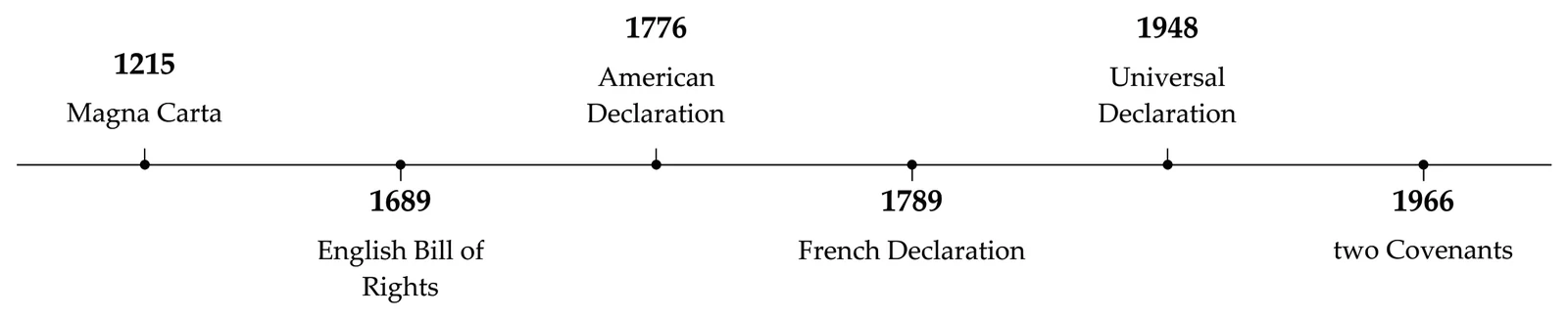
HUMAN rights became an international concern through a series of landmark documents and institutions. The Magna Carta of 1215 established that rulers are bound by law. After the Second World War, the United Nations adopted the Universal Declaration of Human Rights (1948) and later declarations on development, women and indigenous peoples. The two International Covenants of 1966 turned the Declaration’s principles into binding treaties, and the International Court of Justice settles legal disputes between states, including those involving human rights treaties. This chapter studies these documents and institutions, drawing on Johannes Morsink, Manoranjan Mohanty and the South Asia Human Rights Documentation Centre.

2.1 The Magna Carta
The Magna Carta, the Great Charter, was agreed by King John of England with rebellious barons in 1215. Most of its clauses dealt with feudal grievances, but two became famous: no free man could be imprisoned or deprived of his rights except by lawful judgement or the law of the land, and justice would not be sold, denied or delayed. Reinterpreted by later generations, it became a symbol of the rule of law and influenced constitutions and human rights documents across the world.
2.2 UN Declarations
The UN Charter (1945) committed member states to promote human rights. The Universal Declaration of Human Rights, drafted by a commission chaired by Eleanor Roosevelt, set out thirty articles of civil, political, economic, social and cultural rights. Johannes Morsink shows that its drafters saw these rights as inherent in human beings, in response to the atrocities of the war. Later declarations addressed decolonisation, development, violence against women and the rights of indigenous peoples.
2.3 The International Covenants
Because the Declaration was not a binding treaty, the UN drafted two Covenants: the International Covenant on Civil and Political Rights and the International Covenant on Economic, Social and Cultural Rights, both adopted in 1966. Together with the Declaration, they form the International Bill of Human Rights. Further conventions protect against racial discrimination, discrimination against women and torture, and protect the rights of children and persons with disabilities.

2.4 The International Court of Justice
The International Court of Justice, the principal judicial organ of the United Nations, sits at The Hague. Its fifteen judges decide legal disputes between states and give advisory opinions. Although it is not a human rights court, it has decided cases under the Genocide Convention and other treaties, and India has appeared before it, most recently in the Kulbhushan Jadhav case.

2.5 Important Questions
- Question 1 Discuss the significance of the Magna Carta in the history of human rights.
- Question 2 Discuss the Universal Declaration of Human Rights and other UN declarations.
- Question 3 Discuss the International Covenants on human rights.
- Question 4 Discuss the role of the International Court of Justice in international law and human rights.
DU asks the same idea in different words. So learn one broad answer for each question below; the same answer works for every question joined by OR.
Important Question 1
Discuss the significance of the Magna Carta in the history of human rights.
OR
‘The Magna Carta was a feudal document that became a charter of liberty.’ Discuss.
OR
Examine the influence of the Magna Carta on the rule of law and constitutionalism.
Model Answer
“To no one will we sell, to no one deny or delay right or justice.”
— Magna Carta, Clause 40 (1215)
Introduction. The Magna Carta, agreed in 1215 between King John of England and his barons, is one of the most famous documents in the history of liberty. It was originally a practical settlement of feudal disputes, but over the centuries it came to symbolise the principle that rulers are subject to the law and that individuals have rights that the state must respect.
1. Historical Context
King John faced rebellion from barons angered by heavy taxes, arbitrary punishments and military failures. In June 1215, at Runnymede near London, he agreed to a charter of liberties to restore peace.
2. Content
The charter contained about sixty-three clauses, most dealing with feudal matters such as inheritance, taxes, the rights of the Church and the City of London, and the king’s obligations to his barons.
3. Clauses 39 and 40
Clause 39 stated that no free man could be arrested, imprisoned, stripped of rights or punished except by the lawful judgement of his equals or the law of the land. Clause 40 promised that justice would not be sold, denied or delayed. These became the basis of due process.
4. Its Fate in 1215
The Pope annulled the charter within weeks and civil war followed. But it was reissued in revised forms in 1216, 1217 and 1225, becoming part of English law.
5. Limited Scope
The charter protected free men, mainly barons and landholders, not the serfs who formed most of the population. It was a feudal bargain among elites rather than a declaration of universal rights.
6. The Seventeenth-Century Revival
In the seventeenth century, lawyers such as Edward Coke used the Magna Carta against the Stuart kings’ claims to absolute power. It inspired the Petition of Right (1628), the Habeas Corpus Act (1679) and the Bill of Rights (1689).
7. The Rule of Law
The Magna Carta came to symbolise the rule of law: the principle that the ruler is subject to law, that power must be exercised according to established procedures and that individuals have legal protection against arbitrary action.
8. Influence in America
American colonists invoked the Magna Carta in their struggle against Britain. The due process clauses of the Fifth and Fourteenth Amendments of the US Constitution echo Clause 39.
9. Influence on the Universal Declaration
When the Universal Declaration was adopted in 1948, Eleanor Roosevelt said it might become the international Magna Carta for all people everywhere, showing the charter’s symbolic power.
10. Influence in India
The principles of due process and habeas corpus derived from this tradition are reflected in Article 21 and the writ jurisdiction of Indian courts. The failure to protect habeas corpus during the Emergency, in the ADM Jabalpur case of 1976, shows how fragile such protections can be.
11. Myth and Reality
Historians note that much of the Magna Carta’s fame comes from later reinterpretation. Its meaning was expanded by each generation that used it to resist arbitrary power.
12. Critiques
Critics argue that the charter protected aristocratic privileges and excluded most people. Its universal significance was created later, not intended in 1215.
13. Lasting Significance
Its eight-hundredth anniversary in 2015 was marked worldwide, reflecting its continued role as a symbol of limited government, justice and individual rights.
14. Consent to Taxation
Clause 12 of the Magna Carta provided that certain taxes could not be levied without the common counsel of the kingdom. Although limited to feudal dues, this principle grew into the idea that taxation requires the consent of representatives. It contributed to the growth of Parliament in England and later to the American slogan of no taxation without representation.
15. The Charter of the Forest
In 1217, a companion document, the Charter of the Forest, restored ordinary people’s rights to use royal forests for grazing animals, collecting firewood and gathering food. It is sometimes seen as an early recognition of the rights of common people to shared natural resources, a theme that connects with modern struggles over forests and commons.
16. Magna Carta and Constitutionalism
The deeper legacy of the Magna Carta is constitutionalism, the idea that government must operate within written limits and that the law stands above rulers. Modern constitutions, including India’s, which make fundamental rights enforceable against the state and allow courts to strike down unconstitutional laws, develop this principle far beyond what the barons of 1215 imagined.
17. Evaluation
The Magna Carta began as a feudal settlement but became a lasting symbol of the rule of law and due process, shaping constitutions and human rights documents.
Conclusion. Thus, the Magna Carta of 1215 was a feudal bargain between King John and his barons, but its clauses on lawful judgement and justice became the foundation of due process and the rule of law. Revived in the seventeenth century and invoked in America, India and the Universal Declaration, it became a charter of liberty for later ages.
Important Question 2
Discuss the Universal Declaration of Human Rights and other UN declarations.
OR
Examine the origins, drafting and significance of the Universal Declaration of Human Rights.
OR
Discuss the role of the United Nations in promoting human rights.
Model Answer
“To reaffirm faith in fundamental human rights, in the dignity and worth of the human person, in the equal rights of men and women and of nations large and small.”
— Charter of the United Nations (1945), Preamble
Introduction. The United Nations made human rights a central concern of the international community. Its Charter of 1945 committed members to promote human rights, and the Universal Declaration of Human Rights of 1948 set out a common standard for all peoples. Later declarations extended rights to new areas. Johannes Morsink’s study of the Declaration’s origins and drafting shows the intentions behind it.
1. The UN Charter
The UN Charter, signed in San Francisco in 1945, listed the promotion of human rights among the purposes of the UN and committed members to promote universal respect for human rights without distinction of race, sex, language or religion.
2. Drafting the Declaration
The UN Commission on Human Rights, chaired by Eleanor Roosevelt, drafted the Declaration. Key contributors included René Cassin of France, P.C. Chang of China, Charles Malik of Lebanon, John Humphrey of Canada and Hansa Mehta of India.
3. Morsink on Origins and Intent
Johannes Morsink, in The Universal Declaration of Human Rights: Origins, Drafting and Intent (1999), shows that the drafters responded directly to the Holocaust and saw human rights as inherent in all people, not granted by states.
4. Adoption
The General Assembly adopted the Declaration on 10 December 1948, with 48 votes in favour, none against and eight abstentions, including the Soviet bloc, South Africa and Saudi Arabia. The day is celebrated as Human Rights Day.
5. Content
The Declaration has thirty articles. It begins with equality and dignity, sets out civil and political rights such as life, liberty, fair trial and free expression, and economic and social rights such as work, education and an adequate standard of living, and recognises duties to the community.
6. Hansa Mehta’s Contribution
India’s delegate Hansa Mehta successfully argued for changing ‘all men are born free and equal’ to ‘all human beings are born free and equal’, making the Declaration’s language gender-inclusive.
7. Legal Status
The Declaration is not a binding treaty, but many of its principles have become part of customary international law and have been incorporated into national constitutions and later treaties.
8. Later Declarations
The UN adopted declarations on granting independence to colonial peoples (1960), the right to development (1986), the elimination of violence against women (1993) and the rights of indigenous peoples (2007), extending human rights to new areas.
9. The Vienna Conference
The World Conference on Human Rights at Vienna in 1993 affirmed the universality and indivisibility of human rights and led to the creation of the UN High Commissioner for Human Rights.
10. UN Human Rights Machinery
The Human Rights Council, created in 2006 to replace the Commission, reviews every state’s record through the Universal Periodic Review. Treaty bodies and special rapporteurs monitor specific rights.
11. Mohanty on Rights
Manoranjan Mohanty argues that international declarations interact with people’s struggles in countries such as India, where movements use international standards while also expanding the meaning of rights.
12. Criticisms
Critics argue that UN declarations reflect Western liberal values, that powerful states apply them selectively and that the UN lacks power to enforce them.
13. Cultural Relativism
At the time of the Vienna Conference, some Asian governments, in the Bangkok Declaration of 1993, argued that human rights must consider regional and cultural particularities, sparking a debate on universalism and relativism.
14. The Declaration in National Constitutions
The Universal Declaration influenced many constitutions written after 1948, especially in newly independent countries. India’s Constitution, adopted in 1949, contains fundamental rights and directive principles that closely parallel the Declaration’s civil, political, economic and social rights, and Indian courts have referred to it when interpreting the Constitution.
15. Evaluation
The Universal Declaration and later UN declarations created a common global standard of human rights, despite weak enforcement and debates over universality.
Conclusion. Thus, the UN Charter and the Universal Declaration of 1948, drafted under Eleanor Roosevelt with contributions from Hansa Mehta and others, made human rights a global concern. As Morsink shows, its drafters responded to the Holocaust with inherent rights. Later declarations and UN machinery extended its reach, though enforcement remains weak.
Important Question 3
Discuss the International Covenants on human rights.
OR
Distinguish between the ICCPR and the ICESCR.
OR
Examine the role of international covenants in protecting human rights in India.
Model Answer
“Every human being has the inherent right to life. This right shall be protected by law. No one shall be arbitrarily deprived of his life.”
— International Covenant on Civil and Political Rights (1966), Article 6(1)
Introduction. The Universal Declaration set out principles but was not legally binding. To give its rights legal force, the United Nations drafted two covenants, adopted in 1966: the International Covenant on Civil and Political Rights and the International Covenant on Economic, Social and Cultural Rights. With the Declaration, they form the International Bill of Human Rights.
1. The Need for Treaties
States that ratify a covenant accept legal obligations to respect, protect and fulfil the rights it contains and to report on their progress to international bodies.
2. Two Covenants
During the Cold War, Western states emphasised civil and political rights while socialist states emphasised economic and social rights. The rights were therefore placed in two covenants, adopted in 1966, which entered into force in 1976.
3. The ICCPR
The ICCPR protects the rights to life, freedom from torture and slavery, liberty and security, fair trial, privacy, freedom of thought, religion, expression, assembly and association, participation in public affairs and the rights of minorities.
4. Derogation
Article 4 of the ICCPR allows states to suspend some rights during public emergencies, but certain rights, such as the right to life and freedom from torture, can never be suspended.
5. The Human Rights Committee
The ICCPR is monitored by the Human Rights Committee. Its First Optional Protocol (1966) allows individual complaints, and its Second Optional Protocol (1989) aims at abolishing the death penalty.
6. The ICESCR
The ICESCR protects the rights to work, just conditions of work, social security, protection of the family, an adequate standard of living including food and housing, health, education and participation in cultural life.
7. Progressive Realisation
Under Article 2 of the ICESCR, states must take steps, to the maximum of their available resources, to achieve these rights progressively, recognising that they require resources and time.
8. Monitoring Economic and Social Rights
The Committee on Economic, Social and Cultural Rights, set up in 1985, monitors the ICESCR, and an Optional Protocol adopted in 2008 allows individual complaints.
9. Other Core Conventions
Other core treaties include conventions on racial discrimination (1965), discrimination against women (1979), torture (1984), the rights of the child (1989), migrant workers (1990) and persons with disabilities (2006).
10. India and the Covenants
India ratified both Covenants in 1979, CEDAW in 1993, the Convention on the Rights of the Child in 1992 and the disability convention in 2007. It signed the Convention against Torture in 1997 but has not ratified it.
11. Domestic Effect in India
Indian courts have used international covenants to interpret fundamental rights, as in Vishaka (1997), where the Supreme Court drew on CEDAW. The Protection of Human Rights Act of 1993 refers to rights in the covenants.
12. Weaknesses
The covenants depend on states’ willingness to comply. Reporting is often delayed, recommendations are not binding and powerful states face little pressure.
13. Significance
Despite weak enforcement, the covenants give human rights legal form, create standards for judging states and provide tools for citizens and movements to demand rights.
14. Self-Determination
Both Covenants begin with a common Article 1, which declares that all peoples have the right of self-determination, to freely determine their political status and pursue their economic, social and cultural development. This reflected the demands of newly independent states and placed the collective right of peoples alongside individual rights.
15. Reservations by States
States may ratify treaties with reservations or declarations limiting their obligations. When ratifying the Covenants, India declared that the right of self-determination applies only to peoples under foreign domination, not to sections of an independent state, and entered other reservations, showing how states balance international commitments with national concerns.
16. Evaluation
The International Covenants turned the Declaration’s principles into binding obligations, completing the International Bill of Human Rights.
Conclusion. Thus, the ICCPR and ICESCR of 1966 gave legal force to the Universal Declaration, protecting civil and political rights and economic, social and cultural rights respectively. Monitored by committees and supplemented by core conventions, they have influenced Indian law, though enforcement depends on states.
Important Question 4
Discuss the role of the International Court of Justice in international law and human rights.
OR
Examine the composition and jurisdiction of the International Court of Justice.
OR
How has the ICJ contributed to the protection of human rights?
Model Answer
“The International Court of Justice shall be the principal judicial organ of the United Nations.”
— Charter of the United Nations, Article 92
Introduction. The International Court of Justice is the principal judicial organ of the United Nations. It settles legal disputes between states and gives advisory opinions on legal questions. Although it is not a human rights court, its judgments on treaties such as the Genocide Convention and its advisory opinions have contributed to the development of international human rights law.
1. Origins
The ICJ succeeded the Permanent Court of International Justice of the League of Nations. It was established by the UN Charter in 1945 and began work in 1946 at the Peace Palace in The Hague.
2. Composition
The Court has fifteen judges elected for nine-year terms by the General Assembly and the Security Council, representing the main legal systems of the world. Indian judges have included Nagendra Singh, who served as its President, and Dalveer Bhandari.
3. Contentious Jurisdiction
The Court decides disputes between states only if they have consented to its jurisdiction, through special agreements, clauses in treaties or declarations accepting its compulsory jurisdiction.
4. Advisory Jurisdiction
The Court gives advisory opinions on legal questions asked by the General Assembly, the Security Council or other authorised UN bodies. These opinions are not binding but carry great legal authority.
5. Genocide Cases
The Court has decided cases under the Genocide Convention, such as Bosnia and Herzegovina v Serbia (2007), and has heard cases brought by The Gambia against Myanmar and by South Africa against Israel.
6. Important Advisory Opinions
The Court’s advisory opinions include those on the construction of a wall in the occupied Palestinian territory (2004), the separation of the Chagos Islands from Mauritius (2019) and states’ obligations on climate change (2025).
7. India before the ICJ
India has appeared before the Court in cases such as Right of Passage over Indian Territory (1960) against Portugal and Kulbhushan Jadhav (2019), where the Court found that Pakistan had violated the Vienna Convention on Consular Relations.
8. Enforcement
Under Article 94 of the Charter, states must comply with judgments, and the Security Council may act to enforce them. But enforcement depends on politics, as when the United States rejected the Court’s judgment in the Nicaragua case of 1986.
9. The ICJ and the ICC
The ICJ deals with disputes between states, while the International Criminal Court, set up under the Rome Statute of 1998, tries individuals for genocide, war crimes and crimes against humanity. India is not a party to the Rome Statute.
10. Regional Courts
Regional human rights courts allow individuals to bring cases: the European Court of Human Rights, the Inter-American Court of Human Rights and the African Court on Human and Peoples’ Rights. Asia has no such court.
11. Contributions
The ICJ has clarified the law on genocide, self-determination, diplomatic relations and the use of force, strengthening the legal framework within which human rights are protected.
12. Limitations
The Court’s jurisdiction depends on state consent, only states can be parties, and it cannot hear complaints from individuals. Compliance with its judgments is not guaranteed.
13. Reform Debates
Proposals include wider acceptance of compulsory jurisdiction and greater use of advisory opinions to clarify human rights obligations.
14. The Climate Change Opinion
In its advisory opinion of July 2025, requested by the General Assembly after a campaign led by Pacific island states, the Court held that states have legal obligations under international law to protect the climate system from greenhouse gas emissions, and that failing to do so may be an internationally wrongful act, linking climate change to human rights and state responsibility.
15. India and Pakistan at the Court
India and Pakistan have repeatedly gone before the Court. In 1973, Pakistan brought a case concerning Pakistani prisoners of war held after the 1971 war, which was discontinued after the two countries reached agreement. In 2000, the Court found it had no jurisdiction over Pakistan’s complaint about the shooting down of a Pakistani aircraft.
16. Evaluation
The ICJ is an important part of the international legal order. Though not a human rights court, its judgments and opinions support the rule of law in international relations.
Conclusion. Thus, the International Court of Justice, the principal judicial organ of the UN, decides disputes between consenting states and gives advisory opinions. Through cases on genocide and opinions on issues such as climate change, it has contributed to human rights law, though its reliance on state consent and weak enforcement limit its role.
Short Notes
(a) International Bill of Human Rights
The collective name for the Universal Declaration of Human Rights (1948) and the two International Covenants of 1966 on civil and political rights and on economic, social and cultural rights.
(b) Universal Periodic Review
A process of the UN Human Rights Council, begun in 2008, under which the human rights record of every UN member state is reviewed by other states every few years.
(c) Habeas corpus
A writ requiring that a detained person be brought before a court to examine whether the detention is lawful. Rooted in the tradition of the Magna Carta, it is protected in India under Articles 32 and 226.
More notes: DSE-10 Understanding Human Rights
These notes are prepared by PADHO TO AISE for study help. They are not an official University of Delhi publication.