
Semester VII DSE-10 Understanding Human Rights
Unit IV · 19 min read · Updated 24 Nov 2026
As per the University of Delhi (DU) BA (Hons) Political Science syllabus
Contents
- 4.1 Marginalised Groups: Dalits, Adivasis and Women
- 4.2 Tribals, Peasants and Unorganised Workers
- 4.3 Refugees
- 4.4 Terrorism and Human Rights
- 4.5 Important Questions
- Discuss the human rights of marginalised groups in India, with reference to Dalits, Adivasis and women.
- Discuss the human rights of tribals, peasants and unorganised workers in India.
- Discuss the human rights of refugees, with special reference to India.
- Discuss the relationship between terrorism and human rights.
- Short Notes
कहीं भी अन्याय, हर जगह के न्याय के लिए खतरा है।
Injustice anywhere is a threat to justice everywhere.
— Martin Luther King Jr., Letter from Birmingham Jail (1963)
RIGHTS written in constitutions and treaties are not always enjoyed in practice. In India and across the world, the human rights of marginalised groups, Dalits, Adivasis and women, are violated through discrimination and violence; tribal communities, peasants and unorganised workers face dispossession and exploitation; refugees lose the protection of their own states; and terrorism and the measures taken against it threaten the right to life and liberty. This chapter examines these challenges, drawing on Gail Omvedt, Anupama Roy, Nivedita Menon, Sujata Patel and G. Haragopal.
4.1 Marginalised Groups: Dalits, Adivasis and Women
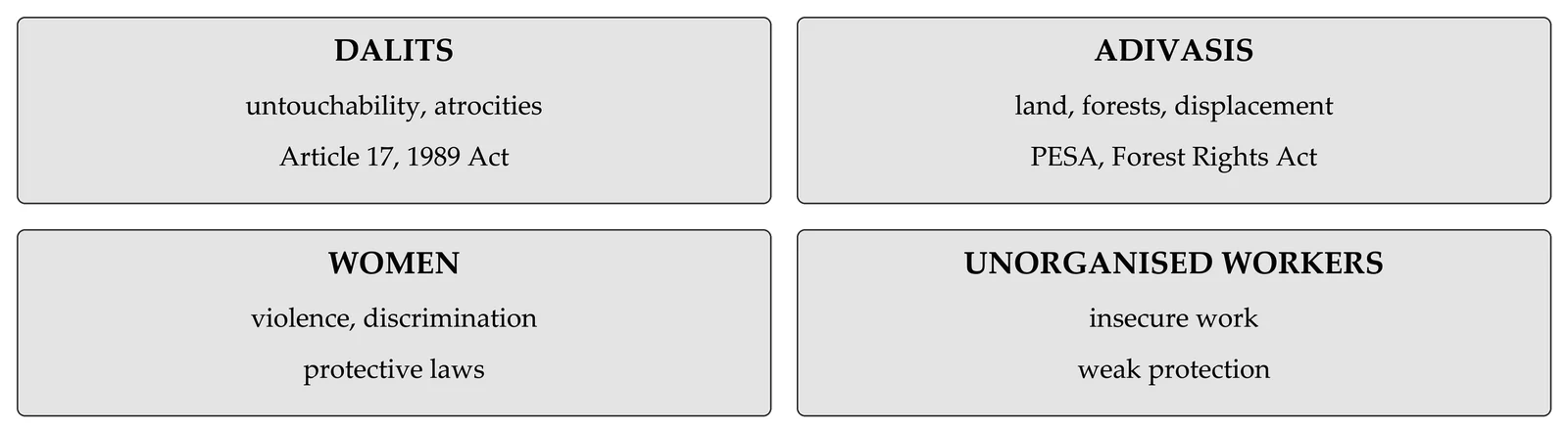
Dalits continue to face untouchability, caste violence, exclusion and degrading work such as manual scavenging, despite constitutional protection. Adivasis suffer displacement from land and forests, poverty and conflict. Women face violence, discrimination and unequal access to property, work and power. Gail Omvedt traces the Dalit struggle after Ambedkar, Anupama Roy the women’s movement, and Nivedita Menon and Sujata Patel show how caste and gender intersect.
4.2 Tribals, Peasants and Unorganised Workers
Development has often violated the rights of tribal communities displaced by dams and mines, peasants facing agrarian distress and land acquisition, and unorganised workers who lack security, fair wages and social protection. G. Haragopal argues that such violations are rooted in the political economy of development and inequality, so human rights must include the right to livelihood.
4.3 Refugees
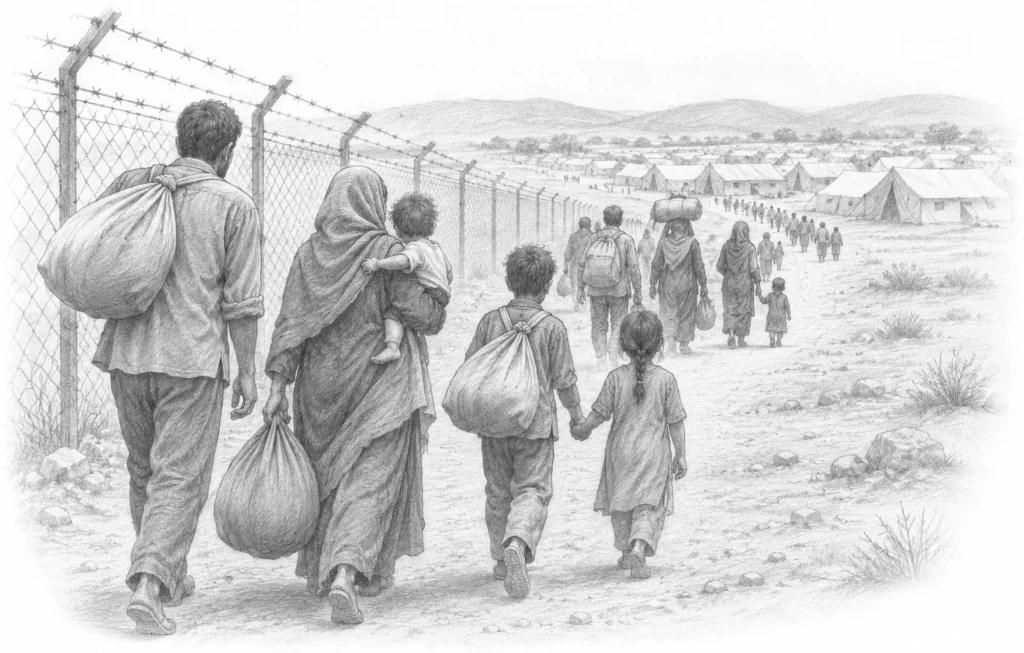
A refugee is a person who has fled their country because of a well-founded fear of persecution. The 1951 Refugee Convention protects refugees, above all through the principle of non-refoulement, which forbids returning them to danger. India is not a party to the Convention but has hosted millions of refugees, from Partition and Tibet to Bangladesh, Sri Lanka and Myanmar, handling them case by case.

4.4 Terrorism and Human Rights
Terrorism violates the most basic right, the right to life, and India has suffered attacks in Punjab, Kashmir, the North-East and its cities. But counter-terrorism laws, such as TADA, POTA, the UAPA and the AFSPA, have also been criticised for torture, prolonged detention and impunity. The challenge is to protect security while respecting human rights.

4.5 Important Questions
- Question 1 Discuss the human rights of marginalised groups in India, with reference to Dalits, Adivasis and women.
- Question 2 Discuss the human rights of tribals, peasants and unorganised workers in India.
- Question 3 Discuss the human rights of refugees, with special reference to India.
- Question 4 Discuss the relationship between terrorism and human rights.
DU asks the same idea in different words. So learn one broad answer for each question below; the same answer works for every question joined by OR.
Important Question 1
Discuss the human rights of marginalised groups in India, with reference to Dalits, Adivasis and women.
OR
Examine the challenges to the human rights of Dalits in India.
OR
How do caste and gender together shape human rights violations in India?
Model Answer
“The State shall promote with special care the educational and economic interests of the weaker sections of the people, and in particular, of the Scheduled Castes and the Scheduled Tribes, and shall protect them from social injustice and all forms of exploitation.”
— Constitution of India, Article 46
Introduction. Marginalised groups are those pushed to the edges of society by discrimination, poverty and lack of power. In India, Dalits, Adivasis and women face systematic violations of their human rights despite strong constitutional protections. Understanding these challenges requires attention to caste, ethnicity and gender and to how they intersect.
1. Meaning of Marginalisation
Marginalisation means exclusion from full participation in social, economic and political life. It denies people equal dignity, opportunities and voice, and makes them more vulnerable to violence and exploitation.
2. Dalits and Untouchability
Dalits, about 16.6 per cent of India’s population, have historically suffered untouchability. Although Article 17 abolished it, discrimination continues in access to water, temples, housing, schools and employment, and in inter-caste marriage.
3. Caste Atrocities
Tens of thousands of crimes against Scheduled Castes are recorded each year, including murder, rape and assault, often in retaliation for asserting rights. The SC/ST (Prevention of Atrocities) Act, 1989, provides special courts and stricter punishment.
4. Manual Scavenging
Despite the Prohibition of Employment as Manual Scavengers Act of 2013, many Dalits, mostly from particular sub-castes, still clean sewers and septic tanks by hand, and workers continue to die in such work, a grave violation of dignity.
5. Omvedt on the Dalit Movement
Gail Omvedt traces how the Dalit movement after Ambedkar fought for dignity, land, education and political power, through organisations, literature and parties, turning victims of caste into agents of their own liberation.
6. Adivasis
Adivasis, about 8.6 per cent of the population, live mainly in forested and mineral-rich regions. They have been displaced by dams, mines and industries, lost access to forests and suffer high poverty. Seventy-five groups are classified as particularly vulnerable.
7. Protecting Adivasi Rights
The Fifth and Sixth Schedules, PESA (1996) and the Forest Rights Act (2006) protect Adivasi land and self-government. In the Samatha judgment of 1997, the Supreme Court held that tribal land in Scheduled Areas could not be leased to private mining companies.
8. Women
Women face violence, including rape, dowry deaths and domestic violence, along with discrimination in property, work and politics. Hundreds of thousands of crimes against women are recorded each year, and many more go unreported.
9. Menon on Gender and Politics
Nivedita Menon’s Gender and Politics in India (2000) shows how women’s rights are shaped by the state, law, community and the women’s movement, and how gender issues are tied to questions of caste, religion and nation.
10. Intersection of Caste and Gender
Sujata Patel and others show that Dalit and Adivasi women face combined discrimination of caste, class and gender. Sexual violence against them is often used to humiliate whole communities.
11. The Women’s Movement
Anupama Roy shows how the women’s movement campaigned for legal reforms on rape, dowry, domestic violence and harassment, while debating its relationship with the state and the differences among women.
12. State Responses
The state has created national commissions, reservations, special laws and welfare schemes for these groups, but implementation is weak, conviction rates are low and social attitudes change slowly.
13. Movements and Resistance
Dalit, Adivasi and women’s movements continue to fight for rights, using protest, courts, elections and international forums, expanding the practice of human rights in India.
14. Religious Minorities
Religious minorities have also faced violations, including communal riots and mob lynching on suspicion of cattle slaughter or other rumours. In Tehseen Poonawalla (2018), the Supreme Court called lynching a horrendous act of mobocracy and directed states to appoint nodal officers, set up fast-track courts and compensate victims, while urging Parliament to make a special law.
15. Evaluation
The human rights of marginalised groups are the true test of a democracy. In India, legal protections are strong but social realities lag behind.
Conclusion. Thus, Dalits, Adivasis and women face serious violations of human rights in India, from untouchability and atrocities to displacement and gender violence. As Omvedt, Roy, Menon and Patel show, constitutional protections and special laws exist, but caste and gender hierarchies and weak implementation keep their rights insecure.
Important Question 2
Discuss the human rights of tribals, peasants and unorganised workers in India.
OR
Examine G. Haragopal’s view of the political economy of human rights.
OR
How does development affect the human rights of the poor in India?
Model Answer
“Traffic in human beings and begar and other similar forms of forced labour are prohibited and any contravention of this provision shall be an offence punishable in accordance with law.”
— Constitution of India, Article 23(1)
Introduction. For millions of tribals, peasants and unorganised workers in India, human rights violations come not only from police repression but from dispossession, poverty, exploitation and insecurity. Scholars such as G. Haragopal argue that these violations are rooted in the political economy of development, so that human rights must include the rights to land, livelihood and decent work.
1. Haragopal: Political Economy of Human Rights
G. Haragopal, in The Political Economy of Human Rights (1997), argues that human rights violations in India are rooted in unequal structures of land, wealth and power. A development model that serves the powerful produces violations against the poor.
2. Tribals and Development
Tribal communities have been displaced in large numbers by dams, mines and industries, often without adequate compensation or rehabilitation. Losing land and forests destroys their livelihoods, culture and community.
3. Tribal Resistance
Tribal communities have resisted displacement, as in the Niyamgiri hills, where gram sabhas rejected bauxite mining in 2013. Conflict in central India, including Maoist insurgency, has caught tribals between the state and armed groups.
4. Peasants and Agrarian Distress
Rising costs, debt, falling prices and climate shocks have produced an agrarian crisis, with many farmers’ suicides since the 1990s. Land acquisition for industry and infrastructure has also threatened peasant livelihoods.
5. The Right to Livelihood
In Olga Tellis (1985), the Supreme Court held that the right to life includes the right to livelihood, recognising that depriving people of their means of living violates their basic rights.
6. Bonded Labour
Bonded labour, in which workers are forced to work to repay debts, was abolished by the Bonded Labour System (Abolition) Act of 1976. In Bandhua Mukti Morcha (1984), the Supreme Court directed the release and rehabilitation of bonded labourers, but the practice persists in brick kilns, quarries and agriculture.
7. Unorganised Workers
About nine out of ten Indian workers are in the unorganised sector, without job security, minimum wages, social security or the protection of labour laws. Their insecurity is a major human rights concern.
8. Child Labour
The Child and Adolescent Labour (Prohibition and Regulation) Act, amended in 2016, bans the employment of children below fourteen, but child labour continues in agriculture, domestic work and small industries.
9. Migrant Workers
Migrant workers face exploitation by contractors, poor housing and exclusion from welfare. The COVID-19 lockdown of 2020, when millions lost work and walked home, exposed their vulnerability.
10. Domestic Workers
Domestic workers, mostly women and many of them migrants, are excluded from most labour laws and face long hours, low pay and abuse. India has not ratified the ILO Domestic Workers Convention.
11. Legal Protections
Laws such as the rural employment guarantee (2005), the Unorganised Workers’ Social Security Act (2008), the Forest Rights Act (2006) and the labour codes provide some protection, but coverage and enforcement are limited.
12. Movements
Peasant movements, tribal movements, trade unions and organisations such as SEWA have fought for land, wages and social security, expanding the meaning of human rights.
13. Development and Rights
The challenge is to pursue development without violating the rights of the poor, through consent, fair compensation, rehabilitation and a share in the benefits of growth.
14. Health and Safety at Work
Unorganised workers often work in dangerous conditions without protection. Workers in stone quarries and mines suffer from silicosis, an incurable lung disease caused by dust, while construction and factory workers face frequent accidents. Rajasthan adopted a policy on pneumoconiosis in 2019 to compensate affected workers, but occupational health remains a neglected human rights issue.
15. Evaluation
For tribals, peasants and unorganised workers, human rights mean land, livelihood and dignity at work. As Haragopal argues, protecting them requires changing the political economy of development.
Conclusion. Thus, tribals, peasants and unorganised workers face violations rooted in displacement, agrarian distress, forced labour and insecure work. As G. Haragopal argues, these are products of the political economy of development, and protecting their rights requires the right to livelihood, fair development and effective labour protection.
Important Question 3
Discuss the human rights of refugees, with special reference to India.
OR
Why has India not signed the 1951 Refugee Convention? Discuss its refugee policy.
OR
Examine the principle of non-refoulement and its significance.
Model Answer
“No Contracting State shall expel or return (‘refouler’) a refugee in any manner whatsoever to the frontiers of territories where his life or freedom would be threatened on account of his race, religion, nationality, membership of a particular social group or political opinion.”
— Convention Relating to the Status of Refugees (1951), Article 33(1)
Introduction. Refugees are people who have been forced to flee their own countries because of persecution, war or violence. Having lost the protection of their own state, they depend on other states and the international community for their rights. India has hosted millions of refugees, but it has no national refugee law and is not a party to the international refugee convention.
1. Definition
The 1951 Convention defines a refugee as a person outside their country who has a well-founded fear of persecution because of race, religion, nationality, membership of a particular social group or political opinion, and is unable or unwilling to return.
2. The 1951 Convention and 1967 Protocol
The Convention was drafted after the Second World War for European refugees. The 1967 Protocol removed its time and geographical limits, making it universal.
3. UNHCR
The Office of the UN High Commissioner for Refugees, created in 1950, protects refugees and seeks solutions. The number of forcibly displaced people in the world has risen to well over 100 million in recent years.
4. Non-Refoulement
The principle of non-refoulement forbids returning refugees to places where their life or freedom would be threatened. It is regarded as part of customary international law, binding even on states that have not signed the Convention.
5. Rights of Refugees
Refugees are entitled to protection from forced return, access to courts, freedom of religion, education, work and documents, and should not be punished for illegal entry if they come directly from danger.
6. India’s Refugee History
India has received many refugees: millions displaced by Partition in 1947, Tibetans from 1959, about ten million people from East Pakistan in 1971, Sri Lankan Tamils, Chakmas, Afghans and Rohingyas from Myanmar.
7. Why India Has Not Signed
India has not signed the Convention, citing porous borders, security concerns, the burden on a developing country and the Convention’s Eurocentric origins. It prefers to deal with refugees case by case.
8. Legal Framework
Refugees in India are governed by general laws on foreigners, now consolidated in the Immigration and Foreigners Act, 2025. Different groups receive different treatment, so protection depends on political decisions.
9. The Role of the Courts
In NHRC v State of Arunachal Pradesh (1996), the Supreme Court held that Chakma refugees were protected by Article 21 against forcible expulsion. In 2021, however, it allowed the deportation process for Rohingyas to proceed according to law.
10. The Rohingya Question
Rohingya refugees fleeing persecution in Myanmar have faced detention and threats of deportation in India, raising questions about non-refoulement and the treatment of refugees based on religion and security.
11. Tibetan Refugees
Tibetan refugees, who came after 1959, have been allowed to build settlements, schools and institutions, showing a more generous approach to some refugee groups.
12. Refugees and the CAA
The Citizenship (Amendment) Act, 2019, offers citizenship to certain non-Muslim migrants from three neighbouring countries, which critics argue introduces religion into refugee protection.
13. Towards a Refugee Law
Scholars and some legislators have proposed a national asylum law to provide clear, non-discriminatory protection, and new challenges such as climate displacement make this more urgent.
14. Climate Displacement
Rising seas, floods, droughts and cyclones are forcing growing numbers of people from their homes, including in the Sundarbans and other coastal regions of South Asia. Such climate migrants are not covered by the 1951 Convention, because they do not flee persecution, which has led to calls for new forms of international protection for people displaced by environmental disasters.
15. Evaluation
India has been generous to many refugees but lacks a consistent legal framework, leaving protection dependent on politics rather than rights.
Conclusion. Thus, refugees are protected internationally by the 1951 Convention and the principle of non-refoulement. India has hosted millions of refugees but is not a party to the Convention and handles them case by case, so courts and politics determine their rights. A national refugee law would provide more consistent protection.
Important Question 4
Discuss the relationship between terrorism and human rights.
OR
Examine the impact of counter-terrorism laws on human rights in India.
OR
How can a democracy balance security and human rights?
Model Answer
“Effective counter-terrorism measures and the protection of human rights are not conflicting goals, but complementary and mutually reinforcing.”
— UN Global Counter-Terrorism Strategy (2006)
Introduction. Terrorism is one of the gravest threats to human rights, because it deliberately kills and terrorises civilians. But the measures taken to fight terrorism, special laws, detention, surveillance and military operations, can themselves violate human rights. India, which has suffered terrorism in many forms, faces the challenge of protecting both security and liberty.
1. Meaning of Terrorism
There is no universally agreed definition, but terrorism generally refers to violence or threats against civilians to create fear and achieve political, religious or ideological aims.
2. Terrorism as a Violation of Rights
Terrorist attacks violate the rights to life, liberty and security of innocent people, spread fear and undermine democratic life. States have a duty to protect their people against such violence.
3. India’s Experience
India has faced militancy in Punjab, Kashmir and the North-East, Maoist insurgency in central India and attacks on cities, such as the Mumbai attacks of 2008, which killed 166 people, and the attack at Pahalgam in 2025.
4. Counter-Terrorism Laws
India has enacted special laws: the Terrorist and Disruptive Activities (Prevention) Act (1985–95), the Prevention of Terrorism Act (2002–04) and the Unlawful Activities (Prevention) Act, strengthened in 2004, 2008 and 2019, along with the National Investigation Agency Act of 2008.
5. The AFSPA
The Armed Forces (Special Powers) Act, 1958, gives the armed forces wide powers in disturbed areas, including the use of lethal force, and protects them from prosecution without government sanction. It has been criticised for enabling abuses.
6. Human Rights Concerns
Critics point to torture in custody, confessions extracted under pressure, long detention without trial, very strict bail conditions and low conviction rates under special laws, which punish people through the process itself.
7. Judicial Review
The Supreme Court upheld TADA in Kartar Singh (1994) and POTA in 2003, but added safeguards. Courts have emphasised that special laws must be applied fairly and not misused.
8. Extra-Judicial Killings
In a case brought by families of victims in Manipur in 2016, the Supreme Court held that the AFSPA does not give the armed forces absolute immunity for excessive force and ordered investigations into alleged fake encounters.
9. International Standards
After the attacks of 11 September 2001, the UN Security Council required states to act against terrorism, while the UN Global Counter-Terrorism Strategy of 2006 insisted that counter-terrorism must respect human rights and the rule of law.
10. Surveillance and Privacy
Counter-terrorism has expanded surveillance of communications and data, raising concerns about privacy and the targeting of dissenters, especially after the recognition of privacy as a fundamental right in 2017.
11. Profiling and Minorities
Human rights groups argue that counter-terrorism has sometimes targeted particular communities, leading to wrongful arrests of young men who were later acquitted after years in prison.
12. Balancing Security and Rights
A democratic approach requires clear definitions of terrorism, independent oversight, judicial review, protection against torture, speedy trials and compensation for the wrongly accused.
13. Rights of Victims
Victims of terrorism also have rights to justice, compensation and support. Protecting human rights means caring for victims as well as respecting the rights of suspects.
14. Left-Wing Extremism
In the Maoist-affected areas of central India, tribal villagers have suffered violence from both insurgents and security forces. In Nandini Sundar v State of Chhattisgarh (2011), the Supreme Court declared the state-backed Salwa Judum militia and the arming of tribal youth as special police officers unconstitutional, holding that the state cannot outsource violence in violation of human rights.
15. International Cooperation
Terrorism crosses borders, so countries cooperate through intelligence sharing, extradition and controls on terrorist financing through the Financial Action Task Force, set up in 1989. India has long pressed for a Comprehensive Convention on International Terrorism, first proposed at the UN in 1996, which remains stalled over disagreements on how to define terrorism.
16. Evaluation
Terrorism threatens human rights, but so can counter-terrorism. As the UN strategy states, security and rights are complementary, not opposed.
Conclusion. Thus, terrorism violates the right to life and India has suffered greatly from it, but counter-terrorism laws such as TADA, POTA, the UAPA and the AFSPA have raised serious concerns about torture, detention and impunity. A democracy must pursue security through the rule of law, treating human rights and counter-terrorism as mutually reinforcing.
Short Notes
(a) Non-refoulement
The principle of refugee law, in Article 33 of the 1951 Convention, that refugees must not be returned to a country where their life or freedom would be threatened. It is considered binding on all states as customary international law.
(b) Samatha judgment
A Supreme Court judgment of 1997 holding that tribal land in Scheduled Areas cannot be leased to private companies for mining, protecting the land rights of Adivasis under the Fifth Schedule.
(c) Unlawful Activities (Prevention) Act
India’s main anti-terror law, first passed in 1967 and strengthened several times. Since 2019 it allows individuals to be designated as terrorists. Critics point to its strict bail conditions and low conviction rates.
(d) Bonded labour
A form of forced labour in which a person works to repay a debt, often for years and across generations. It was abolished by the Bonded Labour System (Abolition) Act, 1976, and Article 23 prohibits forced labour, but the practice persists in brick kilns, quarries and agriculture.
More notes: DSE-10 Understanding Human Rights
These notes are prepared by PADHO TO AISE for study help. They are not an official University of Delhi publication.