
Semester II MDSC-2B India's Foreign Policy
Unit I · 19 min read · Updated 24 Nov 2026
As per the University of Delhi (DU) BA (Hons) Political Science syllabus
Contents
- 1.1 Meaning of Foreign Policy
- 1.2 Domestic and International Determinants of India’s Foreign Policy
- 1.3 Objectives and Principles
- 1.4 Non-Alignment and Beyond: Concepts, Policy and Relevance
- 1.5 The Evolution of India’s Foreign Policy
- 1.6 Important Questions
- Discuss the determinants of India’s foreign policy.
- What is non-alignment? Discuss its relevance in the post-Cold War world.
- Trace the evolution of India’s foreign policy since independence.
- Short Notes
हम सत्ता-गुटों से, जो एक-दूसरे के विरुद्ध खड़े हैं, दूर रहना चाहते हैं।
We propose, as far as possible, to keep away from the power politics of groups, aligned against one another.
— Jawaharlal Nehru, Broadcast, 7 September 1946
FOREIGN POLICY is the set of goals, principles and strategies through which a state conducts its relations with other states and international actors. For India, independence in 1947 came at the start of the Cold War, when the world was dividing into two hostile blocs led by the United States and the Soviet Union. A poor, newly independent country had to protect its freedom, develop its economy and find a place in this world. Jawaharlal Nehru’s answer was non-alignment: India would not join either bloc, but would judge each issue on its merits. In this chapter we study the meaning of foreign policy, the domestic and international factors that determine India’s foreign policy, its objectives and principles, and the concept, practice and continuing relevance of non-alignment, as India’s foreign policy evolved from Nehru’s idealism to the pragmatism of an emerging power.
1.1 Meaning of Foreign Policy
A state’s foreign policy is the set of objectives it seeks in the world and the means it uses to achieve them, through diplomacy, alliances, trade, aid, defence and participation in international organisations. Its basic aim is to protect and promote the national interest: the security of the state, its territorial integrity and independence, the economic welfare of its people, and its values and status in the world. Foreign policy is shaped by the country’s own circumstances, its geography, history, economy and politics, and by the international environment in which it operates. J. Bandyopadhyaya, in The Making of India’s Foreign Policy, insists that foreign policy is not made in a vacuum: it is the product of these determinants, which change slowly or quickly over time.
1.2 Domestic and International Determinants of India’s Foreign Policy
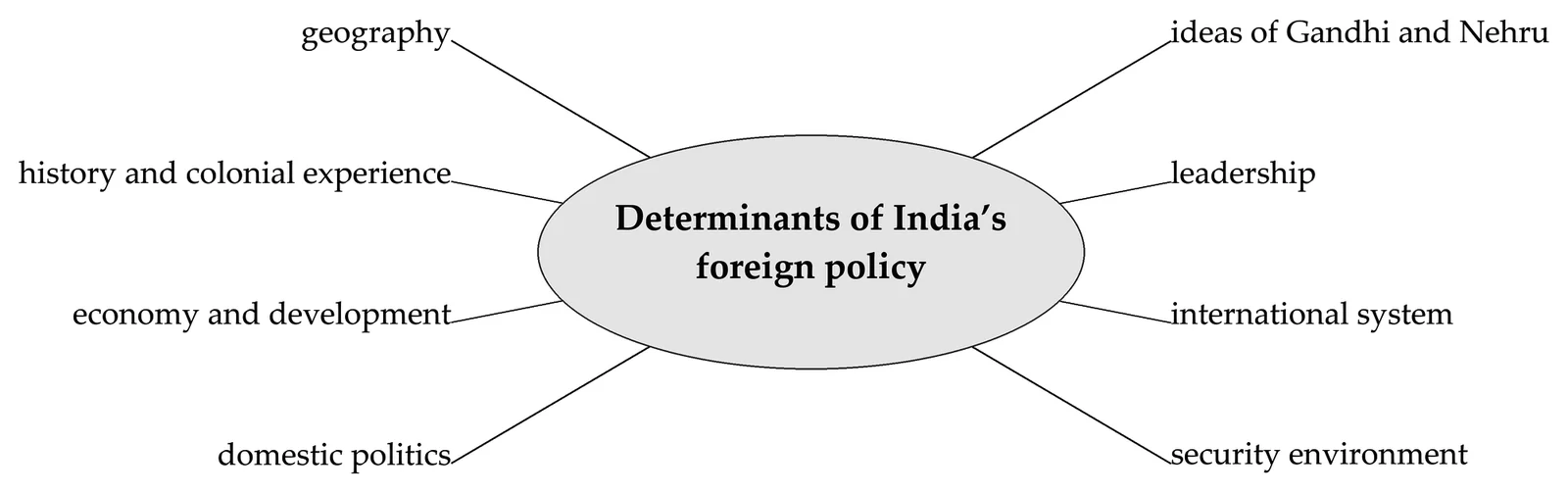
Bandyopadhyaya, A. Appadorai and other scholars identify several determinants (Figure 1.2):
- Geography: India occupies a central position in South Asia and at the head of the Indian Ocean, with long land borders with China and Pakistan, and is close to vital sea lanes. Its size and location give it security concerns on both land and sea, and an interest in a peaceful neighbourhood and a stable Indian Ocean.
- History and colonial experience: two centuries of colonial rule made India deeply committed to anti-colonialism, anti-racism, independence of judgement and economic self-reliance, and suspicious of great-power domination.
- Civilisational and philosophical traditions: J.N. Dixit traces the conceptual origins of India’s foreign policy to its civilisational values of tolerance and coexistence, and to Gandhi’s ideas of non-violence and moral means, which shaped Nehru’s world view.
- Economic needs: India’s poverty and the need for rapid development required aid, technology and trade from all sides, which favoured friendly relations with both blocs.
- Domestic politics and society: India’s democracy, federal structure, diversity, public opinion and political parties shape foreign policy, as Appadorai shows in The Domestic Roots of India’s Foreign Policy; states bordering neighbours, such as Tamil Nadu and West Bengal, have influenced policy towards Sri Lanka and Bangladesh.
- Leadership: the personalities and ideas of leaders, especially Nehru, Indira Gandhi, Rajiv Gandhi, Narasimha Rao, Vajpayee and Narendra Modi, have shaped the style and content of foreign policy.
- Military strength: limited military power in the early years encouraged diplomacy; later, defeats and victories in war, and nuclear capability, changed India’s approach.
- The international system: the Cold War, the rise of China, the end of the Cold War, globalisation and today’s multipolar world have set the external conditions within which India acts.
Varun Sahni argues that India’s foreign policy is now driven above all by its economic growth, its quest for security in a difficult neighbourhood, and its aspiration for status as a major power, all pursued within the constraints of a democratic and diverse polity.
1.3 Objectives and Principles
A. Objectives
Muchkund Dubey, in India’s Foreign Policy: Coping with the Changing World (2016), summarises India’s main objectives: protecting national security and territorial integrity; preserving the independence of decision-making, or strategic autonomy; promoting economic development through trade, investment and technology; building a peaceful and friendly neighbourhood; securing a fair and democratic world order in which developing countries have a voice; and protecting the interests of Indians abroad.
B. Principles
- Non-alignment: keeping out of military blocs and judging issues independently.
- Panchsheel: the five principles of peaceful coexistence agreed with China in 1954: mutual respect for each other’s territorial integrity and sovereignty, mutual non-aggression, mutual non-interference in internal affairs, equality and mutual benefit, and peaceful coexistence.
- Anti-colonialism and anti-racism: support for the freedom of colonised peoples and opposition to apartheid in South Africa.
- Peaceful settlement of disputes and support for the United Nations, international law and multilateral institutions.
- Disarmament: support for general and complete disarmament, combined with opposition to discriminatory arrangements such as the Nuclear Non-Proliferation Treaty (1968).
- A just international economic order: support for the Group of 77 and the demand for a New International Economic Order.
1.4 Non-Alignment and Beyond: Concepts, Policy and Relevance
A. The concept
Non-alignment meant that India would not join either of the Cold War military blocs, the Western bloc led by the United States (NATO, SEATO, CENTO) or the Soviet bloc (the Warsaw Pact), and would decide its policy on each issue on its merits. K.P. Mishra, in ‘Towards Understanding Non-Alignment’ (1981), stresses that non-alignment is not neutrality: a neutral state stays out of conflicts, while a non-aligned state takes an active part in world affairs, taking sides on issues such as colonialism or nuclear testing according to its own judgement. Nor is it isolation or fence-sitting. A.P. Rana, in Imperatives of Non-Alignment (1976), argues that non-alignment was not mere idealism: it was a realistic strategy to protect India’s national interest, preserve its freedom of action, obtain aid from both sides and avoid being drawn into conflicts not of its making.
B. Non-alignment in practice
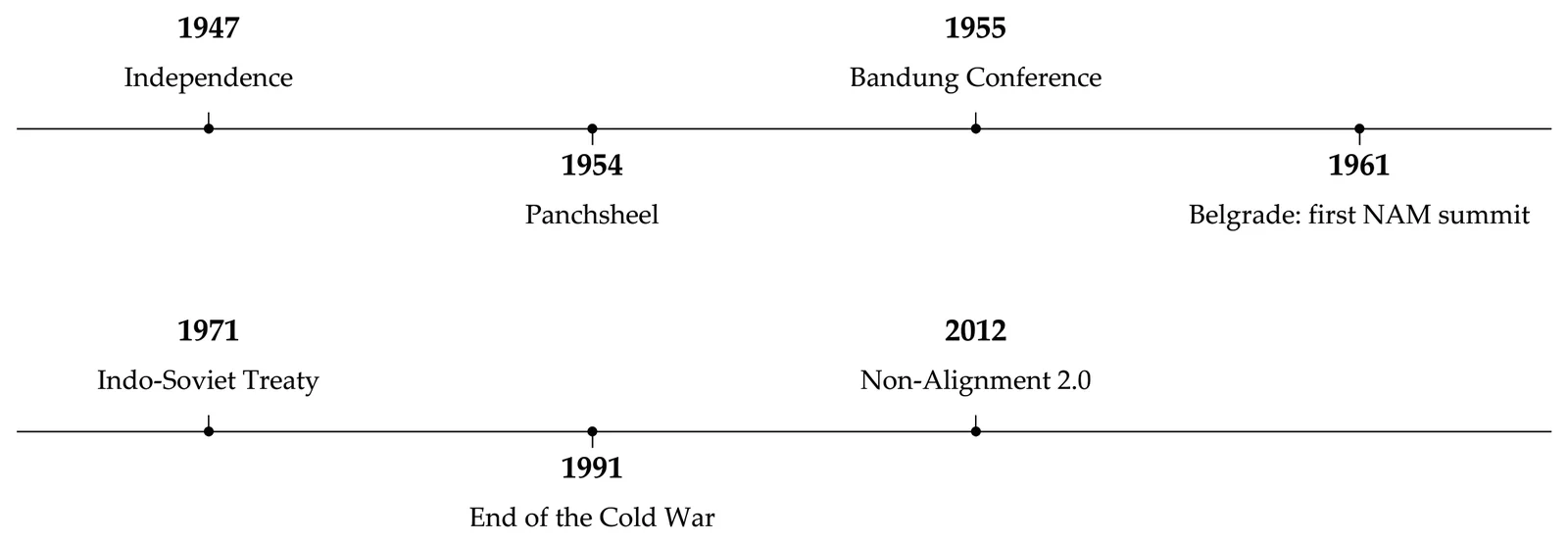
India helped to build the Non-Aligned Movement, together with Yugoslavia’s Tito, Egypt’s Nasser, Indonesia’s Sukarno and Ghana’s Nkrumah; after the Bandung Conference of Asian and African states (1955), its first summit was held at Belgrade in 1961 (Figure 1.3). India mediated in the Korean War, opposed colonialism in Indo-China and Africa, and condemned both the Anglo-French invasion of Suez (1956) and, more mildly, the Soviet intervention in Hungary. Critics pointed out inconsistencies: after the China war of 1962 India sought Western military aid, and the Indo-Soviet Treaty of Peace, Friendship and Co-operation (1971) brought India close to the Soviet Union. Sumit Ganguly and Manjeet Pardesi argue that Nehru’s idealism gradually gave way to greater realism after 1962 and 1971.
C. Beyond non-alignment: relevance after the Cold War
With the end of the Cold War in 1991 there were no longer two blocs to stay away from, and many asked whether non-alignment had become irrelevant. R.S. Yadav describes a paradigm shift from non-alignment to globalisation: India opened its economy, built partnerships with the United States, Israel and East Asia, and pursued economic diplomacy. Yet the core of non-alignment, strategic autonomy, survived. In 2012 a group of scholars and former officials published ‘Non-Alignment 2.0’, arguing that India should maintain its autonomy and maximise its options in a world of shifting power, especially between the United States and China. Vivek Kaura notes the continuing debate: some see non-alignment as outdated, others see multi-alignment, partnerships with many powers without exclusive alliances, as its modern form. India’s ties with both the United States, through the Quad, and Russia, despite the war in Ukraine, illustrate this approach.
1.5 The Evolution of India’s Foreign Policy
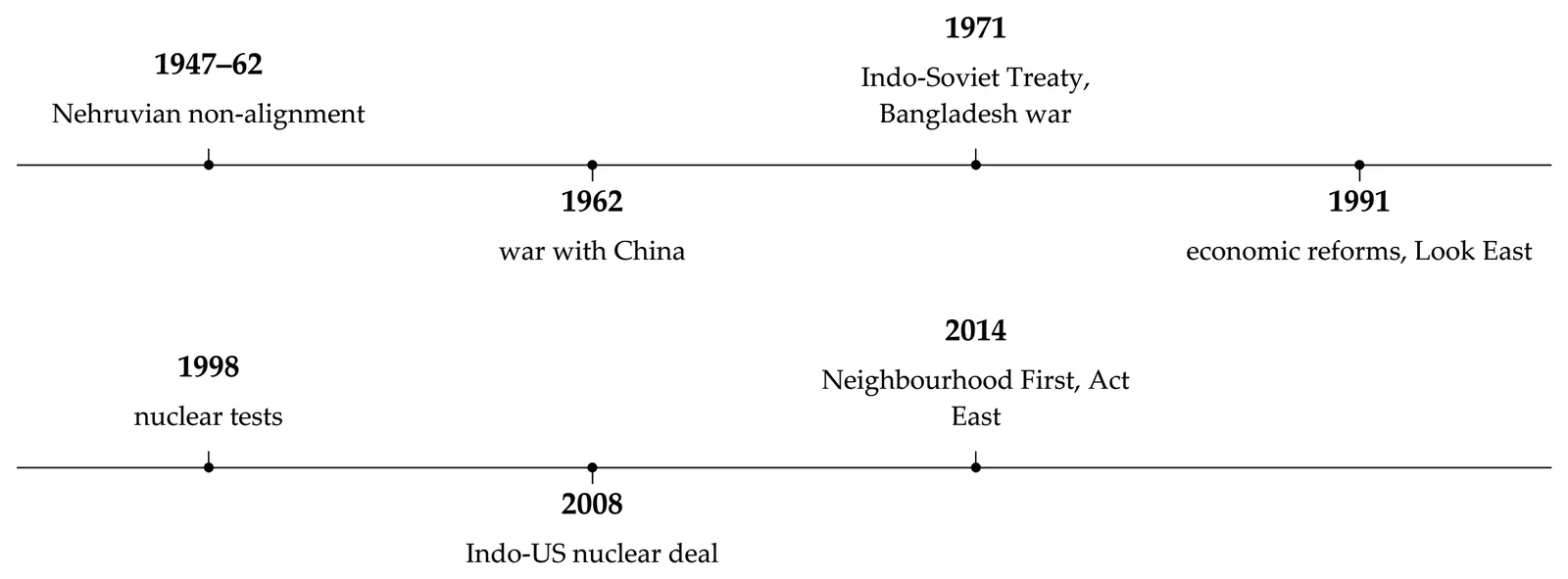
- The Nehru era (1947–64): non-alignment, Panchsheel, Bandung, leadership of the newly independent states, and friendship with China, which ended in the war of 1962.
- Realism under Shastri and Indira Gandhi (1964–84): the war with Pakistan (1965), the liberation of Bangladesh (1971) with Soviet support, the nuclear test at Pokhran (1974) and a more assertive regional role.
- Rajiv Gandhi (1984–89): improving ties with the United States and China (visit of 1988), and the Indian Peace Keeping Force in Sri Lanka (1987–90).
- After the Cold War (1991–2014): economic reforms, the Look East Policy (1992), diplomatic relations with Israel (1992), the Gujral Doctrine (1996) of generosity towards smaller neighbours, nuclear tests (1998), and a strategic partnership with the United States, including the civil nuclear agreement (2008).
- Since 2014: Neighbourhood First, Act East, multi-alignment through groupings such as the Quad, BRICS and the SCO, the G20 presidency (2023) and a stronger voice for the Global South.
1.6 Important Questions
- Question 1 Discuss the determinants of India’s foreign policy.
- Question 2 What is non-alignment? Discuss its relevance in the post-Cold War world.
- Question 3 Trace the evolution of India’s foreign policy since independence.
DU asks the same idea in different words. So learn one broad answer for each question below; the same answer works for every question joined by OR.
Important Question 1
Discuss the determinants of India’s foreign policy.
OR
Examine the domestic and international determinants of India’s foreign policy.
OR
Discuss the objectives and principles of India’s foreign policy.
Model Answer
“We propose, as far as possible, to keep away from the power politics of groups, aligned against one another.”
— Jawaharlal Nehru, broadcast of 7 September 1946
Introduction. A country’s foreign policy is shaped by its own circumstances and by the international environment. India’s foreign policy has been determined by a combination of geography, history, values, economic needs, domestic politics, leadership and the changing world order, as Bandyopadhyaya, Appadorai and Dixit have shown.
1. Geography
India’s central position in South Asia, its long borders with China and Pakistan and its location at the head of the Indian Ocean create security concerns on land and sea and an interest in regional stability and maritime security. Its long coastline also gives it a stake in the Indian Ocean.
2. History and the Colonial Experience
Colonial rule made India committed to anti-colonialism, anti-racism, independence of judgement and self-reliance, and wary of domination by great powers. Partition left a legacy of conflict with Pakistan.
3. Values and Traditions
Dixit traces India’s foreign policy to civilisational values of tolerance and to Gandhi’s non-violence, which shaped Nehru’s emphasis on peace, coexistence and moral leadership. Panchsheel and Gandhian non-violence reflected these values.
4. Economic Needs
The need for development required aid, technology and trade from all sides; since 1991, economic growth, investment and energy security have become key drivers. After 1991 trade and investment became central goals.
5. Domestic Politics
Appadorai shows that India’s democracy, federalism, parties and public opinion shape foreign policy; regional concerns, such as those of Tamil Nadu on Sri Lanka, influence relations with neighbours. Coalition governments and states such as West Bengal and Tamil Nadu have influenced policy towards neighbours.
6. Leadership
Leaders have shaped policy: Nehru’s non-alignment, Indira Gandhi’s realism in 1971, Rao’s Look East and economic diplomacy, Vajpayee’s nuclear tests and Modi’s Neighbourhood First and multi-alignment. Vajpayee’s nuclear tests and Manmohan Singh’s nuclear deal show the role of leaders.
7. Military Strength
Weakness in the early years favoured diplomacy; the defeat of 1962, the victory of 1971 and nuclear capability changed India’s approach to security.
8. Institutions
The Prime Minister’s Office, the Ministry of External Affairs, the National Security Council and Parliament shape foreign policy, with the PMO usually dominant.
9. Public Opinion, Media and Diaspora
Public opinion, the media and the diaspora increasingly influence foreign policy, especially on Pakistan, China and terrorism.
10. Nuclear Status
Nuclear weapons since 1998 have given India greater strategic autonomy and status.
11. The International System
The Cold War, the rise of China, the end of the Cold War, globalisation and multipolarity have set the external conditions within which India pursues its interests.
12. Ideas and Ideology
Nehruvian internationalism, Gandhian ethics, realism and, more recently, civilisational nationalism have each shaped how India sees the world.
13. Objectives and Principles
Dubey identifies the objectives of security, strategic autonomy, development, a peaceful neighbourhood and a fair world order, pursued through non-alignment, Panchsheel, anti-colonialism, support for the UN and peaceful settlement of disputes.
14. Key Drivers Today
Varun Sahni argues that India’s foreign policy is now driven by the needs of economic growth, including energy security, investment and technology; by the search for security in a difficult neighbourhood and against a rising China; and by the aspiration for status as a major power, pursued within the constraints of a democratic and diverse society.
15. Evaluation
India’s foreign policy results from the interaction of permanent factors such as geography and history with changing ones such as leadership, the economy and the global balance of power.
Conclusion. Thus, India’s foreign policy is the product of enduring factors, such as geography and history, and changing ones, such as leadership and the world order, which together explain both its continuity and its change.
Important Question 2
What is non-alignment? Discuss its relevance in the post-Cold War world.
OR
Is non-alignment the same as neutrality? Discuss.
OR
Discuss the shift from non-alignment to strategic autonomy and multi-alignment.
Model Answer
“Where freedom is menaced or justice threatened or where aggression takes place, we cannot and shall not be neutral.”
— Jawaharlal Nehru, address to the US Congress (1949)
Introduction. Non-alignment was the central principle of India’s foreign policy during the Cold War. It meant staying out of military blocs and deciding each issue independently. After the Cold War its relevance has been debated, but its core idea of strategic autonomy continues to guide India.
1. Meaning
Non-alignment meant not joining the American-led or Soviet-led military blocs and judging international issues on their merits, in the light of national interest and values. Nehru developed the idea from the late 1940s to secure independence in foreign policy.
2. Not Neutrality
K.P. Mishra stresses that non-alignment is not neutrality, isolation or fence-sitting. A non-aligned state takes an active part in world affairs and takes positions on issues such as colonialism and disarmament. It allowed India to judge issues on their merits.
3. A Realistic Strategy
A.P. Rana argues that non-alignment served India’s national interest: it preserved freedom of action, allowed India to obtain aid from both blocs, avoided entanglement in conflicts and gave India influence beyond its material power. It also allowed India to receive aid from both blocs.
4. Panchsheel
The five principles of peaceful coexistence agreed with China in 1954, mutual respect for territorial integrity and sovereignty, non-aggression, non-interference, equality and mutual benefit, and peaceful coexistence, expressed the values of non-alignment.
5. The Non-Aligned Movement
After Bandung (1955), India, Yugoslavia, Egypt, Indonesia and Ghana founded the NAM at Belgrade (1961). It opposed colonialism, apartheid and the arms race and called for a fair economic order. The first summit was held at Belgrade in 1961, with Nehru, Tito, Nasser, Sukarno and Nkrumah among its leaders.
6. NAM and the New International Economic Order
In the 1970s the non-aligned countries demanded a New International Economic Order with fairer trade and aid, linking non-alignment with development.
7. Criticism and Inconsistencies
Critics noted India’s request for Western aid after 1962 and the Indo-Soviet Treaty (1971); Ganguly and Pardesi argue that idealism gave way to realism. Others saw NAM as divided and ineffective. Critics saw the Indo-Soviet Treaty of 1971 as a departure from non-alignment.
8. After the Cold War
With the end of the blocs, R.S. Yadav describes a paradigm shift towards globalisation, economic diplomacy and partnerships with the United States, Israel and East Asia.
9. Non-Alignment 2.0 and Strategic Autonomy
The 2012 report ‘Non-Alignment 2.0’ argued that India should preserve strategic autonomy and maximise its options amid US–China rivalry. Kaura notes debates on whether non-alignment remains relevant.
10. Multi-Alignment
Today India practises multi-alignment: partnerships with the United States and Quad, ties with Russia, membership of BRICS and SCO, and leadership of the Global South, without exclusive alliances. Some call this issue-based alignment.
11. Achievements of Non-Alignment
The non-aligned countries supported decolonisation in Asia and Africa, campaigned against apartheid, demanded a New International Economic Order and pressed for nuclear disarmament. India joined the Six-Nation Five-Continent Initiative (1984) and, in 1988, Rajiv Gandhi presented an Action Plan for a nuclear-weapon-free world at the UN. They also opposed apartheid in South Africa.
12. Strategic Autonomy in Practice
India’s strategic autonomy can be seen in its refusal to condemn Russia over Ukraine, its purchase of Russian S-400 systems despite the threat of American sanctions, and its membership of the Quad without a formal alliance. India has also declined to join China’s Belt and Road Initiative.
13. Non-Alignment and the Ukraine War
India’s refusal to join Western sanctions against Russia after 2022 was seen by many as a revival of non-aligned thinking, while India also deepened ties with the West.
14. Evaluation
Non-alignment was a creative strategy for a newly independent state; its core idea, strategic autonomy, remains relevant even though its form has changed to multi-alignment.
Conclusion. Thus, non-alignment as a Cold War policy has changed, but its essence, independence of judgement and strategic autonomy, remains the foundation of India’s foreign policy.
Important Question 3
Trace the evolution of India’s foreign policy since independence.
OR
Discuss the continuity and change in India’s foreign policy.
Model Answer
“Explaining Sixty Years of India’s Foreign Policy.”
— Title of the article by Sumit Ganguly and Manjeet Pardesi (2009)
Introduction. India’s foreign policy has evolved through several phases since 1947, from Nehru’s idealistic non-alignment to the pragmatic, multi-aligned policy of an emerging power, while retaining a commitment to independence of judgement.
1. The Nehru Era
Nehru built a policy of non-alignment, Panchsheel and anti-colonialism, made India a leader of newly independent states, and sought friendship with China, which ended in the 1962 war. India also helped mediate in the Korean War and the Indo-China settlement of 1954.
2. The Turn to Realism
After 1962 India strengthened its defences. Under Indira Gandhi it fought the 1971 war that created Bangladesh, signed the Indo-Soviet Treaty and tested a nuclear device (1974), asserting itself as the leading regional power. India’s role in the liberation of Bangladesh (1971) and the Pokhran test (1974) marked this phase.
3. Indira Gandhi and Regional Primacy
Indira Gandhi treated South Asia as India’s sphere of influence, as shown by the merger of Sikkim (1975) and opposition to outside powers in the region.
4. The Janata Interlude
The Janata government (1977–79), with Vajpayee as foreign minister, pursued ‘genuine non-alignment’ and improved ties with neighbours.
5. The 1980s
Rajiv Gandhi improved ties with the United States and China, but the IPKF intervention in Sri Lanka (1987–90) proved costly. India sent a peacekeeping force to Sri Lanka (1987–90).
6. The Post-Cold War Shift
After 1991 India liberalised its economy, launched the Look East Policy (1992), established relations with Israel and adopted the Gujral Doctrine towards neighbours. The Look East Policy (1991) sought ties with Southeast Asia. India established full diplomatic relations with Israel in 1992.
7. The Gujral Doctrine
In 1996–97 I.K. Gujral promised non-reciprocal generosity to smaller neighbours, which improved relations with Bangladesh and Nepal.
8. Nuclear Tests and the US Partnership
The 1998 tests brought sanctions but led to strategic dialogue with the United States, culminating in the civil nuclear agreement (2008). The civil nuclear deal (2008) ended India’s nuclear isolation.
9. The Kargil War and Diplomacy
During the Kargil war (1999), India’s restraint in not crossing the Line of Control won international support and pressure on Pakistan.
10. Since 2014
Neighbourhood First, Act East, the Quad, BRICS and SCO, the G20 presidency (2023) and the Voice of the Global South summits show a confident, multi-aligned approach. India held the G20 presidency in 2023.
11. From Look East to Act East
The Look East Policy became Act East in 2014, adding security and connectivity to economic ties with Southeast and East Asia.
12. The Gulf and the Diaspora
Ties with the Gulf states, home to millions of Indian workers and suppliers of energy, and outreach to the diaspora became major priorities.
13. Health Diplomacy
During COVID-19 India supplied vaccines to many countries under Vaccine Maitri.
14. Soft Power
Yoga, the International Day of Yoga (from 2015), cinema and the diaspora have been used to project India’s soft power.
15. Continuity
Throughout, India has valued strategic autonomy, opposed exclusive alliances, supported multilateralism and sought a fair world order.
16. Change
India has moved from idealism to pragmatism, from economic self-reliance to globalisation, from a weak to a nuclear and economic power, and from non-alignment to multi-alignment. It has also moved from non-alignment to multi-alignment.
17. Economic Diplomacy
After 1991 economics became central to foreign policy: the Look East Policy (1992) became Act East (2014), India sought investment and technology from Japan, the United States and Europe, and energy diplomacy and the Indian Ocean (SAGAR) gained importance. Trade agreements and investment promotion became tasks of embassies.
18. Nuclear Policy
India tested a nuclear device in 1974 and declared itself a nuclear weapon state after the 1998 tests. It adopted a doctrine of no first use and credible minimum deterrence (2003), refused to sign the NPT and CTBT as discriminatory, and won the civil nuclear agreement with the United States in 2008. Its doctrine (2003) declared no first use and credible minimum deterrence.
19. Evaluation
India’s foreign policy has evolved from Nehruvian idealism to pragmatic realism and multi-alignment, while keeping its core goals of autonomy, security and development; it now seeks a permanent seat on the UN Security Council and reform of global institutions.
Conclusion. Thus, India’s foreign policy shows both continuity and change: its goals of autonomy and development have remained, while its means have adapted to a changing world.
Short Notes
(a) Panchsheel
The five principles of peaceful coexistence set out in the India–China agreement on Tibet (April 1954): mutual respect for territorial integrity and sovereignty, mutual non-aggression, non-interference in internal affairs, equality and mutual benefit, and peaceful coexistence. They became a basis of non-aligned diplomacy, though the 1962 war showed their limits.
(b) The Gujral Doctrine
Set out by I.K. Gujral as Foreign Minister and Prime Minister (1996–97), it held that India, as the largest country in South Asia, should not demand reciprocity from smaller neighbours but give them what it can in good faith, and that disputes should be settled peacefully without interference in each other’s affairs.
More notes: MDSC-2B India's Foreign Policy
These notes are prepared by PADHO TO AISE for study help. They are not an official University of Delhi publication.