
Semester II MDSC-2B India's Foreign Policy
Unit II · 23 min read · Updated 24 Nov 2026
As per the University of Delhi (DU) BA (Hons) Political Science syllabus
Contents
- 2.1 India and USA
- 2.2 India and Russia
- 2.3 India and China
- 2.4 India and EU
- 2.5 Important Questions
- Discuss India–US relations from the Cold War to the post-Cold War era.
- Examine India–Russia relations from the Cold War to the present.
- Discuss India–China relations. Why is it described as an uneasy relationship?
- Examine India’s relations with the European Union.
- Short Notes
हमारे न तो स्थायी मित्र हैं और न स्थायी शत्रु; हमारे हित ही स्थायी और शाश्वत हैं।
We have no eternal allies, and we have no perpetual enemies. Our interests are eternal and perpetual.
— Lord Palmerston, House of Commons, 1 March 1848
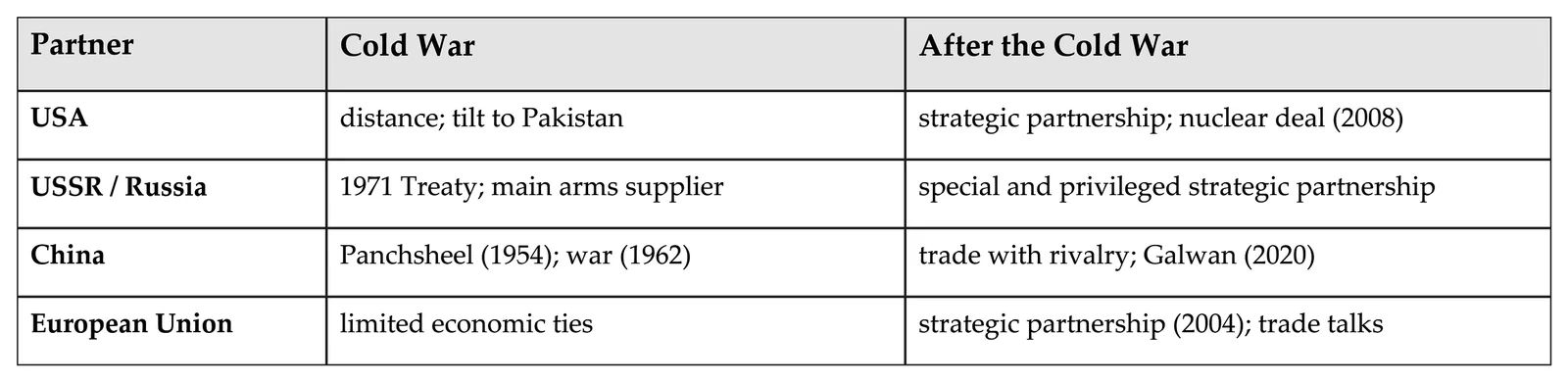
DURING THE COLD WAR, India’s relations with the great powers were shaped by non-alignment and by the rivalry between the United States and the Soviet Union. India drew close to Moscow, kept a wary distance from Washington, fought a war with China and treated Europe mainly as a trading partner. The end of the Cold War in 1991 changed the picture completely. The Soviet Union collapsed, the United States became the sole superpower, China rose rapidly, and India itself liberalised its economy and became a nuclear power. In this chapter we trace how India’s relations with four global powers, the United States, Russia, China and the European Union, changed from the Cold War to the post-Cold War era.
2.1 India and USA
A. The Cold War: estranged democracies
Although both were democracies, India and the United States were often at odds during the Cold War, which Dennis Kux called a relationship of estranged democracies. The United States saw non-alignment as morally suspect and allied with Pakistan through military pacts (1954), arming India’s rival. India received American food aid under PL-480 in the 1950s and 1960s, and the United States helped India during the China war of 1962, but it imposed an arms embargo during the 1965 war. Relations reached their lowest point in 1971, when the Nixon administration ‘tilted’ towards Pakistan and sent the USS Enterprise into the Bay of Bengal during the Bangladesh war. India’s nuclear test of 1974 led to American sanctions and to the creation of the Nuclear Suppliers Group to restrict nuclear trade.
B. After the Cold War: an emerging partnership
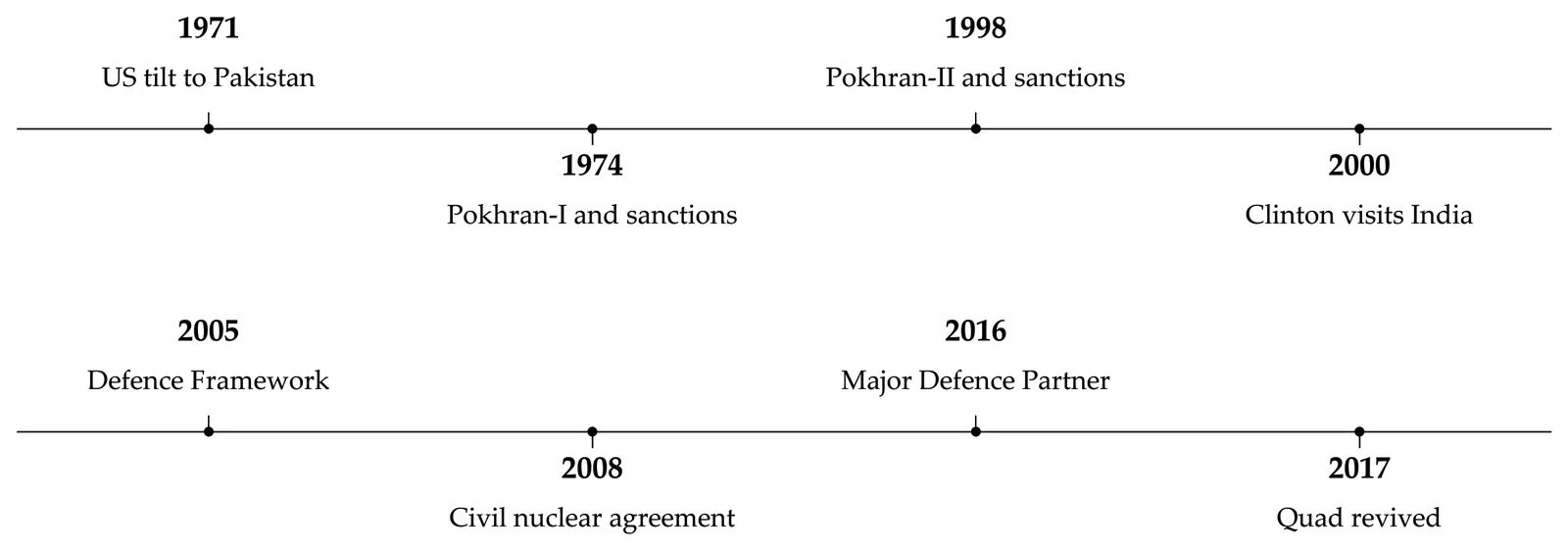
Harsh V. Pant describes how the two countries became partners after 1991 (Figure 2.2). Economic reforms opened India to American investment. The nuclear tests of 1998 brought new sanctions, but the long dialogue between Jaswant Singh and Strobe Talbott that followed built trust, and President Clinton visited India in 2000. Under President Bush, the Next Steps in Strategic Partnership (2004), the Defence Framework Agreement (2005) and the civil nuclear agreement (2008), with a waiver from the Nuclear Suppliers Group, ended India’s nuclear isolation. The United States named India a Major Defence Partner (2016), the two signed foundational defence agreements (LEMOA 2016, COMCASA 2018, BECA 2020), revived the Quad with Japan and Australia (2017), and launched the Initiative on Critical and Emerging Technology (2023). The United States has become one of India’s largest trading partners, and the large Indian-American diaspora strengthens ties.
Muchkund Dubey warns that the relationship is asymmetric and that India must protect its autonomy. Differences remain over trade and tariffs, visas, India’s ties with Russia and Iran, and American criticism of human rights. Devin Hagerty asks whether the entente is a committed relationship or one of ‘friends with benefits’, in which each side co-operates where interests converge, especially in balancing China, without a formal alliance.
2.2 India and Russia
A. The Cold War: a special relationship
Deepa Ollapally traces how the Soviet Union became India’s closest partner during the Cold War. It supported India on Kashmir with vetoes in the UN Security Council, helped build heavy industry, such as the Bhilai steel plant, supplied advanced weapons, such as MiG fighters from 1962, and mediated after the 1965 war through the Tashkent Declaration (1966). Facing an American–Chinese–Pakistani alignment, India signed the Treaty of Peace, Friendship and Co-operation with the Soviet Union in August 1971, which deterred outside intervention in the Bangladesh war. Trade in rupees and roubles helped India save foreign exchange.
B. After the Cold War: convergence over time
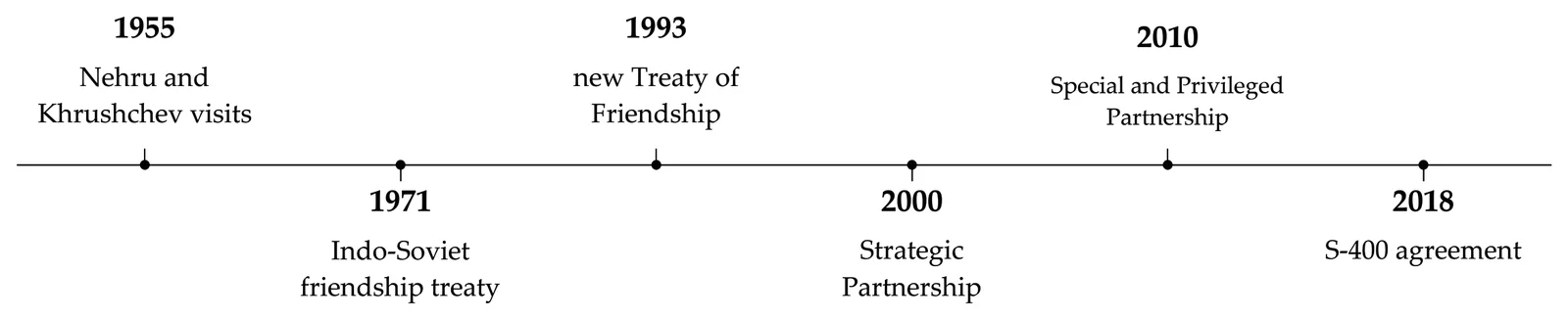
The collapse of the Soviet Union in 1991 created uncertainty, as Russia turned westward and trade fell. But Pant shows how the two countries converged over time. A new Treaty of Friendship and Co-operation was signed in 1993; the Strategic Partnership of 2000 under Vajpayee and Putin instituted annual summits; and in 2010 it was raised to a ‘Special and Privileged Strategic Partnership’. Russia remains a major supplier of defence equipment, including the S-400 air defence system (2018), the aircraft carrier Vikramaditya and the jointly produced BrahMos missile; it built the Kudankulam nuclear power plant; and India has invested in Russian energy. Rajan Menon notes that Russia also supports India’s bid for a permanent UN Security Council seat.
C. The Ukraine war
After Russia invaded Ukraine in 2022, India abstained on UN resolutions condemning Russia, called for dialogue and diplomacy, and sharply increased its purchases of discounted Russian oil, while Prime Minister Modi told President Putin that ‘today’s era is not an era of war’. Shyam Saran examines the implications for India: dependence on Russian arms, Russia’s growing closeness to China, and pressure from Western partners. Sumit Ganguly explains why India has been ‘soft’ on Russia: its dependence on Russian defence supplies, its need for Russian support against China and in the UN, its energy needs and its long history of friendship. Nivedita Kapoor argues that the partnership must adapt to a changing world order.
2.3 India and China
A. From brotherhood to war
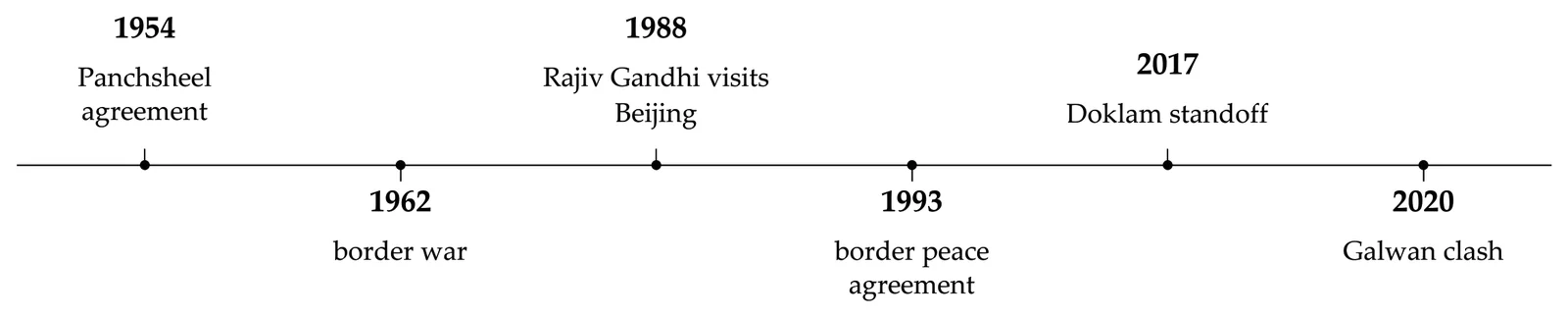
India was among the first non-communist countries to recognise the People’s Republic of China and established diplomatic relations on 1 April 1950. The slogan ‘Hindi-Chini bhai-bhai’ (Indians and Chinese are brothers) and the Panchsheel agreement of 1954 marked a phase of friendship. But China’s control of Tibet, India’s asylum to the Dalai Lama in 1959, and the unresolved boundary dispute, over Aksai Chin in the west, which China occupied, and the McMahon Line in the east, which China rejected, led to the war of 1962, in which India was defeated. Relations remained frozen until ambassadors were restored in 1976.
B. Normalisation and the uneasy relationship
Rajiv Gandhi’s visit in 1988 began normalisation. Agreements in 1993 and 1996 sought to maintain peace and tranquillity along the Line of Actual Control (LAC), and in 2003 the two countries appointed Special Representatives to negotiate the boundary. Trade grew rapidly, and China became one of India’s largest trading partners, but with a huge Indian trade deficit. Harsh Pant calls this an uneasy relationship: co-operation in groupings such as BRICS co-exists with deep rivalry. China’s close partnership with Pakistan, including the China–Pakistan Economic Corridor through Pakistan-occupied Kashmir, its Belt and Road Initiative, which India opposes, its growing presence in the Indian Ocean, and its blocking of India’s entry into the Nuclear Suppliers Group all concern India.
C. Recent tensions
Border standoffs at Depsang (2013), Doklam (2017) and eastern Ladakh culminated in the clash at Galwan on 15 June 2020, in which twenty Indian soldiers were killed, the first deaths on the border in decades. India responded by deploying troops, banning Chinese apps and restricting Chinese investment. After rounds of talks, the two sides reached disengagement agreements, including an agreement on patrolling in October 2024. Shyam Saran argues that the growing asymmetry of power in China’s favour is the key to changing dynamics, and Ashley Tellis calls the relationship the ‘crux of Asia’. Madhu Bhalla shows how the China factor now shapes India’s economic diplomacy, from supply chains to technology.
2.4 India and EU
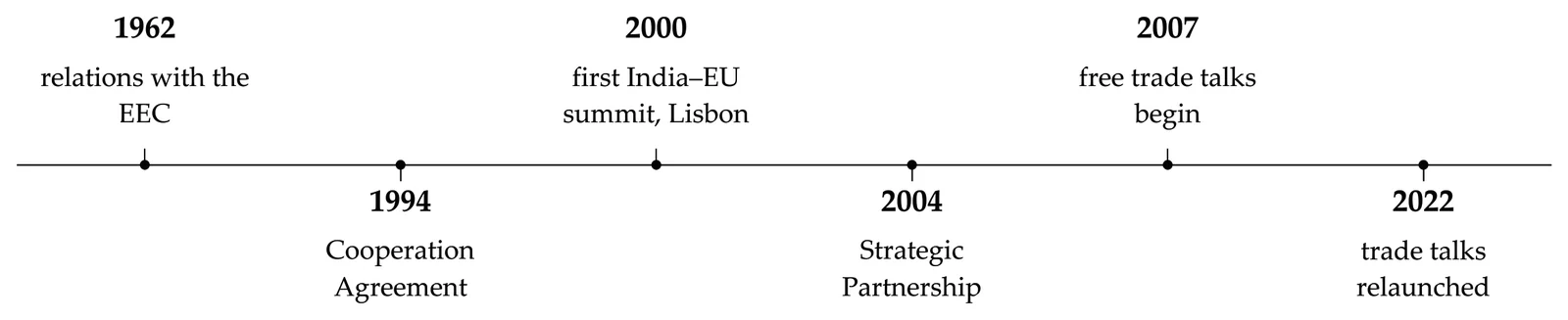
India was among the first countries to establish relations with the European Economic Community, in 1962. A Co-operation Agreement was signed in 1994, the first India–EU summit was held in Lisbon in 2000, and the relationship was raised to a Strategic Partnership in 2004. The EU is one of India’s largest trading partners and a major source of investment and technology. Negotiations for a broad trade and investment agreement began in 2007 but stalled in 2013 over issues such as tariffs on cars and wine, data security and the mobility of professionals; they were relaunched in 2021, together with talks on investment protection and geographical indications, and a Trade and Technology Council was set up in 2023. Harsh Pant describes India–EU ties as a relationship in search of a meaning: despite shared democratic values, the EU has been seen in India mainly as a trading bloc, India has preferred to deal with individual states such as France and Germany, and differences over human rights, climate measures such as the EU’s carbon border tax, and Russia have limited the partnership. Growing concern over China and new projects such as the India–Middle East–Europe Economic Corridor (2023) may give it greater strategic depth.
2.5 Important Questions
- Question 1 Discuss India–US relations from the Cold War to the post-Cold War era.
- Question 2 Examine India–Russia relations from the Cold War to the present.
- Question 3 Discuss India–China relations. Why is it described as an uneasy relationship?
- Question 4 Examine India’s relations with the European Union.
DU asks the same idea in different words. So learn one broad answer for each question below; the same answer works for every question joined by OR.
Important Question 1
Discuss India–US relations from the Cold War to the post-Cold War era.
OR
Examine the emerging strategic partnership between India and the United States.
OR
Discuss the significance of the India–US civil nuclear agreement.
Model Answer
“The relationship between the United States and India … will be one of the defining partnerships of the 21st century.”
— Barack Obama, address to the Indian Parliament (November 2010)
Introduction. India and the United States, the world’s largest and oldest democracies, were estranged for much of the Cold War, but became strategic partners after it ended. The transformation reflects changes in the world order and in India’s own economy and security.
1. Cold War Estrangement
The United States saw non-alignment with suspicion and allied with Pakistan in 1954. India’s closeness to the Soviet Union and its criticism of American policies widened the gap. The US–Pakistan alliance of 1954 deepened mistrust.
2. Moments of Co-operation
American food aid under PL-480 and support during the 1962 war showed that co-operation was possible, but the arms embargo of 1965 disappointed India. The United States also helped India during the 1962 war with China. PL-480 wheat shipments helped India through food shortages in the 1960s.
3. The Low Point of 1971
The Nixon administration tilted towards Pakistan and sent the USS Enterprise to the Bay of Bengal; India’s 1974 nuclear test brought sanctions and the creation of the Nuclear Suppliers Group. It sent the aircraft carrier USS Enterprise into the Bay of Bengal.
4. Post-Cold War Opening
After 1991 economic reforms attracted American investment, and the end of the Cold War removed the main source of disagreement. President Clinton’s visit in 2000 marked a new beginning. The Next Steps in Strategic Partnership (2004) expanded cooperation.
5. From Sanctions to Partnership
The 1998 nuclear tests brought sanctions, but the Singh–Talbott dialogue built trust; Clinton’s visit (2000) opened a new phase, followed by the NSSP (2004) and the Defence Framework (2005).
6. The Nuclear Agreement
The civil nuclear agreement (2008) and the NSG waiver ended India’s nuclear isolation, recognised it as a responsible nuclear power and opened civil nuclear trade. It was negotiated by Prime Minister Manmohan Singh and President George W. Bush. The Nuclear Suppliers Group waiver (2008) allowed India to trade in nuclear technology.
7. Defence and the Indo-Pacific
India became a Major Defence Partner (2016), signed LEMOA, COMCASA and BECA, and joined the revived Quad (2017), reflecting shared concern about China. The agreements LEMOA (2016), COMCASA (2018) and BECA (2020) enabled closer military cooperation. Exercises such as Malabar bring together the Quad navies.
8. The Quad
The Quad of India, the United States, Japan and Australia, revived in 2017 and raised to leaders’ level in 2021, coordinates on Indo-Pacific security, vaccines, technology and infrastructure.
9. Natural Allies
Vajpayee described India and the United States as natural allies, the world’s largest and oldest democracies, and the rise of China has been the main driver of closer ties.
10. The Diaspora
The Indian-American community of over four million, prominent in technology and politics, is an important bridge.
11. Differences
Trade disputes, visas, India’s ties with Russia and Iran, and human rights criticism remain. Dubey warns of asymmetry; Hagerty describes an entente of ‘friends with benefits’ rather than an alliance. The US sanctions law CAATSA and India’s purchase of Russian S-400s created tension.
12. Trade Frictions
Disputes over tariffs and market access, and the withdrawal of India’s preferential trade status in 2019, show the limits of the partnership.
13. Trade, Technology and People
The United States has become one of India’s largest trading partners. Co-operation in technology has grown through the Initiative on Critical and Emerging Technology (2023), including semiconductors and an agreement to produce jet engines in India. More than four million people of Indian origin live in the United States, and Indian students form one of the largest groups of foreign students there, strengthening ties. The Initiative on Critical and Emerging Technology (2023) promotes cooperation in advanced technologies.
14. Visas and Migration
H-1B visas and immigration rules affect Indian professionals and remain a recurring issue.
15. Evaluation
India–US relations have moved from estrangement to a comprehensive global strategic partnership driven by shared interests and values, though differences over trade, Russia and autonomy remain.
Conclusion. Thus, India–US relations have moved from estrangement to strategic partnership, based on converging interests, while India preserves its strategic autonomy.
Important Question 2
Examine India–Russia relations from the Cold War to the present.
OR
Why has India been ‘soft’ on Russia over the Ukraine war? Discuss.
OR
Discuss the significance of the Indo-Soviet Treaty of 1971.
Model Answer
“Today’s era is not an era of war.”
— Narendra Modi to Vladimir Putin, Samarkand (September 2022)
Introduction. Russia, and earlier the Soviet Union, has been one of India’s most reliable partners since the 1950s. The relationship survived the end of the Cold War and has been tested by Russia’s war in Ukraine and its closeness to China.
1. Soviet Support
The Soviet Union vetoed Security Council resolutions on Kashmir, supported India’s industrialisation, as at Bhilai, and supplied advanced weapons such as MiG fighters. It also supported India on Kashmir and Goa.
2. Tashkent and the 1971 Treaty
Soviet mediation produced the Tashkent Declaration (1966). The Treaty of Peace, Friendship and Co-operation (1971) deterred intervention by the United States and China during the Bangladesh war. The Treaty of Peace, Friendship and Co-operation (1971) deterred outside intervention during the Bangladesh war.
3. Post-Soviet Uncertainty
After 1991 Russia turned westward and trade declined, but the 1993 treaty restored the framework of friendship. Yeltsin’s Russia looked to the West in the early 1990s.
4. Strategic Partnership
The Strategic Partnership (2000) instituted annual summits, and in 2010 it became a Special and Privileged Strategic Partnership. It was raised to a ‘Special and Privileged Strategic Partnership’ in 2010. President Putin’s visit in 2000 launched it.
5. Annual Summits
Annual summits since 2000 keep contact at the highest level regular.
6. Defence and Energy
Russia supplies S-400 systems, the Vikramaditya and BrahMos co-production; it built Kudankulam; and India invests in Russian oil and gas. Russia is also building the Kudankulam nuclear power plant.
7. Defence Dependence
A large share of India’s military equipment is of Soviet or Russian origin, so India depends on Russia for spares and upgrades, though it is diversifying towards the United States, France and Israel.
8. Multilateral Cooperation
India and Russia cooperate in BRICS, the SCO and the Russia–India–China format, supporting a multipolar order.
9. The Ukraine War
India abstained on UN resolutions, called for dialogue and bought discounted Russian oil, while stating that this is not an era of war. India sharply increased its purchases of discounted Russian oil.
10. Why India Has Been Soft
Ganguly explains India’s position by its dependence on Russian arms, its need for Russian support against China and in the UN, its energy needs and historical trust. Saran notes the risks of Russia’s closeness to China and Western pressure. India also needs Russia to balance China and to preserve strategic autonomy.
11. Connectivity
The International North–South Transport Corridor through Iran and the Chennai–Vladivostok maritime corridor aim to increase trade.
12. Space Cooperation
The Soviet Union flew India’s first astronaut, Rakesh Sharma, in 1984, and Russia supports India’s human spaceflight programme.
13. Future
The partnership must adapt as Russia depends more on China and India grows closer to the West, but both value it as a means of preserving multipolarity and autonomy. Both value a multipolar world.
14. The Russia–China Factor
Russia’s ‘no limits’ partnership with China, announced in February 2022, worries India, since China is India’s main rival. India therefore keeps close ties with Russia partly to prevent it from becoming wholly dependent on China, while diversifying its arms purchases towards France, the United States and Israel and promoting domestic production. This raises concern that Russia may not support India in a conflict with China.
15. Trade Imbalance
Trade grew sharply after 2022 to over sixty billion dollars, mainly because of Indian oil imports, but it is heavily in Russia’s favour, and payment problems have arisen because of Western sanctions. India has sought to settle trade in national currencies to avoid sanctions.
16. Evaluation
India–Russia relations rest on a long history of trust and defence cooperation; they are strained by Russia’s ties with China and by Western sanctions, but both sides value the partnership in a multipolar world.
Conclusion. Thus, India–Russia relations combine historical trust with pragmatic interests, and remain an important part of India’s multi-aligned foreign policy.
Important Question 3
Discuss India–China relations. Why is it described as an uneasy relationship?
OR
Examine the boundary dispute between India and China.
OR
Discuss the changing dynamics of India–China relations.
Model Answer
“Hindi-Chini bhai-bhai.”
— Popular slogan of India–China friendship in the 1950s
Introduction. India and China, the two most populous countries and ancient civilisations, share a long border and a complex relationship. Harsh Pant describes it as uneasy: co-operation exists alongside deep rivalry over borders, Pakistan and influence in Asia.
1. Early Friendship
India recognised the People’s Republic in 1950; the Panchsheel agreement (1954) and the slogan ‘Hindi-Chini bhai-bhai’ marked a period of friendship. The slogan ‘Hindi-Chini bhai-bhai’ captured the mood. The 1954 agreement on Tibet set out the five principles of Panchsheel.
2. Tibet and the Border
China’s control of Tibet, the Dalai Lama’s asylum in India (1959), and disputes over Aksai Chin and the McMahon Line led to the 1962 war, which India lost. The 1962 war ended in a heavy defeat for India. The Dalai Lama fled to India in 1959.
3. Border Agreements
Agreements of 1993, 1996, 2005 and 2013 sought peace on the LAC through confidence-building measures, but they did not settle the boundary.
4. Normalisation
Ambassadors were restored in 1976; Rajiv Gandhi’s visit (1988) and the 1993 and 1996 agreements maintained peace on the Line of Actual Control; Special Representatives began boundary talks in 2003. Rajiv Gandhi’s 1988 visit set up a joint working group on the boundary. Trade and pilgrimages such as the Kailash Mansarovar Yatra resumed.
5. Economic Ties
Trade expanded rapidly, but with a large deficit for India. Bhalla shows how the China factor now shapes India’s economic diplomacy, supply chains and technology policy. China is among India’s largest trading partners. India depends on China for electronics, pharmaceutical ingredients and solar components.
6. China and Pakistan
China’s partnership with Pakistan, including CPEC through Pakistan-occupied Kashmir, its blocking of India’s NSG membership and its presence in the Indian Ocean concern India. China has at times blocked the UN listing of Pakistan-based terrorists.
7. Border Crises
Standoffs at Depsang (2013) and Doklam (2017) and the Galwan clash (2020), in which twenty Indian soldiers died, damaged trust; India restricted Chinese apps and investment. Disengagement agreements followed, including one in October 2024. The Galwan clash of 2020 killed twenty Indian soldiers. Both sides have since built up troops and infrastructure along the LAC.
8. After Galwan
After Galwan, India banned many Chinese apps, tightened rules on Chinese investment and promoted domestic manufacturing to reduce dependence.
9. Competition in South Asia
China’s Belt and Road Initiative, ports and loans in Sri Lanka, Nepal, Bangladesh and the Maldives compete with India’s influence.
10. Changing Dynamics
Saran argues that China’s growing power advantage shapes the relationship; Tellis calls it the crux of Asia. India balances China through partnerships such as the Quad while engaging it in BRICS and the SCO. China’s economy is several times larger than India’s.
11. Disengagement and Talks
Military and diplomatic talks after 2020 led to disengagement at several friction points, and in October 2024 the two sides agreed on patrolling arrangements.
12. Strategic Narratives
Some Indian analysts see China building a ‘string of pearls’ of ports around India, while China sees India’s ties with the Quad as containment.
13. Prospects
Managing the border, reducing economic dependence and maintaining dialogue are the main challenges; peace requires a boundary settlement and mutual respect for core interests. Resuming direct flights and easing visas have been discussed as steps to rebuild trust.
14. Rivers and the Brahmaputra
China’s dams on the Yarlung Tsangpo, the upper Brahmaputra, including a very large project approved in 2024, raise Indian concerns about water flows and floods, and India seeks better sharing of hydrological data. India has no water-sharing treaty with China.
15. Rivalry and Co-operation in Multilateral Forums
The two countries co-operate in BRICS and the SCO, on climate in the BASIC group, and in the Asian Infrastructure Investment Bank, of which India is a founding member and a major borrower. But China has blocked India’s bid for the NSG and opposes its permanent membership of the Security Council. China opposes India’s membership of the Nuclear Suppliers Group and a permanent Security Council seat.
16. Evaluation
India–China relations combine cooperation and competition; an unsettled border, China’s ties with Pakistan and a growing power gap make the relationship uneasy, and managing it requires both deterrence and dialogue.
Conclusion. Thus, India–China relations combine engagement and rivalry; their management will shape the future of Asia.
Important Question 4
Examine India’s relations with the European Union.
OR
India–EU relations: ‘a relationship in search of a meaning’. Discuss.
Model Answer
“India and the European Union: A Relationship in Search of a Meaning.”
— Title of Harsh V. Pant’s chapter (2016)
Introduction. The European Union and India are the world’s two largest democratic groupings and important economic partners. Yet, as Harsh Pant argues, their relationship has long underperformed its potential.
1. Early Ties
India established relations with the European Economic Community in 1962, among the first countries to do so; the relationship was mainly economic. India was among the first countries to establish relations with the European Economic Community, in 1962.
2. The EU as an Actor
The EU is a unique union of twenty-seven states with common trade and regulatory policies and some common foreign policy, so India must deal both with Brussels and with member states.
3. Institutional Growth
The Co-operation Agreement (1994), the first summit (2000) and the Strategic Partnership (2004) widened co-operation to politics, security, science and climate. A Strategic Partnership was launched in 2004.
4. Economic Relations
The EU is one of India’s largest trading partners and sources of investment and technology. It is also a major source of investment and technology.
5. Trade and Investment
Trade in goods between India and the EU exceeds a hundred billion euros a year, and the EU is a leading investor in India.
6. Trade Negotiations
Talks on a trade and investment agreement began in 2007 but stalled in 2013 over tariffs, data security and professional mobility; they were relaunched in 2021, and a Trade and Technology Council was set up in 2023. Talks stalled in 2013 and were relaunched in 2022. The relaunched talks cover a free trade agreement, an investment protection agreement and an agreement on geographical indications.
7. Values and Sovereignty
The European Parliament has passed resolutions on human rights in India, which India regards as interference, showing different approaches to sovereignty.
8. Why ‘In Search of a Meaning’
India has seen the EU mainly as a trading bloc and preferred dealing with France, Germany and others individually; the EU’s complex decision-making and normative approach on human rights have created friction. The EU sometimes raised human rights issues that India saw as interference.
9. Normative Power Europe
The EU sees itself as a ‘normative power’ promoting democracy, human rights and climate action, while India stresses sovereignty and development, which shapes their different priorities.
10. Points of Friction
The EU’s carbon border adjustment mechanism, differences over Russia and Ukraine, and data and labour issues remain contentious. Data protection and intellectual property also divide them.
11. Brexit
Brexit (2020) removed the United Kingdom, a close partner of India, from the EU, which pushed India to build stronger ties with other members.
12. New Opportunities
Shared concern about China, supply-chain diversification, climate and technology co-operation, and the India–Middle East–Europe Economic Corridor (2023) offer new strategic depth. The India–EU Trade and Technology Council (2023) is a new forum.
13. Indo-Pacific and Connectivity
The EU’s Indo-Pacific strategy (2021) and the India–Middle East–Europe Economic Corridor (2023) open new areas of cooperation.
14. Security and People
Maritime security, counter-terrorism and cyber security are growing areas, and Indian students and professionals in Europe strengthen links.
15. The Ukraine War
Differences over the Ukraine war and India’s ties with Russia tested the relationship, though both sides kept engagement going.
16. Evaluation
The relationship has great potential but needs a clear strategic vision and a completed trade agreement to fulfil it. A trade agreement would be a major step.
17. Partnerships with France and Germany
India has strong bilateral ties with EU members. France has been a strategic partner since 1998, supplying Rafale aircraft (2016) and Scorpène submarines and supporting India on nuclear issues and in the Indian Ocean. Germany holds regular intergovernmental consultations with India, focusing on trade, technology and green energy. France supplied Rafale aircraft, and Germany is India’s largest European trading partner.
18. Climate and Technology
The India–EU Clean Energy and Climate Partnership (2016) and co-operation on digital technology and connectivity show the potential for a partnership beyond trade. Cooperation also covers green hydrogen and offshore wind.
Conclusion. Thus, India–EU relations are growing from an economic partnership towards a strategic one, but are still searching for their full meaning.
Short Notes
(a) The 123 Agreement (2008)
The India–US civil nuclear co-operation agreement, named after Section 123 of the US Atomic Energy Act. Together with a waiver from the Nuclear Suppliers Group (September 2008), it allowed India to engage in civil nuclear trade despite not signing the NPT, in return for separating its civil and military nuclear facilities and placing civil ones under IAEA safeguards.
(b) The Galwan clash (2020)
A violent clash between Indian and Chinese troops in the Galwan valley of eastern Ladakh on 15 June 2020, in which twenty Indian soldiers were killed, along with an unknown number of Chinese soldiers. It was the deadliest border incident since 1967 and led to a prolonged military standoff and Indian economic measures against China.
More notes: MDSC-2B India's Foreign Policy
These notes are prepared by PADHO TO AISE for study help. They are not an official University of Delhi publication.