
Semester I MDSC-1B Public Administration in India
Unit I · 20 min read · Updated 24 Nov 2026
As per the University of Delhi (DU) BA (Hons) Political Science syllabus
Contents
- 1.1 Evolution of the Civil Services: The Colonial Legacy
- The Colonial Legacy
- 1.2 Civil Services in the Constitutional Framework
- 1.3 Recruitment, Training and Promotion
- 1.4 The Prime Minister’s Office and the Cabinet Secretariat
- 1.5 Major Initiatives in Administrative Reforms
- 1.6 Important Questions
- Trace the evolution of the civil services in India. Discuss its colonial legacy.
- Compare the roles of the Prime Minister’s Office and the Cabinet Secretariat.
- Discuss the major initiatives in administrative reforms in India.
- Short Notes
यदि आपके पास एक अच्छी अखिल भारतीय सेवा नहीं होगी, तो आपके पास एकजुट भारत नहीं होगा।
You will not have a united India if you do not have a good All-India Service.
— Sardar Vallabhbhai Patel, Constituent Assembly, 10 October 1949
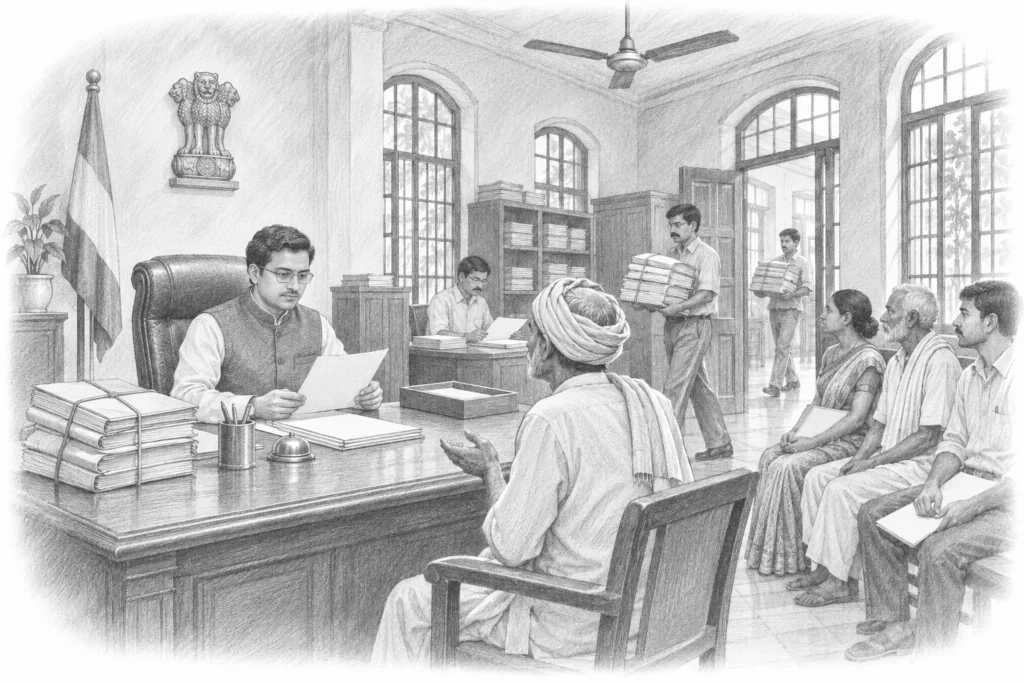
WHEN A CITIZEN applies for a certificate, a farmer receives a subsidy or a flood-hit village gets relief, the work is done by the administration, i.e. the permanent machinery of government that carries out laws and policies. At the heart of Indian administration are the civil services, which Sardar Patel defended as the guarantee of a united India. In this chapter we study how the civil services evolved from their colonial origins, their place in the Constitution, how civil servants are recruited, trained and promoted, the two most important offices at the top of the government, the Prime Minister’s Office and the Cabinet Secretariat, and the major initiatives taken to reform Indian administration.
1.1 Evolution of the Civil Services: The Colonial Legacy
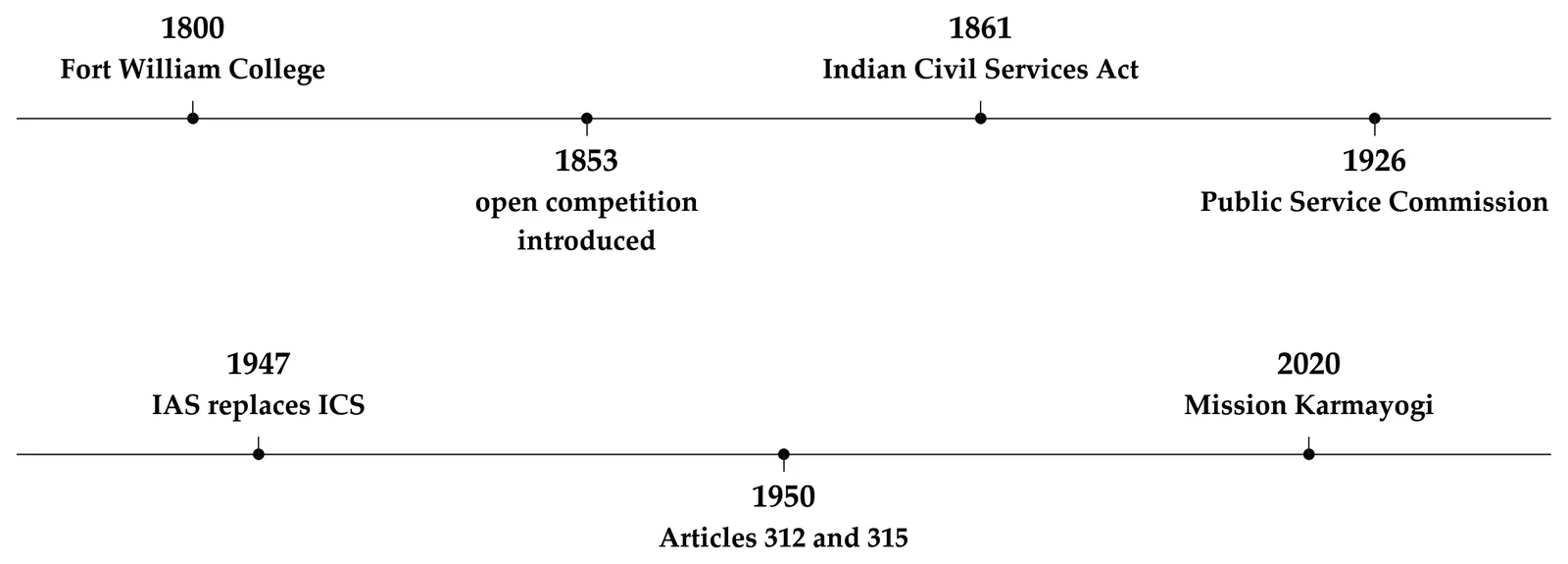
The modern civil service in India was created by the East India Company to collect revenue and administer its territories. Its evolution can be traced through several stages (Figure 1.2):
- Covenanted service. Lord Cornwallis (1786–93) reorganised the Company’s servants into a well-paid, professional service, banned private trade and separated revenue from judicial work.
- Training. Lord Wellesley set up the Fort William College in Calcutta (1800) to train young civil servants; Haileybury College in England took over in 1806.
- Open competition. The Charter Act of 1853 ended patronage and introduced recruitment by open competitive examination, on the recommendation of Macaulay’s committee (1854).
- Indian Civil Service (ICS). After 1858 the service was called the ICS; the Indian Civil Services Act (1861) reserved important posts for it. Because the examination was held only in London and the age limit was low, very few Indians could enter; Satyendranath Tagore was the first (1863).
- Indianisation. Nationalist demands, the Aitchison Commission (1886) and the Islington Commission (1912–15) slowly increased Indian entry; simultaneous examinations in India began in 1922.
- Public Service Commission. The Lee Commission (1924) recommended a Public Service Commission, set up in 1926; the Government of India Act 1935 created a Federal Public Service Commission and provincial commissions.
- Independence. In 1947 the ICS was replaced by the Indian Administrative Service (IAS) and the Indian Police by the Indian Police Service (IPS).
The Colonial Legacy
The colonial civil service left a mixed legacy. On the positive side, it created a merit-based, professional, all-India administration and a tradition of district administration under the collector. The British Prime Minister Lloyd George called the ICS the ‘steel frame’ of British rule in 1922. On the negative side, the service was designed for control and revenue collection, not development; it was hierarchical, secretive and distant from the people; and its officers saw themselves as rulers rather than servants. Independent India debated whether to abolish it. Sardar Patel argued in the Constituent Assembly that an all-India service was necessary for national unity, and the service was retained, but with a new purpose of development and welfare.
1.2 Civil Services in the Constitutional Framework
Part XIV of the Constitution, ‘Services under the Union and the States’ (Articles 308–323), provides the framework for the civil services:
- Article 309: Parliament and state legislatures may regulate recruitment and conditions of service.
- Article 310: civil servants hold office during the pleasure of the President or the Governor.
- Article 311: protects civil servants against arbitrary dismissal: no one can be dismissed by an authority subordinate to the one that appointed him, or without an inquiry and a reasonable opportunity of being heard.
- Article 312: Parliament may create All India Services if the Rajya Sabha passes a resolution by a two-thirds majority; the Indian Forest Service was created in this way in 1966.
- Articles 315–323: establish the Union Public Service Commission (UPSC) and State Public Service Commissions, independent bodies that conduct examinations and advise on recruitment, promotion and discipline.
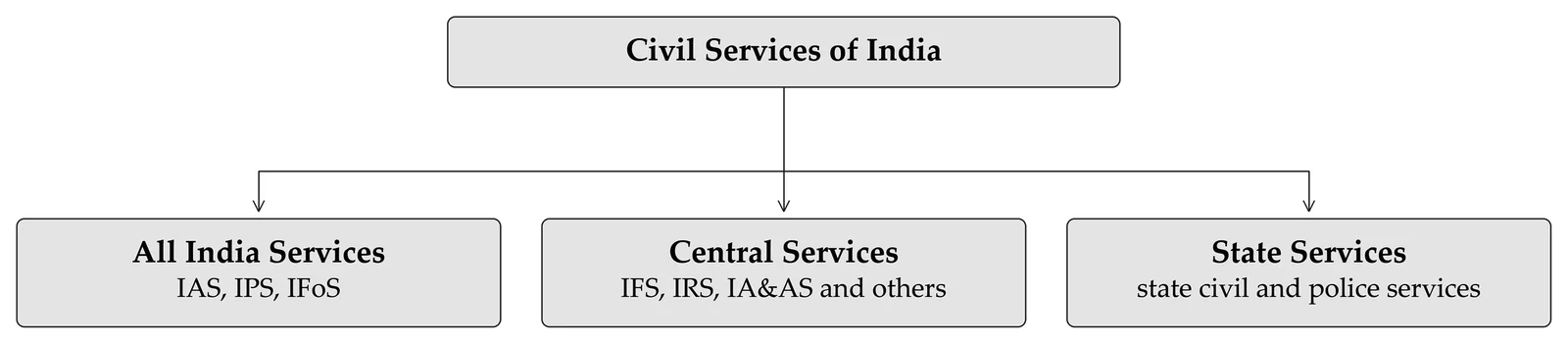
The civil services of India fall into three groups (Figure 1.3): the All India Services (IAS, IPS and IFoS), whose officers are recruited by the Centre but serve in state cadres, a unique feature of Indian federalism; the Central Services, such as the Indian Foreign Service, the Indian Revenue Service and the Indian Audit and Accounts Service; and the State Services, recruited by the states.
1.3 Recruitment, Training and Promotion
A. Appointment (recruitment)
The UPSC conducts the Civil Services Examination in three stages: a preliminary examination, a written main examination and a personality test (interview). Successful candidates are allotted to services and, for All India Services, to state cadres. Recruitment is based on merit, with reservation for SCs, STs, OBCs, EWS and persons with disabilities. Some officers also enter the IAS by promotion from state services. Since 2018 the government has also appointed specialists through lateral entry at the level of joint secretary.
B. Training
Training is designed to turn graduates into public servants. IAS officers train at the Lal Bahadur Shastri National Academy of Administration (LBSNAA), Mussoorie, beginning with a common foundation course for many services, followed by professional training, district training in a state and a final phase. IPS officers train at the Sardar Vallabhbhai Patel National Police Academy, Hyderabad. Mid-career training programmes update officers’ skills, and Mission Karmayogi (2020), the National Programme for Civil Services Capacity Building, aims at continuous, competency-based learning through the iGOT online platform.
C. Promotion
Promotion is based on seniority and merit, assessed through the Annual Performance Appraisal Report (APAR) and decided by Departmental Promotion Committees. An IAS officer typically moves from sub-divisional officer to district collector, and later to positions such as secretary in the state government or joint secretary, additional secretary and secretary at the Centre. Critics argue that promotions depend too much on seniority, that performance appraisal is weak, and that frequent transfers disturb continuity.
1.4 The Prime Minister’s Office and the Cabinet Secretariat
A. The Prime Minister’s Office (PMO)
The PMO began in 1947 as the Prime Minister’s Secretariat and was renamed the Prime Minister’s Office in 1977. It is headed by the Principal Secretary to the Prime Minister. It is not a constitutional body; it is a department of the government that serves the Prime Minister. Its functions are to assist the Prime Minister in his role as head of government, to coordinate with ministries, to handle matters that the Prime Minister deals with directly, to deal with public grievances and to manage his relations with Parliament, the media and foreign governments. Under strong Prime Ministers, such as Indira Gandhi, when P.N. Haksar was the Principal Secretary, the PMO became very powerful, and critics argued that it was taking over the role of the cabinet and ministries.
B. The Cabinet Secretariat
The Cabinet Secretariat works under the direct charge of the Prime Minister and is headed by the Cabinet Secretary, the senior-most civil servant in the country; the post was created in 1950. It works under the Government of India (Allocation of Business) Rules, 1961 and the Transaction of Business Rules, 1961. Its functions are to provide secretarial assistance to the cabinet and its committees, to prepare agendas and record decisions, to coordinate among ministries and resolve inter-ministerial disputes, to monitor the implementation of cabinet decisions, and to manage crises. The Cabinet Secretary also chairs the Committee of Secretaries and is regarded as the head of the civil services.
| Basis | Prime Minister’s Office | Cabinet Secretariat |
|---|---|---|
| Origin | 1947 (as PM’s Secretariat); PMO from 1977 | Evolved from the Executive Council secretariat; Cabinet Secretary from 1950 |
| Head | Principal Secretary to the PM | Cabinet Secretary |
| Serves | The Prime Minister personally | The cabinet and its committees as a whole |
| Main role | Advice, coordination and follow-up for the PM | Coordination of all ministries, cabinet decisions, crisis management |
| Legal basis | Not specified in the Constitution or rules as a separate body | Allocation and Transaction of Business Rules, 1961 |
1.5 Major Initiatives in Administrative Reforms
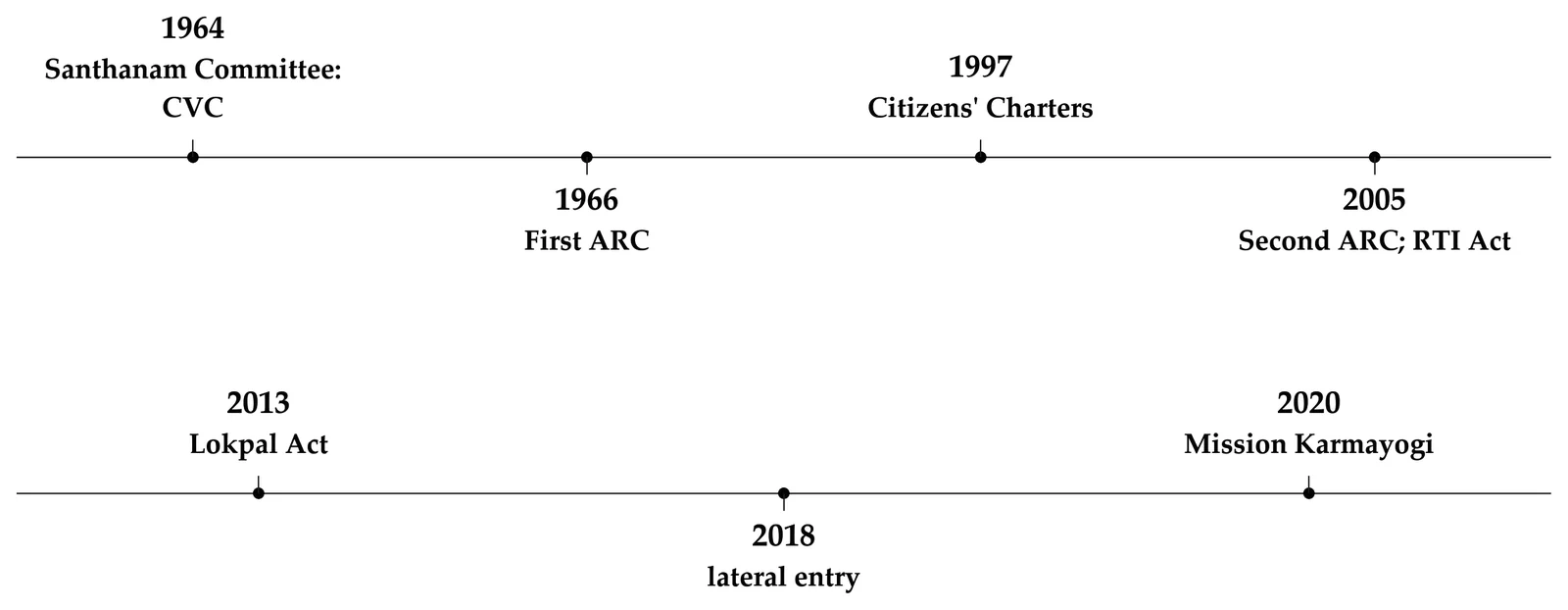
Since independence, India has made repeated efforts to reform its administration (Figure 1.5):
- Santhanam Committee (1962–64) on corruption led to the creation of the Central Vigilance Commission (1964), given statutory status in 2003.
- First Administrative Reforms Commission (1966–70), chaired first by Morarji Desai and then by K. Hanumanthaiya, submitted twenty reports; it recommended Lokpal and Lokayuktas, performance budgeting and better personnel management.
- Citizens’ Charters (1997) were introduced after a conference of Chief Ministers to state the standards of service that citizens can expect.
- Right to Information Act (2005) made administration transparent.
- Second Administrative Reforms Commission (2005–09), chaired by Veerappa Moily, submitted fifteen reports on subjects such as ethics in governance, citizen-centric administration, e-governance and local governance.
- Lokpal and Lokayuktas Act (2013) created an anti-corruption ombudsman; the first Lokpal was appointed in 2019.
- Recent reforms: lateral entry (2018), Mission Karmayogi (2020), e-office, direct benefit transfer and the replacement of the Planning Commission by NITI Aayog (2015).
1.6 Important Questions
- Question 1 Trace the evolution of the civil services in India. Discuss its colonial legacy.
- Question 2 Compare the roles of the Prime Minister’s Office and the Cabinet Secretariat.
- Question 3 Discuss the major initiatives in administrative reforms in India.
DU asks the same idea in different words. So learn one broad answer for each question below; the same answer works for every question joined by OR.
Important Question 1
Trace the evolution of the civil services in India. Discuss its colonial legacy.
OR
Discuss the structure of the civil services in India.
OR
Examine the civil services in the constitutional framework of India.
Model Answer
“The steel frame of the whole structure.”
— David Lloyd George on the Indian Civil Service (1922)
Introduction. The civil services are the permanent, professional machinery of government that implements laws and policies. In India they were created by the East India Company and shaped by colonial rule, and after independence they were adapted to the needs of a democratic, developmental state.
1. Origins under the Company
Cornwallis reorganised the Company’s servants into a professional, well-paid covenanted service and is called the father of the civil service in India. Wellesley founded Fort William College (1800) for training. Fort William College (1800) was set up to train young civil servants in Indian languages and laws.
2. Merit and the ICS
The Charter Act of 1853 introduced open competition; after 1858 the Indian Civil Service became the ‘steel frame’ of British rule. Examinations in London kept Indians out; Satyendranath Tagore (1863) was the first Indian member. Macaulay’s report (1854) recommended recruitment through an open competitive examination held in London. The maximum age and the London venue made it hard for Indians to compete.
3. Indianisation and the Public Service Commission
Nationalist pressure and commissions such as Aitchison (1886), Islington (1912–15) and Lee (1924) gradually increased Indian entry; simultaneous examinations began in 1922, a Public Service Commission was created in 1926, and the 1935 Act set up federal and provincial commissions. Satyendranath Tagore became the first Indian to join the ICS in 1863.
4. The Colonial Legacy
The colonial service left a merit-based, all-India, professional structure and the institution of the district collector. But it was designed for control and revenue, was hierarchical and secretive, and distant from the people, attitudes that critics say still influence Indian bureaucracy. Lloyd George called the ICS the ‘steel frame’ of British rule, a structure built for control rather than development. Its traditions of secrecy and hierarchy also survived independence.
5. The Civil Services after Independence
Sardar Patel defended the All India Services as necessary for unity. The IAS and IPS replaced the ICS and IP, and the Constitution (Articles 308–323) provided their framework: Article 310 (pleasure doctrine), Article 311 (protection against arbitrary dismissal), Article 312 (All India Services) and Articles 315–323 (Public Service Commissions). Patel argued that without an efficient all-India service the Union could not be held together.
6. Constitutional Provisions
Article 312 empowers Parliament to create All India Services, Article 311 protects civil servants against arbitrary dismissal, and Articles 315–323 establish the UPSC and the State Public Service Commissions.
7. Structure
The services are divided into All India Services (IAS, IPS, IFoS), Central Services and State Services; officers of the All India Services are recruited by the Centre but serve the states, which links the two levels of government. Group A central services include the Indian Foreign Service and the Indian Revenue Service.
8. Weber’s Model of Bureaucracy
The civil service follows Max Weber’s model of bureaucracy: hierarchy, written rules, recruitment by merit, specialisation and impersonal administration, which promote efficiency but can produce rigidity and red tape.
9. Bureaucracy and Development
After independence the bureaucracy took on new roles in planning, land reform, community development and welfare, becoming an agent of development rather than only of law and order.
10. A Representative Bureaucracy
Reservations for Scheduled Castes, Scheduled Tribes and backward classes have made the bureaucracy more representative, which strengthens its legitimacy in a diverse society.
11. Training
Officers are trained at the Lal Bahadur Shastri National Academy of Administration in Mussoorie, followed by district training and mid-career programmes.
12. Evaluation
The civil services have provided continuity and national integration, conducted elections and managed crises. But critics point to red tape, corruption, political interference and a gap between officials and citizens, which reforms continue to address. Reformers argue that the services must become more specialised, accountable and citizen-friendly.
13. Recruitment, Training and Promotion Today
Officers are recruited through the UPSC’s three-stage Civil Services Examination, trained at academies such as LBSNAA, Mussoorie, and promoted on the basis of seniority and performance appraisal (APAR). Mission Karmayogi (2020) seeks to make training continuous and competency-based, and lateral entry (2018) has brought outside specialists into senior posts.
Conclusion. Thus, the Indian civil services evolved from an instrument of colonial control into the steel frame of a democratic republic, though they still carry some of the habits of their colonial past.
Important Question 2
Compare the roles of the Prime Minister’s Office and the Cabinet Secretariat.
OR
Discuss the role of the Cabinet Secretariat in Indian administration.
OR
Examine the growing importance of the PMO.
Model Answer
“The President shall make rules for the more convenient transaction of the business of the Government of India, and for the allocation among Ministers of the said business.”
— Article 77(3), Constitution of India
Introduction. The Prime Minister’s Office and the Cabinet Secretariat are the two most important offices at the apex of the Indian government. Both support the Prime Minister, but they serve different functions.
1. The Prime Minister’s Office
Created in 1947 as the Prime Minister’s Secretariat and renamed in 1977, the PMO is headed by the Principal Secretary. It advises the Prime Minister, coordinates with ministries, monitors priority programmes, handles grievances and manages relations with Parliament, the media and foreign governments. It is headed by the Principal Secretary to the Prime Minister and functions as a department under the Allocation of Business Rules.
2. Functions of the PMO
The PMO helps the Prime Minister coordinate policy across ministries, deal with the President, Parliament and the states, handle public grievances, manage communication and oversee ministries placed under the Prime Minister.
3. Growth of the PMO
Under Nehru the secretariat was modest; under Indira Gandhi, with P.N. Haksar as its head, it became a centre of power. Its influence has grown with strong prime ministers and coalition management, leading critics to complain of a ‘super-cabinet’ that bypasses ministers. It remained central under later Prime Ministers and since 2014 has again become the main centre of policy initiative.
4. The Cabinet Secretariat
Headed by the Cabinet Secretary (post created in 1950), it works under the Allocation and Transaction of Business Rules, 1961. It prepares agendas and records decisions of the cabinet and its committees, coordinates ministries, resolves inter-ministerial disputes, monitors implementation and manages crises. It prepares the agenda and minutes of cabinet meetings and monitors the implementation of cabinet decisions.
5. Functions of the Cabinet Secretariat
The Cabinet Secretariat services the cabinet and its committees, coordinates ministries through the Committee of Secretaries, manages crises and helps allocate business among ministries.
6. The Cabinet Secretary
The senior-most civil servant, the Cabinet Secretary chairs the Committee of Secretaries, advises on senior appointments and serves as the link between the political executive and the civil services. He is also the head of the civil services and advises the Prime Minister on senior appointments.
7. Constitutional Basis
Neither body is mentioned in the Constitution; both rest on Article 77, which provides for the rules of business, and on the conventions of cabinet government.

8. Comparison
The PMO serves the Prime Minister personally and politically; the Cabinet Secretariat serves the cabinet collectively and administratively. The PMO is concerned with policy priorities and political management; the Cabinet Secretariat with coordination and procedure. In theory they complement each other: the Cabinet Secretariat secures collective functioning, the PMO the Prime Minister’s leadership.
9. Concerns about Centralisation
Critics argue that a powerful PMO weakens the cabinet and ministers, centralises decisions and blurs accountability, since PMO officials are not answerable to Parliament as ministers are.
10. Coalition and Majority Governments
The importance of the two bodies has varied: in coalition governments the Cabinet Secretariat and cabinet committees mattered more, while dominant Prime Ministers relied more on the PMO.
11. Working Together
During crises such as the COVID-19 pandemic, the Cabinet Secretary chaired coordination meetings with the states while the PMO directed overall policy, showing how the two bodies work together.
12. Evaluation
Both are necessary in a complex government. But the concentration of power in the PMO can weaken cabinet government and ministerial responsibility, so a balance is needed between effective leadership and collective decision-making. A balance is needed between leadership from the PMO and collective cabinet government.
13. Cabinet Committees
Much of the cabinet’s work is done through cabinet committees, such as the Cabinet Committee on Security, the Cabinet Committee on Economic Affairs and the Appointments Committee of the Cabinet, which are serviced by the Cabinet Secretariat. The Prime Minister chairs the most important of them, which links the PMO and the Cabinet Secretariat. The Cabinet Committee on Security and the Cabinet Committee on Economic Affairs take many key decisions.
14. Monitoring and Delivery
In recent years the PMO has taken a direct role in monitoring the implementation of major projects and schemes, for example through PRAGATI (Pro-Active Governance and Timely Implementation, 2015), a platform on which the Prime Minister reviews projects with central secretaries and state chief secretaries. This has strengthened delivery but further centralised power. The PRAGATI platform (2015) lets the Prime Minister review projects with secretaries and chief secretaries by video conference.
Conclusion. Thus, the PMO and the Cabinet Secretariat together form the command centre of Indian government: the first gives direction, the second ensures coordination.
Important Question 3
Discuss the major initiatives in administrative reforms in India.
OR
Write a note on the Administrative Reforms Commissions.
Model Answer
“Administration is the most obvious part of government; it is government in action.”
— Woodrow Wilson, ‘The Study of Administration’ (1887)
Introduction. Administrative reform means planned changes to make administration more efficient, accountable, transparent and citizen-friendly. India has made many such efforts since independence.
1. Early Reforms
The A.D. Gorwala report (1951) and Paul Appleby’s reports (1953, 1956) examined the administration; the Santhanam Committee (1962–64) on corruption led to the Central Vigilance Commission (1964). The Organisation and Methods Division (1954) was set up to improve office procedures. Appleby praised India’s administration as among the most advanced in the world but criticised its procedural delays.
2. The First ARC (1966–70)
Chaired by Morarji Desai and then K. Hanumanthaiya, it submitted twenty reports, recommending Lokpal and Lokayuktas, performance budgeting, specialisation and better personnel management. It led to the creation of the Department of Personnel (1970) and recommended the Lokpal and Lokayuktas.
3. Commissions after 1970
The Kothari Committee (1976) reformed the civil services examination, and the Fifth (1997) and Sixth (2008) Pay Commissions recommended downsizing and performance-related pay.
4. Citizen-Centric Reforms
Citizens’ Charters (1997), the Right to Information Act (2005) and grievance systems such as CPGRAMS aimed to make administration answerable to citizens. Several states passed Right to Services Acts, beginning with Madhya Pradesh in 2010.
5. New Public Management
From the 1990s, ideas of New Public Management, which treat citizens as customers and stress efficiency, outsourcing and results, influenced Indian reforms after liberalisation.
6. The Second ARC (2005–09)
Chaired by Veerappa Moily, it submitted fifteen reports on ethics, e-governance, citizen-centric administration, local governance and personnel reform. Its report on ethics in governance recommended a code of ethics and stronger anti-corruption bodies.
7. Good Governance
Reforms increasingly aim at ‘good governance’, as defined by bodies such as the World Bank and UNDP: accountability, transparency, participation, the rule of law, responsiveness and effectiveness.
8. Recent Reforms
The Lokpal Act (2013), lateral entry (2018), Mission Karmayogi (2020), e-office, direct benefit transfer and NITI Aayog (2015) show a shift towards technology, capacity building and outcomes. The replacement of the Planning Commission by NITI Aayog (2015) also reformed policy-making.
9. Obstacles to Reform
Reforms face resistance from vested interests, political reluctance, frequent transfers, weak capacity in the states and the sheer size of the administration.
10. Performance Management
The Results-Framework Document (2009) and the Performance Monitoring and Evaluation System tried to set targets for ministries and assess their performance.
11. Police and Judicial Reforms
Administrative reform also includes police reform, as directed in Prakash Singh (2006), and judicial reforms to reduce delays, though both remain incomplete.
12. Evaluation
Many recommendations were implemented slowly or partially, and resistance within the bureaucracy and political interference limited reform. But together these initiatives have made administration more transparent and citizen-oriented. Experts argue that reform must change attitudes and incentives, not only structures.
13. Debates on Recent Reforms
Lateral entry has been welcomed for bringing expertise but criticised for bypassing reservations and the merit-based UPSC system; Mission Karmayogi is praised for its focus on competencies but depends on implementation; and e-governance reduces discretion but requires process re-engineering. The Second ARC stressed that reform must change attitudes, not only structures. Mission Karmayogi seeks to build competencies through continuous online training.
14. Personnel and Grievance Reforms
Reforms have also targeted personnel management and grievances: the replacement of the confidential report by the more open Annual Performance Appraisal Report, online grievance redressal through CPGRAMS, the Sevottam model linking Citizens’ Charters with service quality, and state Right to Services Acts (from 2010) that make time-bound delivery of services a legal right.
Conclusion. Thus, administrative reform in India is a continuing process aimed at turning a colonial bureaucracy into a responsive, efficient and accountable public service.
Short Notes
(a) The Union Public Service Commission
Established under Article 315 of the Constitution, the UPSC is an independent body that conducts examinations for the All India and Central Services, advises the government on recruitment rules, promotions, transfers and disciplinary matters, and presents an annual report to the President. Its chairman and members are appointed by the President for six years or until the age of 65, and can be removed only on grounds specified in Article 317, which protects its independence.
(b) Mission Karmayogi
Launched in September 2020 as the National Programme for Civil Services Capacity Building, Mission Karmayogi aims to shift civil service training from rules-based to role-based, competency-driven learning. It uses the iGOT Karmayogi online platform and is overseen by a Prime Minister’s Human Resource Council and a Capacity Building Commission.
More notes: MDSC-1B Public Administration in India
These notes are prepared by PADHO TO AISE for study help. They are not an official University of Delhi publication.