
Semester I MDSC-1B Public Administration in India
Unit II · 17 min read · Updated 24 Nov 2026
As per the University of Delhi (DU) BA (Hons) Political Science syllabus
Contents
- 2.1 Decentralisation: Meaning and Types
- Types of Decentralisation
- 2.2 Evolution of Local Self-Government in India
- 2.3 Rural Local Governance: The 73rd Amendment
- 2.4 Urban Local Governance: The 74th Amendment
- 2.5 PRIs and the Implementation of Public Policies
- Achievements and Problems
- 2.6 Important Questions
- What is decentralisation? Discuss its types with reference to rural and urban local governance in India.
- Discuss the role of Panchayati Raj Institutions in the implementation of public policies.
- Short Notes
सच्चा लोकतंत्र केंद्र में बैठे बीस लोग नहीं चला सकते; इसे नीचे से, हर गाँव के लोगों द्वारा चलाया जाना चाहिए।
True democracy cannot be worked by twenty men sitting at the centre. It has to be worked from below by the people of every village.
— Mahatma Gandhi
INDIA HAS more than two and a half lakh gram panchayats and thousands of urban local bodies, with over thirty lakh elected representatives, of whom more than a million are women. This is the result of decentralisation, i.e. the transfer of power and responsibility from central and state governments to local levels. Decentralisation brings government closer to the people, so that those who are affected by decisions can take part in making them. This chapter explains the meaning and types of decentralisation, the history and structure of Panchayati Raj Institutions (PRIs) and urban local bodies, and the role of PRIs in implementing public policies.
2.1 Decentralisation: Meaning and Types
Decentralisation means the transfer of authority, functions and resources from the central government to lower levels of government or to other bodies. It is the opposite of centralisation, in which power is concentrated at the top. Its main aims are to bring government closer to the people, increase participation, make administration more responsive to local needs and train citizens in democracy.
Types of Decentralisation
Dennis Rondinelli and other scholars identified four types (Figure 2.2):
- Deconcentration: the central government transfers work to its own field offices, such as district offices, without giving them independent power; it is administrative decentralisation only.
- Delegation: authority is given to semi-autonomous bodies, such as public corporations or development authorities, which remain accountable to the government.
- Devolution: powers, functions and funds are transferred to elected local governments with their own authority, such as panchayats and municipalities; this is democratic or political decentralisation, the strongest form.
- Privatisation (divestment): functions are transferred to private companies, NGOs or community groups.

Decentralisation can also be classified as political (power to elected local bodies), administrative (functions to lower levels of the bureaucracy) and fiscal (power to raise and spend revenue). In India, the 73rd and 74th Amendments aimed at democratic decentralisation, i.e. devolution to elected rural and urban bodies.
2.2 Evolution of Local Self-Government in India
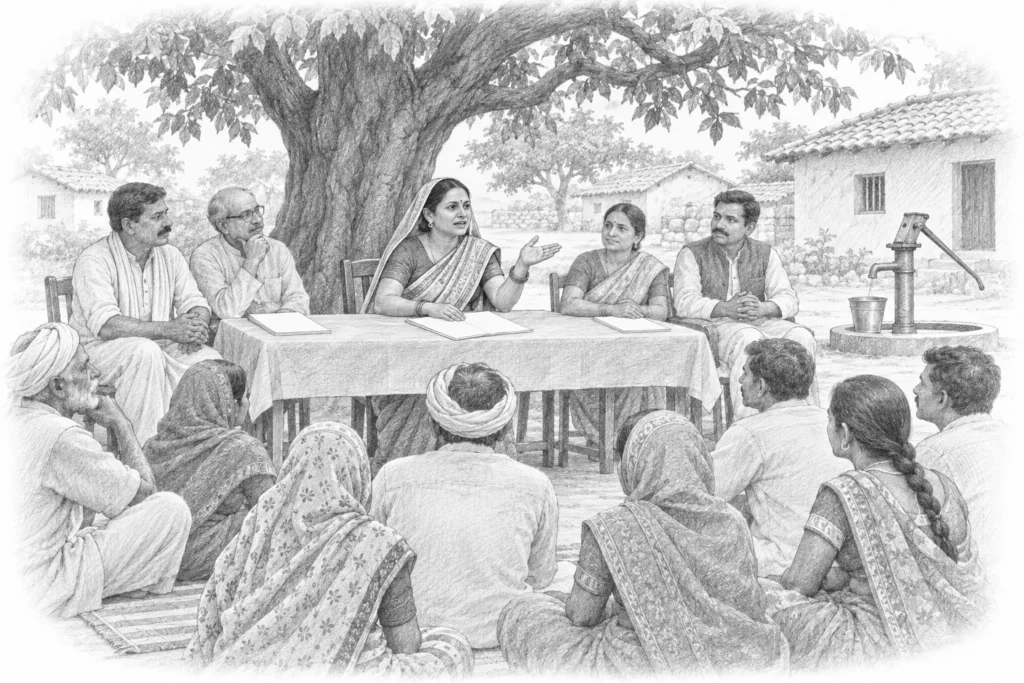
India has an old tradition of village self-government, from the Vedic sabha and the Chola village assemblies to caste and village panchayats. The modern system began under colonial rule: Lord Mayo’s resolution (1870) on financial decentralisation and Lord Ripon’s resolution of 18 May 1882, which made local boards and municipalities largely elected bodies, earned Ripon the title ‘father of local self-government in India’. The Royal Commission on Decentralisation (1909) and the Government of India Act 1919, which made local government a transferred subject, followed. After independence, Article 40 directed the state to organise village panchayats, and Gandhi’s ideal of gram swaraj inspired the movement (Figure 2.3).
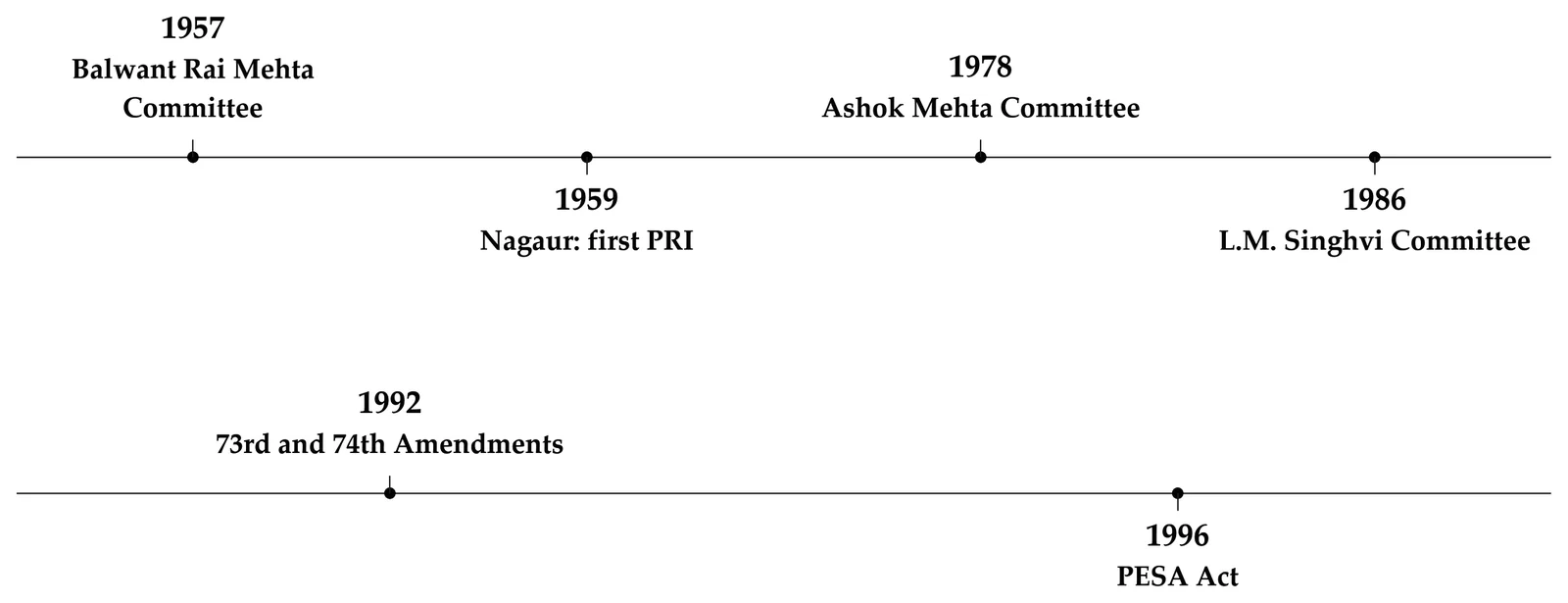
- Balwant Rai Mehta Committee (1957) examined the Community Development Programme (1952) and recommended ‘democratic decentralisation’ through a three-tier system: gram panchayat, panchayat samiti and zila parishad. Rajasthan inaugurated it at Nagaur on 2 October 1959, followed by Andhra Pradesh.
- Ashok Mehta Committee (1978) recommended a two-tier system of zila parishads and mandal panchayats, with participation of political parties and constitutional protection.
- G.V.K. Rao Committee (1985) and the L.M. Singhvi Committee (1986) recommended strengthening PRIs and giving them constitutional status.
- 64th Amendment Bill (1989), introduced by Rajiv Gandhi’s government, failed in the Rajya Sabha.
- 73rd and 74th Amendments (1992), passed under P.V. Narasimha Rao’s government, gave constitutional status to rural and urban local bodies.
- PESA (1996), the Panchayats (Extension to Scheduled Areas) Act, extended Panchayati Raj to tribal areas with special powers for gram sabhas over land, forests and minor forest produce.
2.3 Rural Local Governance: The 73rd Amendment
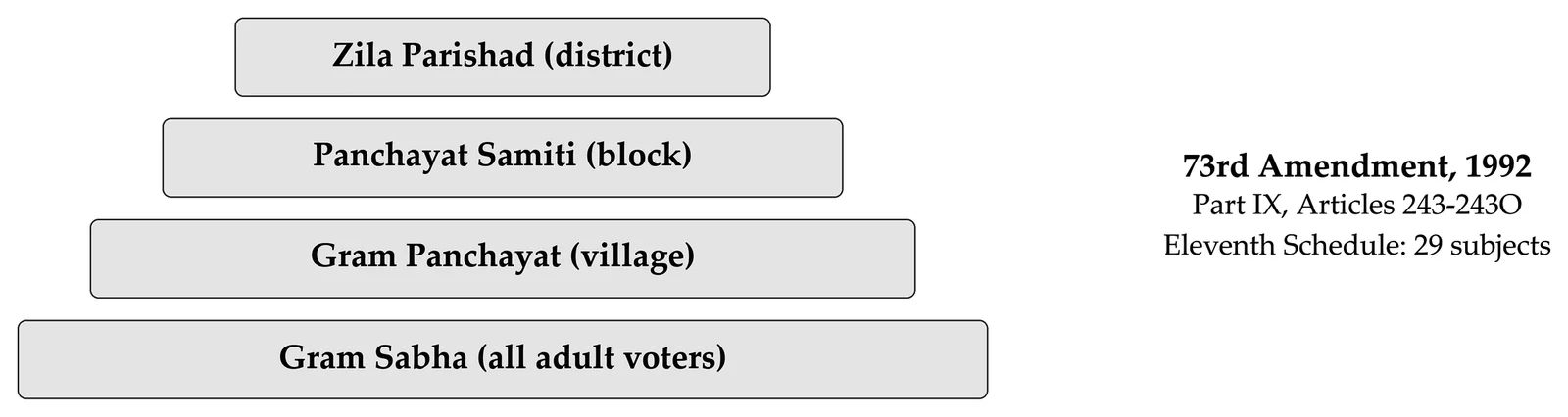
The 73rd Constitutional Amendment Act, 1992 added Part IX (Articles 243 to 243O) and the Eleventh Schedule to the Constitution. Its main features are these (Figure 2.4):
- Gram Sabha (Article 243A): the assembly of all registered voters of a village, the foundation of the system.
- Three-tier structure (Article 243B): village, intermediate (block) and district levels; states with a population below 20 lakh may omit the intermediate tier.
- Direct elections: members at all levels are directly elected.
- Reservation (Article 243D): seats for SCs and STs in proportion to their population, and not less than one-third of seats and chairpersons’ posts for women; many states have raised this to 50%.
- Five-year term (Article 243E): elections must be held before the term ends, or within six months of dissolution.
- State Election Commission (Article 243K) conducts panchayat elections.
- State Finance Commission (Article 243I) reviews panchayat finances every five years.
- Powers and functions (Article 243G): states may devolve to panchayats the 29 subjects of the Eleventh Schedule, such as agriculture, drinking water, roads, poverty alleviation, education, health and women and child development.
Notice that the Amendment made the structure, elections and reservations mandatory, but left the actual transfer of functions, funds and functionaries (the ‘three Fs’) to the discretion of the states. This is why the strength of panchayats varies greatly from state to state: Kerala’s People’s Plan Campaign (1996) devolved a large share of plan funds to local bodies, while many states devolved very little.
State Election and Finance Commissions
Two institutions created by the 73rd and 74th Amendments are crucial for local democracy. The State Election Commission (Article 243K) conducts panchayat and municipal elections, and the State Finance Commission (Article 243I), appointed every five years, recommends how state revenues should be shared with local bodies. In practice, many states have delayed elections, appointed Finance Commissions late or ignored their recommendations, which weakens local governments.
2.4 Urban Local Governance: The 74th Amendment
The 74th Constitutional Amendment Act, 1992 added Part IXA (Articles 243P to 243ZG) and the Twelfth Schedule with 18 subjects, such as urban planning, regulation of land use, roads and bridges, water supply, public health and sanitation, slum improvement and urban poverty alleviation. It provides for three types of urban local bodies (Figure 2.5): a Municipal Corporation for a larger urban area, a Municipal Council for a smaller urban area, and a Nagar Panchayat for an area in transition from rural to urban.

Other features include ward committees in municipalities with a population of three lakh or more, reservation for SCs, STs and women on the same lines as panchayats, a five-year term, the State Election Commission and State Finance Commission, a District Planning Committee (Article 243ZD) to consolidate rural and urban plans, and a Metropolitan Planning Committee (Article 243ZE) for metropolitan areas. Urban bodies face problems of weak finances, dependence on state governments, parastatal agencies that take over their functions, and rapid urbanisation.
Challenges of urban governance
India’s cities face rapid growth, slums, congestion, pollution and shortages of water and housing. Municipalities are often too weak to respond: mayors in most states are indirectly elected for short terms, state-controlled parastatal bodies run water, transport and development, and municipal revenues from property tax and fees are small. Programmes such as JNNURM (2005), the Smart Cities Mission and AMRUT (2015) have brought funds, but critics argue that they often bypass elected councils.
2.5 PRIs and the Implementation of Public Policies
Panchayats are not only units of self-government; they are also the main agencies for implementing many national and state programmes at the village level:
- MGNREGA (2005): gram sabhas select works, and at least 50% of the works by cost must be executed by gram panchayats; social audits by gram sabhas (Section 17) check implementation.
- Drinking water and sanitation: the Swachh Bharat Mission (Gramin) and the Jal Jeevan Mission (2019) rely on panchayats and village water committees.
- Public Distribution System and welfare pensions: gram sabhas help identify beneficiaries.
- Education and health: village education committees and village health, sanitation and nutrition committees work with panchayats; ASHA workers and anganwadis are linked to local governance.
- Planning: the Gram Panchayat Development Plan (from 2015) uses Finance Commission grants for local planning.
Achievements and Problems
PRIs have created a vast base of local democracy and brought millions of women, Dalits and Adivasis into public office; studies by Raghabendra Chattopadhyay and Esther Duflo (2004) found that women leaders invested more in drinking water and other public goods valued by women. But they face serious problems: inadequate devolution of the three Fs, dependence on grants, domination by local elites and bureaucrats, ‘sarpanch pati’ (husbands acting on behalf of elected women), weak gram sabhas, lack of capacity, and corruption.
Panchayats and the Sustainable Development Goals
Since 2021 the Ministry of Panchayati Raj has encouraged panchayats to ‘localise’ the Sustainable Development Goals by adopting themes such as a poverty-free village, a healthy village, a child-friendly village and a water-sufficient village in their development plans. This links global goals with local planning and gives gram sabhas a role in tracking progress.
2.6 Important Questions
- Question 1 What is decentralisation? Discuss its types with reference to rural and urban local governance in India.
- Question 2 Discuss the role of Panchayati Raj Institutions in the implementation of public policies.
DU asks the same idea in different words. So learn one broad answer for each question below; the same answer works for every question joined by OR.
Important Question 1
What is decentralisation? Discuss its types with reference to rural and urban local governance in India.
OR
Explain the meaning and significance of democratic decentralisation.
OR
Discuss the main features of the 73rd and 74th Constitutional Amendments.
Model Answer
“True democracy cannot be worked by twenty men sitting at the centre.”
— Mahatma Gandhi
Introduction. Decentralisation means the transfer of power, functions and resources from central and state governments to lower levels. In India it took the form of democratic decentralisation through elected rural and urban local bodies, given constitutional status in 1992.
1. Meaning and Significance
Decentralisation brings government closer to the people, increases participation, improves responsiveness and accountability, trains citizens in democracy and reduces the burden on higher governments. It also trains citizens in self-government, as Tocqueville observed of local institutions in America.
2. Benefits of Decentralisation
Decentralisation improves the targeting of services, makes officials accountable to local people, encourages local resource mobilisation and gives voice to women and marginalised groups.
3. Types of Decentralisation
Deconcentration (transfer to field offices), delegation (to semi-autonomous bodies), devolution (to elected local governments) and privatisation (to private or civil bodies). It may also be political, administrative or fiscal. Political decentralisation transfers power to elected local bodies, administrative decentralisation to officials, and fiscal decentralisation gives local bodies their own revenues.
4. Gandhi and Ambedkar on the Village
Gandhi’s idea of gram swaraj made self-governing villages the basis of Indian democracy, while Ambedkar criticised the village as a den of localism and caste; the Constitution placed panchayats in the Directive Principles (Article 40).
5. Evolution in India
From Ripon’s resolution (1882) to Article 40, the Balwant Rai Mehta Committee (1957), the first panchayat at Nagaur (1959), the Ashok Mehta (1978) and L.M. Singhvi (1986) Committees, and finally the 73rd and 74th Amendments (1992). The Ashok Mehta Committee (1978) proposed a two-tier system, and the L.M. Singhvi Committee (1986) recommended constitutional status. Lord Ripon’s resolution of 1882 is often called the Magna Carta of local self-government in India.
6. Rural Local Governance
The 73rd Amendment created the gram sabha, a three-tier structure, direct elections, reservation for SCs, STs and one-third for women, a five-year term, State Election and Finance Commissions, and the Eleventh Schedule of 29 subjects. State Election Commissions conduct elections and State Finance Commissions review panchayat finances every five years.
7. PESA, 1996
The Panchayats (Extension to Scheduled Areas) Act gives gram sabhas in tribal areas powers over minor forest produce, land alienation and local resources, recognising tribal self-governance.
8. Urban Local Governance
The 74th Amendment provided for municipal corporations, municipal councils and nagar panchayats, ward committees, reservations, District and Metropolitan Planning Committees, and the Twelfth Schedule of 18 subjects. Ward committees, District Planning Committees and Metropolitan Planning Committees provide for participation and planning.
9. Smart Cities and AMRUT
Recent urban programmes such as the Smart Cities Mission and AMRUT (2015) have often worked through special purpose vehicles that bypass elected municipalities, raising concerns about local democracy.
10. Problems
Devolution of functions, funds and functionaries depends on the states and is often weak; local bodies depend on grants, face elite capture and bureaucratic control, and lack capacity. Urban local bodies also suffer from weak mayors, parastatal agencies and limited revenue. Many states have also failed to transfer staff to panchayats.
11. Women’s Participation
The reservation of one-third of seats and chairpersons’ posts for women, raised to 50% in many states such as Bihar (2006), has brought more than a million women into local government. Studies show that women leaders often give priority to drinking water, sanitation and health, although proxy representation by male relatives remains a problem. Nearly half of all elected local representatives are now women.
12. The Kerala Model
Kerala’s People’s Plan Campaign (1996) devolved about 35–40% of the state’s plan funds to local bodies and involved citizens in planning through gram sabhas, making Kerala a model of genuine devolution of functions, funds and functionaries. Kerala also transferred staff and institutions such as primary health centres and schools to local bodies.
13. Comparative Examples
Countries such as Brazil, with participatory budgeting, and the Scandinavian states, with strong local governments, show how decentralisation can deepen democracy.
14. Evaluation
Decentralisation in India has created a vast structure of local democracy, but its promise will be realised only when states devolve real functions, funds and functionaries, and when local bodies become accountable to citizens.
Conclusion. Thus, India has created the world’s largest system of local democracy. Its success depends on real devolution of powers and resources and on active citizen participation.
Important Question 2
Discuss the role of Panchayati Raj Institutions in the implementation of public policies.
OR
Evaluate the working of Panchayati Raj in India.
OR
Write a note on the gram sabha.
Model Answer
“Town meetings are to liberty what primary schools are to science.”
— Alexis de Tocqueville, Democracy in America (1835)
Introduction. Panchayati Raj Institutions are both organs of local self-government and agencies for implementing development and welfare programmes at the grassroots.
1. Constitutional Basis
Article 243G allows states to entrust panchayats with the preparation and implementation of plans for economic development and social justice, including the 29 subjects of the Eleventh Schedule. The Eleventh Schedule lists 29 subjects, including agriculture, drinking water, roads, primary education, health and poverty alleviation.
2. Role in Key Programmes
Under MGNREGA gram sabhas select works, gram panchayats execute at least half of them, and social audits check implementation; panchayats also implement sanitation and drinking water missions, help select beneficiaries for PDS and pensions, and prepare Gram Panchayat Development Plans. Panchayats also help select beneficiaries for rural housing and implement the Swachh Bharat Mission and the Jal Jeevan Mission.
3. The Gram Sabha
As the assembly of all voters, the gram sabha approves plans, selects beneficiaries, conducts social audits and, in tribal areas under PESA, controls land, forests and minor forest produce. It is the base of direct democracy. It meets several times a year, including on special occasions such as Gandhi Jayanti.
4. Gram Panchayat Development Plans
Since 2015 panchayats prepare annual Gram Panchayat Development Plans through participatory planning with the gram sabha, linking schemes with local priorities.
5. E-Governance in Panchayats
Platforms such as e-Gram Swaraj and the Public Financial Management System help panchayats plan, keep accounts and make payments transparently.
6. Health, Education and Nutrition
Panchayats oversee village health, sanitation and nutrition committees, school management committees and anganwadis, linking them with local needs.
7. Achievements
PRIs have widened participation, brought women and marginalised groups into office, improved local public goods and increased accountability through social audits. Studies show that women-led panchayats invested more in drinking water and other public goods.
8. Accountability of Panchayats
Panchayats themselves must be accountable: gram sabhas, social audits, open records and the RTI Act help prevent corruption and elite capture.
9. Problems
Weak devolution of the three Fs, financial dependence, bureaucratic dominance, elite capture, proxy representation by male relatives of women leaders, and corruption limit their effectiveness. Proxy representation of women by male relatives is another problem.
10. Suggestions
Real devolution of functions and funds, capacity building, stronger gram sabhas, regular elections and transparent accounts can make PRIs more effective. The 15th Finance Commission’s grants tied to water and sanitation show how funds can be linked to outcomes.
11. Finances of PRIs
PRIs depend mainly on grants from the Union and state governments, including Finance Commission grants, which are now given directly to local bodies; their own revenue from property tax, fees and local levies is small. State Finance Commissions are meant to recommend devolution, but many states have delayed implementing their reports. Own revenue from property tax, fees and local levies remains small.
12. Social Audit
Social audit is a process in which the gram sabha and citizens examine the records and works of a programme in public meetings. MGNREGA made social audits mandatory, and Andhra Pradesh (later Telangana) built an independent Society for Social Audit, Accountability and Transparency (2009) that conducted regular audits and recovered misused funds, showing how PRIs can make implementation accountable. Andhra Pradesh and Telangana built the strongest social audit systems.
13. Panchayats and Convergence
Panchayats bring different schemes together at the village level, linking MGNREGA works with water conservation, sanitation, housing (PM Awas Yojana–Gramin) and drinking water, so that the Gram Panchayat Development Plan becomes a single local plan.
14. Evaluation
PRIs have become indispensable for implementing public policies close to the people, but they remain more agents of state and central schemes than genuine self-governments; their role depends on real devolution and capacity.
Conclusion. Thus, PRIs are vital channels for implementing public policies close to the people. Strengthening them is essential for both efficient administration and deeper democracy.
Short Notes
(a) Balwant Rai Mehta Committee (1957)
Appointed to review the Community Development Programme (1952) and the National Extension Service, the committee found that development had failed for lack of people’s participation. It recommended ‘democratic decentralisation’ through a three-tier structure: gram panchayat at the village, panchayat samiti at the block and zila parishad at the district level, with the panchayat samiti as the key executive body. Rajasthan was the first state to adopt it, at Nagaur on 2 October 1959.
(b) PESA Act (1996)
The Panchayats (Extension to Scheduled Areas) Act, 1996, extended Part IX of the Constitution to the Fifth Schedule areas with modifications suited to tribal communities. It gives gram sabhas powers over community resources, land acquisition consultation, minor forest produce, village markets, money-lending and the preservation of customs and traditions. Its implementation by the states has been uneven.
More notes: MDSC-1B Public Administration in India
These notes are prepared by PADHO TO AISE for study help. They are not an official University of Delhi publication.