
Semester VI DSC-18 India’s Foreign Policy: Challenges and Strategies
Unit III · 20 min read · Updated 24 Nov 2026
As per the University of Delhi (DU) BA (Hons) Political Science syllabus
Contents
- 3.1 India and Its Neighbourhood
- 3.2 Land and Boundary Issues
- 3.3 Migration and the Refugee Crisis
- 3.4 Debating Regional Strategies: SAARC and BIMSTEC
- 3.5 Important Questions
- Discuss India’s land and boundary issues with its neighbours.
- Discuss the issues of migration and the refugee crisis in South Asia and India’s approach to them.
- Compare SAARC and BIMSTEC as strategies of regional cooperation for India.
- Examine the challenges of India’s neighbourhood policy.
- Short Notes
बहुत लंबे समय तक हम एशिया के लोग पश्चिमी दरबारों और राजनयिक दफ़्तरों में याचक बने रहे। वह कहानी अब अतीत की बात होनी चाहिए।
For too long have we of Asia been petitioners in Western courts and chancelleries. That story must now belong to the past.
— Jawaharlal Nehru, Asian Relations Conference, New Delhi (23 March 1947)
SOUTH Asia is India’s immediate neighbourhood and its most difficult foreign policy arena. India is far larger than all its neighbours combined, which creates asymmetry and fears of Indian domination. The region carries the legacies of colonial boundary-making and Partition, with disputed borders, cross-border migration and recurring refugee flows. Regional cooperation through SAARC has stalled because of India–Pakistan hostility, and India has turned increasingly to BIMSTEC and bilateral ties. This unit studies these issues and India’s regional strategies, drawing on S.D. Muni, Dhananjay Tripathi and Sanjay Chaturvedi, Nasreen Chowdhory, P.R. Chari, Shibashis Chatterjee and Pinak Ranjan Chakravarty.
3.1 India and Its Neighbourhood
S.D. Muni identifies the problem areas of India’s neighbourhood policy. India’s size and centrality make neighbours fear its dominance and sometimes seek support from outside powers, especially China. Ethnic and religious communities spill across borders, so internal conflicts, such as in Sri Lanka or Bangladesh, affect India. India has alternated between assertive policies and generous ones: the Gujral doctrine (1996) offered non-reciprocal concessions to smaller neighbours, and the Neighbourhood First policy (2014) emphasised connectivity, aid and engagement.
3.2 Land and Boundary Issues
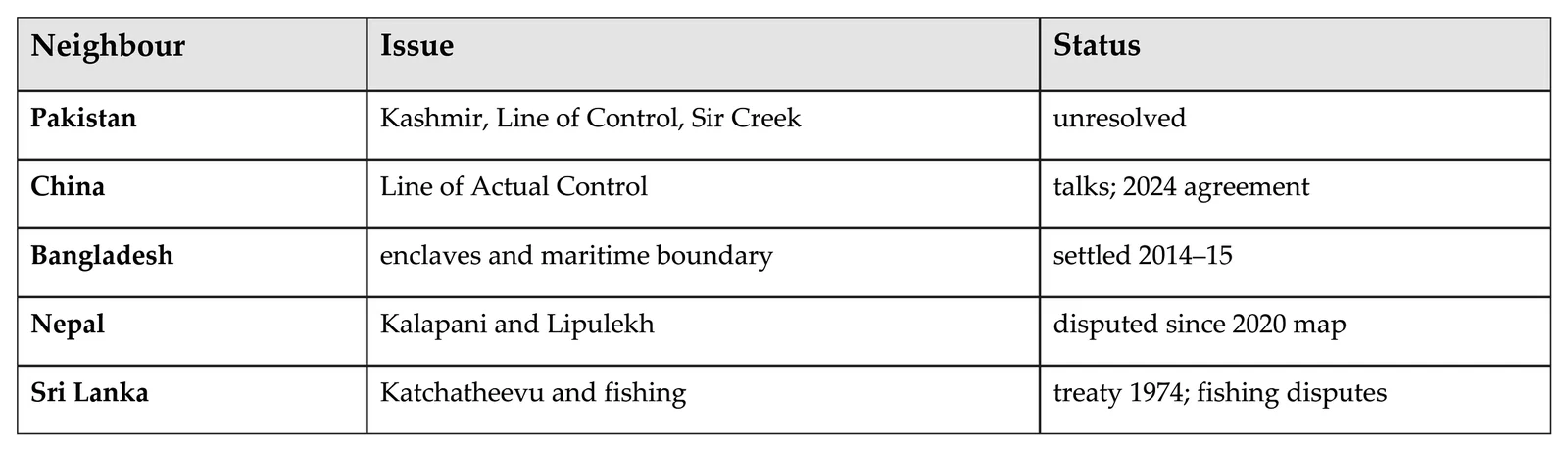
Many of South Asia’s boundaries were drawn by colonial rulers: the Durand Line (1893), the McMahon Line (1914) and the Radcliffe Line of Partition (1947). Dhananjay Tripathi and Sanjay Chaturvedi argue that borders in South Asia should be seen not only as lines of division but as zones where people live, trade and move. India’s most serious dispute is with Pakistan over Kashmir, where the Line of Control was defined by the Simla Agreement (1972); other disputes include Siachen and Sir Creek.
Some disputes have been settled. India and Bangladesh exchanged enclaves in 2015 under the Land Boundary Agreement of 1974, and an international tribunal settled their maritime boundary in 2014. Disputes remain with Nepal over Kalapani and Lipulekh, which Nepal included in a new map in 2020, and fishing disputes with Sri Lanka around Katchatheevu. Shyam Saran emphasises the role of border states in foreign policy, and Pushpita Das examines the management of the India–Pakistan border.
3.3 Migration and the Refugee Crisis
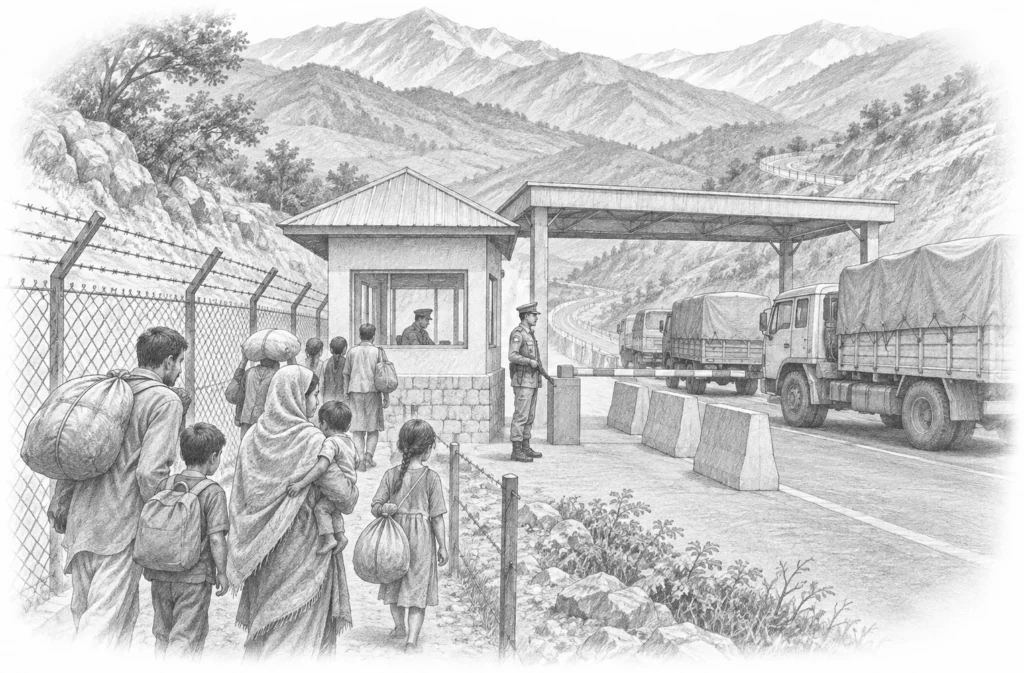
South Asia has a long history of migration: Partition displaced about fifteen million people, the 1971 war drove about ten million refugees into India, and conflicts have produced flows of Tibetans, Sri Lankan Tamils, Chakmas, Afghans and Rohingya. India has an open border with Nepal, while irregular migration from Bangladesh has been a sensitive political issue, leading to the Assam Accord (1985), the National Register of Citizens in Assam (2019) and the Citizenship (Amendment) Act (2019).

India is not a party to the 1951 Refugee Convention and has no refugee law, treating refugees under the Foreigners Act on a case-by-case basis. Nasreen Chowdhory shows how refugees in India are given different kinds of membership: Tibetans received settlements and documents, while Rohingya are treated as illegal migrants. P.R. Chari describes the missing boundaries of South Asia, where refugees, migrants, stateless and internally displaced people blur the line between state security and human security.
3.4 Debating Regional Strategies: SAARC and BIMSTEC
The South Asian Association for Regional Cooperation (SAARC), founded in 1985, includes all eight South Asian states. It created a preferential trade arrangement and the South Asian Free Trade Area (2006), but bilateral disputes are excluded from its agenda, decisions require consensus, and India–Pakistan hostility has paralysed it. Shibashis Chatterjee examines India’s mixed approach to SAARC in terms of security, commerce and community. Since 2016 no summit has been held.
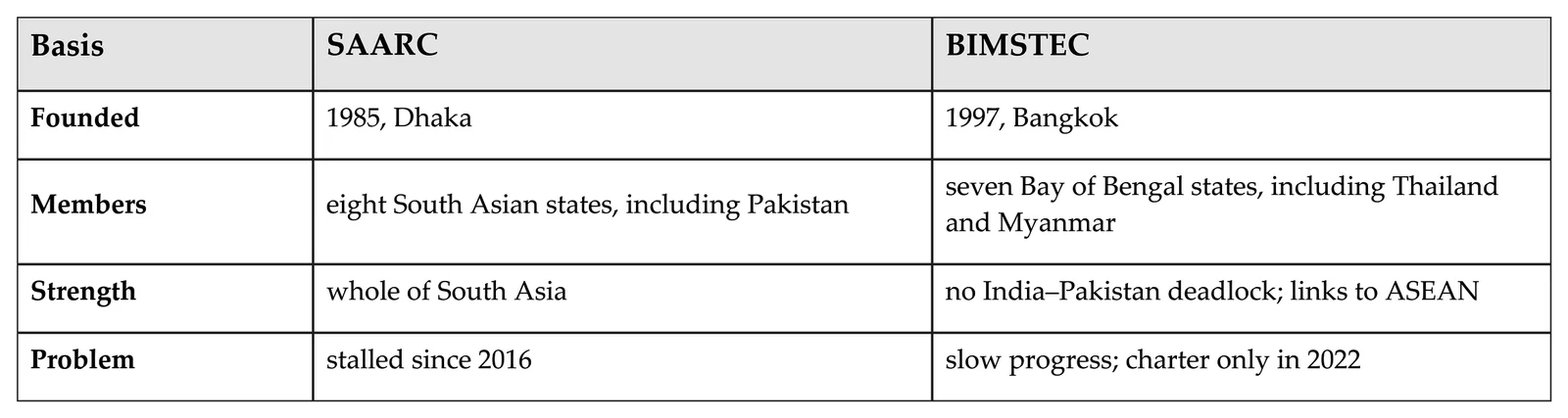
India has turned to the Bay of Bengal Initiative for Multi-Sectoral Technical and Economic Cooperation (BIMSTEC), founded in 1997, which links five South Asian and two Southeast Asian states without Pakistan. Pinak Ranjan Chakravarty calls BIMSTEC a fulcrum of India’s foreign policy, joining Neighbourhood First with Act East. It adopted a charter in 2022, but its progress has been slow.
3.5 Important Questions
- Question 1 Discuss India’s land and boundary issues with its neighbours.
- Question 2 Discuss the issues of migration and the refugee crisis in South Asia and India’s approach to them.
- Question 3 Compare SAARC and BIMSTEC as strategies of regional cooperation for India.
- Question 4 Examine the challenges of India’s neighbourhood policy.
DU asks the same idea in different words. So learn one broad answer for each question below; the same answer works for every question joined by OR.
Important Question 1
Discuss India’s land and boundary issues with its neighbours.
OR
Examine the colonial legacy of borders in South Asia.
OR
Discuss the India–Bangladesh Land Boundary Agreement and its significance.
Model Answer
“The two countries are resolved to settle their differences by peaceful means through bilateral negotiations.”
— Simla Agreement between India and Pakistan (1972)
Introduction. Borders are central to India’s relations with its neighbours. Many South Asian boundaries were drawn by colonial rulers or at Partition, often without regard for local communities, leaving disputes that continue to cause conflict. Some disputes have been resolved, while others remain dangerous. Tripathi and Chaturvedi, Muni, Das and Ranjan analyse these issues.
1. Colonial Boundary-making
British India’s boundaries were drawn to serve imperial security: the Durand Line (1893) with Afghanistan, the McMahon Line (1914) with Tibet, and the Radcliffe Line (1947), drawn hastily to partition India and Pakistan. These lines divided communities and left ambiguities.
2. Borders as Zones
Tripathi and Chaturvedi argue that borders in South Asia are not just lines but borderlands, zones where people share languages, kinship and trade. Treating them only as security lines can harm border communities and fuel conflict.
3. Kashmir
The dispute over Jammu and Kashmir began in 1947 and led to wars in 1947–48, 1965 and 1999 (Kargil). The ceasefire line of 1949 became the Line of Control under the Simla Agreement of 1972, which committed both countries to bilateral negotiations.
4. Siachen and Sir Creek
India has held the Siachen glacier since 1984, the world’s highest battlefield. Sir Creek, a marshy estuary in the Rann of Kutch, is disputed, affecting maritime boundaries and fishing.
5. Managing the Pakistan Border
Pushpita Das examines the management of the India–Pakistan border, guarded by the Border Security Force and largely fenced, which faces infiltration by militants, smuggling of drugs and arms, and the hardships of border villagers. Terrorist attacks and military confrontations, most recently in May 2025, keep it tense.
6. The China Boundary
India and China dispute Aksai Chin in the west and Arunachal Pradesh, which China calls South Tibet, in the east. The undefined Line of Actual Control has seen clashes, most seriously at Galwan in 2020.
7. India–Bangladesh Enclaves
Partition left 111 Indian enclaves inside Bangladesh and 51 Bangladeshi enclaves inside India, whose residents lived without proper citizenship. The Land Boundary Agreement of 1974 was implemented only in 2015, after the 100th Amendment, when the enclaves were exchanged and residents chose their citizenship.
8. Ranjan on the LBA
Amit Ranjan traces the long history of the India–Bangladesh border dispute and the politics that delayed the agreement for four decades, showing how domestic politics in Assam and West Bengal shaped foreign policy.
9. Maritime Boundary
In 2014, an arbitral tribunal under the Law of the Sea settled the maritime boundary between India and Bangladesh in the Bay of Bengal. India accepted the award, which was largely favourable to Bangladesh, demonstrating respect for international law.
10. Nepal
India and Nepal have an open border under the 1950 treaty, but disagree over Kalapani, Lipulekh and Limpiyadhura. In 2020 Nepal issued a new map including these areas, after India opened a road to Lipulekh, causing tension.
11. Sri Lanka and Bhutan
India ceded the islet of Katchatheevu to Sri Lanka in 1974, and fishermen’s disputes continue in the Palk Strait. The Doklam standoff of 2017 involved territory disputed between Bhutan and China, where India intervened.
12. Border States
Shyam Saran stresses the role of border states in foreign policy: their governments and people have interests in trade, water and migration across borders, and their cooperation is needed for agreements such as the LBA.
13. Border Communities
Fencing, militarisation and closures disrupt the lives of border communities. Approaches that facilitate trade and movement, such as border haats with Bangladesh, can turn borders into bridges.
14. Evaluation
India’s boundary issues reflect colonial legacies, Partition and great-power rivalry. The settlement with Bangladesh shows that disputes can be resolved through political will and respect for law, while those with Pakistan and China remain sources of conflict.
Conclusion. Thus, India’s boundaries with its neighbours, drawn largely by colonial rulers and Partition, have produced disputes over Kashmir, the LAC, Nepal’s claims and fishing waters. The settlement of the enclaves and maritime boundary with Bangladesh shows that peaceful resolution is possible.
Important Question 2
Discuss the issues of migration and the refugee crisis in South Asia and India’s approach to them.
OR
Examine India’s refugee policy.
OR
‘Migration in South Asia blurs the line between state security and human security.’ Discuss.
Model Answer
“Owing to well-founded fear of being persecuted for reasons of race, religion, nationality, membership of a particular social group or political opinion, is outside the country of his nationality.”
— UN Convention Relating to the Status of Refugees (1951), Article 1
Introduction. South Asia has experienced some of the largest migrations in history, from Partition to the wars and conflicts that followed. Migration and refugee flows affect India’s relations with its neighbours, its internal politics and its security. Nasreen Chowdhory, P.R. Chari and others show how India has dealt with these issues without a formal refugee framework.
1. Partition
The Partition of 1947 displaced about fifteen million people across the new borders of India and Pakistan and caused perhaps a million deaths. It shaped India’s approach to refugees and citizenship.
2. The 1971 War
Repression in East Pakistan in 1971 drove about ten million refugees into India, creating a humanitarian crisis that contributed to India’s intervention and the creation of Bangladesh.
3. Tibetan Refugees
After the Dalai Lama fled to India in 1959, tens of thousands of Tibetans followed. India gave them settlements, schools and identity documents, and Dharamsala became the seat of the Tibetan government-in-exile.
4. Sri Lankan Tamils and Others
The Sri Lankan civil war brought Tamil refugees to Tamil Nadu from 1983 onwards. Chakmas from Bangladesh, Afghans and, more recently, Rohingya from Myanmar have also sought refuge in India.
5. India’s Legal Framework
India is not a party to the 1951 Refugee Convention or its 1967 Protocol and has no national refugee law. Refugees are governed by the Foreigners Act (1946) and administrative decisions, giving the government wide discretion.
6. Chowdhory on Membership
Nasreen Chowdhory shows that India grants refugees different forms of membership: some, like Tibetans, receive long-term protection; others are treated as temporary guests or illegal migrants. Refugees thus occupy uncertain positions between citizenship and exclusion.
7. The Rohingya
Rohingya Muslims, fleeing persecution in Myanmar, entered India in small numbers. The government treated them as illegal migrants and security risks, and some were deported, raising concerns about the principle of non-refoulement.
8. Migration from Bangladesh
Irregular migration from Bangladesh, driven by poverty and environmental stress, became a major political issue in Assam and West Bengal. The Assam movement led to the Assam Accord of 1985, which set 24 March 1971 as the cut-off date for citizenship.
9. NRC and CAA
The National Register of Citizens in Assam, updated under Supreme Court supervision, excluded about nineteen lakh people in 2019. The Citizenship (Amendment) Act of 2019 offered faster citizenship to non-Muslim migrants from Afghanistan, Bangladesh and Pakistan, provoking protests and concern in Bangladesh.
10. The Nepal Border
Under the 1950 treaty, citizens of India and Nepal move freely across the open border and can work in each other’s country, a unique arrangement that supports livelihoods but also raises security concerns.
11. Chari’s Missing Boundaries
P.R. Chari describes how refugees, migrants, stateless people and internally displaced persons in South Asia fall through the gaps of state protection. Their situation calls for regional cooperation and humanitarian approaches.
12. State Security and Human Security
Ray Chaudhury and Ghosh argue that trans-border migration must be seen through both state security, concerned with borders and identity, and human security, concerned with the rights and needs of migrants. Policies that focus only on security can violate human rights.
13. Involuntary Migration in Border Areas
Studies of the Punjab border belt show how wars, fencing and mines have displaced border villagers within India, illustrating the human costs of hard borders.
14. Evaluation
India has a long tradition of hosting refugees but an ad hoc legal framework that treats groups differently. Balancing security, identity politics and humanitarian obligations remains a major challenge.
Conclusion. Thus, South Asia has seen massive migration and refugee flows, from Partition to the Rohingya crisis. India hosts many refugees without a refugee law, treating groups differently, while migration from Bangladesh has produced the NRC and CAA. As Chowdhory and Chari argue, a balance between state security and human security is needed.
Important Question 3
Compare SAARC and BIMSTEC as strategies of regional cooperation for India.
OR
Why has SAARC failed to achieve its objectives?
OR
Discuss the significance of BIMSTEC for India’s foreign policy.
Model Answer
“To promote the welfare of the peoples of South Asia and to improve their quality of life.”
— Charter of the South Asian Association for Regional Cooperation (1985), Article I
Introduction. Regional cooperation can promote trade, development and peace. South Asia, one of the least integrated regions in the world, created SAARC in 1985, but its progress has been limited. India has increasingly turned to BIMSTEC as an alternative framework. Chatterjee, Muni, Chakravarty and others debate these strategies.
1. Origins of SAARC
SAARC was proposed by President Ziaur Rahman of Bangladesh and founded at Dhaka on 8 December 1985 by Bangladesh, Bhutan, India, the Maldives, Nepal, Pakistan and Sri Lanka. Afghanistan joined in 2007.
2. Principles of SAARC
The Charter commits members to promote welfare, economic growth and cooperation, based on sovereign equality and non-interference. Decisions require unanimity, and bilateral and contentious issues are excluded from discussion.
3. Achievements
SAARC created the South Asian Preferential Trading Arrangement (1995), the South Asian Free Trade Area (2006), a development fund and the South Asian University in Delhi. In 2020, India proposed a SAARC Covid-19 emergency fund.
4. Limitations of SAARC
Intra-regional trade remains a small share of members’ total trade. Non-tariff barriers, weak connectivity and mistrust limit integration. Most importantly, India–Pakistan hostility has blocked progress.
5. The India–Pakistan Problem
Pakistan has resisted trade liberalisation with India and connectivity projects, while India has refused to cooperate in the shadow of terrorism. After the Uri attack in 2016, India and others boycotted the Islamabad summit, and SAARC has been stalled since.
6. Chatterjee on India and SAARC
Shibashis Chatterjee examines how India’s approach to SAARC has been shaped by security concerns, commercial interests and ideas of a South Asian community, and how security concerns have usually prevailed.
7. Origins of BIMSTEC
BIMSTEC began in 1997 in Bangkok as an initiative of Bangladesh, India, Sri Lanka and Thailand; Myanmar joined the same year, and Nepal and Bhutan in 2004. It links South Asia and Southeast Asia around the Bay of Bengal.
8. Advantages of BIMSTEC
BIMSTEC excludes Pakistan, avoiding the main obstacle in SAARC, and connects India’s Neighbourhood First and Act East policies. It focuses on practical sectors such as trade, connectivity, energy, security and the blue economy.
9. Chakravarty’s Fulcrum
Pinak Ranjan Chakravarty calls BIMSTEC a fulcrum of India’s foreign policy, central to connecting India’s northeast with Southeast Asia and countering China’s influence in the Bay of Bengal.
10. India’s Turn to BIMSTEC
In 2016 India invited BIMSTEC leaders to the BRICS outreach summit in Goa, and in 2019 to Prime Minister Modi’s swearing-in, signalling a shift from SAARC. BIMSTEC adopted a charter in 2022 and a vision for 2030 in 2025.
11. Limitations of BIMSTEC
BIMSTEC has moved slowly: its free trade agreement remains unfinished, its secretariat is small, summits are infrequent and Myanmar’s instability and Bangladesh–Myanmar tensions over the Rohingya create problems.
12. Sub-regional Cooperation
India has also promoted sub-regional groupings such as the Bangladesh–Bhutan–India–Nepal (BBIN) initiative for motor vehicle movement, power and water, and bilateral connectivity projects.
13. Comparing the Two
SAARC includes all South Asian states but is paralysed by India–Pakistan rivalry; BIMSTEC avoids that problem and connects to Southeast Asia, but it lacks Pakistan and Afghanistan and has its own weaknesses. Neither has yet achieved deep integration.
14. Evaluation
Regional cooperation in South Asia remains weak. India’s shift towards BIMSTEC reflects frustration with SAARC, but successful regionalism will require better connectivity, trust and political will.
Conclusion. Thus, SAARC, founded in 1985, has achieved little because of India–Pakistan hostility, consensus rules and weak connectivity. India has turned to BIMSTEC, which links South and Southeast Asia without Pakistan and serves Neighbourhood First and Act East, though it too has progressed slowly.
Important Question 4
Examine the challenges of India’s neighbourhood policy.
OR
Discuss S.D. Muni’s view of the problem areas in India’s neighbourhood policy.
OR
Assess the Neighbourhood First policy.
Model Answer
“With neighbours like Nepal, Bangladesh, Bhutan, Maldives and Sri Lanka, India does not ask for reciprocity but gives and accommodates what it can in good faith and trust.”
— I.K. Gujral, statement of the Gujral doctrine (1996)
Introduction. India’s neighbourhood is its most immediate foreign policy priority but also its most difficult. Relations with neighbours are shaped by asymmetry, shared history, cross-border communities and the growing presence of China. S.D. Muni and Muchkund Dubey analyse the problem areas and India’s strategies.
1. Asymmetry
India’s size, population, economy and military dwarf those of its neighbours combined. Muni argues that this asymmetry makes neighbours fear Indian domination, interference or a big brother attitude, even when India acts benignly.
2. Shared Societies
Ethnic, linguistic and religious communities span borders: Tamils in India and Sri Lanka, Bengalis in India and Bangladesh, Madhesis in Nepal. Domestic politics in India and its neighbours therefore affect each other.
3. Internal Conflicts
Civil wars, insurgencies and political crises in neighbouring countries spill over into India through refugees, militancy and pressure from Indian states, as in Sri Lanka’s civil war and India’s intervention in 1987.
4. Extra-regional Powers
Neighbours have sought support from outside powers to balance India: Pakistan from the US and China, and smaller neighbours increasingly from China through investment and infrastructure.
5. The Gujral Doctrine
Prime Minister I.K. Gujral’s doctrine of 1996 held that India should not demand reciprocity from smaller neighbours but give what it can in good faith, and that neighbours should not allow their territory to be used against each other. It led to the Ganga water treaty with Bangladesh in 1996.
6. Neighbourhood First
In 2014 Prime Minister Modi invited all SAARC leaders to his swearing-in and announced the Neighbourhood First policy, emphasising connectivity, trade, aid and quick help in crises, such as relief after the Nepal earthquake of 2015 and vaccines during the pandemic.
7. Aid and Connectivity
India extends lines of credit, builds roads, railways, power lines and ports, and provides training. During Sri Lanka’s economic crisis in 2022, India provided about four billion dollars in assistance.
8. Pakistan
Relations with Pakistan remain hostile because of terrorism and Kashmir. Peace initiatives, such as the Lahore bus journey (1999) and Modi’s visit to Lahore (2015), have been followed by attacks and crises.
9. Nepal
Despite close ties, relations with Nepal suffered from a blockade of the border in 2015 during protests over Nepal’s constitution and from the map dispute of 2020, which nationalist politicians in Nepal used against India.
10. Bangladesh
Relations with Bangladesh improved greatly under Sheikh Hasina, with the settlement of boundaries and security cooperation, but her fall in August 2024 and her stay in India strained ties with the new government. The Teesta water dispute remains unresolved.
11. Sri Lanka and the Maldives
China’s investments in Sri Lankan ports and the Maldives have created competition. In the Maldives, an India Out campaign brought a government in 2023 that initially demanded the withdrawal of Indian military personnel, though relations later improved.
12. Dubey’s Prescriptions
Muchkund Dubey argues that India should approach neighbours with generosity and patience, promote economic integration, respect their sovereignty and avoid interfering in their domestic politics.
13. The China Challenge
China’s Belt and Road investments, arms sales and diplomatic engagement give neighbours alternatives to India, making the region an arena of India–China competition.
14. Afghanistan
In Afghanistan, India became a major development partner after 2001, committing about three billion dollars to roads, dams, schools and the new Parliament building, which earned it goodwill among Afghans. The return of the Taliban in 2021 forced India to close its embassy; it reopened a technical mission in 2022 and has engaged cautiously with the Taliban authorities to protect its interests and counter Pakistan’s influence.
15. Evaluation
India’s neighbourhood policy has achieved successes, such as the Bangladesh boundary settlement and crisis assistance, but asymmetry, domestic politics and Chinese competition make the region persistently challenging.
Conclusion. Thus, India’s neighbourhood policy faces challenges of asymmetry, shared communities, internal conflicts and extra-regional powers, as Muni argues. Approaches such as the Gujral doctrine and Neighbourhood First have improved ties, but crises with Pakistan, Nepal, Bangladesh and the Maldives show the difficulties that remain.
Short Notes
(a) Gujral doctrine
A set of principles stated by I.K. Gujral in 1996: India does not ask for reciprocity from smaller neighbours but gives what it can in good faith; no South Asian country should allow its territory to be used against another; and all should respect sovereignty, non-interference and peaceful settlement of disputes.
(b) Land Boundary Agreement
The India–Bangladesh agreement signed in 1974 by Indira Gandhi and Sheikh Mujibur Rahman, implemented through a 2011 protocol and the 100th Constitutional Amendment in 2015. It exchanged 111 Indian and 51 Bangladeshi enclaves and settled undemarcated stretches of the border.
(c) SAFTA
The South Asian Free Trade Area, agreed by SAARC members in 2004 and in force from 2006, which aimed to reduce tariffs on trade within the region. Long sensitive lists, non-tariff barriers and political tensions have limited its effect, and intra-regional trade remains low.
(d) BIMSTEC
The Bay of Bengal Initiative for Multi-Sectoral Technical and Economic Cooperation, founded in 1997, comprising Bangladesh, Bhutan, India, Myanmar, Nepal, Sri Lanka and Thailand. It links South and Southeast Asia, adopted a charter in 2022 and is central to India’s Neighbourhood First and Act East policies.
More notes: DSC-18 India’s Foreign Policy: Challenges and Strategies
These notes are prepared by PADHO TO AISE for study help. They are not an official University of Delhi publication.