
Semester VI DSC-18 India’s Foreign Policy: Challenges and Strategies
Unit V · 18 min read · Updated 24 Nov 2026
As per the University of Delhi (DU) BA (Hons) Political Science syllabus
Contents
- 5.1 The Rise of India
- 5.2 India in the Changing International Order
- 5.3 Soft Power Diplomacy
- 5.4 Culture, Diaspora and Public Diplomacy
- 5.5 Important Questions
- Examine India’s position as an emerging power in the changing international order.
- What is soft power? Examine India’s soft power diplomacy.
- Discuss the role of culture and the diaspora in India’s foreign policy.
- Short Notes
आधी रात के समय, जब दुनिया सो रही होगी, भारत जीवन और स्वतंत्रता के लिए जागेगा।
At the stroke of the midnight hour, when the world sleeps, India will awake to life and freedom.
— Jawaharlal Nehru, ‘Tryst with Destiny’ speech (14–15 August 1947)
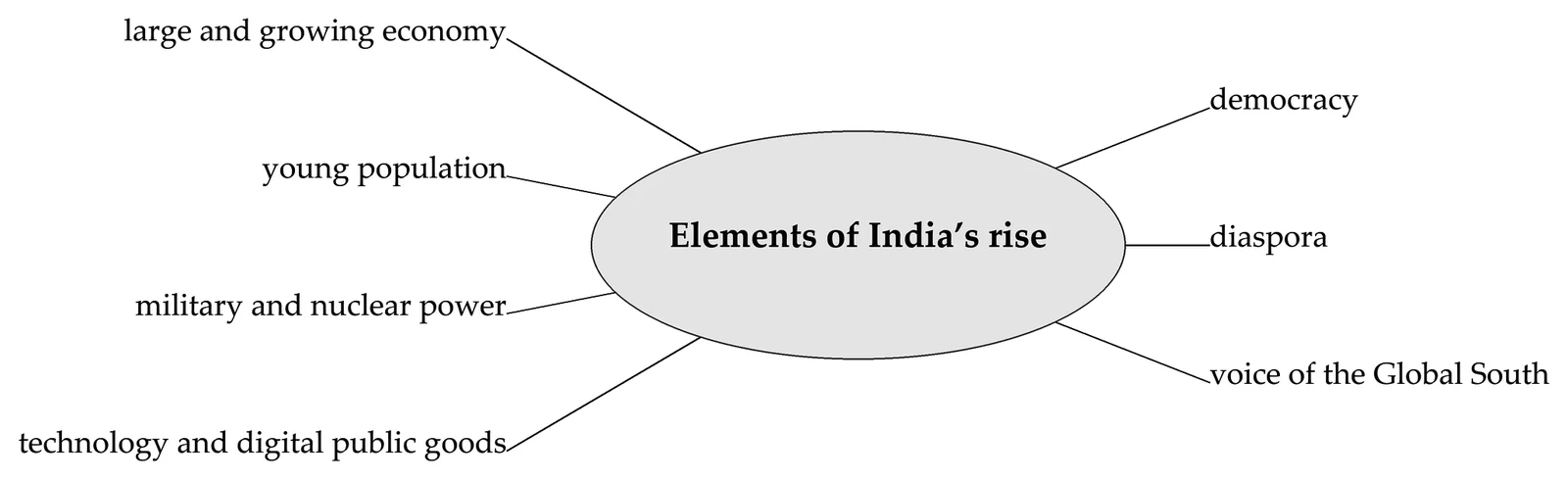
INDIA is widely described as an emerging power: it is the world’s most populous country, one of its largest and fastest-growing economies, a nuclear power with a large military, a leader in digital technology and space, and an influential voice of the developing world. As the international order changes, with American dominance challenged and power spreading towards Asia, India seeks a larger role, from a permanent seat on the UN Security Council to leadership of the Global South. Its influence rests not only on hard power but also on soft power: its culture, democracy, diaspora and ideas. This unit studies India in the changing international order and its soft power diplomacy, drawing on Shyam Saran, Shivshankar Menon, C. Raja Mohan, Patryk Kugiel, T.V. Paul and Arijit Mazumdar.
5.1 The Rise of India
Since the economic reforms of 1991, India has grown rapidly, becoming one of the world’s largest economies. Its demographic weight, young population, nuclear capability, growing military, technological achievements such as the Chandrayaan-3 moon landing (2023) and its digital public infrastructure, such as Aadhaar and UPI, have raised its global standing. Yet India still faces poverty, inequality and weak state capacity, so it combines the features of a major power with those of a developing country.
5.2 India in the Changing International Order
The international order is shifting from American dominance towards multipolarity, with China’s rise, Russia’s confrontation with the West and the growing weight of middle powers. Shyam Saran, in How India Sees the World (2017), argues that India’s strategic culture, from Kautilya onwards, prepares it to navigate such a world while building its strength. Shivshankar Menon, in India and Asian Geopolitics (2021), describes a more fragmented and contested Asia in which India must protect its interests through partnerships and autonomy. C. Raja Mohan traces India’s shift from non-alignment towards seeking to shape the global order as a leading power.
India seeks reform of global institutions, including a permanent seat on the UN Security Council with Brazil, Germany and Japan in the G4. Its G20 presidency in 2023 emphasised the theme One Earth, One Family, One Future and secured permanent membership for the African Union, and it convened Voice of the Global South summits. Rajesh Rajagopalan and Varun Sahni note that India must balance strategic imperatives with normative commitments as it engages the great powers.
5.3 Soft Power Diplomacy
Joseph Nye defined soft power as the ability to get what you want through attraction rather than coercion or payment, arising from a country’s culture, political values and foreign policies. India has rich sources of soft power: its ancient civilisation, religions such as Buddhism, yoga, cinema, music and food, its democracy and pluralism, Gandhi’s legacy of non-violence, and its development partnerships. T.V. Paul argues that India’s soft power depends on its economic success, democracy and pluralism, and can be weakened by poverty, poor governance and communal tensions.
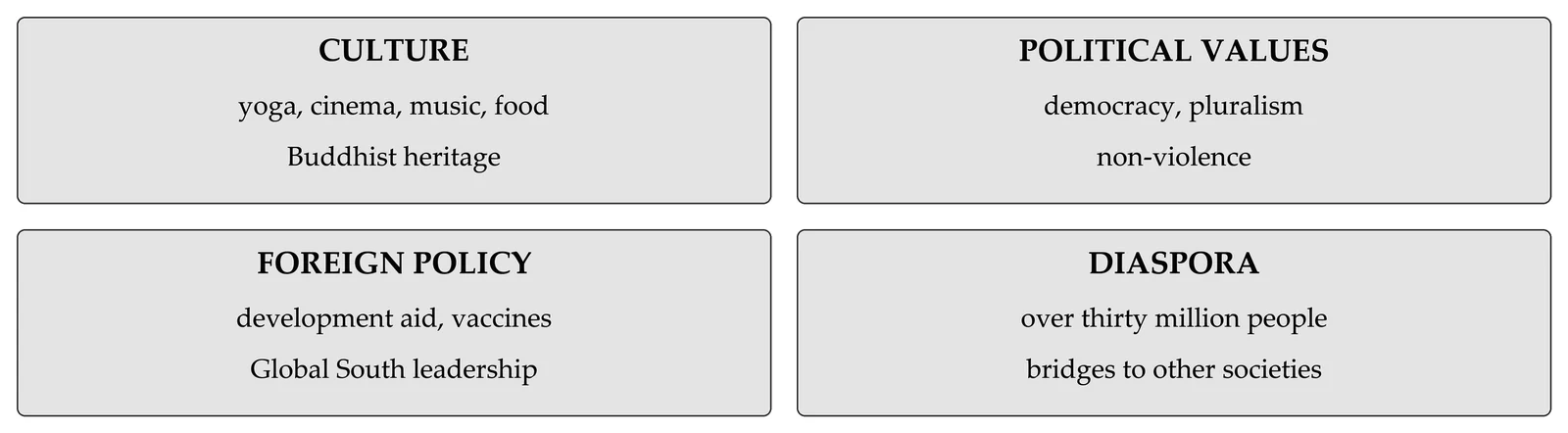
Patryk Kugiel shows that in South Asia, India’s cultural attraction is strong, but its soft power is limited by neighbours’ fears of Indian dominance, so it must be combined with generous development cooperation. Veena Sikri calls for a more strategic and coordinated approach to projecting India’s soft power.
5.4 Culture, Diaspora and Public Diplomacy
India’s cultural diplomacy is conducted through the Indian Council for Cultural Relations (1950), cultural centres abroad, scholarships and festivals. Arijit Mazumdar shows how the Modi government used Buddhism, the diaspora and yoga as instruments of soft power: the UN declared an International Day of Yoga in 2014 at India’s initiative, Buddhist heritage was promoted in Asia, and large diaspora events were held abroad. India’s diaspora, more than thirty million people, is the world’s largest, and remittances to India are the highest of any country.

Vinod Pathak describes the diaspora as a strategic asset: Indian-Americans helped build support for the civil nuclear deal, and the diaspora contributes investment, skills and influence. The government has created the Overseas Citizenship of India scheme (2005), Pravasi Bharatiya Divas (since 2003) and large evacuation operations for Indians abroad in crises.
5.5 Important Questions
- Question 1 Examine India’s position as an emerging power in the changing international order.
- Question 2 What is soft power? Examine India’s soft power diplomacy.
- Question 3 Discuss the role of culture and the diaspora in India’s foreign policy.
DU asks the same idea in different words. So learn one broad answer for each question below; the same answer works for every question joined by OR.
Important Question 1
Examine India’s position as an emerging power in the changing international order.
OR
Is India a rising power? Discuss its strengths and constraints.
OR
Discuss India’s aspirations to be a leading power in a multipolar world.
Model Answer
“This is mine, that is his, say the small-minded; for the large-hearted, the whole world is one family.”
— Maha Upanishad, the source of ‘vasudhaiva kutumbakam’
Introduction. The international order is changing rapidly. American dominance is being challenged, China has risen, and power is shifting towards Asia. India, with its population, economy and military, is widely regarded as an emerging power. Shyam Saran, Shivshankar Menon and C. Raja Mohan examine India’s place in this changing order and its aspirations.
1. The Changing Order
After 1991, the world was briefly unipolar under the United States. Since the 2000s, China’s rise, the 2008 financial crisis, Russia’s challenge to the West and the growth of emerging economies have produced a more multipolar and contested order.
2. Economic Rise
Economic reforms since 1991 made India one of the world’s fastest-growing major economies. By 2022 it had become the world’s fifth-largest economy, and it is a major exporter of software and services.
3. Demography
In 2023 India became the world’s most populous country. A large young population can provide a demographic dividend, if it is educated and employed.
4. Military and Nuclear Power
India has one of the world’s largest armed forces and a nuclear deterrent, and it is modernising its navy and air force. It seeks greater defence self-reliance through domestic production.
5. Technology and Space
India’s space programme landed Chandrayaan-3 near the Moon’s south pole in 2023, and its digital public infrastructure, including Aadhaar and the UPI payments system, is offered as a model to other developing countries.
6. Saran’s View
Shyam Saran argues that India’s worldview, shaped by Kautilya and its civilisational experience, emphasises strategic autonomy and the building of national strength. India should focus on economic growth and capability as the foundation of its global role.
7. Menon on Asian Geopolitics
Shivshankar Menon describes an Asia that is more fragmented and less stable, shaped by US–China rivalry. He argues that India must protect its interests through partnerships, regional engagement and strategic autonomy rather than alliances.
8. From Balancing to Leading
C. Raja Mohan traces India’s shift from non-alignment to active engagement in shaping the global order. In 2015, S. Jaishankar said India aspired to be a leading power rather than merely a balancing power.
9. Reform of Global Institutions
India seeks a permanent seat on the UN Security Council, working with Brazil, Germany and Japan in the G4, and calls for reform of the IMF, World Bank and WTO to reflect today’s world.
10. Voice of the Global South
India presents itself as a voice of the Global South. During its G20 presidency in 2023, it secured permanent membership for the African Union and held Voice of the Global South summits. Its Vaccine Maitri programme supplied Covid vaccines to many countries.
11. Great Powers
Rajesh Rajagopalan and Varun Sahni argue that India’s relations with great powers must balance strategic imperatives, such as countering threats, with normative necessities, such as its commitment to sovereignty and a fair international order.
12. Continuity and Change under Modi
Veena Kukreja finds both continuity and change in Modi’s foreign policy: continuity in goals such as autonomy and development, change in style, energy and emphasis on India’s civilisational identity.
13. Constraints
India’s rise is constrained by poverty, inequality, unemployment, limited state capacity, an unstable neighbourhood, the challenge from China and dependence on imported energy and defence equipment.
14. Vasudhaiva Kutumbakam
India often frames its global role through the idea of vasudhaiva kutumbakam, the world as one family, presenting itself as a responsible, inclusive power rather than a hegemon.
15. The Indian Ocean Foundation
An emerging power must first secure its own region. Through the SAGAR vision (2015), India presents itself as a net security provider and first responder in the Indian Ocean, sending water to the Maldives during its crisis in 2014, relief after cyclones and earthquakes, and naval support against piracy. Leadership in its own neighbourhood and ocean strengthens India’s claim to a wider global role.
16. Evaluation
India is an emerging power with growing economic, military and diplomatic weight and aspirations to lead. Turning potential into power requires sustained growth, stronger state capacity and a stable neighbourhood.
Conclusion. Thus, India is emerging as a major power in a multipolar order, based on its economy, population, military and technology, and seeks to reform global institutions and lead the Global South. As Saran, Menon and Raja Mohan argue, its rise depends on building strength while preserving strategic autonomy.
Important Question 2
What is soft power? Examine India’s soft power diplomacy.
OR
Discuss the sources and limits of India’s soft power.
OR
Examine India’s soft power in South Asia with reference to Patryk Kugiel.
Model Answer
“Soft power is the ability to get what you want through attraction rather than coercion or payments.”
— Joseph S. Nye, Soft Power (2004)
Introduction. Power in international relations is not only military or economic. Countries also influence others through attraction, by the appeal of their culture, values and policies. Joseph Nye called this soft power. India, with its rich civilisation and democratic values, has considerable soft power. T.V. Paul, Patryk Kugiel and Veena Sikri examine its sources and limits.
1. Meaning of Soft Power
Nye, who coined the term in 1990, defined soft power as the ability to shape others’ preferences through attraction rather than coercion or payment. He contrasted it with hard power, based on military force and economic inducements.
2. Sources of Soft Power
Nye identified three sources: a country’s culture, where it attracts others; its political values, when it lives up to them; and its foreign policies, when they are seen as legitimate and having moral authority.
3. India’s Cultural Resources
India’s ancient civilisation, religions including Hinduism, Buddhism, Jainism and Sikhism, yoga, Ayurveda, classical arts, cinema, music, food and cricket attract people across the world.
4. Political Values
India’s democracy, its peaceful transfers of power, its pluralism and the legacy of Gandhi’s non-violence are major sources of attraction, especially for developing countries.
5. Foreign Policy
India’s role in decolonisation, non-alignment, peacekeeping and development partnerships, such as the Indian Technical and Economic Cooperation programme (1964), have built goodwill.
6. Paul’s Argument
T.V. Paul argues that India’s soft power rests on its economic success, democratic stability and pluralism. Without continued growth and good governance, soft power alone cannot bring influence, and poverty or communal violence can undermine it.
7. Kugiel on South Asia
Patryk Kugiel finds that India’s cultural attraction in South Asia is strong, through shared languages, religions and Bollywood, but its soft power is limited by neighbours’ fear of Indian domination and memories of interference.
8. Development Cooperation
Kugiel and others argue that development assistance, such as roads, hospitals, scholarships and disaster relief, makes India’s soft power more credible in the neighbourhood.
9. Vaccine Diplomacy
During the Covid-19 pandemic, India’s Vaccine Maitri programme supplied vaccines to many countries in its neighbourhood and beyond, enhancing its image as a pharmacy of the world.
10. Soft Power under Modi
Arijit Mazumdar shows that the Modi government actively used soft power through yoga, Buddhism and the diaspora, combining cultural diplomacy with energetic personal diplomacy.
11. Sikri on Strategy
Veena Sikri argues that India needs a coordinated strategy for projecting soft power, linking cultural institutions, media, education and development partnerships.
12. Limits of Soft Power
India’s soft power is limited by poverty and inequality, poor infrastructure, concerns about minority rights and press freedom, and limited resources for cultural diplomacy compared with China.
13. Soft and Hard Power
Soft power works best when combined with hard power. A strong economy and military make a country’s culture and values more attractive, while soft power makes hard power more acceptable.
14. Smart Power
Nye later spoke of smart power, the skilful combination of hard and soft power. India’s challenge is to combine its growing capabilities with its cultural and normative appeal.
15. Measuring Soft Power
Soft power is hard to measure. International rankings of soft power usually place India well below its cultural potential, because they weigh factors such as governance, business environment and education, where India lags. This supports Paul’s argument that soft power depends on domestic success as much as on culture, and that improving governance and human development would strengthen India’s attraction.
16. Evaluation
India has rich sources of soft power in its culture, democracy and diplomacy, but realising them requires good governance, economic success and consistency between values and practice.
Conclusion. Thus, soft power is the ability to influence through attraction. India’s culture, democracy, Gandhian legacy and development partnerships give it significant soft power, but as Paul and Kugiel argue, it is limited by domestic problems and neighbours’ fears, and must be combined with hard power.
Important Question 3
Discuss the role of culture and the diaspora in India’s foreign policy.
OR
‘The Indian diaspora is a strategic asset.’ Discuss.
OR
Examine the use of Buddhism and yoga in India’s soft power diplomacy.
Model Answer
“I am proud to belong to a religion which has taught the world both tolerance and universal acceptance.”
— Swami Vivekananda, World’s Parliament of Religions, Chicago (11 September 1893)
Introduction. Culture and people-to-people ties are important instruments of India’s foreign policy. India promotes its cultural heritage abroad and engages its vast diaspora, the largest in the world. Arijit Mazumdar, A.K. Gupta, Veena Sikri and Vinod Pathak examine how culture and the diaspora serve India’s interests.
1. Cultural Diplomacy
Cultural diplomacy uses arts, ideas, languages and heritage to build understanding and goodwill. India’s cultural influence spread historically through trade, Buddhism and migration across Asia.
2. Institutions
The Indian Council for Cultural Relations, founded in 1950 by Maulana Abul Kalam Azad, runs cultural centres abroad, offers scholarships, supports chairs of Indian studies and organises festivals of India.
3. Yoga
At India’s initiative, the UN General Assembly declared 21 June the International Day of Yoga in December 2014, with a record number of co-sponsoring countries. Yoga has become a global symbol of Indian culture.
4. Buddhism
India, the land of the Buddha, uses Buddhist heritage to build ties with East and Southeast Asia, Sri Lanka, Nepal, Bhutan and Mongolia, through conferences, pilgrimage circuits and the revival of Nalanda University. Mazumdar shows how Modi emphasised Buddhist links in his diplomacy.
5. Other Cultural Resources
Indian cinema, music, cuisine, festivals, Ayurveda and cricket spread Indian culture worldwide, often through private and diaspora networks rather than government.
6. The Size of the Diaspora
The Indian diaspora, including non-resident Indians and people of Indian origin, numbers more than thirty million and is the largest in the world, spread across the Gulf, North America, Europe, Africa, the Caribbean and Southeast Asia.
7. Remittances
India receives the highest remittances of any country, well over a hundred billion dollars a year, supporting families, the balance of payments and development, especially from the Gulf and the United States.
8. Diaspora as a Strategic Asset
Vinod Pathak argues that the diaspora is a strategic asset: wealthy and influential Indian communities, especially in the US and UK, lobby for India’s interests, as during the civil nuclear deal, and contribute investment, technology and ideas.
9. Engaging the Diaspora
India created the Pravasi Bharatiya Divas in 2003, held on 9 January to mark Gandhi’s return from South Africa, the Overseas Citizenship of India scheme in 2005, and a ministry for overseas Indians. Prime Minister Modi addressed large diaspora gatherings in New York, London and Houston.
10. Protecting Indians Abroad
India has carried out major evacuations of its citizens from crises, including from Kuwait in 1990, Yemen in 2015, during the Covid-19 pandemic under the Vande Bharat Mission, and from Ukraine in 2022.
11. Gupta on Diaspora and Soft Power
A.K. Gupta notes that the success of Indian professionals and entrepreneurs abroad enhances India’s image, but that the diaspora is diverse and not always aligned with government policies.
12. Sikri on Coordination
Veena Sikri argues for a strategic approach to soft power projection, coordinating cultural institutions, the diaspora, education and media to present a coherent image of India.
13. Challenges
The diaspora faces challenges such as exploitation of migrant workers in the Gulf, racism and changing immigration rules, and its politics can reflect divisions within India, sometimes complicating relations with host countries.
14. Culture and Identity
Critics note that recent cultural diplomacy has emphasised Hindu and Buddhist heritage, while India’s pluralist traditions, including its Islamic and syncretic heritage, are also important sources of its soft power.
15. Gandhi’s Global Legacy
Gandhi remains one of India’s most powerful cultural symbols. His methods of non-violent resistance inspired movements led by Martin Luther King Jr. and Nelson Mandela, and in 2007 the UN declared 2 October, his birthday, the International Day of Non-Violence. Statues, centres and commemorations of Gandhi around the world keep this legacy alive as part of India’s image.
16. Evaluation
Culture and the diaspora are valuable instruments of India’s foreign policy, building goodwill, influence and economic links. Their effectiveness depends on coordinated strategy and on India living up to its pluralist values.
Conclusion. Thus, India uses culture, through the ICCR, yoga and Buddhist heritage, and its diaspora, the largest in the world, as instruments of foreign policy. As Mazumdar and Pathak show, they are strategic assets that bring influence, remittances and goodwill, though challenges of coordination and pluralism remain.
Short Notes
(a) Soft power
Joseph Nye’s term (1990) for the ability to influence others through attraction rather than coercion or payment. Its sources are a country’s culture, political values and foreign policies. India’s soft power rests on its civilisation, democracy, Gandhian legacy, cinema, yoga and diaspora.
(b) Vaccine Maitri
‘Vaccine friendship’, India’s programme launched in January 2021 to supply Covid-19 vaccines made in India to other countries as gifts, commercial sales and through the global COVAX facility. It enhanced India’s image as a reliable partner and the pharmacy of the world.
(c) Overseas Citizenship of India
A scheme introduced in 2005 that gives people of Indian origin who are citizens of other countries a lifelong visa and many rights of residents, though not the right to vote or hold constitutional office. It strengthens ties between India and its diaspora.
(d) Leading power
An aspiration stated by S. Jaishankar in 2015, then Foreign Secretary, that India should seek to be a leading power that shapes the international order, rather than merely a balancing power that chooses between others. It reflects India’s growing confidence as an emerging power.
(e) Digital public infrastructure
Open, shared digital systems that provide identity, payments and data exchange at population scale, such as India’s Aadhaar identity system and the Unified Payments Interface (2016). India promoted the idea during its G20 presidency in 2023 and offers these systems to other developing countries, making technology a new source of influence.
More notes: DSC-18 India’s Foreign Policy: Challenges and Strategies
These notes are prepared by PADHO TO AISE for study help. They are not an official University of Delhi publication.