
Semester VIII MDSE-16 Political Ideas of Ancient India
Unit 4 · 25 min read · Updated 24 Nov 2026
As per the University of Delhi (DU) BA (Hons) Political Science syllabus
Contents
- 4.1 The Rajamandala and the Six Measures
- The Twelve Kings of the Mandala
- When to Use the Six Measures
- The Four Upayas and Three Kinds of Conqueror
- Kautilya and Modern Realism
- 4.2 Diplomacy and the Duta
- Duties of the Envoy
- The Inviolability of Envoys
- Spies and Intelligence
- Ancient Indian Diplomacy in Practice
- 4.3 War and National Security
- Rules of Righteous War
- Kautilya’s Military Organisation
- Ashoka and Dhamma-Vijaya
- Comparisons and Relevance
- 4.4 Important Questions
- Explain Kautilya’s rajamandala theory of inter-state relations.
- Discuss Kautilya’s six measures of foreign policy (shadgunya).
- Discuss the role, types and duties of the duta in ancient Indian diplomacy.
- Discuss the ancient Indian law of war and ideas of national security.
- Short Notes
यह अपना है, वह पराया है, ऐसी गणना छोटे मन वाले करते हैं; उदार चरित्र वालों के लिए तो पूरी पृथ्वी ही परिवार है।
This is mine, that is another’s, so count the narrow-minded; for those of noble conduct, the whole earth is one family.
— Maha Upanishad, Chapter VI
ANCIENT Indian thinkers developed a sophisticated theory of relations between states. Kautilya’s rajamandala, the circle of states, explained how neighbours become enemies and their neighbours friends. The shadgunya, six measures of foreign policy, guided the choice between peace, war and alliance. Detailed rules governed the duta, or envoy, the law of war and national security, while the ideal of Vasudhaiva Kutumbakam, the world as one family, offered a wider moral vision. This chapter explains these ideas, drawing on the Arthashastra, the Manusmriti, the epics, Benoy Kumar Sarkar, Hiralal Chatterjee and Balbir Singh Sihag.
4.1 The Rajamandala and the Six Measures
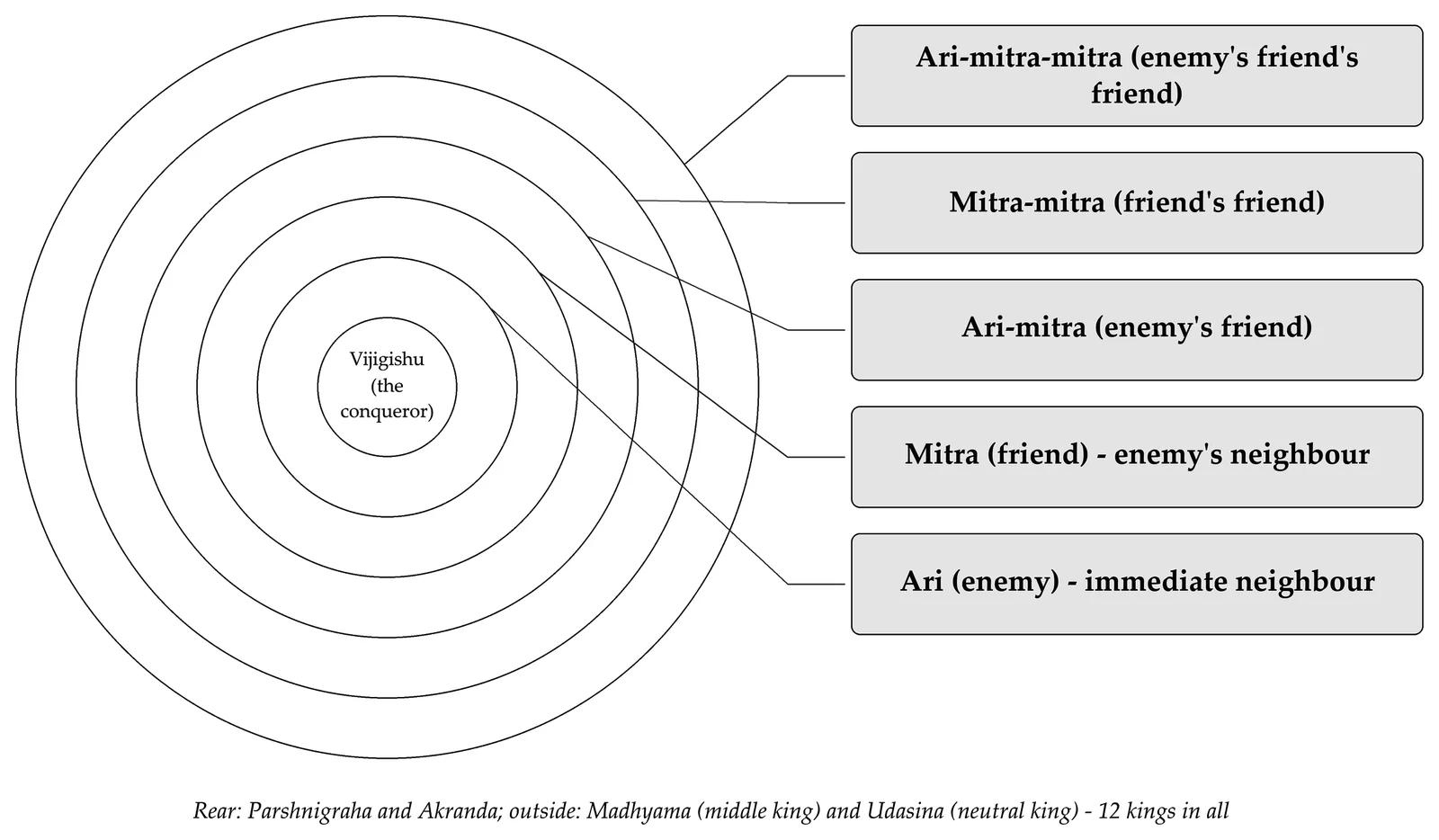
The rajamandala places the ambitious king, the vijigishu, at the centre of a circle of states: his immediate neighbour is a natural enemy, the state beyond is a natural friend, and so on outwards, with a powerful middle king and a distant neutral king. The shadgunya, six measures, tell the king when to make peace, wage war, remain neutral, march, seek shelter with a stronger power or follow a dual policy.
The Twelve Kings of the Mandala
Kautilya’s circle of states includes twelve kings, counted from the would-be conqueror outwards:
- In front: the vijigishu (conqueror) himself, then the ari (enemy, the immediate neighbour), the mitra (friend, beyond the enemy), the ari-mitra (enemy’s friend), the mitra-mitra (friend’s friend) and the ari-mitra-mitra (friend of the enemy’s friend).
- Behind: the parshnigraha (rear enemy), the akranda (rear friend), the parshnigrahasara (ally of the rear enemy) and the akrandasara (ally of the rear friend).
- Above the circle: the madhyama (middle king), who borders both the conqueror and the enemy and is strong enough to help or resist either, and the udasina (neutral king), who lies beyond and is stronger than all of them.
When to Use the Six Measures
Kautilya (Arthashastra 7.1) gives rules for choosing among the six measures. A king who is weaker than his enemy should make sandhi (peace); one who is stronger should make vigraha (war); one who thinks that neither side can harm the other should practise asana (staying quiet); one who has excess strength should undertake yana (marching); one who lacks strength should seek samshraya (shelter) with a stronger king; and one who needs help to achieve his aim should adopt dvaidhibhava (dual policy), making peace with one king and war with another. The underlying rule is that a king should choose the measure that helps him advance rather than decline.
The Four Upayas and Three Kinds of Conqueror
Alongside the six measures, Kautilya lists four means (upayas) of dealing with other states: sama (conciliation), dana (gifts), bheda (division) and danda (force), to be used in that order of preference. He also distinguishes three kinds of conqueror (Arthashastra 12.1): the dharmavijayi, who is satisfied with the submission of the defeated king; the lobhavijayi, who wants land and wealth; and the asuravijayi, who seizes land, wealth, family and even the life of the defeated. A weak king, he advises, should submit to the righteous conqueror and resist the others by every means.
Kautilya and Modern Realism
The Arthashastra was rediscovered when R. Shamasastry found a manuscript in Mysore in 1905, published the text in 1909 and an English translation in 1915; R.P. Kangle produced a critical edition between 1960 and 1965. Max Weber, in Politics as a Vocation (1919), remarked that compared with it Machiavelli’s The Prince is harmless. Roger Boesche, in The First Great Political Realist (2002), places Kautilya alongside Thucydides, Machiavelli and Hans Morgenthau. Unlike modern realists, however, Kautilya saw power as serving the welfare of the people and the protection of dharma.
4.2 Diplomacy and the Duta
The duta, or envoy, was the main instrument of diplomacy. Kautilya distinguishes envoys with full powers, envoys with a limited mission and messengers who carry the royal word. Envoys were to be treated as inviolable, a principle illustrated in the Ramayana and close to the modern idea of diplomatic immunity.

Duties of the Envoy
- Carrying messages. The envoy delivered the king’s words exactly as given and brought back the reply.
- Maintaining treaties. He watched over existing agreements and ensured that the other side kept its promises.
- Upholding honour. He was to protect the dignity of his king and never accept insult.
- Gathering intelligence. He studied the other state’s forts, army, treasury, allies and weak points and the loyalty of its people.
- Winning friends and dividing enemies. He sought to gain allies, win over the enemy’s discontented officials and sow dissension among hostile groups.
- Behaving with restraint. Kautilya advised the envoy not to be elated by honour, not to be provoked by harsh words, to sleep alone and to avoid women and drink, so that he would not reveal secrets.
The Inviolability of Envoys
Kautilya states that envoys are the mouthpieces of kings and must speak as they are instructed, so even an envoy of low birth should not be killed. The Ramayana illustrates the rule: when Ravana orders that Hanuman be killed in Lanka, Vibhishana reminds him that an envoy must never be put to death, and Ravana instead orders Hanuman’s tail to be set on fire. The Mahabharata similarly shows Krishna going to the Kaurava court as an envoy of peace before the war. This tradition anticipates the modern principle of diplomatic immunity, codified in the Vienna Convention on Diplomatic Relations of 1961.
Spies and Intelligence
Kautilya built diplomacy on intelligence. He describes stationary spies (samstha) and roving spies (sanchara) disguised as students, ascetics, householders, traders, monks, poisoners and women agents (Arthashastra 1.11 and 1.12). Spies watched the king’s own ministers as well as foreign states, and reports were trusted only when three independent sources agreed. Modern scholars see in this an early theory of intelligence and counter-intelligence comparable to the work of modern security agencies.
Ancient Indian Diplomacy in Practice
Diplomatic contact was common in practice. Megasthenes served as the envoy of Seleucus Nicator at the court of Chandragupta Maurya around 300 BCE after the two kings made a treaty. In Rock Edict XIII, Ashoka records sending envoys of dhamma to five Hellenistic kings, Antiochus, Ptolemy, Antigonus, Magas and Alexander, and to the peoples of the south. Later, the Guptas and the Cholas exchanged embassies with Sri Lanka, Southeast Asia and China. Scholars such as Kautilya’s modern interpreters see continuity between this tradition and India’s later emphasis on dialogue, non-alignment and the Panchsheel principles of 1954.
4.3 War and National Security
Ancient texts set out rules for just conduct in war, such as sparing those who surrender and the unarmed. Kautilya distinguished open, concealed and silent war, preferred victory without battle and built a system of national security based on intelligence, forts, armies and economic strength. Ashoka’s dhamma-vijaya, conquest by righteousness, offered a moral alternative.

Rules of Righteous War
- Equal combat. Before the war at Kurukshetra, the two sides agreed that chariot-warriors would fight chariot-warriors, horsemen would fight horsemen and foot soldiers would fight foot soldiers.
- Protection of the helpless. The Manusmriti (VII.91 to VII.93) forbids striking one who joins his palms in surrender, one who is asleep, without armour, naked or unarmed, a mere onlooker or one who is fleeing.
- Forbidden weapons. Manu forbids concealed, barbed, poisoned and burning weapons, an early form of the modern ban on certain weapons.
- Protection of civilians. Megasthenes reported that Indian farmers continued to plough their fields in safety even while battles were fought nearby.
- Treatment of the defeated. Kautilya advised the conqueror to respect the customs, gods and festivals of conquered people and to place a member of the defeated royal family on the throne where possible.
Kautilya’s Military Organisation
Kautilya’s army had four arms (chaturanga): infantry, cavalry, chariots and elephants. He classified troops into six kinds (Arthashastra 9.2): hereditary troops (maula), hired troops (bhrita), troops of guilds (shreni), troops of allies (mitra), troops captured from the enemy (amitra) and forest tribes (atavi), and ranked the hereditary troops as the most reliable. He described four kinds of fort, the water fort (audaka), mountain fort (parvata), desert fort (dhanvana) and forest fort (vanadurga), and stressed that a strong treasury was the foundation of military power.
Ashoka and Dhamma-Vijaya
Rock Edict XIII records that in the Kalinga war about one hundred and fifty thousand people were deported, one hundred thousand were killed and many times that number died. Filled with remorse, Ashoka declared that the chief conquest is conquest by dhamma (dhamma-vijaya). He did not abolish the army or the death penalty, and he warned forest peoples that he still had power, but he made non-violence, tolerance and welfare the guiding principles of his foreign and domestic policy. His example shows an alternative to Kautilya’s realism within the same tradition.
Comparisons and Relevance
Kautilya’s ideas can be compared with those of Sun Tzu, whose Art of War also prized winning without battle, and with Carl von Clausewitz, whose On War (1832) presented war as the continuation of politics by other means. Kautilya’s idea of silent war through spies, propaganda and subversion resembles modern grey-zone and hybrid warfare. In India, scholars and strategists have revived Kautilya in debates on national security, arguing that his integration of economic strength, intelligence, alliances and military force offers a comprehensive approach to security in the twenty-first century.
4.4 Important Questions
- Question 1 Explain Kautilya’s rajamandala theory of inter-state relations.
- Question 2 Discuss Kautilya’s six measures of foreign policy (shadgunya).
- Question 3 Discuss the role, types and duties of the duta in ancient Indian diplomacy.
- Question 4 Discuss the ancient Indian law of war and ideas of national security.
DU asks the same idea in different words. So learn one broad answer for each question below; the same answer works for every question joined by OR.
Important Question 1
Explain Kautilya’s rajamandala theory of inter-state relations.
OR
Discuss the mandala theory and its relevance to contemporary international relations.
OR
Examine the guiding principles of international politics in ancient India.
Model Answer
“The king who is situated anywhere immediately on the circumference of the conqueror’s territory is termed the enemy.”
— Kautilya, Arthashastra, Book VI (tr. R. Shamasastry)
Introduction. Kautilya’s Arthashastra contains the most systematic ancient Indian theory of relations between states. Its central idea is the rajamandala, the circle of kings, which explains how geography shapes friendship and enmity among states. Scholars such as Benoy Kumar Sarkar and Hiralal Chatterjee have compared it with modern theories of the balance of power.
1. The Vijigishu
At the centre of the mandala is the vijigishu, the king who seeks to conquer or expand his power. The theory is written from his point of view and advises him how to deal with the states around him.
2. The Enemy
The king whose territory borders the vijigishu’s is the ari, the natural enemy, because neighbours compete for land, resources and influence.
3. The Friend
The king beyond the enemy, who borders the enemy but not the vijigishu, is the mitra, the natural friend, since both share a common enemy. This is the principle that the enemy of my enemy is my friend.
4. The Outer Rings
Beyond the friend lie the enemy’s friend (ari-mitra), the friend’s friend (mitra-mitra) and the enemy’s friend’s friend, alternating between hostility and friendship.
5. The Rear
Behind the vijigishu are the rear enemy (parshnigraha), who may attack when he marches forward, and the rear friend (akranda), who can restrain the rear enemy, along with their allies.
6. The Middle and Neutral Kings
The madhyama, or middle king, borders both the vijigishu and the enemy and is stronger than either, able to help or resist both. The udasina, or neutral king, lies beyond and is more powerful still. Together, the mandala includes twelve kings.
7. Balance of Power
The mandala is a theory of balance of power. Each king seeks to strengthen himself and weaken rivals by making alliances, so the system tends towards a shifting balance among states.
8. Constituents of Power
Kautilya measures each king’s power through the seven limbs of the state and through three forms of power: power of counsel (mantra-shakti), power of might (prabhava-shakti) and power of energy (utsaha-shakti).
9. Sarkar’s Interpretation
Benoy Kumar Sarkar, writing in 1919, presented the mandala as a Hindu theory of international relations, comparable to European ideas of the balance of power and to Machiavelli’s realism, showing that ancient Indians had a developed theory of inter-state politics.
10. Chatterjee on Inter-State Law
Hiralal Chatterjee showed that ancient Indian states followed rules on treaties, envoys, war and neutrality, which he regarded as an early form of international law.
11. Realism
The mandala theory is realist: it assumes that states pursue power and security, that neighbours are rivals and that alliances depend on interest rather than sentiment.
12. Relevance Today
Scholars apply mandala thinking to India’s relations with its neighbours, for example rivalry with neighbouring states and closer ties with countries beyond them, and to the balancing behaviour of states in Asia.
13. Limitations
Critics note that geography no longer determines friendship and enmity so simply, since modern states are linked by trade, institutions and global issues, and that the theory ignores moral and legal restraints.
14. A Wider Vision
Ancient Indian thought also offered a moral vision of the world as one family, Vasudhaiva Kutumbakam, which balances the realism of the mandala with ideals of cooperation.
15. Mandala and Geography
The mandala is not a fixed map but a model. Kautilya assumed that states are arranged in rings around the conqueror and that distance shapes interest. In practice, rivers, mountains and forests changed these patterns, and Kautilya himself advises the king to study terrain, seasons and the character of each neighbour before choosing allies or rivals.
16. Evaluation
The rajamandala is a pioneering realist theory of inter-state relations based on geography and the balance of power.
Conclusion. Thus, Kautilya’s rajamandala places the vijigishu at the centre of twelve kings, with the neighbour as natural enemy, the next state as natural friend and the middle and neutral kings as powerful outsiders. As Sarkar and Chatterjee show, it is a realist theory of balance of power, still used to understand India’s neighbourhood, though modern interdependence limits it.
Important Question 2
Discuss Kautilya’s six measures of foreign policy (shadgunya).
OR
Examine the shadgunya and the upayas as instruments of statecraft.
OR
How did Kautilya advise a king to choose between peace and war?
Model Answer
“Whoever is inferior to another shall make peace with him; whoever is superior in power shall wage war.”
— Kautilya, Arthashastra, Book VII (tr. R. Shamasastry)
Introduction. The rajamandala describes the structure of inter-state relations, and the shadgunya, the six measures, describe the policies a king can follow within it. Kautilya teaches that the choice among these measures depends on the king’s relative strength and his aim of moving from decline to progress. The four upayas add methods of dealing with others.
1. Aim of Foreign Policy
Kautilya says that a king’s situation may be one of decline (kshaya), stagnation (sthana) or progress (vriddhi). The purpose of foreign policy is to move from decline to stagnation and from stagnation to progress.
2. Sandhi
Sandhi means peace or treaty. A weaker king should make peace with a stronger one, and peace is preferable when it brings equal or greater gains than war.
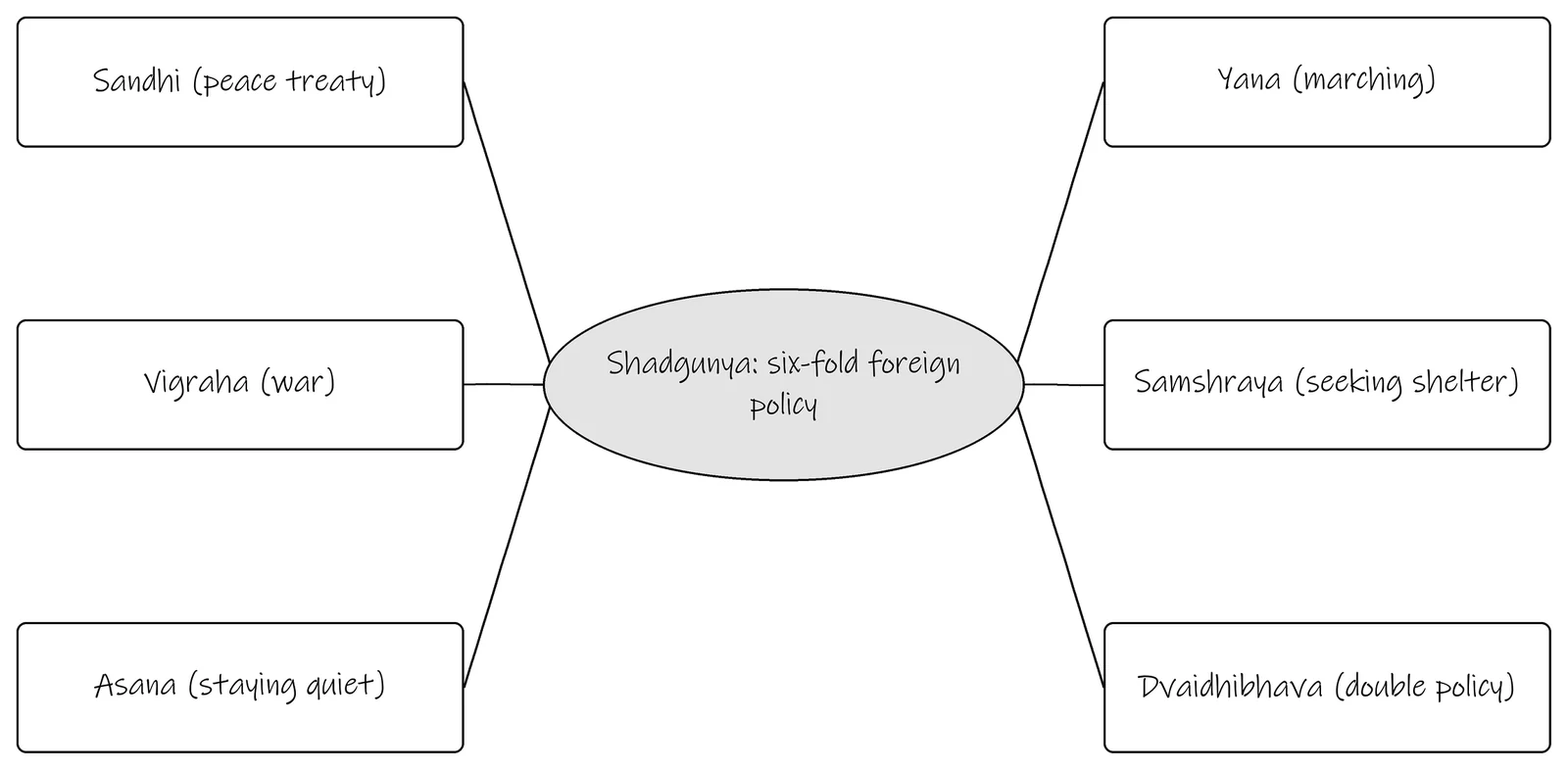
3. Vigraha
Vigraha means hostility or war. A king superior in power may wage war, but Kautilya regards war as costly and prefers other means when they achieve the same ends.
4. Asana
Asana means staying quiet or neutrality. When neither side can harm the other, a king should wait and build his strength.
5. Yana
Yana means marching or preparing to attack. A king with sufficient strength and favourable conditions may march against an enemy.
6. Samshraya
Samshraya means seeking shelter or protection with a stronger king. A king unable to defend himself should ally with a powerful protector.
7. Dvaidhibhava
Dvaidhibhava means a dual policy: making peace with one king while waging war with another, to gain advantage from both.
8. Choosing the Measure
Kautilya says that the measure should be chosen by comparing gains and losses. Between peace and war offering equal gains, peace is preferred, because war brings losses of men and money.
9. Types of Treaties
Kautilya describes many kinds of treaties, such as those for land, for allies, for wealth or for joint action, and discusses how to keep or break them depending on advantage.
10. The Four Upayas
The upayas are four methods: sama (conciliation), dana (gifts), bheda (sowing dissension) and danda (force). Kautilya recommends using the gentler methods first and force only when necessary.
11. Realism and Pragmatism
The shadgunya shows Kautilya’s pragmatic realism: policy depends on circumstances and relative power, not on fixed friendships or moral rules.
12. Sihag’s View
Balbir Singh Sihag argues that Kautilya’s approach was proactive and pragmatic, combining diplomacy, alliances, economic strength and military preparedness to secure the state.
13. Relevance Today
The six measures resemble modern options of peace treaties, war, neutrality, deterrence, alliances and hedging. India’s idea of strategic autonomy, working with many partners without full alliance, recalls dvaidhibhava.
14. Criticisms
Critics say the shadgunya treats treaties as instruments of advantage and may justify deception, which conflicts with modern ideas of international law and trust.
15. Peace and Progress
Kautilya’s preference for peace when gains are equal shows that his realism was not warlike. He notes that in peace a king can build forts, irrigation works, trade routes and mines, which increase his power more surely than a risky war. This idea anticipates modern arguments that economic growth is the foundation of national power.
16. Hostages and Guarantees
Treaties were often secured by guarantees such as oaths, the word of respected persons or the exchange of hostages, sometimes princes. Kautilya discusses which guarantees are more reliable and how a king can recover hostages. Such devices show that ancient diplomacy faced the same problem as modern diplomacy: how to make agreements credible among rivals.
17. Evaluation
The shadgunya provides a flexible framework for foreign policy based on relative strength, gains and losses.
Conclusion. Thus, Kautilya’s shadgunya, peace, war, neutrality, march, shelter and dual policy, guides a king according to his strength to move from decline to progress. With the four upayas, it forms a pragmatic, realist statecraft that Sihag calls proactive, and it still helps explain choices such as strategic autonomy.
Important Question 3
Discuss the role, types and duties of the duta in ancient Indian diplomacy.
OR
Examine Kautilya’s view of envoys and diplomacy.
OR
How did ancient Indian thought protect envoys? Compare with modern diplomatic practice.
Model Answer
“Messengers are the mouth-pieces of kings.”
— Kautilya, Arthashastra, Book I (tr. R. Shamasastry)
Introduction. Diplomacy has a long history in India. The duta, or envoy, carried messages between kings, negotiated treaties and gathered information. The Arthashastra, the Manusmriti and the epics describe the qualities, types, duties and protection of envoys in detail. Hiralal Chatterjee regards these rules as part of an ancient Indian law of nations.
1. Meaning of Duta
A duta is an envoy or messenger sent by one king to another. He represents his king, speaks in his name and protects his interests abroad.
2. Importance of Diplomacy
Kautilya regarded diplomacy as essential to foreign policy, since many aims could be achieved through negotiation, alliances and intrigue without war.
3. Nisrishtartha
The nisrishtartha is an envoy with full powers, who can negotiate and decide on behalf of the king. He must have all the qualities of a minister.
4. Parimitartha
The parimitartha is an envoy with a limited mission, who acts within fixed instructions. He needs three-quarters of a minister’s qualities.
5. Shasanahara
The shasanahara is a messenger who only conveys the royal message. He needs half of a minister’s qualities.
6. Duties of the Envoy
Kautilya lists the envoy’s duties: delivering messages, maintaining treaties, upholding his king’s prestige, winning allies, creating dissension among the enemy’s friends, gathering intelligence, and bringing back hostages or secret agents.
7. Conduct
An envoy should not be elated by honours, should bear harsh words calmly, avoid drink and women, observe the enemy’s strengths and weaknesses, and report faithfully to his king.
8. Gathering Information
Envoys observed the condition of the foreign kingdom, its army, forts, treasury and people, and the loyalty of its officials, making diplomacy closely linked with intelligence.
9. Inviolability
Envoys were considered inviolable. Kautilya says that since envoys are the mouthpieces of kings, they should not be killed even if they speak harshly, a principle similar to modern diplomatic immunity.
10. The Ramayana
When Ravana wanted to kill Hanuman, who had come as Rama’s envoy, Vibhishana objected that killing an envoy was against the rules of kingship, so Hanuman was punished instead by having his tail set on fire.
11. The Mahabharata
Before the Kurukshetra war, Krishna went as an envoy of the Pandavas to the Kaurava court to seek peace, showing the use of diplomacy to avoid war.
12. The Manusmriti
The Manusmriti says that peace and war depend on the envoy, who should be learned, honest, skilful, of good family and able to understand gestures and intentions.
13. Comparison with Modern Diplomacy
The ancient rules resemble the Vienna Convention on Diplomatic Relations of 1961, which protects diplomats and distinguishes ranks of envoys, though modern diplomats are not expected to sow dissension openly.
14. Criticisms
Kautilya’s envoys combined diplomacy with espionage and intrigue, which modern international law treats as improper, showing the realist character of his statecraft.
15. Envoy and Spy
Kautilya clearly distinguishes envoys from secret agents but expects envoys to use their presence at a foreign court to learn as much as possible. They were to contact secret agents, watch the movement of troops and observe which officials were discontented. This blending of diplomacy and intelligence is a feature of his realist statecraft.
16. Reception of Foreign Envoys
Kautilya also advises how to receive envoys from other kings. They should be honoured and lodged suitably, but watched by spies, and their words should be weighed carefully. A king could delay a reply to gain time, but must not harm the envoy. This shows that diplomatic etiquette and caution went together.
17. Envoys in Ancient Practice
Historical sources confirm the exchange of envoys. Megasthenes came as the envoy of Seleucus to Chandragupta Maurya, and Ashoka’s edicts mention envoys and missionaries sent to Hellenistic kings in West Asia and North Africa. Such exchanges show that the rules in the texts reflected real diplomatic practice.
18. Evaluation
Ancient Indian thought developed a detailed theory of diplomacy, with types of envoys, duties and immunity close to modern practice.
Conclusion. Thus, the duta was central to ancient Indian diplomacy. Kautilya distinguished the nisrishtartha, parimitartha and shasanahara, and assigned them duties of negotiation, alliance-building and intelligence. Envoys were inviolable, as the Ramayana shows, a principle close to modern diplomatic immunity, though Kautilya’s diplomacy also included intrigue.
Important Question 4
Discuss the ancient Indian law of war and ideas of national security.
OR
Examine Kautilya’s classification of war and conquerors.
OR
What were the rules of dharmayuddha? How did ancient thinkers approach national security?
Model Answer
“When he fights with his foes in battle, let him not strike with weapons concealed, nor with barbed, poisoned, or the points of which are blazing with fire.”
— Manusmriti, Chapter VII (tr. G. Bühler)
Introduction. War was a central concern of ancient Indian political thought. Texts such as the Mahabharata and the Manusmriti laid down rules of righteous war (dharmayuddha), while Kautilya analysed war realistically as an instrument of policy and developed a comprehensive approach to national security. Ashoka’s turn from war to dhamma offered a moral alternative.
1. Vigraha
Vigraha means hostility or war, one of the six measures of foreign policy. It was to be chosen when a king was stronger and when war promised greater gains than peace.
2. Dharmayuddha
Dharmayuddha, righteous war, required that war be fought according to rules: fighting only between equals, with fair warning, and sparing those who surrendered, fled, were asleep, unarmed or not fighting.
3. The Manusmriti’s Rules
The Manusmriti forbids striking with concealed, barbed or poisoned weapons, and attacking one who has surrendered, who is unarmed, wounded or a spectator. These rules resemble modern humanitarian law.
4. The Mahabharata
Before the Kurukshetra war, both sides agreed on rules of fair fighting, but these were broken during the battle, showing the tension between ideals and the realities of war.
5. Kautilya’s Three Kinds of War
Kautilya distinguishes open war (prakasha yuddha) at a set time and place, concealed war (kuta yuddha) using surprise and deception, and silent war (tushnim yuddha) using secret agents, assassination and subversion.
6. Three Kinds of Conquerors
Kautilya describes the righteous conqueror (dharmavijayi), who is satisfied with submission; the greedy conqueror (lobhavijayi), who seeks land and wealth; and the demonic conqueror (asuravijayi), who seizes land, wealth, family and life.
7. Treatment of the Conquered
Kautilya advises a conqueror to win over the conquered people by respecting their customs, festivals and leaders, remitting taxes and rewarding the loyal, so that they accept the new rule.
8. War as Last Resort
Although Kautilya analysed war, he preferred to achieve aims through diplomacy and intrigue, since war wastes men and money and its outcome is uncertain.
9. Ashoka’s Dhamma-Vijaya
After the bloody Kalinga war, Ashoka renounced conquest by force and proclaimed dhamma-vijaya, conquest by righteousness, as the true conquest, an early example of a ruler turning away from war.
10. Kautilya on National Security
Kautilya identifies four kinds of threats to the state: internal threats, external threats, internal threats aided from outside and external threats aided from inside, and advises measures for each.
11. Intelligence
Kautilya describes a vast system of spies, both stationary and roving, disguised as ascetics, traders and householders, who watched officials, citizens and foreign states.
12. Forts and Army
National security also depended on forts of different kinds, such as water, mountain, desert and forest forts, and on a fourfold army of elephants, chariots, cavalry and infantry.
13. Sihag’s Analysis
Balbir Singh Sihag describes Kautilya’s approach to national security as proactive and pragmatic, combining economic strength, intelligence, deterrence and diplomacy to prevent threats before they grow.
14. Vasudhaiva Kutumbakam
Arvind Gupta and Arpita Mitra argue that ancient ideas such as Vasudhaiva Kutumbakam, the world as one family, remain relevant to India’s strategic outlook. India used the phrase as the theme of its G20 presidency in 2023.
15. Protection of Non-Combatants
Greek observers noted that Indian farmers continued working their fields even when armies fought nearby, because cultivators were not attacked. Megasthenes reported this as a striking custom. The texts also forbid destroying crops and harming priests, women and children, showing an early concern for the protection of non-combatants.
16. Internal Security
Kautilya gave equal attention to internal security. He advised the king to test the loyalty of ministers through secret tests, watch officials for corruption, guard against conspiracies in the palace and remove threats he called thorns, such as fraudulent traders, criminals and rebels. A secure state, for him, needed vigilance at home as well as strength abroad.
17. Evaluation
Ancient Indian thought combined humane rules of war with realistic analysis of security, offering both ideals and practical strategy.
Conclusion. Thus, ancient Indian thought laid down rules of dharmayuddha that protected the surrendered and unarmed, while Kautilya classified open, concealed and silent war and righteous, greedy and demonic conquerors. His approach to national security, through intelligence, forts, armies and economic strength, is called proactive by Sihag, and Ashoka’s dhamma-vijaya and Vasudhaiva Kutumbakam offer moral alternatives.
Short Notes
(a) Madhyama and udasina
In the rajamandala, the middle king who borders both the conqueror and his enemy, and the more powerful neutral king beyond them.
(b) Dvaidhibhava
The dual policy among Kautilya’s six measures: making peace with one king while waging war with another.
(c) Dhamma-vijaya
Conquest by righteousness, which Ashoka proclaimed after the Kalinga war as the true conquest, in place of conquest by force.
(d) Sama, dana, bheda, danda
The four upayas or methods of statecraft: conciliation, gifts, sowing dissension and force, to be used in that order of preference.
More notes: MDSE-16 Political Ideas of Ancient India
These notes are prepared by PADHO TO AISE for study help. They are not an official University of Delhi publication.