
Semester VIII MDSE-16 Political Ideas of Ancient India
Unit 3 · 24 min read · Updated 24 Nov 2026
As per the University of Delhi (DU) BA (Hons) Political Science syllabus
Contents
- 3.1 The Economy of the Janapadas and Mahajanapadas
- Features of the Second Urbanisation
- The Sixteen Mahajanapadas
- The Mauryan Economy
- 3.2 Taxation and Economic Law
- Classical Principles of Taxation
- Kinds of Revenue
- Control of Officials
- Economic Law in the Dharmashastras
- 3.3 The Temple Economy and Trade
- Features of the Temple Economy
- Indo-Roman and Indian Ocean Trade
- Merchant Guilds and the Cholas
- 3.4 Important Questions
- Discuss the economic organisation of the janapadas and mahajanapadas.
- Discuss the principles of taxation and financial administration in ancient India.
- Discuss the Mitakshara and Dayabhaga schools and the laws governing economic life in ancient India.
- Discuss the role of temples and trade in the economy of ancient India.
- Short Notes
सभी कार्य कोष पर निर्भर हैं, इसलिए सबसे पहले कोष पर ध्यान देना चाहिए।
All undertakings depend upon finance. Hence foremost attention shall be paid to the treasury.
— Kautilya, Arthashastra, Book II (tr. R. Shamasastry)
AARTHA niradharan means the arrangement or organisation of economic life. Ancient Indian thinkers treated artha, wealth and its management, as one of the aims of life and the foundation of the state. This chapter examines the economy of the janapadas and mahajanapadas, ancient systems of taxation and financial administration, the laws of property and inheritance in the Mitakshara and Dayabhaga, and the temple economy and maritime trade, drawing on Kautilya’s Arthashastra, the Yajnavalkya Smriti, Balbir Singh Sihag, R. Mehta and Radha Kumud Mookerji.
3.1 The Economy of the Janapadas and Mahajanapadas
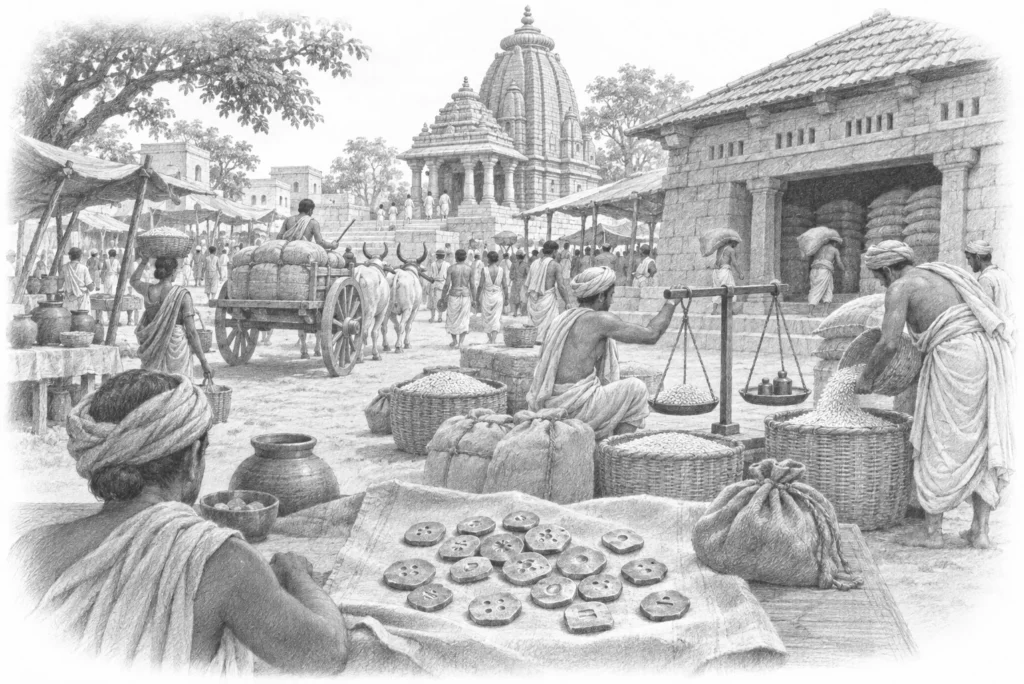
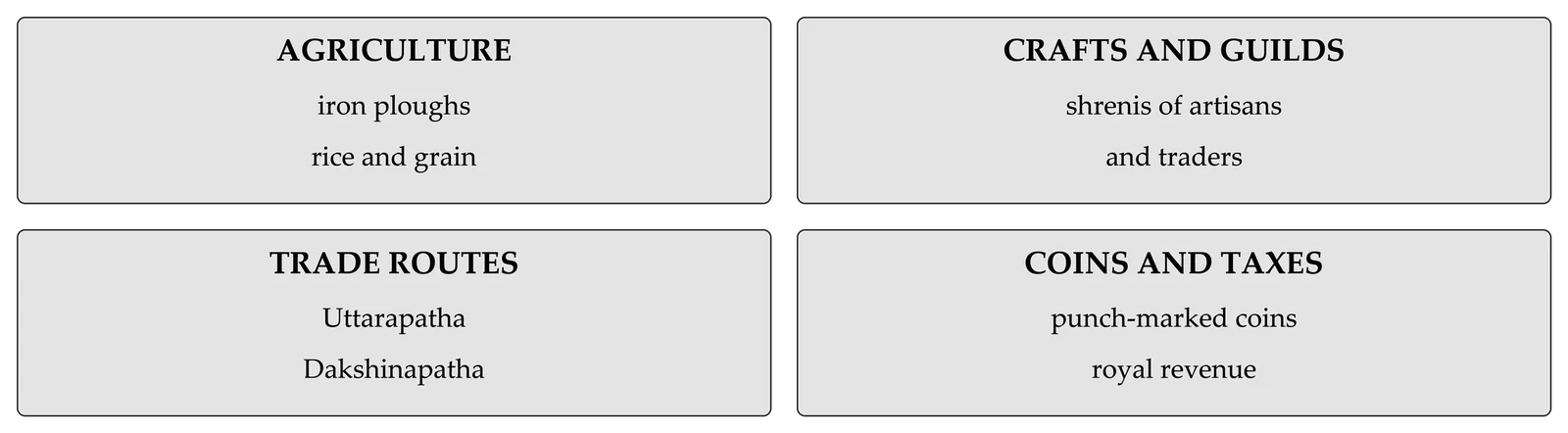
Around the sixth century BCE, the janapadas, territories of settled tribes, grew into sixteen mahajanapadas such as Magadha, Kosala, Vatsa and Avanti. Iron tools, wet-rice farming in the Ganga valley, new towns, guilds (shrenis) of artisans and merchants, trade routes and coins created what historians call the second urbanisation. Kings collected taxes to support armies and administration.
Features of the Second Urbanisation
- Iron and agriculture. Iron axes and ploughshares helped clear the forests of the middle Ganga valley, and the transplantation of wet rice produced large surpluses that could support towns and states.
- New towns. Cities such as Rajagriha, Shravasti, Kaushambi, Varanasi, Champa, Ujjayini and Taxila grew as political capitals and trading centres; the Northern Black Polished Ware pottery marks this urban culture.
- New social groups. The gahapati (rich householder and landowner) and the setthi (wealthy merchant and banker) appear prominently in Buddhist texts.
- Guilds. Artisans and merchants were organised in shrenis, which had their own heads (jettha), rules and courts and were recognised by kings.
- Money. Punch-marked silver coins called karshapanas made exchange, taxation and lending easier.
- Trade routes. The uttarapatha linked the Ganga valley with Taxila and the north-west, and the dakshinapatha ran towards the Deccan.
The Sixteen Mahajanapadas
The Anguttara Nikaya lists the sixteen mahajanapadas: Anga, Magadha, Kashi, Kosala, Vajji, Malla, Chedi, Vatsa, Kuru, Panchala, Matsya, Shurasena, Ashmaka, Avanti, Gandhara and Kamboja. Most were monarchies, but the Vajjis and Mallas were gana-sanghas. Over the next two centuries, they fought each other until Magadha emerged supreme under the Haryanka kings Bimbisara and Ajatashatru, the Shishunagas and the Nandas. Historians explain Magadha’s success by its fertile soil, its access to iron ore, the elephants of its forests, its river communications and its ambitious rulers, who moved the capital from Rajagriha to Pataliputra.
The Mauryan Economy
Under the Mauryas, the state played a large role in the economy. The Arthashastra describes crown lands (sita) managed by a superintendent of agriculture, state control of mines, salt, forests and some manufactures, a superintendent of trade who regulated prices, and officials who supervised weights and measures. Megasthenes, the Seleucid envoy to Chandragupta Maurya, described in his Indika how the city of Pataliputra was administered by six committees of five members each, dealing with industry, foreigners, registration of births and deaths, trade, manufactures and the collection of a tax on sales. Balbir Sihag, in Kautilya: The True Founder of Economics (2014), argues that the Arthashastra anticipated many ideas of modern economics, such as the role of incentives and the importance of institutions.
3.2 Taxation and Economic Law
Ancient texts set out principles of taxation: the king should take a moderate share, such as one-sixth of produce, collect it at the right time and never ruin the taxpayer. Laws on contracts, debts, interest, partnerships, wages and inheritance regulated economic life. The Mitakshara and Dayabhaga schools, which differ on the family’s rights in property, shaped Hindu law until modern times.
Classical Principles of Taxation
- The bee and the flower. The Shanti Parva advises the king to take taxes as a bee gathers honey, without harming the flower, so that the source of revenue is not destroyed.
- The ripe fruit. Kautilya compares the king to a gardener who picks fruit only when it is ripe, warning that unripe collection causes resentment and destroys the source.
- The sun and the rain. Kalidasa, in the Raghuvamsha, says that King Dilipa took taxes only for the good of his subjects, as the sun draws up water only to return it a thousandfold as rain.
- Fixed shares. The Manusmriti (VII.130) allows the king a fiftieth of cattle and gold and a sixth, eighth or twelfth of grain, depending on the quality of the land and the labour needed.
- Exemptions. Brahmins learned in the Vedas, children, women, the disabled and ascetics were usually exempt from taxes.
Kinds of Revenue
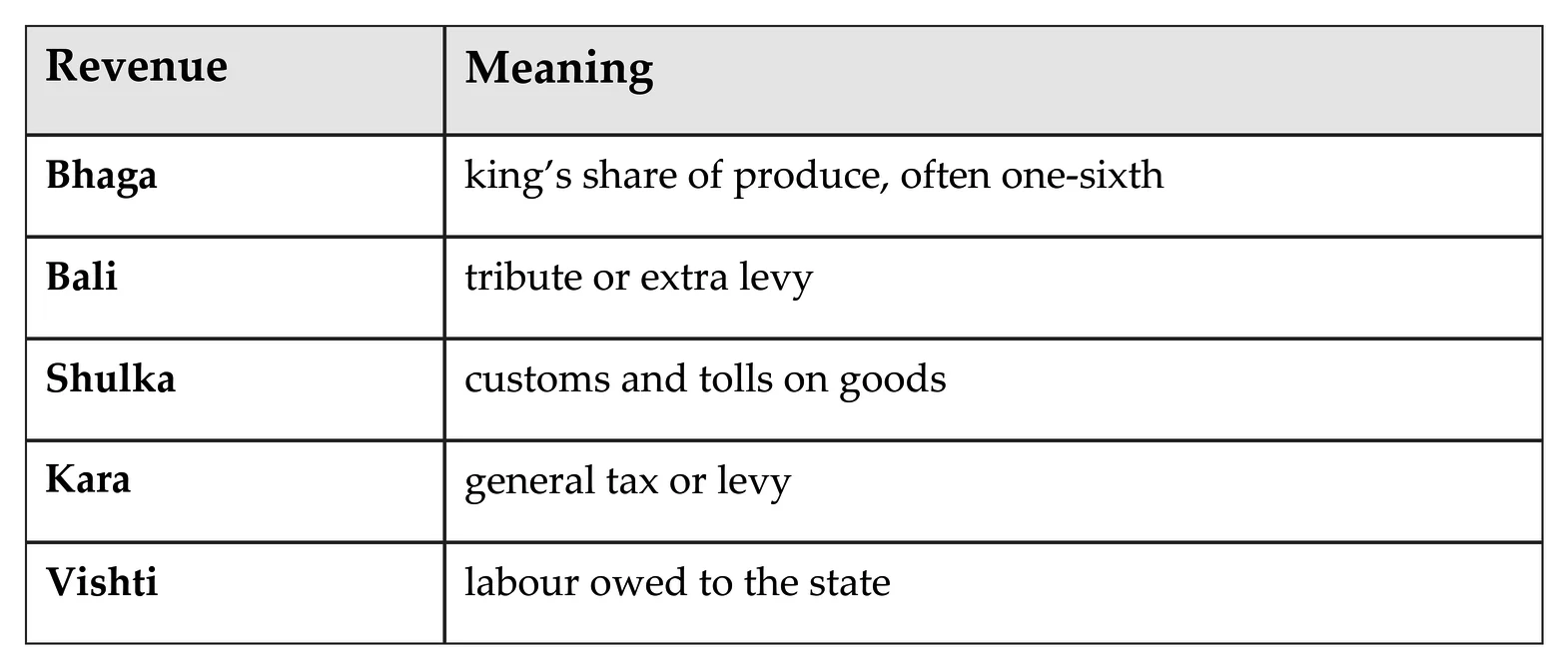
Ancient texts name several kinds of revenue. Bhaga was the king’s share of produce, bali an additional levy, shulka a customs and toll duty on goods, kara a general tax and vishti forced labour. In emergencies the king could ask for pranaya, a special contribution described by Kautilya as a request for affection, to be made only once. Kautilya lists seven sources of revenue (Arthashastra 2.6): the fort (towns), the countryside, mines, irrigation and building works (setu), forests, herds and trade routes. The samaharta acted as the collector-general and the sannidhata as the chief treasurer.
Control of Officials
Kautilya knew that revenue officials might steal. He listed forty ways in which they could embezzle money and observed that just as it is impossible to know when a fish moving in water drinks some of it, so it is impossible to know when officials take money for themselves. He therefore recommended regular audits, a fixed accounting year, the transfer of officials, the rewarding of informers and severe punishment for fraud. These ideas show an early concern with what we now call accountability and anti-corruption measures.
Economic Law in the Dharmashastras
The Manusmriti (VIII.4 to VIII.7) lists eighteen titles of law (vyavaharapadas), among them non-payment of debts, deposits, sale by a non-owner, partnership, non-payment of wages, breach of agreement, rescission of sale and purchase, boundary disputes and partition of inheritance. Rules on interest were detailed: Kautilya fixed a lawful rate of one and a quarter per cent a month, with higher rates for risky trade by land and sea. Later commentators developed property law, most famously Vijnaneshvara’s Mitakshara, written in the Chalukya court in the late eleventh or early twelfth century, and Jimutavahana’s Dayabhaga of twelfth-century Bengal. Their difference on rights by birth and rights on death shaped Hindu law until the Hindu Succession Act of 1956 and its amendment of 2005, which made daughters coparceners.
3.3 The Temple Economy and Trade
In early medieval south India, temples became major economic institutions: they owned land, lent money, stored grain and employed priests, artisans, musicians and cooks. India also had a long tradition of maritime trade, with the Roman world, Southeast Asia and China, which Radha Kumud Mookerji documented in Indian Shipping.

Features of the Temple Economy
- Land grants. Kings and wealthy donors gave temples tax-free land called devadana, while brahmins received brahmadeya villages; temples thus became major landholders.
- Banking. Temples received deposits of money and livestock and lent them to village assemblies and individuals at interest, using the returns to fund lamps, food offerings and festivals.
- Employment. The Brihadishvara temple at Thanjavur, completed under Rajaraja Chola around 1010 CE, supported hundreds of dancers, musicians, priests, accountants, potters and other workers listed in its inscriptions.
- Redistribution. Burton Stein, in Peasant State and Society in Medieval South India (1980), argued that temples redistributed resources and bound together kings, brahmins, peasants and merchants.
- Local institutions. Village assemblies, the brahmin sabha, the non-brahmin ur and the merchant nagaram, managed temple lands and accounts; the Uttaramerur inscriptions of 919 and 921 CE describe the election of committee members by drawing lots from a pot (kudavolai).
Indo-Roman and Indian Ocean Trade
India’s maritime trade flourished in the early centuries CE. The Periplus of the Erythraean Sea, a Greek guide of the first century CE, describes ports such as Barygaza (Bharuch), Muziris on the Kerala coast and Arikamedu near Puducherry, where archaeologists have found Roman pottery and coins. Sailors used the monsoon winds to cross the Arabian Sea. India exported pepper, pearls, ivory, fine textiles and precious stones and imported gold, wine and glass. Pliny the Elder complained in his Natural History that India drained Rome of fifty million sesterces a year.
Merchant Guilds and the Cholas
In south India, powerful merchant guilds such as the Ainnurruvar (the Five Hundred of Ayyavole, i.e. Aihole), the Manigramam and the Nanadesis traded across the Bay of Bengal and into Southeast Asia and China. The Chola kings supported this trade. In 1025, Rajendra I sent a naval expedition against the Srivijaya kingdom in Southeast Asia, probably to protect trade routes, and the Cholas sent embassies to the Song court of China. Radha Kumud Mookerji, in Indian Shipping (1912), used such evidence to argue that ancient India had been a great maritime power, a theme taken up by nationalists to counter colonial claims that Indians had never been seafarers.
3.4 Important Questions
- Question 1 Discuss the economic organisation of the janapadas and mahajanapadas.
- Question 2 Discuss the principles of taxation and financial administration in ancient India.
- Question 3 Discuss the Mitakshara and Dayabhaga schools and the laws governing economic life in ancient India.
- Question 4 Discuss the role of temples and trade in the economy of ancient India.
DU asks the same idea in different words. So learn one broad answer for each question below; the same answer works for every question joined by OR.
Important Question 1
Discuss the economic organisation of the janapadas and mahajanapadas.
OR
Examine the features of the economy during the second urbanisation in ancient India.
OR
How did economic change contribute to the rise of the mahajanapadas?
Model Answer
“All undertakings depend upon finance. Hence foremost attention shall be paid to the treasury.”
— Kautilya, Arthashastra, Book II (tr. R. Shamasastry)
Introduction. Between about 600 and 300 BCE, northern India underwent major economic and political change. Tribal territories called janapadas grew into larger states called mahajanapadas, towns appeared along the Ganga, trade expanded and coins came into use. These changes created the economic base for the rise of powerful kingdoms such as Magadha and, later, the Mauryan Empire.
1. From Jana to Janapada
The word janapada means the foothold of a tribe. As Vedic tribes settled in the Ganga plains, they became attached to territories, which took their names, such as the Kurus, Panchalas and Kosalas.
2. The Sixteen Mahajanapadas
Buddhist texts list sixteen great states: Anga, Magadha, Kashi, Kosala, Vajji, Malla, Chedi, Vatsa, Kuru, Panchala, Matsya, Shurasena, Ashmaka, Avanti, Gandhara and Kamboja. Most were monarchies, while some, such as the Vajji and Malla, were ganas.
3. Agriculture
Iron tools helped clear forests and plough heavy soils, and wet-rice cultivation in the middle Ganga valley produced large surpluses. Agricultural surplus supported towns, armies and the state.
4. The Gahapati
Buddhist texts describe the gahapati, a wealthy householder who owned land and cattle and employed labourers. Gahapatis were important taxpayers and supporters of new religious movements.
5. Second Urbanisation
Towns such as Rajagriha, Shravasti, Kaushambi, Varanasi, Ujjayini and Taxila grew as centres of administration, crafts and trade. Historians call this the second urbanisation, after the Harappan cities.
6. Crafts and Guilds
Artisans and merchants organised themselves into guilds called shrenis, which had their own rules, leaders and courts. The Jataka stories mention eighteen kinds of guilds, including potters, weavers, carpenters and metal workers.
7. Trade Routes
The Uttarapatha connected Taxila in the north-west with the Ganga plains and the eastern port of Tamralipti, while the Dakshinapatha led to the Deccan. Caravans of merchants, called sarthas, carried goods along these routes.
8. Coins
Punch-marked silver coins, called karshapanas, came into use around the sixth or fifth century BCE. Money made trade, taxation and lending easier and helped the growth of markets.
9. Money-Lending
Buddhist and legal texts show that lending at interest was common, and rules on debts and interest developed. Merchants called setthis became wealthy and influential.
10. Taxation
Kings of the mahajanapadas collected taxes such as bali, bhaga and shulka from farmers, artisans and traders. Regular revenue allowed them to maintain standing armies and officials.
11. Rise of Magadha
Magadha rose to dominance under Bimbisara and Ajatashatru because of fertile land, iron ores, forests with elephants, control of river trade and strong rulers, and became the base of the Mauryan Empire.
12. Panini’s Evidence
V.S. Agrawala’s study of Panini’s grammar shows a detailed vocabulary of agriculture, crafts, trade, coins and taxation, revealing a complex economy in the fifth century BCE.
13. Sihag on Kautilya
Balbir Singh Sihag argues that Kautilya, writing in the Mauryan period, developed an understanding of markets, taxation, welfare and economic growth that makes him a true founder of economics.
14. Social Effects
Economic change increased inequality between rich householders and merchants and poor labourers and slaves, and it also encouraged new religious movements such as Buddhism and Jainism, which appealed to traders.
15. Mauryan Economy
The Mauryan Empire built on the economy of the mahajanapadas. The state ran mines, forests, workshops and storehouses, controlled weights and measures and collected revenue through a large bureaucracy. Megasthenes, the Greek envoy at Chandragupta’s court, described a society of farmers, artisans, traders and officials, and a royal road linking the north-west with Pataliputra.
16. Evaluation
The economy of the mahajanapadas, based on agriculture, crafts, guilds, trade and coins, laid the foundations of the large states of ancient India.
Conclusion. Thus, the janapadas grew into sixteen mahajanapadas as iron tools, wet-rice farming, towns, guilds, trade routes and coins created a second urbanisation. Taxation financed armies and administration, allowing Magadha to rise. As Kautilya said, all undertakings depend on finance, and Sihag sees him as a founder of economics.
Important Question 2
Discuss the principles of taxation and financial administration in ancient India.
OR
Examine the tax system according to the Arthashastra, the Manusmriti and the Shukraniti.
OR
How did Kautilya organise the treasury and revenue administration?
Model Answer
“Just as one plucks ripe fruits from a garden, so shall the king collect revenue as it becomes due.”
— Kautilya, Arthashastra, Book V (tr. L.N. Rangarajan)
Introduction. Ancient Indian thinkers regarded the treasury (kosha) as one of the most important elements of the state. The Arthashastra, the Manusmriti, the Mahabharata and the Shukraniti set out principles of taxation and financial administration. Scholars such as Rohan Kulkarni and S.K. Sharma show that these texts recommended moderate, fair and regular taxation.
1. Importance of the Treasury
Kautilya made the treasury one of the seven limbs of the state and said that all undertakings depend on finance. Without a full treasury, a king cannot maintain an army, pay officials or protect the people.
2. Taxes as Wages for Protection
Texts describe taxes as the king’s wages for protecting the people. A king who collects taxes but fails to protect is condemned, making taxation part of a reciprocal relationship.
3. The King’s Share
The main tax was bhaga, the king’s share of agricultural produce, usually one-sixth. The Manusmriti allows the king to take an eighth, sixth or twelfth part of crops depending on circumstances.
4. Other Taxes
Other sources of revenue included bali (tribute), shulka (customs and tolls on goods), kara (general taxes), hiranya (cash payments), water rates for irrigation and vishti, labour owed to the state.
5. Principle of Moderation
Taxes should be light enough not to harm production. The Mahabharata compares the king to a bee that gathers honey without harming the flower and to a garland-maker who plucks flowers without destroying the plant.
6. Timing of Collection
Kautilya says the king should collect revenue as it becomes due, like plucking ripe fruit, and avoid taking unripe fruit, which causes resentment and destroys the source of revenue.
7. Ability to Pay
Texts recommend taxing according to capacity, exempting the poor, learned Brahmins, women and children in some cases, and reducing taxes in times of famine or distress.
8. Sources of Revenue in Kautilya
Kautilya lists seven main heads of revenue: forts, the countryside, mines, irrigation works and gardens, forests, herds and trade routes. Each was managed by officials to maximise income.
9. Revenue Officials
The samaharta, the collector-general, supervised revenue collection, and the sannidhata, the chief treasurer, managed stores and the treasury. More than thirty superintendents (adhyakshas) ran departments such as mines, trade, agriculture and ships.
10. Accounts and Audit
Kautilya describes an accounts office (akshapatala), annual accounts and strict audit. He lists forty ways in which officials may embezzle funds and recommends severe punishment.
11. Emergency Revenue
In a financial crisis, Kautilya allows special levies (pranaya) on farmers, traders and the wealthy, but only once and with care, so as not to cause unrest.
12. The Shukraniti
The Shukraniti, a later text, also recommends moderate taxation and careful budgeting, and discusses the allocation of revenue to the army, charity, officials and reserves.
13. Kulkarni’s Comparison
Rohan Kulkarni compares the tax systems of the Arthashastra, the Manusmriti and the Shukraniti, showing their shared principles of moderation, fairness and the welfare of taxpayers, which remain relevant to modern tax policy.
14. Sharma on Financial Administration
S.K. Sharma describes ancient Indian financial administration as well organised, with budgeting, accounting and audit, and argues that its principles of fairness and efficiency are still useful today.
15. Taxation and Welfare
Revenue was meant to return to the people through public works and welfare. Kautilya directs the king to build irrigation works, roads and storehouses, to maintain granaries for famine, and to support orphans, the aged, the sick and the helpless. Taxation was therefore justified not only as the price of protection but also as a means of securing yogakshema.
16. Evaluation
Ancient Indian thought developed sophisticated principles of taxation and financial administration based on moderation, timeliness and accountability.
Conclusion. Thus, ancient Indian texts treated the treasury as a foundation of the state and taxes as wages for protection. The king’s share of one-sixth, customs, tolls and other levies were to be collected moderately and at the right time, like ripe fruit. Kautilya’s samaharta, sannidhata, accounts and audit show a highly organised financial administration.
Important Question 3
Discuss the Mitakshara and Dayabhaga schools and the laws governing economic life in ancient India.
OR
Distinguish between the Mitakshara and Dayabhaga systems of inheritance.
OR
Examine the regulation of contracts, debts and markets in ancient Indian law.
Model Answer
“The ownership of father and son is co-equal in land which was acquired by the grandfather, or in a corrody, or in chattels.”
— Yajnavalkya Smriti, as cited in the Mitakshara (tr. H.T. Colebrooke)
Introduction. Economic life in ancient India was regulated by detailed laws on property, inheritance, contracts, debts, wages and markets, found in the Dharmashastras and the Arthashastra. Two great schools of inheritance law, the Mitakshara and the Dayabhaga, developed from commentaries on these texts and governed Hindu family property until the twentieth century.
1. Vyavahara
The Dharmashastras distinguished religious duties from vyavahara, civil and criminal law. The Manusmriti lists eighteen titles of law, including debts, deposits, sale, partnership, wages, contracts, boundary disputes and inheritance.
2. The Yajnavalkya Smriti
The Yajnavalkya Smriti, composed in the early centuries CE, gave a concise and systematic treatment of civil law, including property and inheritance. It became the basis of the most influential commentary, the Mitakshara.
3. The Mitakshara
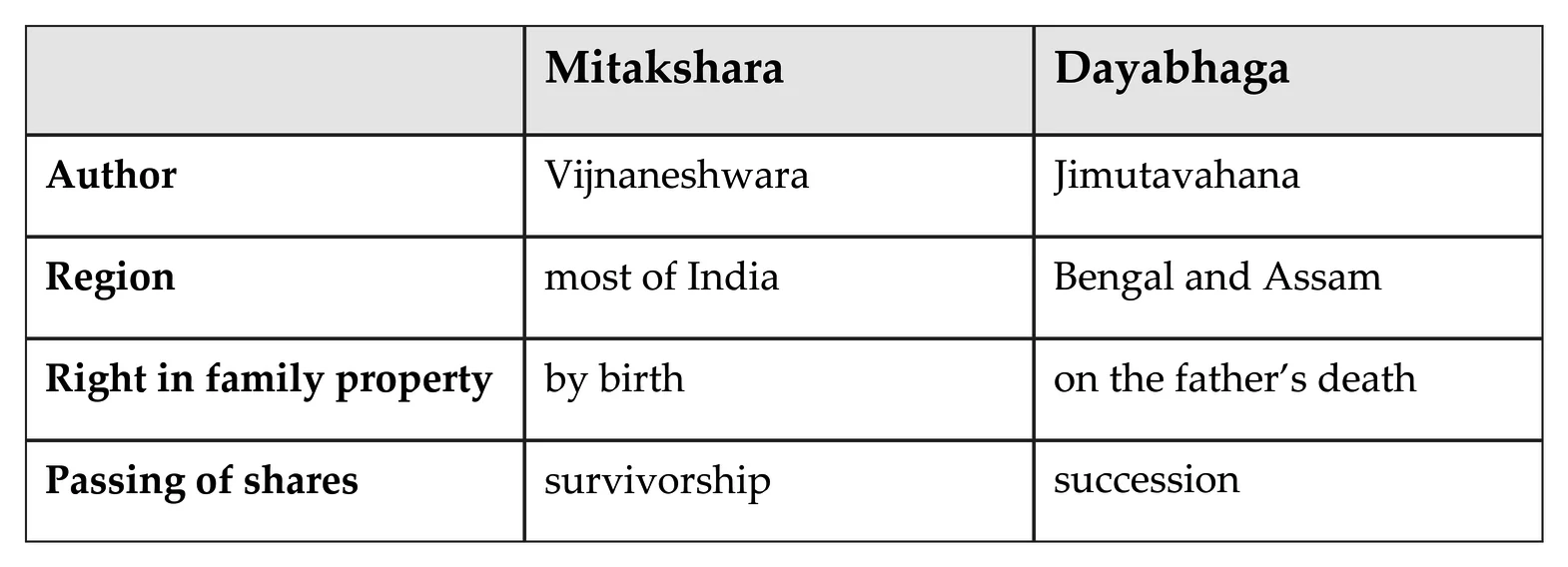
The Mitakshara was written by Vijnaneshwara at the Chalukya court in the late eleventh or early twelfth century. It became the dominant school of Hindu law in most of India.
4. Rights by Birth
Under the Mitakshara, sons, grandsons and great-grandsons acquire an interest in ancestral property by birth. They form a coparcenary, and a member’s share passes to the surviving coparceners by survivorship.
5. Partition
A son can demand partition of ancestral property even during the father’s lifetime, and the father cannot freely sell ancestral property except for legal necessity or family benefit.
6. The Dayabhaga
The Dayabhaga was written by Jimutavahana in Bengal around the twelfth century. It was followed in Bengal and Assam.
7. Rights on Death
Under the Dayabhaga, the father is the absolute owner of family property during his lifetime, and sons acquire rights only on his death. Shares pass by succession, and widows could inherit in the absence of sons.
8. Significance of the Difference
The Mitakshara treated the family as a joint economic unit, while the Dayabhaga gave more freedom to the individual owner. These differences affected the transfer of land and the economic position of women.
9. Contracts and Debts
The Arthashastra’s third book deals with contracts, debts, deposits, sales, partnerships and wages, and requires contracts to be made openly before witnesses. Agreements made under force, by minors or in secret were invalid.
10. Interest
Texts fixed lawful rates of interest. A rate of one and a quarter per cent per month was considered fair, with higher rates allowed for risky trade through forests or by sea.
11. Regulating Markets
Kautilya’s fourth book provides for protection against fraud by traders and artisans, standard weights and measures, punishment for adulteration and control of prices and profits, an early form of consumer protection.
12. Guild Law
Kings recognised the customs and rules of guilds, merchants and castes. The Narada Smriti and other texts allow guilds to settle disputes among their members.
13. Modern Continuity
The Mitakshara and Dayabhaga were applied by colonial courts and later codified by the Hindu Succession Act of 1956. The 2005 amendment made daughters coparceners by birth, a change confirmed by the Supreme Court in Vineeta Sharma (2020).
14. Criticisms
Ancient economic laws reflected hierarchies of caste and gender, giving women limited rights in property and setting different rules for different varnas.
15. Stridhana
Ancient law recognised stridhana, property belonging to a woman, such as gifts made to her before and at marriage, by her husband and by relatives. Women could hold and dispose of stridhana, and it passed mainly to daughters. Though limited, stridhana gave women some economic security in a system where most family property passed through men.
16. Evaluation
Ancient Indian law regulated economic life in detail, and its inheritance schools shaped Hindu family property for centuries.
Conclusion. Thus, the Mitakshara of Vijnaneshwara gave sons rights in ancestral property by birth and survivorship, while the Dayabhaga of Jimutavahana gave the father absolute ownership with succession on death. Laws on contracts, debts, interest, markets and guilds regulated economic life, and these traditions shaped Hindu law until the reforms of 1956 and 2005.
Important Question 4
Discuss the role of temples and trade in the economy of ancient India.
OR
Examine the temple economy in early medieval India.
OR
Discuss maritime trade and shipping in ancient India.
Model Answer
“Muziris, of the same kingdom, abounds in ships sent there with cargoes from Arabia, and by the Greeks.”
— The Periplus of the Erythraean Sea (tr. W.H. Schoff)
Introduction. Temples in ancient and early medieval India were not only religious centres but also major economic institutions that owned land, lent money and employed many people. At the same time, India had a long tradition of trade by land and sea, linking it with the Roman world, West Asia, Southeast Asia and China. Scholars such as Radha Kumud Mookerji and R. Mehta have studied these aspects of the economy.
1. Growth of Temples
From the Gupta period and especially under the Pallavas, Cholas and Pandyas in south India, temples grew in size and wealth through donations by kings, merchants and villagers.
2. Temples as Landowners
Kings and others granted land to temples, called devadana. Temples held villages and fields, collected rents and managed irrigation, becoming among the largest landowners.
3. Temples as Banks
Temples received endowments of gold, money and livestock, and lent money to village assemblies and individuals at interest. The interest paid for lamps, offerings and festivals.
4. Temples as Employers
Large temples employed priests, accountants, musicians, dancers, cooks, gardeners, potters, carpenters and goldsmiths. Inscriptions of the Thanjavur temple, completed around 1010 CE, record hundreds of such employees.
5. Redistribution
Temples collected resources and redistributed them through employment, feeding houses, festivals and support for schools and hospitals, linking kings, landholders, merchants and villagers.
6. Temples and Kingship
Kings built and endowed temples to show their power and piety and to gain the support of Brahmins and local elites. Historians such as Burton Stein see temples as central to the political order of south India.
7. Ancient Shipping
Radha Kumud Mookerji, in Indian Shipping (1912), traced India’s maritime activity from early times, using texts, coins and archaeological evidence to show that Indians built ships and traded overseas.
8. Roman Trade
In the early centuries CE, Indian ports such as Muziris and Arikamedu traded pepper, textiles, gems and spices with the Roman world. Large numbers of Roman coins found in south India show the scale of this trade.
9. Kautilya on Ships
Kautilya’s Arthashastra provides for a superintendent of ships (navadhyaksha), who regulated ports, ferries and sea trade, collected port dues and ensured the safety of travellers.
10. Southeast Asia and China
Indian traders carried goods and culture to Southeast Asia, influencing kingdoms in present-day Indonesia, Cambodia and Thailand. The Chola king Rajendra I sent a naval expedition against Srivijaya around 1025 CE.
11. Merchant Guilds
Powerful merchant guilds such as the Ainnurruvar, the Five Hundred of Ayyavole, and the Manigramam traded across south India and overseas, with their own rules and armed guards.
12. Mehta on Trade and Development
R. Mehta argues that trade was a major engine of economic development in ancient India, encouraging crafts, towns, coinage and links with other civilisations.
13. Ports and Cities
Ports such as Bharuch, Tamralipti, Kaveripattinam and Muziris grew into wealthy cities with markets, warehouses and foreign merchants.
14. Criticisms and Limits
Temple wealth depended on the labour of peasants and workers, and some historians caution against romanticising temple economies or exaggerating the scale of ancient trade.
15. Temples and Learning
Many temples supported schools and colleges. A Chola inscription from Ennayiram in the eleventh century records a temple college with hundreds of students and teachers supported by endowed land, and another from Tirumukkudal records a hospital attached to a temple. Such institutions show how temple wealth funded education and health as well as worship.
16. Land Trade Routes
Overland trade was as important as sea trade. The Uttarapatha linked India with Central Asia and the Silk Road through Taxila, and Buddhist monasteries along the routes offered shelter to merchants. Kushana rulers in the early centuries CE controlled these routes and issued gold coins, showing the wealth that long-distance trade brought.
17. Evaluation
Temples and trade were central to the ancient Indian economy, linking religion, politics and commerce.
Conclusion. Thus, temples in early medieval India were landowners, banks and employers that redistributed resources and supported kingship. Maritime trade, documented by Mookerji and Mehta, linked India with Rome, Southeast Asia and China through ports like Muziris, regulated by officials such as Kautilya’s superintendent of ships and carried by powerful merchant guilds.
Short Notes
(a) Shreni
A guild of artisans or merchants in ancient India, with its own rules, leaders and courts, recognised by kings.
(b) Coparcenary
Under the Mitakshara, the group of male descendants who acquire an interest in ancestral property by birth; since 2005, daughters are also coparceners.
(c) Devadana
Land granted to a temple, which made temples major landowners in early medieval India.
More notes: MDSE-16 Political Ideas of Ancient India
These notes are prepared by PADHO TO AISE for study help. They are not an official University of Delhi publication.