
Semester VI MDSE-4a Gender in International Relations
Unit III · 22 min read · Updated 24 Nov 2026
As per the University of Delhi (DU) BA (Hons) Political Science syllabus
Contents
- 3.1 Gender, State and Sovereignty
- Hoffman: Gender and Sovereignty
- Wadley and Maruska: Performing the State
- Women and Citizenship
- 3.2 Gender, Nation and Nationalism
- Nagel: Masculinity and Nationalism
- Enloe: Nationalism and Masculinity
- Gender, Nation and Partition
- 3.3 Gender and Security
- Young: The Logic of Masculinist Protection
- Wibben: Feminist Security Studies
- Bloom: Women as Agents of Violence
- Feminist Security Studies Today
- Key Ideas at a Glance
- 3.4 Important Questions
- Discuss the feminist critique of the state and sovereignty.
- Discuss the relationship between gender, nation and nationalism.
- Examine Iris Marion Young’s idea of the logic of masculinist protection.
- Discuss the contribution of feminist security studies with reference to women as agents of violence.
- Short Notes
राष्ट्रवाद आम तौर पर पुरुषीकृत स्मृति, पुरुषीकृत अपमान और पुरुषीकृत आशा से उपजा है।
Nationalism has typically sprung from masculinized memory, masculinized humiliation and masculinized hope.
— Cynthia Enloe, Bananas, Beaches and Bases (1989)
TTHE core concepts of IR, the state, sovereignty, the nation and security, appear gender-neutral. Feminist scholars show that they are not. The state presents itself as a masculine protector; nations are imagined through male heroes and female symbols of honour; and security policies often demand that citizens, cast as women and children, obey in return for protection. This chapter studies Unit III of the syllabus: the gendering of state and sovereignty, nation and nationalism, and security, through John Hoffman, Joane Nagel, Cynthia Enloe, Iris Marion Young, Annick Wibben and Mia Bloom.

3.1 Gender, State and Sovereignty
Hoffman: Gender and Sovereignty
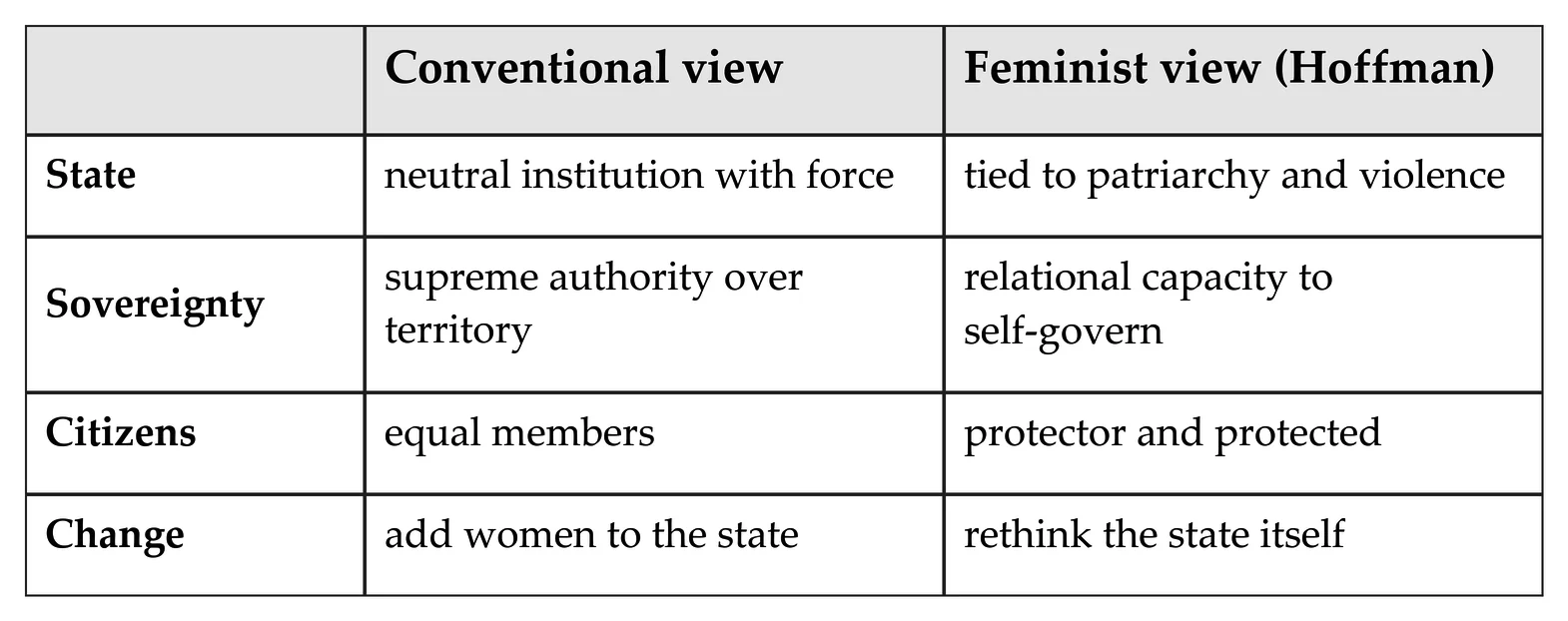
John Hoffman, in Gender and Sovereignty: Feminism, the State and International Relations (2001), argues that feminists should not simply seek to add women to the state, but should question the state itself. Following Max Weber, the state is defined by its claim to a monopoly of legitimate force. Hoffman argues that this reliance on force and hierarchy is closely tied to patriarchy, since both rest on domination and the exclusion of those treated as unequal. The traditional idea of sovereignty as supreme, indivisible authority over a territory reflects this logic of domination. Hoffman proposes rethinking sovereignty as a relational capacity of people to govern themselves, which grows through cooperation rather than force, and he distinguishes the coercive state from forms of government based on negotiation and consent.
Wadley and Maruska: Performing the State
Jonathan Wadley, in Gendering the State: Performativity and Protection in International Security (2010), draws on Judith Butler to argue that the state is not a fixed thing but is performed through repeated acts, especially acts of protection. When a state claims to protect its citizens from danger, it performs a masculine identity, while the protected are cast in a feminised role. Jennifer Maruska, in When Are States Hypermasculine? (2010), argues that states display hypermasculinity, i.e. an exaggerated, aggressive form of masculinity, when their hegemonic masculinity feels threatened. She uses the example of the United States after the attacks of 11 September 2001, when an aggressive military response became a way of reasserting national strength.
- Public and private. The liberal state was built on a separation between the public sphere of men and the private sphere of women, which kept women out of citizenship for long periods.
- Citizenship. Women gained the vote late in many countries: New Zealand in 1893, Britain in 1918 and 1928, and India with universal franchise in 1950.
- Military and citizenship. The link between bearing arms and full citizenship long excluded women from the core of the state.
Women and Citizenship
- Suffrage. New Zealand gave women the vote in 1893; Britain in 1918 for some women and 1928 for all; India adopted universal adult franchise in 1950.
- Nationality laws. For long, many countries made a married woman’s nationality depend on her husband’s, a rule challenged by the UN Convention on the Nationality of Married Women (1957).
- CEDAW. The Convention on the Elimination of All Forms of Discrimination against Women (1979), ratified by India in 1993, commits states to equality in public and private life.
- Armed forces. Women’s entry into armies and combat roles challenges the old link between soldiering and full citizenship.
3.2 Gender, Nation and Nationalism
Nagel: Masculinity and Nationalism
Joane Nagel, in Masculinity and Nationalism: Gender and Sexuality in the Making of Nations (1998), argues that nationalism and masculinity are deeply intertwined. The institutions of nationalism, such as armies, governments and liberation movements, have been dominated by men, and nationalist ideals of honour, courage, duty and sacrifice are closely linked to ideals of manhood. Nationalist politics is therefore a major arena in which men accomplish masculinity. Women, by contrast, are given symbolic roles: as mothers of the nation, as bearers of its culture and as embodiments of its honour, to be protected or avenged. Nagel also shows that nationalism regulates sexuality, policing who may marry or have relationships with whom, and treating sexual relations across national lines as threats.
Enloe: Nationalism and Masculinity
Cynthia Enloe, in her chapter on nationalism and masculinity in Bananas, Beaches and Bases (second edition, 2014), argues that nationalism has typically sprung from masculinised memory, humiliation and hope: memories of men’s defeats, humiliation at being colonised or conquered, and hopes of restoring manly pride. She insists that the nationalist story is not over, since nationalism remains a powerful force, and that it is not simple, since women have also been active nationalists, sometimes using nationalism to win rights and sometimes finding their demands postponed until after national goals are achieved.
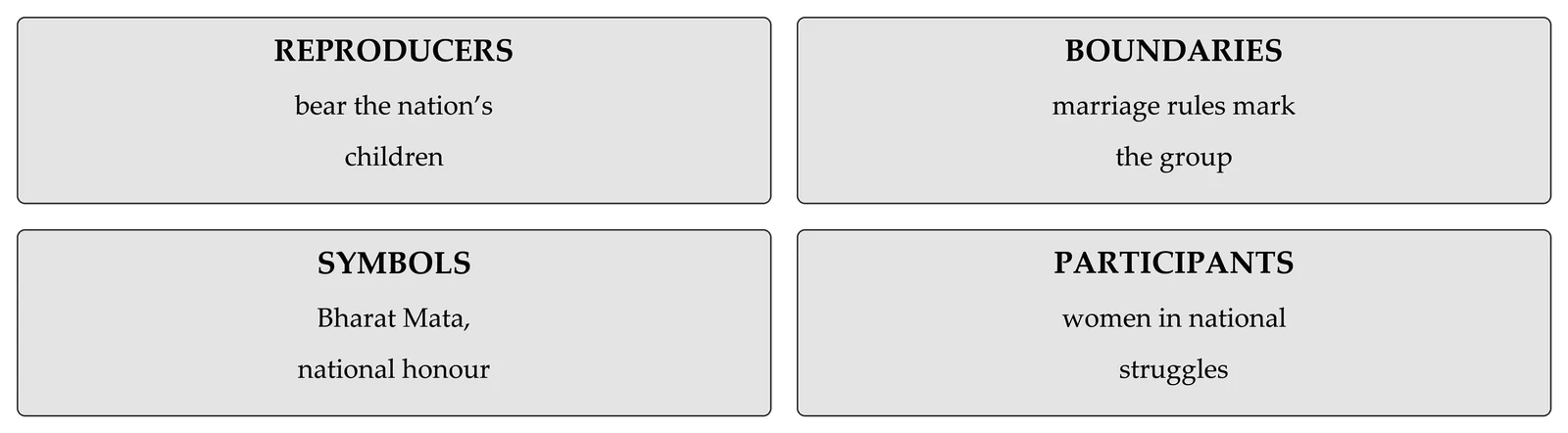
- Biological reproducers of members of the nation.
- Boundary markers, through rules on marriage and sexuality.
- Transmitters of culture, as mothers and teachers.
- Symbols of the nation, such as Bharat Mata, and of its honour.
- Participants in national struggles, from the freedom movement to wars.
These five roles were identified by Floya Anthias and Nira Yuval-Davis (1989) and developed by Yuval-Davis in Gender and Nation (1997). In India, the image of the nation as Bharat Mata, women’s participation in the freedom struggle, and the violence against women during Partition in 1947, when tens of thousands of women were abducted, show how gender and nationalism are entwined.
Gender, Nation and Partition
The Partition of India in 1947 shows how nationalism and gender intersect. During the violence, tens of thousands of women were abducted, raped or killed, and some were killed by their own families to protect community honour. After Partition, India and Pakistan agreed to recover abducted women, often returning them to families and nations without asking their wishes. Scholars such as Urvashi Butalia, in The Other Side of Silence (1998), and Ritu Menon and Kamla Bhasin, in Borders and Boundaries (1998), recovered these women’s stories, showing that the state treated women’s bodies as national property.
3.3 Gender and Security
Young: The Logic of Masculinist Protection
Iris Marion Young, in The Logic of Masculinist Protection: Reflections on the Current Security State (2003), analysed the United States after 11 September 2001. She argued that the security state adopts the role of a masculine protector, like a good father or husband who protects his family from outside dangers. In return, it expects those it protects, cast in the role of women and children, to obey, to accept surveillance and restrictions, and not to question its decisions. Drawing on Thomas Hobbes, she showed how fear justifies authority. She also criticised the claim that the war in Afghanistan was fought partly to save Afghan women, arguing that it used women’s rights to justify war while denying women a voice. The logic of protection, she concluded, undermines democracy by turning citizens into dependants.
Wibben: Feminist Security Studies
Annick Wibben, in Feminist Security Studies: A Narrative Approach (2011), argues that security is constructed through narratives, i.e. stories about who is threatened, by whom and what must be done. Dominant security narratives are told by states and experts, and they silence the experiences of women and others whose insecurity comes from poverty, domestic violence or war. Feminist security studies seeks to open security narratives to many voices and to ask what security means in everyday life.
Bloom: Women as Agents of Violence
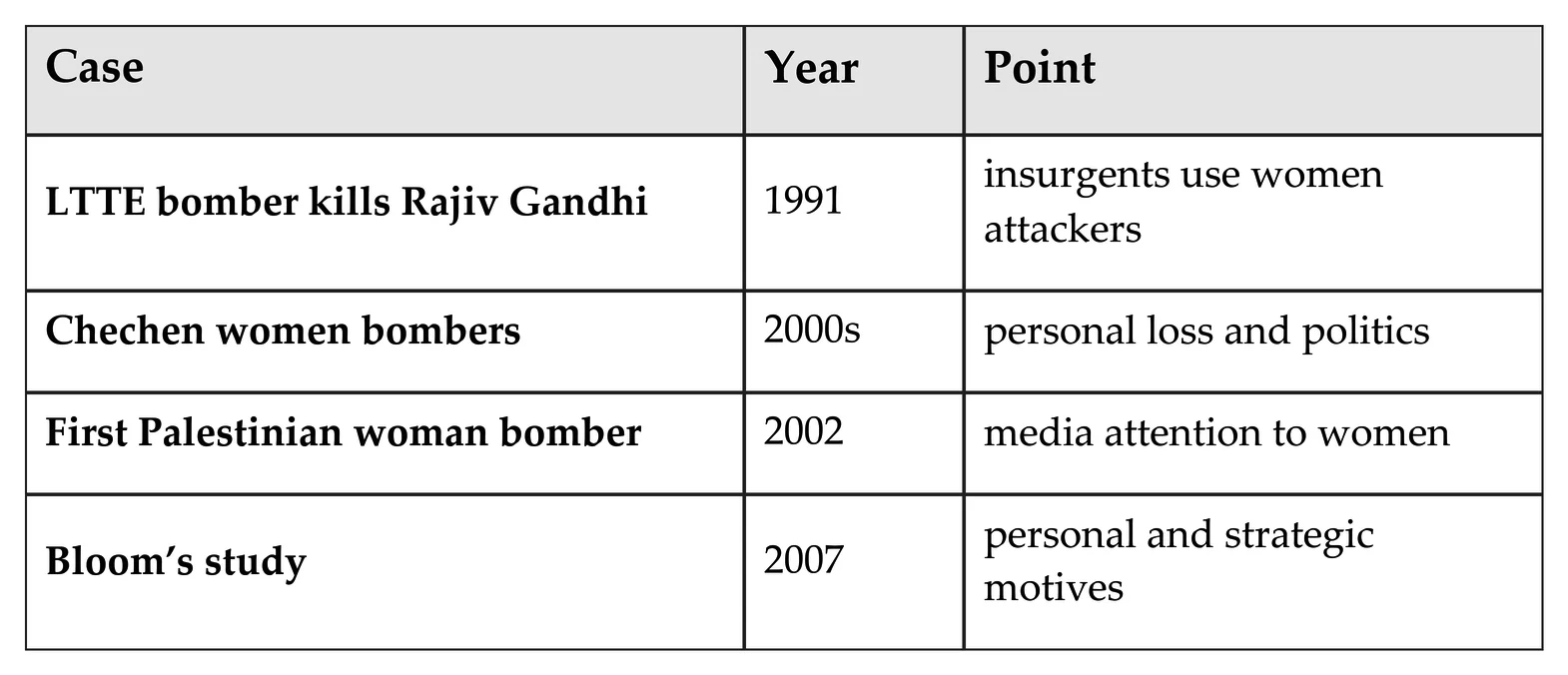
Feminist security studies also examines women as agents of violence, not only as victims. Mia Bloom, in Female Suicide Bombers: A Global Trend (2007), documented the growing use of women as suicide bombers by groups such as the LTTE in Sri Lanka, whose bomber killed former Prime Minister Rajiv Gandhi in 1991, Chechen militants and Palestinian groups. She found that women joined for a mix of personal motives, such as revenge for the deaths of relatives or escape from social stigma, and political motives, while organisations used them because they attracted less suspicion and more media attention. Bloom warned against seeing such women only as manipulated victims, while showing how gender shaped their recruitment.

Feminist Security Studies Today
Feminist security studies has grown into a major field. The International Feminist Journal of Politics (from 1999) and work by scholars such as Laura Sjoberg, Caron Gentry and Laura Shepherd examine topics from women in terrorist organisations to drone warfare and peacekeeping. These studies show that gender analysis is useful for understanding all aspects of security, not only those that obviously involve women.
Key Ideas at a Glance
- State: performed through protection; tied to force and hierarchy (Hoffman, Wadley).
- Hypermasculinity: aggressive state behaviour when masculinity feels threatened (Maruska).
- Nation: imagined through male heroes and female symbols (Nagel, Enloe, Yuval-Davis).
- Security: protection exchanged for obedience (Young); narratives that silence many voices (Wibben).
- Agency: women as perpetrators as well as victims of violence (Bloom).
3.4 Important Questions
- Question 1 Discuss the feminist critique of the state and sovereignty.
- Question 2 Discuss the relationship between gender, nation and nationalism.
- Question 3 Examine Iris Marion Young’s idea of the logic of masculinist protection.
- Question 4 Discuss the contribution of feminist security studies with reference to women as agents of violence.
DU asks the same idea in different words. So learn one broad answer for each question below; the same answer works for every question joined by OR.
Important Question 1
Discuss the feminist critique of the state and sovereignty.
OR
Examine John Hoffman’s argument on gender and sovereignty.
OR
Discuss the idea of the state as a masculine protector.
Model Answer
“The life of man, solitary, poor, nasty, brutish, and short.”
— Thomas Hobbes, Leviathan (1651)
Introduction. The state and sovereignty are central concepts of IR, usually treated as gender-neutral. Feminist scholars argue that the state, defined by its monopoly of force, is tied to patriarchy, and that sovereignty reflects a logic of domination. John Hoffman calls for rethinking sovereignty, while Jonathan Wadley and Jennifer Maruska show how states perform masculine protection and, at times, hypermasculinity.
1. The Conventional View
Mainstream IR treats the state as a neutral institution with supreme authority over a territory. Gender seems irrelevant to it. This view treats the state as a unitary actor whose interests can be studied without asking who it includes or excludes.
2. Hobbes and Protection
Hobbes justified the state as the protector that saves people from a life that would be nasty, brutish and short. Protection is its founding promise.
3. Monopoly of Force
Following Weber, the state is defined by its monopoly of legitimate force. Feminists ask what this reliance on force means for gender.
4. Hoffman’s Argument
Hoffman argues that the state’s reliance on force and hierarchy is tied to patriarchy, since both rest on domination. He notes that the use of force to settle conflicts is itself linked to a hierarchical, masculine model of authority.
5. Beyond Adding Women
He argues that feminists should question the state itself, not simply seek more women in its institutions.
6. Rethinking Sovereignty
Hoffman proposes sovereignty as a relational capacity of people to govern themselves through cooperation, not force. In this view, sovereignty grows as people gain the capacity to shape their lives together, rather than being imposed from above.
7. State versus Government
He distinguishes the coercive state from forms of government based on negotiation and consent.
8. Public and Private
The liberal state was built on a public-private divide that excluded women from citizenship.
9. Late Citizenship
Women won the vote late in many countries, showing their historic exclusion from the state. In India, women voted from the first general election of 1951–52, but their representation in legislatures has remained low.
10. Arms and Citizenship
The link between bearing arms and full citizenship long excluded women from the core of the state.
11. Wadley’s Performativity
Wadley argues that the state is performed through acts of protection, which cast it as masculine. Each time the state claims to keep citizens safe, it reproduces its image as a strong, masculine guardian.
12. The Protected as Feminine
Those protected by the state are placed in a feminised, dependent role.
13. Maruska’s Hypermasculinity
Maruska shows that states become hypermasculine when their masculinity feels threatened, as the US did after 2001. Such hypermasculine responses, she argues, often produce more insecurity by provoking further conflict.
14. Indian Example
Debates on women in combat roles and the long exclusion of women from some services show the gendered state in India.
15. Women in State Leadership
Women leaders often face pressure to prove toughness, showing the masculine norms of statecraft.
16. Criticism
Critics argue that the state also protects women’s rights through law, so it is not simply patriarchal.
17. Nationality Laws
Laws that made married women’s nationality depend on their husbands show how the state long treated women as dependants rather than full citizens.
18. Evaluation
Feminist critiques reveal that the state and sovereignty carry gendered assumptions that shape citizenship and security.
Conclusion. Thus, from Hobbes’s promise of protection to Weber’s monopoly of force, the state has been built on masculine ideas. Hoffman, Wadley and Maruska show that rethinking the state and sovereignty is central to feminist IR.
Important Question 2
Discuss the relationship between gender, nation and nationalism.
OR
Examine Joane Nagel’s argument on masculinity and nationalism.
OR
Discuss the roles of women in nationalist projects.
Model Answer
“It is imagined as a community, because, regardless of the actual inequality and exploitation that may prevail in each, the nation is always conceived as a deep, horizontal comradeship.”
— Benedict Anderson, Imagined Communities (1983)
Introduction. Nations are imagined communities, as Benedict Anderson argued, and feminists show that they are imagined in gendered ways. Joane Nagel argues that nationalism and masculinity are intertwined, while Cynthia Enloe shows that nationalism springs from masculinised memory, humiliation and hope. Women are given symbolic roles as mothers, culture-bearers and symbols of honour, but they have also been active nationalists.
1. Nations as Imagined
Anderson described the nation as an imagined community, a deep, horizontal comradeship among strangers. Members never meet most of their fellow nationals, yet they feel a bond, which nationalist symbols and stories create.
2. A Fraternity
Feminists note that this comradeship is often imagined as a brotherhood of men.
3. Nagel’s Argument
Nagel argues that nationalism and masculinity are intertwined in institutions, ideals and practices.
4. Male-Dominated Institutions
Armies, governments and liberation movements have been dominated by men. Even anti-colonial movements, which drew many women into action, usually kept leadership in male hands.
5. Manly Ideals
Nationalist ideals of honour, courage and sacrifice are linked with ideals of manhood.
6. Accomplishing Masculinity
Nagel argues that nationalist politics is an arena where men accomplish their masculinity.
7. Women as Symbols
Women appear as mothers of the nation, bearers of culture and symbols of honour. Such symbolism places a heavy burden on women, whose behaviour is policed in the name of the nation.
8. Regulating Sexuality
Nationalism polices marriage and relationships across national lines as threats. Laws and campaigns against marriages across communities show how nationalism tries to control intimate life.
9. Enloe’s Masculinised Memory
Enloe argues that nationalism springs from men’s memories of defeat, humiliation and hope of restored pride.
10. Not Simple, Not Over
Enloe stresses that nationalism remains powerful and that women play complex roles within it.
11. Five Roles
Anthias and Yuval-Davis identified women as reproducers, boundary markers, culture transmitters, symbols and participants.
12. Postponed Demands
Women’s demands are often postponed until after national goals are achieved. In many anti-colonial movements, women were told to wait for equality until independence was won.
13. Bharat Mata
In India, the image of the nation as Bharat Mata shows the gendering of nationalism.
14. Women in the Freedom Struggle
Women took part in the freedom movement, from Salt Satyagraha to Quit India, as active nationalists. Leaders such as Sarojini Naidu, Aruna Asaf Ali and Kamaladevi Chattopadhyay played prominent roles.
15. Partition
During Partition, tens of thousands of women were abducted, showing violence against women as a nationalist weapon.
16. Criticism
Some argue that nationalism can also empower women, as in anti-colonial struggles.
17. Butalia and Menon-Bhasin
Urvashi Butalia and Ritu Menon and Kamla Bhasin recovered the stories of women in Partition, showing how states treated women’s bodies as national property.
18. Recovery of Abducted Women
After 1947, India and Pakistan agreed to recover abducted women, often returning them to families without asking their wishes.
19. Evaluation
Gender analysis reveals how nations are built on gendered roles and why women’s experience of nationalism differs.
Conclusion. Thus, the nation imagined by Anderson as a deep, horizontal comradeship is gendered. Nagel and Enloe show that nationalism is bound up with masculinity, while women are cast as symbols, though they have also acted as nationalists.
Important Question 3
Examine Iris Marion Young’s idea of the logic of masculinist protection.
OR
Discuss the gendered nature of the security state after 2001.
OR
Examine the idea of hypermasculine states in international security.
Model Answer
“The fight against terrorism is also a fight for the rights and dignity of women.”
— Laura Bush, radio address (17 November 2001)
Introduction. After the attacks of 11 September 2001, the United States expanded its security powers at home and went to war abroad. Iris Marion Young analysed this through the logic of masculinist protection: the security state acts as a masculine protector and expects citizens, cast as women and children, to obey in return. She showed how this logic, which even used women’s rights to justify war, undermines democracy.
1. Context
After 2001, the US expanded surveillance and detention and went to war in Afghanistan and Iraq. The attacks killed nearly three thousand people and created a climate of fear that shaped politics for years.
2. The Protector Role
Young argued that the security state adopts the role of a masculine protector, like a good father or husband. Like the protector in a family, the state claims to know best and asks for trust in return for safety.
3. The Protected
Citizens are cast as women and children who need protection from outside dangers. This framing presents citizens as vulnerable and dependent, rather than as equals who share in decisions.
4. Obedience for Protection
In return, the protected are expected to obey, accept surveillance and not question decisions. Dissent can be painted as disloyalty, since questioning the protector seems to weaken the household’s defence.
5. Hobbes’s Logic
Young drew on Hobbes, who justified sovereign power by fear of insecurity. For Hobbes, people accept an all-powerful sovereign because the alternative is a war of all against all.
6. Fear and Authority
Fear of terrorism justified expanded state authority and restrictions on liberties. The USA PATRIOT Act of 2001 expanded surveillance powers, showing how fear widened state authority.
7. Saving Afghan Women
The war in Afghanistan was partly justified as saving Afghan women, as Laura Bush’s address showed. Feminist scholars such as Lila Abu-Lughod asked whether Muslim women really needed saving, criticising this justification.
8. Young’s Critique
Young argued that this used women’s rights to justify war while denying women a voice.
9. Threat to Democracy
The logic of protection turns citizens into dependants, undermining democratic accountability. When citizens accept the role of the protected, they give up the active participation that democracy requires.
10. Maruska’s Hypermasculinity
Maruska argues that states become hypermasculine when their masculinity feels threatened.
11. Hypermasculine Responses
An aggressive military response after 2001 became a way of reasserting national strength.
12. Wadley’s Performativity
Wadley shows that the state performs its identity through acts of protection.
13. Domestic Parallels
The logic of protection mirrors patriarchal families, where protection comes with control. Young noted that protection in families often comes with control over women’s movement and choices.
14. Indian Relevance
Debates on emergency powers and security laws in India can also be analysed through this lens.
15. Alternatives
Young called for democratic citizenship in which citizens debate security rather than defer to protectors. Young argued that real security comes from democratic deliberation, cooperation and respect for rights, not from deference.
16. Criticism
Critics say states do need to protect citizens, and that Young underplays real threats.
17. Guantanamo and Detention
Detention without trial at Guantanamo Bay after 2002 showed how protection was used to justify suspending normal legal rights.
18. Women’s Groups in Afghanistan
Afghan women’s organisations such as RAWA had long opposed both the Taliban and foreign intervention, showing that Afghan women were not voiceless.
19. Evaluation
Young’s analysis shows how gendered ideas of protection shape security policy and limit democracy.
Conclusion. Thus, Young shows that the security state acts as a masculine protector demanding obedience, even using claims that the fight against terrorism is a fight for women’s rights. Her logic of masculinist protection reveals the gendered politics of security.
Important Question 4
Discuss the contribution of feminist security studies with reference to women as agents of violence.
OR
Examine Mia Bloom’s analysis of female suicide bombers.
OR
Discuss Annick Wibben’s narrative approach to feminist security studies.
Model Answer
“Everything we know about war we know with a man’s voice.”
— Svetlana Alexievich, The Unwomanly Face of War (1985; tr. 2017)
Introduction. Feminist security studies opens security to the experiences of women and others silenced by dominant narratives. Annick Wibben shows that security is constructed through narratives and calls for including many voices. Mia Bloom shows that women are not only victims but also agents of violence, as in the growing use of female suicide bombers, whose motives combine personal and political factors.
1. Feminist Security Studies
Feminist security studies examines how gender shapes security and whose security counts.
2. A Man’s Voice
Alexievich observed that what we know of war comes in a man’s voice, silencing women’s experience.
3. Wibben’s Narratives
Wibben argues that security is constructed through narratives about threats and responses. These narratives decide which dangers receive attention and resources, and which are ignored.
4. Silenced Voices
Dominant narratives told by states and experts silence those whose insecurity comes from poverty or violence.
5. Everyday Security
Feminist security studies asks what security means in everyday life, not only for states. This includes freedom from domestic violence, access to food and health, and safety in public spaces.
6. Women as Agents
Women are not only victims of violence but also fighters, bombers and leaders of armed groups. Recognising women’s agency challenges the stereotype that women are naturally peaceful.
7. Bloom’s Global Trend
Bloom documented the growing use of women as suicide bombers across several conflicts.
8. The LTTE
An LTTE woman bomber killed Rajiv Gandhi in 1991, and the group used many women fighters.
9. Chechnya and Palestine
Chechen and Palestinian groups also used women bombers from the 2000s.
10. Personal Motives
Women joined for personal reasons such as revenge for relatives or escape from social stigma. Bloom found that some women sought to restore family honour or to escape lives restricted by gender norms.
11. Political Motives
Many women also had political motives, sharing the goals of their movements.
12. Organisational Strategy
Groups used women because they attracted less suspicion and more media attention. Women could pass checkpoints more easily and their attacks drew wide media coverage, which groups exploited.
13. Beyond Victimhood
Bloom warned against seeing such women only as manipulated victims, recognising their agency.
14. Gendered Narratives
Media often explain violent women through personal or sexual stories, unlike violent men. Such explanations deny women political agency by treating their violence as a personal or emotional matter.
15. Indian Examples
Women have also taken part in Maoist and other armed movements in India.
16. Criticism
Some argue that focusing on violent women may distract from the larger number of women who are victims.
17. Sjoberg and Gentry
Laura Sjoberg and Caron Gentry showed that violent women are often described as mothers, monsters or whores, denying them political agency.
18. Women in Maoist Movements
Women have formed a significant share of cadres in Maoist groups in central India, often citing caste, gender and economic oppression.
19. Evaluation
Feminist security studies broadens security by including women’s agency as well as their suffering.
Conclusion. Thus, feminist security studies, from Wibben’s narratives to Bloom’s study of female bombers, challenges the idea that we know war only in a man’s voice. It shows women as both victims and agents of violence.
Short Notes
(a) Masculinist protection
Iris Marion Young’s term for the logic by which the security state acts as a masculine protector and expects citizens, cast as women and children, to obey in return.
(b) Hypermasculinity
An exaggerated, aggressive form of masculinity that, according to Jennifer Maruska, states display when their hegemonic masculinity feels threatened.
(c) Women as boundary markers
Anthias and Yuval-Davis’s idea that nations use rules on women’s marriage and sexuality to mark the boundaries of the national community.
More notes: MDSE-4a Gender in International Relations
These notes are prepared by PADHO TO AISE for study help. They are not an official University of Delhi publication.