

Semester VI MDSE-4a Gender in International Relations
Unit II · 21 min read · Updated 24 Nov 2026
As per the University of Delhi (DU) BA (Hons) Political Science syllabus
Contents
- 2.1 The Feminist Challenge to Mainstream (Malestream) IR
- Malestream Theory
- Steans: Gender and International Relations
- Whitworth: Feminism and International Relations
- Retelling IR’s Foundational Stories
- Feminist Methodology
- 2.2 The Tickner-Keohane Debate
- Tickner: You Just Don’t Understand
- Keohane: Beyond Dichotomy
- Responses to Keohane
- 2.3 Masculinities and Queer Theory
- Hegemonic Masculinity
- Hooper: Manly States
- Queer Theory and IR
- Gender, Sexuality and the Indian Constitution
- 2.4 Important Questions
- Discuss the feminist challenge to mainstream or malestream IR theories.
- Discuss the debate between J. Ann Tickner and Robert Keohane on feminism and IR.
- Discuss the concepts of masculinity and hegemonic masculinity in International Relations.
- Discuss the contribution of queer theory to International Relations.
- Short Notes
मैं नहीं चाहती कि उनका पुरुषों पर अधिकार हो, बल्कि अपने ऊपर हो।
I do not wish them to have power over men; but over themselves.
— Mary Wollstonecraft, A Vindication of the Rights of Woman (1792)
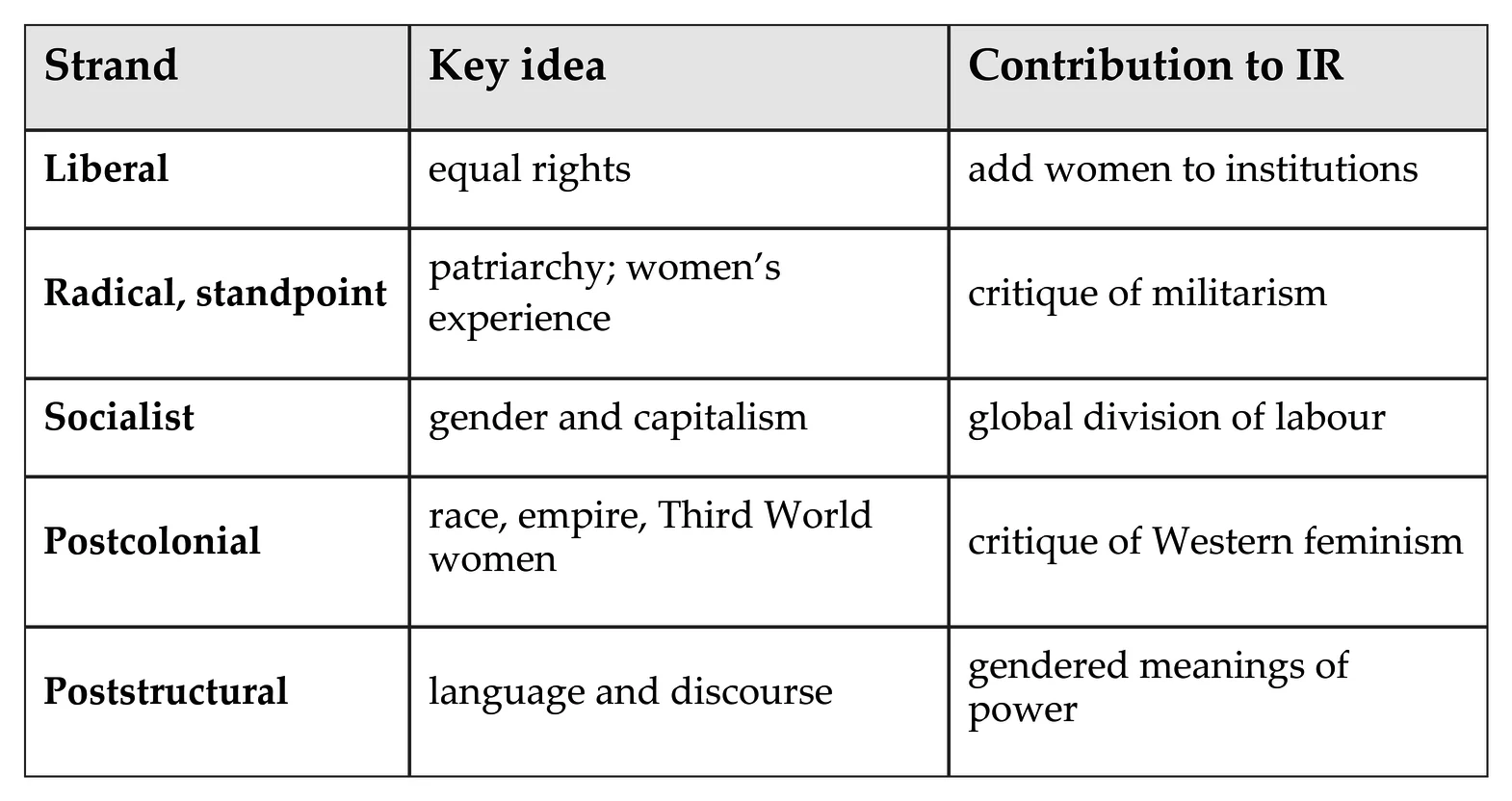
FFEMINIST scholars did not simply add women to existing IR theories; they questioned the theories themselves. They argued that mainstream, or malestream, theories such as realism and liberalism rest on gendered assumptions about the state, power and rationality. They engaged in a famous debate with mainstream scholars about what counts as knowledge and method. They showed that masculinities, not only femininities, are produced in world politics, and queer theorists went further, questioning the categories of sex and sexuality on which IR quietly relies. This chapter studies Unit II of the syllabus: the feminist challenge to mainstream IR, masculinity and hegemonic masculinity, and queer theories and IR.
2.1 The Feminist Challenge to Mainstream (Malestream) IR
Malestream Theory
The word malestream, coined by the feminist philosopher Mary O’Brien (1981), describes knowledge that presents men’s experiences and perspectives as universal. Feminists argue that mainstream IR is malestream in several ways. Realism describes the state as a rational, autonomous actor pursuing power in a dangerous world, an image modelled on an idealised masculine individual. It separates the public world of politics and war from the private world of family and care, placing women outside international politics. Liberalism speaks of free individuals and markets but often ignores the unpaid care work and unequal power relations that sustain them.
Steans: Gender and International Relations
Jill Steans, in Gender and International Relations: An Introduction (1998), explains how feminist perspectives challenge the core assumptions of IR. She shows that the state is not gender-neutral: its institutions, such as the military and diplomacy, have been dominated by men, and its laws shape gender relations, for example through citizenship, marriage and labour rules. She argues that the public-private divide is itself political, since the household is shaped by state policy and global economic forces. Steans also introduces different feminist approaches, from liberal to radical and postmodern, and shows how each raises different questions for IR.
Whitworth: Feminism and International Relations
Sandra Whitworth, in Feminism and International Relations (1997), surveys liberal, radical and postmodern feminist contributions to IR. She argues for a critical feminist approach that studies how gender is constructed through the material practices and institutions of international politics, such as international organisations and the global economy. In her study of the International Labour Organization and the International Planned Parenthood Federation, she showed that assumptions about gender shaped the policies of these institutions, for example in protective labour laws that treated women mainly as mothers. For Whitworth, gender is not a fixed attribute of individuals but a set of social relations that institutions help to create and change.
Retelling IR’s Foundational Stories
J. Ann Tickner, in Retelling IR’s Foundational Stories (2011), argues that IR’s founding myths, such as the Peace of Westphalia (1648) as the birth of the sovereign state system, are told from a narrow Western and masculine perspective. Feminist and postcolonial scholars retell these stories to include the colonised and women, showing that the sovereign state system grew alongside empire and the exclusion of women from public life. In What Is Your Research Program? (2005), she explained the distinct methods of feminist research, which start from women’s lives, use interpretive and historical approaches and aim at both understanding and emancipation.
Feminist Methodology
- Starting from women’s lives. Feminist research begins with the experiences of those at the margins of world politics.
- Reflexivity. Researchers reflect on their own position and how it shapes their knowledge.
- Silences. Feminists look for what is missing, such as women’s labour or sexual violence, in official accounts.
- Methods. They often use interpretive, historical, ethnographic and discourse methods.
- Purpose. Feminist research aims at emancipation as well as understanding, as Tickner explained in 2005.
2.2 The Tickner-Keohane Debate
Tickner: You Just Don’t Understand
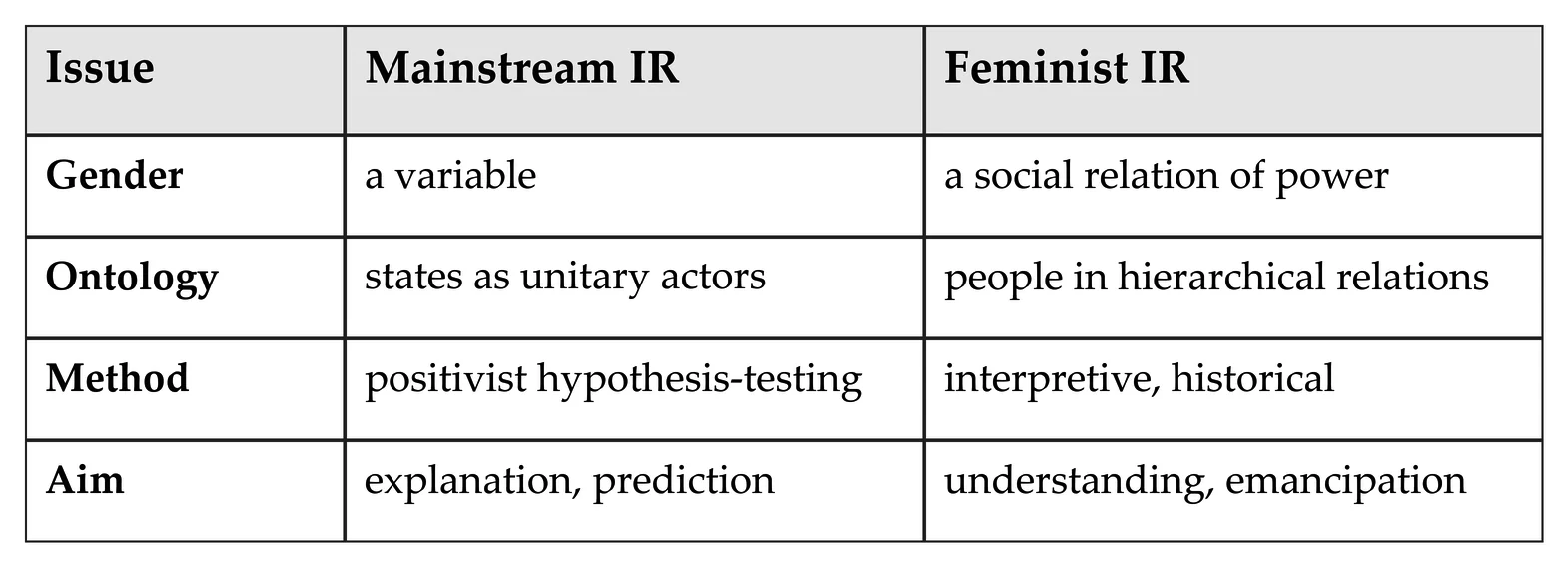
In You Just Don’t Understand: Troubled Engagements Between Feminists and IR Theorists (1997), Tickner borrowed the title of a book on gendered conversation by the linguist Deborah Tannen to describe how feminists and mainstream IR scholars talked past each other. She identified three misunderstandings:
- About gender. Mainstream scholars often treat gender as a variable, i.e. the sex of individuals, while feminists see gender as a social relation of power that shapes institutions and ideas.
- About ontology. Mainstream theories treat states as unitary actors in an anarchic system, while feminists start from individuals embedded in hierarchical social relations that cross the domestic-international divide.
- About epistemology and method. Mainstream IR prefers positivist methods that test hypotheses, while feminists use interpretive, historical and sociological methods and ask whose knowledge counts.
Tickner argued that these differences reflect different purposes: mainstream IR seeks explanation and prediction, while feminist IR seeks understanding and emancipation. Feminists should not be judged only by mainstream standards of science.
Keohane: Beyond Dichotomy
Robert Keohane replied in Beyond Dichotomy: Conversations between International Relations and Feminist Theory (1998). He welcomed the dialogue and accepted that feminist ideas could enrich IR, but argued that feminists should develop a research program with testable propositions, for example about whether gender equality within states affects their foreign policies or their tendency to go to war. He suggested that the sharp dichotomy between positivist and interpretive methods could be overcome. Feminists responded that Keohane still wanted feminism to fit mainstream methods, and that their work already constituted a rich research program, though based on different assumptions. The debate clarified the deep differences in ontology and method between feminist and mainstream IR.
Responses to Keohane
- Cynthia Weber (1994), in Good Girls, Little Girls, and Bad Girls, satirised Keohane’s 1989 sorting of feminisms into acceptable and unacceptable types.
- Marianne Marchand (1998) argued that feminists form different communities with different realities, which cannot be reduced to one research program.
- Later scholars such as Laura Sjoberg developed feminist security studies that combine rigorous research with feminist commitments.
2.3 Masculinities and Queer Theory
Hegemonic Masculinity
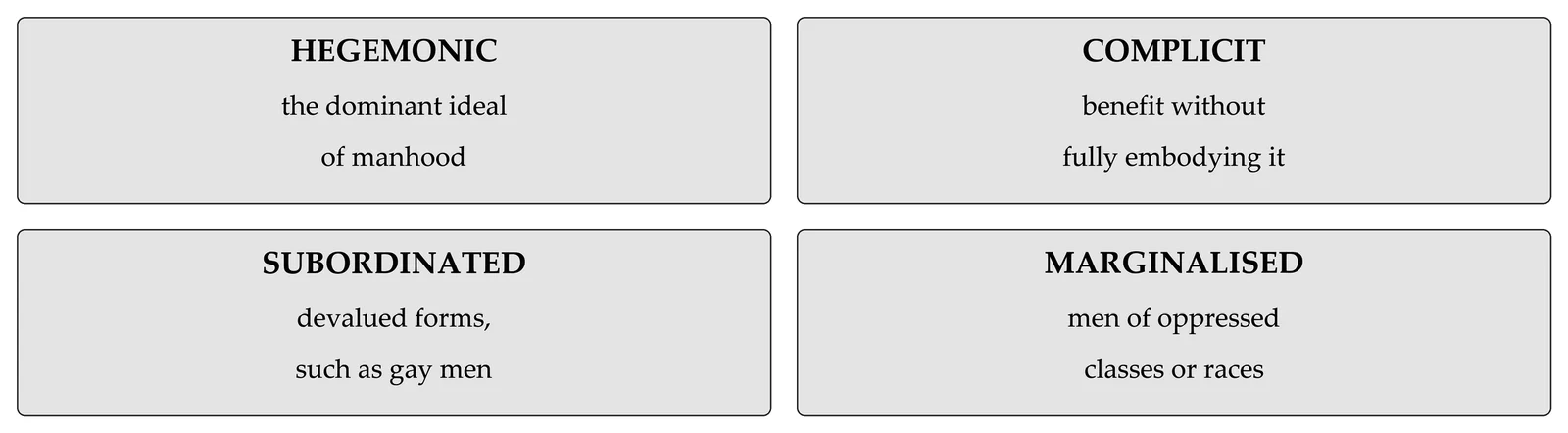
The sociologist R. W. Connell, in Masculinities (1995), argued that there is no single masculinity but several, arranged in a hierarchy. Hegemonic masculinity is the culturally dominant ideal of manhood in a society, which legitimates men’s dominance over women and over other men. Most men do not fully live up to it, but many benefit from it, which Connell called complicit masculinity. Some forms, such as gay masculinities, are subordinated, and men of oppressed classes or races are marginalised. Hegemonic masculinity changes over time and across cultures.
Hooper: Manly States
Charlotte Hooper, in Manly States: Masculinities, International Relations and Gender Politics (2001), applies Connell’s idea to IR. She argues that international politics is a key site where masculinities are produced, performed and legitimated. The images of the warrior, the statesman, the rational strategist and the businessman shape what counts as good leadership and policy. Studying the magazine The Economist, she showed how a modern, technocratic Anglo-American masculinity was celebrated in discussions of globalisation and international affairs. In her article on the gender variable (1999), she argued that even sceptics of feminism gain from studying masculinities, since they reveal hidden assumptions in IR theory. Hooper shows that gender analysis is about men as well as women.
Queer Theory and IR
Queer theory questions the categories of sex, gender and sexuality, especially the assumption that heterosexuality and the binary of male and female are natural. Melanie Richter-Montpetit, in Everything You Always Wanted to Know about Sex (in IR) But Were Afraid to Ask: The Queer Turn in International Relations (2018), surveys the growth of queer IR. She shows that queer scholars study not only the rights of lesbian, gay, bisexual and transgender (LGBT) people but also how ideas of normal and deviant sexuality shape states, wars, borders and development. For example, the torture at Abu Ghraib in 2004 used sexual humiliation, linking sexuality with imperial power.
Jasbir Puar, in Terrorist Assemblages: Homonationalism in Queer Times (2007), introduced the concept of homonationalism: the way some Western states, especially after 2001, have incorporated certain LGBT rights into their national identity and used them to contrast a tolerant West with supposedly homophobic Muslim others, thereby justifying war and anti-immigrant policies. Critics have described the related practice of promoting LGBT-friendly images to deflect criticism as pinkwashing. Cynthia Weber, in Queer International Relations (2016), argues for queer methods that recognise plural logics, i.e. that people and states can be one thing and/or another, rather than fitting fixed categories.
- Global contrasts. Same-sex relations remain criminalised in dozens of countries, while others recognise same-sex marriage, making sexuality an issue of international human rights.
- India. The Supreme Court recognised transgender persons as a third gender in the NALSA case (2014) and decriminalised consensual same-sex relations in Navtej Singh Johar (2018); Parliament passed the Transgender Persons (Protection of Rights) Act in 2019.
- UN. The UN Human Rights Council created an Independent Expert on sexual orientation and gender identity in 2016.

Gender, Sexuality and the Indian Constitution
Indian constitutional law has moved towards recognising gender and sexual diversity. Article 15 forbids discrimination on grounds of sex. The Supreme Court recognised transgender persons as a third gender in NALSA (2014), affirmed privacy as a fundamental right in Puttaswamy (2017), and decriminalised consensual same-sex relations in Navtej Singh Johar (2018). In Supriyo Chakraborty (2023), however, the Court declined to recognise same-sex marriage, leaving the question to Parliament. These developments show how global debates on gender and sexuality play out in national law.
2.4 Important Questions
- Question 1 Discuss the feminist challenge to mainstream or malestream IR theories.
- Question 2 Discuss the debate between J. Ann Tickner and Robert Keohane on feminism and IR.
- Question 3 Discuss the concepts of masculinity and hegemonic masculinity in International Relations.
- Question 4 Discuss the contribution of queer theory to International Relations.
DU asks the same idea in different words. So learn one broad answer for each question below; the same answer works for every question joined by OR.
Important Question 1
Discuss the feminist challenge to mainstream or malestream IR theories.
OR
Examine Jill Steans’s account of feminist perspectives in IR.
OR
Discuss Sandra Whitworth’s contribution to feminist IR.
Model Answer
“That the principle which regulates the existing social relations between the two sexes—the legal subordination of one sex to the other—is wrong in itself, and now one of the chief hindrances to human improvement.”
— John Stuart Mill, The Subjection of Women (1869)
Introduction. Feminist scholars argue that mainstream IR theories are malestream, presenting men’s experiences as universal. Realism and liberalism rest on gendered assumptions about the state, rationality and the public-private divide. Jill Steans and Sandra Whitworth show how feminist perspectives challenge these assumptions and open new questions about gender, institutions and power in world politics.
1. Meaning of Malestream
Mary O’Brien’s term malestream describes knowledge that treats men’s perspectives as universal. Feminists apply it to mainstream IR.
2. Realism’s Gendered Assumptions
Realism pictures the state as a rational, autonomous actor seeking power, modelled on an idealised masculine individual.
3. The Public-Private Divide
Mainstream IR separates public politics from private family life, placing women outside international politics.
4. Liberalism’s Blind Spots
Liberalism speaks of free individuals and markets but ignores unpaid care work and unequal power.
5. Steans on the State
Steans shows that the state is not gender-neutral: its military and diplomacy are male-dominated and its laws shape gender relations.
6. The Political Household
She argues that the household is shaped by state policy and global economic forces, so the private is political.
7. Varieties of Feminism
Steans introduces liberal, radical and postmodern feminist approaches, each raising different questions for IR.
8. Whitworth’s Critical Approach
Whitworth argues for a critical feminism that studies how gender is constructed through institutions and material practices.
9. Institutions and Gender
Her study of the ILO showed that protective labour laws treated women mainly as mothers, shaping gender roles.
10. Gender as Social Relation
For Whitworth, gender is a set of social relations that institutions help create and change, not a fixed attribute.
11. Retelling Foundational Stories
Tickner retells IR’s founding myths, such as Westphalia, to include empire and the exclusion of women.
12. Feminist Methods
Feminist research starts from women’s lives and uses interpretive and historical methods.
13. Mill’s Earlier Insight
Mill argued in 1869 that the subordination of women hindered human improvement, an early liberal feminist argument.
14. Contributions
Feminists have reshaped debates on security, the state, political economy and human rights.
15. Indian Relevance
Studies of women in Indian peacekeeping, migration and development show the value of feminist analysis.
16. Criticism
Mainstream critics argue that feminist IR lacks testable theories, which feminists reject as a narrow standard.
17. Feminism and the Global Economy
Feminists show that global trade and finance rely on women’s low-paid and unpaid work, which mainstream political economy ignores.
18. Feminism and Security
Feminists redefine security to include freedom from domestic, structural and sexual violence, not only military threats.
19. Evaluation
The feminist challenge has made IR more aware of its gendered foundations and its silences.
Conclusion. Thus, feminists show that mainstream IR is malestream, resting on gendered assumptions about the state and the public-private divide. Building on older insights like Mill’s, Steans and Whitworth show how gender shapes institutions and world politics.
Important Question 2
Discuss the debate between J. Ann Tickner and Robert Keohane on feminism and IR.
OR
Examine Tickner’s argument in You Just Don’t Understand.
OR
Discuss Keohane’s Beyond Dichotomy and the feminist response.
Model Answer
“The master’s tools will never dismantle the master’s house.”
— Audre Lorde, Sister Outsider (1984)
Introduction. In 1997 J. Ann Tickner argued that feminists and mainstream IR scholars misunderstood each other on gender, ontology and method. Robert Keohane replied in 1998, urging feminists to develop a research program with testable propositions. The debate clarified deep differences between feminist and mainstream IR.
1. Background
Keohane had welcomed a feminist standpoint in 1989 but urged testable claims, opening the dialogue.
2. Tickner’s Title
Tickner borrowed the title You Just Don’t Understand from Deborah Tannen’s book on gendered conversation.
3. First Misunderstanding: Gender
Mainstream scholars treat gender as a variable, while feminists see it as a social relation of power.
4. Second Misunderstanding: Ontology
Mainstream IR starts from states as unitary actors, while feminists start from people in hierarchical social relations.
5. Third Misunderstanding: Method
Mainstream IR prefers positivist hypothesis-testing, while feminists use interpretive, historical and sociological methods.
6. Different Purposes
Tickner argued that mainstream IR seeks explanation and prediction, while feminist IR seeks understanding and emancipation.
7. Whose Knowledge
Feminists ask whose knowledge counts and whose experience is left out of theory.
8. Keohane’s Reply
Keohane welcomed the dialogue in Beyond Dichotomy and accepted that feminist ideas could enrich IR.
9. A Research Program
He urged feminists to develop testable propositions, for example on gender equality and foreign policy.
10. Overcoming Dichotomy
He suggested that the sharp divide between positivist and interpretive methods could be overcome.
11. Feminist Response
Feminists replied that Keohane still wanted feminism to fit mainstream methods.
12. Lorde’s Warning
Audre Lorde’s warning that the master’s tools cannot dismantle the master’s house captures feminist doubts about mainstream methods.
13. An Existing Program
Feminists argued that their work already formed a rich research program based on different assumptions.
14. Tickner’s Later Work
In 2005 Tickner explained feminist methodology in What Is Your Research Program.
15. Outcome
The debate clarified differences and helped feminist IR gain recognition as a distinct field.
16. Criticism
Some argue that the debate was too polarised and that mixed methods can bridge the divide.
17. Weber’s Satire
Cynthia Weber satirised Keohane’s 1989 sorting of feminisms into good girls, little girls and bad girls, criticising his attempt to discipline feminist scholarship.
18. Marchand’s Reply
Marianne Marchand argued that feminists form different communities with different realities, which cannot be reduced to a single research program.
19. Evaluation
The Tickner-Keohane exchange is a landmark in the engagement between feminism and mainstream IR.
Conclusion. Thus, Tickner showed that feminists and mainstream scholars misunderstood each other on gender, ontology and method, while Keohane urged a testable research program. Echoing Lorde’s warning about the master’s tools, many feminists resisted fitting their work into mainstream methods.
Important Question 3
Discuss the concepts of masculinity and hegemonic masculinity in International Relations.
OR
Examine Charlotte Hooper’s argument in Manly States.
OR
Explain R. W. Connell’s concept of hegemonic masculinity.
Model Answer
“Women have served all these centuries as looking-glasses possessing the magic and delicious power of reflecting the figure of man at twice its natural size.”
— Virginia Woolf, A Room of One’s Own (1929)
Introduction. Gender analysis in IR is not only about women. R. W. Connell showed that there are several masculinities arranged in a hierarchy, with hegemonic masculinity at the top. Charlotte Hooper applied this idea to IR, arguing that international politics is a key site where masculinities are produced and legitimated, shaping ideas of leadership, war and statecraft.
1. Beyond Women
Gender analysis includes men and masculinities, since gender is a relation between and among women and men.
2. Many Masculinities
Connell argued that there is no single masculinity but several, arranged in a hierarchy.
3. Hegemonic Masculinity
Hegemonic masculinity is the dominant ideal of manhood that legitimates men’s dominance over women and other men.
4. Complicit Masculinity
Most men do not fully embody the ideal but benefit from it, which Connell called complicit masculinity.
5. Subordinated and Marginalised
Gay masculinities are subordinated, and men of oppressed classes or races are marginalised.
6. Change over Time
Hegemonic masculinity changes across time and cultures; it is not fixed.
7. Hooper’s Manly States
Hooper argues that international politics is a key site where masculinities are produced and performed.
8. Images of Leadership
The warrior, statesman, strategist and businessman shape what counts as good leadership in world politics.
9. The Economist
Studying The Economist, Hooper showed how a technocratic Anglo-American masculinity was celebrated in globalisation.
10. The Gender Variable
Hooper argued that even sceptics gain from studying masculinities, which reveal hidden assumptions in IR.
11. Militarised Masculinity
Militaries cultivate ideas of toughness and protection, linking manhood with war.
12. Woolf’s Mirror
Woolf observed that women have reflected men at twice their size, showing how male power depends on gender relations.
13. Masculinity and Foreign Policy
Leaders often use tough, masculine language to justify war and to attack rivals as weak.
14. Costs for Men
Hegemonic masculinity also harms men, pushing them into violence, risk and emotional silence.
15. Indian Examples
Images of martial races in colonial recruitment and of muscular nationalism show masculinity in Indian politics.
16. Criticism
Critics say the concept can be vague and hard to measure, though it remains widely used.
17. Masculinity and Terrorism
Studies show that militant groups often recruit young men by promising them heroic masculine identities, linking masculinity with political violence.
18. Changing Masculinities
Peacekeeping and humanitarian work have produced new ideals of the protective, caring soldier, showing that masculinities can change.
19. Cohn on Defence Intellectuals
Carol Cohn showed in 1987 that nuclear strategists used sexual and masculine language that made the horrors of nuclear war seem abstract and manageable.
20. Masculinity in Diplomacy
Diplomatic culture has long valued toughness and composure as masculine virtues, shaping who is seen as a credible negotiator.
21. Evaluation
Studying masculinities shows that IR’s core practices are gendered and that changing them benefits all.
Conclusion. Thus, Connell’s hegemonic masculinity and Hooper’s Manly States show that world politics produces and celebrates particular ideals of manhood. As Woolf noted, male power depends on gender relations, which is why studying masculinities is central to gendering IR.
Important Question 4
Discuss the contribution of queer theory to International Relations.
OR
Explain Jasbir Puar’s concept of homonationalism.
OR
Examine Melanie Richter-Montpetit’s account of the queer turn in IR.
Model Answer
“History owes an apology to the members of this community and their families, for the delay in providing redressal for the ignominy and ostracism that they have suffered through the centuries.”
— Justice Indu Malhotra, Navtej Singh Johar v. Union of India (2018)
Introduction. Queer theory questions the categories of sex, gender and sexuality, especially the assumption that heterosexuality and a binary of male and female are natural. Melanie Richter-Montpetit shows how a queer turn has emerged in IR, Jasbir Puar introduced the concept of homonationalism, and Cynthia Weber proposes queer methods. Together they show that sexuality is part of international politics.
1. Meaning of Queer Theory
Queer theory questions fixed categories of sex, gender and sexuality and the norms that make some natural and others deviant.
2. Beyond Identity
Queer IR studies not only LGBT rights but how sexual norms shape states, wars and borders.
3. The Queer Turn
Richter-Montpetit surveys the growth of queer IR and its challenge to IR’s silence about sex.
4. Sexuality and Empire
The sexual humiliation of prisoners at Abu Ghraib in 2004 showed how sexuality was used in imperial power.
5. Puar’s Homonationalism
Puar argued that some Western states incorporate LGBT rights into national identity to contrast themselves with Muslim others.
6. Justifying War
Homonationalism helped justify the war on terror and anti-immigrant policies after 2001.
7. Pinkwashing
Critics use the term pinkwashing for promoting LGBT-friendly images to deflect criticism of other policies.
8. Weber’s Queer Methods
Weber proposes methods that recognise plural logics, in which people and states can be one thing and/or another.
9. Sovereignty and Sexuality
Weber shows how ideas of sovereignty depend on figures of normal and perverse sexuality.
10. Global Divergence
Same-sex relations remain criminal in dozens of countries while others recognise same-sex marriage.
11. Human Rights
The UN Human Rights Council created an Independent Expert on sexual orientation and gender identity in 2016.
12. India’s NALSA Judgment
In 2014 the Supreme Court recognised transgender persons as a third gender.
13. Navtej Singh Johar
In 2018 the Supreme Court decriminalised consensual same-sex relations, with Justice Malhotra saying history owed an apology.
14. Colonial Laws
Section 377 was a colonial law of 1860, showing how empire spread certain sexual norms.
15. Criticism of Homonationalism
Some argue that the concept underplays real gains in LGBT rights in Western countries.
16. Criticism of Queer IR
Mainstream critics say queer IR is too abstract, while supporters say it reveals hidden norms.
17. Same-Sex Marriage Debate
In 2023 the Supreme Court declined to recognise same-sex marriage, leaving the issue to Parliament, which shows the continuing debate in India.
18. Asylum and Sexuality
Many people seek asylum because of persecution for their sexuality, making sexual orientation a matter of international refugee law.
19. Queer Critique of the State
Queer scholars show that states regulate sexuality through laws on marriage, citizenship and the military, making sexuality a matter of statecraft.
20. Global South Perspectives
Scholars from the Global South warn against assuming that Western categories of sexual identity apply everywhere, pointing to diverse local traditions.
21. Hijras in South Asia
South Asia’s hijra communities, with long histories, show gender diversity that predates modern Western categories and was suppressed by colonial law.
22. Evaluation
Queer theory shows that sexuality and its norms are woven into international politics.
Conclusion. Thus, queer theory reveals how norms of sex and sexuality shape states, wars and rights. Puar’s homonationalism and Weber’s plural logics, and India’s own judgments such as Navtej Singh Johar, show the growing place of sexuality in IR.
Short Notes
(a) Malestream
Mary O’Brien’s term for knowledge that presents men’s experiences and perspectives as universal; feminists apply it to mainstream IR theories.
(b) Hegemonic masculinity
R. W. Connell’s term for the culturally dominant ideal of manhood that legitimates men’s dominance over women and over other men.
(c) Homonationalism
Jasbir Puar’s term for the use of certain LGBT rights by Western states to build national identity and contrast themselves with supposedly homophobic others.
(d) Feminist standpoint
The view, associated with Sandra Harding and Nancy Hartsock, that knowledge gained from the experience of subordination can reveal what dominant perspectives hide; Keohane welcomed it in 1989, while urging testable claims.
More notes: MDSE-4a Gender in International Relations
These notes are prepared by PADHO TO AISE for study help. They are not an official University of Delhi publication.