
Semester VIII MDSE-14 Rural-Urban Local Development in India
Unit 2 · 23 min read · Updated 24 Nov 2026
As per the University of Delhi (DU) BA (Hons) Political Science syllabus
Contents
- 2.1 The Origins of Development
- Theories of Development
- Planning before and after Independence
- 2.2 The State and Development in India
- Features of the Developmental State
- India’s Shifting Development Strategy
- The Kerala Model
- 2.3 Changing Dimensions of Development
- Measures of Development
- Discontents of Development
- Sustainable Development and the SDGs
- 2.4 Important Questions
- Discuss the origins of the idea of development and India’s path of planned development.
- What is a democratic developmental state? Discuss with reference to India.
- Discuss the role of the state in economic growth and development in India.
- Discuss the changing dimensions and discontents of development in India.
- Short Notes
भारत की सेवा का अर्थ है उन करोड़ों लोगों की सेवा जो पीड़ित हैं। इसका अर्थ है गरीबी, अज्ञान, रोग और अवसर की असमानता को समाप्त करना।
The service of India means the service of the millions who suffer. It means the ending of poverty and ignorance and disease and inequality of opportunity.
— Jawaharlal Nehru, Tryst with Destiny (14 August 1947)
DEVELOPMENT became the central goal of India after independence: to end poverty, build industry, improve health and education and reduce inequality. But the meaning of development has changed over time, from economic growth and industrialisation to human development, inclusion and sustainability. This chapter examines the origins of the idea of development, the role of the democratic developmental state, the changing role of the state in India’s growth and the changing dimensions and discontents of development, drawing on Mark Robinson and Gordon White, Rahul Mukherji and M.A. Oommen.

2.1 The Origins of Development
The modern idea of development emerged after the Second World War, as newly independent countries sought to overcome poverty. Modernisation theorists expected poor countries to follow the West through stages of growth, while dependency theorists argued that the global economy kept them poor. India chose planned development, combining a large public sector with a mixed economy.
Theories of Development
- The development era. In his inaugural address of 20 January 1949, US President Harry Truman spoke of helping underdeveloped areas, a moment often seen as the start of the development era.
- Modernisation theory. W.W. Rostow, in The Stages of Economic Growth (1960), described five stages: traditional society, preconditions for take-off, take-off, the drive to maturity and the age of high mass consumption.
- Dependency theory. Raúl Prebisch argued that the terms of trade worked against countries exporting primary goods, and Andre Gunder Frank wrote in 1966 of the development of underdevelopment, holding that the periphery was impoverished by its link with the core.
- Basic needs and human development. The ILO’s basic needs approach of 1976 and the first Human Development Report of 1990, prepared under Mahbub ul Haq with Amartya Sen, shifted attention to health, education and living standards.
- Post-development. Arturo Escobar, in Encountering Development (1995), and Wolfgang Sachs’s The Development Dictionary (1992) criticised development itself as a Western discourse that devalued local ways of life.
Planning before and after Independence
Indian interest in planning predates independence. M. Visvesvaraya published Planned Economy for India in 1934, the Congress set up a National Planning Committee under Nehru in 1938, and in 1944 leading industrialists published the Bombay Plan, while S.N. Agarwal published a Gandhian Plan; M.N. Roy’s People’s Plan followed in 1945. After independence, the Planning Commission was created in 1950. The First Plan (1951 to 1956) focused on agriculture and irrigation; the Second Plan (1956 to 1961), based on P.C. Mahalanobis’s model, emphasised heavy industry and the public sector, guided by the Industrial Policy Resolution of 1956. Wars, droughts and foreign exchange crises led to plan holidays from 1966 to 1969, and growth averaged about three and a half per cent a year until the 1980s, which the economist Raj Krishna called the Hindu rate of growth.
2.2 The State and Development in India
The developmental state directs economic growth through planning and industrial policy. Mark Robinson and Gordon White ask whether democracies can be developmental states, combining state capacity with accountability and inclusion. Rahul Mukherji shows how India’s state shifted from state-led development to market-friendly growth after 1991.

Features of the Developmental State
- A committed elite. A leadership determined to achieve rapid growth, often in response to external threats, as in South Korea and Taiwan.
- A capable bureaucracy. Chalmers Johnson, in MITI and the Japanese Miracle (1982), showed how Japan’s Ministry of International Trade and Industry guided industry through a meritocratic bureaucracy.
- Industrial policy. Alice Amsden, in Asia’s Next Giant (1989), showed how South Korea deliberately got prices wrong to promote industries, and Robert Wade, in Governing the Market (1990), described how Taiwan’s state led the market.
- Embedded autonomy. Peter Evans, in Embedded Autonomy (1995), argued that successful states are both insulated from capture and connected with business, and placed India as an intermediate case.
- Types of state. Atul Kohli, in State-Directed Development (2004), distinguished cohesive-capitalist states such as Korea, fragmented-multiclass states such as India and neo-patrimonial states such as Nigeria.
India’s Shifting Development Strategy
India’s state moved through several phases. Under Nehru and Indira Gandhi, it pursued state-led industrialisation behind high tariffs and an elaborate system of licences, which C. Rajagopalachari called the licence-permit raj. In the 1980s, governments became more pro-business, and growth picked up, as Dani Rodrik and Arvind Subramanian argued in 2004. The balance of payments crisis of 1991 led to liberalisation, privatisation and globalisation. Rahul Mukherji, in Globalization and Deregulation (2014), shows that reform was gradual and shaped by ideas, interests and institutions. In the 2000s, the state added a rights-based welfare approach, and since 2014 it has emphasised the delivery of goods such as toilets, cooking gas, housing and bank accounts through direct benefit transfers, which some economists call a new welfarism.
The Kerala Model
Kerala achieved high literacy, low infant mortality and long life expectancy, comparable to some developed countries, despite modest income levels. A study by the Centre for Development Studies and the United Nations in 1975 drew attention to this Kerala model. Scholars attribute it to land reforms, public education and health care, social reform movements such as those led by Sree Narayana Guru, strong trade unions and competitive politics. Jean Drèze and Amartya Sen, in An Uncertain Glory (2013), contrast Kerala and other southern states with the lagging northern states, arguing that public action in health and education is essential for development. Kerala also faces challenges, such as unemployment among educated youth, dependence on remittances and an ageing population.
2.3 Changing Dimensions of Development
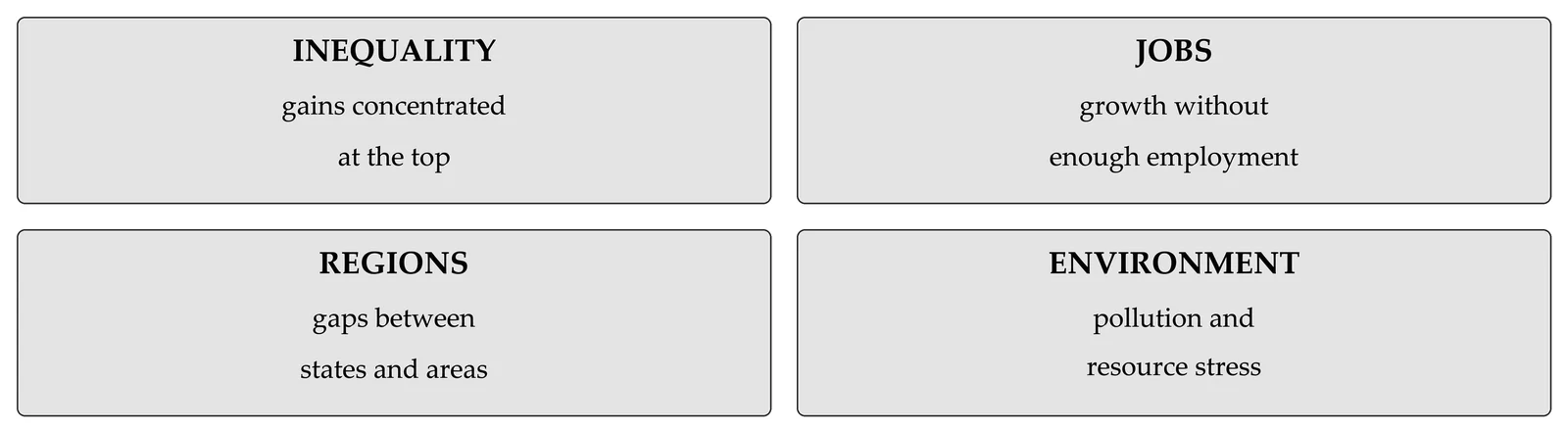
Development has come to mean not only economic growth but also human development, inclusion, rights and sustainability. Yet India’s development has produced discontents, such as inequality, jobless growth, regional imbalance and environmental damage, which M.A. Oommen and others analyse.
Measures of Development
- Growth. Gross domestic product and income per person measure economic output but ignore distribution and well-being.
- Human development. The Human Development Index combines life expectancy, education and income; India remains in the medium human development category.
- Multidimensional poverty. The Multidimensional Poverty Index, developed by UNDP and Oxford, measures deprivations in health, education and living standards.
- Inclusive growth. The Eleventh Plan (2007 to 2012) was titled Towards Faster and More Inclusive Growth, and the Twelfth sought faster, more inclusive and sustainable growth.
- Happiness. Bhutan’s idea of Gross National Happiness, promoted from the 1970s, and the World Happiness Report since 2012 offer alternative measures.
Discontents of Development
India’s growth has produced serious discontents. The World Inequality Lab reported in 2024 that the share of national income going to the top one per cent had risen to levels higher than under British rule. Employment has not kept pace with growth, women’s participation in paid work has remained low though rising, and much work is informal and insecure. Regional disparities are large, with income per person in the richest states several times that in the poorest. Development projects have displaced Adivasis and farmers, and pollution and water scarcity have grown. Scholars such as M.A. Oommen argue that decentralised, participatory development, as attempted in Kerala, is needed to make growth inclusive.
Sustainable Development and the SDGs
Since the Brundtland Report of 1987, development has increasingly been linked with sustainability. India adopted the seventeen Sustainable Development Goals of 2015, and NITI Aayog publishes an SDG India Index ranking states and Union territories. Localising the SDGs through panchayats and municipalities, for example through Gram Panchayat Development Plans prepared under the People’s Plan Campaign, has become a key strategy. The goals reflect a broad view of development that includes poverty, hunger, health, education, gender equality, clean water, decent work, reduced inequality, climate action and strong institutions.
2.4 Important Questions
- Question 1 Discuss the origins of the idea of development and India’s path of planned development.
- Question 2 What is a democratic developmental state? Discuss with reference to India.
- Question 3 Discuss the role of the state in economic growth and development in India.
- Question 4 Discuss the changing dimensions and discontents of development in India.
DU asks the same idea in different words. So learn one broad answer for each question below; the same answer works for every question joined by OR.
Important Question 1
Discuss the origins of the idea of development and India’s path of planned development.
OR
Examine the modernisation and dependency theories of development.
OR
Why did India adopt planned development after independence?
Model Answer
“We must embark on a bold new program for making the benefits of our scientific advances and industrial progress available for the improvement and growth of underdeveloped areas.”
— Harry S. Truman, Inaugural Address (1949)
Introduction. Development as a goal of public policy is a modern idea that emerged after the Second World War. Newly independent countries, including India, sought to end poverty and catch up with industrial nations. Different theories explained the causes of underdevelopment and proposed different paths. India chose planned development under the leadership of Jawaharlal Nehru.
1. The Post-War Moment
After 1945, the end of colonial empires and the creation of the World Bank and the United Nations made development a global goal. US President Truman’s speech of 1949 spoke of helping underdeveloped areas through science and investment.
2. Modernisation Theory
Modernisation theorists, such as W.W. Rostow in The Stages of Economic Growth (1960), argued that all societies pass through stages from traditional society to take-off and mass consumption, and that poor countries should follow the Western path.
3. Dependency Theory
Dependency theorists, such as Raúl Prebisch and Andre Gunder Frank, argued that underdevelopment results from the unequal global economy, in which rich core countries exploit poor peripheral ones through trade and investment.
4. Basic Needs and Human Development
In the 1970s, the focus shifted to meeting basic needs, and from 1990 the UNDP’s Human Development Index, developed by Mahbub ul Haq and Amartya Sen, measured development by health, education and income.
5. Plans before Independence
In 1944, Indian industrialists produced the Bombay Plan, M.N. Roy proposed a People’s Plan and S.N. Agarwal a Gandhian Plan, showing a broad consensus that independent India needed planned development.
6. The Planning Commission
The Planning Commission was set up in March 1950 to raise living standards by using the country’s resources efficiently, increasing production and offering employment to all.
7. The Mahalanobis Model
The Second Five Year Plan of 1956, based on the model of P.C. Mahalanobis, gave priority to heavy industry and the public sector, aiming at long-term self-reliance.
8. Mixed Economy
India adopted a mixed economy, with public and private sectors, guided by the Industrial Policy Resolution of 1956, which reserved key industries for the state.
9. Rural Development
The Community Development Programme of 1952 and panchayati raj sought to develop villages through agriculture, health, education and local participation.
10. Gandhi’s Alternative
Gandhi proposed a different path of development based on village self-reliance, small industries and limited wants, which influenced programmes such as khadi and village industries, though it was not the dominant model.
11. Achievements
Planned development built steel plants, dams, scientific institutions and universities, and the Green Revolution of the late 1960s made India self-sufficient in food grains.
12. Limitations
Growth was slow, at about three and a half per cent a year until 1980, poverty remained widespread, and controls created inefficiency and corruption.
13. Sustainable Development
From the 1980s, sustainable development added the concern that growth must not destroy the environment or the prospects of future generations.
14. Relevance
The debates between growth and equity, state and market, and industrialisation and village development continue to shape India’s development choices.
15. Nehru’s Vision
Nehru saw science, industry and planning as the means to modernise India and called dams and steel plants the temples of modern India. At the same time, he stressed democracy and the welfare of the poor, so that Indian planning combined modernisation with a commitment to social justice.
16. Critics of Development
Some scholars, such as Arturo Escobar and Wolfgang Sachs, criticised the idea of development itself, arguing that it imposed Western models on the global South, treated local ways of life as backward and often benefited elites. In India, Gandhian and environmental critics similarly questioned large dams and industrialisation.
17. Evaluation
The idea of development emerged from post-war hopes and theories, and India’s planned path achieved industrial foundations but slow progress against poverty.
Conclusion. Thus, development emerged as a global goal after 1945, explained by modernisation theory, challenged by dependency theory and broadened by basic needs and human development. India chose planned development through the Planning Commission and the Mahalanobis model, building industry but making slow progress against poverty.
Important Question 2
What is a democratic developmental state? Discuss with reference to India.
OR
Can democracy and rapid development go together? Discuss.
OR
Examine Robinson and White’s idea of the democratic developmental state.
Model Answer
“The State shall strive to promote the welfare of the people by securing and protecting as effectively as it may a social order in which justice, social, economic and political, shall inform all the institutions of the national life.”
— Constitution of India, Article 38
Introduction. The rapid development of East Asian countries such as Japan, South Korea and Taiwan was led by developmental states that directed industrialisation, often under authoritarian rule. This raised the question whether democracies can also be developmental. Mark Robinson and Gordon White examined how a democratic developmental state could be designed, a question highly relevant to India.
1. The Developmental State
Chalmers Johnson used the term developmental state to describe Japan, where a capable bureaucracy guided industrial growth through planning, credit and industrial policy.
2. East Asian Examples
South Korea and Taiwan achieved rapid growth through states that disciplined business, invested in education and promoted exports, but they did so largely under authoritarian governments.

3. Embedded Autonomy
Peter Evans argued that successful developmental states combine autonomy, a coherent bureaucracy free from capture, with embeddedness, close ties with business and society, which he called embedded autonomy.
4. The Question of Democracy
Some argued that democracy hinders development because of populist pressures and slow decisions. Others argued that democracy provides legitimacy, accountability and information that support development.
5. Robinson and White
Mark Robinson and Gordon White argue that a democratic developmental state is possible if institutions are designed to combine state capacity and autonomy with democratic accountability, inclusive coalitions and protection of the poor.
6. Institutional Design
They stress institutions such as a competent bureaucracy, stable party systems, mechanisms for consultation with business and labour, and decentralised government that brings development closer to people.
7. Examples
Botswana and Mauritius are often cited as democracies that achieved rapid development with relatively capable and honest states.
8. India as a Developmental State
India attempted to be a developmental state through planning, but Atul Kohli described it as a fragmented multi-class state, in which competing interests and weak implementation limited its developmental capacity.
9. Democracy and Development in India
India’s democracy has provided legitimacy and prevented famines, as Amartya Sen noted, but competitive politics has sometimes favoured subsidies and short-term benefits over long-term investment.
10. The Kerala Model
Kerala achieved high levels of literacy, health and life expectancy with modest incomes, through social movements, public action and democratic decentralisation, showing a democratic path to human development.
11. Local Government and Development
The 73rd and 74th Amendments made panchayats and municipalities institutions of economic development and social justice, giving democracy a role in local development planning.
12. Rights-Based Development
Since the 2000s, India has used rights-based laws on employment, education, food and information, combining democracy with welfare and development.
13. Challenges
Challenges include weak state capacity at the local level, corruption, inequality, and the difficulty of balancing growth with inclusion in a diverse democracy.
14. Recent Trends
India has expanded infrastructure, digital public goods and direct benefit transfers, showing state capacity in some areas, while debates continue about inclusion and federalism.
15. Capacity and Corruption
A developmental state needs a capable and honest bureaucracy. In India, studies show that implementation of schemes is often weakened by corruption, absenteeism and poor coordination, which limits the state’s developmental role despite good policies.
16. Social Movements and Development
In a democracy, social movements push the state to address neglected needs. Movements for the right to information, food and work led to laws in the 2000s, showing how democratic pressure can make the state more developmental for the poor.
17. Evaluation
The democratic developmental state is a demanding ideal, and India’s experience shows both its possibilities and its difficulties.
Conclusion. Thus, the developmental state, as in Japan and South Korea, guided rapid growth but often under authoritarian rule. Robinson and White argue that democracies can be developmental through well-designed institutions combining capacity, accountability and inclusion. India, a fragmented multi-class state in Kohli’s view, shows both achievements, as in Kerala, and limits.
Important Question 3
Discuss the role of the state in economic growth and development in India.
OR
Examine the shift from state-led development to market-friendly growth in India.
OR
Discuss Mukherji’s analysis of the state, growth and development in India.
Model Answer
“To promote a rapid rise in the standard of living of the people by efficient exploitation of the resources of the country, increasing production and offering opportunities to all for employment in the service of the community.”
— Government of India, Resolution setting up the Planning Commission (1950)
Introduction. The state has played a central role in India’s development, but that role has changed greatly since independence. From planning and public enterprise, India moved towards liberalisation after 1991, while expanding welfare and rights in the 2000s. Rahul Mukherji analyses how the state has shaped growth and development, and how ideas and crises led to policy change.
1. State-Led Development
From 1950 to 1980, the state directed development through five-year plans, public sector industries, licensing of private industry, nationalisation of banks in 1969 and protection from imports.
2. The Hindu Rate of Growth
Growth averaged about three and a half per cent a year, which the economist Raj Krishna called the Hindu rate of growth, too slow to reduce poverty significantly.
3. The 1980s Shift
In the 1980s, the government began easing controls and supporting business. Atul Kohli argues that this pro-business tilt, rather than the reforms of 1991, began India’s faster growth.
4. The 1991 Reforms
A balance of payments crisis in 1991 led to major reforms: abolition of most industrial licensing, reduction of tariffs, opening to foreign investment and reform of the financial sector.
5. Mukherji on Policy Change
Rahul Mukherji argues that the Indian state’s ideas changed gradually as technocrats learned from experience and crises, so that reforms came when a crisis tipped the balance in favour of new ideas.
6. Growth after Reforms
Growth accelerated to six to eight per cent a year in the 2000s, making India one of the fastest-growing major economies and reducing the share of people in poverty.
7. Growth and Development
Mukherji stresses that growth is not the same as development: India’s improvements in health, nutrition and education lagged behind its economic growth.
8. Rights-Based Welfare
In the 2000s, the state expanded welfare through rights-based laws such as MGNREGA (2005), the Right to Education Act (2009) and the National Food Security Act (2013).
9. Regulatory State
The state shifted from owning industries to regulating markets through bodies such as SEBI, TRAI and the Competition Commission.
10. Infrastructure and Digital Public Goods
Since 2014, the state has invested heavily in roads, railways and digital public infrastructure such as Aadhaar and UPI, and used direct benefit transfers to deliver welfare.
11. Federalism
States play a large role in development, and differences in state policies and capacity explain why some states, such as Tamil Nadu, have developed faster than others.
12. Local Development
Panchayats and municipalities implement many development schemes, but limited funds and capacity reduce their effectiveness.
13. Debates
Debates continue over the right balance between state and market, the role of public investment, the protection of workers and farmers and the pace of privatisation.
14. State Capacity
Scholars argue that India’s development depends on improving state capacity, such as the quality of bureaucracy, police, courts and local administration.
15. The Green Revolution
In the late 1960s, the state promoted high-yielding seeds, fertilisers, irrigation and minimum support prices, leading to the Green Revolution in Punjab, Haryana and western Uttar Pradesh. It ended food shortages but increased regional inequality and environmental stress, illustrating both the power and limits of state-led development.
16. Public Investment
Public investment in infrastructure, research and education laid the foundations for later growth, including the institutes of technology and management, space and atomic energy programmes and the national highway network, showing the state’s long-term role in development.
17. Welfare through Technology
The state now uses digital systems to deliver welfare. The combination of Jan Dhan bank accounts, Aadhaar and mobile phones allows direct benefit transfers into the bank accounts of beneficiaries, which the government says has reduced leakages, though critics point to exclusion when authentication fails or records are wrong.
18. Evaluation
The Indian state has been central to development, shifting from planning to markets and welfare, as Mukherji shows, though growth has outpaced human development.
Conclusion. Thus, the Indian state moved from planning and controls, with the Hindu rate of growth, to a pro-business shift in the 1980s and market reforms in 1991. Mukherji shows how ideas and crises drove change and that growth has outpaced development, while rights-based welfare and digital infrastructure reflect new roles for the state.
Important Question 4
Discuss the changing dimensions and discontents of development in India.
OR
Examine the problems of inequality, jobless growth and regional imbalance in India.
OR
How has the meaning of development changed in India?
Model Answer
“That the operation of the economic system does not result in the concentration of wealth and means of production to the common detriment.”
— Constitution of India, Article 39(c)
Introduction. The meaning of development in India has broadened from economic growth to include human development, inclusion, rights and sustainability. Despite impressive growth, India’s development has produced discontents, such as rising inequality, jobless growth, regional imbalance, agrarian distress and environmental damage. M.A. Oommen and other scholars examine these problems.
1. From Growth to Human Development
Early planning focused on growth and industrialisation. Later, the focus shifted to human development, measured by health, education and living standards, influenced by Amartya Sen and the Human Development Reports.
2. Inclusive Growth
The Eleventh Five Year Plan (2007–12) adopted the goal of faster and more inclusive growth, recognising that the benefits of growth had not reached all groups.
3. Rights-Based Development
The rights-based approach treats education, food, work and information as legal entitlements, making the state accountable for development outcomes.
4. Sustainable Development
Sustainable development requires that growth respect environmental limits, and India has committed to the Sustainable Development Goals and to climate targets.
5. Oommen on Discontents
M.A. Oommen argues that Indian development has produced growth without commensurate gains in employment and equity, and that centralised policy-making and weak local governments have limited inclusive development.
6. Rising Inequality
Studies by the World Inequality Lab show that the share of national income going to the richest one per cent has risen sharply since the 1990s, reaching very high levels.
7. Jobless Growth
Growth has created too few good jobs, as most workers remain in informal employment with low wages and little security, and manufacturing employment has grown slowly.
8. Agrarian Distress
Agriculture, which employs a large share of workers, has faced low incomes, debt and farmer suicides, leading to protests such as those against the farm laws in 2020–21.
9. Regional Imbalance
Southern and western states have grown faster and achieved better human development than many northern and eastern states, widening regional disparities.
10. Human Development Gaps
Jean Drèze and Amartya Sen, in An Uncertain Glory (2013), argued that India’s neglect of health, education and nutrition left it behind countries such as Bangladesh on some social indicators despite faster growth.
11. Displacement
Development projects such as dams, mines and industrial zones have displaced millions, mostly Adivasis and the rural poor, often without adequate rehabilitation.
12. Environmental Costs
Growth has brought air and water pollution, depletion of groundwater and loss of forests, imposing costs on health and livelihoods.
13. Urban Discontents
Rapid urbanisation has produced slums, inadequate housing, congestion and poor services for many urban residents.
14. Local Development as Response
Many scholars, including Oommen, argue that stronger local governments and decentralised planning can make development more inclusive and responsive to local needs.
15. Gender Gaps
Women’s participation in the paid workforce in India has been low by international standards, and women face gaps in wages, property and safety. Development that ignores gender limits both women’s freedom and economic growth, which is why gender equality is now seen as central to development.
16. Health and Education Outcomes
India has made progress in school enrolment and life expectancy, but surveys show weak learning outcomes and high levels of child malnutrition. These gaps show that development requires improving the quality of public services, not only expanding them.
17. Informal Economy
Most Indian workers are in the informal economy, without written contracts, social security or protection under labour laws. Economists such as Arjun Sengupta, whose commission reported in 2007, showed that informal workers formed the large majority of the workforce and were among the poorest, making their protection central to inclusive development.
18. Evaluation
Development in India has broadened in meaning, but its discontents show the need for inclusive, sustainable and decentralised development.
Conclusion. Thus, development in India has broadened from growth to human development, inclusion, rights and sustainability. Yet, as Oommen, Drèze and Sen show, it has produced discontents of inequality, jobless growth, agrarian distress, regional imbalance, displacement and environmental damage, calling for inclusive and decentralised development.
Short Notes
(a) Developmental state
A state that actively directs economic growth through planning, industrial policy and a capable bureaucracy, as in Japan and South Korea.
(b) Hindu rate of growth
Raj Krishna’s term for India’s slow growth of about three and a half per cent a year from 1950 to 1980.
(c) Inclusive growth
Growth whose benefits reach all sections of society, adopted as a goal in the Eleventh Five Year Plan (2007–12).
(d) Embedded autonomy
Peter Evans’s idea that an effective developmental state combines a coherent, independent bureaucracy with close ties to business and society.
(e) Kerala model
Kerala’s pattern of high literacy, health and life expectancy achieved with modest incomes, through public action, social movements and decentralisation.
More notes: MDSE-14 Rural-Urban Local Development in India
These notes are prepared by PADHO TO AISE for study help. They are not an official University of Delhi publication.