
Semester VIII MDSE-14 Rural-Urban Local Development in India
Unit 1 · 24 min read · Updated 24 Nov 2026
As per the University of Delhi (DU) BA (Hons) Political Science syllabus
Contents
- 1.1 Understanding the Rural and the Urban
- Features of Urbanisation in India
- Hidden and Subaltern Urbanisation
- Rural India Today
- 1.2 Historical Legacies of Local Government
- Milestones of Colonial Local Government
- Village Republics and Their Critics
- From Community Development to Constitutional Status
- Urban Governance after Independence
- 1.3 Continuities and Discontinuities
- Continuities in Local Government
- Discontinuities after 1992
- Changing Rural-Urban Relations
- 1.4 Important Questions
- How are the rural and the urban defined in India? Discuss the trends of urbanisation.
- Trace the historical evolution of rural local government in India.
- Trace the historical evolution of urban local government in India.
- Discuss the relationship between rural and urban India with reference to continuities and discontinuities.
- Short Notes
ग्राम समुदाय छोटे गणराज्य हैं, जिनके पास अपनी ज़रूरत की लगभग हर चीज़ अपने भीतर है।
The village communities are little republics, having nearly everything they can want within themselves, and almost independent of any foreign relations.
— Charles Metcalfe, Minute on village communities (1830)
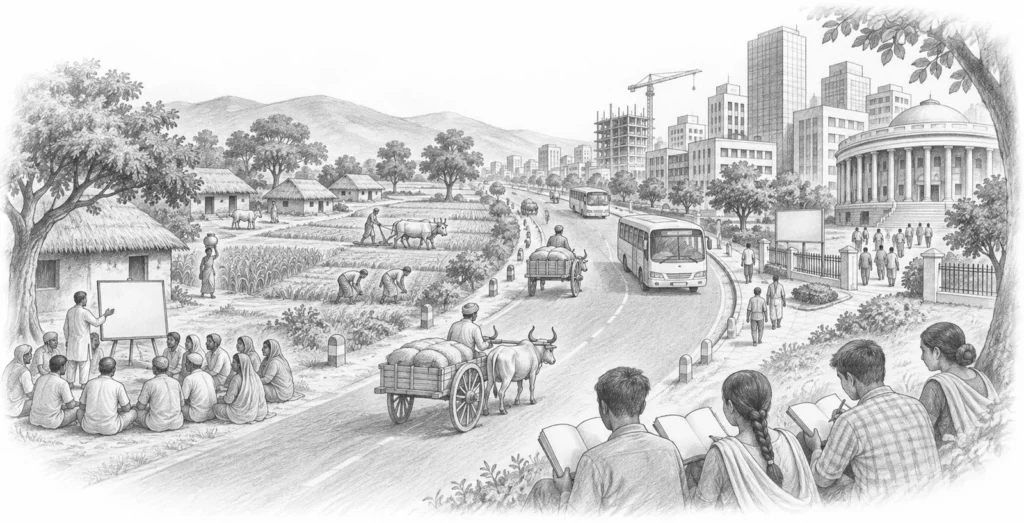
INDIA is still largely a land of villages, but its towns and cities are growing fast. Understanding local development requires knowing how the rural and the urban are defined, how they are connected and how local government has evolved over centuries. This chapter explains the Census definitions of rural and urban areas, the trends of urbanisation, and the historical legacies of rural and urban local government, from ancient village assemblies and colonial reforms to the 73rd and 74th Amendments of 1992, drawing on George Mathew, K.C. Sivaramakrishnan and the Ministry of Housing and Urban Affairs.
1.1 Understanding the Rural and the Urban
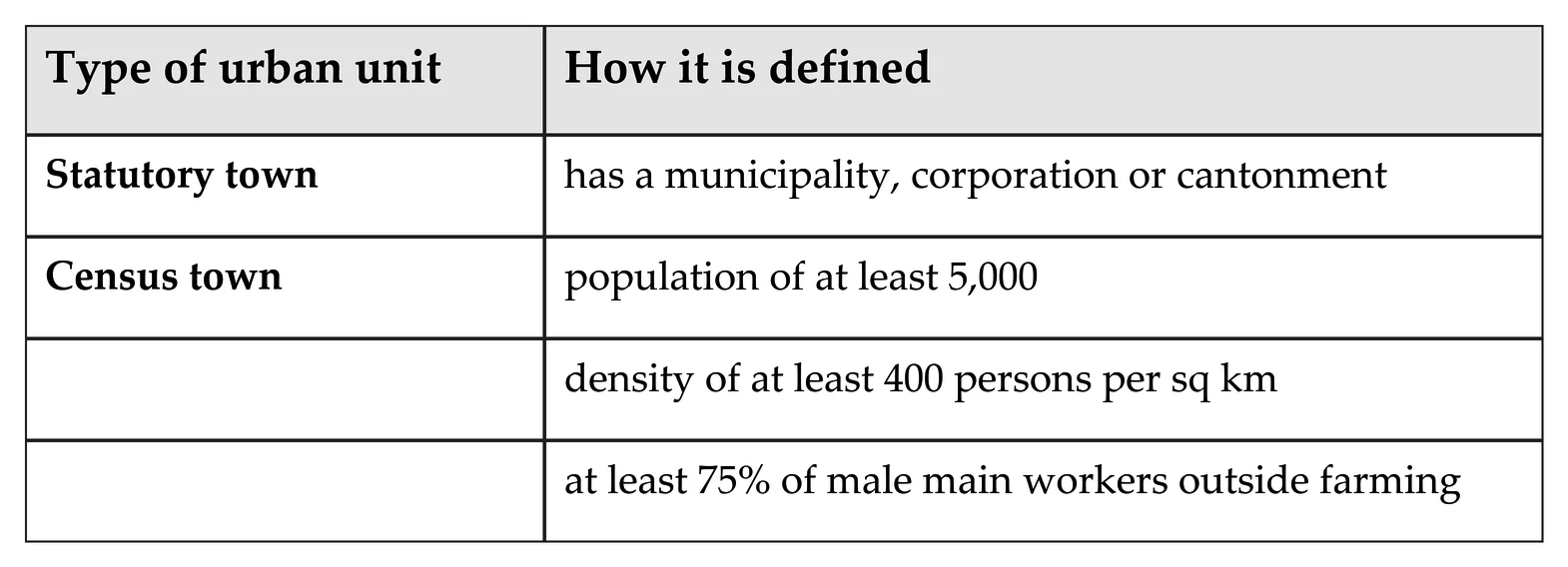
The Census of India classifies an area as urban if it is a statutory town with a municipality, corporation or cantonment, or a census town with at least 5,000 people, a density of at least 400 per square kilometre and at least 75 per cent of male main workers outside agriculture. All other areas are rural. By this definition, India was about 31 per cent urban in 2011, though other measures suggest it is more urban than official figures show.
Features of Urbanisation in India
- Slow but steady growth. The urban share of the population rose from about 17 per cent in 1951 to about 31 per cent in 2011; the next Census, delayed since 2021, has been scheduled with a reference date of 1 March 2027.
- Rise of census towns. The number of census towns jumped from 1,362 in 2001 to 3,894 in 2011, while statutory towns numbered about four thousand, so much urban growth happened in places still governed as villages.
- Big cities. The number of million-plus urban agglomerations rose to fifty-three in 2011, led by Greater Mumbai, Delhi and Kolkata.
- Sources of growth. Urban growth comes from natural increase, reclassification of rural areas as urban and migration, with natural increase contributing the largest share.
- Regional variation. States such as Tamil Nadu, Kerala and Maharashtra are far more urbanised than Bihar, Assam and Odisha; Kerala’s urban share almost doubled between 2001 and 2011, mainly because many large villages were reclassified as census towns.
Hidden and Subaltern Urbanisation
Many scholars argue that India is more urban than the Census suggests. A World Bank report of 2016, using an agglomeration index based on population density and travel time to a large city, estimated that more than half of India’s population lived in areas with urban characteristics. Eric Denis, Partha Mukhopadhyay and Marie-Hélène Zérah, in Subaltern Urbanisation in India (2012), showed that much urbanisation occurs in small towns and large villages, driven by local economic dynamics rather than by big metropolitan cities. This hidden urbanisation creates a governance mismatch, since places with urban needs such as drainage, waste management and planning are governed by gram panchayats with rural powers and funds.
Rural India Today
Rural India still contains most of the population, spread across more than six lakh villages. Close to half of the workforce depends on agriculture, though its share in national output is much smaller, which means low incomes for many rural households. The rural economy is diversifying into construction, trade, transport and services, and many households combine farming with migrant work. The Shyama Prasad Mukherji Rurban Mission of 2016 sought to develop clusters of villages with urban amenities, building on A.P.J. Abdul Kalam’s earlier idea of PURA, Providing Urban Amenities in Rural Areas, reflecting the view that rural and urban areas form a continuum rather than separate worlds.
1.2 Historical Legacies of Local Government
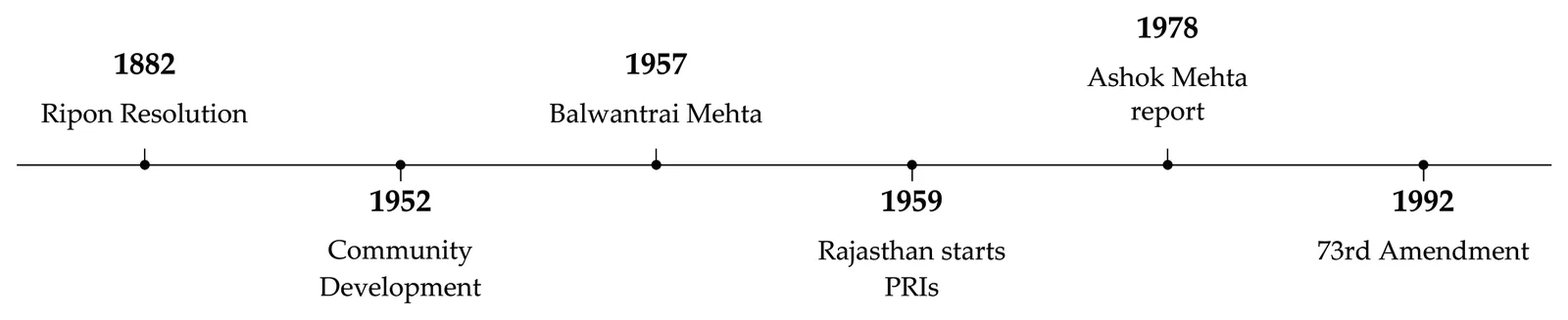
India has ancient traditions of village assemblies and city administration. Colonial rule introduced municipal bodies and, through Lord Ripon’s Resolution of 1882, elected local self-government. After independence, the Community Development Programme and panchayati raj followed, and the 73rd and 74th Amendments of 1992 gave rural and urban local bodies constitutional status.
Milestones of Colonial Local Government
- 1688 → The Madras Municipal Corporation, the oldest in India, was set up by the East India Company.
- 1870 → Lord Mayo’s resolution on financial decentralisation transferred some departments and funds to provinces and encouraged local bodies.
- 1882 → Lord Ripon’s resolution, which earned him the title of father of local self-government in India, called for elected non-official majorities and non-official chairmen in local boards, mainly as a means of political education.
- 1909 → The Royal Commission on Decentralisation recommended village panchayats and greater powers for local bodies.
- 1919 → Under the Montagu-Chelmsford reforms, local self-government became a transferred subject under Indian ministers, and provinces passed village panchayat acts.
- 1935 → Provincial autonomy gave provinces fuller control over local government.
Village Republics and Their Critics
In 1830, the British official Charles Metcalfe described Indian village communities as little republics, self-sufficient and enduring through the rise and fall of empires. Gandhi’s idea of gram swaraj built on this image, imagining villages as self-governing units. B.R. Ambedkar disagreed sharply, telling the Constituent Assembly in November 1948 that the village had been a home of localism, ignorance and communalism and that he welcomed the choice of the individual rather than the village as the unit of the Constitution. As a compromise, village panchayats were placed in Article 40 of the Directive Principles, which directs the state to organise them as units of self-government.
From Community Development to Constitutional Status
The Community Development Programme began on 2 October 1952, followed by the National Extension Service in 1953, but people’s participation remained weak. The Balwantrai Mehta Committee of 1957 recommended democratic decentralisation through a three-tier system of village panchayats, panchayat samitis at the block level and zila parishads, and Rajasthan launched it at Nagaur on 2 October 1959. After a period of decline, the Ashok Mehta Committee of 1978 proposed a two-tier system with mandal panchayats, and the G.V.K. Rao (1985) and L.M. Singhvi (1986) committees recommended constitutional recognition. Rajiv Gandhi’s 64th Amendment Bill of 1989 failed in the Rajya Sabha, but the 73rd and 74th Amendments were passed in 1992 and came into force in 1993; 24 April is now observed as National Panchayati Raj Day.
Urban Governance after Independence
Urban local bodies were long neglected, and state governments often superseded municipalities and created parastatal agencies, such as development authorities and water boards, that took over key functions. The National Commission on Urbanisation, chaired by the architect Charles Correa, reported in 1988 on the need for planned urban growth. After the 74th Amendment, the Jawaharlal Nehru National Urban Renewal Mission of 2005 linked central funds to urban reforms, and in 2015 it was followed by AMRUT and the Smart Cities Mission, which critics say again relied on special purpose vehicles that bypass elected councils.
1.3 Continuities and Discontinuities
Local government in India shows continuities, such as the dominance of local elites and the control of higher governments, and discontinuities, such as constitutional status, regular elections and reservations for women and disadvantaged groups. The relationship between rural and urban areas, through migration, markets and planning, has also changed.

Continuities in Local Government
- Dominance of local elites. M.N. Srinivas’s idea of the dominant caste helps explain how landowning castes continue to control many panchayats, despite reservations.
- Bureaucratic control. The district collector, an office dating from 1772, and state officials still exercise great power over local bodies through approvals, transfers and funds.
- Fiscal dependence. Local bodies raise little revenue of their own; municipal revenues in India are about one per cent of GDP or less, far below those of countries such as Brazil and South Africa.
- Parallel bodies. District Rural Development Agencies, parastatals and schemes such as the MPs’ Local Area Development Scheme (1993) operate alongside and often around elected local bodies.
Discontinuities after 1992
- Constitutional status. Local bodies are now part of the Constitution and cannot be abolished or indefinitely suspended at the will of state governments.
- Regular elections. State Election Commissions must hold elections every five years, and a dissolved body must be re-elected within six months.
- Reservations. Seats and chairpersons’ posts are reserved for Scheduled Castes, Scheduled Tribes and women, and about twenty states have raised women’s reservation to fifty per cent.
- Functions and finance. The Eleventh and Twelfth Schedules list twenty-nine subjects for panchayats and eighteen for municipalities, and State Finance Commissions review local finances; the Fifteenth Finance Commission recommended grants of more than four lakh crore rupees to local bodies for 2021 to 2026.
- Tribal self-rule. The Panchayats (Extension to Scheduled Areas) Act of 1996 gave gram sabhas in Scheduled Areas powers over land, forest produce and local resources.
Changing Rural-Urban Relations
The relationship between rural and urban India is being transformed by migration, markets and infrastructure. Millions of workers migrate seasonally or circularly between villages and cities, keeping a foot in both. The sudden lockdown of March 2020 exposed their vulnerability, as migrant workers walked hundreds of kilometres home. Remittances support rural households, and expanding roads, mobile phones and digital payments link villages with urban markets. Peri-urban areas around big cities, where farmland gives way to housing and industry, face problems of planning, water and waste. These changes call for governance arrangements that cross the rigid rural-urban divide.
1.4 Important Questions
- Question 1 How are the rural and the urban defined in India? Discuss the trends of urbanisation.
- Question 2 Trace the historical evolution of rural local government in India.
- Question 3 Trace the historical evolution of urban local government in India.
- Question 4 Discuss the relationship between rural and urban India with reference to continuities and discontinuities.
DU asks the same idea in different words. So learn one broad answer for each question below; the same answer works for every question joined by OR.
Important Question 1
How are the rural and the urban defined in India? Discuss the trends of urbanisation.
OR
Examine the Census definition of urban areas and its limitations.
OR
Discuss the nature and pattern of urbanisation in India.
Model Answer
“Cities have the capability of providing something for everybody, only because, and only when, they are created by everybody.”
— Jane Jacobs, The Death and Life of Great American Cities (1961)
Introduction. The distinction between rural and urban areas shapes how India is governed, since villages are governed by panchayats and towns by municipalities, and different schemes apply to each. The Census of India provides the official definitions. Urbanisation, the growth of the share of people living in towns and cities, is one of the most important changes in modern India.
1. Statutory Towns
Statutory towns are places notified by state governments as having a municipal corporation, municipal council, nagar panchayat or cantonment board. They are urban by administrative status.
2. Census Towns
Census towns are places without municipal status that meet three criteria: a population of at least 5,000, a density of at least 400 persons per square kilometre and at least 75 per cent of male main workers engaged outside agriculture.
3. Rural Areas
All areas that are not statutory or census towns are rural. India had about 6.4 lakh villages in 2011, which vary greatly in size, economy and access to services.
4. Urban Agglomerations
An urban agglomeration is a continuous urban spread including a town and its outgrowths. In 2011, India had more than fifty cities and agglomerations with a million or more people.
5. Trends
India’s urban share rose from about 11 per cent in 1901 to 17 per cent in 1951, 23 per cent in 1981 and 31 per cent in 2011, when about 377 million people lived in towns and cities.
6. Census Towns Growth
The number of census towns grew sharply between 2001 and 2011, showing that many places have become urban in character without being recognised as towns or given municipal government.
7. Hidden Urbanisation
Scholars argue that India is more urban than the Census shows. A World Bank measure based on population density and access to cities suggested that more than half of India’s population lives in urban-like areas.
8. Subaltern Urbanisation
Some scholars describe subaltern urbanisation, the growth of small towns and settlements that develop through local economic activity rather than as satellites of big cities.
9. The Rural-Urban Continuum
Rural and urban areas are not sharply separate. Peri-urban areas around cities combine farming and urban work, and many villages have non-farm jobs, forming a continuum rather than a divide.
10. The Rurban Idea
The Shyama Prasad Mukherji Rurban Mission, launched in 2016, aimed to develop clusters of villages with urban amenities while keeping their rural character.
11. Urban Statistics
The Ministry of Housing and Urban Affairs publishes a Handbook of Urban Statistics, which provides data on urban population, services, finances and housing for planning.
12. Drivers of Urbanisation
Urbanisation is driven by natural increase in urban population, migration from villages and the reclassification of rural areas as urban, with natural increase being the largest factor in recent decades.
13. Uneven Urbanisation
Urbanisation is uneven: states such as Tamil Nadu, Kerala and Maharashtra are highly urbanised, while Bihar, Assam and Odisha remain largely rural.
14. Implications
Rapid urbanisation creates opportunities for growth and jobs but also challenges of housing, slums, water, sanitation, transport and pollution, requiring strong urban governance.
15. Governance Mismatch
Because census towns are urban in character but are still governed by gram panchayats, they lack the planning, services and finances of municipalities. Scholars argue that states should convert such places into urban local bodies, or give panchayats urban functions, so that governance matches the reality on the ground.
16. Evaluation
The Census definitions provide a basis for policy, but they understate urbanisation and ignore the continuum between rural and urban life.
Conclusion. Thus, the Census defines urban areas as statutory towns and census towns meeting criteria of population, density and non-farm work, with all other areas rural. India’s urban share rose to 31 per cent in 2011, but hidden urbanisation, census towns without municipal status and the rural-urban continuum show that official definitions understate change.
Important Question 2
Trace the historical evolution of rural local government in India.
OR
Discuss the development of panchayati raj from colonial times to the 73rd Amendment.
OR
Examine the role of committees in the evolution of panchayati raj.
Model Answer
“What is the village but a sink of localism, a den of ignorance, narrow-mindedness and communalism?”
— B.R. Ambedkar, Constituent Assembly (4 November 1948)
Introduction. Rural local government in India has a long history, from ancient village assemblies to modern panchayati raj institutions. Its development was shaped by colonial policies, Gandhi’s vision of village self-rule, debates in the Constituent Assembly, a series of government committees and, finally, the 73rd Amendment of 1992. George Mathew has documented the uneven status of panchayati raj in the states.
1. Ancient Traditions
Village assemblies existed in ancient India. Inscriptions from Uttaramerur in Tamil Nadu, from the tenth century, describe how members of the village assembly were chosen by lot, showing early local self-government.
2. Little Republics
In 1830, Charles Metcalfe described Indian villages as little republics, largely self-sufficient and independent. Later scholars said this view romanticised villages and ignored caste hierarchy.
3. Colonial Policies
Colonial rule weakened traditional village institutions while creating district boards and some village panchayats under provincial laws, mainly for administrative convenience.
4. Ripon and the Royal Commission
Lord Ripon’s Resolution of 1882 promoted elected local bodies as a means of political education. The Royal Commission on Decentralisation of 1907–09 recommended village panchayats, which several provinces later created.
5. Gandhi’s Gram Swaraj
Gandhi envisioned gram swaraj, self-governing and self-reliant villages as the foundation of Indian democracy, with power flowing from the bottom up.
6. The Constituent Assembly
Ambedkar criticised the village as a den of ignorance and communalism and preferred the individual as the unit of the Constitution. As a compromise, Article 40 of the Directive Principles directed the state to organise village panchayats.
7. Community Development
The Community Development Programme of 1952 sought rural development through government officials and people’s participation, but it remained largely bureaucratic.
8. The Balwantrai Mehta Committee
The Balwantrai Mehta Committee of 1957 recommended democratic decentralisation through a three-tier system of village panchayats, block samitis and zila parishads. Rajasthan launched panchayati raj at Nagaur on 2 October 1959.
9. Decline
In the 1960s and 1970s, panchayati raj declined as elections were postponed, powers were withheld and state governments and bureaucracies dominated rural development.
10. The Ashok Mehta Committee
The Ashok Mehta Committee of 1978 recommended a two-tier system with mandal panchayats and stronger powers. Karnataka and West Bengal revived panchayati raj in the late 1970s and 1980s.
11. Towards Constitutional Status
The G.V.K. Rao Committee of 1985 and the L.M. Singhvi Committee of 1986 recommended stronger panchayats, and Singhvi proposed constitutional status. A constitutional amendment bill failed in 1989.
12. The 73rd Amendment
The 73rd Amendment of 1992, which came into force on 24 April 1993, gave panchayats constitutional status, with regular elections, reservations, state election and finance commissions and a list of 29 subjects. The date is observed as National Panchayati Raj Day.
13. Mathew on the States
George Mathew’s study of the status of panchayati raj in the states showed great variation: some states, such as Kerala, devolved real powers, while others kept panchayats weak and dependent.
14. Continuing Problems
Problems include inadequate devolution of funds, functions and functionaries, bureaucratic control, elite capture and weak gram sabhas.
15. Kerala’s People’s Plan
Kerala’s People’s Plan Campaign of 1996 devolved about a third of the state’s plan funds to local governments and involved citizens in preparing development plans through gram sabhas and seminars. It is often cited as the most ambitious example of democratic decentralisation after the 73rd Amendment.
16. PESA, 1996
The Panchayats (Extension to the Scheduled Areas) Act of 1996 extended panchayati raj to tribal areas under the Fifth Schedule, giving gram sabhas special powers over land, minor forest produce, local markets and customary disputes. It recognised tribal traditions of self-governance, though many states have been slow to implement it.
17. Evaluation
Rural local government has evolved from ancient assemblies and colonial experiments to constitutionally protected panchayats, though real devolution remains incomplete.
Conclusion. Thus, rural local government evolved from ancient assemblies through colonial reforms, Gandhi’s gram swaraj and Article 40 to the Community Development Programme, the Mehta committees and the 73rd Amendment of 1992. Mathew shows uneven implementation across states, and devolution of real powers remains the key challenge.
Important Question 3
Trace the historical evolution of urban local government in India.
OR
Discuss the colonial origins of municipal government in India.
OR
Examine the background and significance of the 74th Amendment.
Model Answer
“It is not primarily with a view to improvement in administration that this measure is put forward and supported. It is chiefly desirable as an instrument of political and popular education.”
— Lord Ripon, Resolution on Local Self-Government (1882)
Introduction. Cities have been centres of trade, administration and culture in India since ancient times. Modern urban local government, however, was largely shaped by colonial rule, which created municipalities in the major cities. After independence, municipalities were often weak and overshadowed by state agencies until the 74th Amendment of 1992 gave them constitutional status. K.C. Sivaramakrishnan and Isher Ahluwalia have analysed this history.
1. Ancient and Medieval Cities
Ancient cities such as Pataliputra had organised administration. Megasthenes described boards that managed industry, foreigners, trade and other matters in the Mauryan capital. In medieval times, the kotwal managed city order.
2. The First Municipal Body
The first municipal corporation in India was set up in Madras in 1688 by the East India Company, followed by bodies in Bombay and Calcutta, mainly to raise local taxes.
3. Mayo and Ripon
Lord Mayo’s resolution of 1870 encouraged financial decentralisation, and Lord Ripon’s Resolution of 1882 introduced elected non-official majorities in local bodies, regarding them as a means of political education.
4. Royal Commission and the 1919 Act
The Royal Commission on Decentralisation of 1907–09 recommended more powers for municipalities, and the Government of India Act of 1919 made local self-government a transferred subject under elected provincial ministers.
5. After Independence
After 1947, municipalities often lacked powers and funds. States created parastatal agencies, such as development authorities and water boards, which took over urban functions and weakened elected municipal bodies.
6. Suspended Municipalities
Many municipal bodies were superseded for long periods, with elections postponed and officials appointed to run them, weakening local democracy.
7. The Nagarpalika Bill
A constitutional amendment bill on municipalities was introduced in 1989 but failed in the Rajya Sabha. A revised bill became the 74th Amendment in 1992.
8. The 74th Amendment
The 74th Amendment, which came into force on 1 June 1993, gave municipalities constitutional status, with regular elections, reservations, state finance commissions, ward committees and a list of 18 functions in the Twelfth Schedule.
9. Sivaramakrishnan’s Assessment
K.C. Sivaramakrishnan argued that the 74th Amendment was implemented half-heartedly, as states did not transfer functions, funds and staff to municipalities, and parastatals continued to dominate.
10. Urban Missions
The Jawaharlal Nehru National Urban Renewal Mission of 2005 linked central funds to reforms, and the Smart Cities Mission and AMRUT of 2015 funded urban infrastructure.
11. Ahluwalia on Urban Governance
Isher Ahluwalia argues that Indian cities need empowered municipal governments with elected mayors, adequate finances such as property tax, and professional capacity to meet the demands of urbanisation.
12. Municipal Finance
Indian municipalities raise very little revenue compared with cities in other countries, depending on grants from higher governments, which limits their autonomy.
13. Weak Mayors
In most Indian cities, mayors are indirectly elected for short terms with little executive power, while state-appointed commissioners control administration.
14. Citizen Participation
Ward committees and area sabhas, meant to involve citizens, have been formed in few cities, so participation in urban governance remains limited.
15. Rural-Urban Relationship Committee
The Rural-Urban Relationship Committee of 1966 examined the finances and functions of municipalities and recommended stronger local bodies, better tax powers and trained staff. Its recommendations were largely ignored, showing the low priority given to urban local government in the early decades after independence.
16. Evaluation
Urban local government has a long history, but municipalities remain weak, needing real devolution of powers, finances and participation.
Conclusion. Thus, urban local government evolved from the Madras Corporation of 1688 through Mayo’s and Ripon’s reforms and the 1919 Act to the 74th Amendment of 1992. Sivaramakrishnan shows its half-hearted implementation and Ahluwalia calls for empowered, well-financed cities, as urban missions alone cannot replace strong municipal government.
Important Question 4
Discuss the relationship between rural and urban India with reference to continuities and discontinuities.
OR
How are rural and urban areas interdependent in India?
OR
Examine the continuities and discontinuities in India’s local governance.
Model Answer
“If the village perishes, India will perish too.”
— M.K. Gandhi, Harijan (1936)
Introduction. Rural and urban India are closely connected through migration, markets, food, labour and politics. Their relationship has been seen in different ways by Gandhi, who valued villages, and by Nehru and Ambedkar, who looked to modern cities and industry. The history of local governance shows both continuities with the past and important breaks.
1. Interdependence
Villages supply food, raw materials and labour to cities, while cities provide markets, jobs, services and remittances to villages. Neither can develop without the other.
2. Migration
Millions of people migrate between villages and cities. The 2011 Census recorded about 45 crore internal migrants, and many workers move seasonally, keeping ties with their villages.

3. The 2020 Migrant Crisis
During the Covid-19 lockdown of 2020, millions of migrant workers walked back to their villages, revealing how dependent cities were on rural labour and how little protection migrants had.
4. The Rural-Urban Divide
Rural areas lag behind urban areas in incomes, health, education and infrastructure, while urban areas face slums and informal work, creating different forms of deprivation.
5. Urban Bias
Michael Lipton argued that development policies in poor countries showed urban bias, favouring cities in investment and prices at the expense of rural people.
6. Gandhi, Nehru and Ambedkar
Gandhi wanted self-reliant villages, Nehru saw industry and cities as the path to modernity, and Ambedkar saw cities as places where Dalits could escape caste oppression in villages.
7. Bridging the Divide
Programmes such as Providing Urban Amenities in Rural Areas, proposed by President A.P.J. Abdul Kalam, and the Rurban Mission of 2016 aimed to bring urban facilities to rural clusters.
8. Continuity of Elite Dominance
A continuity in local governance is the dominance of local elites, such as landed castes in villages and propertied groups in towns, which persists despite democratic reforms.
9. Continuity of Central Control
Another continuity is the control of higher governments over local bodies, from colonial officials to state governments and bureaucrats today, limiting local autonomy.
10. Discontinuity of Constitutional Status
The 73rd and 74th Amendments marked a major break by giving local bodies constitutional status, regular elections and state finance commissions.
11. Discontinuity of Inclusion
Reservations for women, Scheduled Castes and Scheduled Tribes brought millions of new representatives into local government, changing its social composition.
12. District Planning
District Planning Committees are meant to integrate rural and urban plans, recognising the links between them, though they function poorly in many states.
13. Peri-Urban Areas
Peri-urban areas at the edges of cities face problems of land conversion, pollution and unclear governance, since they fall between panchayats and municipalities.
14. Changing Villages
Villages themselves are changing, with more non-farm work, mobile phones, roads and education, blurring the line between rural and urban life.
15. Remittances to Villages
Money sent home by migrants working in cities and abroad supports rural families, pays for education and housing and reduces poverty. In states such as Bihar and Uttar Pradesh, remittances from urban workers are a major source of rural income, showing how closely village and city economies are linked.
16. Agriculture and Urban Markets
Urban demand shapes rural production. The growth of cities has increased demand for vegetables, fruits, milk and meat, encouraging farmers near cities to shift from grain to higher-value crops, while supply chains and cold storage link rural producers with urban consumers.
17. Small Towns as Bridges
Small and medium towns act as bridges between villages and big cities, providing markets, schools, hospitals and non-farm jobs. Scholars argue that developing small towns can reduce pressure on big cities and spread the benefits of urbanisation to rural areas.
18. Rural Non-Farm Economy
A growing share of rural incomes now comes from non-farm work, such as construction, transport, trade, small manufacturing and services. This rural non-farm economy, often linked to nearby towns, shows that villages are no longer purely agricultural and that rural and urban economies increasingly overlap, requiring planning that crosses the rural-urban boundary.
19. Evaluation
Rural and urban India are interdependent, and local governance must address their links while overcoming continuing problems of elite control and centralisation.
Conclusion. Thus, rural and urban India are linked through migration, markets and labour, as the 2020 migrant crisis showed, though a rural-urban divide and urban bias persist. Local governance shows continuities of elite dominance and central control, and discontinuities of constitutional status and inclusion, while district planning and rurban programmes try to bridge the divide.
Short Notes
(a) Census town
A place without municipal status that has at least 5,000 people, a density of 400 per square kilometre and 75 per cent of male main workers outside agriculture.
(b) Ripon Resolution
Lord Ripon’s resolution of 1882 promoting elected local bodies as instruments of political education, the foundation of local self-government in India.
(c) Urban bias
Michael Lipton’s idea that development policies favour cities at the expense of rural people.
More notes: MDSE-14 Rural-Urban Local Development in India
These notes are prepared by PADHO TO AISE for study help. They are not an official University of Delhi publication.