
Semester I DSC-1 Understanding Political Theory
Unit IV · 27 min read · Updated 24 Nov 2026
As per the University of Delhi (DU) BA (Hons) Political Science syllabus
Contents
- 4.1 Critical Perspectives
- 4.2 Feminism
- Features of Feminism
- The Waves of Feminism
- The Strands of Feminism
- 4.3 Key Feminist Debates
- Sex and Gender
- Public and Private
- Patriarchy
- Equality and Difference
- Contribution and Criticism
- 4.4 Postmodernism
- Features of Postmodernism
- 4.5 Postmodern Thinkers and Their Critics
- Postmodernism and Politics
- Criticisms of Postmodernism
- Feminism and Postmodernism
- 4.6 Important Questions
- Write an essay on the sex and gender debate within feminism.
- What is postmodernism? Examine its contribution to political theory.
- Examine the feminist critique of mainstream political theory.
- Short Notes
स्त्री पैदा नहीं होती, बल्कि बना दी जाती है।
One is not born, but rather becomes, a woman.
— Simone de Beauvoir, The Second Sex (1949)
THE TRADITIONS we studied in Chapter 3 each offered a complete picture of society. Feminism and postmodernism are called critical perspectives because they question the very foundations on which those traditions, and political theory itself, were built. Feminism asks why, for most of history, political theory spoke only of men and treated the family as lying outside politics. Postmodernism asks whether the Enlightenment’s faith in universal reason, objective truth and progress was justified at all. Both connect directly to Chapter 1: the feminist slogan ‘the personal is political’ and Foucault’s idea that power is everywhere both widen what counts as political.
4.1 Critical Perspectives
A perspective is called critical when it does not simply accept the assumptions of existing theory but asks whose interests those assumptions serve. Critical perspectives try to uncover hidden forms of power and to free people from them. Feminism and postmodernism grew strongly from the 1960s and 1970s, alongside the women’s movement, the student movements and the decline of faith in grand ideologies. Both challenge what some feminists have called ‘malestream’ political theory, i.e. a tradition written by men, about men and for men, which claimed to speak for all humanity.
4.2 Feminism
In simple words, feminism is the belief that women are disadvantaged because of their sex, and that this disadvantage can and should be overcome. All feminists share two ideas. First, women have been systematically subordinated to men in politics, the economy, culture and the family. Second, this subordination is not natural or unavoidable; it is created by society and can therefore be changed. Beyond these shared ideas, feminists differ widely about the causes of women’s oppression and the remedies for it.
Features of Feminism
- Women’s subordination is social, not natural. Mary Wollstonecraft wrote A Vindication of the Rights of Woman (1792) when the French Revolution proclaimed the rights of ‘man’ but ignored women, replying to Rousseau’s claim in Emile that girls should be educated only to please men.
- Equal rights in public life. Women must have the same legal and political rights as men. J.S. Mill, with Harriet Taylor, argued this in The Subjection of Women (1869), and in 1867 moved an amendment in the British Parliament to give women the vote.
- Sex is different from gender. Womanhood is made by society, not by biology. Simone de Beauvoir wrote The Second Sex (1949) in post-war France, just after French women had won the vote, showing that legal equality had not ended their position as ‘the Other’.
- Patriarchy as a system of power. Male domination is a political structure, not a set of individual prejudices. Kate Millett developed Sexual Politics (1970) from her doctoral thesis at Columbia University at the height of the American women’s liberation movement.
- The personal is political. Private experiences reflect public structures of power. Carol Hanisch wrote her 1969 essay to defend women’s ‘consciousness-raising’ groups in New York against critics who dismissed them as mere personal therapy.
- Activism for change. Feminism is a movement, not only a theory. Betty Friedan, after The Feminine Mystique (1963), co-founded the National Organization for Women in 1966 to campaign for equal pay and opportunities in America.
- Recognition of care and difference. Women’s experiences and values deserve respect, not only equality on male terms. Carol Gilligan wrote In a Different Voice (1982) in reply to the psychologist Lawrence Kohlberg, whose theory of moral development had been built on studies of boys.
- Intersectionality. Gender oppression interacts with race, class and caste. Kimberlé Crenshaw introduced the term in 1989 after studying American court cases in which Black women’s claims of discrimination fell between the separate laws on race and on sex.
The Waves of Feminism
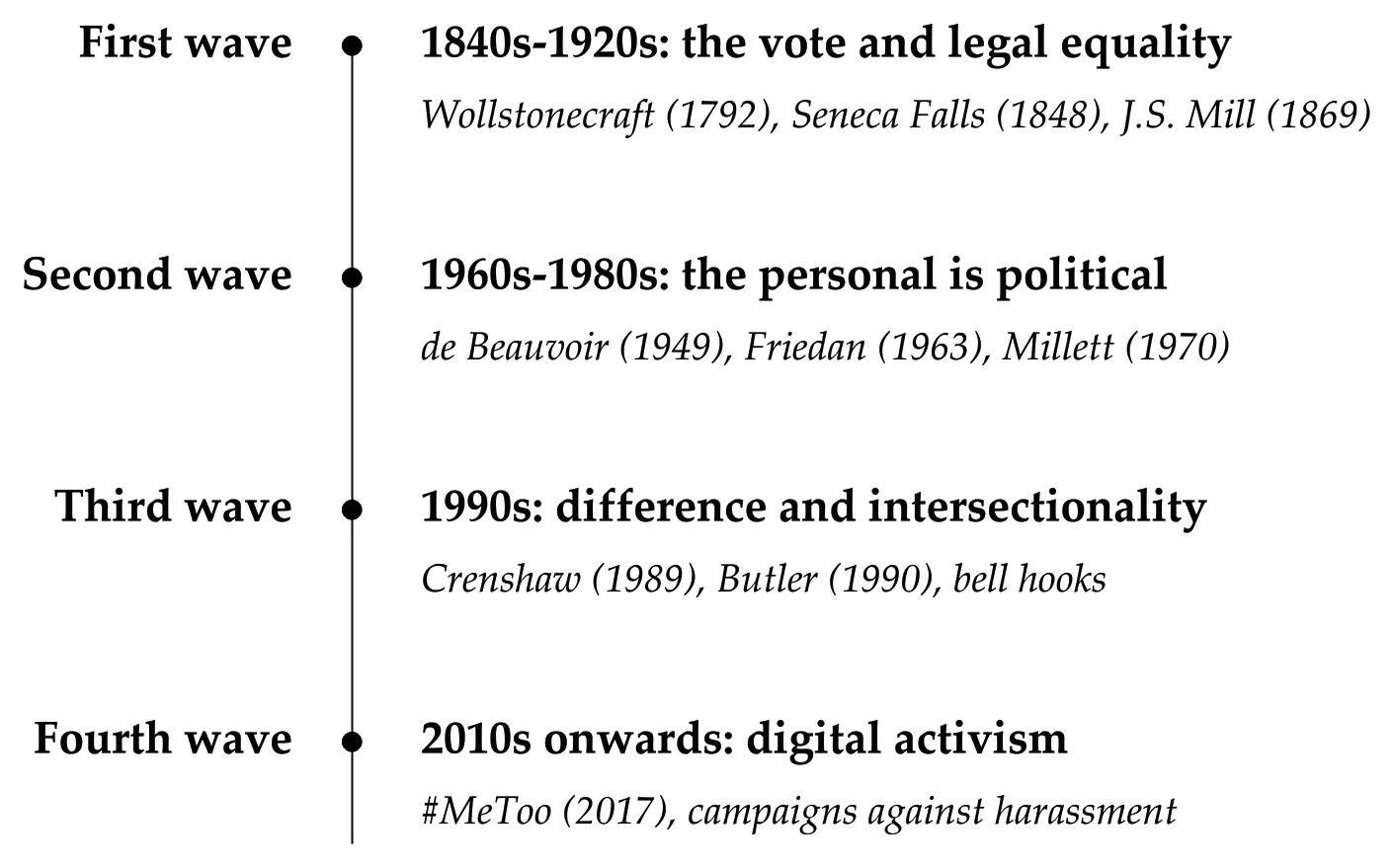
The history of feminism is usually told as a series of ‘waves’ (Figure 4.2). The first wave, from the mid-nineteenth to the early twentieth century, fought for the vote, property rights and access to education; New Zealand became the first country to give women the national vote in 1893. The second wave, from the 1960s, went beyond legal equality to challenge the family, sexuality and culture. Betty Friedan’s The Feminine Mystique (1963) described the frustration of educated housewives as ‘the problem that has no name’, and Kate Millett’s Sexual Politics (1970) analysed patriarchy as a political system. The third wave, from the 1990s, stressed differences among women of different races, classes and sexualities, and the fourth wave of the 2010s used digital media in campaigns such as #MeToo against sexual harassment.
The Strands of Feminism
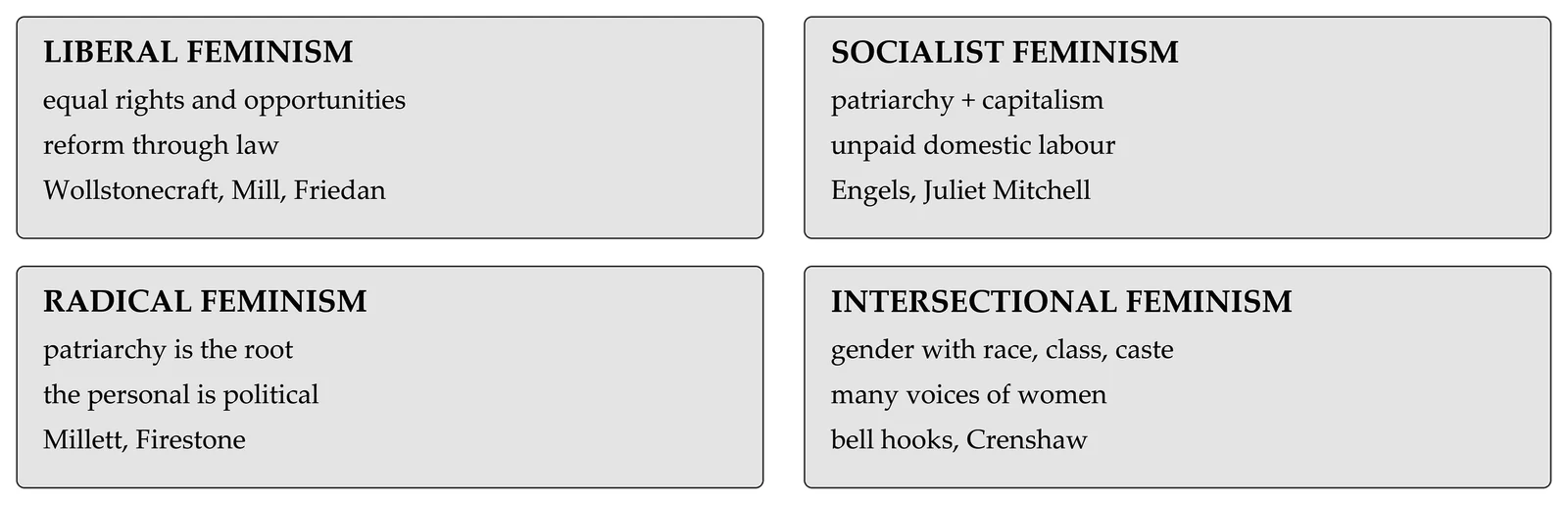
Feminists disagree about why women are oppressed and what should be done. Four main strands can be identified (Figure 4.3).
Liberal feminism demands equal rights and equal opportunities for women within the existing system. Wollstonecraft argued that women are as rational as men and are held back only by lack of education; Mill and Friedan extended this to law, employment and public life. Critics say that liberal feminism changes the rules of the public world but leaves the family and the deeper structures of power untouched.
Socialist and Marxist feminism links the oppression of women to capitalism. Engels, in The Origin of the Family, Private Property and the State (1884), traced women’s subordination to the rise of private property. Socialist feminists such as Juliet Mitchell (Woman’s Estate, 1971) stress that women’s unpaid domestic labour supports the capitalist economy, so women’s liberation requires both economic and social change.
Radical feminism sees patriarchy, i.e. the system of male domination, as the most basic form of oppression, found in every society and every sphere of life. Kate Millett and Shulamith Firestone (The Dialectic of Sex, 1970) argued that patriarchy operates through the family, sexuality and culture, and coined the politics of ‘the personal is political’.
Black, postcolonial and intersectional feminism criticises mainstream feminism for speaking mainly for white, middle-class Western women. bell hooks (Ain’t I a Woman?, 1981) and Kimberlé Crenshaw, who introduced the term intersectionality in 1989, showed that gender oppression intersects with race, class and, in societies like India, caste. Chandra Talpade Mohanty’s essay ‘Under Western Eyes’ (1984) criticised Western feminists for presenting ‘Third World women’ as a single, passive victim.
4.3 Key Feminist Debates
Sex and Gender
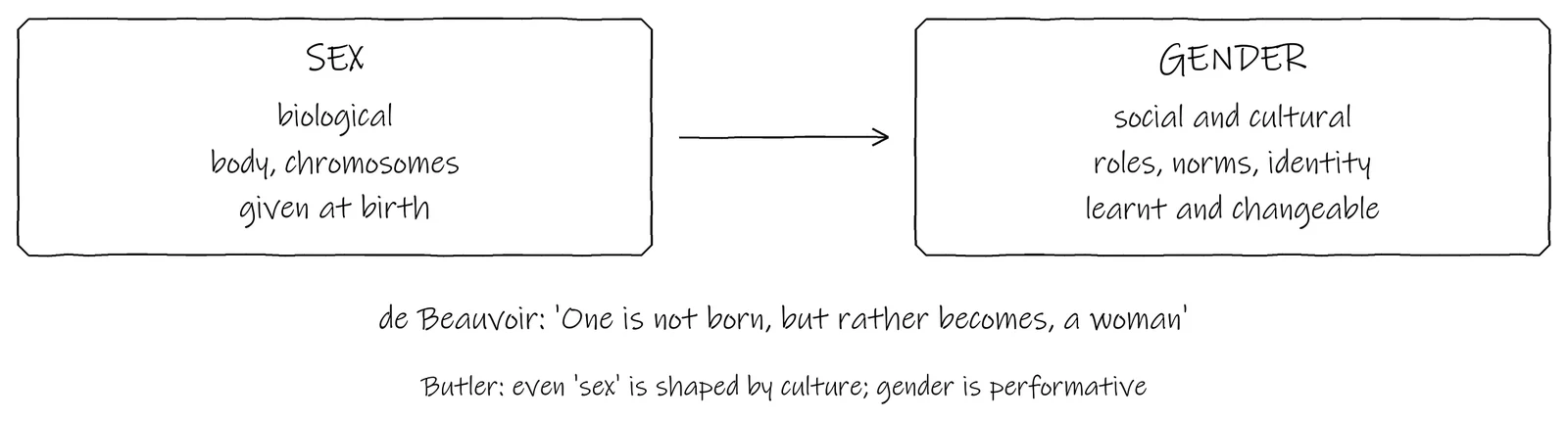
One of the most important feminist ideas is the distinction between sex and gender. Sex refers to biological differences between males and females; gender refers to the social and cultural roles, behaviour and identities that society expects of men and women. The distinction, developed by the psychiatrist Robert Stoller (1968) and popularised by the sociologist Ann Oakley in Sex, Gender and Society (1972), allowed feminists to argue that women’s subordination is not determined by biology but by society. Simone de Beauvoir had already expressed the idea in 1949: “One is not born, but rather becomes, a woman.” Later, Judith Butler questioned the distinction itself, arguing that even ‘sex’ is shaped by culture and that gender is performative, i.e. produced through repeated acts rather than expressing a fixed inner identity. This debate is examined in Important Question 1.
Public and Private
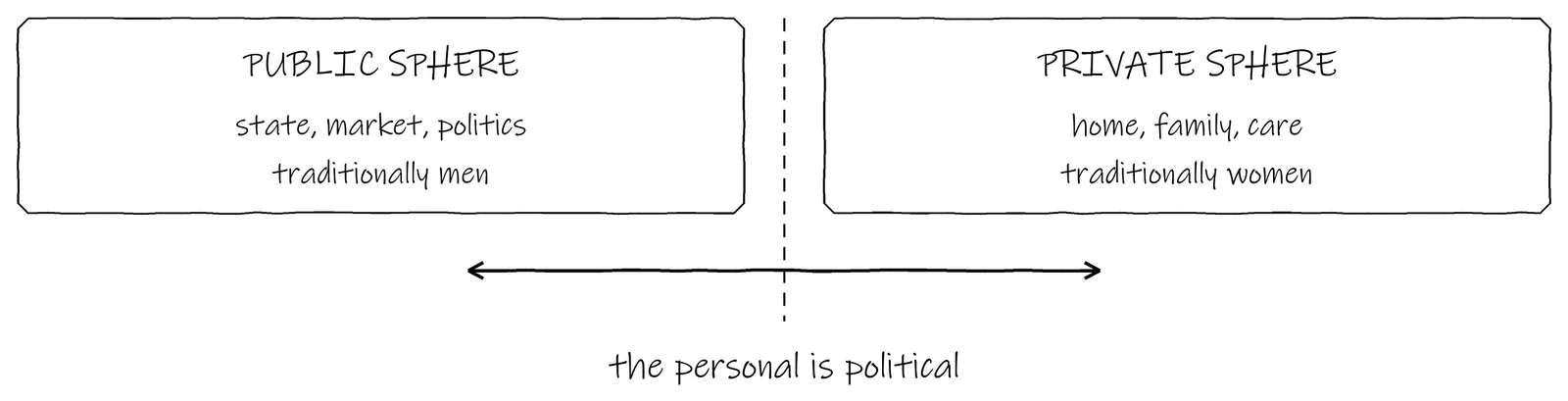
Liberal political theory divides life into a public sphere of the state, the market and politics, and a private sphere of the home and the family, which is protected from interference. Feminists argue that this division has been gendered: men were placed in public life and women confined to the home, while power within the family was treated as non-political. Carole Pateman, in The Sexual Contract (1988), argued that the classical social contract rested on a hidden ‘sexual contract’ that secured men’s rule over women. Susan Moller Okin, in Justice, Gender, and the Family (1989), insisted that principles of justice must apply within the family too. The slogan ‘the personal is political’ sums up this critique.
Patriarchy
Patriarchy literally means ‘rule of the father’, but feminists use it for the wider system of male domination. Sylvia Walby (Theorizing Patriarchy, 1990) identified six structures through which it works: paid work, household production, culture, sexuality, male violence and the state. The concept helps to show that individual experiences of discrimination are part of a larger social pattern.
Equality and Difference
Feminists also disagree about the goal. Equality feminists want women to have the same rights and opportunities as men. Difference feminists argue that women have distinct experiences and values that should be respected rather than erased. Carol Gilligan, in In a Different Voice (1982), argued that women often reason through an ethic of care, focused on relationships and responsibility, while traditional moral theory valued only an ethic of justice and rights. Critics fear that stressing difference may revive old stereotypes about women’s ‘nature’.
Contribution and Criticism
Feminism has transformed political theory by widening the meaning of politics, exposing the male bias of the classic texts, and bringing questions of care, the body and the family into the centre of the discipline. Its critics, however, argue that some feminists treat ‘women’ as a single group with one shared experience, a problem called essentialism; that mainstream feminism reflected Western middle-class concerns; and, from the conservative side, that it undervalues the family. The critique of essentialism leads us directly to postmodernism, which questions all fixed identities and universal claims.
4.4 Postmodernism
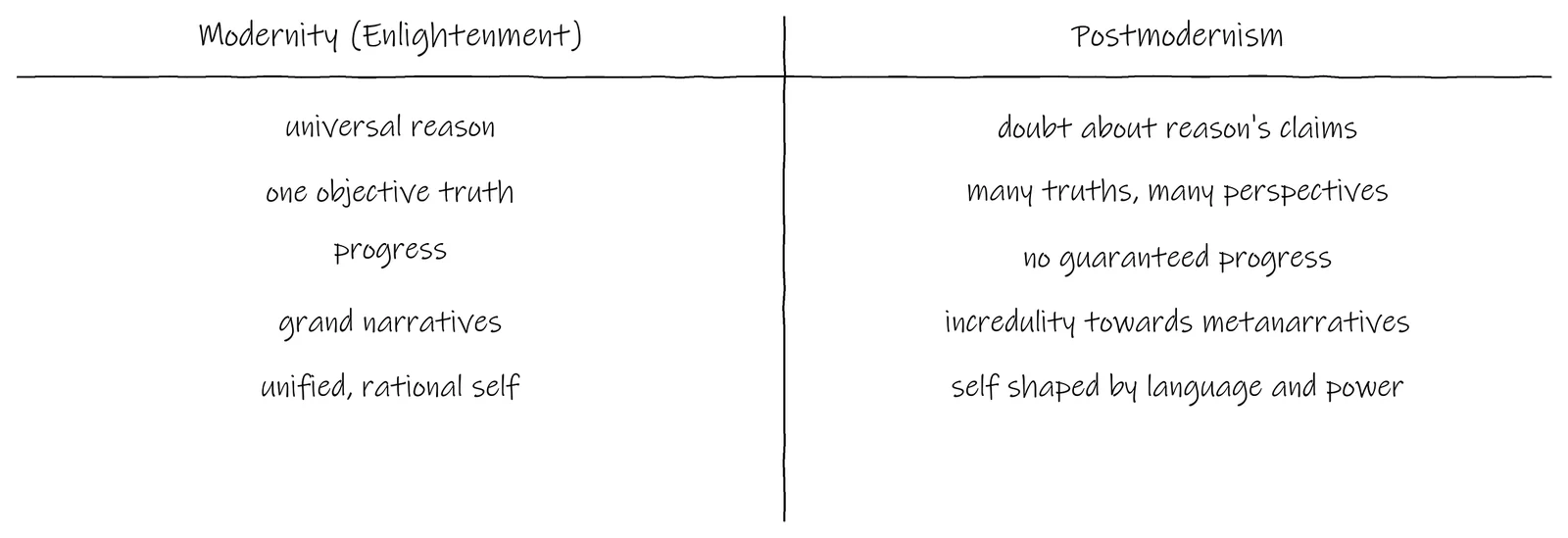
To understand postmodernism we must first understand modernity. The Enlightenment of the eighteenth century placed its faith in human reason. Immanuel Kant summed up its spirit in the motto ‘Dare to know!’ (1784). Enlightenment thinkers believed that reason could discover universal and objective truths, that science and knowledge would bring steady progress, and that human beings were rational subjects able to shape their own destiny. Liberalism and Marxism, for all their differences, are both children of this faith.
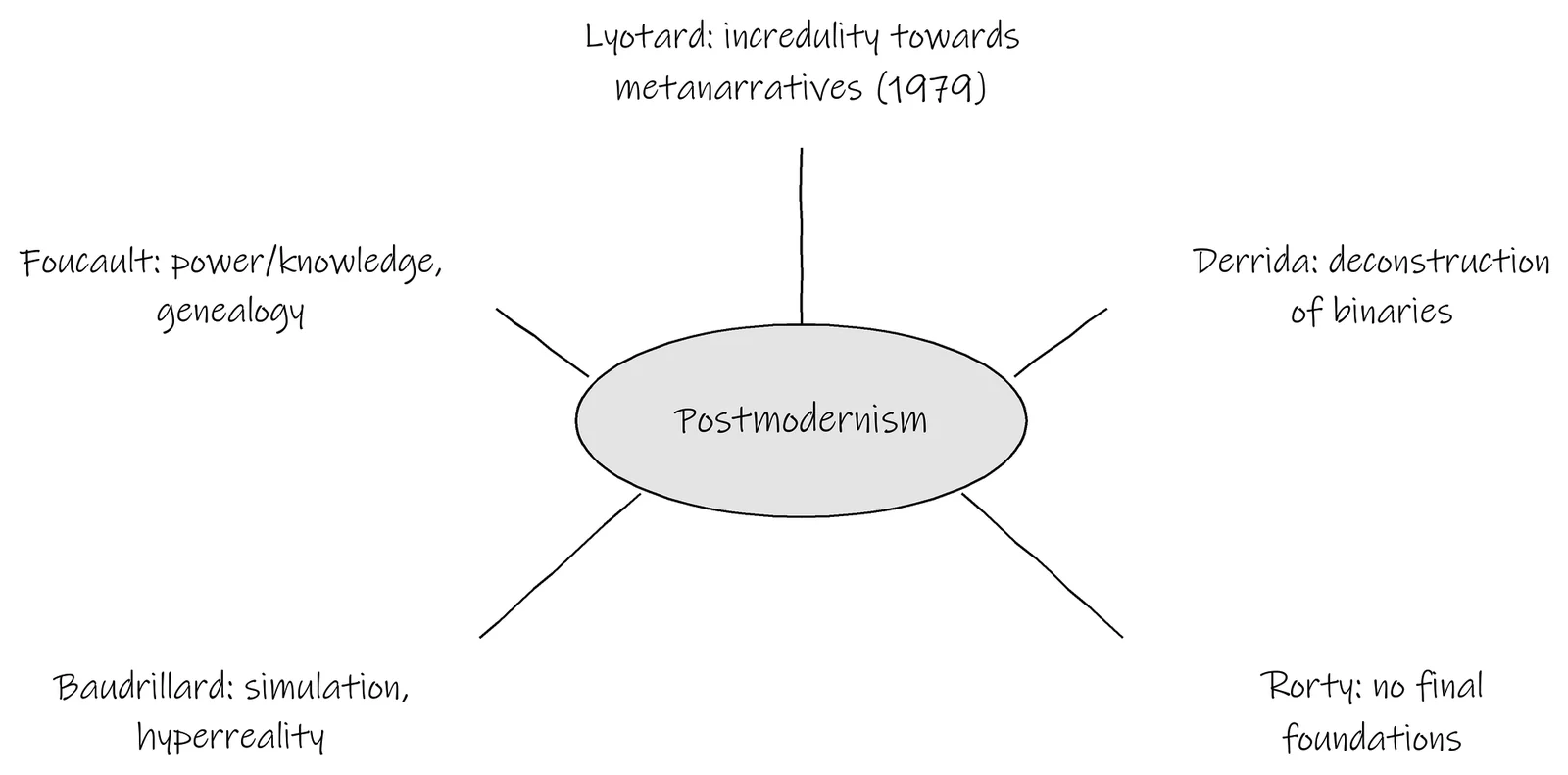
Postmodernism is a broad intellectual movement, strong from the 1970s, that doubts these Enlightenment beliefs. The prefix post means both ‘after’ and ‘against’ modernity. Postmodernists argue that there is no neutral standpoint from which universal truth can be known; that what we call truth is shaped by language, culture and power; and that the great stories of progress told by liberals and Marxists have lost their credibility (Figure 4.4).
Features of Postmodernism
- Anti-foundationalism. Knowledge has no final, secure foundation. Richard Rorty, in Philosophy and the Mirror of Nature (1979), rejected the old idea that the mind or language simply mirrors reality.
- Incredulity towards metanarratives. Grand stories of history are no longer believed. Lyotard wrote The Postmodern Condition (1979) as a report on knowledge for the Council of Universities of Quebec, at a time when computers and information were transforming how knowledge is produced.
- Language shapes reality. We never meet the world without the mediation of language. Jacques Derrida developed deconstruction in Of Grammatology (1967) in the Paris of structuralist thought, showing how texts depend on unstable binary oppositions.
- Power/knowledge. Truth is bound up with power. Michel Foucault wrote Discipline and Punish (1975) after co-founding the Prison Information Group in 1971, during a wave of prison revolts in France.
- The decentred subject. The self is not a fixed, rational centre but is produced by language and power. Foucault ended The Order of Things (1966) by predicting that ‘man’ would be erased ‘like a face drawn in sand at the edge of the sea’.
- Difference and plurality. Diversity is celebrated instead of a single universal standard. Ernesto Laclau and Chantal Mouffe, in Hegemony and Socialist Strategy (1985), wrote as class politics declined and new movements of women, minorities and ecologists arose, and called for a radical and plural democracy.
- Simulation and hyperreality. Images replace the reality they claim to represent. Jean Baudrillard wrote Simulacra and Simulation (1981) about consumer societies dominated by advertising and television.
4.5 Postmodern Thinkers and Their Critics
A. Jean-François Lyotard: the end of grand narratives
In The Postmodern Condition (1979), Lyotard defined the postmodern as ‘incredulity towards metanarratives’, i.e. disbelief in the grand stories that once gave meaning to modern knowledge and politics, such as the liberal story of progress through reason or the Marxist story of emancipation through revolution. In their place he saw many small, local narratives, none of which can claim to be the final truth.
B. Michel Foucault: power, knowledge and discourse
Foucault studied how institutions such as the asylum, the prison and the clinic produced knowledge about ‘madness’, ‘crime’ and ‘sexuality’, and how that knowledge was used to classify and control people. His method, called genealogy, traces how ideas we take for granted came into being through struggles of power. As we saw in Chapter 1, he treated power as present everywhere and as productive. In The History of Sexuality (1976) he added that power manages whole populations, their health and their bodies.
C. Jacques Derrida: deconstruction
Derrida’s method of deconstruction shows that Western thought is built on binary oppositions, such as reason and emotion, man and woman, West and East, in which the first term is treated as superior. Deconstruction exposes the instability of these hierarchies and shows that the ‘inferior’ term is always needed to define the ‘superior’ one. His famous claim that ‘there is nothing outside the text’ means that we never meet reality without the mediation of language.
D. Jean Baudrillard: simulation and hyperreality
Baudrillard argued that in media-saturated societies images and signs no longer represent reality but replace it, producing a hyperreality in which the copy seems more real than the original. His provocative essays on the 1991 Gulf War argued that most people experienced the war only as a television spectacle.
Postmodernism and Politics
Postmodern ideas encouraged a politics of identity and difference, giving voice to groups excluded by universal theories. They influenced the new social movements of women, ethnic minorities and sexual minorities, and postcolonial theory: Edward Said’s Orientalism (1978) used Foucault to show how Western knowledge about ‘the East’ served colonial power, and Gayatri Chakravorty Spivak asked ‘Can the Subaltern Speak?’ (1988). Ernesto Laclau and Chantal Mouffe, in Hegemony and Socialist Strategy (1985), drew on postmodern ideas to develop a theory of radical democracy, which connects directly with Mouffe’s idea of agonism in Chapter 1.
Criticisms of Postmodernism
Critics argue that postmodernism leads to relativism: if there is no objective truth, there is no basis for saying that injustice is wrong. Its central claim also seems self-refuting, since the claim that there are no universal truths is itself a universal claim. Jürgen Habermas defended modernity as ‘an unfinished project’ that should be completed rather than abandoned. The Marxist Fredric Jameson described postmodernism as ‘the cultural logic of late capitalism’. Others criticise its difficult language and its tendency towards political passivity.
Feminism and Postmodernism
Feminism and postmodernism meet and clash at the same time (Table 4.1). Postmodernism helped feminists question a single, universal idea of ‘woman’, as in the work of Judith Butler. But many feminists, such as Seyla Benhabib, warned that if the subject ‘women’ dissolves completely, feminism loses the collective identity it needs for political action.
| Basis | Feminism | Postmodernism |
|---|---|---|
| Main target | Patriarchy and male bias in theory | Enlightenment reason and grand narratives |
| Key idea | The personal is political | Truth and identity are shaped by language and power |
| View of the subject | Women as a group that can act together | No fixed or unified subject |
| Political aim | Equality and emancipation of women | Exposing power; respecting difference |
| Point of tension | Needs a shared identity for action | Questions every shared identity |
4.6 Important Questions
- Question 1 Write an essay on the sex and gender debate within feminism.
- Question 2 What is postmodernism? Examine its contribution to political theory.
- Question 3 Examine the feminist critique of mainstream political theory.
DU asks the same idea in different words. So learn one broad answer for each question below; the same answer works for every question joined by OR.
Important Question 1
Write an essay on the sex and gender debate within feminism.
OR
Distinguish between sex and gender. Is gender socially constructed?
OR
“One is not born, but rather becomes, a woman.” Discuss.
Model Answer
“There is no gender identity behind the expressions of gender.”
— Judith Butler, Gender Trouble (1990)
Introduction. The distinction between sex and gender is one of feminism’s most important contributions to political theory. It allowed feminists to argue that the subordination of women is created by society rather than fixed by nature. Later feminists, however, questioned the distinction itself, making it one of the liveliest debates within feminism.
1. The Distinction
Sex refers to biological differences between males and females, such as chromosomes and anatomy. Gender refers to the social and cultural meanings attached to being a man or a woman: roles, behaviour, dress and expectations. The distinction was developed by the psychiatrist Robert Stoller (1968) and popularised by Ann Oakley in Sex, Gender and Society (1972). The distinction was popularised by Ann Oakley’s Sex, Gender and Society (1972). Gender norms differ across cultures and periods, which shows that they are social rather than natural.
2. Simone de Beauvoir
In The Second Sex (1949), de Beauvoir wrote that “one is not born, but rather becomes, a woman”. Man, she argued, has defined himself as the Subject and the Absolute, and woman as the Other. Femininity is not a natural essence but a situation produced by upbringing, custom and economic dependence. She argued that women’s liberation requires economic independence and freedom from the myths that confine them to motherhood and domesticity.
3. Why the Distinction Mattered
Traditional thought held, in Freud’s phrase, that ‘anatomy is destiny’: women’s bodies were thought to fit them for the home and unfit them for public life. By showing that gender roles are learnt through socialisation in the family, school and media, feminists could argue that these roles can be changed, and that inequality is a political, not a natural, fact. If gender roles are social, they can be changed through education, law and political action, which made the distinction a foundation of the women’s movement.
4. Radical and Socialist Feminist Views
Kate Millett argued that patriarchy works through socialisation into gender roles, which she called ‘sexual politics’. Shulamith Firestone, more unusually, located oppression in biological reproduction itself and hoped that technology would free women from it. Socialist feminists linked gender roles to the division between unpaid domestic labour and paid work under capitalism. Shulamith Firestone, in The Dialectic of Sex (1970), traced women’s oppression to biological reproduction and imagined technology freeing women from it.
5. Difference Feminism
Some feminists, such as Carol Gilligan, argued that women’s distinct experiences produce a different moral voice, an ethic of care, which should be valued rather than erased. Critics warned that this risks essentialism, i.e. treating certain traits as natural to all women. Critics worried that this view could reinforce the very stereotypes feminism wished to overcome.
6. Judith Butler and Performativity
Judith Butler, in Gender Trouble (1990), challenged the distinction itself. If gender is constructed, she asked, why should sex be treated as simply natural? Our very understanding of biological sex is shaped by cultural norms. Gender, for Butler, is performative: it is produced by the repeated performance of norms, not expressed by a fixed inner identity. Since it is performed, it can also be performed differently, which opens space for resistance to rigid binaries. Because gender is a repeated performance of norms, it can also be subverted by performing it differently.
7. The Intersectional Critique
bell hooks and Kimberlé Crenshaw showed that gender is never experienced alone; it intersects with race, class, sexuality and caste. A Black working-class woman or a Dalit woman experiences gender differently from a privileged woman. Transgender perspectives have further questioned the assumption that sex and gender always align. Indian feminists such as Uma Chakravarti and Sharmila Rege showed how caste shapes gender, for example through the control of women’s sexuality to preserve caste purity.
8. Sex, Gender and Law in India
Indian law has moved from treating gender roles as natural towards recognising them as social: the Supreme Court’s judgments on women’s entry into the Sabarimala temple (2018), on permanent commission for women officers in the army (2020) and on the rights of transgender persons show courts questioning stereotypes based on sex.
9. Evaluation
The sex–gender distinction was a powerful tool against biological determinism, and it remains central to feminist politics. Butler’s critique deepened the debate but raised a problem: if the category ‘woman’ is unstable, on whose behalf does feminism speak? Most feminists today keep the distinction as a useful tool while recognising that both sex and gender are shaped by society. Recent debates on transgender rights, recognised in India in NALSA v. Union of India (2014), show that the debate continues.
Conclusion. Thus, the debate has moved from separating biology from culture to questioning how culture shapes our understanding of biology itself. Its lasting lesson is that what seems natural in the relations between men and women is largely made by society, and can therefore be remade.
Important Question 2
What is postmodernism? Examine its contribution to political theory.
OR
Write a short note on postmodernism.
OR
Examine the postmodern critique of the Enlightenment.
Model Answer
“Simplifying to the extreme, I define postmodern as incredulity toward metanarratives.”
— Jean-François Lyotard, The Postmodern Condition (1979)
Introduction. Postmodernism is a broad intellectual movement that doubts the Enlightenment’s faith in universal reason, objective truth and progress. Strong from the 1970s, it has reshaped political theory by drawing attention to language, power and difference.
1. Modernity and the Enlightenment
The Enlightenment, summed up in Kant’s motto ‘Dare to know!’ (1784), believed that reason could discover universal truths, that knowledge would bring progress, and that human beings were rational subjects. Liberalism and Marxism both inherited this faith.
2. Meaning of Postmodernism
The prefix post means both after and against modernity. Postmodernism holds that there is no neutral standpoint from which universal truth can be known, and that what passes for truth is shaped by language, culture and power.
3. Main Features
- Anti-foundationalism: no final foundation for knowledge; Rorty, Philosophy and the Mirror of Nature (1979).
- Incredulity towards metanarratives: grand stories lose credibility; Lyotard’s report on knowledge for Quebec (1979).
- Language shapes reality: deconstruction of binary oppositions; Derrida, Of Grammatology (1967).
- Power/knowledge: truth is tied to power; Foucault, Discipline and Punish (1975), after the French prison revolts.
- Decentred subject: the self is produced by language and power; Foucault, The Order of Things (1966).
- Difference and plurality: radical and plural democracy; Laclau and Mouffe (1985), amid the new social movements.
4. Leading Thinkers
Lyotard announced the end of grand narratives. Foucault showed how institutions produce knowledge that controls people, and studied the genealogy of ideas. Derrida deconstructed the binary oppositions of Western thought. Baudrillard described a world of simulation and hyperreality, and Richard Rorty argued that philosophy cannot provide final foundations for our beliefs.
5. Contribution to Political Theory
Postmodernism exposed the power hidden in knowledge, showing that claims of neutrality often serve particular interests. It encouraged a politics of identity and difference and gave voice to groups excluded by universal theories. It inspired postcolonial theory, from Edward Said’s Orientalism (1978) to Spivak’s ‘Can the Subaltern Speak?’ (1988), and influenced feminist theory through Judith Butler. Laclau and Mouffe’s radical democracy (1985) drew on it to rethink democratic politics as an open contest of identities. It also encouraged attention to marginal voices, such as those of colonised peoples, sexual minorities and subaltern groups.
6. Criticisms
Critics charge postmodernism with relativism, which leaves no basis for condemning injustice, and with self-refutation, since the claim that there are no universal truths is itself universal. Habermas defended modernity as an unfinished project, and Jameson saw postmodernism as the cultural logic of late capitalism. Others criticise its obscure language and its weak guidance for political action. Habermas defended modernity as an unfinished project against what he saw as postmodern irrationalism.
7. Evaluation
Postmodernism is most valuable as a critical method: it teaches suspicion of claims to neutral truth and sensitivity to excluded voices. It is weakest as a positive political theory, since it offers few standards for building just institutions.
8. Foucault’s Power/Knowledge in Detail
Foucault showed how modern institutions produce knowledge that classifies people as normal or abnormal: medicine defines the healthy and the sick, psychiatry the sane and the mad, criminology the law-abiding and the delinquent. This knowledge is not neutral; it becomes a means of disciplining people through examinations, records, timetables and surveillance. Because power works through knowledge and norms rather than only through force, political theory must study the ‘micro-physics’ of power in everyday life, not just the state.
9. Postmodernism and Feminism
Judith Butler’s Gender Trouble (1990) applied postmodern ideas to gender, arguing that gender is performative rather than natural. This helped feminists question a single, universal idea of ‘woman’. But feminists such as Seyla Benhabib warned that if the subject ‘women’ dissolves completely, feminism loses the collective identity it needs for political action. The relationship is therefore one of both alliance and tension.
Conclusion. Thus, postmodernism has made political theory more aware of power, language and difference. Its challenge cannot be ignored, but most political theorists still believe that some shared standards of reason and justice are needed for a democratic politics.
Important Question 3
Examine the feminist critique of mainstream political theory.
OR
“The personal is political.” Discuss.
OR
Discuss the main strands of feminist thought.
Model Answer
“I do not wish them to have power over men; but over themselves.”
— Mary Wollstonecraft, A Vindication of the Rights of Woman (1792)
Introduction. Feminists argue that mainstream political theory, while claiming to speak for all humanity, was largely written by men and about men. Its concepts of citizenship, justice and politics excluded women and treated the family as outside politics. The feminist critique seeks to expose this bias and to rethink the basic concepts of the discipline.
1. The Male Bias of the Classics
Aristotle held that women’s reason lacked authority and confined them to the household. Rousseau, in Emile (1762), gave the boy Emile an education for independence and citizenship but trained the girl Sophie to please and serve men. Even liberal theorists who proclaimed equal rights long excluded women from citizenship. Hobbes and Locke spoke of free and equal individuals but assumed that these individuals were male heads of households.
2. The Public–Private Divide
Liberal theory separates a public sphere of politics from a private sphere of family life protected from the state. Feminists argue that this divide confined women to the home and made power within the family invisible. Carole Pateman’s The Sexual Contract (1988) argued that the social contract rested on a hidden contract securing men’s rule over women, and Susan Moller Okin insisted that justice must apply within the family. Hence the slogan ‘the personal is political’. The slogan ‘the personal is political’, associated with Carol Hanisch (1969), captured this critique: power in the family and in sexual relations is a political issue.
3. Patriarchy
Kate Millett’s Sexual Politics (1970) showed that relations between the sexes are relations of power. Sylvia Walby later identified six structures of patriarchy: paid work, household production, culture, sexuality, violence and the state. Carole Pateman’s The Sexual Contract (1988) argued that the social contract of Hobbes and Locke presupposed a prior sexual contract giving men power over women.
4. Strands of Feminist Thought
Liberal feminists seek equal rights within existing institutions; socialist feminists link women’s oppression to capitalism and unpaid domestic labour; radical feminists see patriarchy as the root of all oppression; and intersectional feminists show how gender intersects with race, class and caste.
5. Rethinking Political Concepts
Feminists have reworked the main concepts of political theory: justice, which must cover the distribution of work and power in the family; citizenship, which must recognise care work; rights, which must include bodily and reproductive rights; and violence, which includes violence in the home. Susan Moller Okin’s Justice, Gender, and the Family (1989) argued that the family must itself be just, since it is the first school of moral development.
6. The Ethics of Care
Carol Gilligan’s In a Different Voice (1982) argued that mainstream moral and political theory valued only an ethic of rights and justice, ignoring an ethic of care rooted in relationships. Care theorists ask how societies should value and share the work of caring for others. Joan Tronto argued that care should be treated as a political value, since every society depends on caring work, most of it unpaid and done by women.
7. Feminism and the State
Feminists disagree about the state: liberal feminists use it to win legal equality, radical feminists see it as patriarchal, and socialist feminists as capitalist. In India, laws on domestic violence (2005) and sexual harassment at work (2013, following the Vishaka guidelines of 1997) show both the potential and the limits of state action.
8. Gender and Political Participation
Feminists also show that women remain under-represented in parliaments and governments, which is why many countries, including India in its panchayats and now its legislatures, have adopted reservations for women.
9. Criticisms
Critics argue that some feminists treat women as a single group, ignoring differences of class, race and culture; that early feminism reflected Western middle-class concerns; and that bringing the state into the family may threaten privacy. Conservatives also see feminism as weakening the family. Others note that feminist theory has sometimes neglected the voices of women from the Global South.
10. Gains and Limits of Liberal Reform
The first-wave struggle won women the vote (New Zealand 1893, Britain 1918 and 1928, the United States 1920, India with universal adult franchise in 1950), access to education and property rights. Second-wave feminists argued that legal equality was not enough: women still did most unpaid domestic and care work, faced violence at home and were under-represented in power. The gap between formal and real equality became the focus of feminist theory.
11. Indian Feminist Perspectives
Indian thinkers made their own contributions. Tarabai Shinde’s Stri Purush Tulana (1882) attacked the double standards of patriarchy; Pandita Ramabai linked gender oppression with caste and religion; and contemporary scholars such as Nivedita Menon (Seeing Like a Feminist, 2012) show how the family, caste and the state together shape women’s lives. Dalit feminists stress that gender cannot be separated from caste, an Indian form of intersectionality. Savitribai Phule and Pandita Ramabai pioneered women’s education, and the Towards Equality report (1974) revealed the depth of women’s disadvantage in independent India.
Conclusion. Thus, the feminist critique has shown that political theory cannot claim to be universal while ignoring half of humanity. By making the personal political, it has widened the very meaning of politics and justice.
Short Notes
(a) The personal is political
A slogan of second-wave feminism, popularised by Carol Hanisch’s essay of 1969. It challenges the liberal separation of the public sphere of politics from the private sphere of family and sexuality, arguing that power relations between men and women in the home, such as the division of domestic labour and domestic violence, are political issues that require public attention and change.
(b) Incredulity towards metanarratives
Jean-François Lyotard, in The Postmodern Condition (1979), defined the postmodern as incredulity towards metanarratives, the grand stories, such as the progress of reason, liberal emancipation or Marxist revolution, through which modern thought claimed to explain and legitimise everything. Postmodernists prefer local, plural and partial narratives, and they question claims to universal truth.
More notes: DSC-1 Understanding Political Theory
These notes are prepared by PADHO TO AISE for study help. They are not an official University of Delhi publication.