
Semester I DSC-1 Understanding Political Theory
Unit II · 32 min read · Updated 24 Nov 2026
As per the University of Delhi (DU) BA (Hons) Political Science syllabus
Contents
- 2.1 Approaches to Political Theory
- 2.2 The Normative Approach
- The Classical Tradition
- Features of the Normative Approach
- How Normative Theorists Work
- Decline and Revival
- Strengths and Criticisms
- 2.3 The Historical Approach
- Features of the Historical Approach
- Strengths and Criticisms
- 2.4 The Empirical Approach
- Features of the Empirical Approach
- Behaviouralism
- Easton’s Political System
- Criticisms of Behaviouralism
- Post-behaviouralism
- 2.5 Comparing the Three Approaches
- 2.6 Important Questions
- Critically examine the empirical approach to political theory.
- What is the normative approach to political theory? Discuss its significance.
- Discuss the historical approach to the study of political theory.
- Short Notes
बिना परीक्षण किया गया जीवन जीने योग्य नहीं है।
The unexamined life is not worth living.
— Socrates, in Plato’s Apology
IN CHAPTER 1 we saw that political theory has two sides: it explains what is and it asks what ought to be. A third task is equally important: understanding what the great thinkers of the past actually said. These three tasks give us the three main approaches to political theory: the normative, the historical and the empirical. An approach is simply a way of studying something, i.e. the kind of questions we ask and the method we use to answer them. In this chapter we will study each approach, its methods, its strengths and its weaknesses, and finally see why a good political theorist needs all three.
2.1 Approaches to Political Theory
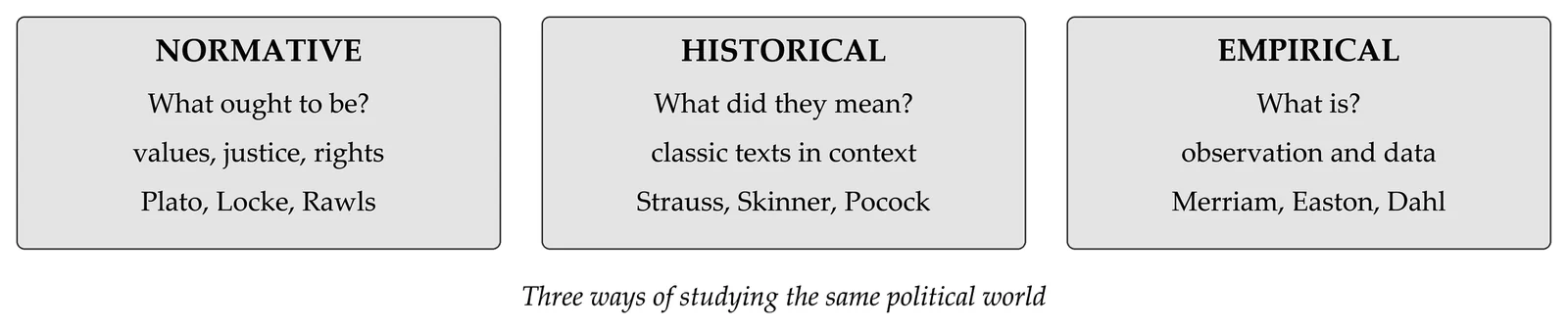
Let us first understand why we need the word approach at all. Suppose three students study the same topic, say, democracy. The first asks: is democracy the best form of government, and why? The second asks: what did J.S. Mill mean when he wrote about representative government in 1861? The third asks: in which countries do more people vote, and what makes them vote? All three are studying democracy, but they ask different kinds of questions and use different methods. These are the three approaches (Figure 2.2).
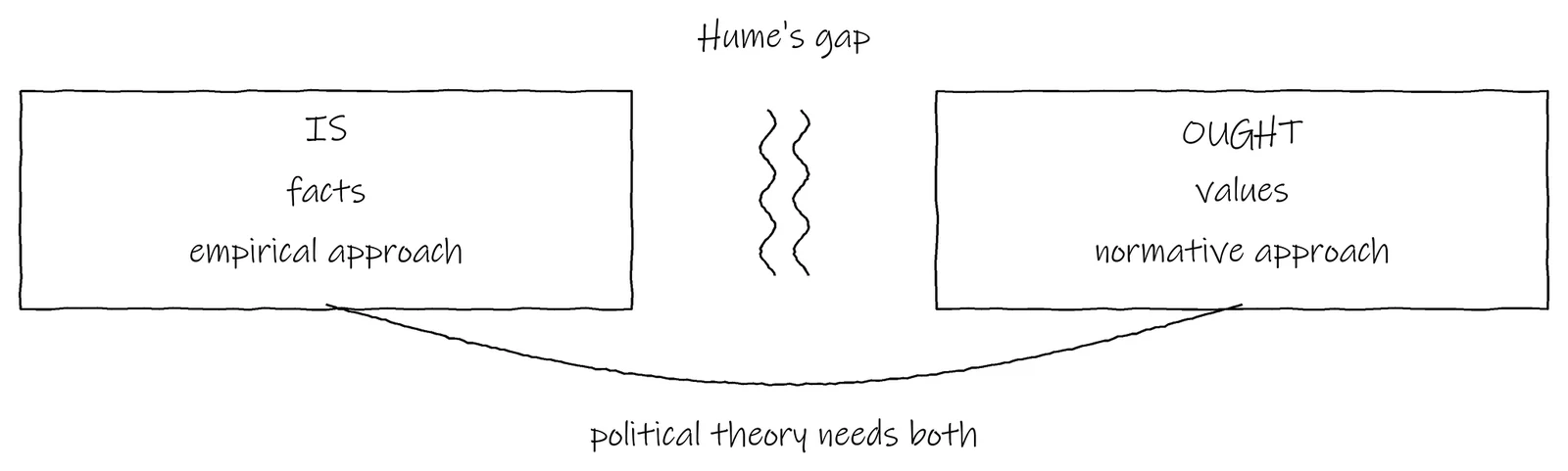
Behind these approaches lies a famous problem raised by the Scottish philosopher David Hume in A Treatise of Human Nature (1739). Hume observed that writers often move from statements about what is to statements about what ought to be, without explaining how. A fact by itself, he argued, cannot tell us what we should do. This is known as the is–ought gap. The empirical approach stays on the side of facts, the normative approach works on the side of values, and the historical approach shows how the thinkers of the past tried to connect the two. Keep this gap in mind, because much of the debate between the approaches is about it.
2.2 The Normative Approach
The normative approach is the oldest approach to political theory. The word normative comes from norm, i.e. a standard or rule. A normative theory therefore sets standards by which political life can be judged. It does not ask how many people support a policy; it asks whether the policy is right, just or good. Typical normative questions are: Why should we obey the state? What is a just distribution of wealth? Do people have natural rights? When is it right to disobey a law?
The Classical Tradition
Most of the great works of political theory are normative: Plato’s Republic, Thomas Hobbes’s Leviathan (1651), John Locke’s Two Treatises of Government (1690), Jean-Jacques Rousseau [रूसो]’s The Social Contract (1762) and J.S. Mill’s On Liberty (1859). Plato asked what justice is and designed an ideal state ruled by philosopher-kings. Hobbes asked why rational people would create an absolute sovereign, and Locke asked what limits every government must respect. Each began from a view of human nature and reasoned towards the best political order.
Features of the Normative Approach
The normative approach can be recognised by the following features. For each one, notice which thinker used it and the situation in which he wrote, because the context explains why the question was asked.
- Prescriptive. It tells us what ought to be done, not merely what is. Plato used it in the Republic (c. 375 BCE). Writing after democratic Athens had executed his teacher Socrates in 399 BCE, he asked what a truly just city ought to look like, and answered with the rule of philosopher-kings.
- Value-centred. It judges political life by moral values such as dignity, rights and justice. Immanuel Kant, in Enlightenment Prussia, held in the Groundwork of the Metaphysics of Morals (1785) that every person must be treated as an end and never merely as a means, and in Perpetual Peace (1795), written as Europe was torn by the wars of the French Revolution, laid down the principles on which states ought to live in peace.
- Begins from a view of human nature. Every normative theory rests on an idea of what human beings are like. Thomas Hobbes wrote Leviathan (1651) amid the English Civil War (1642–1651); seeing people as selfish and fearful of violent death, he argued for an absolute sovereign to keep the peace.
- Concerned with legitimacy and justification. It asks when power is rightful and why we should obey. John Locke, in the struggle against absolute Stuart monarchy, argued in Two Treatises of Government (published 1690, after the Glorious Revolution) that government rests on consent and may be resisted if it violates natural rights.
- Speculative and deductive. It reasons from principles rather than from data. Rousseau, living in the France of absolute monarchy and deep inequality, imagined in The Social Contract (1762) an agreement that creates a ‘general will’, through which people obey only laws they give themselves.
- Critical and reformist. It judges existing institutions by higher standards. J.S. Mill, in Victorian England, attacked the ‘tyranny of the majority’ and social conformity in On Liberty (1859), and the legal subordination of women in The Subjection of Women (1869).
- Links politics with ethics. It treats politics as part of the good life. Gandhi wrote Hind Swaraj (1909) on board a ship from London to South Africa, criticising modern civilisation and British rule and insisting that the means must be as pure as the ends.
- Ideal-building. It designs principles for a just society. John Rawls wrote A Theory of Justice (1971) in an America divided by the civil rights movement and the Vietnam War, and proposed principles of ‘justice as fairness’ for a well-ordered society.
How Normative Theorists Work
Normative theory is not personal opinion. It follows careful methods of reasoning:
- Conceptual analysis: clarifying the meaning of concepts such as liberty, equality or justice, and showing how they differ from one another.
- Argument and justification: giving reasons for a position and answering the strongest objections against it.
- Thought experiments: imagining a situation that isolates the question. John Rawls asked which principles of justice people would choose behind a veil of ignorance, i.e. if they did not know whether they would be rich or poor, man or woman, talented or not.
- Reflective equilibrium: Rawls’s term for moving back and forth between general principles and our considered judgements about particular cases, adjusting each until they fit together.
Decline and Revival
In the twentieth century the normative approach came under strong attack. The logical positivists, such as A.J. Ayer in Language, Truth and Logic (1936), argued that only statements which can be verified by observation are meaningful; a moral statement like ‘slavery is wrong’ merely expresses a feeling. The behaviouralists, as we shall see, wanted a value-free science of politics, and this is why Peter Laslett could declare political philosophy ‘dead’ in 1956. The revival came with Rawls’s A Theory of Justice (1971), followed by Robert Nozick’s Anarchy, State, and Utopia (1974) and by communitarian critics of liberalism such as Michael Sandel and Alasdair MacIntyre.
Strengths and Criticisms
The great strength of the normative approach is that politics is always about choices, and choices need standards. Even an empirical study begins with a normative concern: we study voting because we value democracy. Normative theory also helps us criticise unjust institutions and imagine better ones. Its critics raise three points. First, value judgements cannot be tested like facts, so disagreement may never end. Second, Marxists see normative theory as ideology, i.e. ideas that serve the ruling class while claiming to be universal. Third, postmodernists doubt that universal moral truths exist at all. In simple words, normative theory is necessary, but it must stay in touch with the facts of political life.
Normative theorists constantly return to the great texts of the past. How those texts should be read is the subject of the historical approach.
2.3 The Historical Approach
The historical approach studies political ideas through the writings of the great thinkers of the past, from Plato and Aristotle to Hobbes, Locke, Rousseau, Marx and Gandhi. It asks what these thinkers said, why they said it, and what their ideas mean for us. For a long time this was the standard way of teaching political theory; George Sabine [सेबाइन]’s A History of Political Theory (1937), read by generations of students, is a classic example. There are three main reasons for studying old texts:
- Perennial questions: questions of justice, authority and liberty keep returning, and the classics offer some of the deepest answers to them.
- Origins of concepts: our ideas of the state, rights and sovereignty were shaped at particular moments in history; knowing their history helps us use them carefully.
- Critical distance: reading thinkers from other times shows that our own assumptions are not the only possible ones.
Features of the Historical Approach
- Focus on classic texts. It studies the great works of political thought in sequence. George Sabine wrote A History of Political Theory (1937) when fascism and communism were challenging liberal democracy, tracing political ideas from the Greeks to modern ideologies.
- Search for perennial questions. It looks for lasting answers to lasting questions. Leo Strauss, a Jewish scholar who left Germany in 1932 and settled in America, believed that the collapse of the Weimar Republic showed the danger of modern relativism, and turned to the classics for timeless standards.
- Reading texts in their context. It places a text in the circumstances of its writing. Peter Laslett’s edition of Locke (1960) showed that the Two Treatises were written around 1679–1683, during the Exclusion Crisis over the Catholic heir to the throne, and not as a defence of the Revolution of 1688.
- Recovering the author’s intention. It asks what the author was doing in writing. Quentin Skinner (1969) developed this method at Cambridge against both ‘timeless’ readings and Marxist reductions, and used it in The Foundations of Modern Political Thought (1978) to show how the modern idea of the state emerged.
- Tracing political languages over time. It follows a vocabulary across centuries. J.G.A. Pocock, in The Machiavellian Moment (1975), traced the language of republican virtue from Renaissance Florence to the American Revolution.
- Linking ideas to society. It connects ideas with the social and economic conditions that produced them. C.B. Macpherson (1962), writing during the Cold War debates about liberalism and capitalism, read Hobbes and Locke as theorists of the emerging market society.
But how should a classic text be read? Two influential schools give opposite answers.
A. Leo Strauss [स्ट्रॉस]: timeless truths
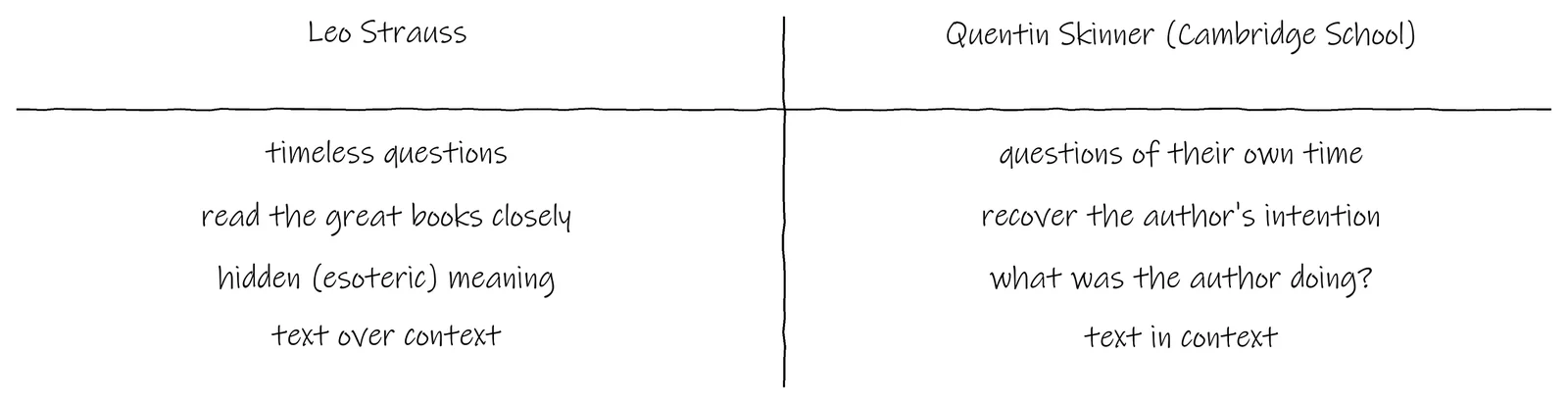
Leo Strauss, a German-American thinker at the University of Chicago, believed that the great books deal with timeless questions about the best way of life and the best political order. They must be read slowly and on their own terms, because their authors were wiser than most of their readers. In Persecution and the Art of Writing (1952), Strauss argued that many philosophers, writing under the threat of persecution, hid their real views between the lines. Their texts therefore carry an outer, exoteric teaching for ordinary readers and a hidden, esoteric teaching for careful ones. Strauss was also a fierce critic of behaviouralism and of the claim that political science can be value-free. Critics reply that his method allows a reader to find almost any hidden meaning he wishes.
B. The Cambridge School: text in context
A very different method was developed at Cambridge in the 1960s by Quentin Skinner and J.G.A. Pocock [पोकॉक]. It built on Peter Laslett’s edition of Locke’s Two Treatises (1960), which showed that the work had been written years before the Glorious Revolution of 1688 that it was long thought to defend. In his famous essay ‘Meaning and Understanding in the History of Ideas’ (1969), Skinner argued that we cannot understand a text unless we recover what its author was doing in writing it, i.e. which arguments he was supporting or attacking in the debates of his own time. Borrowing from the philosopher J.L. Austin, he treated political writings as speech acts: to write a text is to perform an action within a particular debate.
Skinner also warned against several ‘mythologies’ that distort the history of ideas, such as assuming that every classic thinker must have had a doctrine on every topic, or reading later meanings back into earlier texts. Pocock added that each age has its own political languages, i.e. shared vocabularies, such as the language of republican virtue traced in his The Machiavellian Moment (1975), within which thinkers argue.
Strengths and Criticisms
The historical approach keeps political theory rooted in its great tradition and protects us from using old ideas carelessly. Its critics say that it can turn into antiquarianism, i.e. the study of the past for its own sake, with little to say about present problems; in the 1950s David Easton complained that political theory had become a mere history of ideas. Strict contextualism is also accused of relativism: if every text belongs only to its own time, can the classics teach us anything today? Skinner’s reply is that understanding the past frees us from treating our present beliefs as natural and unavoidable. Easton’s complaint leads us to the third approach, which wanted to turn political theory into a science.
2.4 The Empirical Approach
The empirical approach studies politics as it actually is, through observation and evidence. Empirical means based on experience and observation. Its aim is to describe and explain political behaviour, i.e. why people vote, protest, obey or rebel, and to discover regularities that can be tested. Its roots are old. Aristotle is said to have studied 158 Greek constitutions before writing his Politics; Niccolò Machiavelli [मैकियावेली] based his advice on how rulers actually behave rather than how they ought to behave; and Kautilya’s Arthashastra is full of close observation of statecraft. In the nineteenth century Auguste Comte [कॉम्त]’s positivism argued that society should be studied with the methods of natural science.
Features of the Empirical Approach
- Based on observed facts. It studies what is. Aristotle’s school collected the constitutions of 158 Greek city-states, and in the Politics he used such evidence to explain why constitutions remain stable or collapse into revolution.
- Realist. It studies how power is actually used, not how it ought to be used. Machiavelli wrote The Prince (1513) after losing his post in Florence, when Italy was divided and invaded by France and Spain, and gave advice drawn from how rulers really gain and keep power.
- Scientific (positivist). It applies the methods of natural science to society. Auguste Comte, in post-revolutionary France, argued in his Course of Positive Philosophy (1830–1842) that society follows laws that can be discovered by observation, and coined the word ‘sociology’.
- Value-neutral. It separates facts from values. Max Weber, in his lecture ‘Science as a Vocation’ (1917), delivered in Munich amid the turmoil of the First World War, told students that a teacher must not use the lecture hall to preach political views.
- Focused on behaviour. It studies how people actually behave, including their emotions and habits. Graham Wallas, in Human Nature in Politics (1908), observed that voters in Britain’s new mass democracy were moved more by impulse than by reason; Charles Merriam and Harold Lasswell carried this forward at Chicago in the 1920s and 1930s.
- Quantitative. It measures behaviour with surveys and statistics. Paul Lazarsfeld and his colleagues surveyed voters in Erie County, Ohio, during the 1940 US presidential election, and showed in The People’s Choice (1944) that social background strongly shapes voting.
- Testable theory-building. It forms generalisations that can be checked against evidence. Robert Dahl’s Who Governs? (1961) tested, with data from New Haven, the rival claims of pluralists and of C. Wright Mills, who had argued in The Power Elite (1956) that a small elite ruled America.
- Comparative and interdisciplinary. It compares societies and borrows from other social sciences. Gabriel Almond and Sidney Verba’s The Civic Culture (1963) surveyed citizens in five countries, the USA, Britain, West Germany, Italy and Mexico, to discover which political culture supports a stable democracy in the post-war world.
Behaviouralism
In the twentieth century the empirical approach took the form of behaviouralism. Charles Merriam, in New Aspects of Politics (1925), urged political scientists at the University of Chicago to study political behaviour scientifically. After the Second World War behaviouralism became the dominant approach in American political science. Instead of studying formal institutions and legal texts, behaviouralists studied the observable behaviour of individuals and groups: voters, legislators, parties and interest groups. They used surveys, statistics and interviews, as in the famous voting study The American Voter (1960).
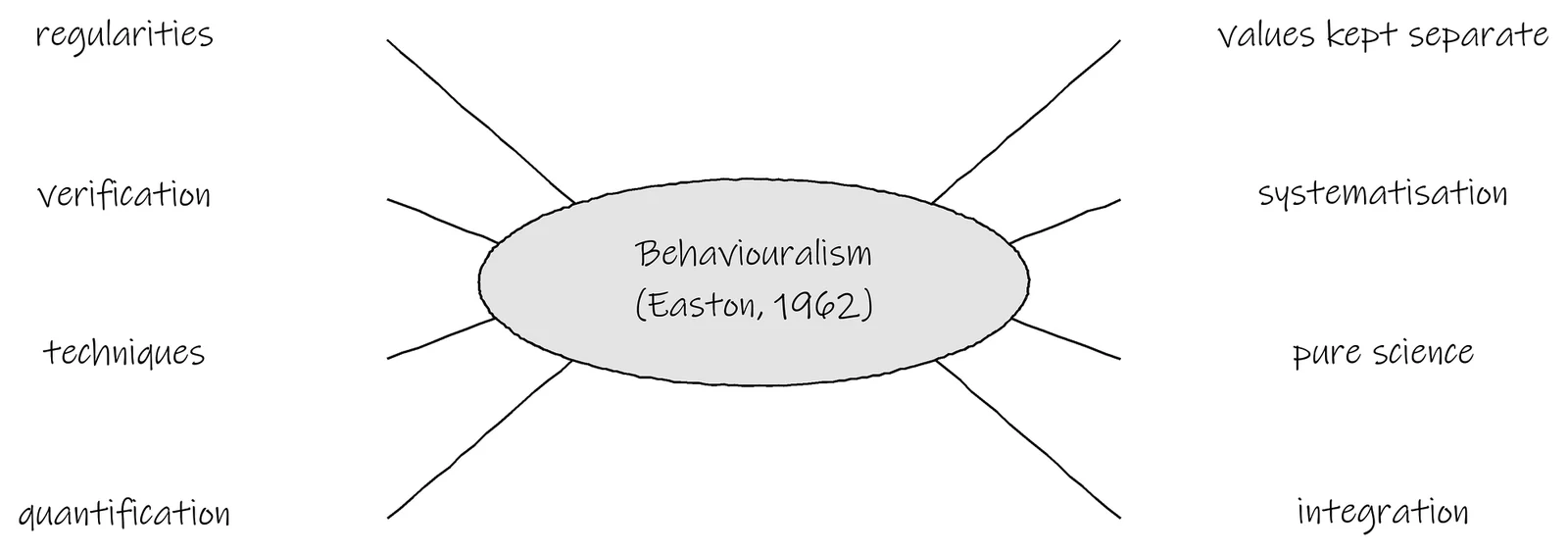
In ‘The Current Meaning of Behavioralism’ (1962), David Easton listed its eight intellectual foundations (Figure 2.3):
- Regularities: political behaviour shows uniformities that can be expressed as generalisations.
- Verification: such generalisations must be tested against actual behaviour.
- Techniques: research needs rigorous methods for collecting and analysing data.
- Quantification: wherever possible, findings should be measured and expressed in numbers.
- Values: ethical judgements and empirical explanations must be kept separate.
- Systematisation: research should be guided by theory, and theory should be tested by research.
- Pure science: understanding must come before applying knowledge to practical problems.
- Integration: political science should work closely with sociology, psychology and economics.
Easton’s Political System
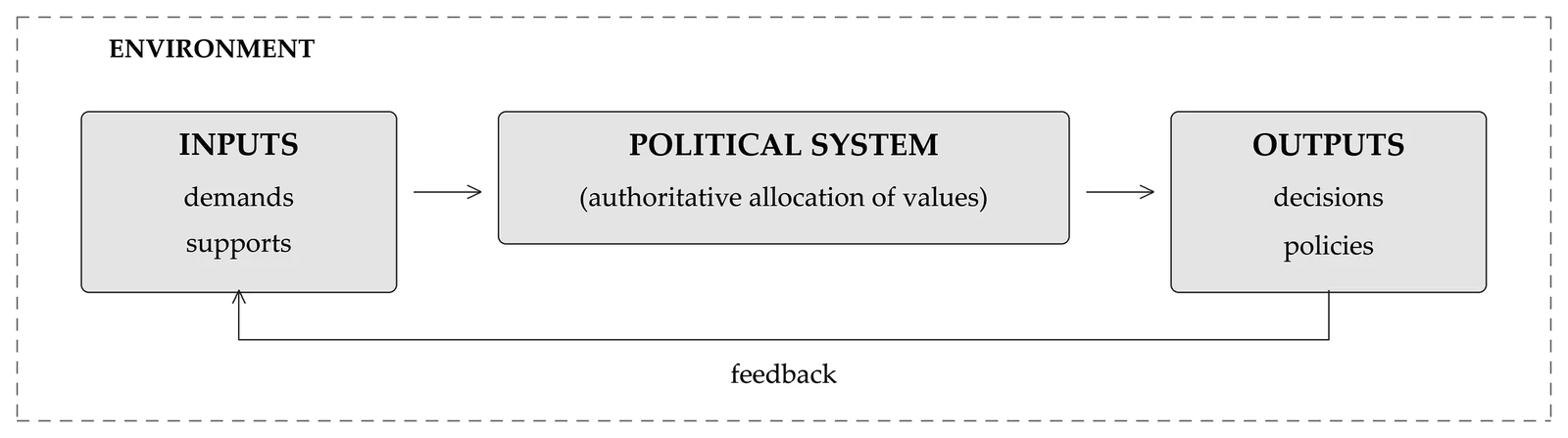
Easton also gave the empirical approach its most famous model. In The Political System (1953) and A Systems Analysis of Political Life (1965), he treated politics as a system that receives inputs from its environment, i.e. demands (what people want) and supports (their loyalty and acceptance), and converts them into outputs, i.e. authoritative decisions and policies. The outputs in turn affect the environment and create new demands and supports, a process Easton called feedback (Figure 2.4). The model helps us see politics as a continuous process rather than a set of separate events.
Criticisms of Behaviouralism
- Value-free science is impossible: the very choice of what to study reflects the researcher’s values.
- Hyperfactualism: collecting data for its own sake, while losing sight of the important questions.
- Status quo bias: by studying only what exists, behaviouralism tended to accept the existing order as given.
- Neglect of ends: it could measure how people vote but could not say what a good society is; Leo Strauss attacked it on exactly this ground.
- Irrelevance: it had little to say about the great crises of its time, such as the Vietnam War, racial injustice and poverty.
Post-behaviouralism
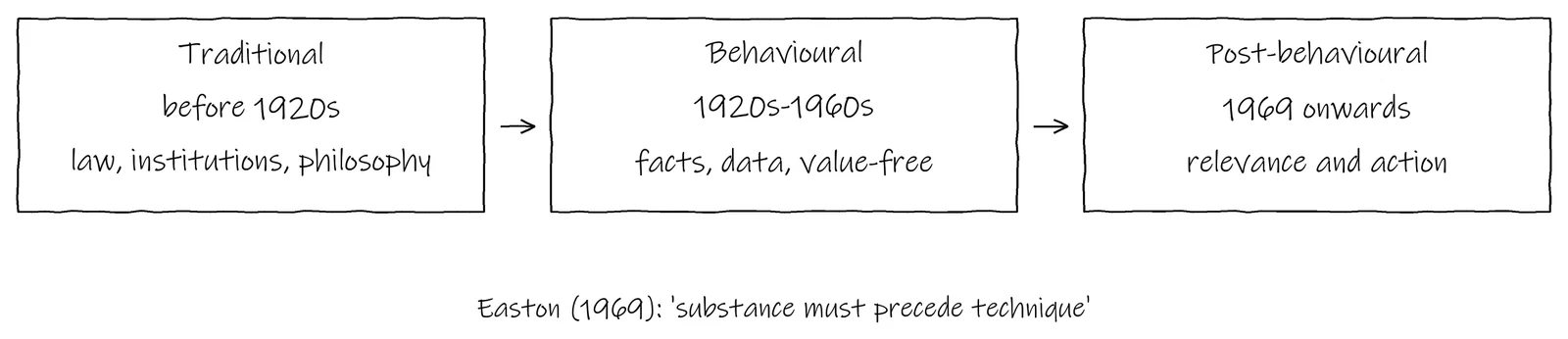
These criticisms came from within the discipline too. In his presidential address to the American Political Science Association in 1969, ‘The New Revolution in Political Science’, Easton himself announced a post-behavioural revolution. He did not reject the scientific method, but he set out a ‘credo of relevance’: substance must precede technique; research must address urgent social problems; values cannot be ignored; scholars have a responsibility to act on their knowledge; and the profession itself must engage with society. In simple words, post-behaviouralism wanted science to serve human needs.
2.5 Comparing the Three Approaches
We can now put the three approaches side by side (Table 2.1).
| Approach | Central question | Method | Key thinkers | Main criticism |
|---|---|---|---|---|
| Normative | What ought to be? | Conceptual analysis, argument, thought experiments | Plato, Locke, Rawls | Values cannot be tested; may hide ideology |
| Historical | What did the classic thinkers mean? | Close reading; reading texts in context | Sabine, Strauss, Skinner, Pocock | Antiquarianism; relativism |
| Empirical | What is, and why? | Observation, surveys, statistics, models | Merriam, Easton, Dahl | Value-free science is impossible; status quo bias |
Although the three approaches were once seen as rivals, most political theorists today see them as complementary, i.e. as completing one another. Normative theory needs empirical facts: a theory of justice that ignores how markets and states actually work is of little use. Empirical research needs normative questions: we study inequality because we care about fairness. And both need the historical approach, which shows where our concepts come from and how they have been used. In short, the empirical approach tells us where we are, the normative approach tells us where we should go, and the historical approach tells us how we got here.
2.6 Important Questions
- Question 1 Critically examine the empirical approach to political theory.
- Question 2 What is the normative approach to political theory? Discuss its significance.
- Question 3 Discuss the historical approach to the study of political theory.
DU asks the same idea in different words. So learn one broad answer for each question below; the same answer works for every question joined by OR.
Important Question 1
Critically examine the empirical approach to political theory.
OR
Discuss the main features of behaviouralism. Why did post-behaviouralism emerge?
OR
Explain David Easton’s systems approach to the study of politics.
Model Answer
“Substance must precede technique.”
— David Easton, ‘The New Revolution in Political Science’ (1969)
Introduction. The empirical approach studies politics as it actually is, through observation and evidence. It seeks to describe and explain political behaviour and to discover regularities that can be tested. In the twentieth century it took the form of behaviouralism, which dominated American political science in the 1950s and 1960s and was later corrected by post-behaviouralism.
1. Meaning and Roots
Empirical means based on experience and observation. The approach is old: Aristotle compared the constitutions of many Greek city-states, and Machiavelli studied how rulers actually behave. In the nineteenth century Auguste Comte’s positivism demanded that society be studied with the methods of natural science.
2. Features of the Empirical Approach
- Factual: studies what is; Aristotle compared 158 Greek constitutions to explain stability and revolution.
- Realist: studies power as it is actually used; Machiavelli’s The Prince (1513), written for a divided and invaded Italy.
- Scientific: applies the methods of natural science; Comte’s positivism in post-revolutionary France.
- Value-neutral: separates facts from values; Weber’s ‘Science as a Vocation’ (1917) in wartime Germany.
- Quantitative: measures behaviour with surveys and statistics; Lazarsfeld’s study of the 1940 US election, The People’s Choice (1944).
- Theory-building and comparative: builds testable generalisations; Easton’s systems theory (1953) and Almond and Verba’s five-nation study (1963).
3. Behaviouralism
Charles Merriam’s New Aspects of Politics (1925) and the Chicago School began the movement, and after 1945 it became dominant. Several factors explain its rise: dissatisfaction with the old legal and institutional approach, the prestige of the natural sciences, the arrival of European social scientists in America, new techniques of survey research, and generous funding by foundations. Behaviouralists shifted attention from formal institutions and legal texts to the observable behaviour of voters, legislators, parties and groups. They used sample surveys, statistics, interviews and content analysis, as in the Michigan voting studies such as The American Voter (1960) and Gabriel Almond and Sidney Verba’s The Civic Culture (1963).
4. Easton’s Eight Foundations of Behaviouralism
David Easton, in ‘The Current Meaning of Behavioralism’ (1962), summed up its eight intellectual foundations. Political behaviour shows regularities that can be expressed as generalisations; these must be open to verification; research needs rigorous techniques; findings should be quantified wherever possible; ethical values must be kept separate from empirical explanation; theory and research must be systematically linked; understanding should come before application, as in pure science; and political science must be integrated with the other social sciences. Behaviouralism also took the individual and the group as its main units of study, and preferred a cautious, step-by-step building of theory.
5. Easton’s Systems Approach
In The Political System (1953) Easton described politics as a system that converts inputs (demands and supports) from the environment into outputs (authoritative decisions and policies), which in turn produce new inputs through feedback. The model presents politics as a continuous process and allows comparison across political systems.
6. Contributions
The empirical approach brought rigour and precision to political studies. It produced valuable knowledge about voting behaviour, public opinion, parties and elites, encouraged comparative politics, and made political science an interdisciplinary social science.
7. Criticisms
Critics argued that a value-free science is impossible, since the choice of problems itself reflects values. Behaviouralism was accused of hyperfactualism, of a status quo bias that treated the existing order as given, and of neglecting the ends of political life; Leo Strauss attacked it for being unable to say what a good society is. Above all, it seemed irrelevant to the crises of the 1960s, such as the Vietnam War and the civil rights struggle.
8. Post-behaviouralism
In his presidential address to the American Political Science Association in 1969, Easton himself announced a post-behavioural revolution. Its ‘credo of relevance’ had seven points:
- Substance must precede technique: important problems matter more than refined methods.
- Social change: research should not only describe and preserve the existing order but also study change.
- Relevance: political science must face the real crises of society rather than retreat into abstraction.
- Values: research always rests on values, which must be made explicit.
- Responsibility of intellectuals: scholars must protect the humane values of civilisation.
- Action: to know is to bear the responsibility to act.
- Politicisation of the profession: professional bodies and universities cannot stand apart from the struggles of society.
Post-behaviouralism, therefore, did not abandon science; it demanded that science serve human needs. It was both a continuation of behaviouralism and a correction of it.
Conclusion. Thus, the empirical approach made political theory more scientific and more aware of how politics actually works. Its weaknesses, however, showed that facts alone cannot guide political life. The best political theory today joins empirical evidence with normative judgement.
Important Question 2
What is the normative approach to political theory? Discuss its significance.
OR
“Normative theory is concerned with what ought to be.” Discuss.
OR
Write a note on normative theory.
Model Answer
“Man is born free, and everywhere he is in chains.”
— Jean-Jacques Rousseau, The Social Contract (1762)
Introduction. The normative approach is concerned with what ought to be rather than what is. It sets standards, such as justice, liberty and equality, by which political institutions and actions can be judged. It is the oldest approach to political theory and, after a period of decline, remains central to it.
1. Meaning
The word normative comes from norm, i.e. a standard. Normative theory asks questions such as: Why should we obey the state? What is a just distribution of wealth? When is disobedience justified? It is therefore prescriptive and evaluative, not merely descriptive.
2. Features
- Prescriptive: asks what ought to be; Plato’s Republic, written after Athens executed Socrates (399 BCE).
- Value-centred: judges politics by moral values; Kant’s principle that persons are ends in themselves (1785) and his Perpetual Peace (1795).
- Rooted in human nature: reasons from a view of human beings; Hobbes’s Leviathan (1651), written amid the English Civil War.
- Justificatory: asks when authority is legitimate; Locke’s government by consent, published after the Glorious Revolution of 1688.
- Critical and reformist: judges existing institutions; Mill’s On Liberty (1859) and The Subjection of Women (1869) in Victorian England.
- Ideal-building: designs principles for a just society; Rawls’s A Theory of Justice (1971), written in the America of the civil rights movement.
3. The Classical Tradition
Plato’s Republic sought the meaning of justice and the ideal state. Hobbes, Locke and Rousseau used the idea of a social contract to justify political authority, and J.S. Mill defended individual liberty in On Liberty (1859). The great works of political theory are, in this sense, largely normative.
4. Methods
Normative theorists use conceptual analysis to clarify ideas, argument and justification to defend positions against objections, and thought experiments, such as Rawls’s veil of ignorance. Rawls also proposed reflective equilibrium, i.e. adjusting principles and particular judgements until they fit together. Rawls’s method of reflective equilibrium moves back and forth between general principles and our considered judgements about particular cases until they fit together.
5. Decline
David Hume’s is–ought gap suggested that values cannot be derived from facts. In the twentieth century logical positivists such as A.J. Ayer dismissed moral statements as expressions of feeling, and behaviouralists sought a value-free science. By 1956 Peter Laslett could declare political philosophy ‘dead’.
6. Revival
John Rawls’s A Theory of Justice (1971) revived the approach. Behind the veil of ignorance, Rawls argued, rational people would choose two principles: first, equal basic liberties for all; second, social and economic inequalities arranged so that they benefit the least advantaged (the difference principle) and are attached to positions open to all under fair equality of opportunity. Robert Nozick’s Anarchy, State, and Utopia (1974) replied with an entitlement theory that defends a minimal state and free exchange. Communitarians such as Michael Sandel, in Liberalism and the Limits of Justice (1982), criticised Rawls’s ‘unencumbered self’, i.e. a person imagined without community and attachments, and feminist and multicultural theorists widened the debate further. Normative argument is once again at the heart of the discipline.
7. Significance
Normative theory gives us standards for judging laws and governments; it enables criticism of injustice; it helps in imagining alternatives; it guides public policy; and it is unavoidable, because every empirical study rests on some normative concern. In India, debates on reservations, secularism and the death penalty are normative debates that rely on arguments about justice, equality and dignity.
8. Normative Theory in India
Indian thinkers also debated what a just society should be: Gandhi stressed truth, non-violence and swaraj, Ambedkar liberty, equality and fraternity, and Nehru democratic socialism. The Preamble to the Constitution is itself a normative statement of these ideals.
9. Criticisms
Value judgements cannot be tested like facts, so normative disagreements may never be finally settled. Marxists see normative theory as ideology that presents the interests of the ruling class as universal values; postmodernists doubt the existence of universal truths; and realists warn that normative theory becomes too abstract if it ignores how institutions and power actually work. Postmodernists go further and question whether any universal standard of justice exists at all.
10. Normative and Empirical Together
The sharp separation of facts and values is now widely questioned. Empirical research rests on normative choices about what is worth studying, and normative theories rely on empirical claims about human nature, markets and states. A theory of justice that ignores the facts is empty; a collection of facts without normative questions is blind. Good political theory joins the two.
Conclusion. Thus, the normative approach gives political theory its purpose. Facts tell us how things are, but only normative reasoning can tell us whether they are just and how they should change.
Important Question 3
Discuss the historical approach to the study of political theory.
OR
Compare the views of Leo Strauss and Quentin Skinner on reading classical texts.
OR
Compare the normative, historical and empirical approaches to political theory.
Model Answer
“Those who cannot remember the past are condemned to repeat it.”
— George Santayana, The Life of Reason (1905)
Introduction. The historical approach studies political ideas through the writings of the great thinkers of the past. It asks what they said, why they said it and what their ideas mean today. It also raises a methodological question: how should a classic text be read?
1. Meaning and Scope
The approach covers the tradition from Plato and Aristotle to Hobbes, Locke, Rousseau, Marx and beyond. George Sabine’s A History of Political Theory (1937) is a classic example of the traditional history of ideas. Sabine’s A History of Political Theory (1937) traced how ideas developed in response to the problems of their times.
2. Why Study the Classics
The classics address perennial questions of justice, authority and liberty; they reveal the origins of our concepts; and they give us critical distance from our own assumptions. Sheldon Wolin, in Politics and Vision (1960), argued that the classics offer an ‘epic’ vision of political life which ordinary empirical research cannot provide.
3. Leo Strauss
For Strauss, the great books deal with timeless truths and must be read closely on their own terms. In Persecution and the Art of Writing (1952) he argued that philosophers often hid their real (esoteric) teaching behind a public (exoteric) one. In Natural Right and History (1953) he criticised both historicism and value-free social science. Strauss believed that philosophers often wrote between the lines to avoid persecution, so careful readers must look for hidden meanings; he criticised modern thought from Machiavelli onwards for abandoning the question of the best regime.
4. The Cambridge School
Building on Peter Laslett’s edition of Locke (1960), Quentin Skinner argued in ‘Meaning and Understanding in the History of Ideas’ (1969) that a text can be understood only by recovering what its author was doing in a particular debate. Drawing on J.L. Austin, he treated texts as speech acts, i.e. actions performed with words. He identified several mythologies that distort the history of ideas: the mythology of doctrines, which expects every classic thinker to have a view on every topic; the mythology of coherence, which forces a thinker’s scattered remarks into a perfect system; and the mythology of prolepsis, which judges a text by consequences its author could not have intended. J.G.A. Pocock, in The Machiavellian Moment (1975), studied the political languages, such as the language of civic republicanism, within which thinkers argued. J.G.A. Pocock, in The Machiavellian Moment (1975), used this method to trace the language of republicanism from Renaissance Florence to the American Revolution. Skinner’s The Foundations of Modern Political Thought (1978) traced the emergence of the modern concept of the state.
5. The Social History of Ideas
A third way of reading the classics links them to social and economic change. C.B. Macpherson, in The Political Theory of Possessive Individualism (1962), read Hobbes and Locke as theorists of the emerging market society, whose idea of the individual as the owner of his own person and capacities reflected the rise of capitalism. This reading shows that even the most abstract theory has social roots. Neal Wood and Ellen Meiksins Wood developed this approach, reading the classics against the class struggles of their societies.
6. The Historical Approach and Indian Thought
Indian scholars have applied the historical approach to Indian political thought, studying Kautilya, Manu, the Bhakti saints and modern thinkers such as Gandhi and Ambedkar in their contexts; Thomas Pantham and Kenneth Deutsch’s Political Thought in Modern India (1986) is a well-known example.
7. Example: Three Readings of Locke
The different readings of Locke show how the methods differ: Strauss saw him as a covert follower of Hobbes, Macpherson as a theorist of possessive individualism defending capitalist property, and Laslett and the Cambridge School as a writer responding to the Exclusion Crisis of the 1680s.
8. Strengths
The approach keeps political theory connected to its great tradition, prevents careless use of old concepts and shows that our present beliefs have a history. It also trains students to read difficult texts closely and to judge arguments in their full context, which is the basic skill of every political theorist. It also guards against anachronism, the error of reading modern meanings into old texts, such as treating Locke as a modern democrat.
9. Criticisms
Critics accuse it of antiquarianism, i.e. studying the past for its own sake; David Easton complained in the 1950s that political theory had become a mere history of ideas. Strict contextualism risks relativism, and the ‘great books’ tradition has been criticised for ignoring women and non-Western thinkers. Others warn that strict contextualism turns the classics into museum pieces with nothing to say to the present.
10. Significance Today
The historical approach helps us understand where concepts such as sovereignty, rights and citizenship come from, why they mean what they do today and how they might be revised; without history, political theory would lose its memory.
11. Relation to Other Approaches
The normative approach asks what ought to be, the empirical approach studies what is, and the historical approach explains how our concepts came to be. They are complementary rather than rival approaches. Most political theorists now combine all three.
Conclusion. Thus, the historical approach is not a study of dead ideas. Read with care, the classics help us understand our present and judge it more wisely.
Short Notes
(a) Behaviouralism
A movement in American political science of the 1950s and 1960s that sought to make the discipline a science by studying observable political behaviour with quantitative methods. David Easton listed its intellectual foundations, including regularities, verification, techniques, quantification, value-freedom, systematisation, pure science and integration. In 1969 Easton himself announced a post-behavioural revolution with a credo of relevance and action, arguing that research must address urgent social problems.
(b) The Cambridge School
An approach to the history of political thought associated with Quentin Skinner, J.G.A. Pocock and John Dunn. In ‘Meaning and Understanding in the History of Ideas’ (1969), Skinner argued that texts must be read in their linguistic and historical context to recover what their authors were doing in writing them, treating texts as speech acts. The approach rejects reading classic texts as timeless answers to perennial questions.
More notes: DSC-1 Understanding Political Theory
These notes are prepared by PADHO TO AISE for study help. They are not an official University of Delhi publication.