

Generic Electives (GE) GE-14 Fundamental Rights, Duties and Directive Principles of State Policy
Unit 4 · 24 min read · Updated 27 Nov 2026
As per the University of Delhi (DU) Generic Elective (GE) syllabus offered by the Department of Political Science
Contents
- 4.1 Origin and Incorporation of Fundamental Duties
- How the Duties Were Added
- The Eleven Fundamental Duties
- 4.2 Nature and Significance of Fundamental Duties
- Features of Fundamental Duties
- Significance
- Criticisms
- 4.3 Judicial Recognition, Implementation and Civic Sense
- Laws That Give Effect to Duties
- Judicial Recognition
- Civic Sense and Constitutional Obligations
- 4.4 Important Questions
- Discuss the origin and incorporation of Fundamental Duties in the Indian Constitution.
- Examine the nature and significance of Fundamental Duties.
- Discuss the judicial recognition and implementation of Fundamental Duties.
- Discuss the importance of civic sense and constitutional obligations for Indian democracy.
- Short Notes
मैंने अपनी अनपढ़ किंतु बुद्धिमान माँ से सीखा कि सभी अधिकार, जिनके हम योग्य हों और जिन्हें हम बनाए रखें, भली-भाँति निभाए गए कर्तव्य से ही आते हैं।
I learnt from my illiterate but wise mother that all rights to be deserved and preserved came from duty well done.
— Mahatma Gandhi, Letter to the Director-General of UNESCO (1947)
RRIGHTS and duties go together. The original Constitution of 1950 listed Fundamental Rights and Directive Principles but no duties of citizens. In 1976, during the Emergency, the 42nd Amendment added Part IVA with a list of Fundamental Duties in Article 51A, and a further duty was added in 2002. This chapter studies the origin and incorporation of the duties, their nature and significance, how the courts and laws have recognised and implemented them, and the wider idea of civic sense and constitutional obligations on which a democracy depends.
4.1 Origin and Incorporation of Fundamental Duties
A duty is an obligation that a person owes to others or to the community. In political theory, rights and duties are correlative: if I have a right, others have a duty to respect it, and as a member of a political community I have duties to the state and to fellow citizens. Indian traditions also stressed duty: the idea of dharma emphasised the performance of one’s duties, and Gandhi taught that rights flow from duties well performed. Many constitutions, especially those of socialist countries such as the former Soviet Union and of Japan and China, list the duties of citizens.
How the Duties Were Added
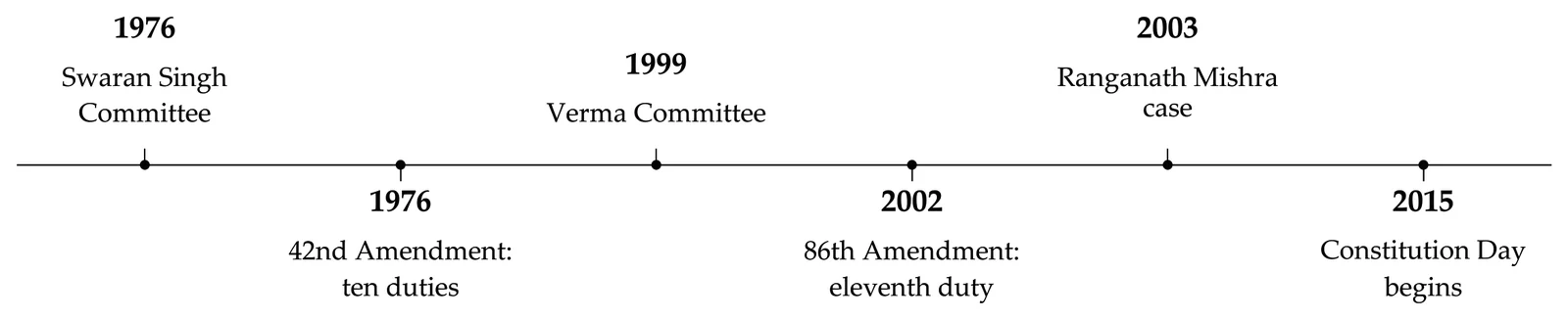
The original Constitution did not include duties because the founders believed that citizens’ obligations were implied and that the Constitution should mainly limit the state. During the Emergency of 1975–77, the government set up a committee under Sardar Swaran Singh to recommend constitutional changes. It recommended a chapter of duties, and the 42nd Amendment of 1976 added Part IVA, containing Article 51A, with ten duties. The committee had suggested eight duties, penalties for their violation and a duty to pay taxes, but Parliament added ten duties without penalties or the tax duty. The 86th Amendment of 2002 added an eleventh duty for parents and guardians to provide opportunities for education to their children between six and fourteen years.
The Eleven Fundamental Duties
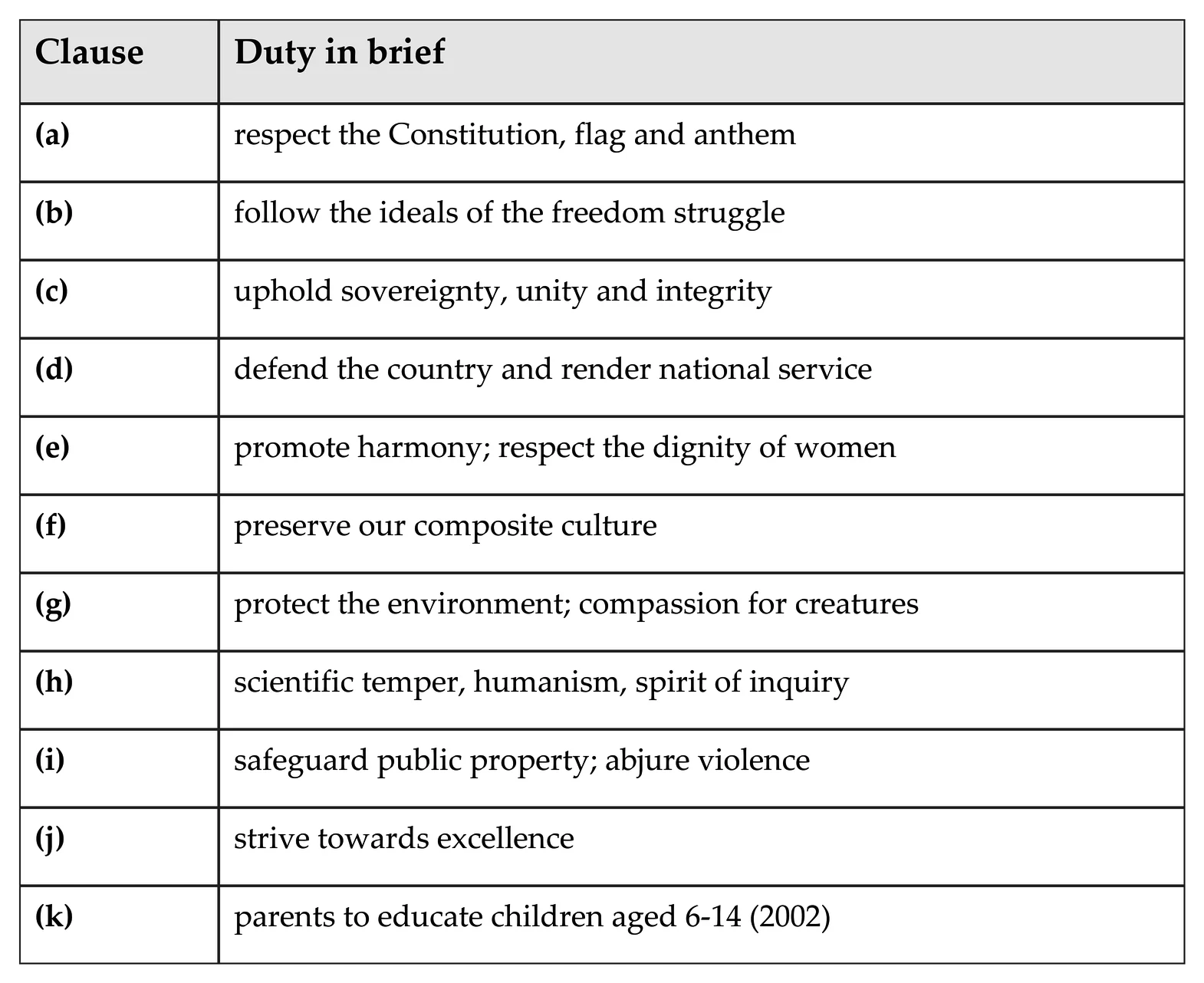
Article 51A declares that it shall be the duty of every citizen of India:
- to abide by the Constitution and respect its ideals and institutions, the National Flag and the National Anthem;
- to cherish and follow the noble ideals which inspired the national struggle for freedom;
- to uphold and protect the sovereignty, unity and integrity of India;
- to defend the country and render national service when called upon to do so;
- to promote harmony and the spirit of common brotherhood among all the people of India transcending religious, linguistic and regional or sectional diversities, and to renounce practices derogatory to the dignity of women;
- to value and preserve the rich heritage of our composite culture;
- to protect and improve the natural environment including forests, lakes, rivers and wildlife, and to have compassion for living creatures;
- to develop the scientific temper, humanism and the spirit of inquiry and reform;
- to safeguard public property and to abjure violence;
- to strive towards excellence in all spheres of individual and collective activity so that the nation constantly rises to higher levels of endeavour and achievement;
- who is a parent or guardian, to provide opportunities for education to his child or ward between the age of six and fourteen years (added in 2002).
4.2 Nature and Significance of Fundamental Duties
Features of Fundamental Duties
- Addressed to citizens. Unlike some Fundamental Rights, which belong to all persons, the duties apply only to citizens of India.
- Non-justiciable. The Constitution provides no direct penalty or court remedy for their violation, though Parliament can enforce them through laws.
- Moral and civic. Some duties are moral, such as cherishing the ideals of the freedom struggle, while others are civic, such as respecting the Constitution, the flag and the anthem.
- Rooted in Indian values. They reflect Indian traditions of duty and the ideals of the national movement, such as harmony, composite culture and non-violence.
- Linked to the Preamble and rights. They complement the Preamble’s goals of unity and fraternity and balance the rights of citizens with obligations.
- Positive and negative. Some require action, such as protecting the environment and educating children, while others require restraint, such as abjuring violence.
Significance
- Reminder to citizens. They remind citizens that, while enjoying rights, they also owe obligations to the country and to one another.
- Warning against anti-national activities. They serve as a warning against activities such as burning the flag or destroying public property.
- Inspiration and discipline. They promote a sense of discipline and commitment among citizens.
- Aid to courts. Courts can consider them when judging whether a law imposing restrictions on rights is reasonable; a law that seeks to give effect to a duty may be treated as reasonable.
- Educational value. They guide civic education in schools, helping to form responsible citizens.
- Democratic citizenship. They express the idea that democracy depends not only on institutions and rights but also on active, responsible citizens.
Criticisms
- No enforcement. Since they are non-justiciable, critics call them a moral code without teeth.
- Vague language. Terms such as composite culture, scientific temper and noble ideals are difficult to define.
- Incomplete list. Important duties such as voting, paying taxes and family planning, suggested by the Swaran Singh Committee or later commentators, were left out.
- Introduced during the Emergency. Critics saw their introduction in 1976, when rights were suspended, as an attempt to stress obedience over liberty.
- Already covered by law. Many duties, such as safeguarding public property and protecting the environment, were already required by ordinary laws.
- Placement. Some argue that the duties should have been placed alongside Fundamental Rights to stress their correlation.

4.3 Judicial Recognition, Implementation and Civic Sense
Laws That Give Effect to Duties
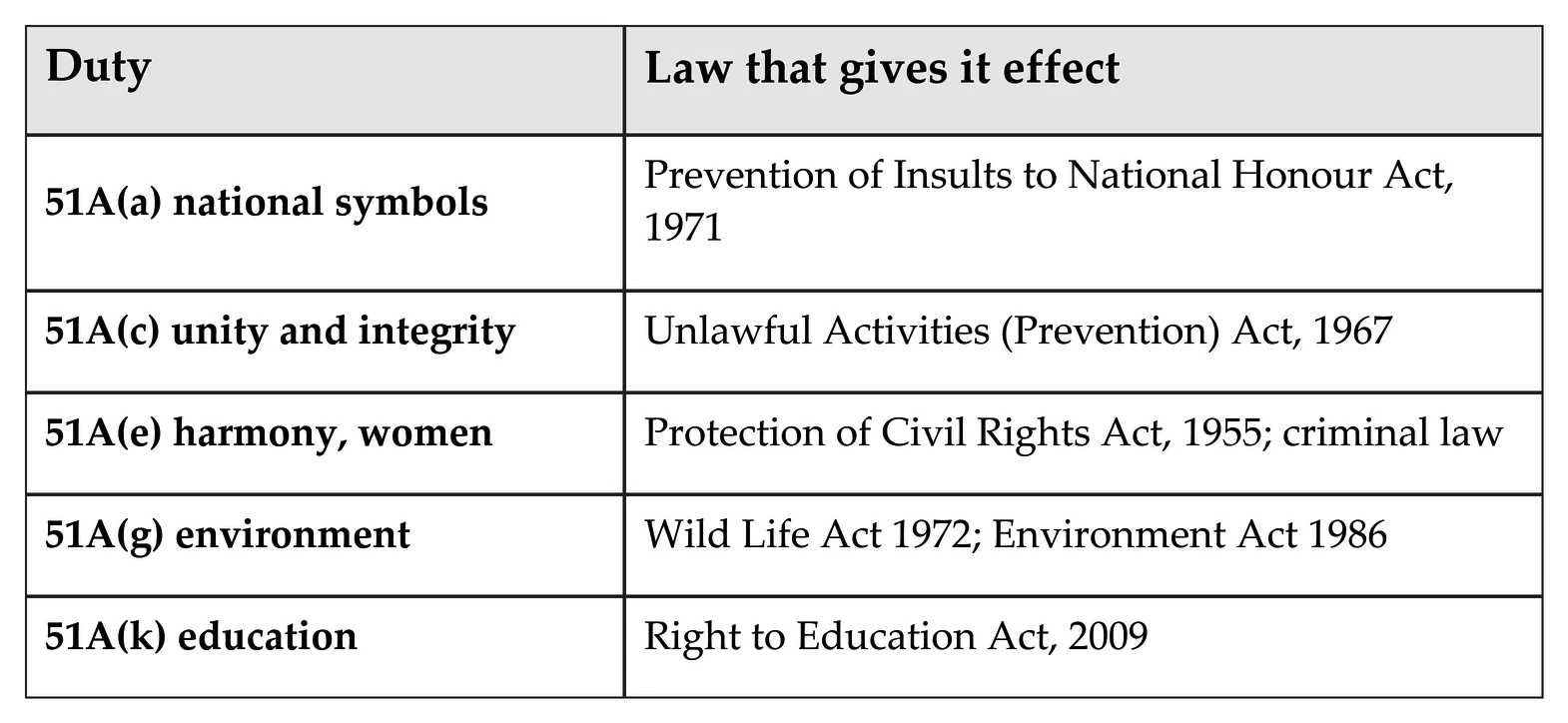
Although the duties are not directly enforceable, many laws give effect to them. The Justice J.S. Verma Committee of 1999 identified such laws and recommended measures to make citizens aware of their duties:
- Respect for national symbols. The Prevention of Insults to National Honour Act of 1971 punishes insults to the Constitution, the National Flag and the National Anthem.
- Harmony and dignity. The Protection of Civil Rights Act of 1955 punishes the practice of untouchability, and the Indian Penal Code, now the Bharatiya Nyaya Sanhita, punishes promoting enmity between groups.
- Unity and integrity. The Unlawful Activities (Prevention) Act of 1967 deals with organisations threatening the sovereignty and integrity of India.
- Environment. The Wild Life (Protection) Act of 1972, the Forest (Conservation) Act of 1980 and the Environment (Protection) Act of 1986 give effect to Article 51A(g).
- Elections. The Representation of the People Act of 1951 disqualifies persons convicted of promoting enmity between groups.
- Education. The Right of Children to Free and Compulsory Education Act of 2009 gives effect to Article 51A(k) along with Article 21A.
Judicial Recognition
- Environment education. In M.C. Mehta v. Union of India (1988 and later orders), the Supreme Court, citing Article 51A(g), directed that lessons on the environment be taught in schools and that awareness programmes be broadcast.
- The National Anthem. In Bijoe Emmanuel v. State of Kerala (1986), the Court held that students of the Jehovah’s Witnesses faith who stood respectfully but did not sing the anthem could not be expelled, since respect does not require singing.
- The National Flag. In Union of India v. Naveen Jindal (2004), the Court held that flying the national flag with respect is part of freedom of expression, subject to reasonable restrictions and the Flag Code.
- Duties and rights. In AIIMS Students’ Union v. AIIMS (2001), the Court said that Fundamental Duties are as important as Fundamental Rights and can be used to interpret laws.
- Awareness. In Ranganath Mishra v. Union of India (2003), the Court directed the government to implement the Verma Committee’s recommendations for teaching Fundamental Duties.
- Anthem in cinemas. In Shyam Narayan Chouksey (2016), the Court ordered the anthem to be played in cinemas, but in 2018 it made this optional, showing the difficulty of enforcing respect through compulsion.
Civic Sense and Constitutional Obligations
Civic sense means the awareness and behaviour of citizens that make shared life possible: obeying laws, respecting public property, keeping public places clean, respecting others’ rights and taking part in public life. Constitutional obligations go further, requiring citizens to uphold the values of the Constitution, liberty, equality, fraternity and justice, in their daily conduct. Ambedkar warned in 1949 that democracy in India was only a top-dressing on an Indian soil which is essentially undemocratic, and that constitutional morality must be cultivated. Jawaharlal Nehru, who coined the phrase scientific temper in The Discovery of India (1946), believed that citizens must learn to think rationally. Since 2015, 26 November has been observed as Constitution Day to promote awareness of constitutional values, and campaigns such as Swachh Bharat (2014) have sought to strengthen civic responsibility.
4.4 Important Questions
- Question 1 Discuss the origin and incorporation of Fundamental Duties in the Indian Constitution.
- Question 2 Examine the nature and significance of Fundamental Duties.
- Question 3 Discuss the judicial recognition and implementation of Fundamental Duties.
- Question 4 Discuss the importance of civic sense and constitutional obligations for Indian democracy.
DU asks the same idea in different words. So learn one broad answer for each question below; the same answer works for every question joined by OR.
Important Question 1
Discuss the origin and incorporation of Fundamental Duties in the Indian Constitution.
OR
Explain the Fundamental Duties listed in Article 51A of the Constitution.
OR
Why were Fundamental Duties added to the Constitution by the 42nd Amendment? Discuss.
Model Answer
“It shall be the duty of every citizen of India to abide by the Constitution and respect its ideals and institutions, the National Flag and the National Anthem.”
— Constitution of India, Article 51A(a)
Introduction. Fundamental Duties are the moral and civic obligations of citizens listed in Part IVA, Article 51A, of the Constitution. They were not part of the original Constitution of 1950 but were added by the 42nd Amendment of 1976 on the recommendation of the Swaran Singh Committee, and an eleventh duty was added in 2002. They express the idea that citizens owe obligations to the nation and to one another, along with enjoying rights.
1. Rights and Duties
In political theory, rights and duties are correlative: every right implies a duty on others to respect it, and membership of a political community brings obligations. Indian traditions, such as dharma, and Gandhi’s teaching that rights flow from duties well done, stressed duties.
2. Absence in the Original Constitution
The Constituent Assembly did not include duties, believing that the Constitution should mainly limit the state and protect citizens, and that duties were implied in citizenship and in laws.
3. The Swaran Singh Committee
During the Emergency, the government set up a committee under Sardar Swaran Singh in 1976 to recommend constitutional changes. It recommended a separate chapter of duties, eight in number, with penalties for non-compliance and a duty to pay taxes.
4. The 42nd Amendment
The 42nd Amendment of 1976 added Part IVA and Article 51A with ten duties, but did not include penalties or the duty to pay taxes. The duties were placed after the Directive Principles.
5. Influence of Other Constitutions
The idea of listing duties is often said to have been borrowed from the Constitution of the former Soviet Union, and duties appear in many constitutions, including those of Japan and China, reflecting the view that citizenship involves obligations.
6. Duties Relating to the Constitution and Nation
The first four duties require citizens to abide by the Constitution and respect the flag and anthem, cherish the ideals of the freedom struggle, uphold the sovereignty, unity and integrity of India and defend the country when called upon.
7. Duties Relating to Society
Citizens must promote harmony and brotherhood transcending religious, linguistic and regional differences, renounce practices derogatory to the dignity of women and value the heritage of India’s composite culture.
8. Duties Relating to Environment and Reason
Citizens must protect and improve the natural environment and have compassion for living creatures, and develop the scientific temper, humanism and the spirit of inquiry and reform.
9. Duties Relating to Public Life and Excellence
Citizens must safeguard public property, abjure violence and strive towards excellence in all spheres of individual and collective activity so that the nation rises to higher levels of achievement.
10. The 86th Amendment
The 86th Amendment of 2002, which made education for children aged six to fourteen a Fundamental Right under Article 21A, also added a duty for parents and guardians to provide educational opportunities to their children.
11. Reasons for Incorporation
The government argued that citizens had become too conscious of their rights and neglectful of their obligations, and that duties would promote discipline and national unity. Critics saw the timing, during the Emergency, as an attempt to stress obedience.
12. The Verma Committee
The Justice J.S. Verma Committee of 1999 found that many laws already gave effect to the duties and recommended ways to make citizens aware of them, especially through education.
13. Place in the Constitution
The duties complete the constitutional scheme of rights, directives and duties: rights protect individuals, directives guide the state and duties guide citizens, together serving the goals of the Preamble.
14. Evaluation
Though added in controversial circumstances, the Fundamental Duties have been retained by all later governments and have become an accepted part of the Constitution’s vision of responsible citizenship.
Conclusion. Thus, Fundamental Duties were added to the Constitution by the 42nd Amendment of 1976 on the recommendation of the Swaran Singh Committee, with ten duties in Article 51A and an eleventh added in 2002. They cover respect for the Constitution, national unity, social harmony, the environment, scientific temper and education, completing the constitutional balance between rights and obligations.
Important Question 2
Examine the nature and significance of Fundamental Duties.
OR
‘Fundamental Duties are only a moral code without legal force.’ Discuss.
OR
Critically evaluate the Fundamental Duties in the Indian Constitution.
Model Answer
“Rights are those conditions of social life without which no man can seek, in general, to be himself at his best.”
— Harold Laski, A Grammar of Politics (1925)
Introduction. Fundamental Duties are obligations of citizens listed in Article 51A. They are non-justiciable, i.e. not directly enforceable in court, and many of them are moral in character. Their significance lies in reminding citizens of their responsibilities, guiding civic education and helping courts interpret laws. Critics, however, consider them vague and ineffective. A balanced evaluation must consider both views.
1. Nature: Duties of Citizens
Fundamental Duties apply only to citizens of India, not to foreigners. They express the obligations that come with membership of the Indian political community.
2. Nature: Non-Justiciable
The Constitution provides no direct penalty or remedy for violating the duties. They can be enforced only through laws made by Parliament, and courts cannot compel citizens to perform them simply because they are in Article 51A.
3. Nature: Moral and Civic
Some duties are moral, such as cherishing the ideals of the freedom struggle and developing humanism, while others are civic, such as respecting the flag and safeguarding public property, which can be backed by laws.
4. Nature: Indian Values
The duties reflect Indian traditions and the values of the national movement, such as non-violence, harmony among communities, respect for women, composite culture and compassion for living creatures.
5. Significance: Reminder of Obligations
The duties remind citizens that rights and duties go together, and that the enjoyment of rights depends on responsible behaviour towards the nation and fellow citizens.
6. Significance: Aid to Interpretation
Courts can consider the duties when deciding whether restrictions on Fundamental Rights are reasonable. In AIIMS Students’ Union (2001), the Supreme Court said that Fundamental Duties are as important as Fundamental Rights.
7. Significance: Civic Education
The duties guide the teaching of citizenship in schools and campaigns of public awareness, helping to create responsible citizens who respect the Constitution and its values.
8. Significance: Unity and Harmony
Duties such as upholding unity and integrity, promoting brotherhood and valuing composite culture strengthen national unity in a diverse society.
9. Criticism: No Enforcement
Since the duties have no direct legal force, critics call them a moral code without teeth, which citizens may ignore without consequence.
10. Criticism: Vagueness
Terms such as composite culture, scientific temper and noble ideals are open to different interpretations and difficult for ordinary citizens to understand.
11. Criticism: Incomplete and Untimely
Important duties such as voting and paying taxes are missing, and the introduction of duties during the Emergency, when rights were suspended, led critics to suspect an authoritarian purpose.
12. Criticism: Redundancy
Many duties, such as protecting public property and the environment, were already enforced by ordinary laws, so critics argue that their inclusion added little.
13. Response to Criticisms
Defenders reply that the duties are meant to educate and inspire rather than punish, that laws can give them effect, and that their moral value in a democracy should not be underestimated.
14. Duties in Other Constitutions and International Law
Many constitutions list duties of citizens. The Japanese Constitution of 1947 includes duties to pay taxes and to educate children, and socialist constitutions such as China’s of 1982 list extensive duties. Article 29(1) of the Universal Declaration of Human Rights (1948) also states that everyone has duties to the community in which alone the free and full development of the personality is possible.
15. Duties in Indian Tradition
The idea of duty has deep roots in Indian thought. The concept of dharma stressed the performance of one’s obligations, and Gandhi taught that rights flow from duties well performed. The Fundamental Duties draw on this tradition and on the ideals of the freedom struggle, such as non-violence, harmony and service.
16. Evaluation
The Fundamental Duties are more than a moral code because laws and courts give them effect, but their real strength depends on citizens’ awareness and commitment rather than on legal compulsion.
Conclusion. Thus, Fundamental Duties are non-justiciable obligations of citizens that combine moral and civic duties rooted in Indian values. They remind citizens of their responsibilities, aid judicial interpretation and guide civic education, though critics point to their vagueness, lack of enforcement and controversial origin. Their value lies in fostering responsible citizenship.
Important Question 3
Discuss the judicial recognition and implementation of Fundamental Duties.
OR
How have courts and laws given effect to the Fundamental Duties? Discuss with examples.
OR
Examine the role of the Supreme Court in interpreting the Fundamental Duties.
Model Answer
“To protect and improve the natural environment including forests, lakes, rivers and wild life, and to have compassion for living creatures.”
— Constitution of India, Article 51A(g)
Introduction. Although the Fundamental Duties are not directly enforceable, they have been given effect through legislation and judicial interpretation. Parliament has passed laws that enforce several duties, and the Supreme Court has used the duties to interpret laws, to judge the reasonableness of restrictions on rights and to direct governments to promote awareness. This shows that the duties have practical, not only symbolic, importance.
1. Enforcement through Legislation
Article 51A does not provide penalties, but Parliament can make laws to enforce duties. Many existing and new laws give effect to them, as the Justice J.S. Verma Committee pointed out in 1999.
2. Respect for National Symbols
The Prevention of Insults to National Honour Act of 1971 punishes insults to the Constitution, the National Flag and the National Anthem, enforcing Article 51A(a).
3. Harmony and Dignity
The Protection of Civil Rights Act of 1955 punishes untouchability, and the criminal law punishes promoting enmity between groups and insulting women, giving effect to Article 51A(e).
4. Environment Laws
The Wild Life (Protection) Act of 1972, the Forest (Conservation) Act of 1980 and the Environment (Protection) Act of 1986 give effect to the duty to protect the environment in Article 51A(g).
5. Education
The Right to Education Act of 2009 gives effect to Article 51A(k), the duty of parents to provide educational opportunities to their children, along with the right in Article 21A.
6. Environmental Education Cases
In M.C. Mehta v. Union of India, the Supreme Court, relying on Article 51A(g), directed that environmental lessons be taught in schools and colleges and that awareness programmes be broadcast, showing how duties can shape policy.
7. The National Anthem
In Bijoe Emmanuel (1986), the Court held that students who stood respectfully but did not sing the anthem for religious reasons could not be expelled, balancing the duty of respect with freedom of religion.
8. The National Flag
In Naveen Jindal (2004), the Court held that citizens have a right to fly the national flag with respect as part of freedom of expression, linking rights and duties regarding national symbols.
9. Duties as Equal to Rights
In AIIMS Students’ Union (2001), the Court said that Fundamental Duties, though not enforceable, are as important as Fundamental Rights and can guide the interpretation of laws and policies.
10. Duties and Reasonable Restrictions
Courts have held that a law which seeks to give effect to a Fundamental Duty may be considered a reasonable restriction on Fundamental Rights, so the duties help to justify certain laws.
11. Awareness and Education
In Ranganath Mishra (2003), the Court directed the government to implement the Verma Committee’s recommendations for teaching Fundamental Duties, recognising that awareness is essential to their realisation.
12. The Cinema Anthem Case
In Shyam Narayan Chouksey (2016), the Court ordered that the anthem be played in cinemas, but in 2018 it made this optional, showing the limits of enforcing respect through compulsion.
13. Limits of Judicial Enforcement
Courts cannot directly compel citizens to perform moral duties such as developing scientific temper. Their role is mainly to interpret laws, judge reasonableness and encourage awareness.
14. Duties in Education
Courts and committees have stressed that duties are best realised through education. School textbooks prepared by bodies such as the NCERT include the Fundamental Duties, and education policies, including the National Education Policy of 2020, emphasise constitutional values and responsible citizenship as aims of schooling.
15. Evaluation
Through laws and judicial interpretation, several Fundamental Duties have gained practical force, while others remain moral ideals whose realisation depends on education and civic culture.
Conclusion. Thus, the Fundamental Duties have been implemented through laws on national honour, civil rights, the environment and education, and recognised by courts in cases such as M.C. Mehta, Bijoe Emmanuel, AIIMS Students’ Union and Ranganath Mishra. Though not directly enforceable, they guide interpretation and policy, giving practical meaning to the obligations of citizenship.
Important Question 4
Discuss the importance of civic sense and constitutional obligations for Indian democracy.
OR
‘Rights and duties are two sides of the same coin.’ Discuss with reference to the Indian Constitution.
OR
How can Fundamental Duties promote responsible citizenship? Discuss.
Model Answer
“The first thing in my judgement we must do is to hold fast to constitutional methods of achieving our social and economic objectives.”
— B.R. Ambedkar, Constituent Assembly (25 November 1949)
Introduction. A democracy depends not only on good institutions and rights but also on citizens who behave responsibly. Civic sense, the everyday awareness and conduct that make shared life possible, and constitutional obligations, the commitment to the Constitution’s values, are essential for democracy to work. The Fundamental Duties express these ideas, but their realisation depends on education, culture and the example of leaders.
1. Meaning of Civic Sense
Civic sense means respecting laws, public property and the rights of others, keeping public places clean, following traffic rules, paying taxes and taking part in public life. It reflects a citizen’s awareness of belonging to a community.
2. Meaning of Constitutional Obligations
Constitutional obligations require citizens to uphold the values of the Constitution, justice, liberty, equality and fraternity, and to respect its institutions and methods, such as elections and courts, rather than violence.
3. Rights and Duties as Correlative
Rights and duties are two sides of the same coin. My right to free speech implies a duty to respect others’ right to speak, and the state’s protection of rights depends on citizens obeying laws. Harold Laski and Gandhi both stressed this link.
4. Ambedkar on Constitutional Morality
Ambedkar warned that constitutional morality is not a natural sentiment but must be cultivated, and on 25 November 1949 urged citizens to hold fast to constitutional methods, abandon methods such as civil disobedience after independence and avoid hero-worship in politics.
5. Fraternity and Harmony
Ambedkar stressed that without fraternity, liberty and equality would not survive. The duty to promote harmony and brotherhood across religious, linguistic and regional divisions is central to Indian democracy.
6. Scientific Temper
Nehru coined the phrase scientific temper in The Discovery of India (1946), and Article 51A(h) makes developing it a duty. Rational thinking helps citizens resist superstition, misinformation and prejudice.
7. Environment and Public Property
Protecting the environment and public property are civic duties that affect everyone. Campaigns such as Swachh Bharat (2014) seek to change behaviour on cleanliness and sanitation.
8. Respect for Women and Composite Culture
The duties to renounce practices derogatory to women and to value composite culture call on citizens to change social attitudes, not only to obey laws, which is essential for a just society.
9. Participation in Democracy
Voting, though not listed as a Fundamental Duty, is widely seen as a civic obligation. Active participation in elections, local bodies and public debate strengthens democratic accountability.
10. Role of Education
Schools, colleges and the media can build civic sense by teaching the Constitution and the duties. The Verma Committee recommended including the duties in curricula, and Constitution Day since 2015 promotes awareness.
11. Role of Leaders and Institutions
Citizens learn from the example of leaders and institutions. When public officials respect the law and the Constitution, citizens are more likely to do so, so constitutional obligations apply to leaders as much as to ordinary citizens.
12. Challenges
Weak civic sense is seen in littering, traffic violations, tax evasion, communal violence and disregard for public property. Poverty, inequality and lack of awareness make the problem more complex.
13. Balancing Rights and Duties
Stressing duties should not become a reason to weaken rights. A healthy democracy needs both: rights that protect citizens from the state and duties that guide citizens’ conduct towards each other and the nation.
14. Evaluation
Civic sense and constitutional obligations are the foundation on which rights and institutions rest. The Fundamental Duties express them, but they must be nurtured through education, example and public culture.
Conclusion. Thus, civic sense and constitutional obligations, expressed in the Fundamental Duties, are essential for Indian democracy because rights and duties are correlative. Ambedkar’s call to hold fast to constitutional methods and cultivate constitutional morality, Nehru’s scientific temper and the duty of fraternity show that a living democracy depends on responsible citizens as much as on good laws.
Short Notes
(a) Swaran Singh Committee
The committee set up in 1976 under Sardar Swaran Singh to recommend constitutional changes; it proposed a chapter of Fundamental Duties, which led to Part IVA in the 42nd Amendment.
(b) Scientific temper
A phrase coined by Jawaharlal Nehru in The Discovery of India (1946) for a rational, questioning attitude; developing it is a Fundamental Duty under Article 51A(h).
(c) Verma Committee (1999)
The committee headed by Justice J.S. Verma which identified laws giving effect to the Fundamental Duties and recommended ways to promote awareness of them, especially through education.
More notes: GE-14 Fundamental Rights, Duties and Directive Principles of State Policy
These notes are prepared by PADHO TO AISE for study help. They are not an official publication.