
Generic Electives (GE) GE-4 Understanding International Relations
Unit 5 · 22 min read · Updated 27 Nov 2026
As per the University of Delhi (DU) Generic Elective (GE) syllabus offered by the Department of Political Science
Contents
- 5.1 The Visual Turn in IR
- Images and Politics
- The Refugee Crisis in Images
- 5.2 The Internet
- Franklin: How We Use the Internet
- The Zapatista Effect
- The Internet and Power
- India and the Internet
- 5.3 Museums and Cinemas
- Sylvester: Art, Museums and IR
- Museums of Memory
- Cinema and IR
- Bollywood and Foreign Policy
- 5.4 Important Questions
- What is the visual turn in International Relations? How do images shape global politics?
- How does the internet make a difference to international relations? Discuss with reference to the Zapatista effect.
- Discuss the role of museums as sites of international relations.
- Examine the relationship between cinema and international relations.
- Short Notes
माध्यम ही संदेश है।
The medium is the message.
— Marshall McLuhan, Understanding Media (1964)
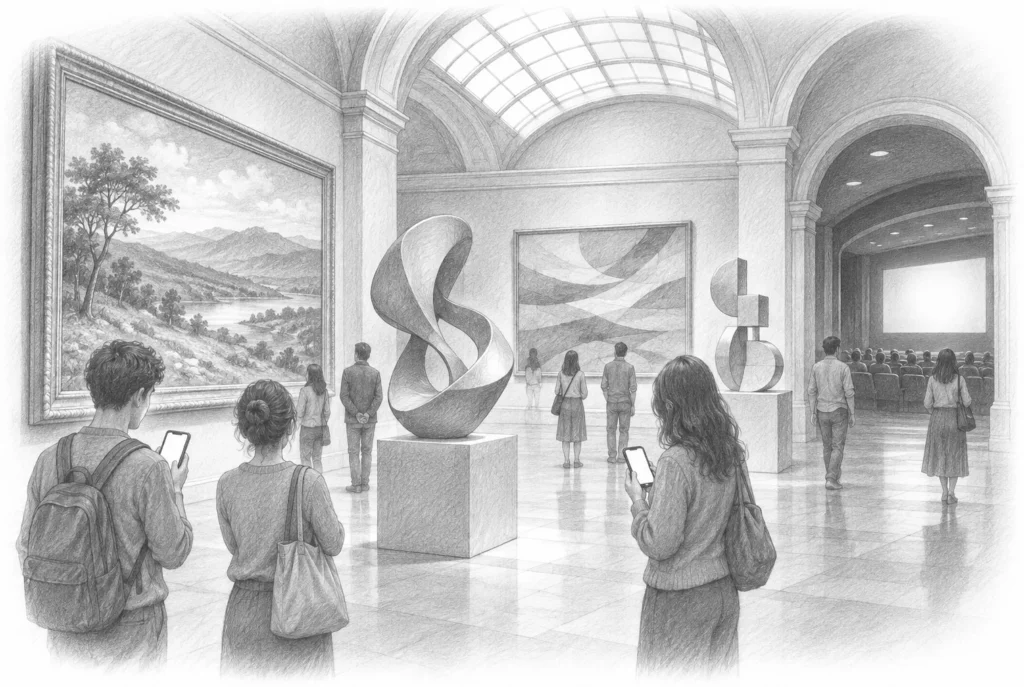
WWE learn about the world not only through books and speeches but through images, screens and spaces: news photographs, social media feeds, films and museum exhibitions. Scholars of the visual turn and aesthetic turn in IR argue that these visual and creative forms do not simply reflect international events; they shape how we understand them and how we act. This chapter examines how the internet transforms global politics, how museums tell stories of nations, wars and empires, and how cinema shapes our images of other peoples and the world.
5.1 The Visual Turn in IR
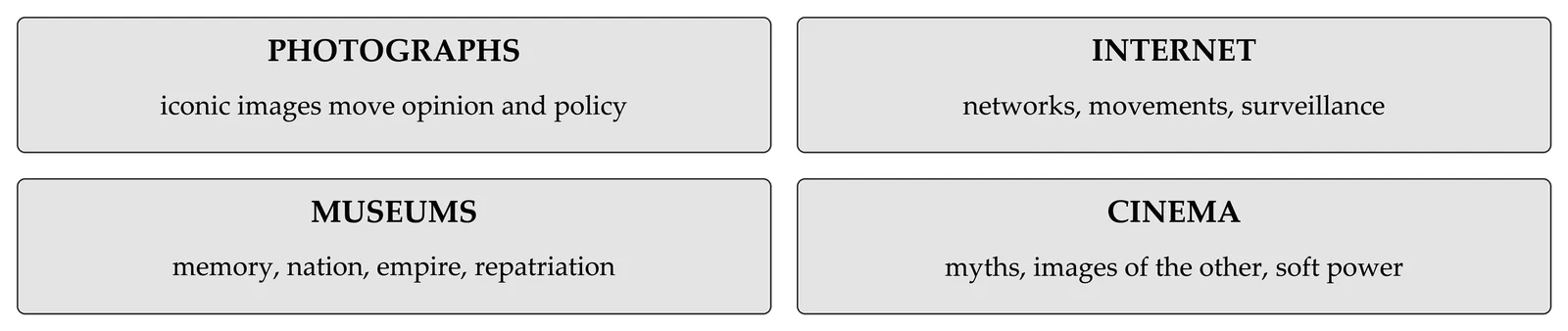
Traditional IR studied texts, speeches, treaties and statistics. Roland Bleiker, in Visual Global Politics (2018), argues that images are central to global politics: they shape how we perceive events, who we see as friends or enemies, and what we consider possible. Bleiker earlier called for an aesthetic turn in IR, arguing that art, literature, music and film offer insights into politics that conventional analysis misses. Nicholas Mirzoeff, in An Introduction to Visual Culture, shows that we live in a global visual culture in which images circulate instantly across the world.
Images and Politics
Iconic images have influenced public opinion and policy: the 1972 photograph of a Vietnamese girl fleeing a napalm attack strengthened opposition to the Vietnam War; images of the lone man facing tanks in Beijing in 1989 became symbols of resistance; photographs of prisoner abuse at Abu Ghraib in 2004 damaged the legitimacy of the Iraq war. Susan Sontag, in Regarding the Pain of Others (2003), observed that being a spectator of calamities in other countries is a quintessential modern experience, but warned that images can also numb viewers or be used for propaganda.
The Refugee Crisis in Images
Lene Hansen, Rebecca Adler-Nissen and Katrine Emelie Andersen, in The Visual International Politics of the European Refugee Crisis (2021), studied how images shaped European responses to refugees in 2015. The photograph of the drowned Syrian child Alan Kurdi on a Turkish beach in September 2015 produced a wave of sympathy and calls for humanitarian action. They show that images were framed in different ways, as tragedy, as a call for humanitarianism, or as a threat requiring borders and security, and that these frames shaped policy. Images thus do political work, but their meaning depends on how they are framed and received.
5.2 The Internet
The internet has transformed communication, commerce, politics and conflict. The International Telecommunication Union estimates that about two-thirds of the world’s population now use the internet, though access remains unequal between rich and poor countries, urban and rural areas, and men and women.
Franklin: How We Use the Internet
M.I. Franklin, in How Does the Way We Use the Internet Make a Difference? (2008), argues that the internet is not simply a neutral technology; how it is designed, governed and used shapes power relations. She highlights questions of internet governance, such as who controls domain names and standards, through bodies such as ICANN (1998), and the debates at the World Summit on the Information Society (2003 and 2005) and the Internet Governance Forum (from 2006) about making governance more inclusive. She also stresses the digital divide and the everyday ways people use the internet to create communities and resist power.
The Zapatista Effect
Harry Cleaver, in The Zapatista Effect: The Internet and the Rise of an Alternative Political Fabric (1998), showed how the Zapatista rebels of Chiapas, Mexico, who rose on 1 January 1994, used the internet to communicate their demands to the world. Supporters circulated their communiqués by email and websites, building a global network of solidarity that pressured the Mexican government to negotiate rather than crush the rebellion. Cleaver called this an electronic fabric of struggle. María Elena Martínez-Torres similarly argued that civil society networks connected through the internet protected the Zapatistas. The Zapatista effect anticipated later uses of the internet by movements such as the global justice movement, the Arab Spring of 2011 and Me Too.
The Internet and Power
- Empowerment. The internet allows movements to organise, citizens to access information and marginalised voices to be heard.
- Surveillance. States and corporations collect vast amounts of data; Edward Snowden’s revelations in 2013 exposed mass surveillance by the US National Security Agency.
- Misinformation. Social media spread false information and propaganda, influencing elections and inciting violence.
- Cyber conflict. States use cyber attacks and information warfare against rivals.
- Cyber sovereignty. Some states, such as China, control the internet within their borders, while debates continue over a free, open internet versus national control.
- Platform power. A few companies dominate search, social media and e-commerce, giving them great influence over information and markets.
India and the Internet
India has one of the largest internet populations in the world, and its digital public infrastructure, Aadhaar, UPI and DigiLocker, has attracted global attention. At the same time, India has recorded many regional internet shutdowns, debates over regulation of social media, and challenges of misinformation and the digital divide.

5.3 Museums and Cinemas
Sylvester: Art, Museums and IR
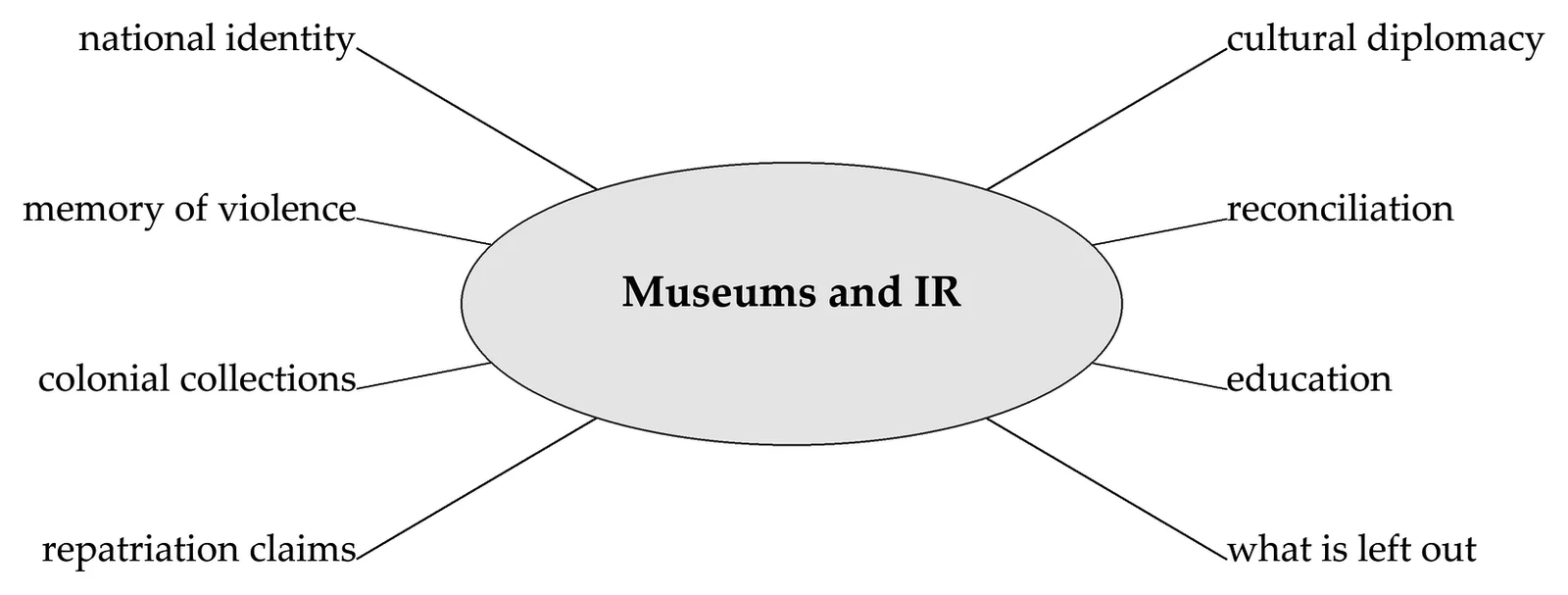
Christine Sylvester, in Art/Museums: International Relations Where We Least Expect It, argues that museums and art are important sites of international relations. Museums display objects from around the world, tell stories about nations, empires and wars, and shape how visitors understand the international. Many great Western museums hold objects acquired through colonial conquest, such as the Benin Bronzes taken by British forces in 1897, raising debates over repatriation. India has long sought the return of artefacts such as the Kohinoor diamond. Museums are also tools of cultural diplomacy, as when the Louvre opened a branch in Abu Dhabi in 2017.
Museums of Memory
- United States Holocaust Memorial Museum. Opened in Washington in 1993, it documents the Holocaust, educates visitors about genocide and promotes human rights, showing how memory shapes moral and political lessons.
- The Partition Museum. Opened in Amritsar in 2017, it is dedicated to the memories of the Partition of 1947, collecting oral histories, letters and objects from survivors, giving voice to ordinary people’s experiences of displacement and violence.
- Jallianwala Bagh. The massacre of 13 April 1919 in Amritsar, when British troops fired on an unarmed crowd, was remembered at its centenary in 2019, including through an exhibition by the Partition Museum, reminding us of colonial violence.
- Other memorials. Museums such as the Hiroshima Peace Memorial Museum and the Kigali Genocide Memorial in Rwanda keep alive the memory of nuclear war and genocide.
Museums can promote reconciliation and understanding, but they can also promote nationalist narratives, silence uncomfortable histories or display the spoils of empire. Studying them helps us see how the international is represented and remembered.
Cinema and IR
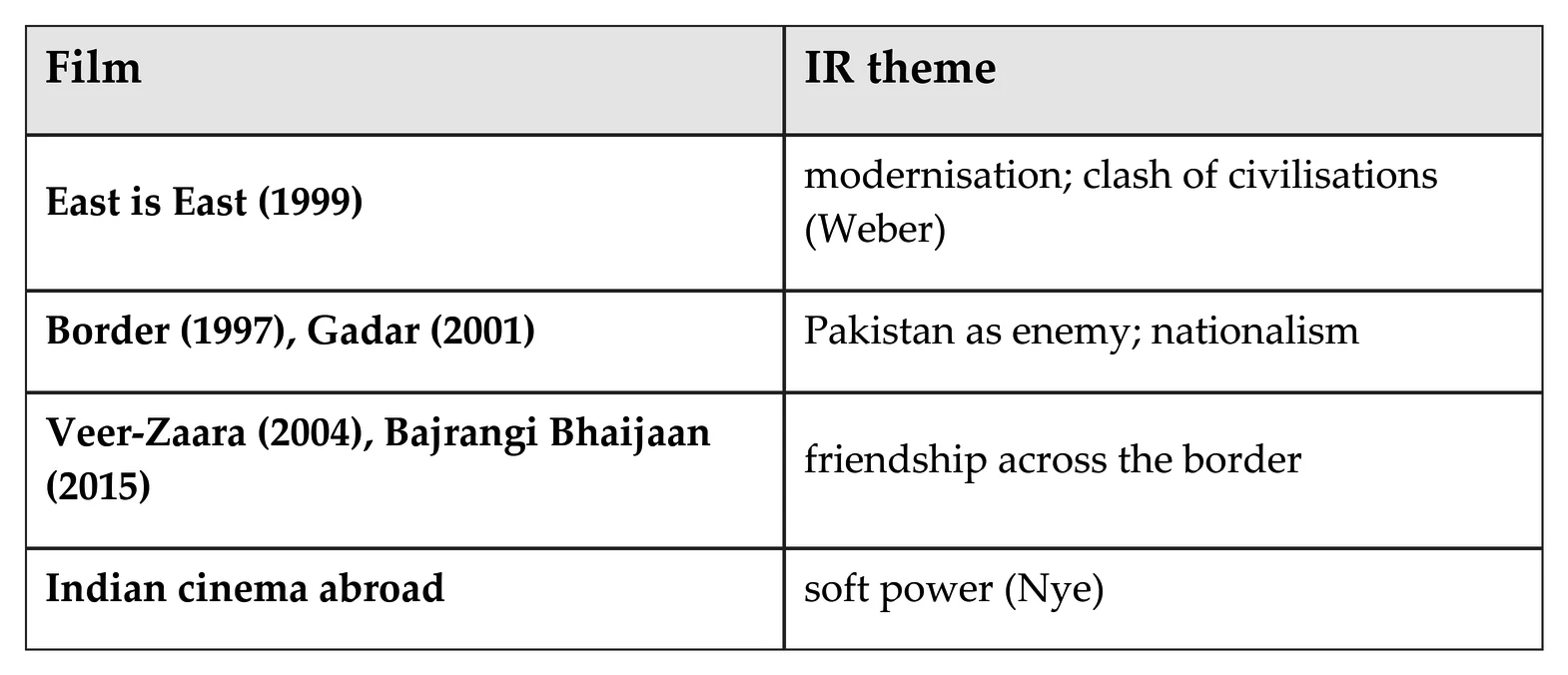
Cynthia Weber, in International Relations Theory: A Critical Introduction, uses popular films to explain IR theories. She argues that IR theories rely on myths, stories that appear true and natural, such as the idea that anarchy produces conflict. The myth function of a theory makes its assumptions seem like common sense. Films help reveal and question these myths. In her case study of the British film East is East (1999), about a Pakistani-British family in Salford in 1971 whose father tries to impose traditional values on his children, Weber discusses modernisation and development theory and Samuel Huntington’s thesis of a clash of civilisations (1993), showing how the film both reproduces and challenges the idea of a clash between tradition and modernity, East and West.
Bollywood and Foreign Policy
Azmat Rasul and Mudassir Mukhtar, in Bollywoodization of Foreign Policy (2015), examine how Indian films portray tensions between India and Pakistan. War films such as Border (1997) and Gadar (2001) often portray Pakistan as an enemy, reinforcing nationalist images, while films such as Veer-Zaara (2004) and Bajrangi Bhaijaan (2015) show friendship and shared humanity across the border. Films thus shape public perceptions of other countries and can either deepen or soften hostility. Indian cinema is also a major source of soft power, a concept developed by Joseph Nye, as Indian films are popular across Asia, Africa and the diaspora. Hollywood similarly shaped images of the Cold War and the war on terror.
5.4 Important Questions
- Question 1 What is the visual turn in International Relations? How do images shape global politics?
- Question 2 How does the internet make a difference to international relations? Discuss with reference to the Zapatista effect.
- Question 3 Discuss the role of museums as sites of international relations.
- Question 4 Examine the relationship between cinema and international relations.
DU asks the same idea in different words. So learn one broad answer for each question below; the same answer works for every question joined by OR.
Important Question 1
What is the visual turn in International Relations? How do images shape global politics?
OR
Discuss the role of images in the European refugee crisis.
OR
Examine the aesthetic turn in IR.
Model Answer
“Being a spectator of calamities taking place in another country is a quintessential modern experience.”
— Susan Sontag, Regarding the Pain of Others (2003)
Introduction. International Relations has traditionally studied texts, speeches and statistics. The visual turn argues that images, photographs, films, television and social media, are central to global politics, shaping how we perceive events and how we respond. Scholars such as Roland Bleiker and Lene Hansen show that images do political work, though their meaning depends on framing.
1. Meaning of the Visual Turn
The visual turn is the growing attention in IR to images and visual culture as forces that shape perceptions, identities and policies in world politics.
2. The Aesthetic Turn
Bleiker called for an aesthetic turn, arguing that art, literature, music and film offer insights into politics that conventional analysis misses.
3. Visual Global Politics
In Visual Global Politics (2018), Bleiker and his contributors show how images shape our understanding of war, terrorism, migration, humanitarianism and identity.
4. Global Visual Culture
Mirzoeff shows that we live in a global visual culture, in which images circulate instantly across the world through television, the internet and social media.
5. Iconic Images and War
The 1972 photograph of a Vietnamese girl fleeing napalm strengthened opposition to the Vietnam War, showing how a single image can change public opinion.
6. Images of Resistance
The image of a lone man facing tanks in Beijing in 1989 became a global symbol of resistance to authoritarian power.
7. Images and Legitimacy
Photographs of prisoner abuse at Abu Ghraib in 2004 damaged the legitimacy of the Iraq war and the moral claims of the United States.
8. Sontag’s Warning
Sontag observed that watching distant suffering is a modern experience, but warned that images can numb viewers, be manipulated or serve propaganda.
9. The Refugee Crisis
Hansen, Adler-Nissen and Andersen studied how images shaped European responses to refugees in 2015, showing the political power of visual representation.
10. Alan Kurdi
The photograph of the drowned Syrian child Alan Kurdi in September 2015 produced a wave of sympathy and calls for humanitarian action across Europe.
11. Framing
Images were framed as tragedy, as a call for humanitarianism or as a security threat requiring borders, and these frames shaped different policy responses.
12. Limits of Images
The sympathy produced by the Kurdi photograph faded within months, and border controls tightened, showing that images alone cannot sustain policy change.
13. Social Media
Social media allow anyone to produce and share images, giving voice to citizens but also spreading misinformation and manipulated images.
14. Images and India
Images of Partition, of the Bangladesh war of 1971 and of migrant workers walking home during the 2020 lockdown have shaped public memory and debate in India.
15. Visual Literacy
The visual turn calls for visual literacy, the ability to analyse how images are produced, framed and used, as a skill for citizens and scholars.
16. Evaluation
The visual turn enriches IR by showing that images are not mere illustrations but active forces in global politics, though their effects are complex and contested.
Conclusion. Thus, the visual turn shows that images shape perceptions and policies in global politics, as iconic photographs from Vietnam to Alan Kurdi demonstrate. As Sontag noted, spectatorship of distant suffering is a modern experience, and Hansen’s work shows that the political effect of images depends on how they are framed.
Important Question 2
How does the internet make a difference to international relations? Discuss with reference to the Zapatista effect.
OR
Examine the role of the internet in social movements.
OR
Discuss the issues of internet governance and the digital divide.
Model Answer
“Our common desire and commitment to build a people-centred, inclusive and development-oriented Information Society.”
— World Summit on the Information Society, Geneva Declaration of Principles (2003) (abridged)
Introduction. The internet has transformed communication, commerce, politics and conflict across the world. It empowers citizens and movements, but also enables surveillance, misinformation and new forms of conflict. Scholars such as M.I. Franklin and Harry Cleaver show how the ways we use and govern the internet shape power in international relations.
1. Spread of the Internet
About two-thirds of the world’s population now use the internet, according to the International Telecommunication Union, though access remains unequal.
2. Franklin’s Argument
Franklin argues that the internet is not a neutral technology; how it is designed, governed and used shapes power relations and everyday life.
3. Internet Governance
Bodies such as ICANN, created in 1998, manage domain names, while the WSIS (2003 and 2005) and the Internet Governance Forum debate how to make governance more inclusive.
4. The Digital Divide
Access to the internet is unequal between rich and poor countries, urban and rural areas, and men and women, which reproduces wider inequalities.
5. The Zapatista Uprising
The Zapatistas rose in Chiapas, Mexico, on 1 January 1994, demanding land, dignity and autonomy for indigenous people, the day NAFTA came into force.
6. The Zapatista Effect
Cleaver showed that supporters circulated Zapatista communiqués by email and websites, building a global solidarity network that pressured the Mexican government.
7. An Electronic Fabric of Struggle
Cleaver described this network as an electronic fabric of struggle, linking local resistance to global civil society through the internet.
8. Martínez-Torres
Martínez-Torres argued that civil society networks connected through the internet protected the Zapatistas by raising the costs of repression.
9. Later Movements
The global justice movement, the Arab Spring of 2011, Occupy and Me Too used the internet and social media to mobilise across borders, following the Zapatista example.
10. Surveillance
Edward Snowden’s revelations in 2013 exposed mass surveillance by the US National Security Agency, showing how the internet enables state monitoring.
11. Misinformation
Social media spread false information and propaganda, influencing elections and sometimes inciting violence, posing challenges for democracy.
12. Cyber Conflict
States use cyber attacks and information warfare against rivals, making cyberspace a new domain of international conflict.
13. Cyber Sovereignty
Some states, such as China, control the internet within their borders, while others defend a free and open internet, creating debates over cyber sovereignty.
14. Platform Power
A few technology companies dominate search, social media and commerce, giving them great influence over information and markets across borders.
15. India and the Internet
India has a vast internet population and pioneering digital public infrastructure, but also many regional internet shutdowns and debates over regulating social media.
16. Digital Diplomacy
Governments and diplomats now use social media to communicate directly with foreign publics, announce policies and respond to crises, a practice called digital diplomacy. India’s Ministry of External Affairs used social media to help citizens stranded abroad, as during evacuations from conflict zones.
17. Artificial Intelligence and the Internet
Artificial intelligence now shapes what people see online through recommendation algorithms, and generative AI can produce realistic fake images and videos, known as deepfakes. These technologies raise new concerns about manipulation of public opinion, elections and international relations.
18. Evaluation
The internet makes a profound difference to international relations, empowering movements while also enabling surveillance and control, so its governance is a key political issue.
Conclusion. Thus, the internet shapes power through its design, governance and use, as Franklin argues, and the Zapatista effect shows how it can link local struggles to global solidarity. At the same time, surveillance, misinformation, cyber conflict and the digital divide show that the internet’s promise depends on inclusive governance.
Important Question 3
Discuss the role of museums as sites of international relations.
OR
Can IR and art and museums come together? Discuss with reference to Christine Sylvester.
OR
Examine the role of museums in remembering violence, with reference to the Holocaust and Partition.
Model Answer
“A museum is a not-for-profit, permanent institution in the service of society that researches, collects, conserves, interprets and exhibits tangible and intangible heritage.”
— International Council of Museums, Museum Definition (2022)
Introduction. Museums may seem far from international relations, but they are important sites where nations, empires, wars and peoples are represented and remembered. Christine Sylvester argues that IR can be found in art and museums, where we least expect it. Museums of memory, such as the Holocaust Museum and the Partition Museum, show how societies remember violence and draw political lessons.
1. Meaning of Museums
The International Council of Museums defines a museum as a permanent institution in the service of society that collects, conserves, interprets and exhibits heritage.
2. Sylvester’s Argument
Sylvester argues that museums and art are sites of IR, where the international is represented, contested and experienced by visitors.
3. Museums and National Identity
National museums tell stories of the nation’s history and achievements, shaping national identity and pride, as studied in debates on nationalism.
4. Colonial Collections
Many Western museums hold objects acquired through colonial conquest, such as the Benin Bronzes taken by British forces in 1897, revealing the history of empire.
5. Repatriation Debates
Former colonies demand the return of looted artefacts; India has sought the return of objects such as the Kohinoor, and some museums have begun returning items.
6. Cultural Diplomacy
Museums serve as tools of cultural diplomacy and soft power, as when the Louvre opened a branch in Abu Dhabi in 2017 and exhibitions travel between countries.
7. The Holocaust Museum
The United States Holocaust Memorial Museum, opened in Washington in 1993, documents the Holocaust and educates visitors about genocide and human rights.
8. Memory and Moral Lessons
Holocaust museums promote the lesson of never again, linking memory to the prevention of genocide and the protection of human rights.
9. The Partition Museum
The Partition Museum in Amritsar, opened in 2017, collects oral histories, letters and objects from survivors of the 1947 Partition, giving voice to ordinary people.
10. Voices of Ordinary People
By focusing on ordinary people rather than leaders, the Partition Museum shows the human costs of decisions taken by states and empires.
11. Jallianwala Bagh
The centenary of the Jallianwala Bagh massacre of 13 April 1919 was marked in 2019, including through exhibitions, reminding visitors of colonial violence.
12. Other Memorials
The Hiroshima Peace Memorial Museum and the Kigali Genocide Memorial keep alive the memory of nuclear war and genocide and promote peace.
13. Museums and Reconciliation
Museums can promote reconciliation by acknowledging past wrongs and sharing different perspectives, helping societies come to terms with violent histories.
14. Politics of Representation
Museums can also promote nationalist narratives, silence uncomfortable histories or glorify war, so what is displayed and what is left out are political choices.
15. Value for IR
Studying museums helps IR understand how memory, identity and emotion shape international relations beyond the actions of states.
16. Digital Museums
Museums increasingly present collections online, as the United States Holocaust Memorial Museum does with its teaching materials and the Partition Museum with digital archives of oral histories. Digital access allows people across the world to engage with memory and history beyond physical visits.
17. Museums and Indian Nationhood
India’s National Museum in New Delhi, opened in its present building in 1960, and museums such as the Pradhanmantri Sangrahalaya (2022) present narratives of Indian civilisation and the nation, showing how states use museums to shape national identity.
18. Evaluation
Museums are significant sites of international relations, where history, memory and identity are shaped, contested and passed on to future generations.
Conclusion. Thus, museums, as Sylvester argues, are places where IR appears where we least expect it, through national identity, colonial collections, repatriation and cultural diplomacy. Museums of memory such as the Holocaust Museum and the Partition Museum show how societies remember violence and draw lessons for the future.
Important Question 4
Examine the relationship between cinema and international relations.
OR
Discuss Cynthia Weber’s idea of the myth function in IR theory.
OR
How does cinema shape foreign policy perceptions? Discuss with reference to India and Pakistan.
Model Answer
“Soft power is the ability to get what you want through attraction rather than coercion or payments.”
— Joseph S. Nye Jr., Soft Power (2004)
Introduction. Films are among the most powerful forms of popular culture, shaping how people imagine other countries, conflicts and identities. Scholars such as Cynthia Weber use films to explain and question IR theories, while studies of Bollywood show how cinema shapes perceptions of foreign policy. Cinema is also a source of soft power for states.
1. Popular Culture and IR
Popular culture, including films, television and music, shapes public understandings of international relations and is increasingly studied by IR scholars.
2. Weber’s Approach
Cynthia Weber uses popular films to explain IR theories, arguing that films reveal the assumptions and myths on which theories rest.
3. The Myth Function
Weber argues that IR theories rely on myths, stories that appear true and natural, and the myth function makes theoretical assumptions seem like common sense.
4. Questioning Myths
By examining how films present stories, students can see how myths such as anarchy producing conflict are constructed and can be questioned.
5. East is East
Weber’s case study of the British film East is East (1999), about a Pakistani-British family in Salford in 1971, explores tensions between a traditional father and his modern children.
6. Modernisation Theory
Weber uses the film to discuss modernisation and development theory, which assumes that societies move from tradition to modernity on a Western model.
7. Clash of Civilisations
She also discusses Huntington’s clash of civilisations thesis (1993), showing how the film both reproduces and challenges the idea of a clash between East and West.
8. Hybridity
The children in the film combine British and Pakistani identities, suggesting that cultures mix rather than clash, against the clash of civilisations myth.
9. Bollywoodization of Foreign Policy
Rasul and Mukhtar examined how Indian films portray India-Pakistan tensions, showing how cinema reflects and shapes perceptions of the other.
10. Films of Hostility
War films such as Border (1997) and Gadar (2001) often portray Pakistan as an enemy, reinforcing nationalist images and public hostility.
11. Films of Friendship
Films such as Veer-Zaara (2004) and Bajrangi Bhaijaan (2015) show friendship and shared humanity across the border, softening hostile images.
12. Hollywood and Global Politics
Hollywood shaped images of the Cold War and the war on terror, often presenting American power as heroic and rivals as threats.
13. Soft Power
Joseph Nye defined soft power as attraction rather than coercion; cinema is a major source of soft power for the United States and India.
14. Indian Cinema as Soft Power
Indian films are popular across Asia, Africa, the Middle East and the diaspora, spreading Indian culture and strengthening India’s image abroad.
15. Cinema and Propaganda
States have also used cinema for propaganda, to mobilise support for war or to demonise enemies, so films must be analysed critically.
16. Cinema and Partition Memory
Films such as Garm Hava (1973) and Tamas (1988, a television film) depicted the human costs of Partition, offering images of shared suffering and loss that complicate nationalist narratives of India-Pakistan relations.
17. Global Streaming and Soft Power
Streaming platforms now carry Indian, Korean and other non-Western films and series to global audiences. The worldwide success of the Telugu film RRR, whose song won an Academy Award in 2023, shows how Indian cinema contributes to India’s cultural presence in the world.
18. Evaluation
Cinema shapes how people see the world and other nations, making it an important site for understanding and questioning international relations.
Conclusion. Thus, cinema shapes international relations by revealing the myths of IR theory, as Weber’s analysis of East is East shows, and by shaping perceptions of other nations, as Bollywood films on India and Pakistan demonstrate. As Nye argues, films are also a source of soft power through attraction.
Short Notes
(a) Zapatista effect
Harry Cleaver’s term for the way the Zapatistas used the internet from 1994 to build a global solidarity network, creating an electronic fabric of struggle.
(b) Myth function
Cynthia Weber’s term for the way IR theories rely on myths that make their assumptions appear natural and true, which films can reveal and question.
(c) Soft power
Joseph Nye’s term for the ability of a country to get what it wants through the attraction of its culture, values and policies rather than force or payment.
More notes: GE-4 Understanding International Relations
These notes are prepared by PADHO TO AISE for study help. They are not an official publication.