
Generic Electives (GE) GE-13 Introduction to Human Rights
Unit 4 · 23 min read · Updated 27 Nov 2026
As per the University of Delhi (DU) Generic Elective (GE) syllabus offered by the Department of Political Science
Contents
- 4.1 Women and Children
- Women’s Human Rights
- Children’s Rights
- 4.2 Dalits, Tribals, Manual Scavengers and LGBTQ+ Persons
- Dalits
- Tribals
- Manual Scavengers
- LGBTQ+ Persons
- 4.3 Persons with Disabilities, Refugees and Prisoners
- Persons with Disabilities
- Refugees
- Prisoners
- 4.4 Important Questions
- Discuss the human rights of women and children, with special reference to India.
- Examine the human rights of Dalits, tribals and manual scavengers in India.
- Discuss the rights of LGBTQ+ persons and persons with disabilities in India.
- Discuss the human rights of refugees and prisoners, with special reference to India.
- Short Notes
इस महान सामूहिक यात्रा पर निकलते हुए हम संकल्प लेते हैं कि कोई भी पीछे नहीं छूटेगा।
As we embark on this great collective journey, we pledge that no one will be left behind.
— United Nations, Transforming our World: the 2030 Agenda for Sustainable Development (2015)
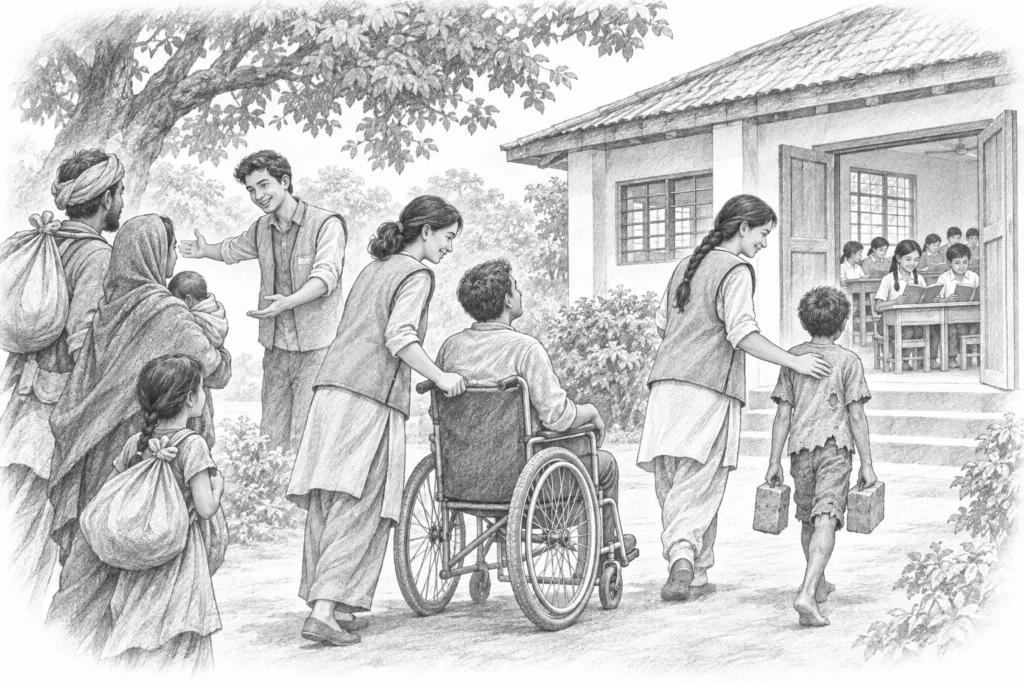
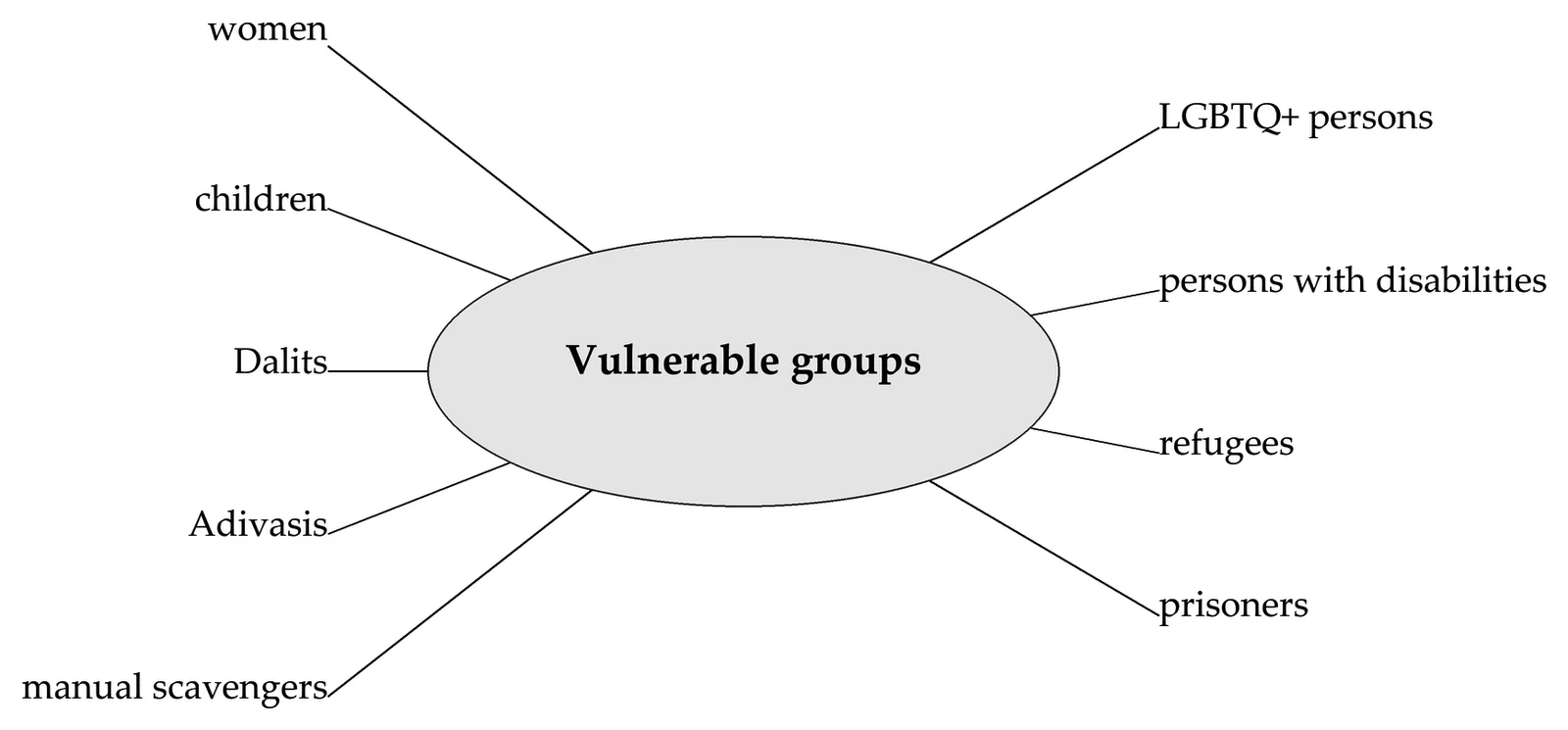
HHUMAN rights belong to everyone, but some groups face greater risks of having their rights denied because of their gender, age, caste, ethnicity, sexuality, disability, nationality or situation. These vulnerable groups need special protection, which is why the international community and India have adopted laws and institutions for them. This chapter studies the rights of women and children, Dalits, Adivasis and manual scavengers, LGBTQ+ persons and persons with disabilities, and refugees and prisoners, looking at international standards, Indian laws and judgments, and the problems that remain.
4.1 Women and Children
Vulnerability means a greater risk of harm or of having one’s rights denied, arising not from any weakness of the person but from social structures, discrimination and lack of power. The UN’s 2030 Agenda for Sustainable Development pledges to leave no one behind, recognising that development must reach the most vulnerable first.
Women’s Human Rights
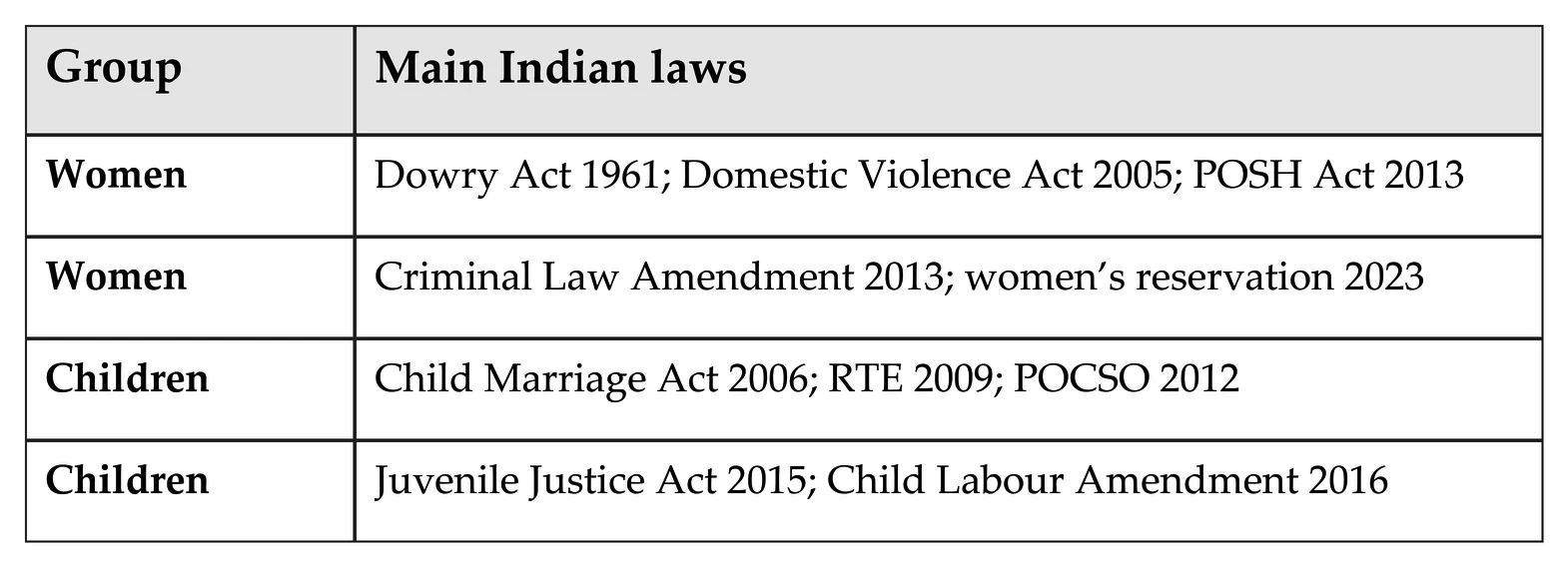
Women face discrimination and violence across the world, in the family, workplace and public life. The international community recognised this through CEDAW (1979), the Vienna Declaration (1993), which declared that women’s rights are an inalienable, integral and indivisible part of universal human rights, the Declaration on the Elimination of Violence against Women (1993), the Beijing Platform for Action (1995) and UN Women (2010). In India, the Constitution guarantees equality (Articles 14 and 15) and permits special provisions for women (Article 15(3)), and Parliament has passed many laws:
- Against dowry and violence. The Dowry Prohibition Act (1961), Section 498A of the Indian Penal Code (1983) against cruelty by husbands and in-laws, and the Protection of Women from Domestic Violence Act (2005).
- Against sexual harassment. The Vishaka guidelines (1997) and the Sexual Harassment of Women at Workplace Act (2013).
- Criminal law reform. After the Delhi gang rape of December 2012, the Justice J.S. Verma Committee led to the Criminal Law (Amendment) Act of 2013, which widened the definition of rape and added offences such as stalking.
- Personal law. In Shayara Bano (2017), the Supreme Court struck down instant triple talaq, followed by a law in 2019.
- Representation. One-third of seats in panchayats and municipalities are reserved for women, and the 106th Amendment of 2023 provides for one-third reservation in legislatures.
Yet problems remain: crimes against women recorded by the National Crime Records Bureau run into lakhs every year, female labour force participation is low, the child sex ratio is skewed and marital rape is not yet a crime under Indian law.
Children’s Rights
Children need special protection because they depend on adults. The Convention on the Rights of the Child (1989), which India acceded to in 1992, recognises their rights to survival, development, protection and participation. India’s main laws include the Right of Children to Free and Compulsory Education Act (2009), the Prohibition of Child Marriage Act (2006), the Protection of Children from Sexual Offences Act (2012), the Juvenile Justice (Care and Protection of Children) Act (2015) and the Child Labour (Prohibition and Regulation) Amendment Act (2016), which bans the employment of children below fourteen in all occupations except family enterprises. The National Commission for Protection of Child Rights (2007) monitors these rights. Child labour, trafficking, malnutrition and child marriage remain serious problems, and activists such as Kailash Satyarthi, whose Bachpan Bachao Andolan rescued thousands of children, have drawn attention to them.
4.2 Dalits, Tribals, Manual Scavengers and LGBTQ+ Persons
Dalits
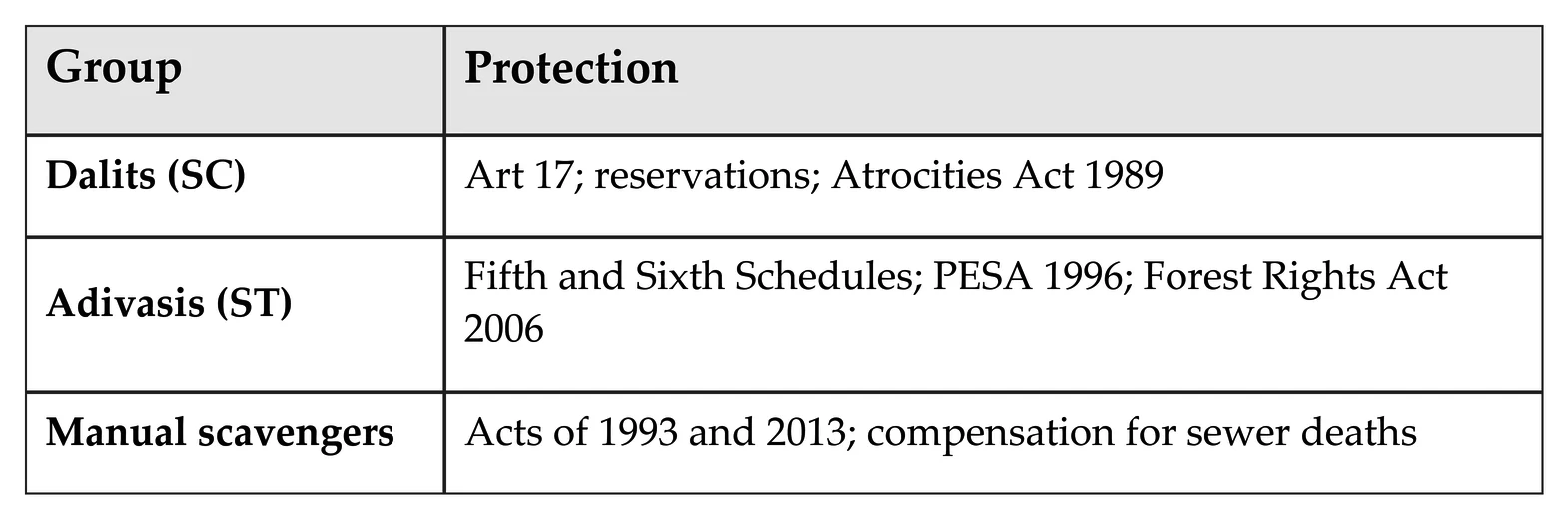
Dalits, meaning the broken or oppressed, are the communities formerly treated as untouchable and classified as Scheduled Castes. Article 17 abolished untouchability, the Protection of Civil Rights Act (1955) punishes its practice, and the Scheduled Castes and Scheduled Tribes (Prevention of Atrocities) Act (1989) punishes atrocities such as violence, humiliation and social boycott. In Subhash Kashinath Mahajan (2018), the Supreme Court introduced safeguards against misuse of the Act, which provoked nationwide protests; Parliament restored the Act’s strength by an amendment in 2018, which the Court upheld in 2020. Reservations in education, employment and legislatures seek to overcome historical disadvantage. Yet caste atrocities, such as the Khairlanji killings (2006), continue, and the UN Committee on the Elimination of Racial Discrimination has described caste discrimination as discrimination based on descent.
Tribals
Adivasis, classified as Scheduled Tribes, make up about 8.6 per cent of India’s population according to the 2011 Census. The Fifth and Sixth Schedules provide special administration for tribal areas, the Panchayats (Extension to Scheduled Areas) Act (1996) gives gram sabhas power over land and resources, and the Forest Rights Act (2006) recognises their rights over forest land. Internationally, the UN Declaration on the Rights of Indigenous Peoples (2007) recognises rights to land, culture and free, prior and informed consent; India voted for it but holds that all Indians are indigenous. The main threats to Adivasi rights are displacement by dams, mines and industries, loss of forests and conflict, as seen in the Niyamgiri case (2013), where gram sabhas rejected bauxite mining.
Manual Scavengers
Manual scavenging, the cleaning of human excreta from dry latrines, sewers and septic tanks by hand, is imposed mainly on Dalits and is a grave violation of dignity. It was prohibited by an Act of 1993 and more comprehensively by the Prohibition of Employment as Manual Scavengers and their Rehabilitation Act (2013). In Safai Karmachari Andolan v. Union of India (2014), the Supreme Court ordered compensation for deaths in sewers, and in 2023 it raised the amount to thirty lakh rupees. Yet workers continue to die while cleaning sewers. Bezwada Wilson, convenor of the Safai Karmachari Andolan, received the Ramon Magsaysay Award in 2016 for his campaign.
LGBTQ+ Persons
LGBTQ+ persons, i.e. lesbian, gay, bisexual, transgender, queer and others, have long faced criminalisation, discrimination and violence. The Yogyakarta Principles (2006) applied international human rights law to sexual orientation and gender identity. In India, the Supreme Court recognised transgender persons as a third gender in NALSA v. Union of India (2014), and in Navtej Singh Johar v. Union of India (2018) it read down Section 377 of the Indian Penal Code, decriminalising consensual same-sex relations between adults. Parliament passed the Transgender Persons (Protection of Rights) Act in 2019, though activists criticised parts of it. In Supriyo v. Union of India (2023), the Court declined to recognise same-sex marriage, leaving it to Parliament.
4.3 Persons with Disabilities, Refugees and Prisoners
Persons with Disabilities
The Convention on the Rights of Persons with Disabilities (2006) marked a shift from seeing disability as a medical problem or a matter of charity to seeing it as a human rights issue, arising from barriers in society. India ratified it in 2007 and passed the Rights of Persons with Disabilities Act (2016), which recognises twenty-one disabilities, reserves four per cent of government jobs and five per cent of seats in higher education for persons with benchmark disabilities, and requires accessibility in public buildings and transport. The Accessible India Campaign (2015) sought to make public spaces barrier-free. Challenges include inaccessible infrastructure, stigma and low employment.
Refugees
A refugee is a person who has fled his or her country because of a well-founded fear of persecution, as defined by the 1951 Refugee Convention and its 1967 Protocol, protected by the UN High Commissioner for Refugees (UNHCR). The core principle is non-refoulement, i.e. refugees must not be returned to a country where they face persecution. India is not a party to the 1951 Convention and has no national refugee law, treating refugees under the Foreigners Act of 1946, yet it has hosted large numbers of refugees, including Tibetans since 1959, Sri Lankan Tamils, Chakmas, Afghans and Rohingya. In NHRC v. State of Arunachal Pradesh (1996), the Supreme Court protected Chakma refugees under Article 21. The Citizenship (Amendment) Act of 2019, whose rules were notified in 2024, offers a faster path to citizenship to Hindus, Sikhs, Buddhists, Jains, Parsis and Christians from Afghanistan, Bangladesh and Pakistan, and has been criticised for excluding Muslims.
Prisoners
Prisoners keep their human rights except those necessarily limited by imprisonment. The UN Standard Minimum Rules for the Treatment of Prisoners, revised in 2015 as the Nelson Mandela Rules, set standards for humane treatment. In India, about three-quarters of prisoners are undertrials, i.e. persons not yet convicted, and prisons are overcrowded. The Supreme Court has protected prisoners’ rights in cases such as Sunil Batra (1978 and 1980), Hussainara Khatoon (1979) and D.K. Basu (1997), and Justice V.R. Krishna Iyer declared in 1977 that the basic rule is bail, not jail. Custodial deaths and torture remain serious concerns, and India has not ratified the Convention against Torture.

4.4 Important Questions
- Question 1 Discuss the human rights of women and children, with special reference to India.
- Question 2 Examine the human rights of Dalits, tribals and manual scavengers in India.
- Question 3 Discuss the rights of LGBTQ+ persons and persons with disabilities in India.
- Question 4 Discuss the human rights of refugees and prisoners, with special reference to India.
DU asks the same idea in different words. So learn one broad answer for each question below; the same answer works for every question joined by OR.
Important Question 1
Discuss the human rights of women and children, with special reference to India.
OR
Examine the laws and institutions for the protection of women’s rights in India.
OR
Discuss the rights of the child under the CRC and Indian law.
Model Answer
“The human rights of women and of the girl-child are an inalienable, integral and indivisible part of universal human rights.”
— Vienna Declaration and Programme of Action (1993), paragraph 18
Introduction. Women and children are among the groups most vulnerable to human rights violations. Women face discrimination and violence in the family, workplace and society, while children depend on adults and are exposed to exploitation and abuse. International law, through CEDAW and the Convention on the Rights of the Child, and Indian law, through the Constitution and many statutes, provide special protection for them, though serious problems remain.
1. Why Women Need Special Protection
Women face structural disadvantages created by patriarchy: unequal access to education, property and employment, violence in the home and public spaces, and under-representation in politics. These inequalities make special protection necessary to achieve real equality.
2. International Standards for Women
CEDAW (1979) requires states to eliminate discrimination against women in all fields, the Vienna Declaration (1993) recognised women’s rights as human rights, and the Beijing Platform for Action (1995) set out twelve areas of action, including violence, poverty, education and decision-making.
3. Constitutional Protection of Women
The Constitution guarantees equality before law (Article 14) and non-discrimination (Article 15), permits special provisions for women (Article 15(3)), directs equal pay for equal work (Article 39(d)) and maternity relief (Article 42), and asks citizens to renounce practices derogatory to women (Article 51A(e)).
4. Laws against Violence
India has passed the Dowry Prohibition Act (1961), added Section 498A against cruelty in 1983, enacted the Domestic Violence Act (2005) and strengthened rape laws through the Criminal Law (Amendment) Act of 2013 after the Delhi gang rape of 2012.
5. Workplace and Personal Law
The Vishaka guidelines (1997), based on CEDAW, and the Sexual Harassment of Women at Workplace Act (2013) protect working women, while Shayara Bano (2017) struck down instant triple talaq, showing reform of personal laws.
6. Political Representation
One-third of seats in panchayats and municipalities are reserved for women under the 73rd and 74th Amendments, and the 106th Amendment of 2023 provides for one-third reservation in the Lok Sabha and state assemblies after delimitation.
7. Continuing Problems for Women
Crimes against women remain high, female labour force participation is low, the child sex ratio is unfavourable and marital rape is not criminalised, showing that legal equality has not yet produced social equality.
8. Why Children Need Special Protection
Children are dependent, cannot easily claim their own rights and are vulnerable to labour, trafficking, abuse, malnutrition and early marriage, so the law must protect their best interests.
9. The Convention on the Rights of the Child
The CRC (1989), which India acceded to in 1992, rests on non-discrimination, the best interests of the child, the right to life and development and respect for the child’s views, and protects rights to education, health, protection and participation.
10. Indian Laws for Children
India’s laws include the Right to Education Act (2009), the Prohibition of Child Marriage Act (2006), the POCSO Act (2012), the Juvenile Justice Act (2015) and the Child Labour Amendment Act (2016), monitored by the National Commission for Protection of Child Rights.
11. Child Labour and Trafficking
Despite the law, millions of children work in agriculture, homes and small industries, and many are trafficked. Kailash Satyarthi’s Bachpan Bachao Andolan, recognised by the Nobel Peace Prize in 2014, has rescued thousands of children.
12. Nutrition and Education
Schemes such as Integrated Child Development Services and PM POSHAN address nutrition, and the Right to Education Act has increased enrolment, though malnutrition and learning gaps remain serious.
13. Role of Courts and Commissions
The Supreme Court, the National Commission for Women (1992) and the NCPCR have intervened on issues such as acid attacks, child labour and sexual abuse, strengthening the protection of women and children.
14. Evaluation
India has built a strong legal framework for women and children, but social attitudes, poverty and weak enforcement mean that their rights are still frequently violated.
Conclusion. Thus, women and children are protected by CEDAW, the CRC, the Indian Constitution and laws on dowry, domestic violence, sexual harassment, education, child marriage, sexual abuse and child labour. Courts and commissions have strengthened these protections, but violence, discrimination and exploitation remain, showing that legal rights must be matched by social change.
Important Question 2
Examine the human rights of Dalits, tribals and manual scavengers in India.
OR
Discuss the constitutional and legal protection of Scheduled Castes and Scheduled Tribes.
OR
Why does manual scavenging persist in India despite legal prohibition? Discuss.
Model Answer
“Untouchability is abolished and its practice in any form is forbidden.”
— Constitution of India, Article 17
Introduction. Dalits, Adivasis and manual scavengers are among the most marginalised groups in India. Dalits face caste discrimination and violence, Adivasis face displacement and loss of land and forests, and manual scavengers, mostly Dalits, are forced into degrading and dangerous work. The Constitution and special laws protect them, but the gap between law and reality remains wide.
1. Dalits and Caste Discrimination
Dalits, classified as Scheduled Castes, were treated as untouchable for centuries, denied access to temples, water sources, schools and dignified work. Caste discrimination is a violation of the most basic principle of human rights, equal dignity.
2. Constitutional Protection of Dalits
Article 17 abolishes untouchability, Articles 15 and 16 permit special provisions and reservations, Articles 330 and 332 reserve seats in legislatures, and Article 46 directs the state to protect them from social injustice and exploitation.
3. The Atrocities Act
The SC/ST (Prevention of Atrocities) Act of 1989 punishes violence, humiliation and social boycott against Dalits and Adivasis. After the Supreme Court diluted it in 2018, protests led Parliament to restore its provisions, which the Court upheld in 2020.
4. Continuing Atrocities
Despite the law, caste atrocities such as the Khairlanji killings of 2006 continue, and conviction rates under the Atrocities Act remain low, showing the persistence of caste prejudice.
5. Caste and International Law
The UN Committee on the Elimination of Racial Discrimination has described caste discrimination as discrimination based on descent under CERD, while India maintains that caste is an internal matter distinct from race.
6. Adivasis and Their Rights
Adivasis, classified as Scheduled Tribes, have distinct cultures and depend on land and forests. The Fifth and Sixth Schedules provide special administration and protection for tribal areas.
7. PESA and the Forest Rights Act
The PESA Act of 1996 gives gram sabhas in Scheduled Areas power over land, forest produce and local resources, and the Forest Rights Act of 2006 recognises individual and community rights over forest land.
8. Displacement and Development
Dams, mines and industries have displaced millions of Adivasis, often without adequate rehabilitation. In the Niyamgiri case of 2013, the Supreme Court required the consent of gram sabhas before bauxite mining, and they rejected it.
9. International Indigenous Rights
The UN Declaration on the Rights of Indigenous Peoples (2007) recognises rights to land, culture and free, prior and informed consent. India voted for it but holds that all Indians are indigenous.
10. Manual Scavenging
Manual scavenging means cleaning human excreta by hand from dry latrines, sewers and septic tanks. It is imposed mainly on Dalit communities and is a grave assault on dignity and health.
11. Laws against Manual Scavenging
It was prohibited by an Act of 1993 and more fully by the Prohibition of Employment as Manual Scavengers and their Rehabilitation Act of 2013, which requires identification and rehabilitation of manual scavengers.
12. Courts and Campaigns
In Safai Karmachari Andolan (2014), the Supreme Court ordered compensation for sewer deaths, raised to thirty lakh rupees in 2023, and Bezwada Wilson’s campaign, recognised by the Magsaysay Award in 2016, has kept the issue in public view.
13. Why Problems Persist
These violations persist because of caste prejudice, poverty, weak enforcement, lack of mechanised sanitation, displacement for development and the political weakness of marginalised communities.
14. Dalit Movements
Dalit organisations, from Ambedkar’s Scheduled Castes Federation to the Dalit Panthers of 1972 and the Bahujan Samaj Party founded in 1984, have mobilised Dalits to claim their rights, showing that legal protection has been reinforced by political organisation and assertion.
15. Evaluation
India has extensive constitutional and legal protections for Dalits, Adivasis and manual scavengers, but real change requires social transformation, effective enforcement and the empowerment of these communities.
Conclusion. Thus, Dalits are protected by Article 17, reservations and the Atrocities Act, Adivasis by the Fifth and Sixth Schedules, PESA and the Forest Rights Act, and manual scavengers by the Act of 2013 and court orders. Yet caste atrocities, displacement and deaths in sewers continue, showing the gap between legal rights and social reality.
Important Question 3
Discuss the rights of LGBTQ+ persons and persons with disabilities in India.
OR
Examine the role of the judiciary in protecting the rights of sexual minorities in India.
OR
Discuss the shift from a charity model to a rights model of disability.
Model Answer
“History owes an apology to the members of this community and their families.”
— Justice Indu Malhotra, Navtej Singh Johar v. Union of India (2018)
Introduction. LGBTQ+ persons and persons with disabilities have long been marginalised, not because of anything wrong with them but because of social prejudice and barriers. In recent decades, international human rights law and Indian law have increasingly recognised their rights to equality, dignity and full participation in society. The Indian judiciary has played a key role, especially for sexual minorities.
1. LGBTQ+ Persons and Human Rights
LGBTQ+ persons, lesbian, gay, bisexual, transgender, queer and others, have faced criminalisation, discrimination, violence and social exclusion in many countries, violating their rights to equality, privacy and dignity.
2. International Standards
The Yogyakarta Principles of 2006 applied existing human rights law to sexual orientation and gender identity, and the UN Human Rights Council has adopted resolutions against violence and discrimination on these grounds since 2011.
3. NALSA (2014)
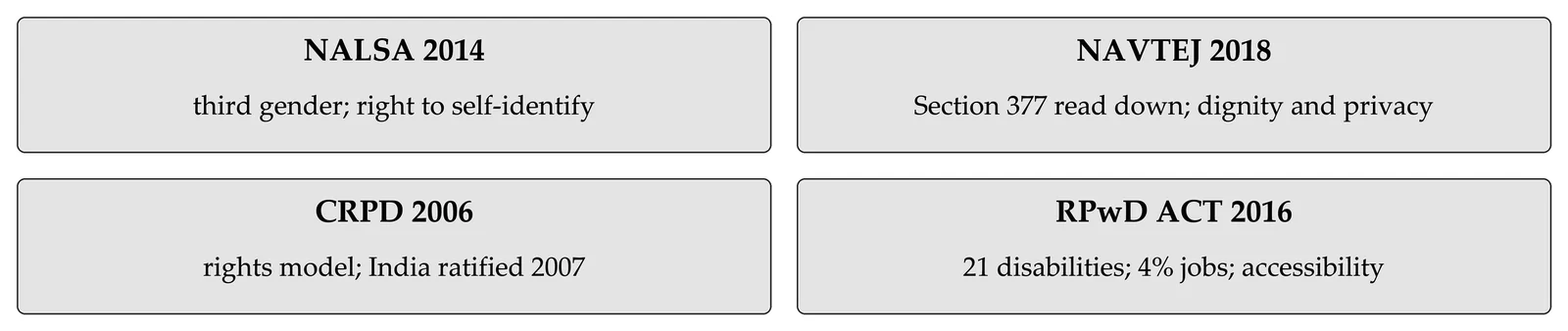
In NALSA v. Union of India, the Supreme Court recognised transgender persons as a third gender, affirmed their right to self-identify their gender and directed governments to provide them with reservations and welfare measures.
4. Navtej Singh Johar (2018)
In Navtej Singh Johar, a five-judge bench read down Section 377 of the Indian Penal Code, decriminalising consensual same-sex relations between adults and holding that sexual orientation is protected by equality, privacy and dignity.
5. The Transgender Persons Act (2019)
The Transgender Persons (Protection of Rights) Act of 2019 prohibits discrimination in education, employment and health care. Activists criticised its certification process and lighter punishments for offences against transgender persons.
6. Same-Sex Marriage
In Supriyo v. Union of India (2023), the Supreme Court declined to recognise a right to same-sex marriage, leaving the matter to Parliament, though it recognised the right of queer persons to be free from discrimination.
7. Continuing Challenges for LGBTQ+ Persons
LGBTQ+ persons still face family rejection, harassment, violence and discrimination at work, showing that social acceptance lags behind legal change.
8. Models of Disability
The medical model saw disability as an individual defect to be cured, and the charity model saw disabled persons as objects of pity. The social or rights model sees disability as created by barriers in society that prevent full participation.
9. The CRPD
The Convention on the Rights of Persons with Disabilities (2006), which India ratified in 2007, adopted the rights model, requiring states to ensure equality, accessibility, inclusive education, employment and participation.
10. The RPwD Act (2016)
The Rights of Persons with Disabilities Act of 2016 recognises twenty-one disabilities, reserves four per cent of government jobs and five per cent of seats in higher education, and requires accessible buildings, transport and information.
11. Accessibility
The Accessible India Campaign of 2015 sought to make public buildings, transport and websites accessible, but many spaces remain inaccessible to wheelchair users and persons with visual and hearing impairments.
12. Inclusion in Education and Work
Inclusive education and employment are key to the rights model, but persons with disabilities still face low enrolment, high dropout and low employment rates.
13. Role of Courts
Courts have enforced reservations and accessibility for persons with disabilities, as in Jeeja Ghosh (2016), where the Supreme Court awarded compensation to a passenger with cerebral palsy removed from a flight.
14. Disability and Elections
The Election Commission has introduced measures such as accessible polling stations, braille ballot guides and, since 2020, the option of postal ballots for voters with disabilities, reflecting the principle that persons with disabilities must be able to take part in public life on equal terms.
15. Evaluation
Both LGBTQ+ persons and persons with disabilities have gained significant legal recognition in India, largely through courts and international standards, but social attitudes and infrastructure must change for their rights to be fully realised.
Conclusion. Thus, LGBTQ+ persons won recognition through NALSA (2014) and Navtej Singh Johar (2018) and the Transgender Persons Act (2019), though same-sex marriage remains unrecognised, while persons with disabilities gained rights under the CRPD and the RPwD Act (2016). In both cases, legal progress must be matched by social acceptance and accessibility.
Important Question 4
Discuss the human rights of refugees and prisoners, with special reference to India.
OR
Examine India’s approach to refugees in the absence of a national refugee law.
OR
Discuss the rights of prisoners and undertrials in India.
Model Answer
“The basic rule may perhaps be tersely put as bail, not jail.”
— Justice V.R. Krishna Iyer, State of Rajasthan v. Balchand (1977)
Introduction. Refugees and prisoners are vulnerable because they are under the control of states that may not treat them as full members of society. Refugees have lost the protection of their own country, while prisoners are confined by the state and depend on it for basic needs. International law protects both, and Indian courts have extended constitutional protection to them, though serious gaps remain.
1. Meaning of a Refugee
Under the 1951 Refugee Convention, a refugee is a person outside his or her country owing to a well-founded fear of persecution for reasons of race, religion, nationality, membership of a social group or political opinion. The 1967 Protocol removed the Convention’s time and geographical limits.
2. Non-Refoulement
The core principle of refugee protection is non-refoulement, i.e. a refugee must not be returned to a country where he or she faces persecution. It is widely regarded as part of customary international law, binding even on states not party to the Convention.
3. India and the Refugee Convention
India is not a party to the 1951 Convention or the 1967 Protocol and has no national refugee law. Refugees are dealt with under the Foreigners Act of 1946 and policies that vary from one group to another.
4. India as a Host
India has nevertheless hosted large refugee populations: Tibetans since 1959, refugees from East Pakistan in 1971, Sri Lankan Tamils, Chakmas, Afghans and Rohingya, giving some of them protection and assistance.
5. Courts and Refugees
In NHRC v. State of Arunachal Pradesh (1996), the Supreme Court protected Chakma refugees from forcible eviction under Article 21, holding that the right to life applies to all persons, including non-citizens.
6. The Citizenship (Amendment) Act, 2019
The CAA offers a faster path to citizenship to Hindus, Sikhs, Buddhists, Jains, Parsis and Christians from Afghanistan, Bangladesh and Pakistan who entered India before 2015. Supporters see it as protecting persecuted minorities, while critics argue that excluding Muslims violates equality.
7. Challenges for Refugees
Without a national law, refugees in India face uncertainty, detention, lack of documents and limited access to work and education, as the situation of Rohingya refugees shows.
8. Rights of Prisoners
Prisoners keep their human rights, except those necessarily limited by imprisonment. The UN’s Nelson Mandela Rules (2015) require humane treatment, adequate food, health care and protection from torture.
9. Undertrials
About three-quarters of India’s prisoners are undertrials, many of them poor and unable to afford bail or lawyers. Justice Krishna Iyer declared that the basic rule is bail, not jail, and Hussainara Khatoon (1979) recognised the right to speedy trial.
10. Protection against Torture
In Sunil Batra the Court protected prisoners against torture and solitary confinement, and in D.K. Basu (1997) it laid down safeguards against custodial violence, while Nilabati Behera (1993) awarded compensation for custodial death.
11. Prison Conditions
Indian prisons are overcrowded and under-staffed. The Model Prison Manual of 2016 and the Model Prisons and Correctional Services Act of 2023 seek reform, focusing on rehabilitation and humane conditions.
12. The Convention against Torture
India signed the Convention against Torture in 1997 but has not ratified it, and there is no specific anti-torture law, a gap repeatedly highlighted by human rights bodies.
13. Role of the NHRC
The NHRC must be informed of custodial deaths within twenty-four hours, visits prisons and recommends compensation and reforms, providing an additional layer of oversight.
14. Statelessness
Statelessness, i.e. not being recognised as a citizen by any state, leaves people without legal protection. The UN conventions of 1954 and 1961 address statelessness, and debates over the National Register of Citizens in Assam, completed in 2019, raised concerns about people being left without citizenship.
15. Evaluation
Refugees and prisoners in India have gained protection through Article 21 and judicial activism, but the absence of a refugee law, the ratification gap on torture and the plight of undertrials remain serious human rights concerns.
Conclusion. Thus, refugees are protected internationally by the 1951 Convention and non-refoulement, and in India by Article 21 despite the absence of a refugee law, while prisoners are protected by the Nelson Mandela Rules and Supreme Court judgments on speedy trial, bail and custodial violence. Yet undertrial detention, torture and uncertain refugee status remain urgent challenges.
Short Notes
(a) Non-refoulement
The principle of refugee law that a person must not be returned to a country where he or she faces persecution; it is regarded as part of customary international law.
(b) Yogyakarta Principles (2006)
A set of principles applying international human rights law to sexual orientation and gender identity, drafted by experts at Yogyakarta, Indonesia.
(c) Rights of Persons with Disabilities Act (2016)
India’s law implementing the CRPD, which recognises twenty-one disabilities and provides for reservations, accessibility and non-discrimination.
More notes: GE-13 Introduction to Human Rights
These notes are prepared by PADHO TO AISE for study help. They are not an official publication.