
Generic Electives (GE) GE-4 Understanding International Relations
Unit 3 · 23 min read · Updated 27 Nov 2026
As per the University of Delhi (DU) Generic Elective (GE) syllabus offered by the Department of Political Science
Contents
- 3.1 Mapping Inequalities and Politico-Military Inequalities
- Sovereign Equality and Real Inequality
- Big States and Small States
- Strategies of Small States
- Ayoob: Subaltern Realism
- 3.2 Economic Inequalities: Rich States, Poor States
- Measuring Inequality
- Why Are Some People Better Off than Others
- Explanations of Global Inequality
- The South’s Response
- 3.3 Climate Change: Global Commons and Differentiated Responsibilities
- Unequal Responsibility and Vulnerability
- Common but Differentiated Responsibilities
- Damodaran: India and the Global Commons
- Climate Justice
- 3.4 Important Questions
- Discuss politico-military inequalities between big states and small states in international relations.
- Examine the causes and consequences of economic inequality between rich and poor states.
- Discuss the politics of climate change with reference to the global commons and common but differentiated responsibilities.
- How have theories of International Relations addressed the problem of inequality? Discuss with reference to subaltern realism.
- Short Notes
शक्तिशाली वही करते हैं जो वे कर सकते हैं, और कमज़ोर वही सहते हैं जो उन्हें सहना पड़ता है।
The strong do what they can and the weak suffer what they must.
— Thucydides, History of the Peloponnesian War, the Melian Dialogue
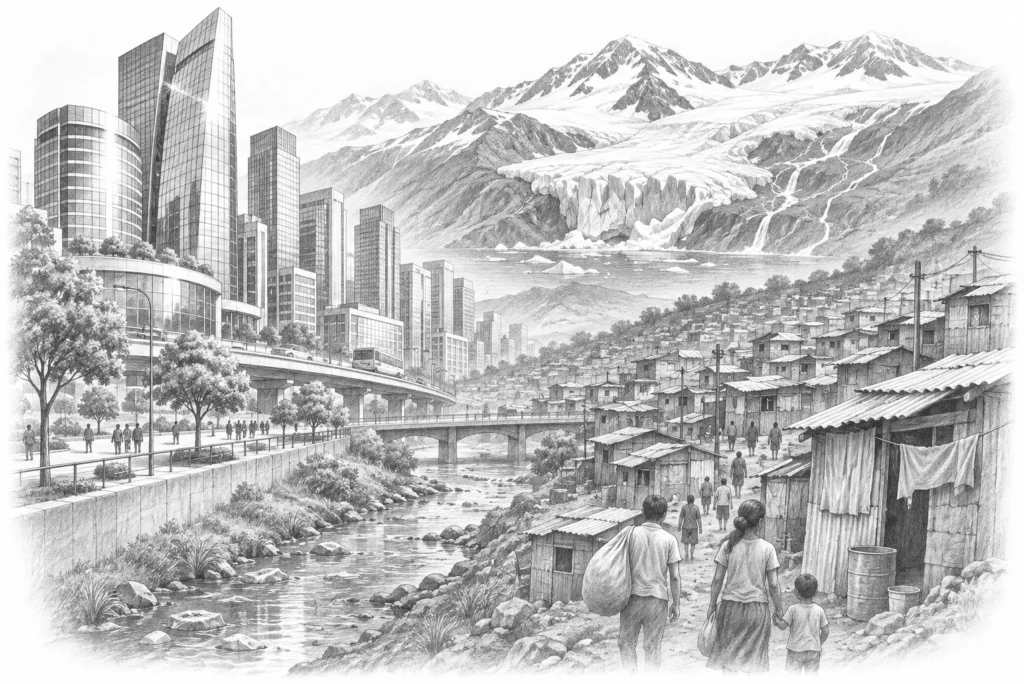
IIN law, all states are equal: each has one vote in the UN General Assembly. In reality, the world is deeply unequal. A few states possess most of the world’s military power, nuclear weapons and wealth, and the richest people own far more than the poorest billions. Inequality shapes who makes the rules of world politics, who bears the costs of war and climate change, and whose voices are heard. This chapter maps politico-military inequalities between big and small states, economic inequalities between rich and poor states, and the politics of climate change, the global commons and differentiated responsibilities.

3.1 Mapping Inequalities and Politico-Military Inequalities
João Pontes Nogueira, in Inequality (2020), argues that inequality is central to international relations but has been neglected by mainstream IR, which assumes a world of formally equal sovereign states in anarchy. In reality, the international system is marked by hierarchy: differences of power, wealth, status and voice among states, and deep inequalities among people across the world. Inequality has historical roots in colonialism and is reproduced by international institutions and the global economy.
Sovereign Equality and Real Inequality
The UN Charter proclaims the sovereign equality of all members, and each state has one vote in the General Assembly. But the five permanent members of the Security Council, the United States, Russia, China, Britain and France, hold a veto over substantive decisions under Article 27(3). The IMF and World Bank give voting power according to economic weight. Formal equality thus coexists with institutionalised inequality.
Big States and Small States
- Great powers. States with large military and economic capabilities and global reach, such as the United States, China and Russia, shape the rules of the international system.
- Middle powers. States such as India, Brazil, Japan, Germany and South Africa have significant regional influence and play important roles in international institutions.
- Small states. States with small populations, territories or capabilities, such as Bhutan, the Maldives, Singapore and many island states, are vulnerable to pressure from larger neighbours and global forces.
- Military concentration. World military spending is highly concentrated; the United States alone accounts for well over a third of the global total, according to SIPRI.
- Nuclear inequality. The NPT of 1968 recognised only the five states that had tested nuclear weapons before 1967 as nuclear-weapon states, creating a division between nuclear haves and have-nots that India criticised as nuclear apartheid.
Strategies of Small States
Small states use various strategies to survive and pursue their interests: alliances with great powers; bandwagoning with a dominant power or balancing against it; neutrality, as in Switzerland; reliance on international law and institutions, which offer some protection to the weak; niche diplomacy, specialising in issues such as climate change or mediation; and regional groupings such as the Alliance of Small Island States. Singapore’s economic success shows that small states can wield influence beyond their size.
Ayoob: Subaltern Realism
Mohammed Ayoob, in Inequality and Theorizing in International Relations: The Case for Subaltern Realism (2002), argued that mainstream IR theories are based on the experience of the strong states of the West and ignore the majority of states, those of the Third World. For these subaltern states, the main security threats are often internal, arising from the process of state-building: weak institutions, ethnic conflicts, insurgencies and contested borders inherited from colonialism. They entered the international system late, in a world already dominated by powerful states. Ayoob proposed subaltern realism, which combines realism’s attention to power and security with the historical sociology of state-making in the Third World, to explain the behaviour of these states and the persistence of inequality.
3.2 Economic Inequalities: Rich States, Poor States
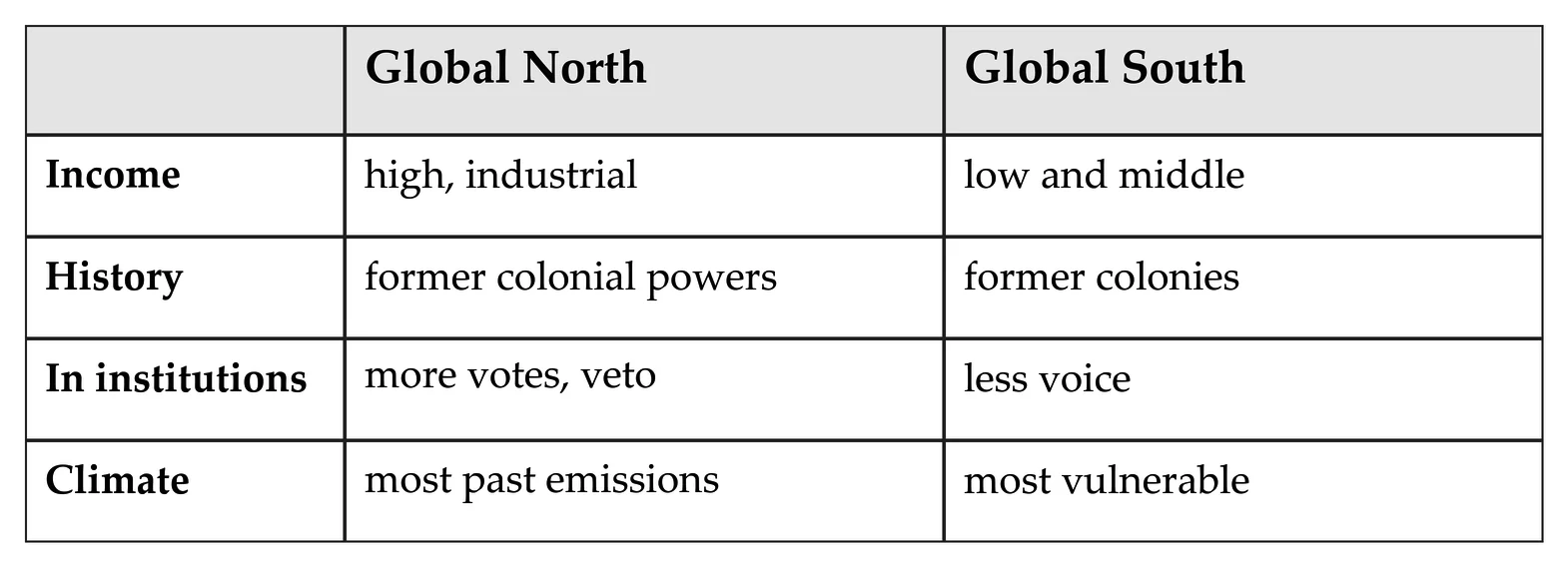
The world is divided between rich and poor states, often described as the Global North and the Global South. The Brandt Report (1980) drew a line across the world map separating the rich North from the poor South. Today, the World Bank classifies countries into low, lower-middle, upper-middle and high-income groups. Inequality is also stark among individuals: the World Inequality Report 2022 found that the richest 10% of the world’s population own about three-quarters of global wealth, while the poorest half own about 2%.
Measuring Inequality
Amartya Sen, in On Economic Inequality (1973), noted that the idea of inequality is both very simple and very complex. Common measures include the Gini coefficient, which ranges from 0 (perfect equality) to 1 (perfect inequality), the Lorenz curve, and comparisons of income shares. Sen also argued, in The Idea of Justice (2009), that inequality should be judged by capabilities, people’s real freedoms to live lives they value, not only by resources or income, since people differ in their ability to convert resources into well-being because of health, gender, disability and social conditions.
Why Are Some People Better Off than Others
Paul Cammack, in Why Are Some People Better Off than Others? (2008), argues that global inequality cannot be explained only by differences in culture or national policies. It results from the way global capitalism has developed, with its uneven distribution of production, capital and power. He critically examines the development project of institutions such as the World Bank, which promote market-friendly reforms that integrate poor countries into global capitalism on terms that often reproduce inequality.
Explanations of Global Inequality
- Modernisation theory. Poor countries are backward and will develop by following the path of the West through growth, investment and modern values.
- Dependency theory. Raúl Prebisch, Hans Singer and Andre Gunder Frank argued that the periphery is kept poor by unequal exchange with the core, as prices of primary goods fall relative to manufactured goods.
- World-systems theory. Immanuel Wallerstein described a capitalist world-economy divided into core, semi-periphery and periphery.
- Colonial legacy. Colonialism drained wealth, destroyed industries and created economies dependent on primary exports, as India’s experience under British rule shows.
- Globalisation and technology. Graham Thompson shows that economic globalisation and technological change have reduced inequality between some countries, especially through the rise of China and India, while increasing inequality within many countries; Branko Milanović’s elephant curve shows that the global middle class and the global rich gained most, while the lower middle classes of rich countries gained least.
The South’s Response
Developing countries have sought to change the rules of the world economy through the Group of 77 and UNCTAD (both 1964), the demand for a New International Economic Order (1974), South-South cooperation, and today groupings such as BRICS and the New Development Bank. India has played a leading role in these efforts and in G-20 debates on debt and development finance.
3.3 Climate Change: Global Commons and Differentiated Responsibilities
Climate change is the clearest example of a problem of the global commons: the atmosphere is shared by all, and greenhouse gas emissions anywhere affect the climate everywhere. Yet responsibility for emissions and vulnerability to their effects are deeply unequal, making climate change a question of justice as well as cooperation.
Unequal Responsibility and Vulnerability
Most historical emissions came from the industrialised countries of the North, which grew rich by burning fossil fuels since the Industrial Revolution. The United States and Europe together account for a large share of cumulative carbon dioxide emissions, while India’s share is small. Per capita emissions in India are a fraction of those in the United States. Yet poor countries and communities are the most vulnerable to climate impacts such as floods, droughts, heat waves and sea-level rise, and have the least capacity to adapt. Dipesh Chakrabarty notes that the Anthropocene involves both a shared human predicament and deep inequalities of responsibility.
Common but Differentiated Responsibilities
The UN Framework Convention on Climate Change (1992), in Article 3(1), requires parties to protect the climate system on the basis of equity and in accordance with their common but differentiated responsibilities and respective capabilities (CBDR-RC). Lavanya Rajamani explains how this principle has evolved. Under the Kyoto Protocol (1997), only developed countries listed in Annex I had binding emission targets. Developed countries, especially the United States, objected that large emerging emitters such as China and India had no obligations. The Paris Agreement (2015) applied obligations to all countries through nationally determined contributions, but retained CBDR-RC, adding the phrase in the light of different national circumstances. Differentiation thus shifted from a strict division between developed and developing countries to a more flexible, self-differentiated approach.
Damodaran: India and the Global Commons
A. Damodaran, in Encircling the Seamless: India, Climate Change, and the Global Commons (2010), examines India’s approach to global environmental negotiations on climate, ozone and biodiversity. India has consistently argued for equity, historical responsibility, per capita approaches to emissions and the right to development, insisting that developed countries should take the lead in cutting emissions and provide finance and technology to developing countries. At the same time, India has increasingly accepted its own role, announcing ambitious renewable energy targets and a net zero by 2070 goal at Glasgow in 2021.
Climate Justice
Climate justice holds that those least responsible for climate change should not bear its heaviest burdens. It includes demands for climate finance, the loss and damage fund agreed at COP27 in 2022 and operationalised at COP28 in 2023, fair sharing of the remaining carbon budget, and protection of vulnerable communities, indigenous peoples and future generations. Small island states, threatened with disappearance, have been powerful advocates for ambitious action.

3.4 Important Questions
- Question 1 Discuss politico-military inequalities between big states and small states in international relations.
- Question 2 Examine the causes and consequences of economic inequality between rich and poor states.
- Question 3 Discuss the politics of climate change with reference to the global commons and common but differentiated responsibilities.
- Question 4 How have theories of International Relations addressed the problem of inequality? Discuss with reference to subaltern realism.
DU asks the same idea in different words. So learn one broad answer for each question below; the same answer works for every question joined by OR.
Important Question 1
Discuss politico-military inequalities between big states and small states in international relations.
OR
How do small states survive in an unequal international system?
OR
Sovereign equality is a myth. Discuss.
Model Answer
“Decisions of the Security Council on all other matters shall be made by an affirmative vote of nine members including the concurring votes of the permanent members.”
— Charter of the United Nations (1945), Article 27(3)
Introduction. International law declares all states sovereign and equal, but the distribution of military power is profoundly unequal. A few great powers possess most military capabilities and nuclear weapons, and enjoy privileges in international institutions, while small states are vulnerable to pressure. Understanding this inequality is essential to understanding world politics.
1. Sovereign Equality in Law
The UN Charter proclaims the sovereign equality of all members, and each state has one vote in the General Assembly, regardless of its size or power.
2. Inequality in Practice
Nogueira argues that mainstream IR assumes formal equality in anarchy, but the system is marked by hierarchies of power, wealth, status and voice.
3. The Security Council Veto
Under Article 27(3), the five permanent members hold a veto over substantive decisions, giving them a privileged position in international peace and security.
4. Great Powers
Great powers such as the United States, China and Russia have global military reach and shape international rules, alliances and institutions.
5. Military Concentration
World military spending is highly concentrated; the United States alone spends well over a third of the global total, according to SIPRI.
6. Nuclear Inequality
The NPT of 1968 recognised only five nuclear-weapon states, creating a division between nuclear haves and have-nots that India criticised as nuclear apartheid.
7. India’s Position
India refused to sign the NPT, conducted nuclear tests in 1974 and 1998, and declared a policy of no first use and credible minimum deterrence.
8. Middle Powers
Middle powers such as India, Brazil, Japan and South Africa have regional influence and seek greater roles, including permanent seats in a reformed Security Council.
9. Vulnerability of Small States
Small states are vulnerable to military pressure, economic coercion and the effects of great power rivalry, as Thucydides’ Melian Dialogue illustrates.
10. Alliances and Bandwagoning
Small states may ally with great powers for protection or bandwagon with a dominant power, though this can reduce their autonomy.
11. Neutrality and Law
Some small states choose neutrality, as Switzerland did, while others rely on international law and institutions, which offer some protection to the weak.
12. Niche Diplomacy and Coalitions
Small states specialise in issues such as climate change or mediation and form coalitions such as the Alliance of Small Island States to amplify their voice.
13. Ayoob’s Subaltern Realism
Ayoob argued that Third World states face mainly internal threats arising from state-building, which mainstream theories based on Western great powers ignore.
14. India and Its Neighbours
India is a large state in South Asia, and its smaller neighbours, such as Nepal, Bhutan and Sri Lanka, balance relations with India and China to protect their autonomy.
15. Reform of Institutions
Demands for Security Council reform and fairer representation reflect the desire of middle and small states to reduce institutionalised inequality.
16. The Melian Dialogue
In Thucydides’ account of the Peloponnesian War, the powerful Athenians told the small island of Melos, which wished to remain neutral, that the strong do what they can and the weak suffer what they must. Melos refused to submit and was destroyed, a story often used to illustrate the vulnerability of small states.
17. Hierarchy in International Relations
David Lake argued in Hierarchy in International Relations (2009) that relations between states often involve legitimate authority, not only anarchy, as when smaller states accept the leadership of a dominant power in return for security and order, as in US alliances in Europe and East Asia.
18. Evaluation
Politico-military inequality is a basic feature of the international system, but small states are not powerless and can use law, coalitions and diplomacy to protect their interests.
Conclusion. Thus, sovereign equality coexists with deep politico-military inequality, embodied in the Security Council veto under Article 27(3) and the NPT. Great powers shape the system, while small states survive through alliances, neutrality, law and coalitions, and Ayoob’s subaltern realism explains the concerns of weaker states.
Important Question 2
Examine the causes and consequences of economic inequality between rich and poor states.
OR
Why are some people better off than others? Discuss.
OR
Discuss the North-South divide in international relations.
Model Answer
“The idea of inequality is both very simple and very complex.”
— Amartya Sen, On Economic Inequality (1973)
Introduction. The world is divided between rich and poor states, the Global North and the Global South, and between the wealthy few and the poor billions. Economic inequality shapes international relations by determining who has power in the global economy, who sets the rules and who bears the costs. Scholars offer different explanations of why this inequality exists and persists.
1. The North-South Divide
The Brandt Report of 1980 drew a line separating the rich North from the poor South, highlighting the gap in income, industry and power between them.
2. Scale of Global Inequality
The World Inequality Report 2022 found that the richest 10% of the world’s population own about three-quarters of global wealth, while the poorest half own about 2%.
3. Measuring Inequality
Sen noted that inequality is both simple and complex. Measures include the Gini coefficient, the Lorenz curve and income shares, each capturing different aspects.
4. Capabilities
Sen argued that inequality should be judged by capabilities, people’s real freedoms, since people differ in their ability to convert resources into well-being.
5. Modernisation Theory
Modernisation theory attributes poverty to backwardness and holds that poor countries will develop by following the Western path of growth and modern values.
6. Dependency Theory
Prebisch, Singer and Frank argued that the periphery is kept poor by unequal exchange with the core, as prices of primary exports fall relative to manufactured imports.
7. World-Systems Theory
Wallerstein described a capitalist world-economy divided into core, semi-periphery and periphery, in which surplus flows from the periphery to the core.
8. Colonial Legacy
Colonialism drained wealth, destroyed local industries and created dependent economies, as Dadabhai Naoroji’s drain theory described for India.
9. Cammack’s Argument
Cammack argues that global inequality results from the uneven development of global capitalism, and that the World Bank’s development project reproduces it.
10. Globalisation and Inequality
Thompson shows that globalisation and technology reduced inequality between some countries, such as China and India, while increasing inequality within many countries.
11. The Elephant Curve
Milanović’s elephant curve shows that the global middle class and the global rich gained most from globalisation, while the lower middle classes of rich countries gained least.
12. Consequences: Power
Rich states dominate international economic institutions, set trade and financial rules, and control technology and investment, reinforcing their advantages.
13. Consequences: Human Costs
Poverty in the South means hunger, ill-health, low education and vulnerability to disasters, and drives migration and, sometimes, conflict.
14. The South’s Response
The G-77 and UNCTAD (1964), the NIEO (1974), South-South cooperation and BRICS reflect efforts by the South to change the rules of the world economy.
15. India’s Role
India has championed the concerns of developing countries in trade, finance and climate negotiations, most recently through its G-20 presidency in 2023.
16. Debt and Inequality
Many poor countries spend more on servicing debt than on health or education. The debt crisis of the 1980s, the Heavily Indebted Poor Countries initiative of 1996 and recent debt distress in countries such as Sri Lanka and Zambia show how debt reproduces inequality between creditors and debtors.
17. Evaluation
Economic inequality between and within states is rooted in history and reproduced by the global economy, and reducing it requires fairer rules and national action.
Conclusion. Thus, economic inequality between rich and poor states, which Sen called both simple and complex, has been explained by modernisation, dependency, world-systems and colonial legacies. Cammack and Thompson show how global capitalism and globalisation shape it, and the South continues to demand a fairer world economy.
Important Question 3
Discuss the politics of climate change with reference to the global commons and common but differentiated responsibilities.
OR
Examine India’s position on climate change and the global commons.
OR
Write a note on the principle of CBDR-RC.
Model Answer
“The Parties should protect the climate system for the benefit of present and future generations of humankind, on the basis of equity and in accordance with their common but differentiated responsibilities and respective capabilities.”
— UN Framework Convention on Climate Change (1992), Article 3(1)
Introduction. Climate change is a problem of the global commons: the atmosphere is shared by all, and emissions anywhere affect everyone. But responsibility for emissions and vulnerability to climate impacts are deeply unequal. The principle of common but differentiated responsibilities and respective capabilities seeks to reconcile the shared problem with these inequalities.
1. The Global Commons
Global commons are resources shared by all, such as the atmosphere, oceans and outer space, which no state owns and which are vulnerable to overuse.
2. Climate as a Commons Problem
Since the atmosphere is shared, each state is tempted to free-ride on others’ efforts to cut emissions, making cooperation difficult.
3. Historical Responsibility
Most historical emissions came from industrialised countries, which grew rich by burning fossil fuels, while developing countries contributed much less.
4. Per Capita Inequality
Per capita emissions in India are a fraction of those in the United States, so India argues that equity requires considering emissions per person, not only national totals.
5. Unequal Vulnerability
Poor countries and communities are most vulnerable to floods, droughts, heat waves and sea-level rise, and have the least capacity to adapt.
6. The Principle of CBDR-RC
Article 3(1) of the UNFCCC requires parties to protect the climate on the basis of equity and common but differentiated responsibilities and respective capabilities.
7. Kyoto and Differentiation
Under the Kyoto Protocol of 1997, only developed countries listed in Annex I had binding targets, reflecting a strict division between developed and developing countries.
8. Disputes over Differentiation
The United States objected that large emerging emitters such as China and India had no obligations, and did not ratify Kyoto.
9. Rajamani on the Evolution
Lavanya Rajamani shows that differentiation evolved from a strict binary under Kyoto to a more flexible, self-differentiated approach under the Paris Agreement.
10. The Paris Agreement
The Paris Agreement of 2015 applied obligations to all countries through nationally determined contributions, retaining CBDR-RC in the light of different national circumstances.
11. Damodaran on India
Damodaran shows that India has consistently argued for equity, historical responsibility, per capita approaches and the right to development in climate negotiations.
12. India’s Commitments
India has set ambitious renewable energy targets, launched the International Solar Alliance with France in 2015 and pledged net zero by 2070 at Glasgow in 2021.
13. Climate Finance
Developing countries demand finance and technology from developed countries, which promised 100 billion dollars a year, a goal met late.
14. Loss and Damage
A fund for loss and damage suffered by vulnerable countries was agreed at COP27 in 2022 and operationalised at COP28 in 2023, a key demand of climate justice.
15. Chakrabarty’s Perspective
Chakrabarty notes that the Anthropocene combines a shared human predicament with deep inequalities of responsibility, so climate politics must address both.
16. Carbon Budget and Fair Shares
Scientists estimate a limited carbon budget, the total emissions compatible with limiting warming to 1.5°C or 2°C. Developing countries argue that rich countries have used most of this budget and should leave carbon space for the development of poorer countries, while cutting their own emissions faster.
17. Common Pool Problems and Ostrom
Elinor Ostrom argued that climate change can be addressed through polycentric governance, combining action by cities, regions, businesses and communities with international agreements, rather than waiting only for a global treaty. India’s state and city climate action plans reflect this approach.
18. Evaluation
CBDR-RC remains essential for fair climate cooperation, though its interpretation has changed as emerging economies grow and the climate crisis deepens.
Conclusion. Thus, climate change is a global commons problem marked by unequal responsibility and vulnerability. The principle of CBDR-RC in Article 3(1) of the UNFCCC, evolving from Kyoto to Paris as Rajamani shows, and India’s equity-based position described by Damodaran, seek a fair sharing of the burden.
Important Question 4
How have theories of International Relations addressed the problem of inequality? Discuss with reference to subaltern realism.
OR
Examine Mohammed Ayoob’s case for subaltern realism.
OR
Discuss the demand for a New International Economic Order.
Model Answer
“To correct inequalities and redress existing injustices, make it possible to eliminate the widening gap between the developed and the developing countries.”
— UN Declaration on the Establishment of a New International Economic Order (1974) (abridged)
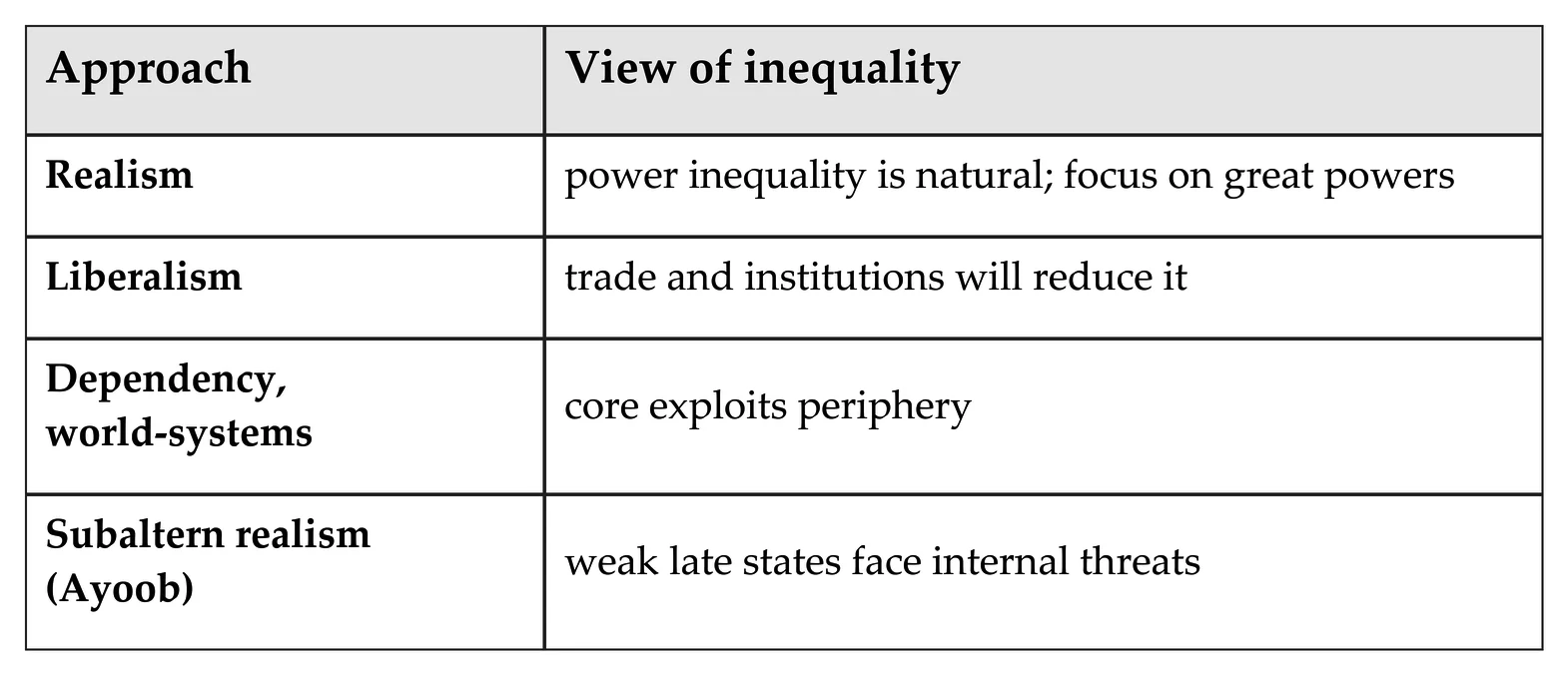
Introduction. Mainstream IR theories, realism and liberalism, have paid little attention to inequality, focusing on great powers and the problems of anarchy and cooperation. Other approaches, including dependency theory, Marxism, post-colonialism and Mohammed Ayoob’s subaltern realism, place inequality at the centre. Their insights help explain the persistence of hierarchy in world politics.
1. Realism and Inequality
Realists recognise inequality of power, as Thucydides’ Melian Dialogue shows, but treat it as natural and focus on the behaviour of great powers rather than the concerns of the weak.
2. Liberalism and Inequality
Liberals believe that trade, institutions and democracy promote cooperation and prosperity, and expect inequality to decline as countries integrate into the world economy.
3. Nogueira’s Critique
Nogueira argues that the assumption of formal equality in anarchy hides the hierarchies of power, wealth and status that structure international relations.
4. Dependency Theory
Dependency theorists argue that underdevelopment results from the exploitative relationship between core and periphery, not from internal backwardness.
5. World-Systems Theory
Wallerstein’s world-systems theory shows how the capitalist world-economy reproduces inequality among core, semi-peripheral and peripheral states.
6. Post-Colonial Approaches
Post-colonial scholars show how colonialism and racial hierarchy shaped the international order, and how these legacies persist in institutions and knowledge.
7. Ayoob’s Critique of Mainstream IR
Ayoob argued that mainstream theories are based on the experience of strong Western states and ignore the majority of states in the Third World.
8. Late State-Making
Third World states entered the international system late, after decolonisation, with weak institutions and borders drawn by colonial powers.
9. Internal Security Threats
For these subaltern states, the main threats are often internal, such as ethnic conflict, insurgency and secession, arising from incomplete state-building.
10. Subaltern Realism
Ayoob proposed subaltern realism, combining realism’s focus on power and security with the historical sociology of state-making, to explain the behaviour of Third World states.
11. Explaining Inequality
Subaltern realism explains why weak states remain unequal: they struggle with internal threats while facing an international order dominated by powerful states.
12. The NIEO
In 1974, developing countries demanded a New International Economic Order to correct inequalities, with fair commodity prices, technology transfer and reform of institutions.
13. Failure of the NIEO
The NIEO faced opposition from rich countries and was overtaken by the debt crisis and neo-liberalism in the 1980s, but its demands remain relevant.
14. Feminist Approaches
Feminist scholars show how gender inequality intersects with global inequality, as women bear disproportionate burdens of poverty, conflict and care work.
15. Global IR
Calls for a Global IR seek to include the perspectives of the South and to treat inequality as a central concern of the discipline.
16. Global Justice Debates
Political philosophers debate whether justice applies globally. Cosmopolitans such as Thomas Pogge and Peter Singer argue that rich countries have duties to reduce global poverty, while others, following John Rawls, limit full principles of justice to societies and propose only a duty of assistance to burdened peoples.
17. Evaluation
Theories that place inequality at the centre offer a more complete understanding of world politics than those that assume formal equality among states.
Conclusion. Thus, while realism and liberalism neglected inequality, dependency, world-systems, post-colonial and feminist approaches placed it at the centre. Ayoob’s subaltern realism explains the internal security predicaments of late-forming states, and the NIEO’s call to correct inequalities shows the South’s long struggle for a fairer order.
Short Notes
(a) Subaltern realism
Mohammed Ayoob’s theory (2002) that explains the security behaviour of Third World states by combining realism with the historical sociology of late state-making.
(b) CBDR-RC
The principle of common but differentiated responsibilities and respective capabilities in Article 3(1) of the UNFCCC, under which all states share responsibility but in different degrees.
(c) Brandt Line
The line drawn by the Brandt Report (1980) across the world map to separate the rich North from the poor South.
More notes: GE-4 Understanding International Relations
These notes are prepared by PADHO TO AISE for study help. They are not an official publication.