
Generic Electives (GE) GE-4 Understanding International Relations
Unit 2 · 24 min read · Updated 27 Nov 2026
As per the University of Delhi (DU) Generic Elective (GE) syllabus offered by the Department of Political Science
Contents
- 2.1 The State and the Diffusion of Authority and Power
- Strange: The State of the State
- Sovereignty and Supranationalism
- The State Remains Important
- 2.2 Nations and Nationalism
- Theories of Nationalism
- Kinds of Nationalism
- How People Identify with Nations
- Does the Nation-State Work
- India: Nation-State and the Colonial Legacy
- Nationalism in a Global Age
- 2.3 States and Markets
- Three Perspectives
- Strange: States and Markets
- Corporate Power and Global Production
- State and Market in Modern Society
- States and Markets in India
- 2.4 Important Questions
- Discuss the nature of the state and the diffusion of its authority and power in the contemporary world.
- What is a nation? Discuss the major theories of nationalism.
- Does the nation-state work? Discuss with reference to India’s colonial legacy.
- Examine the relationship between states and markets in international political economy.
- Short Notes
एक मानव समुदाय जो किसी निश्चित भू-भाग के भीतर भौतिक बल के वैध प्रयोग पर एकाधिकार का (सफलतापूर्वक) दावा करता है।
A human community that (successfully) claims the monopoly of the legitimate use of physical force within a given territory.
— Max Weber, Politics as a Vocation (1919)
TTHREE great forces shape the modern world: the state, which claims authority over a territory; the nation, which gives people a sense of collective identity; and the market, which organises production and exchange across borders. The modern ideal of the nation-state joins the first two, while the relationship between states and markets is at the heart of international political economy. This chapter examines the state and the diffusion of authority and power, nations and nationalism, including India’s colonial legacy, and the relationship between states and markets.
2.1 The State and the Diffusion of Authority and Power
The state is the central political institution of the modern world. Max Weber defined it as a human community that successfully claims the monopoly of the legitimate use of physical force within a given territory. The modern state has four elements: territory, population, government and sovereignty. Stuart Elden, in Why the World Divided Territorially (2008), shows that the idea of territory, a bounded space under exclusive control, is itself a historical creation, developed in early modern Europe and spread worldwide through colonialism, so that today almost all land on Earth is divided among states.
Strange: The State of the State
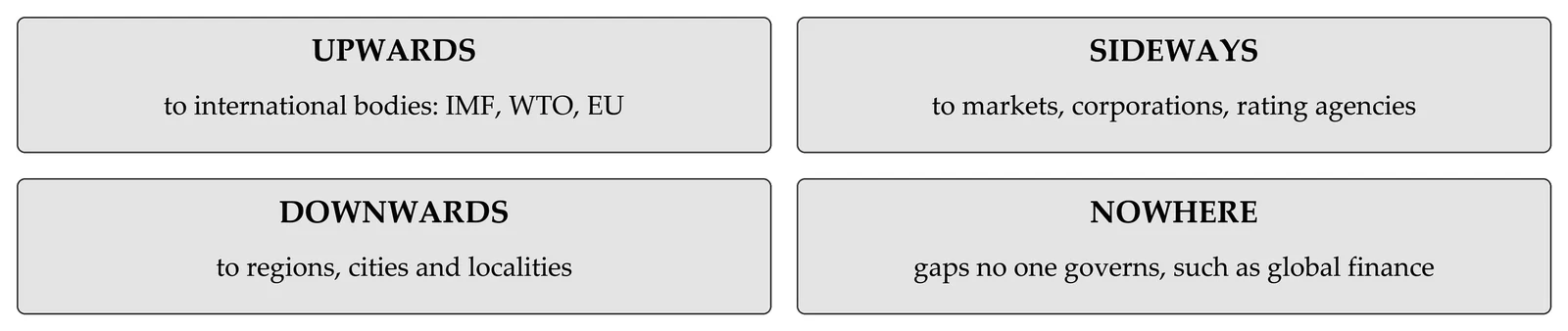
Susan Strange, in The Retreat of the State (1996), argued that the authority of states has diffused to other actors. In her chapter The State of the State, she observed that states have lost control over key functions such as defending territory against economic penetration, maintaining the value of their currency, choosing their path of development and providing social safety nets. Authority has shifted to markets, to transnational corporations, to international bureaucracies, to private bodies such as accountancy firms and credit rating agencies, and even to criminal networks and cartels. Some authority has gone nowhere, leaving gaps that no one governs. She also noted an asymmetry: the United States retains far more power than other states, so the retreat of the state is uneven.
Sovereignty and Supranationalism
Andrew Heywood explains that globalisation and regional integration have led to supranationalism, in which states transfer authority to bodies above them, such as the European Union, whose laws override national laws. Sovereignty is increasingly pooled or shared. Stephen Krasner, in Sharing Sovereignty (2004), argued that for collapsed and failing states, such as those affected by civil war, conventional sovereignty cannot ensure order, and proposed shared sovereignty arrangements in which external actors share authority with local governments for a time, a proposal criticised as a return of trusteeship.
The State Remains Important
Despite diffusion, states remain the main holders of military force, makers of law and collectors of taxes, and they decide whether to join international bodies. Strong states such as the United States, China and India shape global rules, while weak or failing states struggle. The diffusion of authority is therefore real but uneven, and the state is being transformed rather than replaced.
2.2 Nations and Nationalism
A nation is a group of people who see themselves as a community, bound by shared culture, history, language, religion or political values, and who usually aspire to self-government. Nationalism is the ideology and movement that holds that the nation should be the basis of political organisation, ideally in its own state. Ernest Gellner defined nationalism as primarily a political principle holding that the political and the national unit should be congruent.
Theories of Nationalism
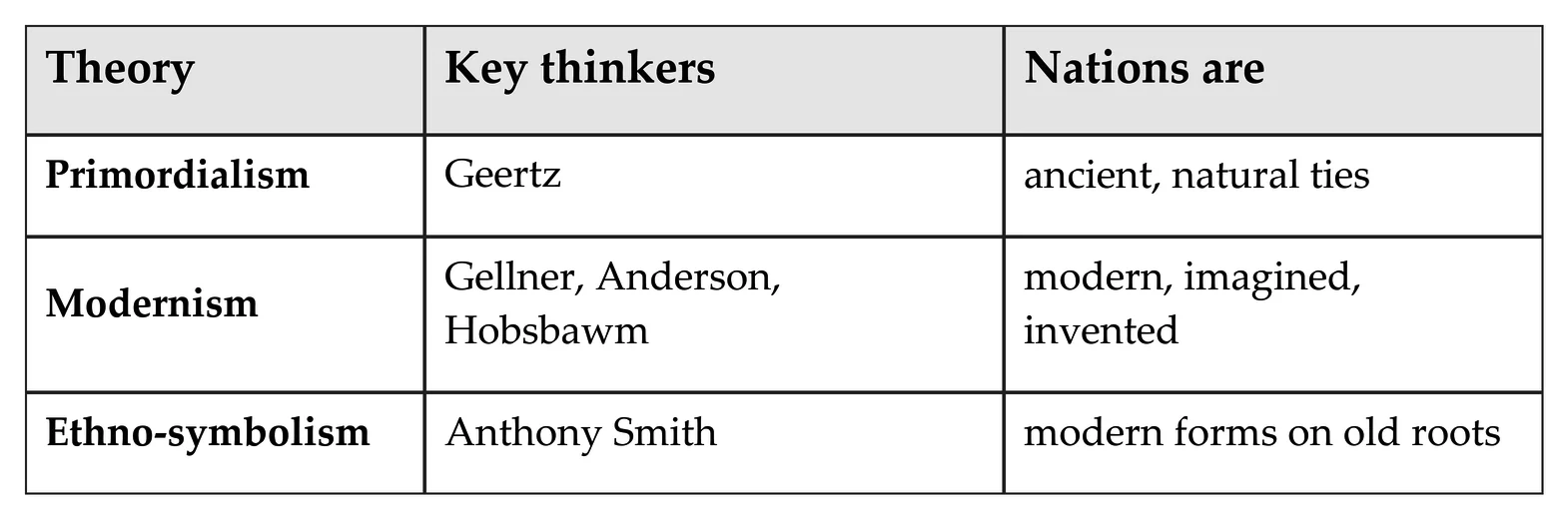
- Primordialism. Nations are ancient and natural, based on deep ties of kinship, language and culture; Clifford Geertz spoke of primordial attachments.
- Modernism. Nations are modern creations. Gellner linked nationalism to industrialisation, which required a common language and education; Benedict Anderson, in Imagined Communities (1983), argued that print capitalism allowed people who would never meet to imagine themselves as a nation; Eric Hobsbawm showed how traditions are invented.
- Ethno-symbolism. Anthony Smith argued that modern nations build on older ethnic communities, myths, memories and symbols.
Kinds of Nationalism
Heywood distinguishes liberal nationalism, which links national self-determination with freedom and equality of nations; conservative nationalism, which stresses tradition and social unity; expansionist or chauvinist nationalism, which seeks domination over others, as in fascism; and anti-colonial nationalism, which sought liberation from imperial rule in Asia and Africa. Scholars also distinguish civic nationalism, based on citizenship and shared political values, from ethnic nationalism, based on common descent and culture.
How People Identify with Nations
Elena Barabantseva, in How Do People Come to Identify with Nations? (2008), shows that national identity is produced through education, maps, history textbooks, museums, media, rituals and symbols such as flags and anthems. Michael Billig called the everyday reproduction of nationhood, through unnoticed symbols such as flags on buildings and weather maps on television, banal nationalism. National identity is not fixed but constantly made and remade.
Does the Nation-State Work
Michael Shapiro, in Does the Nation-State Work? (2008), questions the assumption that nation and state naturally coincide. Few states are nationally homogeneous; most contain many ethnic, linguistic and religious groups, as well as indigenous peoples. The effort to make the state and nation congruent has often involved violence against minorities, forced assimilation, expulsion and even genocide. Migration and diasporas also make national belonging more complex. Shapiro argues that the nation-state is a historically specific form that does not fit the diversity of peoples.
India: Nation-State and the Colonial Legacy
Sanjay Chaturvedi, in Indian Geopolitics: Nation-State and the Colonial Legacy (2005), shows how India’s geopolitical imagination was shaped by colonial rule. British cartography defined India’s boundaries, such as the McMahon Line (1914) with Tibet and the Durand Line (1893) with Afghanistan, and the hurried Radcliffe Line of 1947 partitioned the subcontinent, causing massive violence and displacement. These colonial boundaries continue to cause disputes with China and Pakistan. Sankaran Krishna has described India’s cartographic anxiety, its concern with the official map as a symbol of national identity. India’s nationalism was also shaped by debates between a composite, civic idea of the nation, held by Gandhi and Nehru, and cultural ideas of the nation. Rabindranath Tagore criticised the Western idea of the nation as a mechanical organisation of power.
Nationalism in a Global Age
Yuval Noah Harari, in 21 Lessons for the 21st Century (2018), argues that nationalism has done much good by creating large communities of cooperation, but it cannot solve global problems such as nuclear war, climate change and technological disruption, which require global cooperation. He argues that loyalty to the nation must be combined with responsibility to humanity and the planet.
2.3 States and Markets
The relationship between states and markets is the core concern of international political economy (IPE). States make the rules within which markets operate, while markets generate the wealth on which states depend. Robert Gilpin identified three main perspectives on political economy.
Three Perspectives
- Economic liberalism. Associated with Adam Smith and David Ricardo, it holds that markets are efficient and self-regulating, free trade benefits all, and the state should play a limited role.
- Economic nationalism (mercantilism). Associated with Alexander Hamilton and Friedrich List, it holds that the economy should serve the power and security of the state, which should protect and promote national industries.
- Marxism. It holds that the economy is based on class exploitation, the state serves the capitalist class, and global capitalism produces inequality between core and periphery.
Strange: States and Markets
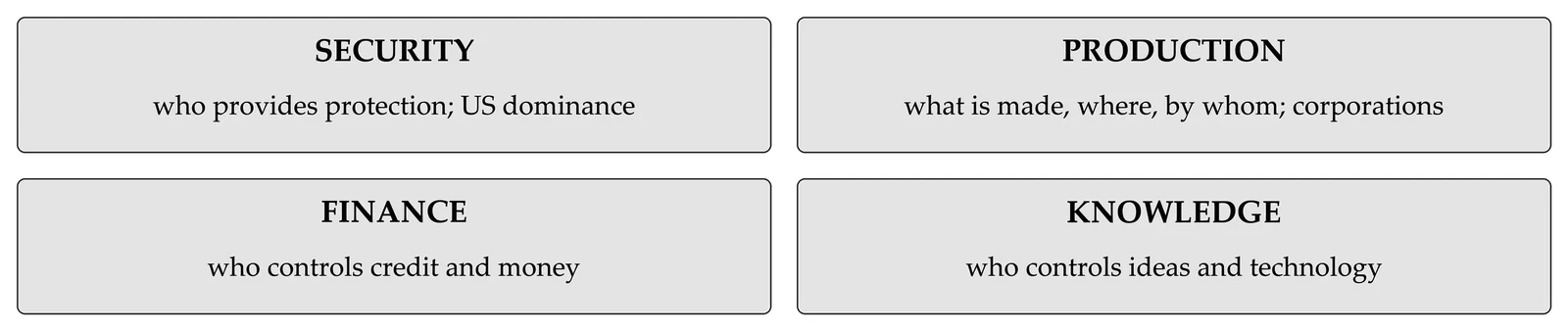
Susan Strange, in States and Markets (1988), argued that IPE should ask who gets what, and should study the balance between authority (states) and markets. She distinguished relational power, the power of A to get B to do something, from structural power, the power to shape the structures within which others must operate. She identified four primary structures of the world economy:
- The security structure. The framework of power created by those who provide protection against violence; the United States dominates it.
- The production structure. Who decides what is produced, by whom, where and on what terms; transnational corporations play a major role.
- The financial structure. Who controls credit and money; it has become increasingly global and volatile.
- The knowledge structure. Who controls knowledge, beliefs, ideas and technology, including how they are communicated.
Corporate Power and Global Production
David Held and his colleagues, in Global Transformations (1999), showed how transnational corporations organise global production networks, spreading research, manufacturing and sales across many countries. TNCs control a large share of world trade and investment, and their decisions about where to invest shape the fortunes of countries and workers. States compete to attract them, which can increase their bargaining power over governments.
State and Market in Modern Society
Matthew Watson argues that the state and the market are not separate spheres but are both embedded in modern society. Markets depend on states for property rights, contracts, money and infrastructure, while states depend on markets for revenue and growth. Karl Polanyi, in The Great Transformation (1944), argued that the attempt to create a self-regulating market society in the nineteenth century provoked a double movement, as society sought protection through regulation and welfare. Thomas Friedman, in The World Is Flat (2005), argued that technology and globalisation have levelled the playing field, though critics note persistent inequalities.
States and Markets in India
India moved from a state-led model, with planning, a large public sector and the licence raj, to liberalisation in 1991, giving markets a larger role. The state now regulates markets through bodies such as SEBI and the Competition Commission, provides welfare, and pursues industrial policy through schemes such as production-linked incentives. The debate on the proper balance between state and market continues.
2.4 Important Questions
- Question 1 Discuss the nature of the state and the diffusion of its authority and power in the contemporary world.
- Question 2 What is a nation? Discuss the major theories of nationalism.
- Question 3 Does the nation-state work? Discuss with reference to India’s colonial legacy.
- Question 4 Examine the relationship between states and markets in international political economy.
DU asks the same idea in different words. So learn one broad answer for each question below; the same answer works for every question joined by OR.
Important Question 1
Discuss the nature of the state and the diffusion of its authority and power in the contemporary world.
OR
Examine Susan Strange’s argument on the state of the state.
OR
Is the authority of the state declining? Discuss.
Model Answer
“Where states were once the masters of markets, now it is the markets which, on many crucial issues, are the masters over the governments of states.”
— Susan Strange, The Retreat of the State (1996)
Introduction. The modern state claims supreme authority over its territory and people. But in a globalised world, many scholars argue that this authority has diffused to markets, corporations, international institutions and other actors. Susan Strange’s analysis of the state of the state is the most influential statement of this view, though others insist that the state remains central.
1. Weber’s Definition
Weber defined the state as a human community that successfully claims the monopoly of the legitimate use of physical force within a given territory.
2. Elements of the State
The modern state has territory, population, government and sovereignty, and it is recognised by other states as an equal member of the international system.
3. Territory as a Historical Creation
Elden shows that the idea of territory as bounded, exclusive space developed in early modern Europe and spread worldwide through colonialism, dividing almost all land among states.
4. Strange’s Thesis
Strange argued that the impersonal forces of world markets have become more powerful than states, so that markets are now masters over governments on many issues.
5. Functions Lost by States
States have lost control over the value of their currencies, their path of development, the location of industry and, increasingly, the provision of social safety nets.
6. Diffusion to Markets and Firms
Authority has shifted to markets and transnational corporations, which decide where to invest, what to produce and how to employ workers across borders.
7. Diffusion to Private and Criminal Actors
Strange noted the authority of accountancy firms, credit rating agencies, cartels and even mafias, which exercise power without public accountability.
8. International Bureaucracies
International organisations such as the IMF and WTO make rules that bind states, shifting authority upwards from national governments.
9. Authority Going Nowhere
Some authority has gone nowhere, leaving gaps in governance, such as the regulation of global finance, which contributed to crises.
10. The Asymmetric State
Strange stressed that the retreat is uneven: the United States retains great power, while weaker states lose most, so diffusion reflects global inequality.
11. Supranationalism
Heywood shows that bodies such as the European Union exercise supranational authority, with laws that override national laws, so sovereignty is pooled.
12. Failing States
Krasner argued that collapsed and failing states cannot provide order alone and proposed shared sovereignty with external actors, a proposal criticised as neo-trusteeship.
13. The State Remains Central
States still hold military force, make laws and collect taxes, and powerful states shape global rules, as the responses to the 2008 crisis and the pandemic showed.
14. India’s Experience
India has accepted some constraints through liberalisation and the WTO, but it retains strong state capacity in security, regulation, welfare and digital infrastructure.
15. Transformation, Not Disappearance
Most scholars conclude that the state is being transformed, sharing authority with other actors, rather than disappearing.
16. Theories of the State
Liberals see the state as a neutral referee protecting rights, Marxists as an instrument of the ruling class, pluralists as an arena of competing groups, and feminists as an institution shaped by patriarchy. These theories give different answers to whether the diffusion of authority to markets threatens democracy or simply reflects the interests of capital.
17. The Developmental State
Scholars such as Chalmers Johnson and Peter Evans showed that states like Japan, South Korea and Taiwan guided industrialisation through planning, credit and close but disciplined links with business. Their success shows that globalisation does not make the state powerless; capable states can shape their place in the world economy.
18. The State in the Digital Age
Digital technology both diffuses and concentrates power. Platforms such as social media companies exercise authority over speech and data across borders, while states use digital identity, surveillance and data localisation rules to extend their reach, as India has done through Aadhaar and its data protection law of 2023.
19. Evaluation
Strange’s analysis captures real shifts of power in the world economy, though the continuing importance of strong states shows that diffusion is partial and uneven.
Conclusion. Thus, the state, defined by Weber’s monopoly of legitimate force, has seen its authority diffuse to markets, corporations, international bureaucracies and private actors, as Strange argued. Yet the asymmetry she noted and the continuing power of strong states show that the state is transformed, not replaced.
Important Question 2
What is a nation? Discuss the major theories of nationalism.
OR
Nations are imagined communities. Discuss.
OR
How do people come to identify with nations?
Model Answer
“It is an imagined political community — and imagined as both inherently limited and sovereign.”
— Benedict Anderson, Imagined Communities (1983)
Introduction. Nations and nationalism are among the most powerful forces in modern politics. They have inspired liberation struggles and also wars and violence. Scholars disagree about what nations are and where they come from: some see them as ancient and natural, others as modern constructions. Understanding these debates helps explain the role of nationalism in international relations.
1. Meaning of Nation
A nation is a group of people who see themselves as a community bound by shared culture, history, language or political values, and who usually aspire to self-government.
2. Meaning of Nationalism
Nationalism is the ideology holding that the nation should be the basis of political organisation. Gellner defined it as the principle that the political and national unit should be congruent.
3. Primordialism
Primordialists see nations as ancient and natural, based on deep ties of kinship, language, religion and territory, which Geertz called primordial attachments.
4. Gellner’s Modernism
Gellner argued that nationalism arose with industrialisation, which required a mobile, literate workforce sharing a common language and culture spread by mass education.
5. Anderson’s Imagined Communities
Anderson defined the nation as an imagined political community, since members never meet most of their fellow nationals, yet imagine themselves as one community.
6. Print Capitalism
Anderson argued that print capitalism, through newspapers and novels in vernacular languages, allowed people to imagine themselves as members of a national community.
7. Invention of Tradition
Hobsbawm showed that many national traditions, ceremonies and symbols that seem ancient were in fact invented in the nineteenth and twentieth centuries.
8. Ethno-Symbolism
Anthony Smith argued that modern nations build on older ethnic communities, myths, memories and symbols, combining ancient roots with modern forms.
9. Kinds of Nationalism
Heywood distinguishes liberal, conservative, expansionist and anti-colonial nationalism, and scholars contrast civic nationalism with ethnic nationalism.
10. Barabantseva on Identification
Barabantseva shows that people come to identify with nations through education, history textbooks, maps, museums, media, rituals and symbols.
11. Banal Nationalism
Michael Billig described banal nationalism, the everyday reproduction of national identity through unnoticed symbols such as flags, anthems and national weather maps.
12. Anti-Colonial Nationalism
In Asia and Africa, nationalism mobilised people against colonial rule, as in India’s freedom struggle, combining demands for self-rule with social reform.
13. Indian Debates
Gandhi and Nehru held a composite, civic idea of the Indian nation, while others stressed cultural unity, and Tagore criticised the Western idea of the nation as organised power.
14. Nationalism and Conflict
Nationalism has fuelled wars, secessionist movements and violence against minorities, as in the partition of India and the conflicts in former Yugoslavia.
15. Nationalism in a Global Age
Harari argues that nationalism cannot solve global problems such as nuclear war, climate change and technological disruption, which require global cooperation.
16. Nation and State Distinguished
A state is a political and legal institution with territory, government and sovereignty, while a nation is a cultural and psychological community. Some nations have no state of their own, such as the Kurds and Palestinians, while some states contain many nations, such as India, Canada and the United Kingdom.
17. Self-Determination
The principle of national self-determination, promoted by Woodrow Wilson and Lenin after the First World War and recognised in the UN Charter, inspired decolonisation. But it also raises difficult questions when groups within existing states demand secession, since international law generally protects the territorial integrity of states.
18. Evaluation
Nations are best understood as historically constructed communities that nonetheless draw on real cultural ties, and nationalism can be both emancipatory and dangerous.
Conclusion. Thus, a nation is, in Anderson’s words, an imagined political community, and theories of nationalism range from primordialism to the modernism of Gellner, Anderson and Hobsbawm and Smith’s ethno-symbolism. People come to identify with nations through education, symbols and everyday banal nationalism.
Important Question 3
Does the nation-state work? Discuss with reference to India’s colonial legacy.
OR
Examine the relationship between the nation and the state.
OR
Discuss the impact of colonial cartography on Indian geopolitics.
Model Answer
“A nation, in the sense of the political and economic union of a people, is that aspect which a whole population assumes when organised for a mechanical purpose.”
— Rabindranath Tagore, Nationalism (1917)
Introduction. The nation-state, in which the boundaries of the state coincide with those of a nation, is the ideal form of political organisation in the modern world. Yet few states are nationally homogeneous, and the effort to make state and nation coincide has often been violent. India’s experience, shaped by colonial boundaries and partition, illustrates the difficulties of the nation-state model.
1. The Nation-State Ideal
The nation-state ideal holds that each nation should have its own state and each state should represent one nation, an idea that spread after the French Revolution and decolonisation.
2. Shapiro’s Question
Michael Shapiro asks whether the nation-state works, questioning the assumption that nation and state naturally coincide.

3. Diversity within States
Most states contain many ethnic, linguistic and religious groups and indigenous peoples, so the claim that each state represents one nation is rarely true.
4. Violence of Nation-Building
The effort to make state and nation congruent has involved forced assimilation, expulsion and genocide of minorities, as in Europe in the twentieth century.
5. Migration and Diaspora
Migration and diasporas create communities whose loyalties and identities cross state borders, complicating the idea of a single national belonging.
6. Chaturvedi on Indian Geopolitics
Sanjay Chaturvedi shows that India’s geopolitical imagination was shaped by colonial rule, which defined its boundaries and its sense of territory.
7. Colonial Cartography
British surveys and maps defined India’s frontiers, creating lines such as the Durand Line (1893) with Afghanistan and the McMahon Line (1914) with Tibet.
8. The Radcliffe Line and Partition
The Radcliffe Line, drawn hurriedly in 1947, partitioned the subcontinent, causing massive communal violence and the displacement of millions of people.
9. Continuing Disputes
Colonial boundaries continue to cause disputes, such as India’s border dispute with China over the McMahon Line and Aksai Chin, and the Kashmir conflict with Pakistan.
10. Cartographic Anxiety
Sankaran Krishna described India’s cartographic anxiety, a concern with the official map as a symbol of national identity and integrity.
11. Composite Nationalism
Gandhi and Nehru held a composite idea of India, based on unity in diversity and equal citizenship for people of all religions, languages and regions.
12. Accommodating Diversity
India has accommodated diversity through federalism, linguistic reorganisation of states in 1956, special provisions for tribal areas and protection of minority rights.
13. Continuing Tensions
Yet secessionist movements, communal violence and debates over citizenship show the continuing tensions between national unity and diversity.
14. Tagore’s Critique
Tagore criticised the Western nation as a mechanical organisation of power and self-interest, warning India against imitating it and favouring a civilisational idea of unity.
15. Alternatives
Scholars propose multinational federalism, consociational arrangements and cosmopolitan citizenship as alternatives to the homogeneous nation-state.
16. Nation-Building after Independence
After 1947, India’s leaders built the nation through the Constitution, democratic elections, the integration of princely states under Sardar Patel, planned development and a common civic identity. The linguistic reorganisation of states in 1956, initially resisted, strengthened national unity by recognising diversity.
17. The North-East and Kashmir
Insurgencies in parts of the North-East and the conflict in Jammu and Kashmir show the difficulties of integrating regions with distinct histories into the nation-state. Peace accords, such as the Mizo Accord of 1986, show how negotiated autonomy can resolve such conflicts.
18. Diaspora and Long-Distance Nationalism
Benedict Anderson spoke of long-distance nationalism among diasporas who support nationalist causes in their homelands. The large Indian diaspora maintains strong ties with India, showing that national belonging today extends beyond the territory of the state.
19. Evaluation
The nation-state works best when it accommodates diversity rather than imposing uniformity, a lesson India’s democratic federalism illustrates despite its tensions.
Conclusion. Thus, the nation-state ideal rarely fits the diversity of peoples, and its pursuit has often been violent, as Shapiro argues. India’s colonial legacy of cartography and partition shaped its geopolitics, and Tagore’s critique of the mechanical nation reminds us that the nation-state works only when it accommodates diversity.
Important Question 4
Examine the relationship between states and markets in international political economy.
OR
Discuss Susan Strange’s concept of structural power.
OR
Examine the liberal, nationalist and Marxist perspectives on political economy.
Model Answer
“Structural power… is the power to shape and determine the structures of the global political economy within which other states, their political institutions, their economic enterprises and (not least) their scientists and other professional people have to operate.”
— Susan Strange, States and Markets (1988)
Introduction. The relationship between states and markets is the central concern of international political economy. States make the rules within which markets operate, while markets create the wealth that states need. Scholars disagree about the proper balance between them and about who holds power in the global economy. Susan Strange’s idea of structural power offers a powerful way to analyse these questions.
1. Meaning of IPE
International political economy studies the interaction of politics and economics at the global level, especially the relationship between states and markets.
2. Gilpin’s Three Perspectives
Robert Gilpin identified three main perspectives on political economy: economic liberalism, economic nationalism and Marxism.
3. Economic Liberalism
Liberals such as Smith and Ricardo hold that markets are efficient and self-regulating, free trade benefits all, and the state should play a limited role.
4. Economic Nationalism
Economic nationalists such as Hamilton and List hold that the economy should serve state power and security, and that states should protect and promote national industries.
5. Marxism
Marxists hold that the economy rests on class exploitation, the state serves the capitalist class, and global capitalism produces inequality between core and periphery.
6. Strange’s Approach
Strange argued that IPE should ask who gets what, and should study the balance between the authority of states and the forces of markets.
7. Relational and Structural Power
She distinguished relational power, getting others to do what they would not otherwise do, from structural power, shaping the structures within which others must operate.
8. The Security Structure
The security structure is the framework of protection against violence, dominated by the United States through its military power and alliances.
9. The Production Structure
The production structure determines what is produced, where and by whom, and transnational corporations play a decisive role in it.
10. The Financial Structure
The financial structure controls credit and money. It has become global and volatile, and control over it gives great power, as the dollar’s role shows.
11. The Knowledge Structure
The knowledge structure concerns who controls knowledge, ideas and technology, increasingly important in the digital age.
12. Corporate Power
Held shows that transnational corporations organise global production networks, and states compete to attract their investment, increasing corporate bargaining power.
13. Polanyi’s Double Movement
Polanyi argued that attempts to create a self-regulating market provoke a double movement, as society demands protection through regulation and welfare.
14. State and Market Embedded in Society
Watson argues that state and market are not separate spheres but are both embedded in modern society and depend on each other.
15. India’s Experience
India moved from a state-led model to liberalisation in 1991, and now combines markets with regulation, welfare and industrial policy.
16. Hegemonic Stability Theory
Charles Kindleberger and Robert Gilpin argued that an open world economy needs a hegemon, a dominant state willing to provide public goods such as a stable currency and open markets, as Britain did in the nineteenth century and the United States after 1945. Strange criticised the theory for exaggerating American decline.
17. Sovereign Wealth Funds and State Capitalism
State-owned enterprises and sovereign wealth funds, especially from China and the Gulf, have become major players in global markets, blurring the line between state and market. This state capitalism challenges the liberal model that separates political authority from economic activity.
18. Evaluation
States and markets are interdependent, and Strange’s structural power shows that the key question is who shapes the rules of the global economy.
Conclusion. Thus, liberal, nationalist and Marxist perspectives offer different views of the state-market relationship. Strange’s concept of structural power, operating through the security, production, financial and knowledge structures, shows that power in the global economy lies in the ability to shape the structures within which others must operate.
Short Notes
(a) Imagined community
Benedict Anderson’s description of the nation as a community whose members, though they never meet most of each other, imagine themselves as one people.
(b) Structural power
Susan Strange’s term for the power to shape the structures of the global political economy, such as security, production, finance and knowledge, within which others must act.
(c) Banal nationalism
Michael Billig’s term for the everyday, unnoticed reproduction of national identity through symbols such as flags, anthems and national maps.
(d) Supranationalism
The transfer of authority by states to bodies above them, such as the European Union, whose laws and institutions can override national decisions, so that sovereignty is pooled rather than held by each state alone.
More notes: GE-4 Understanding International Relations
These notes are prepared by PADHO TO AISE for study help. They are not an official publication.