

Generic Electives (GE) GE-13 Introduction to Human Rights
Unit 1 · 25 min read · Updated 27 Nov 2026
As per the University of Delhi (DU) Generic Elective (GE) syllabus offered by the Department of Political Science
Contents
- 1.1 Definition and Nature of Human Rights
- Features of Human Rights
- Theories of Human Rights
- 1.2 Historical Development of Human Rights
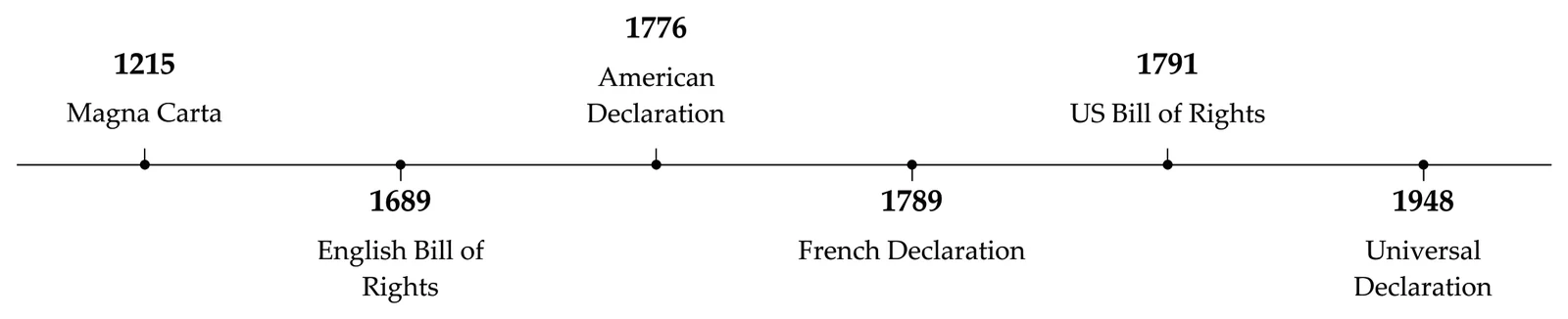
- The Magna Carta (1215)
- English Developments after the Magna Carta
- The American Revolution and Bill of Rights
- The French Revolution
- Towards Universal Rights
- 1.3 Generations of Human Rights
- First Generation: Civil and Political Rights
- Second Generation: Economic, Social and Cultural Rights
- Third Generation: Solidarity Rights
- Debates on the Generations
- 1.4 Important Questions
- Define human rights and discuss their nature and features.
- Trace the historical development of human rights with reference to the Magna Carta, the American Bill of Rights and the French Revolution.
- Explain the three generations of human rights.
- Examine the debate between universalism and cultural relativism in human rights.
- Short Notes
सभी मनुष्य जन्म से स्वतंत्र हैं और गरिमा तथा अधिकारों में समान हैं।
All human beings are born free and equal in dignity and rights.
— Universal Declaration of Human Rights, Article 1 (1948)
HHUMAN rights are the rights that every person has simply because he or she is a human being. Today they are recognised in international law and in national constitutions, and they are invoked by citizens, movements and governments across the world. Yet the idea has a long and contested history. This chapter explains the definition and nature of human rights, traces their historical development through landmarks such as the Magna Carta, the American Bill of Rights and the French Revolution, and studies the three generations of human rights: civil and political, economic, social and cultural, and solidarity rights.
1.1 Definition and Nature of Human Rights
Human rights are the basic rights and freedoms that belong to every person in the world, from birth until death, regardless of nationality, race, sex, religion, language, caste or any other status. The political scientist Jack Donnelly, in Universal Human Rights in Theory and Practice (1989), defined them simply as the rights one has because one is a human being. In simple words, they are the minimum conditions necessary for a life of dignity. India’s Protection of Human Rights Act of 1993 defines them as the rights relating to life, liberty, equality and dignity guaranteed by the Constitution or embodied in the international covenants and enforceable by Indian courts.
Features of Human Rights
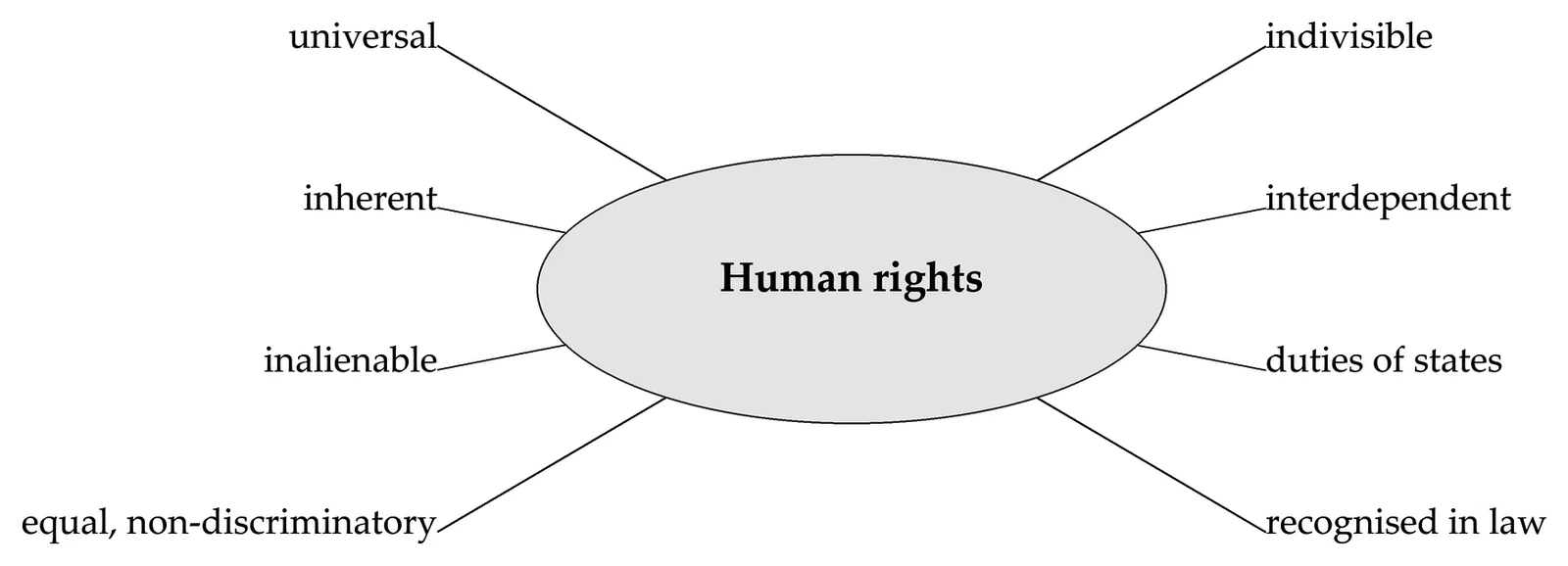
- Universal. They belong to all human beings everywhere, not only to citizens of particular states.
- Inherent. They arise from human dignity itself; they are not gifts of the state, though states must recognise and protect them.
- Inalienable. They cannot be taken away or surrendered, though some may be lawfully restricted in specific situations, such as imprisonment after a fair trial.
- Equal and non-discriminatory. All persons are entitled to them equally, without discrimination of any kind.
- Indivisible and interdependent. Civil, political, economic, social and cultural rights depend on one another; the right to vote means little without education and food, as the Vienna Declaration of 1993 stressed.
- Rights and duties. States have duties to respect, protect and fulfil human rights, and individuals have duties to respect the rights of others.
- Recognised in law. Though moral in origin, they are now codified in international treaties and national constitutions.
Theories of Human Rights
- Natural rights theory. John Locke, in the Second Treatise of Government (1690), argued that all people have natural rights to life, liberty and property, which governments exist to protect; this idea inspired the American and French declarations.
- Legal positivism. Jeremy Bentham, in Anarchical Fallacies (written in 1796), mocked natural rights as nonsense upon stilts, arguing that rights exist only when created by law.
- Marxist critique. Karl Marx, in On the Jewish Question (1843), argued that the rights of man were the rights of the egoistic, property-owning individual of bourgeois society.
- Capabilities approach. Amartya Sen and Martha Nussbaum linked human rights with the real capabilities people need to live a life they value.
- Feminist perspective. Charlotte Bunch, in Women’s Rights as Human Rights (1990), argued that violations of women’s rights in the family had been ignored, leading to the slogan that women’s rights are human rights.
1.2 Historical Development of Human Rights
Ideas of justice, dignity and limits on rulers appear in many ancient traditions, from the Code of Hammurabi in Babylon to the edicts of the Indian emperor Ashoka in the third century BCE and the teachings of the Buddha, Confucius and the prophets. The modern idea of rights, however, developed mainly through struggles in Europe and America against absolute monarchy, and was universalised after the Second World War.
The Magna Carta (1215)
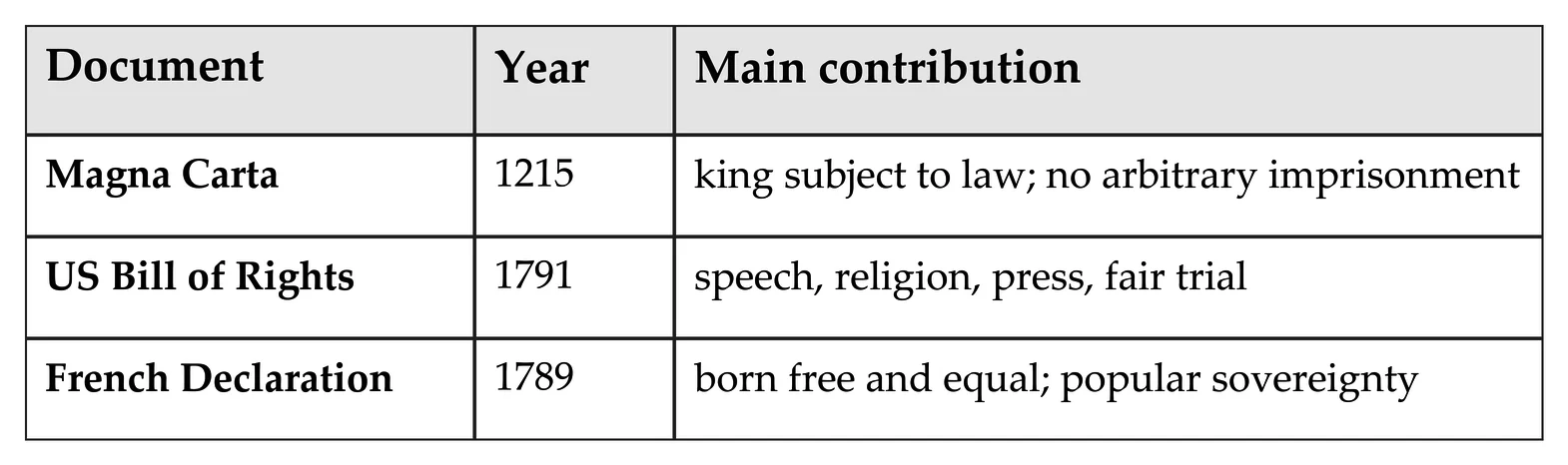
On 15 June 1215, at Runnymede, the English barons forced King John to accept the Magna Carta, the Great Charter. It limited the king’s power to impose taxes without consent and, in its famous clause 39, declared that no free man shall be seized, imprisoned or deprived of his rights except by the lawful judgment of his peers or by the law of the land. Although it protected mainly the barons and the church, it established the principle that the ruler is subject to law, and it became a symbol of liberty for later generations, including the American colonists.
English Developments after the Magna Carta
- Petition of Right (1628). Parliament forced Charles I to accept that there should be no taxation without parliamentary consent and no imprisonment without cause.
- Habeas Corpus Act (1679). It required that a detained person be brought before a court, protecting against arbitrary detention.
- Bill of Rights (1689). After the Glorious Revolution of 1688, it limited the powers of the monarch, guaranteed free elections and freedom of speech in Parliament, and prohibited cruel and unusual punishments.
The American Revolution and Bill of Rights
The American colonists, inspired by Locke, declared independence on 4 July 1776, affirming that all men are created equal and endowed with unalienable rights to life, liberty and the pursuit of happiness. The Virginia Declaration of Rights of June 1776, drafted by George Mason, listed rights such as free press and religious freedom. After the Constitution of 1787, James Madison proposed amendments, and the Bill of Rights, the first ten amendments, was ratified in 1791. It guaranteed freedom of religion, speech, press and assembly, the right to bear arms, protection against unreasonable searches, the right to a fair trial and protection against cruel punishment. Yet these rights did not extend to enslaved African Americans or to women, showing the gap between principle and practice.
The French Revolution
On 26 August 1789, the National Assembly of revolutionary France adopted the Declaration of the Rights of Man and of the Citizen. Its first article declared that men are born and remain free and equal in rights, and it proclaimed liberty, property, security and resistance to oppression as natural rights, popular sovereignty, equality before law, freedom of opinion and religion and the presumption of innocence. The revolutionary slogan Liberté, Égalité, Fraternité became a universal call. Olympe de Gouges, in her Declaration of the Rights of Woman and of the Female Citizen (1791), protested that the declaration ignored women; she was executed in 1793.
Towards Universal Rights
- Abolition of slavery. Britain abolished the slave trade in 1807 and slavery in its colonies in 1833; the United States abolished slavery in 1865.
- Humanitarian law. The first Geneva Convention of 1864, inspired by Henri Dunant, protected wounded soldiers.
- Labour rights. The International Labour Organization, founded in 1919, set standards for workers.
- The Second World War. The horrors of the Holocaust led to the UN Charter (1945), which committed member states to promote human rights, and the Universal Declaration of Human Rights (1948), drafted by a commission chaired by Eleanor Roosevelt.
1.3 Generations of Human Rights
In 1977, the Czech-French jurist Karel Vasak, writing in the UNESCO Courier, classified human rights into three generations, linking them to the three ideals of the French Revolution: liberty, equality and fraternity. The classification describes the historical order in which different kinds of rights gained recognition.
First Generation: Civil and Political Rights
First-generation rights correspond to liberty. They developed in the seventeenth and eighteenth centuries in the struggles against absolute monarchy and include the rights to life, liberty and security, freedom from torture and slavery, equality before law, a fair trial, freedom of thought, religion, expression, assembly and association, and the right to vote and take part in government. They are often called negative rights, because they mainly require the state not to interfere. They are set out in the International Covenant on Civil and Political Rights of 1966 and, in India, largely in the Fundamental Rights.
Second Generation: Economic, Social and Cultural Rights
Second-generation rights correspond to equality. They developed in the nineteenth and twentieth centuries in response to industrial capitalism, the labour and socialist movements, the Russian Revolution of 1917 and the welfare state. They include the rights to work, fair wages, social security, health, education, housing, food and participation in cultural life. They are often called positive rights, because they require the state to act and provide resources. They are set out in the International Covenant on Economic, Social and Cultural Rights of 1966 and, in India, largely in the Directive Principles.
Third Generation: Solidarity Rights
Third-generation rights correspond to fraternity. They developed after decolonisation, mainly through the demands of countries of the global South, and belong to peoples and groups as well as individuals. They include the right to self-determination, the right to development, recognised by the UN Declaration on the Right to Development of 1986, the right to peace, the right to a healthy environment, recognised by the UN General Assembly in 2022, and rights over the common heritage of mankind. They require international cooperation, since no single state can secure them.

Debates on the Generations
- Indivisibility. Critics argue that the idea of generations suggests a hierarchy, with civil rights more important than economic rights, whereas the Vienna Declaration of 1993 insisted that all rights are indivisible and interdependent.
- Cold War division. During the Cold War, Western states stressed civil and political rights and socialist states stressed economic and social rights, which is why the UDHR was turned into two separate covenants in 1966.
- Positive and negative rights. Scholars such as Henry Shue, in Basic Rights (1980), argued that all rights require both restraint and positive action by the state, so the distinction is not sharp.
- New rights. Some speak of a fourth generation of rights relating to digital privacy, genetic technology and the rights of future generations.
1.4 Important Questions
- Question 1 Define human rights and discuss their nature and features.
- Question 2 Trace the historical development of human rights with reference to the Magna Carta, the American Bill of Rights and the French Revolution.
- Question 3 Explain the three generations of human rights.
- Question 4 Examine the debate between universalism and cultural relativism in human rights.
DU asks the same idea in different words. So learn one broad answer for each question below; the same answer works for every question joined by OR.
Important Question 1
Define human rights and discuss their nature and features.
OR
‘Human rights are universal, indivisible and interdependent.’ Discuss.
OR
What are human rights? How are they different from other rights?
Model Answer
“All human rights are universal, indivisible and interdependent and interrelated.”
— Vienna Declaration and Programme of Action (1993), paragraph 5
Introduction. Human rights are the rights that belong to every person simply because he or she is a human being. They protect human dignity and set limits on what states and others may do to individuals, while also requiring states to provide the conditions for a dignified life. Recognised in the Universal Declaration of Human Rights of 1948 and many treaties, they have become a common language of justice in the modern world.
1. Meaning of Human Rights
Human rights are basic rights and freedoms that belong to all human beings regardless of nationality, race, sex, religion, language or other status. Jack Donnelly defined them as the rights one has simply because one is a human being, i.e. rights that do not depend on citizenship, wealth or social position.
2. Basis in Human Dignity
Human rights are grounded in the idea that every person has inherent dignity and worth. The Universal Declaration begins by recognising the inherent dignity and equal rights of all members of the human family as the foundation of freedom, justice and peace in the world.
3. Universality
Human rights are universal: they apply to all people in all countries. This universality was affirmed by the Universal Declaration of 1948 and reaffirmed by 171 states at the World Conference on Human Rights in Vienna in 1993.
4. Inherent and Inalienable
Human rights are inherent, i.e. they arise from being human rather than being granted by governments, and inalienable, i.e. they cannot be taken away or surrendered, though some may be lawfully restricted, for example after a fair trial.
5. Equality and Non-Discrimination
All persons are equally entitled to human rights without discrimination on grounds such as race, colour, sex, language, religion, political opinion, national or social origin, property or birth, as Article 2 of the Universal Declaration states.
6. Indivisibility and Interdependence
Civil, political, economic, social and cultural rights are indivisible and interdependent. The right to free speech is hollow without education, and the right to vote means little to someone who is starving, so all rights must be realised together.
7. Duties of States
States have three kinds of duties: to respect human rights by not violating them, to protect them by preventing violations by others, and to fulfil them by taking positive measures, such as providing education and health care.
8. Human Rights and Citizenship Rights
Citizenship rights depend on membership of a particular state and are granted by its laws, while human rights belong to everyone, including refugees and stateless persons, and are recognised in international law.
9. Legal Recognition
Human rights are moral claims that have been codified in law: the UN Charter (1945), the Universal Declaration (1948), the two International Covenants (1966) and many other treaties, as well as national constitutions such as India’s.
10. Natural Rights Theory
The idea of human rights grew from the natural rights theory of John Locke, who argued in 1690 that all people have natural rights to life, liberty and property that governments must protect.
11. Critiques
Bentham dismissed natural rights as nonsense upon stilts, Marx saw them as rights of the bourgeois individual, and cultural relativists argue that they reflect Western values. These critiques have shaped debates about the meaning of human rights.
12. Expanding Scope
The scope of human rights has expanded to include the rights of women, children, persons with disabilities, indigenous peoples and minorities, and rights to development and a healthy environment.
13. Human Rights in India
In India, human rights are protected by the Fundamental Rights, the Directive Principles, the Protection of Human Rights Act of 1993, the National Human Rights Commission and an active judiciary.
14. Evaluation
Human rights have become a universal standard for judging governments and societies, though their realisation remains uneven and debates continue about their foundations and priorities.
Conclusion. Thus, human rights are universal, inherent, inalienable, equal, indivisible and interdependent rights that belong to every person by virtue of human dignity. Grounded in natural rights theory and codified in international law since 1948, they impose duties on states to respect, protect and fulfil them, though their realisation remains an ongoing struggle.
Important Question 2
Trace the historical development of human rights with reference to the Magna Carta, the American Bill of Rights and the French Revolution.
OR
Discuss the significance of the Magna Carta in the history of human rights.
OR
Examine the contribution of the American and French Revolutions to the idea of human rights.
Model Answer
“We hold these truths to be self-evident, that all men are created equal, that they are endowed by their Creator with certain unalienable Rights, that among these are Life, Liberty and the pursuit of Happiness.”
— The American Declaration of Independence (4 July 1776)
Introduction. The modern idea of human rights developed over many centuries through struggles against arbitrary power. Three landmarks stand out: the English Magna Carta of 1215, which subjected the king to law; the American Revolution, which produced the Declaration of Independence of 1776 and the Bill of Rights of 1791; and the French Revolution, which proclaimed the Declaration of the Rights of Man and of the Citizen in 1789. Together they laid the foundations of the Universal Declaration of 1948.
1. Ancient Roots
Ideas of justice and limits on rulers appear in many ancient traditions, such as the Code of Hammurabi, Ashoka’s edicts urging tolerance and welfare, and the ethical teachings of the Buddha and Confucius. These, however, spoke of rulers’ duties rather than individuals’ rights.
2. The Magna Carta (1215)
In 1215, the English barons forced King John to accept the Magna Carta at Runnymede. It limited arbitrary taxation and, in clause 39, declared that no free man could be imprisoned or punished except by the lawful judgment of his peers or the law of the land.
3. Significance of the Magna Carta
Though it protected mainly the nobility, the Magna Carta established that the ruler is bound by law and that liberty requires due process. It later inspired the English Parliament, the American colonists and modern ideas of habeas corpus and fair trial.
4. Later English Developments
The Petition of Right (1628), the Habeas Corpus Act (1679) and the Bill of Rights (1689) further limited royal power, protected against arbitrary detention and guaranteed free elections and freedom of speech in Parliament.
5. Locke and Natural Rights
John Locke’s Second Treatise of Government (1690) argued that all people have natural rights to life, liberty and property, and that governments exist to protect them and may be resisted if they violate them. This theory inspired the American and French revolutionaries.
6. The American Declaration of Independence (1776)
The American colonists declared that all men are created equal and endowed with unalienable rights to life, liberty and the pursuit of happiness, and that governments derive their just powers from the consent of the governed.
7. The Virginia Declaration and the US Bill of Rights
The Virginia Declaration of Rights (1776) listed specific rights, and the US Bill of Rights (1791), the first ten amendments, guaranteed freedom of religion, speech, press and assembly, fair trial and protection against cruel and unusual punishment.
8. Limits of the American Model
The American rights did not extend to enslaved African Americans, Native Americans or women. Slavery was abolished only in 1865, and women gained the vote in 1920, showing the gap between universal principles and practice.
9. The French Declaration (1789)
The French Declaration of the Rights of Man and of the Citizen declared that men are born and remain free and equal in rights, proclaimed liberty, property, security and resistance to oppression as natural rights and established popular sovereignty and equality before law.
10. Liberty, Equality, Fraternity
The French revolutionary motto of liberty, equality and fraternity became a universal call for rights and later inspired Karel Vasak’s three generations of human rights.
11. Olympe de Gouges
Olympe de Gouges’s Declaration of the Rights of Woman and of the Female Citizen (1791) criticised the exclusion of women from the French Declaration, an early demand for women’s human rights.
12. From National to Universal Rights
These declarations protected the rights of citizens of particular nations. After the Holocaust and the Second World War, the UN Charter (1945) and the Universal Declaration (1948) made human rights universal and international.
13. Influence on India
These landmarks influenced Indian demands for rights, such as the Nehru Report (1928) and the Karachi Resolution (1931), and shaped the Fundamental Rights of the Indian Constitution.
14. Evaluation
The Magna Carta, the American and French declarations were partial and exclusive in their time, but they established principles of limited government, natural rights and equality that later movements extended to all humanity.
Conclusion. Thus, human rights developed from the Magna Carta of 1215, which subjected the king to law, through the English Bill of Rights, Locke’s natural rights, the American Declaration of 1776 and Bill of Rights of 1791, and the French Declaration of 1789. Though limited in their own time, these landmarks laid the foundations of the universal human rights proclaimed in 1948.
Important Question 3
Explain the three generations of human rights.
OR
Discuss the classification of human rights into civil and political, economic, social and cultural, and solidarity rights.
OR
Distinguish between first, second and third generation human rights.
Model Answer
“Men are born and remain free and equal in rights.”
— Declaration of the Rights of Man and of the Citizen (1789), Article 1
Introduction. In 1977, the jurist Karel Vasak proposed that human rights can be classified into three generations, corresponding to the three ideals of the French Revolution: liberty, equality and fraternity. First-generation rights are civil and political, second-generation rights are economic, social and cultural, and third-generation rights are solidarity rights belonging to peoples. The classification helps explain how the idea of human rights has expanded over time.
1. Vasak’s Classification
Karel Vasak, a Czech-French jurist working with UNESCO, introduced the idea of generations in 1977, linking each generation to one ideal of the French revolutionary motto, liberté, égalité, fraternité, and to the historical period in which those rights gained recognition.
2. First Generation: Meaning
First-generation rights are civil and political rights corresponding to liberty. They emerged in the seventeenth and eighteenth centuries in struggles against absolute monarchy, as in the English Bill of Rights (1689), the American Bill of Rights (1791) and the French Declaration (1789).
3. First Generation: Content
They include the rights to life, liberty and security, freedom from torture and slavery, equality before law, fair trial, freedom of thought, religion, expression, assembly and association, and the right to vote and participate in government, as set out in the ICCPR of 1966.
4. First Generation: Nature
First-generation rights are often called negative rights, because they mainly require the state to refrain from interfering with individual freedom. They are usually justiciable and enforceable in courts.
5. Second Generation: Meaning
Second-generation rights are economic, social and cultural rights corresponding to equality. They emerged in the nineteenth and twentieth centuries in response to industrial capitalism, labour movements, socialism, the Russian Revolution of 1917 and the welfare state.
6. Second Generation: Content
They include the rights to work, just conditions of work, social security, an adequate standard of living including food and housing, health, education and participation in cultural life, as set out in the ICESCR of 1966.
7. Second Generation: Nature
Second-generation rights are often called positive rights, because they require the state to take action and provide resources. They are usually realised progressively according to available resources, as Article 2 of the ICESCR provides.
8. Third Generation: Meaning
Third-generation rights are solidarity rights corresponding to fraternity. They emerged after decolonisation, mainly through the demands of newly independent countries, and belong to peoples and communities as well as individuals.
9. Third Generation: Content
They include the rights to self-determination, development (UN Declaration on the Right to Development, 1986), peace, a healthy environment (recognised by the UN General Assembly in 2022) and the common heritage of mankind.
10. Third Generation: Nature
Third-generation rights require international cooperation, since no single state can secure peace, development or a healthy environment alone. They are often less clearly defined and harder to enforce than earlier generations.
11. India and the Generations
India’s Fundamental Rights largely reflect first-generation rights, its Directive Principles second-generation rights, and its support for the right to development and environmental protection third-generation rights.
12. Criticism: Hierarchy
Critics argue that the idea of generations suggests that civil rights are more important or came first, whereas the Vienna Declaration of 1993 insisted that all rights are indivisible and interdependent and must be treated equally.
13. Criticism: Positive and Negative
Henry Shue argued in Basic Rights (1980) that all rights require both restraint and positive action; for example, the right to a fair trial requires courts and lawyers paid for by the state, so the distinction between generations is not sharp.
14. Evaluation
The classification into generations is useful for understanding the historical development of human rights, but it should not be read as a ranking, since all rights are needed for a life of dignity.
Conclusion. Thus, Karel Vasak classified human rights into three generations: civil and political rights of liberty, economic, social and cultural rights of equality, and solidarity rights of fraternity such as development, peace and a healthy environment. The classification shows the expanding scope of human rights, though critics stress that all rights are indivisible and interdependent.
Important Question 4
Examine the debate between universalism and cultural relativism in human rights.
OR
Are human rights universal or Western? Discuss.
OR
Discuss the major critiques of the idea of human rights.
Model Answer
“Natural rights is simple nonsense: natural and imprescriptible rights, rhetorical nonsense, nonsense upon stilts.”
— Jeremy Bentham, Anarchical Fallacies (written 1796)
Introduction. Human rights claim to be universal, belonging to all people everywhere. Yet critics have questioned this claim, arguing that human rights reflect particular Western, liberal or bourgeois values, or that they cannot be justified apart from law. The most important debate is between universalism, which holds that human rights apply to all cultures, and cultural relativism, which holds that rights and values depend on cultural context.
1. The Universalist Position
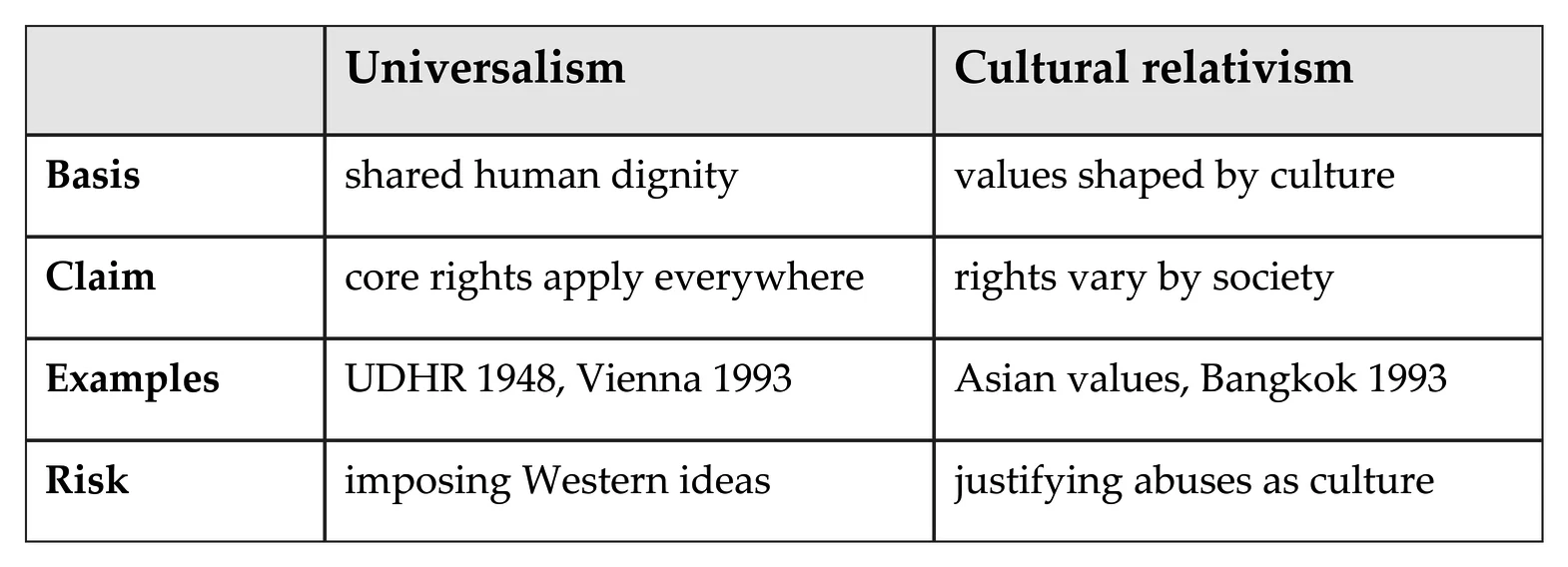
Universalists argue that all human beings share a common dignity and basic needs, so certain rights, such as freedom from torture and slavery, must apply everywhere. The Universal Declaration of 1948 and the Vienna Declaration of 1993 affirmed this universality.
2. Drafting of the Universal Declaration
Universalists point out that the Universal Declaration was drafted by a commission including members from China, Lebanon, Chile, India and other non-Western countries, such as P.C. Chang and Charles Malik, and Hansa Mehta of India, so it was not a purely Western document.
3. The Relativist Position
Cultural relativists argue that moral values are shaped by culture, so there is no single universal standard. Imposing Western ideas of individual rights on societies with different traditions, they argue, is a form of cultural imperialism.
4. The Asian Values Debate
In the 1990s, leaders such as Lee Kuan Yew of Singapore argued that Asian societies valued community, family, order and duty over individual rights. The Bangkok Declaration of Asian states (1993) stressed national and regional particularities, though it accepted the universality of rights.
5. Sen’s Response
Amartya Sen, in Human Rights and Asian Values (1997) and Development as Freedom (1999), argued that Asian traditions, from Ashoka to Akbar, also valued tolerance and freedom, so the claim that Asian values reject human rights is historically false.
6. Bentham’s Positivist Critique
Jeremy Bentham argued that rights exist only when created by law and dismissed natural rights as nonsense upon stilts. Positivists hold that human rights are meaningful only when codified in enforceable law.
7. Marx’s Critique
Karl Marx, in On the Jewish Question (1843), argued that the rights of man were the rights of the egoistic individual separated from community, which protected private property and bourgeois interests rather than true human emancipation.
8. Feminist Critique
Feminists argued that human rights traditionally focused on the public sphere and ignored violations of women in the family, such as domestic violence. The Vienna Declaration of 1993 recognised women’s rights as human rights.
9. Postcolonial Critique
Postcolonial scholars, such as Makau Mutua, argue that human rights discourse often portrays Western states as saviours and non-Western societies as savages and victims, reflecting unequal power relations in the world.
10. A Middle Path
Many scholars, such as Abdullahi An-Na’im, argue for cross-cultural dialogue, finding support for human rights within different traditions, so that rights become universal through local legitimacy rather than imposition.
11. Universality and Diversity
The Vienna Declaration of 1993 accepted that national and regional particularities must be borne in mind, but insisted that states have a duty to promote and protect all human rights regardless of their cultural systems.
12. Indian Perspectives
Indian thinkers have found support for human rights in traditions of dharma, Buddhism and the bhakti movement, while also criticising practices such as caste and untouchability that violate human dignity.
13. Practical Implications
The debate matters in issues such as women’s rights, freedom of expression and the death penalty, where governments sometimes invoke culture to justify restrictions criticised by human rights bodies.
14. The Vienna Compromise
At the Vienna World Conference of 1993, states debated universality intensely. The final declaration accepted that national and regional particularities and various historical, cultural and religious backgrounds must be borne in mind, but insisted that it is the duty of states, regardless of their political, economic and cultural systems, to promote and protect all human rights, a compromise that most states still accept.
15. Overlapping Consensus
Some philosophers, following John Rawls’s idea of an overlapping consensus, argue that people from different religions and cultures can agree on core human rights for different reasons of their own, so universality does not require everyone to share Western liberal philosophy.
16. Evaluation
Most scholars now accept a minimal universalism, in which core rights apply everywhere, combined with respect for cultural diversity in how rights are interpreted and implemented.
Conclusion. Thus, universalists hold that human rights belong to all people because of shared dignity, while cultural relativists, positivists, Marxists, feminists and postcolonial critics question their foundations or neutrality. The best approach combines a core of universal rights with cross-cultural dialogue that roots them in diverse traditions.
Short Notes
(a) Magna Carta
The Great Charter accepted by King John of England in 1215, which limited royal power and declared that no free man could be imprisoned except by the lawful judgment of his peers or the law of the land.
(b) Karel Vasak
The Czech-French jurist who in 1977 classified human rights into three generations, corresponding to liberty, equality and fraternity.
(c) Vienna Declaration (1993)
The declaration adopted at the World Conference on Human Rights in Vienna, which affirmed that all human rights are universal, indivisible, interdependent and interrelated and led to the creation of the UN High Commissioner for Human Rights.
More notes: GE-13 Introduction to Human Rights
These notes are prepared by PADHO TO AISE for study help. They are not an official publication.