
Generic Electives (GE) GE-7 Politics of Globalisation
Unit 4 · 23 min read · Updated 27 Nov 2026
As per the University of Delhi (DU) Generic Elective (GE) syllabus offered by the Department of Political Science
Contents
- 4.1 World Bank, IMF, WTO and G-20
- International Monetary Fund
- World Bank
- World Trade Organization
- G-20
- 4.2 The Globalisation of Trade
- Features of Contemporary Trade
- International Political Economy of Trade
- Recent Trends
- 4.3 Global Epidemics and the World Health Organization
- The World Health Organization
- The WHO and Covid-19
- 4.4 Important Questions
- Examine the role of the IMF and the World Bank in the process of globalisation.
- Discuss the role of the WTO in the globalisation of trade. What are the concerns of developing countries?
- Trace the evolution of the G-20 and examine its role in global economic governance.
- Examine the role of the World Health Organization in managing global epidemics, with special reference to Covid-19.
- Short Notes
एक स्थायी संस्था के माध्यम से अंतरराष्ट्रीय मौद्रिक सहयोग को बढ़ावा देना, जो अंतरराष्ट्रीय मौद्रिक समस्याओं पर परामर्श और सहयोग का तंत्र प्रदान करे।
To promote international monetary cooperation through a permanent institution which provides the machinery for consultation and collaboration on international monetary problems.
— International Monetary Fund, Articles of Agreement, Article I(i)
GGLOBALISATION is not only driven by markets and technology; it is also governed by international institutions. The International Monetary Fund, the World Bank and the World Trade Organization set rules for money, development and trade, while the G-20 coordinates the policies of the major economies. The World Health Organization deals with global health and epidemics, which spread quickly in a connected world. This chapter studies these institutions, the globalisation of trade, and the working of the WHO during global epidemics, showing the multi-dimensionality of globalisation.
4.1 World Bank, IMF, WTO and G-20
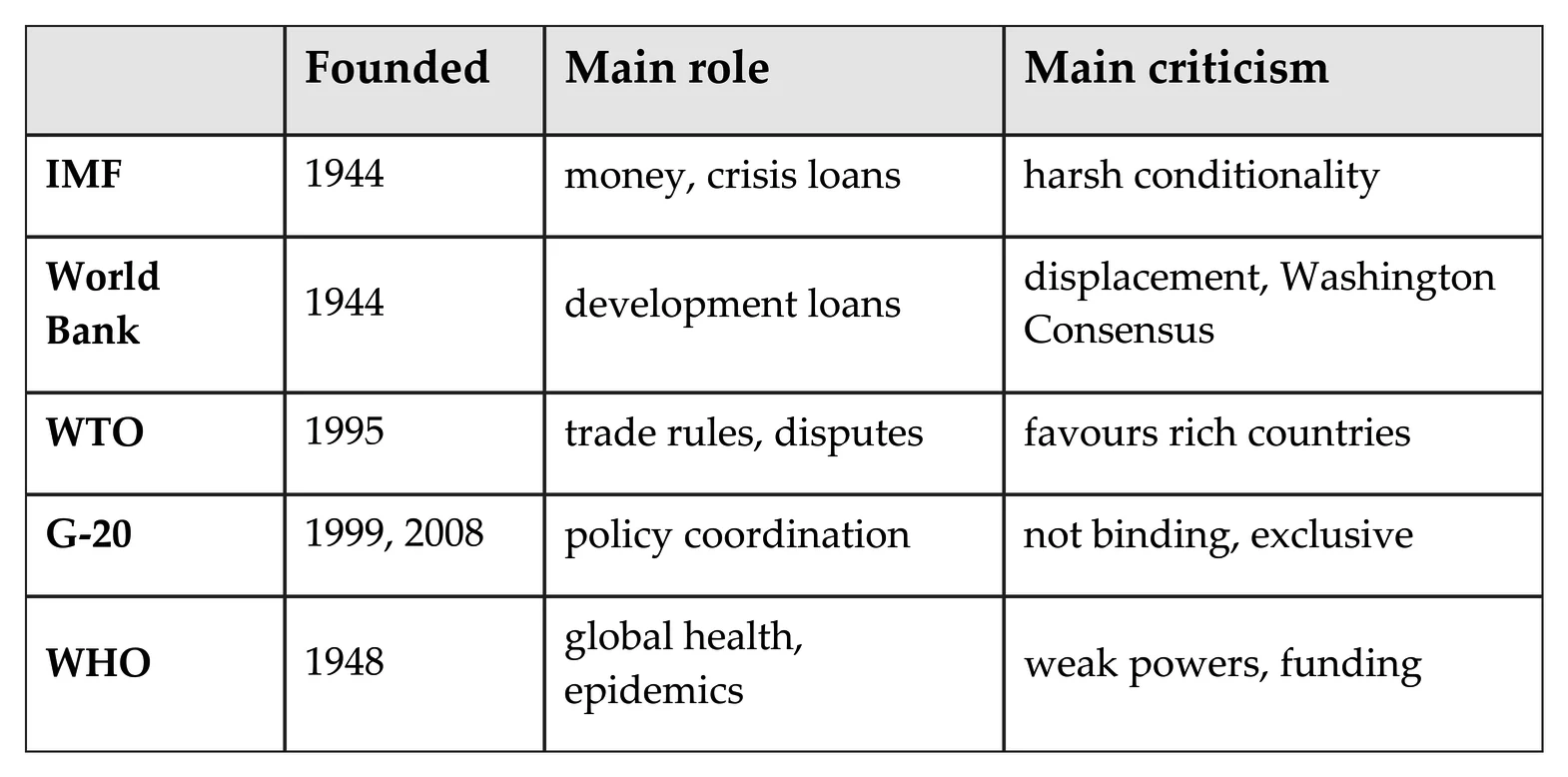
At the Bretton Woods conference in New Hampshire in July 1944, delegates of 44 allied countries, led by John Maynard Keynes of Britain and Harry Dexter White of the United States, designed institutions to prevent a return to the economic chaos of the 1930s. They created the International Monetary Fund and the International Bank for Reconstruction and Development, the core of the World Bank. A planned International Trade Organization failed, and the General Agreement on Tariffs and Trade (GATT) of 1947 governed trade until the WTO was created in 1995.
International Monetary Fund
- Aims. To promote international monetary cooperation, exchange rate stability and balanced growth of trade, and to provide resources to members facing balance of payments problems.
- Functions. Surveillance of members’ economic policies, lending to countries in crisis, and technical assistance; it created Special Drawing Rights in 1969 as an international reserve asset.
- Governance. Voting power depends on quotas based on economic size; the United States holds about one-sixth of the votes, enough to veto major decisions that need an 85% majority. By tradition, its managing director is a European.
- Conditionality. Loans come with conditions, such as fiscal austerity, liberalisation and privatisation. In the 1980s and 1990s, structural adjustment programmes in Latin America, Africa and Asia were criticised for causing hardship.
- India. India borrowed from the IMF during the 1991 crisis, and the loan was linked to economic reforms. The 2010 quota reform, effective in 2016, increased the shares of emerging economies, including India.
World Bank
The World Bank began by financing the reconstruction of Europe and then turned to development in poorer countries. The World Bank Group includes the IBRD, which lends to middle-income countries; the International Development Association (1960), which gives concessional loans and grants to the poorest; the International Finance Corporation; the Multilateral Investment Guarantee Agency; and the International Centre for Settlement of Investment Disputes. By tradition, its president is an American. The Bank promoted the Washington Consensus of market reforms in the 1980s and 1990s, and later emphasised poverty reduction, governance and climate. It was criticised for projects that displaced people; after protests and the Morse Report (1992), it withdrew from the Sardar Sarovar project on the Narmada in 1993.
World Trade Organization
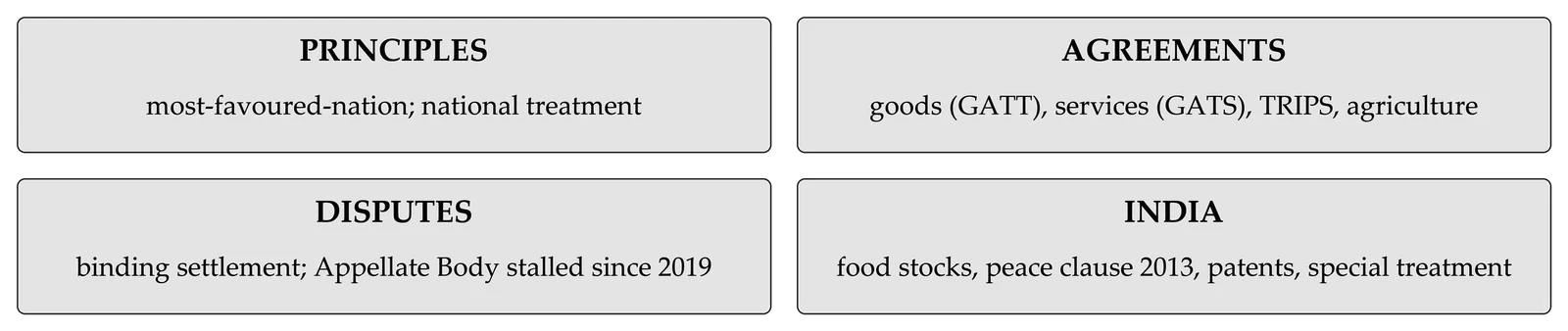
The Uruguay Round of GATT negotiations (1986–94) led to the Marrakesh Agreement, which created the WTO on 1 January 1995. Unlike GATT, the WTO covers not only goods but also services (GATS), intellectual property (TRIPS) and agriculture, and has a binding dispute settlement system. Its core principles are most-favoured-nation treatment (no discrimination among trading partners) and national treatment (no discrimination between imported and domestic goods). Decisions are taken by consensus among its 166 members. The Doha Development Round, launched in 2001 to address developing countries’ concerns, has stalled over agriculture. Since December 2019, the Appellate Body has been unable to function because the United States has blocked new appointments. India has defended the right to maintain public stockholding of food grains for food security, securing a peace clause at Bali in 2013.
G-20
The G-20 brings together 19 countries, the European Union and, since 2023, the African Union, representing most of the world’s economy and population. It began in 1999 as a meeting of finance ministers and central bank governors after the Asian financial crisis, and became a leaders’ summit in 2008 during the global financial crisis. At Pittsburgh in 2009, leaders designated it the premier forum for international economic cooperation. As Dash, Shaw and Khandelwal show, it has evolved from crisis management to broader development cooperation, covering issues such as climate, health, digital economy and debt. India’s presidency in 2023, with the theme Vasudhaiva Kutumbakam: One Earth, One Family, One Future, focused on the Global South, and the New Delhi summit admitted the African Union as a permanent member. The G-20 has no permanent secretariat and its decisions are not binding, which limits its effectiveness.
4.2 The Globalisation of Trade
World trade has grown much faster than world output since 1945, so that trade now forms a large share of global GDP. The liberal case for trade rests on David Ricardo’s theory of comparative advantage: countries gain by specialising in what they produce relatively efficiently and trading for the rest. Successive GATT rounds reduced tariffs, and the WTO extended trade rules to new areas.
Features of Contemporary Trade
- Global value chains. Production is split across countries, so a product may contain parts from many places; much trade is in intermediate goods and within multinational firms.
- Services trade. Trade in services such as software, finance and tourism has grown rapidly; India is a major exporter of IT and business services.
- Regionalism. Regional trade agreements have multiplied, such as the EU, the North American agreement (now USMCA), ASEAN and the Regional Comprehensive Economic Partnership (2020), which India chose not to join in 2019.
- Rise of new powers. China became the world’s largest exporter of goods, and emerging economies have a growing share of world trade.
- Trade and finance. Matthew Watson stresses that global trade is linked with global finance; free capital flows have increased instability, as in the crises of 1997 and 2008.
International Political Economy of Trade
Ngaire Woods explains that international political economy studies how politics shapes economic outcomes and vice versa. Trade policy reflects the interests of powerful states and groups: rich countries protected agriculture while demanding market access in industry and services; intellectual property rules favoured technology owners; and developing countries sought special and differential treatment. Trade creates winners and losers within countries, which explains the political backlash against globalisation in many places.
Recent Trends
Since the 2008 crisis, trade growth has slowed. The US-China trade war from 2018, supply chain disruptions during the Covid-19 pandemic and the Russia-Ukraine war, and policies of friend-shoring and reshoring have changed trade patterns. Countries increasingly use tariffs and export controls for strategic purposes, especially in technology. India has pursued new trade agreements, such as with the UAE and Australia in 2022 and the EFTA countries in 2024, while seeking to become a manufacturing hub through production-linked incentives.
4.3 Global Epidemics and the World Health Organization
Diseases have always travelled along trade and migration routes, but globalisation, with mass air travel, global supply chains and dense cities, allows them to spread faster than ever. Epidemics such as HIV/AIDS, SARS (2003), H1N1 influenza (2009), Ebola (2014–16) and Covid-19 (from 2019) show that health is a global issue requiring international cooperation.
The World Health Organization
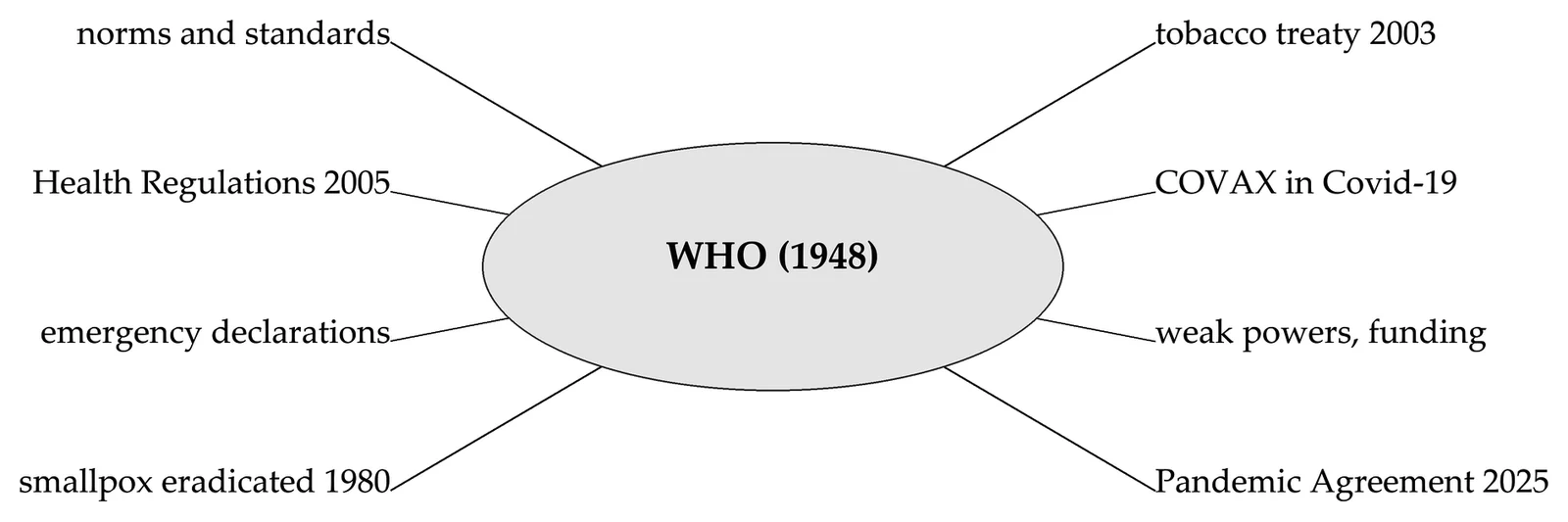
The WHO, a specialised agency of the UN, was founded on 7 April 1948 and is based in Geneva. Its constitution defines health as a state of complete physical, mental and social well-being and not merely the absence of disease or infirmity, and sets the objective of the attainment by all peoples of the highest possible level of health. It is governed by the World Health Assembly of member states and led by a Director-General.
- Setting norms and standards. The WHO issues guidelines on diseases, medicines and health systems, and maintains the International Classification of Diseases.
- International Health Regulations (2005). These binding rules require states to report outbreaks and allow the Director-General to declare a Public Health Emergency of International Concern (PHEIC), as for H1N1 (2009), Ebola (2014 and 2019), Zika (2016), Covid-19 (January 2020) and mpox (2022 and 2024).
- Disease eradication and control. The WHO led the eradication of smallpox, declared in 1980, and leads efforts against polio, tuberculosis, malaria and HIV.
- Treaties. The Framework Convention on Tobacco Control (2003) was its first treaty, and the World Health Assembly adopted a Pandemic Agreement in May 2025.
- Support to countries. It provides technical assistance, coordinates emergency responses and helps strengthen health systems.
The WHO and Covid-19
During the Covid-19 pandemic, the WHO coordinated information, issued guidance and co-led COVAX to distribute vaccines to poorer countries. But it was criticised for being slow to declare an emergency and for relying on information from China. As Kelley Lee and Julianne Piper note, the WHO depends on member states for information, access and funding, and has no power to enforce its rules. Most of its budget comes from voluntary, earmarked contributions from states and private donors rather than assessed contributions, limiting its independence. The United States announced its withdrawal in 2020, reversed it in 2021, and announced withdrawal again in January 2025. Vaccine nationalism by rich countries left poorer countries behind. India supplied vaccines to many countries under Vaccine Maitri (2021) and, with South Africa, proposed a TRIPS waiver for Covid-19 vaccines and medicines in 2020, which led to a limited waiver at the WTO in 2022.
4.4 Important Questions
- Question 1 Examine the role of the IMF and the World Bank in the process of globalisation.
- Question 2 Discuss the role of the WTO in the globalisation of trade. What are the concerns of developing countries?
- Question 3 Trace the evolution of the G-20 and examine its role in global economic governance.
- Question 4 Examine the role of the World Health Organization in managing global epidemics, with special reference to Covid-19.
DU asks the same idea in different words. So learn one broad answer for each question below; the same answer works for every question joined by OR.
Important Question 1
Examine the role of the IMF and the World Bank in the process of globalisation.
OR
Critically evaluate the Bretton Woods institutions.
OR
Discuss the criticism of IMF conditionality and structural adjustment.
Model Answer
“To assist in the reconstruction and development of territories of members by facilitating the investment of capital for productive purposes.”
— IBRD Articles of Agreement, Article I(i) (abridged)
Introduction. The International Monetary Fund and the World Bank, created at Bretton Woods in 1944, are central institutions of the global economy. Originally designed to stabilise currencies and rebuild war-torn economies, they became powerful agents of globalisation, lending to developing countries and promoting market reforms. Their role has been both praised and strongly criticised.
1. The Bretton Woods Conference
In July 1944, 44 countries, led by Keynes and White, created the IMF and the World Bank to prevent a return to the competitive devaluations and protectionism of the 1930s.
2. Aims of the IMF
The IMF promotes international monetary cooperation, exchange rate stability and balanced trade growth, and provides resources to members facing balance of payments problems.
3. Functions of the IMF
The IMF conducts surveillance of members’ policies, lends to countries in crisis and provides technical assistance. It created Special Drawing Rights in 1969 as a reserve asset.
4. Aims of the World Bank
The World Bank began with the reconstruction of Europe and then focused on development lending for infrastructure, agriculture, education and health in poorer countries.
5. The World Bank Group
The group includes the IBRD for middle-income countries, IDA for the poorest, the IFC for private sector lending, MIGA for investment guarantees and ICSID for investment disputes.
6. Governance and Voting
Voting depends on quotas based on economic size, giving the United States effective veto power over major decisions, and by tradition a European heads the IMF and an American the Bank.
7. The Washington Consensus
In the 1980s and 1990s, the two institutions promoted the Washington Consensus of fiscal discipline, liberalisation, privatisation and deregulation as conditions for loans.
8. Structural Adjustment
Structural adjustment programmes in Latin America, Africa and Asia required austerity and market reforms, which critics blamed for cuts in health and education and rising poverty.
9. The East Asian Crisis
During the 1997 crisis, IMF demands for austerity and high interest rates in countries such as Indonesia and South Korea were criticised by Stiglitz for deepening the downturn.
10. India and the IMF
India borrowed from the IMF in 1991, and the loan was linked to economic reforms, marking India’s integration into the global economy.
11. Narmada and the World Bank
After protests by the Narmada Bachao Andolan and the critical Morse Report of 1992, the World Bank withdrew from the Sardar Sarovar project in 1993, showing the influence of social movements.
12. Democratic Deficit
Developing countries, which are most affected by these institutions, have limited voting power, creating a democratic deficit in global economic governance.
13. Reforms
The 2010 quota reform, effective in 2016, increased the voting shares of emerging economies such as China and India, though the United States retains its veto.
14. New Priorities
The institutions now emphasise poverty reduction, governance, social protection and climate finance, and the IMF has accepted some capital controls in certain circumstances.
15. Alternatives
Emerging economies created the New Development Bank of BRICS (2015) and the Asian Infrastructure Investment Bank (2016) as alternatives to Western-dominated institutions.
16. Evaluation
The IMF and World Bank have played major roles in shaping globalisation, but their legitimacy depends on fairer governance and policies sensitive to developing countries’ needs.
Conclusion. Thus, the IMF and World Bank, created at Bretton Woods to stabilise money and finance reconstruction and development, became powerful agents of globalisation through loans and conditionality. Criticism of structural adjustment and their democratic deficit has led to reforms and the rise of alternative institutions.
Important Question 2
Discuss the role of the WTO in the globalisation of trade. What are the concerns of developing countries?
OR
Examine the main features of the globalisation of trade.
OR
Discuss India’s position in the WTO.
Model Answer
“Relations in the field of trade and economic endeavour should be conducted with a view to raising standards of living, ensuring full employment and a large and steadily growing volume of real income and effective demand.”
— Marrakesh Agreement Establishing the World Trade Organization (1994), Preamble
Introduction. Trade is the oldest and most visible dimension of globalisation. Since 1945, world trade has grown faster than world output, supported by the GATT and, since 1995, the World Trade Organization. The WTO sets rules for trade in goods, services and intellectual property, and settles disputes, but developing countries have raised concerns about its fairness.
1. Comparative Advantage
Ricardo’s theory of comparative advantage holds that countries gain by specialising in what they produce relatively efficiently and trading for the rest, the basis of the liberal case for trade.
2. From GATT to WTO
The GATT of 1947 reduced tariffs through rounds of negotiations. The Uruguay Round (1986–94) led to the Marrakesh Agreement and the creation of the WTO on 1 January 1995.
3. Principles of the WTO
The WTO is based on most-favoured-nation treatment, meaning no discrimination among trading partners, and national treatment, meaning no discrimination between imported and domestic goods.
4. Scope of the WTO
Unlike GATT, the WTO covers services through GATS, intellectual property through TRIPS and agriculture through the Agreement on Agriculture, extending trade rules into new areas.
5. Dispute Settlement
The WTO has a binding dispute settlement system, but its Appellate Body has been unable to function since December 2019 because the United States blocked new appointments.
6. Global Value Chains
Contemporary trade is organised in global value chains, with production split across countries and much trade in intermediate goods within multinational firms.
7. Services Trade
Trade in services has grown rapidly, and India has become a major exporter of IT and business services, benefiting from globalisation.
8. Regionalism
Regional agreements such as the EU, USMCA, ASEAN and RCEP have multiplied. India withdrew from RCEP negotiations in 2019, fearing a flood of imports from China.
9. Agriculture
Developing countries argue that rich countries subsidise their farmers heavily while demanding that poor countries open their markets, distorting world agricultural trade.
10. India’s Food Security Concerns
India has defended its right to maintain public stockholding of food grains for food security, securing a peace clause at the Bali ministerial conference in 2013.
11. Intellectual Property
TRIPS strengthened patents, raising concerns about the cost of medicines and seeds in developing countries; India’s patent law protects against evergreening of patents.
12. The Doha Round
The Doha Development Round, launched in 2001 to address developing countries’ concerns, has stalled over disagreements on agriculture and market access.
13. Special and Differential Treatment
Developing countries seek flexibility in implementing WTO rules, but rich countries have questioned whether large emerging economies such as China and India should still receive it.
14. Trade Wars and Protectionism
The US-China trade war from 2018, export controls and strategic tariffs have weakened the multilateral trading system and increased uncertainty.
15. India’s Trade Strategy
India has signed agreements with the UAE and Australia in 2022 and the EFTA countries in 2024, while seeking to boost manufacturing through production-linked incentives.
16. E-Commerce and New Issues
Rich countries have pushed for WTO rules on e-commerce, investment facilitation and digital trade, while India has resisted a permanent moratorium on customs duties on electronic transmissions, arguing that developing countries need policy space and revenue in the digital economy.
17. Fisheries and Recent Outcomes
At the twelfth ministerial conference in Geneva in 2022, members agreed on curbing harmful fisheries subsidies and a limited waiver of patent rules for Covid-19 vaccines, showing that the WTO can still produce agreements despite deep divisions.
18. Evaluation
The WTO has expanded and regulated world trade, but its legitimacy depends on addressing the concerns of developing countries and restoring its dispute settlement system.
Conclusion. Thus, the WTO, created in 1995 to raise living standards through trade, has extended rules to services, intellectual property and agriculture and provided dispute settlement. Developing countries, including India, have raised concerns about agricultural subsidies, TRIPS and the stalled Doha Round, while trade wars threaten the system.
Important Question 3
Trace the evolution of the G-20 and examine its role in global economic governance.
OR
Discuss the significance of India’s G-20 presidency.
OR
Write a note on the G-20.
Model Answer
“We designated the G-20 to be the premier forum for our international economic cooperation.”
— G-20 Leaders’ Statement, Pittsburgh Summit (2009)
Introduction. The G-20 is a forum of the world’s major economies that coordinates policies on global economic issues. It grew out of financial crises, first in Asia in 1997 and then globally in 2008, and has become a key institution of global economic governance. India’s presidency in 2023 highlighted the voice of the Global South.
1. Origins
The G-20 was created in 1999 as a meeting of finance ministers and central bank governors after the Asian financial crisis, to include emerging economies in discussions dominated by the G-7.
2. Membership
The G-20 includes 19 countries, the European Union and, since 2023, the African Union, representing most of the world’s GDP, trade and population.

3. The 2008 Crisis
During the global financial crisis, G-20 leaders met for the first time in Washington in November 2008, agreeing on coordinated stimulus and financial reforms.
4. Premier Forum
At Pittsburgh in 2009, leaders designated the G-20 the premier forum for international economic cooperation, reflecting the shift of economic power towards emerging economies.
5. Crisis Management
The G-20 coordinated stimulus packages, increased IMF resources and created the Financial Stability Board to strengthen financial regulation after 2008.
6. From Crisis to Development
Dash, Shaw and Khandelwal show that the G-20 evolved from crisis management to development cooperation, addressing infrastructure, food security, climate and digital economy.
7. Structure
The G-20 works through a rotating presidency, a troika of past, present and future presidents, a finance track and a sherpa track, and engagement groups of business, labour, youth and civil society.
8. India’s Presidency
India held the presidency from December 2022 to November 2023 under the theme Vasudhaiva Kutumbakam: One Earth, One Family, One Future, holding meetings across the country.
9. Voice of the Global South
India convened the Voice of the Global South summits and pushed for the concerns of developing countries, such as debt, climate finance and multilateral development bank reform.
10. The New Delhi Summit
The New Delhi summit of September 2023 adopted a leaders’ declaration by consensus despite divisions over Ukraine and admitted the African Union as a permanent member.
11. Other Initiatives
India promoted digital public infrastructure, the Global Biofuels Alliance and lifestyle for sustainable development, showcasing its development experience.
12. Strengths
The G-20 is more representative than the G-7, flexible and able to respond quickly to crises, bringing together developed and emerging economies.
13. Weaknesses
It has no permanent secretariat, its decisions are not binding, and geopolitical tensions, such as over Ukraine, make consensus difficult.
14. Legitimacy Concerns
Countries outside the G-20 argue that it is a self-selected club that excludes most of the world’s states, unlike the universal United Nations.
15. Future Role
The G-20 faces challenges such as debt crises, climate finance and the reform of global institutions, which require cooperation among rival powers.
16. G-20 and Debt
During the pandemic, the G-20 launched the Debt Service Suspension Initiative (2020) and the Common Framework for debt treatments, allowing poor countries to delay repayments. Progress has been slow, because creditors such as China and private bondholders have different interests.
17. G-7 and G-20 Compared
The G-7 brings together seven rich democracies with shared values, while the G-20 includes emerging powers such as China, India, Brazil and Saudi Arabia. The rise of the G-20 after 2008 reflected the shift of economic weight towards the emerging economies.
18. India’s Continuing Role
After its presidency, India remained in the troika with Brazil and South Africa, so that three successive Global South presidencies, Indonesia, India and Brazil, followed by South Africa in 2025, kept development issues at the centre of the G-20 agenda.
19. Evaluation
The G-20 has become central to global economic governance, and India’s presidency strengthened its focus on development and the Global South.
Conclusion. Thus, the G-20 evolved from a finance ministers’ forum in 1999 to a leaders’ summit in 2008, designated at Pittsburgh as the premier forum for economic cooperation. It has moved from crisis management to development, and India’s 2023 presidency gave voice to the Global South, though its non-binding nature limits it.
Important Question 4
Examine the role of the World Health Organization in managing global epidemics, with special reference to Covid-19.
OR
Globalisation has made epidemics a global problem. Discuss.
OR
Critically evaluate the working of the WHO.
Model Answer
“Health is a state of complete physical, mental and social well-being and not merely the absence of disease or infirmity.”
— Constitution of the World Health Organization (1946)
Introduction. Globalisation, with mass air travel, global trade and dense cities, allows diseases to spread across the world in days. Epidemics such as SARS, H1N1, Ebola and Covid-19 have shown that health is a global issue. The World Health Organization, founded in 1948, is the main international institution for global health, but the Covid-19 pandemic exposed both its importance and its limitations.
1. Globalisation and Disease
Diseases have always travelled along trade routes, as the Black Death did, but today’s connectivity allows them to spread faster and further than ever before.
2. Recent Epidemics
HIV/AIDS, SARS (2003), H1N1 (2009), Ebola (2014–16), Zika (2016) and Covid-19 (from 2019) have shown the need for international cooperation on health.
3. Foundation of the WHO
The WHO was founded on 7 April 1948 as a specialised UN agency based in Geneva, with the goal of the highest possible level of health for all peoples.
4. Structure
The WHO is governed by the World Health Assembly of member states, which elects the Director-General, and works through regional offices across the world.
5. Norms and Standards
The WHO sets standards on diseases, medicines and health systems and maintains the International Classification of Diseases used worldwide.
6. International Health Regulations
The International Health Regulations (2005) require states to report outbreaks and allow the Director-General to declare a Public Health Emergency of International Concern.
7. Successes
The WHO led the eradication of smallpox, declared in 1980, and has made major progress against polio, and its Framework Convention on Tobacco Control (2003) has reduced smoking.
8. Covid-19 Response
The WHO declared Covid-19 a PHEIC on 30 January 2020 and a pandemic in March 2020, issued guidance and co-led COVAX to share vaccines with poorer countries.
9. Criticism of Delay
Critics argued that the WHO was slow to declare an emergency and relied too heavily on information provided by China in the early weeks of the outbreak.
10. Limited Powers
Lee and Piper note that the WHO depends on member states for information and access and cannot enforce its rules, so its effectiveness depends on their cooperation.
11. Funding Problems
Most of the WHO’s budget comes from voluntary, earmarked contributions by states and private donors, limiting its independence and ability to set priorities.
12. Politics and Withdrawal
The United States announced its withdrawal from the WHO in 2020, reversed it in 2021 and announced withdrawal again in January 2025, showing the politicisation of global health.
13. Vaccine Nationalism
Rich countries secured most early vaccine supplies, leaving poorer countries behind, and COVAX could not deliver doses as quickly as planned.
14. India’s Role
India supplied vaccines to many countries under Vaccine Maitri (2021) and, with South Africa, proposed a TRIPS waiver in 2020, leading to a limited waiver at the WTO in 2022.
15. Reforms
The World Health Assembly adopted a Pandemic Agreement in May 2025 to improve prevention, preparedness and equitable access to vaccines and medicines.
16. One Health
The WHO, with the Food and Agriculture Organization and other agencies, promotes the One Health approach, recognising that the health of people, animals and ecosystems is linked, since most new infectious diseases, such as Covid-19 and avian flu, come from animals.
17. Health Inequality
Global health is marked by deep inequalities: poorer countries have fewer doctors, weaker health systems and less access to medicines and vaccines. Pandemics deepen these gaps, which is why equity is central to the WHO’s mission of health for all.
18. Evaluation
The WHO is indispensable for global health, but it needs stronger powers, sustainable funding and the cooperation of states to manage future pandemics.
Conclusion. Thus, globalisation has made epidemics global problems, and the WHO, committed to health as complete well-being, sets norms, coordinates responses and declares emergencies. Covid-19 exposed its limited powers, funding problems and politicisation, making reforms such as the 2025 Pandemic Agreement essential.
Short Notes
(a) Washington Consensus
The set of market-oriented policies, such as fiscal discipline, liberalisation, privatisation and deregulation, promoted by the IMF, World Bank and US Treasury from the 1980s.
(b) Most-favoured-nation principle
The WTO principle that a trade advantage given to one member must be given to all members, so that there is no discrimination among trading partners.
(c) Public Health Emergency of International Concern
A declaration by the WHO Director-General under the International Health Regulations that an outbreak poses a risk to other countries and requires a coordinated response.
More notes: GE-7 Politics of Globalisation
These notes are prepared by PADHO TO AISE for study help. They are not an official publication.