
Generic Electives (GE) GE-7 Politics of Globalisation
Unit 2 · 23 min read · Updated 27 Nov 2026
As per the University of Delhi (DU) Generic Elective (GE) syllabus offered by the Department of Political Science
Contents
- 2.1 Eurocentrism and the Question of Post-Coloniality
- Colonialism and the Making of the Modern World
- Post-Colonial Theory
- Post-Coloniality and Globalisation
- 2.2 Modernity beyond Europe: Chatterjee and Multiple Modernities
- Partha Chatterjee: Our Modernity
- Multiple Modernities
- Contesting Modernity in South Asia
- Indian Responses
- 2.3 Making Sense of Globalisation for the People at the Margins
- Vandana Shiva: Ecology and Globalisation
- Local Resistance: Jaiv Panchayat
- The Dark Side of Globalisation: Human Trafficking
- Other Margins
- 2.4 Important Questions
- Is globalisation a Eurocentric project? Discuss with reference to post-colonial perspectives.
- Discuss Partha Chatterjee’s idea of our modernity. How does it challenge Eurocentric views of globalisation?
- How does globalisation affect people at the margins? Discuss with reference to Vandana Shiva.
- Discuss human trafficking as the dark side of globalisation. Examine the actors and activities of the anti-trafficking movement.
- Short Notes
पूर्व (ओरिएंट) लगभग एक यूरोपीय आविष्कार था।
The Orient was almost a European invention.
— Edward W. Said, Orientalism (1978)
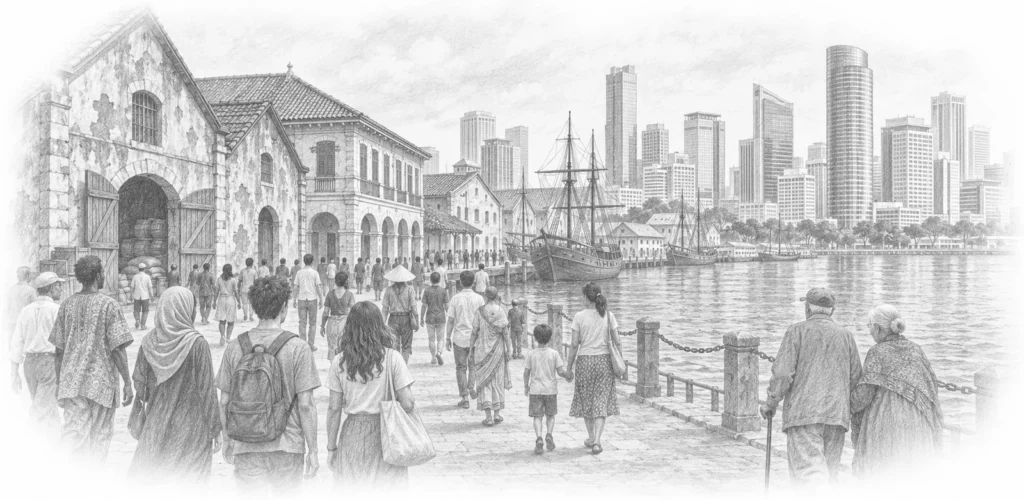
IIS globalisation simply the spread of Western, European modernity across the world? Many accounts of globalisation tell its story from the standpoint of Europe and North America, treating Western institutions, values and lifestyles as the universal model that others must follow. Post-colonial thinkers challenge this Eurocentric view, showing how colonialism shaped the modern world and how non-European voices have been marginalised. This chapter examines the question of post-coloniality and asks how globalisation looks from the standpoint of people at the margins: farmers, Adivasis, women, informal workers and victims of trafficking.

2.1 Eurocentrism and the Question of Post-Coloniality
Eurocentrism is the tendency to view the world from the standpoint of Europe (and the West more broadly), treating European history, institutions and values as the universal norm and other societies as backward or lacking. In accounts of globalisation, Eurocentrism appears in the idea that globalisation is the spread of Western modernity, of markets, the nation-state, science, democracy and consumer culture, from the West to the rest. Critics call this Westernisation or Americanisation, and ask whether it is the only path to the modern world.
Colonialism and the Making of the Modern World
Post-colonial scholars stress that the modern global order was shaped by European colonialism. From the sixteenth century, colonial conquest, the slave trade and the extraction of resources linked the world in unequal ways. India’s textile industry was destroyed while Britain industrialised, and Dadabhai Naoroji’s drain theory described the transfer of wealth from India to Britain. Andre Gunder Frank, in ReOrient (1998), and John Hobson, in The Eastern Origins of Western Civilisation (2004), argued that Asia, especially China and India, was at the centre of the world economy before 1800, and that the rise of the West drew on Eastern ideas, technologies and resources. The story of globalisation as a purely European achievement is therefore misleading.
Post-Colonial Theory
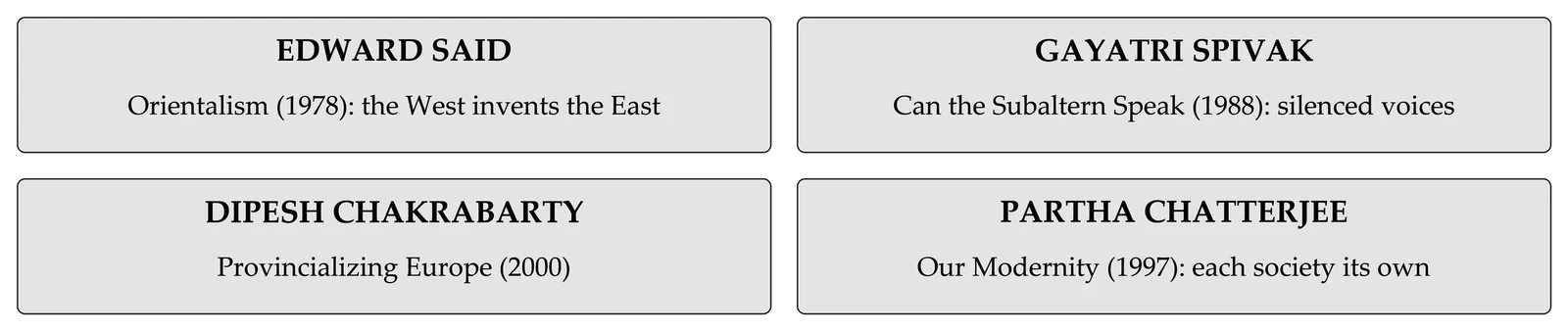
- Edward Said. In Orientalism (1978), Said showed how Western scholarship, literature and art constructed the East as exotic, irrational and inferior, a construction that justified colonial rule.
- Gayatri Chakravorty Spivak. In Can the Subaltern Speak? (1988), she argued that the voices of the most marginalised, especially poor women in colonised societies, are silenced both by colonial and by nationalist elite discourses.
- Homi Bhabha. He described colonial encounters as producing hybridity and ambivalence rather than simple domination, as colonised people adapted and subverted colonial culture.
- Dipesh Chakrabarty. In Provincializing Europe (2000), he argued that Europe remains the silent reference point of all histories, and that European thought, though indispensable, is inadequate for understanding non-Western experiences.
- Ashcroft, Griffiths and Tiffin. In The Empire Writes Back (1989), they showed how writers from former colonies use and transform the coloniser’s language to tell their own stories.
- Decolonial thinkers. Latin American scholars such as Aníbal Quijano and Walter Mignolo speak of the coloniality of power, the persistence of colonial hierarchies of race, knowledge and economy after formal independence.
Post-Coloniality and Globalisation
From a post-colonial standpoint, contemporary globalisation often reproduces older hierarchies. International institutions dominated by Western powers set rules for trade, finance and intellectual property; Western media and universities shape global knowledge; and developing countries are expected to adopt Western models of governance and development. At the same time, the Global South has resisted and reshaped globalisation: through the Bandung Conference (1955), the Non-Aligned Movement, the demand for a New International Economic Order (1974), and today through the rise of China and India and groupings such as BRICS. Post-coloniality thus raises the question: whose globalisation, and on whose terms?
2.2 Modernity beyond Europe: Chatterjee and Multiple Modernities
Partha Chatterjee: Our Modernity
In his lecture Our Modernity (1997), Partha Chatterjee asked what modernity means for people who were colonised. He noted that for Europeans, modernity was associated with reason, freedom and progress, but for the colonised, modernity came through colonial rule, as an alien imposition tied to domination. Hence colonised societies have an ambivalent relationship with modernity: they desire its benefits, such as science, rights and democracy, but resist its colonial form. Chatterjee argued that there is not one universal modernity: each society must fashion its own modernity in its own way, drawing on its traditions and history. He noted that Indian nationalists created their own modernity by distinguishing an outer material domain, where they accepted Western science and institutions, from an inner spiritual domain of culture and family, which they claimed as their own.
Multiple Modernities
The sociologist S.N. Eisenstadt proposed the idea of multiple modernities (2000), arguing that modernity is not the same as Westernisation, and that different societies have developed distinct forms of modernity shaped by their cultures and histories. Japan, India, China and the Islamic world have all become modern in different ways. This view challenges the Eurocentric assumption that all societies will converge on a single Western model.
Contesting Modernity in South Asia
Sanjeev Kumar H.M., in Contesting Modernity: Crisis of Democratization in South Asia (2008), argued that the imposition of Western models of the nation-state and democracy in South Asia, without regard to local social structures and traditions, has produced recurring crises of democratisation: military rule, ethnic conflict, authoritarianism and weak institutions. He suggested that democracy in South Asia must be rooted in local contexts and negotiate between tradition and modernity, rather than simply copying Western forms.
Indian Responses
Indian thinkers have long debated modernity. Gandhi’s Hind Swaraj (1909) criticised modern Western civilisation for its materialism and violence, and proposed self-rule based on simplicity and village self-reliance. Nehru embraced science, industry and planning while stressing India’s distinct civilisation. Rabindranath Tagore criticised aggressive nationalism and sought a meeting of East and West. Ambedkar saw modern constitutional democracy as a means to overcome caste hierarchy. These debates show that Indians have engaged with modernity creatively rather than simply accepting or rejecting it.
2.3 Making Sense of Globalisation for the People at the Margins
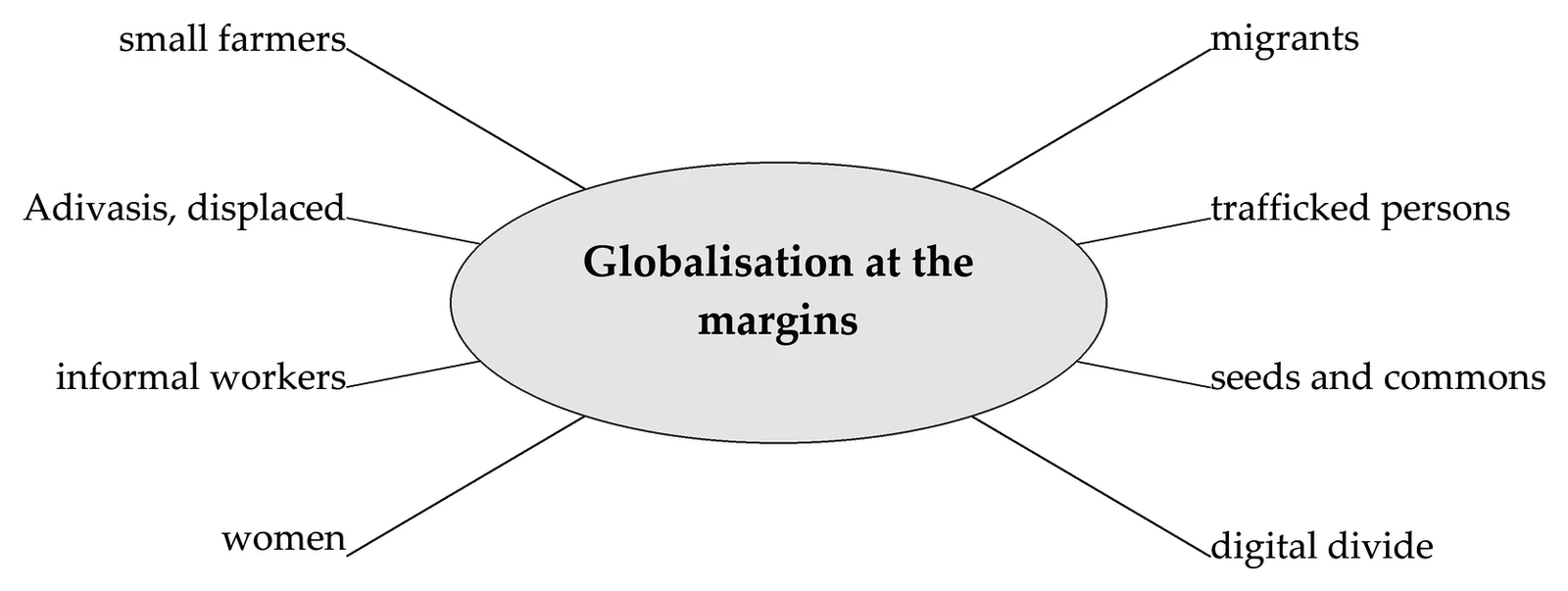
Globalisation looks very different from the standpoint of those at the margins of society. For the poor, women, Adivasis, Dalits, small farmers, informal workers and migrants, globalisation has brought some opportunities but also new forms of insecurity and exploitation. Amartya Sen reminds us that development must be judged by the freedoms it brings to the most deprived.
Vandana Shiva: Ecology and Globalisation
Vandana Shiva, in Ecological Balance in an Era of Globalization, argued that corporate globalisation threatens ecological balance and the livelihoods of those who depend directly on nature. She described it as a new enclosure of the commons, in which land, water, seeds and biodiversity are turned into private property controlled by corporations. She criticised the WTO’s TRIPS agreement for allowing patents on life, which enable biopiracy, the appropriation of traditional knowledge; India successfully challenged patents on neem, turmeric and basmati rice. She founded Navdanya to conserve native seeds and promoted earth democracy, based on the rights of communities and the living earth.
Local Resistance: Jaiv Panchayat
The Research Foundation for Science, Technology and Ecology promoted Jaiv Panchayats (living democracy) in villages, in which communities registered their biodiversity and traditional knowledge and asserted their collective rights over local resources against patents and corporate control. Gustavo Esteva and Madhu Suri Prakash, in From Global to Local, argued that people at the grassroots resist global neo-liberalism by regenerating their own local spaces, economies and cultures.
The Dark Side of Globalisation: Human Trafficking
Globalisation has also expanded illicit flows of drugs, arms, money and people. Human trafficking, the recruitment and movement of people by force, fraud or coercion for exploitation, is one of its darkest sides. The UN Palermo Protocol (2000) defined trafficking and committed states to the 3Ps: prevention, protection of victims and prosecution of traffickers, later adding partnership. Kirsten Foot, in her study of the anti-human trafficking movement, showed that it involves many actors, governments, international organisations, NGOs, faith groups, businesses and survivors, engaged in activities such as awareness campaigns, rescue and rehabilitation, legal advocacy and research. She found that collaboration among these actors is essential but difficult, because of differences in goals, ideologies and resources. In India, trafficking affects women and children from poor regions and communities, and laws such as the Immoral Traffic (Prevention) Act, 1956 and Section 370 of the Indian Penal Code (now in the Bharatiya Nyaya Sanhita) address it.
Other Margins
- Small farmers. Exposure to global price fluctuations, rising input costs and debt have contributed to agrarian distress.
- Informal workers. Global production chains rely on low-paid, insecure workers; Guy Standing calls this growing class the precariat.
- Adivasis and the displaced. Mining, dams and industrial projects linked to global markets have displaced tribal communities from their lands.
- Women. Women are concentrated in low-paid export industries and care work, while also gaining new employment opportunities.
- Digital divide. Those without access to technology are excluded from the opportunities of the digital economy.
2.4 Important Questions
- Question 1 Is globalisation a Eurocentric project? Discuss with reference to post-colonial perspectives.
- Question 2 Discuss Partha Chatterjee’s idea of our modernity. How does it challenge Eurocentric views of globalisation?
- Question 3 How does globalisation affect people at the margins? Discuss with reference to Vandana Shiva.
- Question 4 Discuss human trafficking as the dark side of globalisation. Examine the actors and activities of the anti-trafficking movement.
DU asks the same idea in different words. So learn one broad answer for each question below; the same answer works for every question joined by OR.
Important Question 1
Is globalisation a Eurocentric project? Discuss with reference to post-colonial perspectives.
OR
Examine the post-colonial critique of globalisation.
OR
Discuss the relationship between colonialism and globalisation.
Model Answer
“Europe remains the sovereign, theoretical subject of all histories, including the ones we call Indian, Chinese, Kenyan, and so on.”
— Dipesh Chakrabarty, Provincializing Europe (2000)
Introduction. Many accounts present globalisation as the spread of Western modernity, its markets, nation-states, science and culture, across the world. Post-colonial thinkers challenge this Eurocentric view. They show that the modern world was shaped by colonialism, that non-European societies contributed to global history, and that contemporary globalisation often reproduces colonial hierarchies. They ask whose globalisation it is and on whose terms.
1. Meaning of Eurocentrism
Eurocentrism is the tendency to see European history, institutions and values as the universal norm, and other societies as backward or lacking what Europe has.
2. Globalisation as Westernisation
Eurocentric accounts see globalisation as the spread of Western modernity from the West to the rest, so that non-Western societies are expected to follow the Western path.
3. Colonialism and the Modern World
Post-colonial scholars stress that colonial conquest, the slave trade and resource extraction created an unequal global order from the sixteenth century onwards.
4. India’s Experience
India’s textile industry declined under colonial rule while Britain industrialised. Dadabhai Naoroji’s drain theory described the transfer of India’s wealth to Britain.
5. Asia at the Centre
Andre Gunder Frank in ReOrient and John Hobson argued that Asia was at the centre of the world economy before 1800, and that the rise of the West drew on Eastern ideas and resources.
6. Said’s Orientalism
Edward Said showed how Western knowledge constructed the East as exotic and inferior, a construction that justified colonial domination and still shapes images of the non-West.
7. Spivak and the Subaltern
Spivak asked whether the subaltern can speak, arguing that the voices of the most marginalised, especially poor women, are silenced by both colonial and elite nationalist discourses.
8. Bhabha and Hybridity
Homi Bhabha described colonial encounters as producing hybridity and ambivalence, as colonised people adapted and subverted colonial culture rather than simply absorbing it.
9. Chakrabarty
Dipesh Chakrabarty argued that Europe remains the silent reference point of all histories, and called for provincialising Europe by recognising the limits of European categories.
10. Coloniality of Power
Quijano and Mignolo argued that colonial hierarchies of race, knowledge and economy persist after independence, shaping contemporary globalisation.
11. Institutions and Rules
International institutions dominated by Western powers set rules on trade, finance and intellectual property, often limiting the policy space of developing countries.
12. Knowledge and Culture
Western media, universities and languages dominate global knowledge and culture, marginalising non-Western languages and traditions of thought.
13. Resistance of the Global South
The Bandung Conference (1955), the Non-Aligned Movement and the demand for a New International Economic Order (1974) were efforts by the Global South to reshape the world order.
14. The Rising South
The rise of China and India and groupings such as BRICS show that globalisation is no longer only Western, as new centres of power shape its direction.
15. Limits of the Critique
Critics argue that post-colonial theory can overlook the benefits of science and democracy and the agency of non-Western elites who embraced globalisation.
16. Development Discourse
Post-development thinkers such as Arturo Escobar argued that the very idea of development after 1945 was a Western discourse that defined Asia, Africa and Latin America as underdeveloped and in need of Western expertise. Programmes of modernisation, he argued, often ignored local knowledge and imposed Western models of progress.
17. Language and Knowledge
The dominance of English in global business, science and the internet gives native speakers and English-educated elites an advantage, while knowledge produced in other languages is often ignored. Ngũgĩ wa Thiong’o called for decolonising the mind by writing in African languages, a debate that also echoes in India over English and Indian languages.
18. Evaluation
Globalisation has Eurocentric roots and features, but it is increasingly contested and reshaped by non-Western societies and actors.
Conclusion. Thus, post-colonial thinkers such as Said, Spivak, Bhabha and Chakrabarty show that globalisation has been shaped by colonialism and Eurocentric knowledge, treating Europe as the subject of all histories. Yet the resistance and rise of the Global South show that globalisation can be reshaped on more equal terms.
Important Question 2
Discuss Partha Chatterjee’s idea of our modernity. How does it challenge Eurocentric views of globalisation?
OR
Is there one modernity or many? Discuss.
OR
Examine the crisis of democratisation in South Asia in the context of contested modernity.
Model Answer
“The idea of multiple modernities presumes that the best way to understand the contemporary world… is to see it as a story of continual constitution and reconstitution of a multiplicity of cultural programs.”
— S.N. Eisenstadt, Multiple Modernities (2000)
Introduction. Modernity is often identified with the West, and globalisation with the spread of Western modernity. Partha Chatterjee and other scholars question this. They argue that colonised societies experienced modernity differently, through colonial domination, and that each society must fashion its own modernity. This challenges the Eurocentric view that all societies will converge on a single Western model.
1. Modernity and the West
European thinkers associated modernity with reason, science, individual freedom, secularism and the nation-state, and saw Europe as its birthplace and model.
2. Modernity under Colonialism
Chatterjee pointed out that for the colonised, modernity arrived through colonial rule, tied to domination and humiliation, so it was experienced as an alien imposition.
3. Ambivalence
Colonised societies have an ambivalent relationship with modernity: they desire its benefits, such as science, rights and democracy, but resist its colonial and Western form.
4. Our Modernity
In Our Modernity (1997), Chatterjee argued that there is no single universal modernity; each society must create its own, drawing on its history and traditions.
5. Material and Spiritual Domains
Chatterjee showed that Indian nationalists accepted Western science and institutions in the material domain while claiming sovereignty over the spiritual domain of culture, religion and family.
6. Multiple Modernities
Eisenstadt argued that modernity is not Westernisation and that societies such as Japan, India and China have developed distinct forms of modernity.
7. Challenge to Convergence
The multiple modernities view challenges modernisation theory, which assumed that all societies would converge on the Western model of development and democracy.
8. Gandhi’s Critique
Gandhi’s Hind Swaraj (1909) rejected modern Western civilisation as materialistic and violent, proposing swaraj based on simplicity, self-reliance and moral restraint.
9. Nehru and Tagore
Nehru embraced science and planning while valuing India’s civilisation, and Tagore sought a meeting of East and West while criticising aggressive nationalism.
10. Ambedkar
Ambedkar saw modern constitutional democracy, rights and education as tools to overcome caste hierarchy, showing that modernity could be emancipatory for the oppressed.
11. Contested Modernity in South Asia
Sanjeev Kumar H.M. argued that the imposition of Western models of state and democracy in South Asia, without regard to local structures, produced recurring crises of democratisation.
12. Examples of Crisis
Military rule in Pakistan and Bangladesh, ethnic conflict in Sri Lanka and political instability in Nepal illustrate the difficulties of transplanting Western models.
13. Rooting Democracy Locally
He suggested that democracy in South Asia must negotiate between tradition and modernity, drawing on local institutions and values rather than copying Western forms.
14. Implications for Globalisation
If there are many modernities, globalisation need not mean Westernisation; societies can engage with global flows while shaping their own paths.
15. Criticism
Critics warn that appeals to distinct modernities can be used to justify authoritarianism or reject universal human rights in the name of culture.
16. Nationalism as a Derivative Discourse
In Nationalist Thought and the Colonial World (1986), Chatterjee argued that Indian nationalism was a derivative discourse: it challenged colonial rule but used the same categories of reason, progress and the nation-state that colonialism had introduced. This explains the ambivalence of post-colonial modernity, which resists the West while borrowing its forms.
17. Political Society
Chatterjee later distinguished civil society, the domain of educated citizens who deal with the state through rights and law, from political society, where the poor and marginalised negotiate with the state through mobilisation and informal arrangements. This shows that democracy in India works differently from the Western model.
18. Evaluation
Chatterjee’s idea of our modernity opens space for non-Western societies to define modernity for themselves, while requiring care to preserve universal values of freedom and equality.
Conclusion. Thus, Chatterjee argued that colonised societies experienced modernity as an imposition and must fashion their own modernity, as Indian nationalists did. With Eisenstadt’s idea of multiple modernities and the South Asian experience, this challenges the Eurocentric view that globalisation means convergence on a single Western model.
Important Question 3
How does globalisation affect people at the margins? Discuss with reference to Vandana Shiva.
OR
Examine the ecological critique of globalisation.
OR
Discuss the impact of globalisation on farmers, Adivasis and informal workers.
Model Answer
“Earth provides enough to satisfy every man’s needs, but not every man’s greed.”
— M.K. Gandhi, as recorded by Pyarelal in Mahatma Gandhi: The Last Phase (1958)
Introduction. Globalisation looks different from the standpoint of the margins. For small farmers, Adivasis, women, informal workers and migrants, it has brought some opportunities but also displacement, insecurity and loss of control over resources. Vandana Shiva’s ecological critique shows how corporate globalisation threatens both nature and the livelihoods of those who depend directly on it.
1. Who Are the Margins
People at the margins are those excluded from power and resources: the poor, small farmers, Adivasis, Dalits, women, informal workers, migrants and the displaced.
2. Shiva’s Ecological Critique
Vandana Shiva argued that corporate globalisation threatens ecological balance by treating nature as a commodity and concentrating control over land, water, seeds and biodiversity.
3. Enclosure of the Commons
Shiva described globalisation as a new enclosure, turning common resources such as water, forests and seeds into private property, excluding communities that depended on them.
4. Patents on Life
She criticised the WTO’s TRIPS agreement for allowing patents on seeds and living organisms, which threaten farmers’ rights to save and exchange seeds.
5. Biopiracy
Biopiracy is the appropriation of traditional knowledge and biological resources through patents. India successfully challenged foreign patents on neem, turmeric and basmati rice.
6. Navdanya and Earth Democracy
Shiva founded Navdanya to conserve native seeds and promote organic farming, and advocated earth democracy based on the rights of communities and the living earth.
7. Jaiv Panchayat
Jaiv Panchayats allowed villages to register their biodiversity and traditional knowledge, asserting collective rights over local resources against corporate control.
8. From Global to Local
Esteva and Prakash argued that people at the grassroots resist global neo-liberalism by regenerating local economies, cultures and commons.
9. Small Farmers
Exposure to global price fluctuations, rising input costs and debt have contributed to agrarian distress among small farmers in India.
10. Adivasis and Displacement
Mining, dams and industrial projects linked to global markets have displaced Adivasi communities, as in the struggles at Niyamgiri and in central India.
11. Informal Workers
Global production chains rely on low-paid, insecure workers without social protection; Guy Standing calls this growing class the precariat.
12. Women
Women are concentrated in low-paid export industries and care work, though globalisation has also opened new jobs and opportunities for them.
13. The Digital Divide
Those without access to digital technology and skills are excluded from the opportunities of the digital economy, deepening existing inequalities.
14. Opportunities at the Margins
Globalisation has also created jobs, remittances, access to information and global solidarity networks that marginalised groups can use to press their claims.
15. Sen’s Perspective
Amartya Sen argues that globalisation should be judged by whether it expands the freedoms and capabilities of the most deprived, not only by aggregate growth.
16. Water and Privatisation
Shiva and other activists also opposed the privatisation of water and the extraction of groundwater by bottling plants. The protests against a soft drinks plant at Plachimada in Kerala in the early 2000s, led by Adivasi women, forced its closure and became a symbol of local resistance to corporate control over natural resources.
17. Indian Law on Biodiversity
India’s Biological Diversity Act of 2002 and the Protection of Plant Varieties and Farmers’ Rights Act of 2001 sought to protect traditional knowledge and farmers’ right to save, use and exchange seeds, showing how national law can respond to the concerns raised by critics of corporate globalisation.
18. Evaluation
For people at the margins, globalisation has been a mixed experience, and their voices must shape how it is governed if it is to be just.
Conclusion. Thus, Vandana Shiva shows how corporate globalisation encloses the commons, patents life and threatens ecological balance, while farmers, Adivasis, informal workers and women face new insecurities. Gandhi’s reminder that the earth provides for need, not greed, captures the ecological critique of globalisation from the margins.
Important Question 4
Discuss human trafficking as the dark side of globalisation. Examine the actors and activities of the anti-trafficking movement.
OR
Write a note on the anti-human trafficking movement.
OR
Examine the illicit dimensions of globalisation.
Model Answer
“Trafficking in persons shall mean the recruitment, transportation, transfer, harbouring or receipt of persons, by means of the threat or use of force or other forms of coercion… for the purpose of exploitation.”
— UN Palermo Protocol (2000), Article 3 (abridged)
Introduction. Globalisation has expanded not only legal flows of trade and people but also illicit flows of drugs, arms, money and human beings. Human trafficking, the movement of people by force, fraud or coercion for exploitation, is one of the darkest sides of globalisation. A global movement of governments, international organisations and civil society has emerged to combat it.
1. The Dark Side of Globalisation
Open borders, cheap transport, digital communication and global demand for cheap labour and sex have made it easier for criminal networks to operate across borders.
2. Meaning of Trafficking
The Palermo Protocol of 2000 defines trafficking as the recruitment, transport or harbouring of persons by force, fraud or coercion for exploitation, including sexual exploitation and forced labour.

3. Forms of Trafficking
Trafficking includes sexual exploitation, forced and bonded labour, domestic servitude, child labour, forced marriage and organ trafficking.
4. Causes
Poverty, unemployment, gender discrimination, conflict, natural disasters and demand for cheap labour make people vulnerable to traffickers’ false promises.
5. Scale
UN agencies estimate that millions of people are in forced labour worldwide, and women and children are a large share of detected trafficking victims.
6. The 3Ps
The Palermo Protocol committed states to prevention, protection of victims and prosecution of traffickers; a fourth P, partnership, was later added.
7. Kirsten Foot’s Study
Kirsten Foot studied the anti-human trafficking movement, mapping its many actors and activities and examining how they collaborate.
8. Actors: Governments and IGOs
Governments pass laws and train police, while international organisations such as the UN Office on Drugs and Crime and the International Organization for Migration coordinate efforts.
9. Actors: NGOs and Faith Groups
NGOs and faith-based groups conduct rescues, run shelters and rehabilitation programmes and advocate for victims’ rights.
10. Actors: Businesses and Survivors
Businesses are urged to remove forced labour from supply chains, and survivors increasingly lead advocacy and shape policy.
11. Activities
Anti-trafficking activities include awareness campaigns, research, rescue and rehabilitation, legal aid, prosecution of traffickers and campaigns for supply chain transparency.
12. Challenges of Collaboration
Foot found that collaboration is difficult because actors differ in goals, ideologies and resources, for example over whether all sex work should be treated as trafficking.
13. Trafficking in India
In India, women and children from poor regions are trafficked for sexual exploitation and labour, and bonded labour persists in brick kilns and agriculture.
14. Indian Laws
The Immoral Traffic (Prevention) Act of 1956, Article 23 of the Constitution prohibiting traffic in human beings, and provisions of the criminal law address trafficking.
15. Other Illicit Flows
Globalisation has also expanded drug trafficking, arms smuggling, money laundering and cybercrime, requiring international cooperation through bodies such as the Financial Action Task Force.
16. Technology and Trafficking
Traffickers increasingly use social media, fake job advertisements and online platforms to recruit victims, while technology also helps anti-trafficking efforts through databases, hotlines and the tracking of financial flows. This shows how the same tools of globalisation can serve both exploitation and protection.
17. SAARC and Regional Cooperation
Since trafficking in South Asia often crosses borders, especially from Nepal and Bangladesh into India, the SAARC Convention on Preventing and Combating Trafficking in Women and Children for Prostitution (2002) and bilateral agreements seek to improve cooperation in rescue, repatriation and prosecution.
18. Evaluation
Human trafficking shows that globalisation benefits criminals as well as businesses, and combating it requires global cooperation that puts victims’ rights first.
Conclusion. Thus, human trafficking, defined by the Palermo Protocol as the movement of persons by force or coercion for exploitation, is the dark side of globalisation. Kirsten Foot shows that the anti-trafficking movement involves many actors in prevention, protection, prosecution and partnership, though collaboration among them remains difficult.
Short Notes
(a) Orientalism
Edward Said’s term for the Western way of representing the East as exotic, irrational and inferior, which justified colonial domination.
(b) Biopiracy
The appropriation of traditional knowledge and biological resources of communities through patents by corporations, criticised by Vandana Shiva.
(c) Multiple modernities
S.N. Eisenstadt’s idea that modernity takes different forms in different societies and is not the same as Westernisation.
More notes: GE-7 Politics of Globalisation
These notes are prepared by PADHO TO AISE for study help. They are not an official publication.