
Generic Electives (GE) GE-7 Politics of Globalisation
Unit 1 · 23 min read · Updated 27 Nov 2026
As per the University of Delhi (DU) Generic Elective (GE) syllabus offered by the Department of Political Science
Contents
- 1.1 Is Globalisation New? Historical Perspectives
- Archaic and Early Globalisation
- Proto-Globalisation and Colonialism
- The First Modern Wave, 1870–1914
- Deglobalisation and the Bretton Woods Era
- Contemporary Globalisation
- 1.2 Approaches to Understanding Globalisation
- Hyperglobalists
- Sceptics
- Transformationalists
- Other Key Concepts
- Dimensions of Globalisation
- 1.3 The Globalisation Debate
- Arguments for Globalisation
- Arguments against Globalisation
- Keohane and Nye: What Is New
- Deglobalisation and Reglobalisation
- 1.4 Important Questions
- Is globalisation a new phenomenon? Discuss with reference to its historical evolution.
- Discuss the main approaches to the study of globalisation.
- Critically examine the arguments for and against globalisation.
- Examine Keohane and Nye’s analysis of globalism. Is the world moving towards deglobalisation or reglobalisation?
- Short Notes
वैश्वीकरण को विश्वव्यापी सामाजिक संबंधों के ऐसे सघन होने के रूप में परिभाषित किया जा सकता है जो दूर-दराज़ के स्थानों को इस तरह जोड़ता है कि स्थानीय घटनाएँ मीलों दूर घटने वाली घटनाओं से आकार पाती हैं, और इसका उल्टा भी होता है।
Globalisation can thus be defined as the intensification of worldwide social relations which link distant localities in such a way that local happenings are shaped by events occurring many miles away and vice versa.
— Anthony Giddens, The Consequences of Modernity (1990)
TTHE phone in your pocket is designed in one country, assembled in another from parts made in a dozen more, and runs on software written across continents. The news you read, the music you hear and the jobs available in your city are all shaped by events far away. This growing interconnectedness of the world is called globalisation. This chapter asks whether globalisation is new, examines the main approaches to understanding it, and explains the debate between its supporters and critics, including recent arguments about deglobalisation and reglobalisation.

1.1 Is Globalisation New? Historical Perspectives
Globalisation refers to the process by which the world becomes more interconnected through flows of goods, capital, people, information, ideas and culture across national borders. Anthony Giddens defined it as the intensification of worldwide social relations that link distant localities, so that local events are shaped by events far away. David Held and Anthony McGrew describe it as the widening, deepening and speeding up of worldwide interconnectedness. But is this process new? Scholars give different answers, and George Ritzer and Paul Dean note that the date we give to the start of globalisation depends on how we define it.
Archaic and Early Globalisation
Long-distance connections are very old. The Silk Road linked China with Central Asia, India, Persia and the Mediterranean for over a thousand years. The Indian Ocean trade connected East Africa, Arabia, India and South-East Asia, and Roman coins found in South India show trade with the Roman Empire. The spread of religions such as Buddhism, Christianity and Islam, and of diseases such as the Black Death in the fourteenth century, also linked distant regions. Some historians therefore argue that globalisation has existed in some form for millennia.
Proto-Globalisation and Colonialism
From the late fifteenth century, European voyages of discovery, beginning with Columbus in 1492 and Vasco da Gama’s arrival in India in 1498, created truly worldwide connections. The Columbian exchange moved crops, animals, people and diseases between the Americas, Europe and Africa. Trading companies such as the English East India Company (1600) and the Dutch East India Company (1602) built global trade networks, while the Atlantic slave trade forcibly moved millions of Africans. This phase was closely tied to colonialism, which subordinated Asia, Africa and Latin America to European powers.
The First Modern Wave, 1870–1914
Between about 1870 and 1914, steamships, railways and the telegraph reduced the costs of trade and communication; the gold standard stabilised currencies; and large flows of capital and migrants crossed the oceans. John Maynard Keynes described how a Londoner in 1914 could order goods from the whole world by telephone and invest his wealth anywhere. Hirst and Thompson argued that in some respects the international economy was more open in this period than in the late twentieth century, in terms of trade and capital flows relative to output, and especially migration.
Deglobalisation and the Bretton Woods Era
The two world wars and the Great Depression of the 1930s reversed globalisation, as countries raised tariffs and restricted capital and migration. After 1945, the Bretton Woods system created the IMF, the World Bank and the GATT (1947), and fixed exchange rates tied to the US dollar. Trade grew rapidly among Western countries, but capital flows were controlled and the socialist bloc remained largely separate.
Contemporary Globalisation
From the 1970s, the collapse of fixed exchange rates (1971), the rise of neo-liberalism, deregulation of finance, the information and communication revolution, the end of the Cold War (1989–91), China’s opening from 1978 and India’s reforms of 1991, and the creation of the WTO in 1995 produced a new and more intense wave. What is distinctive today is the speed, scale and density of connections, the role of transnational corporations and global production chains, the near-instant movement of finance, and the spread of the internet and social media. So globalisation is not entirely new, but its contemporary form differs in degree and in kind.
1.2 Approaches to Understanding Globalisation
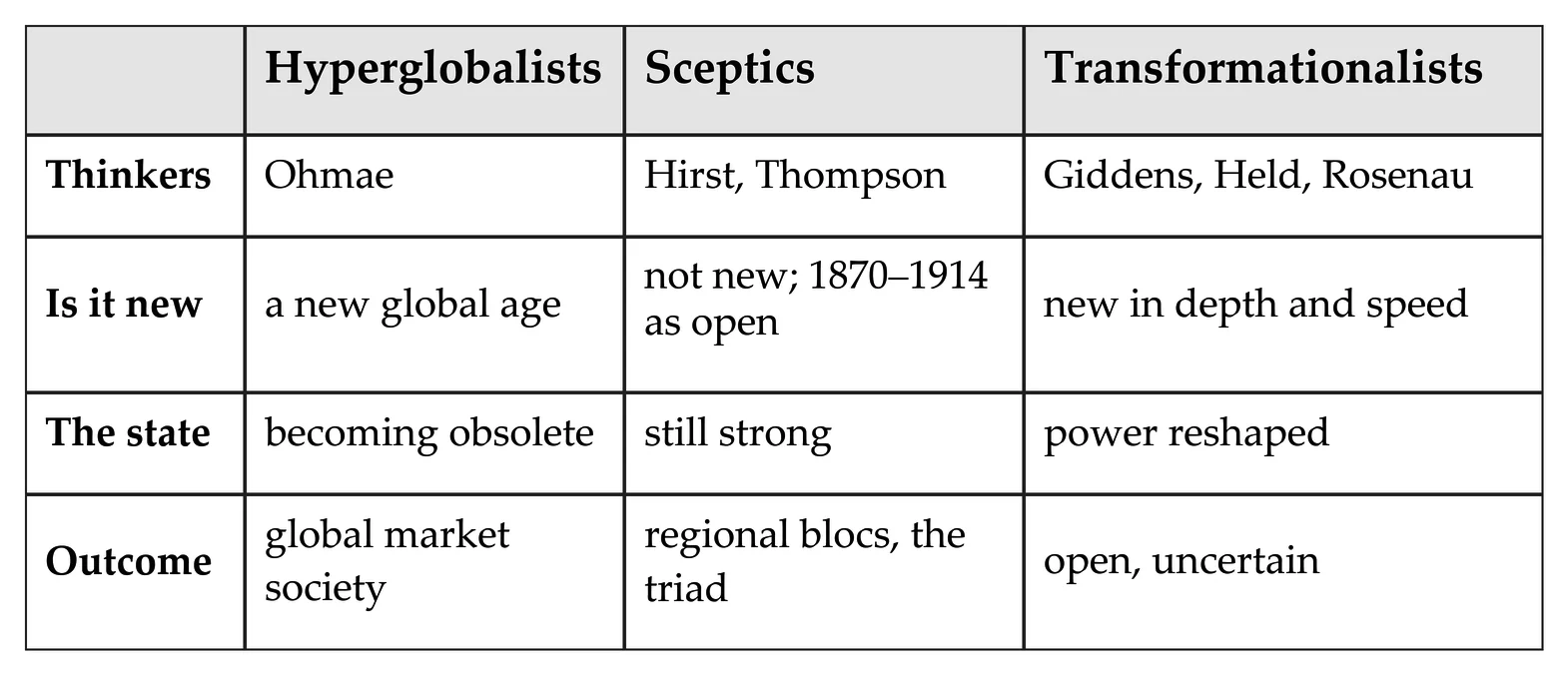
David Held, Anthony McGrew, David Goldblatt and Jonathan Perraton, in Global Transformations (1999), identified three main schools of thought on globalisation: the hyperglobalists, the sceptics and the transformationalists.
Hyperglobalists
Hyperglobalists argue that globalisation marks a new epoch in human history, in which national states are becoming obsolete. Kenichi Ohmae, in The End of the Nation State (1995), argued that in a borderless world, global markets and corporations matter more than states, and that region-states would replace nation-states as economic units. Neo-liberal hyperglobalists welcome this as the triumph of markets, while some radical hyperglobalists see it as the triumph of global capitalism over workers. Both agree that the power of states is declining.
Sceptics
Sceptics such as Paul Hirst and Grahame Thompson argue that globalisation is largely a myth. They point out that the world economy was as open before 1914; that most trade and investment are concentrated among a triad of Europe, North America and East Asia, so the economy is international or regional rather than truly global; that most corporations remain rooted in their home countries; and that states remain powerful and can regulate markets if they choose. For them, talk of globalisation is often used to justify neo-liberal policies.
Transformationalists
Transformationalists such as Anthony Giddens, David Held and James Rosenau argue that globalisation is a real and powerful force that is transforming societies and states, but its outcomes are open and uncertain. States are not disappearing, but their power and functions are being reconstituted as they share authority with international institutions, regional bodies and non-state actors. Globalisation produces both integration and fragmentation, winners and losers, and its direction is shaped by politics.
Other Key Concepts
- Time-space compression. David Harvey (1989) argued that capitalism speeds up life and overcomes spatial barriers, so the world seems to shrink.
- Compression of the world. Roland Robertson described globalisation as the compression of the world and the intensification of consciousness of the world as a whole; he also coined glocalisation, the adaptation of global products and ideas to local contexts.
- McDonaldization. George Ritzer (1993) argued that the principles of the fast-food restaurant, efficiency, calculability, predictability and control, are spreading across societies, leading to cultural homogenisation.
- Scapes. Arjun Appadurai, in Modernity at Large (1996), described global cultural flows as five scapes: ethnoscapes, mediascapes, technoscapes, financescapes and ideoscapes, which create disjunctures rather than uniformity.
- World-systems theory. Immanuel Wallerstein saw globalisation as the expansion of a capitalist world-system divided into core, semi-periphery and periphery.
Dimensions of Globalisation
Globalisation is multi-dimensional. Its economic dimension includes trade, investment, finance and production networks; its political dimension includes international institutions, global governance and the changing role of states; its cultural dimension includes the spread of media, consumer culture, languages and ideas; its technological dimension includes the internet and digital platforms; and its ecological dimension includes climate change and pandemics that cross borders.
1.3 The Globalisation Debate
Arguments for Globalisation
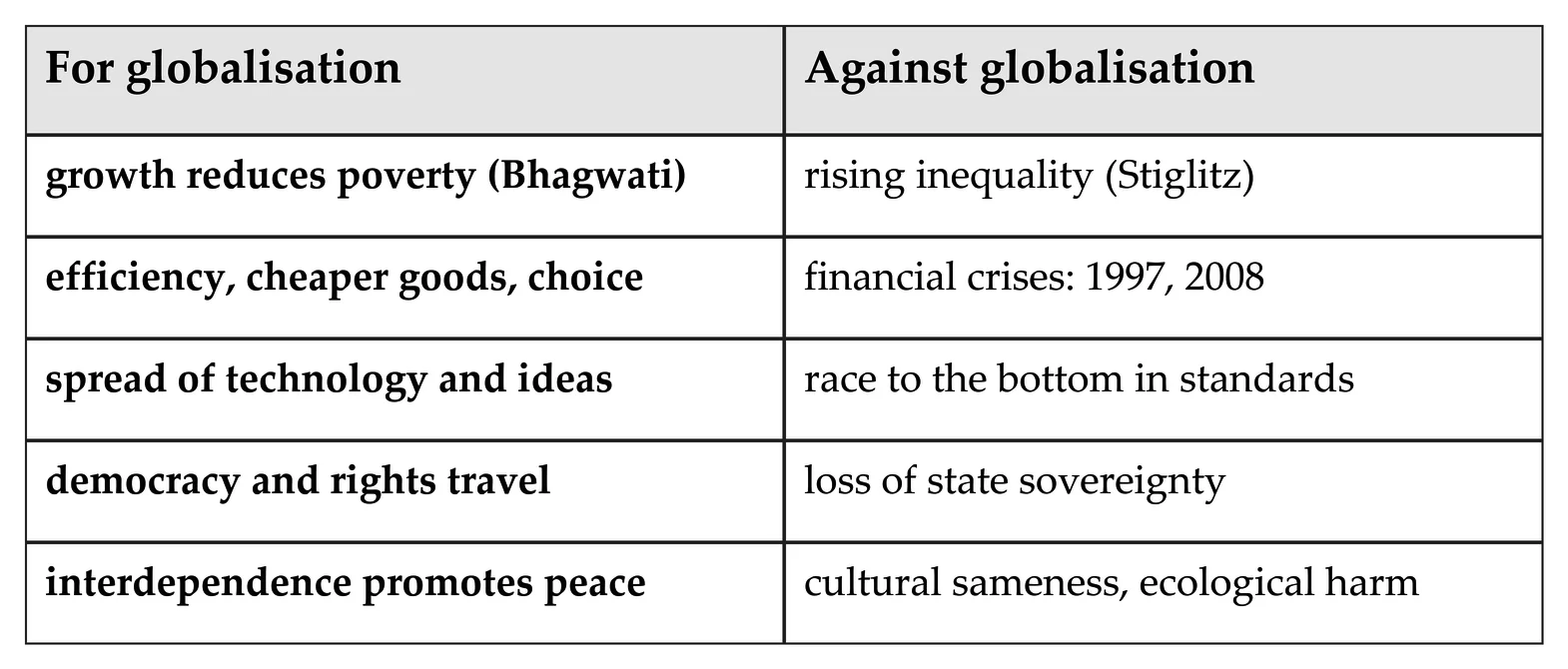
- Growth and poverty reduction. Jagdish Bhagwati, in In Defense of Globalization (2004), argued that trade and openness promote growth, which reduces poverty; the rapid growth of China and India after opening up is often cited.
- Efficiency and choice. Free trade allows countries to specialise according to comparative advantage, lowering prices and widening consumer choice.
- Technology and knowledge. Globalisation spreads technology, ideas and skills, as Thomas Friedman argued in The World Is Flat (2005).
- Democracy and rights. Global communication spreads ideas of democracy, human rights and gender equality.
- Cooperation. Interdependence encourages peaceful cooperation and makes war costly.
Arguments against Globalisation
- Inequality. Joseph Stiglitz, in Globalization and Its Discontents (2002), argued that globalisation, managed by the IMF and the US Treasury in the interests of rich countries and finance, has hurt many of the world’s poor and increased inequality.
- Instability. Free capital flows caused financial crises such as the East Asian crisis of 1997 and the global financial crisis of 2008.
- Race to the bottom. Competition for investment pressures states to cut wages, taxes and environmental standards.
- Loss of sovereignty. International institutions and markets limit the policy choices of states, especially developing countries.
- Cultural homogenisation. Global media and consumer culture threaten local cultures and languages.
- Environmental damage. Global production and consumption increase emissions and resource use.
Keohane and Nye: What Is New
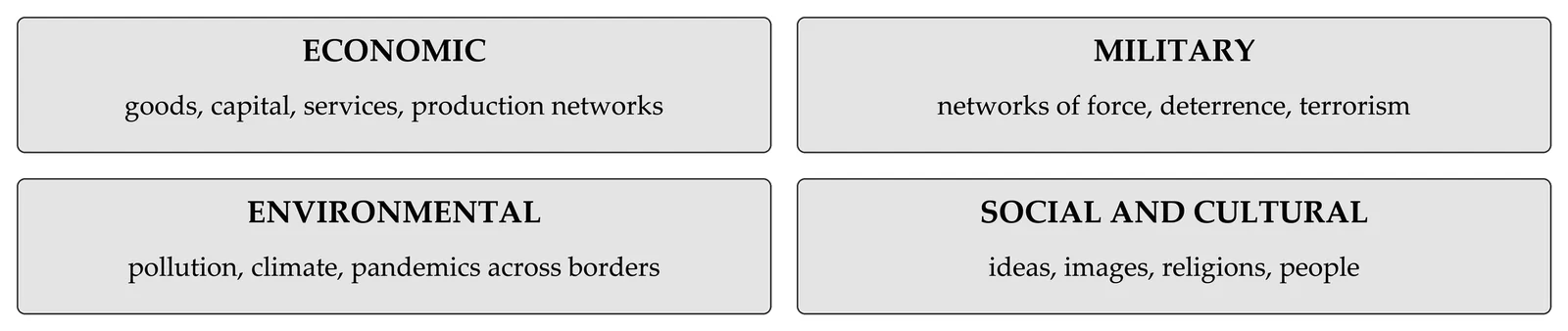
Robert Keohane and Joseph Nye, in Globalization: What’s New? What’s Not? (And So What?) (2000), distinguished globalism, a state of the world involving networks of interdependence at multicontinental distances, from globalisation, the increase of globalism. They identified economic, military, environmental and social and cultural globalism, and argued that globalism is old, but contemporary globalism is thicker: networks are denser, institutional velocity (the speed of change) is greater and transnational participation is wider. They warned that globalism can also decline, as it did after 1914.
Deglobalisation and Reglobalisation
Since the 2008 financial crisis, trade growth has slowed, and events such as Brexit (2016), the US-China trade war (from 2018), the Covid-19 pandemic and the Russia-Ukraine war (2022) have disrupted supply chains and revived economic nationalism. Some scholars speak of deglobalisation or slowbalisation. Matthew Louis Bishop and Anthony Payne (2020) argue instead for reglobalisation: globalisation is not ending but being reshaped, with states playing a larger role, supply chains being regionalised, and new powers such as China shaping its rules. India’s policy of Atmanirbhar Bharat (2020) and debates on localisation versus globalisation reflect this shift, as countries seek to combine global integration with national resilience.
1.4 Important Questions
- Question 1 Is globalisation a new phenomenon? Discuss with reference to its historical evolution.
- Question 2 Discuss the main approaches to the study of globalisation.
- Question 3 Critically examine the arguments for and against globalisation.
- Question 4 Examine Keohane and Nye’s analysis of globalism. Is the world moving towards deglobalisation or reglobalisation?
DU asks the same idea in different words. So learn one broad answer for each question below; the same answer works for every question joined by OR.
Important Question 1
Is globalisation a new phenomenon? Discuss with reference to its historical evolution.
OR
Trace the historical evolution of globalisation.
OR
Globalisation is as old as human history. Discuss.
Model Answer
“The inhabitant of London could order by telephone, sipping his morning tea in bed, the various products of the whole earth, in such quantity as he might see fit, and reasonably expect their early delivery upon his doorstep.”
— John Maynard Keynes, The Economic Consequences of the Peace (1919)
Introduction. Globalisation, the growing interconnectedness of the world, is often described as a recent phenomenon of the late twentieth century. But historians and social scientists disagree about its origins. Some trace it to ancient trade routes, others to European expansion after 1492 or to the late nineteenth century. Examining its history helps us see what is new and what is old about contemporary globalisation.
1. Meaning of Globalisation
Giddens defines globalisation as the intensification of worldwide social relations linking distant localities, while Held and McGrew describe it as the widening, deepening and speeding up of worldwide interconnectedness.
2. The Question of Origins
Ritzer and Dean note that the date assigned to the beginning of globalisation depends on its definition. A broad definition finds it in ancient times; a narrow one sees it as recent.
3. Ancient Trade Networks
The Silk Road linked China with India, Persia and the Mediterranean, and the Indian Ocean trade connected Africa, Arabia, India and South-East Asia. Roman coins found in South India show early long-distance trade.
4. Spread of Religions and Diseases
Buddhism spread from India across Asia, and Christianity and Islam spread across continents. The Black Death of the fourteenth century travelled along trade routes, showing early global connections.
5. European Expansion after 1492
The voyages of Columbus in 1492 and Vasco da Gama in 1498 created worldwide connections. The Columbian exchange moved crops, animals, people and diseases between continents.
6. Trading Companies and Colonialism
The English and Dutch East India Companies built global trade networks, and colonialism subordinated Asia, Africa and Latin America to Europe, shaping an unequal world economy.
7. The Slave Trade
The Atlantic slave trade forcibly moved millions of Africans to the Americas, showing that early globalisation was built on coercion and exploitation.
8. The First Modern Wave
From 1870 to 1914, steamships, railways, the telegraph and the gold standard created a highly integrated world economy, with large flows of trade, capital and migrants.
9. Hirst and Thompson’s Argument
Hirst and Thompson argued that the world economy before 1914 was in some respects more open than today, especially in migration, so contemporary globalisation is not unprecedented.
10. Deglobalisation, 1914–1945
The world wars and the Great Depression reversed globalisation as countries raised tariffs and restricted capital and migration, showing that globalisation can be reversed.
11. The Bretton Woods Era
After 1945, the IMF, World Bank and GATT supported trade growth among Western countries under fixed exchange rates, while capital flows remained controlled.
12. Contemporary Globalisation
From the 1970s, floating exchange rates, neo-liberalism, financial deregulation, the end of the Cold War, the opening of China and India, and the WTO in 1995 produced a new wave.
13. The Technological Revolution
The internet, mobile phones and container shipping made communication instant and transport cheap, allowing global production chains and real-time financial flows.
14. What Is New
Contemporary globalisation is distinguished by its speed, scale and density, the dominance of transnational corporations, near-instant financial flows and global digital networks.
15. What Is Old
Long-distance trade, migration, the spread of ideas and diseases, and unequal power relations between regions are old features that continue in new forms.
16. Evaluation
Globalisation is both old and new: it has deep historical roots, but its contemporary form differs in intensity and character from earlier periods.
Conclusion. Thus, globalisation has a long history, from ancient trade routes and European expansion to the first modern wave of 1870–1914, which Keynes vividly described. Contemporary globalisation is new in its speed, scale and density, but it continues older patterns of connection and inequality.
Important Question 2
Discuss the main approaches to the study of globalisation.
OR
Examine the views of hyperglobalists, sceptics and transformationalists on globalisation.
OR
What is globalisation? Explain its different dimensions.
Model Answer
“The widening, deepening and speeding up of worldwide interconnectedness in all aspects of contemporary social life.”
— David Held, Anthony McGrew, David Goldblatt and Jonathan Perraton, Global Transformations (1999)
Introduction. Globalisation is one of the most debated concepts in the social sciences. Scholars disagree about its nature, extent and consequences. Held, McGrew and their colleagues classified the main positions into three schools: the hyperglobalists, who see a new global age; the sceptics, who doubt that anything fundamentally new is happening; and the transformationalists, who see deep but uncertain change.
1. Defining Globalisation
Held and McGrew define globalisation as the widening, deepening and speeding up of worldwide interconnectedness, while Giddens stresses the linking of distant localities so that local events are shaped by distant ones.
2. The Hyperglobalist Thesis
Hyperglobalists argue that globalisation marks a new epoch in which national states are becoming obsolete, as global markets and corporations dominate economic life.
3. Kenichi Ohmae
In The End of the Nation State (1995), Ohmae argued that the world has become borderless and that region-states, not nation-states, are the natural economic units.
4. Variants of Hyperglobalism
Neo-liberal hyperglobalists welcome the triumph of markets, while radical hyperglobalists see the triumph of global capital over workers. Both see the state’s power declining.
5. The Sceptical Thesis
Sceptics such as Hirst and Thompson argue that globalisation is largely a myth, used to justify neo-liberal policies, and that the world economy is international rather than global.
6. Evidence of the Sceptics
They point out that the economy was as open before 1914, that trade and investment are concentrated in a triad of Europe, North America and East Asia, and that corporations remain rooted in home countries.
7. States Remain Strong
Sceptics argue that states retain the power to regulate markets and that regional blocs, rather than a single global economy, are the main trend.
8. The Transformationalist Thesis
Transformationalists such as Giddens, Held and Rosenau argue that globalisation is real and powerful, transforming societies and states, but its outcomes are open and uncertain.
9. Reconstituted State Power
States are not disappearing, but their power is being reshaped as they share authority with international institutions, regional bodies and non-state actors in multi-level governance.
10. Integration and Fragmentation
Transformationalists note that globalisation produces both integration and fragmentation, inclusion and exclusion, creating new hierarchies of winners and losers.
11. Time-Space Compression
David Harvey argued that capitalism compresses time and space, speeding up economic and social life, so that the world seems to shrink.
12. Robertson and Glocalisation
Roland Robertson saw globalisation as the compression of the world and the growth of global consciousness, and coined glocalisation for the blending of global and local.
13. Ritzer and Appadurai
Ritzer’s McDonaldization stresses homogenisation, while Appadurai’s five scapes of people, media, technology, finance and ideas stress disjuncture and diversity in global cultural flows.
14. World-Systems Theory
Wallerstein saw globalisation as the expansion of a capitalist world-system divided into core, semi-periphery and periphery, highlighting inequality.
15. Dimensions of Globalisation
Globalisation has economic, political, cultural, technological and ecological dimensions, which interact and advance at different speeds.
16. Theoretical Lenses in International Relations
Liberals see globalisation as increasing interdependence and cooperation; realists argue that states remain the main actors and that globalisation depends on the power of the dominant state, the United States after 1945; Marxists see it as the expansion of capitalism; and constructivists stress how shared ideas, such as neo-liberalism, made globalisation seem natural and inevitable.
17. Evaluation
The transformationalist view offers the most balanced account, recognising real change while avoiding the exaggerations of hyperglobalists and the denials of sceptics.
Conclusion. Thus, hyperglobalists see a borderless world in which states are obsolete, sceptics see an international economy dominated by states and regional blocs, and transformationalists see a real but uncertain transformation of states and societies. Globalisation, as Held and McGrew say, is the widening, deepening and speeding up of interconnectedness in all aspects of life.
Important Question 3
Critically examine the arguments for and against globalisation.
OR
Has globalisation benefited the poor? Discuss.
OR
Discuss the globalisation debate with reference to Bhagwati and Stiglitz.
Model Answer
“Globalization today is not working for many of the world’s poor. It is not working for much of the environment. It is not working for the stability of the global economy.”
— Joseph E. Stiglitz, Globalization and Its Discontents (2002)
Introduction. Globalisation has produced intense debate. Supporters argue that it promotes growth, reduces poverty and spreads technology and ideas. Critics argue that it increases inequality, causes instability, weakens states and damages cultures and the environment. Economists Jagdish Bhagwati and Joseph Stiglitz represent two influential positions in this debate.
1. The Liberal Case
Liberal economists argue that free trade allows countries to specialise according to comparative advantage, increasing efficiency, output and consumer welfare.
2. Bhagwati’s Defence
In In Defense of Globalization (2004), Bhagwati argued that globalisation has a human face: trade promotes growth, and growth reduces poverty, child labour and gender inequality.
3. Growth in Asia
The rapid growth of China after 1978 and India after 1991, which lifted hundreds of millions out of poverty, is often cited as evidence of the benefits of openness.
4. Technology and Knowledge
Globalisation spreads technology, skills and knowledge. Thomas Friedman argued in The World Is Flat (2005) that digital technology allows people everywhere to compete and collaborate.
5. Democracy and Rights
Global communication spreads ideas of democracy, human rights and gender equality, and global civil society can pressure repressive governments.
6. Peace through Interdependence
Liberals argue that economic interdependence makes war costly and encourages cooperation among states through international institutions.
7. Stiglitz’s Critique
In Globalization and Its Discontents (2002), Stiglitz argued that globalisation, as managed by the IMF and the US Treasury, served rich countries and financial interests rather than the poor.
8. Inequality
Critics note rising inequality within many countries, as gains have gone to skilled workers, capital owners and urban areas, while unskilled workers and farmers have lost out.
9. Financial Instability
Free capital flows contributed to the East Asian crisis of 1997 and the global financial crisis of 2008, which caused severe hardship in many countries.
10. Race to the Bottom
Competition for investment pressures states to lower wages, taxes and labour and environmental standards, weakening protections for workers.
11. Loss of Sovereignty
International institutions, trade rules and global markets limit the policy choices of states, especially developing countries dependent on loans and investment.
12. Cultural Homogenisation
Critics fear that global media and consumer culture, dominated by Western corporations, threaten local cultures, languages and ways of life.
13. Environmental Costs
Global production and consumption increase carbon emissions and resource use, and Vandana Shiva argues that globalisation threatens ecological balance and the livelihoods of the poor.
14. India’s Experience
India’s growth since 1991 has reduced poverty and created a large middle class, but it has also increased regional and income inequality and agrarian distress.
15. Managing Globalisation
Many scholars, including Stiglitz, argue for globalisation with fair rules, social protection, regulation of finance and policy space for developing countries.
16. Evaluation
Globalisation is neither wholly good nor wholly bad; its effects depend on how it is governed and on the policies adopted by states.
Conclusion. Thus, supporters such as Bhagwati argue that globalisation promotes growth, poverty reduction and the spread of ideas, while critics such as Stiglitz argue that it has not worked for many of the world’s poor, causing inequality and instability. The challenge is to govern globalisation fairly.
Important Question 4
Examine Keohane and Nye’s analysis of globalism. Is the world moving towards deglobalisation or reglobalisation?
OR
Discuss the dimensions of globalism according to Keohane and Nye.
OR
Write a note on reglobalisation.
Model Answer
“Globalism is a state of the world involving networks of interdependence at multicontinental distances.”
— Robert O. Keohane and Joseph S. Nye Jr., Globalization: What’s New? What’s Not? (And So What?) (2000)
Introduction. Robert Keohane and Joseph Nye offered an influential framework for understanding what is new about contemporary globalisation. They distinguished globalism as a condition from globalisation as a process, and identified its dimensions. Recent events have raised the question whether globalisation is reversing, or being reshaped into a new form described as reglobalisation.
1. Globalism and Globalisation
Keohane and Nye defined globalism as a state of the world involving networks of interdependence at multicontinental distances, and globalisation as the increase of globalism.
2. Interdependence and Globalism
Interdependence refers to mutual dependence between actors, while globalism refers specifically to networks spanning continents, not just regional or bilateral links.
3. Economic Globalism
Economic globalism involves long-distance flows of goods, services, capital and information, and the organisation of markets and production across continents.
4. Military Globalism
Military globalism refers to long-distance networks of force and threat, such as nuclear deterrence during the Cold War and global terrorism.
5. Environmental Globalism
Environmental globalism refers to the long-distance transport of materials and biological substances that affect health and the environment, such as ozone depletion and pandemics.
6. Social and Cultural Globalism
Social and cultural globalism involves the movement of ideas, information, images and people, including religions, knowledge and popular culture.
7. Globalism Is Old
Keohane and Nye argued that globalism is not new: the Silk Road, the spread of religions and nineteenth-century empires were forms of globalism.
8. Thick Globalism
What is new is thick globalism: networks are denser and more intersecting, so that events in one area affect many others, as in the financial crisis of 1997.
9. Institutional Velocity
The speed of change in networks and institutions has increased, as information and finance move almost instantly, requiring rapid responses from governments.
10. Transnational Participation
More people and organisations, including NGOs, corporations and individuals, take part in global networks, reducing the dominance of states.
11. Globalism Can Decline
Keohane and Nye warned that globalism can decline, as it did after 1914, so globalisation is not irreversible.
12. Signs of Deglobalisation
Since 2008, trade growth has slowed, and Brexit, the US-China trade war, the Covid-19 pandemic and the Russia-Ukraine war have disrupted supply chains and revived economic nationalism.
13. Slowbalisation
Some observers describe the slowing of global trade and investment as slowbalisation, rather than a complete reversal of globalisation.
14. Reglobalisation
Bishop and Payne argue that globalisation is being reshaped, not ended: states play a larger role, supply chains are regionalised and new powers such as China shape the rules.
15. India’s Response
India’s Atmanirbhar Bharat policy of 2020 and production-linked incentives aim to build domestic capacity while remaining integrated with global markets, reflecting reglobalisation.
16. Globalism and Americanisation
Keohane and Nye accepted that contemporary globalism has been shaped heavily by the United States, through its economy, military power, universities and popular culture. But they argued that globalism is not the same as Americanisation, since global networks also carry influences from other societies and are used by actors who oppose the United States.
17. Sensitivity and Vulnerability
Building on their earlier work on complex interdependence, Keohane and Nye distinguished sensitivity, how quickly and how much one country is affected by changes elsewhere, from vulnerability, the costs a country bears even after it adjusts its policies. Thick globalism increases both, which explains why financial and health shocks spread so quickly.
18. Evaluation
Keohane and Nye’s framework helps us see globalisation as multi-dimensional and reversible, and current trends suggest reshaping rather than collapse.
Conclusion. Thus, Keohane and Nye defined globalism as networks of interdependence at multicontinental distances, with economic, military, environmental and social dimensions, and argued that today’s globalism is thicker and faster. Recent shocks suggest not the end of globalisation but its reshaping into reglobalisation.
Short Notes
(a) Glocalisation
Roland Robertson’s term for the adaptation of global products, ideas and practices to local cultures and conditions, showing that the global and the local shape each other.
(b) Time-space compression
David Harvey’s term for the way capitalism speeds up economic and social life and overcomes spatial barriers, so that the world seems to shrink.
(c) Hyperglobalists
Scholars, such as Kenichi Ohmae, who argue that globalisation has created a borderless world in which national states are becoming obsolete.
More notes: GE-7 Politics of Globalisation
These notes are prepared by PADHO TO AISE for study help. They are not an official publication.