
Semester VIII MDSE-16 Political Ideas of Ancient India
Unit 2 · 26 min read · Updated 24 Nov 2026
As per the University of Delhi (DU) BA (Hons) Political Science syllabus
Contents
- 2.1 Republics in Ancient India
- Features of the Gana-Sanghas
- The Buddha and the Vajjis
- Kautilya on Sanghas
- Later Republics and the Debate on Their Nature
- 2.2 Rajadharma and Prajadharma
- Features of Rajadharma
- The Ideal King in the Epics
- Prajadharma and the Right to Resist
- Ashoka’s Paternal Kingship
- 2.3 Apaddharma
- Where Apaddharma Applies
- Stories of Apaddharma
- Apaddharma as Moral Reasoning
- Comparison with Western Ideas of Necessity
- 2.4 Important Questions
- Discuss the nature and working of republics in ancient India.
- Discuss the concept of rajadharma in ancient Indian political thought.
- Discuss the concept of prajadharma and the relationship between the king and the people.
- What is apaddharma? Discuss its significance in ancient Indian political thought.
- Short Notes
प्रजा के सुख में राजा का सुख है, प्रजा के हित में उसका हित है।
In the happiness of his subjects lies the king’s happiness; in their welfare his welfare.
— Kautilya, Arthashastra, Book I (tr. L.N. Rangarajan)
ANCIENT India knew not only monarchies but also republics, the ganas and sanghas, in which assemblies of clan members governed. Even where kings ruled, political thought bound them by rajadharma, the duties of the king, and expected the people to follow prajadharma, the duties of subjects. In times of crisis, apaddharma, the dharma of distress, allowed rules to be relaxed. This chapter examines these ideas, drawing on K.P. Jayaswal, Jagadish Sharma, V.P. Varma, P.V. Kane, the Shanti Parva of the Mahabharata and the Arthashastra.
2.1 Republics in Ancient India
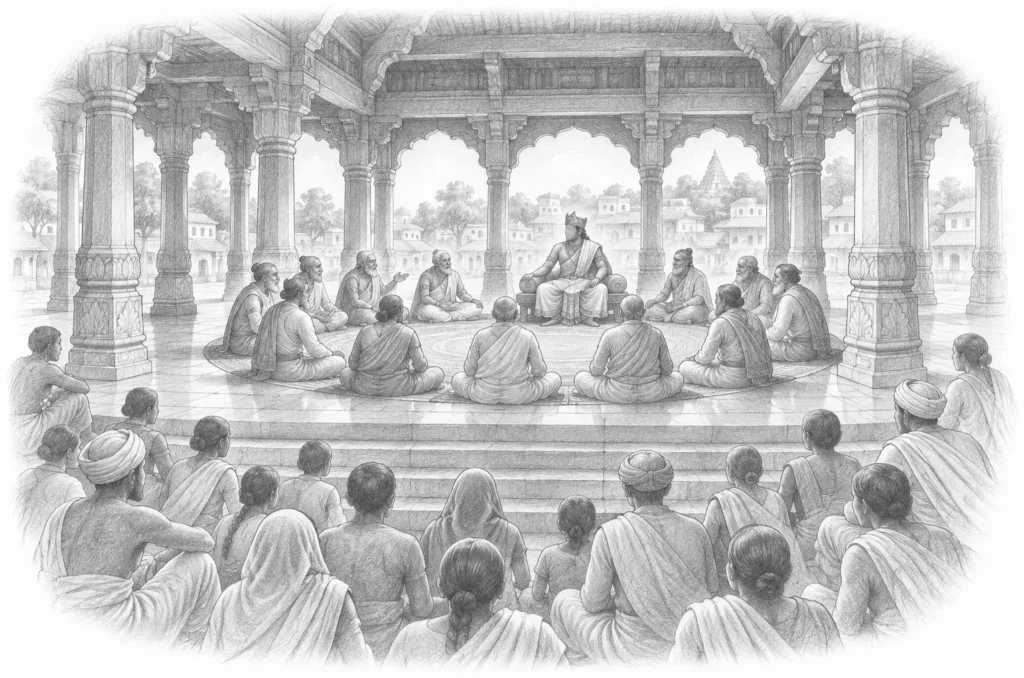
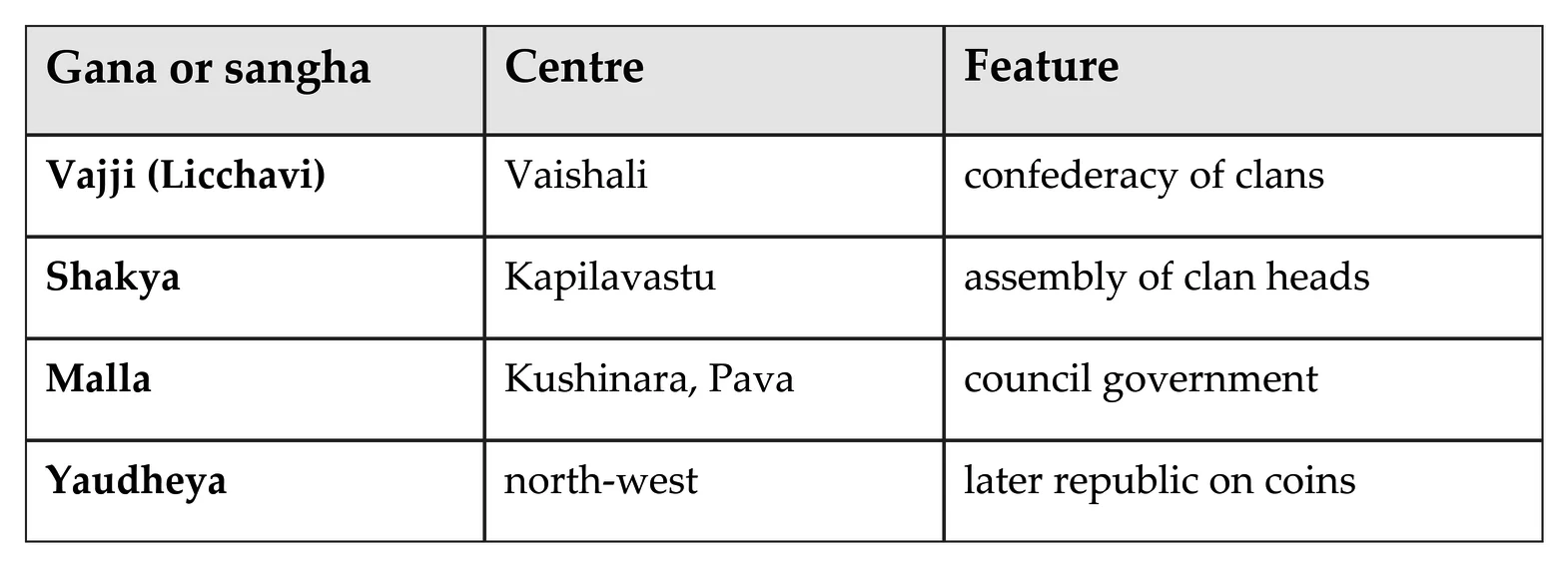
Ganas and sanghas were states governed by assemblies of the members of ruling clans rather than by a single king. Buddhist texts describe the Vajjis of Vaishali, the Shakyas of Kapilavastu and the Mallas, who met in assembly halls, debated and decided by majority. K.P. Jayaswal called them republics, while later historians stressed that power lay with kshatriya clans, making them closer to oligarchies.
Features of the Gana-Sanghas
- Collective rule. Power lay with the heads of kshatriya families, each called a raja; Jataka stories say that the Licchavis of Vaishali had 7,707 rajas, which suggests a large ruling assembly.
- The assembly hall. Members met in the santhagara, where they debated and decided matters of war, peace and administration.
- Voting procedures. Buddhist monastic rules in the Vinaya Pitaka, which Jayaswal believed copied the procedures of the ganas, describe a motion (natti), a quorum checked by an official called the ganapuraka, proxy votes (chhanda) and voting by wooden tickets (shalaka) collected by the shalaka-grahaka, either openly, by whispering or in secret.
- Elected officers. A chief, sometimes called the ganapati or senapati, led the gana with a small council, and judicial cases passed through several stages of appeal.
- Clan exclusiveness. Only members of the ruling clans had political rights; slaves and labourers (dasa-karmakaras) and other varnas were excluded.
The Buddha and the Vajjis
The Mahaparinibbana Sutta of the Digha Nikaya tells that King Ajatashatru of Magadha sent his minister Vassakara to the Buddha to ask whether he could conquer the Vajjis. The Buddha replied that the Vajjis would prosper, not decline, as long as they held frequent and full assemblies, met and acted in concord, followed their established laws, respected their elders, protected their women, honoured their shrines and supported holy men. He applied the same seven conditions to the Buddhist sangha. Later tradition says that Vassakara sowed discord among the Vajjis and that Magadha then conquered them, which shows that unity was the main strength and weakness of republics.
Kautilya on Sanghas
Book 11 of the Arthashastra deals with sanghas. Kautilya distinguishes sanghas that live by agriculture, trade and arms, such as the Kambojas and Surashtras, from those that use the title of raja, such as the Licchavis, Vrijis, Mallas, Madras, Kukuras, Kurus and Panchalas. He regards a united sangha as harder to defeat than an army and advises a king to win it over with gifts or to break it through secret agents who spread quarrels among its leaders. This shows both the strength of the republics and the methods by which monarchies absorbed them.
Later Republics and the Debate on Their Nature
Republics survived in north-western and western India after the Mauryas. Greek historians of Alexander’s invasion in 326 BCE mention free peoples such as the Malloi and Oxydrakai, identified with the Malavas and Kshudrakas, and coins of the Yaudheyas, Malavas and Arjunayanas show that ganas existed until about the fourth century CE, when Samudragupta subdued them. Jayaswal called these states democracies, but R.S. Sharma and Romila Thapar, in From Lineage to State (1984), describe them as lineage-based oligarchies. They are best seen as early forms of collective and deliberative government rather than democracies.
2.2 Rajadharma and Prajadharma
Rajadharma is the duty of the king: to protect the people, uphold dharma, punish wrongdoers, secure welfare and rule with self-control. Prajadharma is the duty of subjects: to obey a righteous king, pay fair taxes and follow their own duties. The Shanti Parva and the Arthashastra present the relationship as reciprocal, with protection given in return for loyalty and revenue.

Features of Rajadharma
- Protection (raksha). The first duty of the king was to protect the people from external enemies and internal disorder; the Shanti Parva describes protection as the highest dharma of the kshatriya.
- Upholding dandaniti. The king was to use danda justly, neither too harshly nor too mildly; Kautilya warns that a severe punishment terrifies the people and a mild one makes the king despised.
- Welfare (yogakshema). Kautilya (Arthashastra 1.19) writes that in the happiness of the subjects lies the happiness of the king and in their welfare his welfare.
- Self-control. The king must conquer the six inner enemies, lust, anger, greed, conceit, arrogance and excessive joy, and be trained in the sciences and served by learned elders.
- Justice and the social order. The king was to settle disputes, protect the weak and maintain the duties of varna and ashrama.
- Hard work. Kautilya divides the king’s day and night into eight parts each and assigns duties to each, such as hearing petitions, reviewing accounts and consulting ministers.
The Ideal King in the Epics
The Mahabharata tells that the first king, Vena, was wicked and oppressive, so the sages killed him and produced Prithu from his body. Prithu promised to rule according to dharma, and because he pleased (ranjana) the people, he was called raja. The epic thus derives the very word king from the duty to make the people happy. In the Ramayana, Rama is the model of the righteous ruler, and Ramarajya became a symbol of good government, invoked by Gandhi in the twentieth century to mean rule based on truth, justice and the welfare of the poorest.
Prajadharma and the Right to Resist
The duty of the subjects to obey was not unconditional. The Anushasana Parva says that a king who promises to protect his people and fails to do so should be killed by them like a mad dog. Kautilya warns that impoverished, greedy and disaffected subjects destroy their own king, and he lists the causes of disaffection, such as neglect of the good, encouragement of the wicked, unjust violence and failure to protect. The Shukraniti allows a wicked king to be replaced by a worthy member of the royal family. Ancient theory therefore combined a strong duty of obedience with a recognised, though limited, right to resist tyranny.
Ashoka’s Paternal Kingship
Ashoka gave rajadharma a new form after the Kalinga war. In the Separate Kalinga Edicts he declared that all men are his children and that he desires their welfare in this world and the next, as he desires it for his own children. In Rock Edict VI he ordered that reporters should bring him news of the people at any time, even while he was eating or resting, and he appointed dhamma-mahamattas to promote welfare and moral conduct. This paternal kingship turned the duty of protection into an active duty of care.
2.3 Apaddharma
Apaddharma is dharma in times of distress (apad), such as famine, invasion or collapse of the treasury. In the Shanti Parva, Bhishma teaches Yudhishthira that in such times a king or person may depart from normal rules to survive, but only as far as necessary and only until normal conditions return.

Where Apaddharma Applies
- The king in distress. The Apaddharma Parva of the Shanti Parva teaches a weakened king how to survive when enemies, famine or an empty treasury threaten the state, permitting extra taxation, alliances with former enemies and strategic retreat.
- Occupations of the varnas. The Manusmriti (X.81 to X.117) allows a brahmin who cannot live by his own work to live by the work of a kshatriya or vaishya, and similar relaxations apply to other varnas, but only until the distress passes.
- Food and survival. Manusmriti X.104 says that a person in danger of losing life who eats food from any source is not tainted by sin, as the sky is not soiled by mud.
- Individual conduct. In extreme hunger, rules of purity, gifts and acceptance of food could be relaxed to preserve life.
Stories of Apaddharma
The Shanti Parva teaches apaddharma through stories. In the story of Vishvamitra and the chandala, the sage, starving in a twelve-year famine, tries to steal dog’s meat from a chandala’s hut; the chandala argues against it, but Vishvamitra replies that preserving life is a higher duty, and afterwards he purifies himself. In the story of the cat and the mouse, the mouse Palita, trapped between enemies, makes a temporary alliance with the cat Lomasha, and once the danger passes both return to mutual distrust. The lesson is that in crisis a wise ruler may make alliances of convenience but must never forget his long-term interests.
Apaddharma as Moral Reasoning
Scholars read apaddharma as evidence that classical Indian thought treated dharma as flexible and sensitive to context. Bimal Krishna Matilal, in his essays on moral dilemmas in the Mahabharata, showed how the epic explores situations where duties conflict and no choice is perfectly right. Gurcharan Das, in The Difficulty of Being Good (2009), similarly argues that the epic teaches that dharma is subtle (sukshma). Apaddharma is therefore not a licence to abandon morality but a recognition that rules must sometimes bend to preserve the purposes they serve.
Comparison with Western Ideas of Necessity
Apaddharma resembles Western ideas of necessity and emergency. Machiavelli, in The Prince (1513), advised rulers to learn how not to be good when necessary. John Locke, in the Second Treatise (1690), recognised a prerogative power of the executive to act for the public good without or even against the law. The Roman republic appointed a dictator for six months in crisis. Like these ideas, apaddharma allows departures from normal rules, but it insists that they be temporary, proportionate and followed by restoration and expiation, much like modern safeguards on emergency powers in Articles 352 to 360 of the Indian Constitution.
2.4 Important Questions
- Question 1 Discuss the nature and working of republics in ancient India.
- Question 2 Discuss the concept of rajadharma in ancient Indian political thought.
- Question 3 Discuss the concept of prajadharma and the relationship between the king and the people.
- Question 4 What is apaddharma? Discuss its significance in ancient Indian political thought.
DU asks the same idea in different words. So learn one broad answer for each question below; the same answer works for every question joined by OR.
Important Question 1
Discuss the nature and working of republics in ancient India.
OR
Were the ganas and sanghas of ancient India republics? Discuss.
OR
Examine the idea of republic in ancient India with reference to the Vajji confederacy.
Model Answer
“So long as the Vajjis meet together in concord, and rise in concord, and carry out their undertakings in concord, so long may they be expected not to decline, but to prosper.”
— The Buddha, Mahaparinibbana Sutta (tr. T.W. Rhys Davids)
Introduction. It was once assumed that ancient India knew only monarchy. Research by scholars such as K.P. Jayaswal and Jagadish Sharma showed that ancient India also had states governed by assemblies, called ganas and sanghas. These existed especially in the foothills of the Himalaya and the north-west between about the sixth century BCE and the fourth century CE.
1. Meaning of Gana and Sangha
Gana means a group or multitude, and sangha means an association. In politics, both terms referred to states in which power was held by an assembly of members of the ruling clans rather than by a single hereditary king.
2. Sources
Evidence comes from Panini’s grammar, which mentions sanghas, from Buddhist and Jain texts, from the Arthashastra, from Greek accounts of Alexander’s campaigns in the north-west, and from coins issued in the name of ganas such as the Yaudheyas.
3. The Vajji Confederacy
The Vajji confederacy, which included the Licchavis, had its capital at Vaishali in north Bihar. It was governed by an assembly of clan heads, each called raja, who met in an assembly hall (santhagara) to decide public matters.
4. The Buddha’s Conditions of Welfare
When King Ajatashatru of Magadha planned to attack the Vajjis, the Buddha said they would prosper so long as they held frequent assemblies, met and acted in concord, followed their established laws, respected elders, protected women and honoured shrines.
5. Other Republics
Other ganas included the Shakyas of Kapilavastu, the Buddha’s own clan, the Mallas of Kushinara and Pava, and in the north-west the Malavas and Kshudrakas, who resisted Alexander. The Yaudheyas flourished later.
6. Assembly Procedures
Buddhist sangha procedures, probably drawn from gana practice, included a quorum, formal resolutions, discussion and voting with tickets (salaka) collected by an officer. Decisions were reached by majority when consensus failed.
7. Officials
Ganas had officials such as a president or chief, a council of senior members and officers for justice and finance. The Licchavis are said to have had a careful judicial procedure with several levels of review.
8. Kautilya on Sanghas
Kautilya divided sanghas into those that lived by arms and those whose members used the title of raja. He regarded them as strong because of their unity and advised a conquering king to divide them by intrigue rather than war.
9. Jayaswal’s View
K.P. Jayaswal, in Hindu Polity (1924), argued that ancient India had genuine republics and constitutional government, challenging colonial claims that Indians knew only despotism.
10. Sharma on Republics
Jagadish Sharma, in Republics in Ancient India (1968), traced non-monarchical governments back to the Vedic period and examined their institutions in detail, supporting the view that republican traditions were long-standing.
11. Oligarchies, Not Democracies
Later historians note that power in the ganas lay with kshatriya clans, while slaves, labourers and others had no voice. In this sense they were aristocratic republics or oligarchies, not democracies in the modern sense.
12. Decline
The ganas declined as large monarchies grew. Magadha under Ajatashatru conquered the Vajjis, and the Mauryas and later the Guptas absorbed most remaining republics.
13. Legacy
The ganas show that collective rule, debate and voting have deep roots in India. The Buddhist sangha preserved many of their procedures, and modern Indians have cited them as part of a democratic heritage.
14. Comparison with Greece
Like the Greek city-states, the ganas were small, governed by assemblies of privileged citizens and eventually absorbed by larger empires, suggesting parallel developments in different civilisations.
15. Panini and the Ganas
Panini’s grammar, explained by V.S. Agrawala in India as Known to Panini, mentions many sanghas and the terms used in their working, such as words for members, voting and the leader of a gana. This shows that republican states were familiar enough in the fifth century BCE for a grammarian to record their vocabulary.
16. Evaluation
The ganas and sanghas were real non-monarchical states with assemblies and voting, though they were oligarchic rather than democratic.
Conclusion. Thus, ancient India had republics, the ganas and sanghas, such as the Vajjis, Shakyas and Mallas, governed by assemblies of clan members who debated and voted. The Buddha praised their concord, and Jayaswal and Sharma showed their importance, though they were kshatriya oligarchies and were absorbed by growing monarchies.
Important Question 2
Discuss the concept of rajadharma in ancient Indian political thought.
OR
Examine the duties of the king according to the Shanti Parva and the Arthashastra.
OR
Was the ancient Indian king an absolute ruler? Discuss with reference to rajadharma.
Model Answer
“In the happiness of his subjects lies the king’s happiness; in their welfare his welfare. He shall not consider as good only that which pleases him but treat as beneficial to him whatever pleases his subjects.”
— Kautilya, Arthashastra, Book I (tr. L.N. Rangarajan)
Introduction. Rajadharma means the dharma or duty of the king. It is the central concept of ancient Indian political thought, discussed at length in the Rajadharma section of the Shanti Parva of the Mahabharata, in the Arthashastra and in the Dharmashastras. It presents kingship not as a privilege but as a duty to protect and serve the people.
1. Meaning
Rajadharma is the set of duties that the king must perform as ruler. It covers protection, justice, welfare, administration, war and peace, and the king’s own conduct and self-discipline.
2. The Shanti Parva
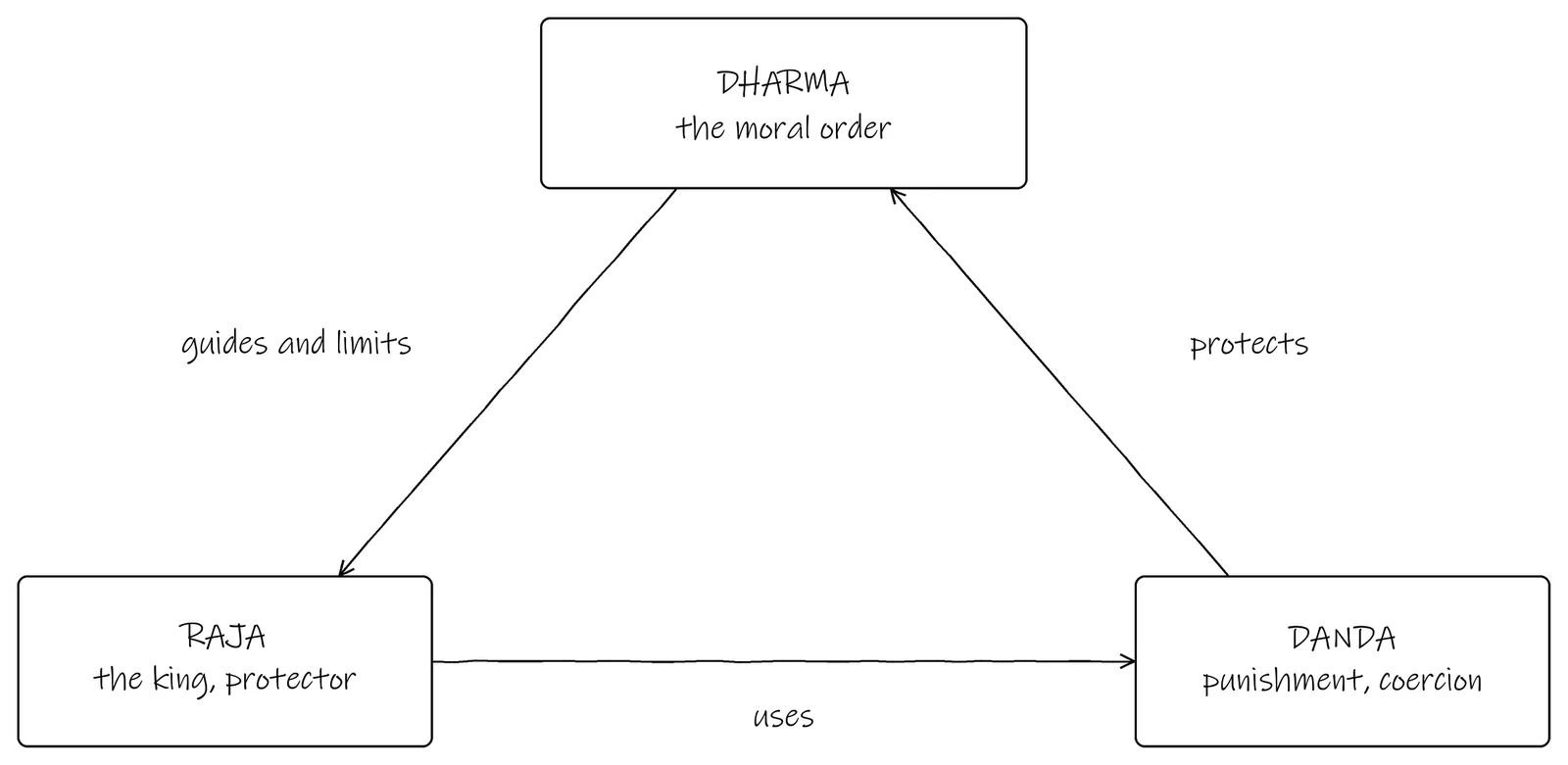
After the Kurukshetra war, Bhishma, lying on his bed of arrows, instructs Yudhishthira on rajadharma. He says that rajadharma is the foundation of all other dharmas, because without a protecting king, society collapses.
3. Protection
The first duty of the king is protection (raksha) of the people, their lives and property, from external enemies and internal wrongdoers. Taxes were justified as the price of this protection.
4. Danda
The king upholds order through danda, the power of punishment. The Manusmriti says that punishment governs and protects all beings, but it must be applied justly, after due consideration, or it destroys the king himself.
5. Justice
The king was the highest judge, assisted by learned judges. He was expected to decide cases according to dharma, custom and evidence, without favour, and to protect the weak against the strong.
6. Welfare
Kautilya stresses yogakshema, the welfare and security of the people. The king must promote agriculture, trade and irrigation, help the poor, widows, orphans and the sick, and provide relief in famine.
7. Self-Control
Kautilya says the king must conquer the six enemies of the mind: lust, anger, greed, conceit, arrogance and foolhardiness. A king without self-control will perish, while a disciplined king is a rajarishi, a royal sage.
8. The King’s Daily Routine
The Arthashastra lays down a detailed daily timetable for the king, dividing day and night into periods for hearing reports, receiving petitions, consulting ministers, inspecting forces and rest, showing kingship as hard work.
9. Ministers and Council
The king must rule with the advice of ministers (amatyas) and a council (mantriparishad). Kautilya says that rule is possible only with assistance, just as one wheel alone cannot move a chariot.
10. Dharma above the King
Ancient thought placed dharma above the king. The Upanishads describe dharma as the power above the ruler, and the king was seen as the protector, not the creator, of dharma.
11. Ashoka’s Dhamma
Emperor Ashoka declared in his edicts that all people are his children and that he works for their welfare in this world and the next, giving a practical example of rajadharma as paternal welfare.
12. Varma and Sharan
V.P. Varma traces rajadharma to its metaphysical foundations in ideas of cosmic order, while P. Sharan studies the institutions through which it was practised, such as councils, courts and revenue systems.
13. Limits on Royal Power
The king was limited by dharma, custom, ministers, priests, assemblies and the fear of popular discontent. Yet there was no formal institution to enforce these limits, so their effectiveness depended on the king.
14. Criticisms
Critics note that rajadharma upheld the varna order and gave special privileges to Brahmins, and that welfare was paternal rather than based on the rights of citizens.
15. Evaluation
Rajadharma presented kingship as a duty bound by dharma and directed to the welfare of the people, a rich ideal of responsible rule.
Conclusion. Thus, rajadharma required the king to protect his people, uphold dharma through just danda, secure their welfare, consult ministers and control himself. As Kautilya said, the king’s happiness lay in his subjects’ happiness. Though bound by dharma, the king faced no formal checks, and rajadharma reflected the social hierarchies of its time.
Important Question 3
Discuss the concept of prajadharma and the relationship between the king and the people.
OR
What were the duties of subjects in ancient Indian political thought?
OR
Did ancient Indian thought recognise a right to resist an unjust king? Discuss.
Model Answer
“Punishment alone governs all created beings, punishment alone protects them, punishment watches over them while they sleep.”
— Manusmriti, Chapter VII (tr. G. Bühler)
Introduction. Prajadharma means the duty of the praja, the people or subjects. Ancient Indian political thought saw the relationship between king and people as reciprocal: the king protects and serves, and the people obey, support and pay taxes. Some texts also recognised that people could remove a king who failed in his duty.
1. Meaning of Praja
Praja means both subjects and offspring. The word suggests that the king should treat the people like his children, and the people should respect the king like a father.
2. Obedience to a Righteous King
The first duty of subjects was to obey the king and his laws, since order depends on obedience. But this obedience was owed to a king who ruled according to dharma.
3. Payment of Taxes
Subjects had to pay taxes, such as the king’s share (bhaga) of produce, often one-sixth. Some texts describe this share as the king’s wages for protecting the people, implying a contract.
4. Following Svadharma
Each person had a duty to follow their own dharma (svadharma) according to their varna, ashrama and occupation. Social order depended on everyone performing their role.
5. Supporting the State
Subjects were expected to support the state in defence, public works and emergencies, to report wrongdoing and to take part in local assemblies and village affairs.
6. The Reciprocal Bond
The relationship was one of mutual obligation. The king who protects deserves obedience and taxes; the king who fails to protect forfeits his claim, since taxes are the price of protection.
7. Removing an Unjust King
The Mahabharata says that subjects may join together to remove a king who promises protection but fails to protect, comparing such a king to a dangerous animal. This suggests a limited right of resistance.
8. The Story of Vena
The Puranas tell of King Vena, who stopped sacrifices and oppressed the people, and was killed by the sages. From his body Prithu was born, who ruled righteously, showing that tyranny could be ended.
9. Kautilya on Disaffection
Kautilya warns that impoverished, greedy or disaffected subjects become dangerous and may join enemies or rebel. He advises the king to prevent oppression, punish corrupt officials and win the people’s loyalty.
10. Popular Opinion
Kings were expected to know public opinion through spies and to respond to it. The Ramayana shows Rama giving weight to what his subjects said, illustrating the importance of the people’s view.
11. Limited Rights
Prajadharma emphasised duties rather than rights. Subjects did not have rights against the state in the modern sense, and the right to resist was a moral idea rather than a legal procedure.
12. Village Self-Government
In practice, villages, guilds and caste councils managed many local affairs, giving people a role in governance beyond obedience to the king.
13. Modern Parallels
The emphasis on duties has echoes in the Fundamental Duties of the Indian Constitution, while the reciprocal bond resembles social contract theories in which government depends on fulfilling its purpose.
14. Criticisms
Critics note that prajadharma reinforced hierarchy by binding people to their varna duties, and that it placed heavy obligations on subjects while leaving the king’s accountability vague.
15. Taxes as Wages
The Baudhayana Dharmasutra and later texts describe the king’s share of one-sixth as his wages for protecting the people. A king who takes taxes but does not protect is said to take upon himself the sins of his subjects. This idea makes taxation conditional on service and shows the contractual element in the bond between king and people.
16. Guilds and Local Bodies
Merchants and artisans organised in guilds (shrenis) had their own rules, which kings were expected to respect. Inscriptions record guilds receiving deposits, making donations and settling disputes among members. Such bodies gave subjects a collective voice and a degree of self-government within the kingdom, adding to the reciprocal relationship between ruler and ruled.
17. Evaluation
Prajadharma described a reciprocal bond between king and people in which obedience depended on righteous rule.
Conclusion. Thus, prajadharma required subjects to obey a righteous king, pay fair taxes, follow their svadharma and support the state. The bond between king and people was reciprocal, and texts such as the Mahabharata and the story of Vena show that an oppressive king could be removed, though rights in the modern sense were absent.
Important Question 4
What is apaddharma? Discuss its significance in ancient Indian political thought.
OR
Examine the teachings of the Shanti Parva on conduct in times of distress.
OR
How did ancient Indian thought deal with emergencies?
Model Answer
“He who, when in danger of losing his life, accepts food from any person whatsoever, is no more tainted by sin than the sky by mud.”
— Manusmriti, Chapter X (tr. G. Bühler)
Introduction. Apaddharma means dharma in times of distress (apad). The Shanti Parva of the Mahabharata contains a section called the Apaddharma Parva, in which Bhishma teaches Yudhishthira how a king and individuals should act when normal rules cannot be followed because of famine, war, weakness or an empty treasury. The idea shows the flexibility of dharma.
1. Meaning
Apad means calamity or distress. Apaddharma is the set of rules that apply in such times, when the normal duties of a king or person cannot be performed without endangering survival.
2. The Apaddharma Parva
In the Shanti Parva, after teaching rajadharma, Bhishma turns to apaddharma. He explains what a king should do when his kingdom is weak, his treasury empty, his allies lost and enemies strong.
3. Survival of the State
Bhishma teaches that the survival of the kingdom is essential, because without the state dharma cannot be protected. In distress, a king may use extraordinary measures to preserve it.
4. Extra Taxes
A king with an empty treasury may raise extra revenue in an emergency. Kautilya also allows special levies to replenish the treasury in crisis, but only once and without ruining the people.
5. Alliances of Convenience
The story of the cat and the mouse in the Shanti Parva shows that natural enemies may cooperate when both face danger, and separate when the danger passes. A weak king may make alliances with enemies to survive.
6. Vishvamitra and the Famine
During a long famine, the sage Vishvamitra took dog’s meat from an outcaste’s hut to survive and argued that preserving life is necessary for the practice of dharma. The story shows how extreme distress can justify breaking rules.
7. Occupations in Distress
The Dharmashastras allow members of a varna who cannot live by their own occupation to adopt the occupation of another in times of distress, showing flexibility in the social order.
8. Limits of Apaddharma
Apaddharma is not permission for permanent rule-breaking. It applies only in genuine distress, only as far as necessary, and conduct should return to normal dharma once the crisis passes.
9. Context-Sensitive Dharma
Apaddharma reflects the idea that dharma depends on place, time and circumstance. Moral rules must be applied with judgement, not mechanically, especially in extraordinary situations.
10. Political Realism
The Apaddharma Parva contains realistic, even harsh, advice on deception, concealment and strategy, similar to Kautilya’s statecraft, showing that ancient thought recognised the hard realities of politics.
11. Comparison with Emergency Powers
Apaddharma resembles modern emergency powers and the doctrine of necessity, which allow governments to suspend normal rules in a crisis. Both raise the danger that emergency becomes an excuse for abuse.
12. Safeguards
Ancient texts tried to limit apaddharma by insisting on genuine distress, the welfare of the people and return to normal dharma, just as modern constitutions use time limits and oversight.
13. Kane’s Account
P.V. Kane’s History of Dharmashastra discusses apaddharma rules in detail, showing how widely the idea of exceptions in distress was accepted in legal texts.
14. Criticisms
Critics warn that apaddharma could be used by rulers to justify oppression or by privileged groups to escape their duties, since distress is easy to claim.
15. The Three Fishes
The Shanti Parva tells the story of three fish in a pond about to be drained. One fish leaves early, one acts when danger arrives, and one delays and dies. Bhishma uses the story to teach that a king must foresee calamities and act in time, so that apaddharma is guided by prudence and preparation.
16. Apaddharma and the Brahmin
Texts allow a Brahmin unable to live by teaching and priestly work to live by the occupations of a kshatriya or vaishya in distress, though not permanently. This shows that the social order itself bent under pressure, and that survival and maintenance of family were treated as duties that could, for a time, outweigh rules of occupation.
17. Restoration after Crisis
Bhishma stresses that once the crisis passes, the king must return to normal dharma, repair the harm caused by emergency measures and restore the confidence of the people. Extra taxes must end, and those who suffered should be helped. This teaching anticipates modern ideas that emergency powers must be temporary and followed by restoration.
18. Evaluation
Apaddharma shows the flexibility and realism of ancient Indian political thought, recognising that extraordinary times need extraordinary measures within limits.
Conclusion. Thus, apaddharma is dharma in times of distress, taught by Bhishma in the Shanti Parva. It allows a king to raise extra revenue, make alliances of convenience and take extraordinary measures, and individuals to break rules to survive, as Vishvamitra did. But it is limited to genuine crises and ends when normal conditions return, much like modern emergency powers.
Short Notes
(a) Santhagara
The assembly hall in which members of a gana, such as the Licchavis of Vaishali, met to debate and decide public matters.
(b) Yogakshema
The welfare and security of the people, which Kautilya treated as a central duty of the king.
(c) Apaddharma Parva
The section of the Shanti Parva of the Mahabharata in which Bhishma teaches conduct in times of distress.
(d) Salaka
A voting ticket used in assemblies of the ganas and the Buddhist sangha, collected by an officer to count votes when consensus failed.
More notes: MDSE-16 Political Ideas of Ancient India
These notes are prepared by PADHO TO AISE for study help. They are not an official University of Delhi publication.