
Semester VIII MDSE-16 Political Ideas of Ancient India
Unit 1 · 27 min read · Updated 24 Nov 2026
As per the University of Delhi (DU) BA (Hons) Political Science syllabus
Contents
- 1.1 The Idea of Bharatavarsha
- Bharatavarsha in Puranic Cosmology
- Features of the Idea of Bharatavarsha
- Scholarly Readings of Bharatavarsha
- Bharat in the Constitution
- 1.2 The Vedic Idea of India and Its Polity
- Features of Vedic Polity
- The Later Vedic Polity
- Vedic Theories of Kingship
- Scholarly Debates on Vedic Polity
- 1.3 The Purusharthas and the State
- Theories of the Origin of the State
- The Saptanga Theory
- Kautilya on Artha
- Purusharthas in Modern Thought
- 1.4 Important Questions
- Discuss the idea of Bharatavarsha as a civilisational entity.
- Discuss the Vedic idea of polity with reference to the sabha and samiti.
- Explain the concept of purusharthas and its significance for political thought.
- Discuss the theories of the origin and nature of the state in ancient India.
- Short Notes
समुद्र के उत्तर में और हिमालय के दक्षिण में जो देश है, उसका नाम भारत है, जहाँ भरत की संतान निवास करती है।
The country that lies north of the ocean and south of the snowy mountains is called Bharata, for there dwell the descendants of Bharata.
— Vishnu Purana, Book II, Chapter 3
BHARATAVARSHA, the land of the descendants of Bharata, is the oldest name for the Indian subcontinent as a single cultural space. Ancient texts describe it as the land between the Himalaya and the southern sea, united by sacred rivers, pilgrimage, shared rituals and ideas of social order. This chapter examines the idea of Bharatavarsha, the Vedic idea of polity and assembly, the four purusharthas of dharma, artha, kama and moksha, and ancient theories of the origin of the state, drawing on B.D. Chattopadhyaya, Radha Kumud Mookerji, A.S. Altekar, Benoy Kumar Sarkar and P.V. Kane.

1.1 The Idea of Bharatavarsha
Bharatavarsha appears in the Puranas and the Mahabharata as the land between the Himalaya and the ocean, part of the larger continent of Jambudvipa. B.D. Chattopadhyaya shows that it was a cultural and geographical idea of the land, organised around sacred geography and social order, rather than a single political state. Radha Kumud Mookerji argued that rivers, pilgrimage and the ideal of the chakravartin, the universal ruler, gave India a fundamental unity beneath its diversity.
Bharatavarsha in Puranic Cosmology
The Puranas place Bharatavarsha within a larger picture of the world. The earth is imagined as seven concentric islands (dvipas) separated by seven oceans, with Jambudvipa, named after the jambu or rose-apple tree, at the centre and the golden mountain Meru at its heart. Bharatavarsha is the southernmost region (varsha) of Jambudvipa. The Vishnu Purana describes it as the land that lies north of the ocean and south of the snowy mountains, where the descendants of Bharata live, and calls it the karmabhumi, the land of action, where deeds bring results in this world and the next, unlike the other regions, which are lands of enjoyment.
Features of the Idea of Bharatavarsha
- A defined geography. The Puranas name seven principal mountain ranges (kulaparvatas): Mahendra, Malaya, Sahya, Shuktiman, Riksha, Vindhya and Pariyatra, and list the rivers that flow from each, giving the subcontinent a recognisable shape.
- Named peoples and regions. The Puranic lists of janapadas divide the land into the Madhyadesha (middle country) and the northern, eastern, southern and western regions, so the idea included many peoples within one frame.
- Sacred rivers. A common prayer invokes seven rivers, the Ganga, Yamuna, Godavari, Sarasvati, Narmada, Sindhu and Kaveri, joining the north and south of the land in daily ritual.
- Pilgrimage networks. The four dhams, the twelve jyotirlingas and the shakti pithas drew pilgrims across regions; tradition credits Adi Shankaracharya in the eighth century with founding four mathas at Sringeri, Dwarka, Puri and Jyotirmath.
- A shared social order. Bharatavarsha was defined as the land where the order of varna and ashrama was followed, so the idea was cultural and social as much as geographical.
- An ideal of political unity. The chakravartin and rituals such as the ashvamedha and rajasuya expressed the hope of one paramount ruler over the land, even though such unity was rarely achieved.
Scholarly Readings of Bharatavarsha
Nationalist historians of the early twentieth century, such as Radha Kumud Mookerji in The Fundamental Unity of India (1914), used the idea to show that India was an ancient nation and not merely a collection of territories united by British rule. Diana Eck, in India: A Sacred Geography (2012), argues that pilgrimage created a living map of the land long before modern nationalism. Other historians, such as Romila Thapar, warn against projecting the modern nation-state onto the past, and B.D. Chattopadhyaya shows that Bharatavarsha was an idea of a cultural space with changing boundaries rather than a single political unit. A balanced answer treats it as a civilisational idea that later nationalists drew upon.
Bharat in the Constitution
The idea of Bharatavarsha found a place in the Constitution. Article 1 declares that India, that is Bharat, shall be a Union of States. When the Constituent Assembly debated the name in September 1949, members such as H.V. Kamath and Seth Govind Das wanted Bharat placed first, and some suggested Bharatavarsha or Hindustan. The final wording kept both names, linking the new republic to the ancient idea of the land while adopting the modern form of a federal Union.
1.2 The Vedic Idea of India and Its Polity
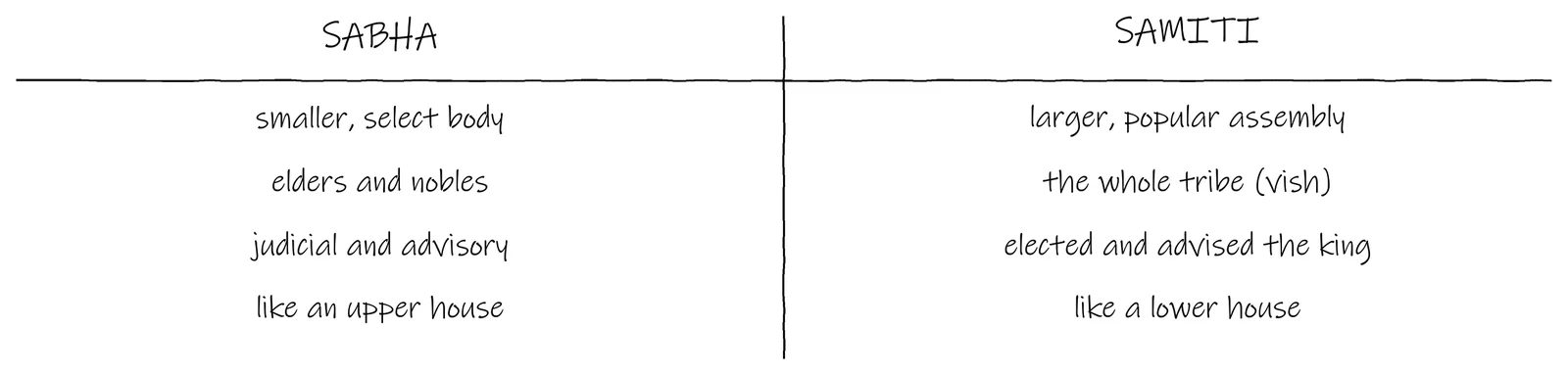
The Vedic texts describe tribes such as the Bharatas, kings (rajan) and popular assemblies, the sabha and samiti, which advised the king and took part in decisions. The Atharva Veda calls the earth a mother and the people her children, and scholars such as Jagadish Sharma find evidence of non-monarchical forms of government in Vedic India.
Features of Vedic Polity
- Tribal organisation. Society was organised into the jana (tribe), the vish (clan) and the grama (village group); the king was called gopati, protector of cattle, showing a pastoral economy.
- Popular assemblies. The sabha, the samiti, the vidatha and the gana were bodies through which members of the tribe took part in decisions; the Atharva Veda calls the sabha and samiti the two daughters of Prajapati.
- Limited officials. The purohita (priest and adviser), the senani (army commander) and the gramani (village headman) assisted the king; there was no standing army or regular bureaucracy.
- Voluntary tribute. The people offered bali, a voluntary gift to the king, which later became a regular tax.
- War and leadership. The Rig Veda describes the Battle of Ten Kings on the Parushni (Ravi), in which Sudas of the Bharatas, advised by Vasishtha, defeated a confederacy of ten tribes.
The Later Vedic Polity
In the later Vedic period, roughly 1000 to 600 BCE, the centre of life moved east into the Ganga plain. The use of iron, settled agriculture and larger territories changed politics. Tribal identity gave way to territorial kingdoms called janapadas, and the king’s power grew. Elaborate rituals such as the rajasuya (consecration), the vajapeya (a drink of strength and chariot race) and the ashvamedha (horse sacrifice) proclaimed his authority. The Shatapatha Brahmana describes the ratnins, the jewels of the king, such as the queen, the senani, the purohita, the charioteer, the gramani, the treasurer and the collector of shares, whose houses the king visited during the rajasuya. At the same time, the sabha and samiti declined, and the varna order became more rigid.
Vedic Theories of Kingship
The Aitareya Brahmana tells that the gods were being defeated by the asuras and concluded that this was because they had no king, so they chose Indra as their king. Historians read this as an early theory that kingship arose from the need for leadership in war. Other passages present the king as chosen or accepted by the people; hymns of the Atharva Veda pray that the people may choose the king and that the samiti may agree with him. These texts suggest that early kingship rested partly on consent, although it grew more hereditary and sacred over time.
Scholarly Debates on Vedic Polity
K.P. Jayaswal, in Hindu Polity (1924), found in the sabha and samiti evidence of early popular government. A.S. Altekar, in State and Government in Ancient India (1949), and R.S. Sharma, in Aspects of Political Ideas and Institutions in Ancient India (1959), gave more cautious accounts: Sharma showed that the assemblies were kin-based tribal bodies, which declined as class divisions and territorial states emerged. Jagadish Sharma, in Republics in Ancient India (1968), traced non-monarchical traditions back to the gana of the Vedic age. Students should treat the Vedic assemblies as participatory tribal institutions, not as democracy in the modern sense.
1.3 The Purusharthas and the State
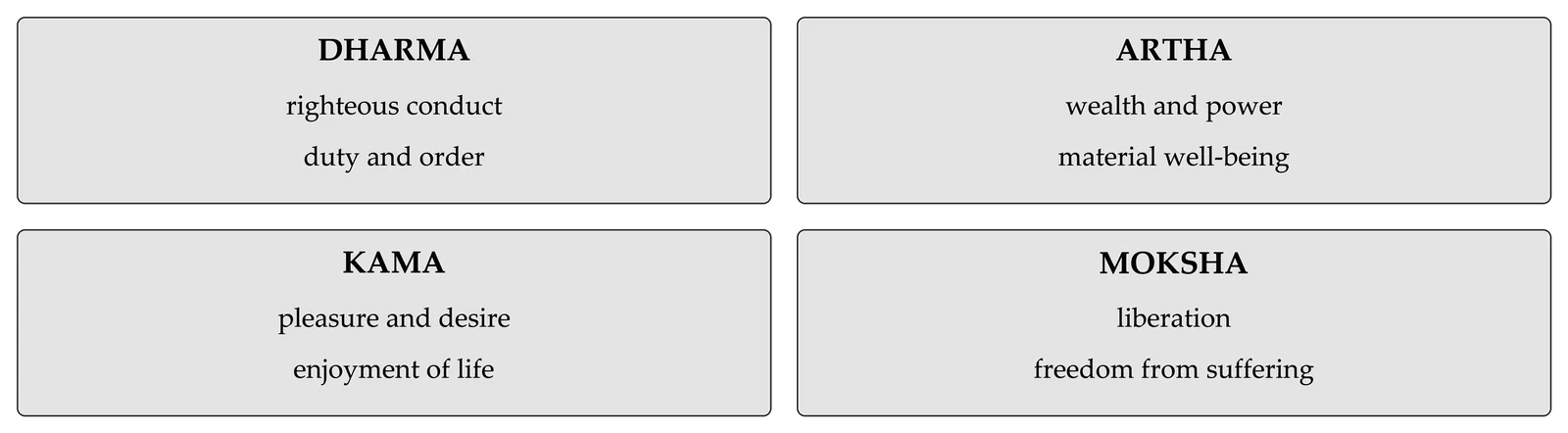
The purusharthas are the four aims of human life: dharma (righteous duty), artha (wealth and power), kama (pleasure and desire) and moksha (liberation). Ancient political thought saw the state as the order within which people could pursue these aims. Theories of the origin of the state explained that kingship arose to end matsyanyaya, the law of the fishes, in which the strong devour the weak.
Theories of the Origin of the State
- Matsyanyaya and force. The Mahabharata and the Arthashastra describe a condition in which the strong devour the weak like big fish eating small fish; the state and danda (punishment) arise to end it, an idea comparable to Hobbes’s state of nature in Leviathan (1651).
- Contract. Kautilya (Arthashastra 1.13) tells that people oppressed by matsyanyaya made Manu Vaivasvata their king and agreed to give him one-sixth of their grain and one-tenth of their merchandise in return for protection.
- The Buddhist Mahasammata. The Aggañña Sutta of the Digha Nikaya relates that when greed and theft appeared, people chose the most handsome and capable person as Mahasammata, the great elect, and paid him a share of rice to punish wrongdoers.
- Divine origin. The Manusmriti (VII.3 to VII.4) says that the Lord created the king out of eternal particles of Indra, Vayu, Yama, Surya, Agni, Varuna, Chandra and Kubera to protect the world.
- Evolution and the family. Some modern scholars, following Altekar, argue that the state grew gradually out of the family and tribe rather than through any single event.
The Saptanga Theory
Kautilya (Arthashastra 6.1) describes the state as having seven limbs (saptanga): svami (the king), amatya (ministers), janapada (territory and people), durga (fort), kosha (treasury), danda (army and coercive power) and mitra (ally). The limbs depend on one another like parts of a body, and a weakness in one harms the whole. Scholars compare this organic view with modern definitions of the state as population, territory, government and sovereignty, noting that Kautilya adds the treasury, the fort and allies, which reflects the practical needs of ancient kingdoms.
Kautilya on Artha
Kautilya gave special importance to artha. In Arthashastra 1.7 he states that material well-being alone is supreme, because dharma and kama both depend on it, yet he also advises the king to enjoy pleasure without violating dharma and artha and to pursue the three aims in balance. For Kautilya, artha means not only wealth but also the land inhabited by people, so the science of artha is the science of acquiring and protecting territory, which makes it a science of politics.
Purusharthas in Modern Thought
The purusharthas continued to influence modern Indian political thought. Bhagwan Das, in The Science of Social Organisation (1910), used them to argue for a balanced social order. Deendayal Upadhyaya, in his lectures on Integral Humanism in 1965, presented the four aims as a basis for an Indian alternative to both capitalism and communism, in which economic life serves wider moral and spiritual ends. The philosopher Daya Krishna, in an essay titled The Myth of the Purusharthas (1986), criticised the scheme, arguing that it was a later systematisation that did not describe how Indians actually understood the goals of life. These debates show that the idea remains alive and contested.
1.4 Important Questions
- Question 1 Discuss the idea of Bharatavarsha as a civilisational entity.
- Question 2 Discuss the Vedic idea of polity with reference to the sabha and samiti.
- Question 3 Explain the concept of purusharthas and its significance for political thought.
- Question 4 Discuss the theories of the origin and nature of the state in ancient India.
DU asks the same idea in different words. So learn one broad answer for each question below; the same answer works for every question joined by OR.
Important Question 1
Discuss the idea of Bharatavarsha as a civilisational entity.
OR
Examine the concept of Bharatavarsha in ancient Indian texts.
OR
What is meant by the fundamental unity of India? Discuss.
Model Answer
“The country that lies north of the ocean and south of the snowy mountains is called Bharata, for there dwell the descendants of Bharata.”
— Vishnu Purana, Book II, Chapter 3
Introduction. Long before modern nation-states, ancient Indian texts imagined the subcontinent as a single land called Bharatavarsha. This idea was cultural and geographical rather than political, since the land was divided into many kingdoms. Historians such as B.D. Chattopadhyaya and Radha Kumud Mookerji have examined how this idea expressed a civilisational unity across great diversity.
1. Origin of the Name
The name is linked with the Bharatas, a Vedic tribe whose king Sudas won the Battle of Ten Kings described in the Rig Veda, and with the legendary king Bharata. Bharatavarsha means the land of the descendants of Bharata.
2. Puranic Geography
The Puranas place Bharatavarsha in the southern part of Jambudvipa, one of the great continents of the world. The Vishnu Purana defines it as the land north of the ocean and south of the snowy mountains, and lists its mountains, rivers and peoples.
3. The Mahabharata
The Bhishma Parva of the Mahabharata describes Bharatavarsha with its rivers, mountains and many peoples, praising it as a land where people can pursue the aims of life. The epic itself, recited across the subcontinent, became a shared cultural inheritance.
4. Chattopadhyaya’s View
B.D. Chattopadhyaya shows that Bharatavarsha in the Puranas was a cultural and geographical concept organised around sacred geography and the social order of varna and ashrama. It was not a political state, and it included regions and peoples at its margins with different practices.
5. Mookerji’s Fundamental Unity
Radha Kumud Mookerji, in The Fundamental Unity of India (1914), argued that despite political divisions, India had a deep unity based on geography, sacred rivers, places of pilgrimage, shared religious ideas and the ideal of a universal ruler.
6. Sacred Geography
Pilgrimage linked distant regions. Sacred rivers such as the Ganga, Yamuna, Narmada, Godavari and Kaveri, and pilgrimage sites in every direction, created a mental map in which the whole land was sacred and connected.
7. The Chakravartin Ideal
The ideal of the chakravartin, a universal ruler whose wheel of authority rolls across the land, expressed political unity as an aspiration. Kautilya described the domain of such a ruler as extending from the Himalaya to the sea.
8. Empires
The Mauryan Empire under Ashoka in the third century BCE and later the Gupta Empire brought large parts of the subcontinent under one rule. Ashoka’s edicts, found across India, show an effort to unite subjects through shared moral principles.
9. Shared Culture
Sanskrit served as a shared language of learning, while the epics, Puranas, ritual practices, festivals and philosophical schools spread across regions, interacting with local languages and traditions.
10. Ojha’s Account
Madhusudan Ojha, a Sanskrit scholar of the early twentieth century, presented in his Indravijaya an account of Bharatavarsha based on Vedic sources, arguing for the antiquity of the idea of India as a land with a distinct identity.
11. Unity in Diversity
Bharatavarsha combined unity with great diversity of languages, customs, beliefs and political forms. Its unity was not uniformity but a shared framework within which many traditions coexisted.
12. Civilisation and Nation
Modern nationalists drew on the idea of Bharatavarsha to argue that India was an ancient nation. Historians caution that the ancient idea was civilisational and cultural, and differed from the modern nation-state with fixed borders and citizenship.
13. Constitutional Echo
Article 1 of the Constitution states that India, that is Bharat, shall be a Union of States, linking the modern republic with the ancient name and idea.
14. Criticisms
Critics note that the Puranic idea was shaped by Brahmanical social order and may have marginalised tribes and groups outside it. A balanced view recognises both the unifying power of the idea and its exclusions.
15. Bharatavarsha in Inscriptions
The idea appears not only in texts but also in inscriptions. The Hathigumpha inscription of King Kharavela of Kalinga, from around the first century BCE, refers to Bharadhavasa, an early form of Bharatavarsha, showing that rulers in different regions shared this idea of the land. Later kings also claimed authority over Bharatavarsha in their praise inscriptions.
16. Evaluation
Bharatavarsha expressed a civilisational unity of land, culture and sacred geography that shaped later ideas of India, though it differs from the modern nation.
Conclusion. Thus, Bharatavarsha was the ancient idea of the subcontinent as one land between the Himalaya and the sea. Chattopadhyaya shows it was a cultural and geographical concept, while Mookerji stressed India’s fundamental unity through sacred geography, pilgrimage and the chakravartin ideal. It remains part of India’s identity, as Article 1 shows.
Important Question 2
Discuss the Vedic idea of polity with reference to the sabha and samiti.
OR
Examine the nature of kingship and assemblies in Vedic India.
OR
Were there non-monarchical forms of government in Vedic India? Discuss.
Model Answer
“Assemble together, speak together, let your minds be of one accord.”
— Rig Veda, Book X, Hymn 191
Introduction. The Vedic texts, composed roughly between 1500 and 500 BCE, give the earliest picture of political life in India. They describe tribes led by kings, popular assemblies that advised and checked them, and rituals that legitimised royal power. Scholars such as A.S. Altekar and Jagadish Sharma have shown that Vedic polity included important popular and even non-monarchical elements.
1. Tribal Polity
Early Vedic society was organised in tribes (jana) and clans, such as the Bharatas, Purus and Yadus. The king (rajan) was a tribal leader whose main duties were to lead in war and protect the people and their cattle.
2. The Rig Veda and the Bharatas
The Rig Veda describes the Battle of Ten Kings, in which Sudas, king of the Bharatas, defeated a coalition of tribes on the river Parushni (the Ravi). The Bharatas gave their name to the land.
3. The Sabha
The sabha was an assembly, probably of elders and leading men, which discussed public matters, settled disputes and advised the king. It was a respected body whose support the king needed.
4. The Samiti
The samiti was a larger assembly of the people, which may have played a role in choosing or confirming the king and in important decisions. The Atharva Veda calls the sabha and samiti the two daughters of Prajapati.
5. The Vidatha
The vidatha was another early assembly, associated with ritual, distribution of wealth and possibly military matters. It disappears in later texts, suggesting changes in the political order.
6. Election of the King
Some Vedic hymns suggest that the people chose the king, as in the Atharva Veda’s verse saying that the people choose thee for kingship. Kingship was often hereditary, but it required popular acceptance.
7. Rituals of Kingship
In the later Vedic period, rituals such as the rajasuya, the vajapeya and the ashvamedha legitimised royal power and expressed the king’s claims to supremacy, while officials called ratnins assisted the king.
8. Rashtra and Prithvi
The word rashtra, meaning realm or kingdom, appears in the Vedas. The Prithvi Sukta of the Atharva Veda praises the earth as a mother and the people as her children, expressing attachment to the land.
9. Rta and Dharma
The Vedic idea of rta, the cosmic order, later developed into dharma, the moral and social order. Kings were expected to uphold this order, which stood above them.
10. Non-Monarchical Governments
Jagadish Sharma argues that Vedic texts show evidence of non-monarchical governments, where power lay with assemblies or groups rather than a single king, foreshadowing the later republics (ganas).
11. Forms of Rule
The Aitareya Brahmana mentions forms of rule such as rajya, samrajya, svarajya, vairajya and bhaujya in different regions, which scholars such as Altekar interpret as evidence of varied political forms.
12. Changes in the Later Vedic Period
As tribes settled and larger kingdoms emerged, royal power grew, assemblies declined in importance, and the Brahmana priests gained influence through ritual, setting the stage for the janapadas.
13. Limits on the King
The king was limited by the assemblies, the priests, custom and dharma. He was expected to rule for the welfare of the people and could lose support if he failed.
14. Debates
Historians debate how democratic the Vedic assemblies were, since evidence is limited and women and lower groups were probably excluded. Nationalist scholars emphasised their popular character, while others are more cautious.
15. Purohita and Senani
The king was assisted by officials, especially the purohita, the royal priest who advised the king and performed rituals, and the senani, the commander of the army. The gramani, the village headman, linked the king with local communities. These offices show the beginnings of an administrative structure around Vedic kingship.
16. Evaluation
Vedic polity combined kingship with assemblies and ideas of cosmic order, showing early forms of consultation and limits on power.
Conclusion. Thus, Vedic polity was based on tribal kingship checked by the sabha, samiti and vidatha, with kings chosen or accepted by the people and bound by rta and dharma. Scholars such as Jagadish Sharma and Altekar find evidence of non-monarchical and varied forms of rule, though the extent of popular participation is debated.
Important Question 3
Explain the concept of purusharthas and its significance for political thought.
OR
Discuss dharma, artha, kama and moksha as the aims of human life.
OR
How did ancient Indian thinkers relate the purusharthas to the state?
Model Answer
“Artha alone is supreme, for dharma and kama depend on artha.”
— Kautilya, Arthashastra, Book I
Introduction. Ancient Indian thought identified four aims of human life, the purusharthas: dharma, artha, kama and moksha. These aims gave a balanced view of human life, combining duty, material well-being, pleasure and spiritual liberation. Political thinkers saw the state as the order that made the pursuit of these aims possible.
1. Meaning
Purushartha means the object or aim of a human being. The four purusharthas describe what people rightly seek in life and how these goals should be balanced.
2. Dharma
Dharma means righteousness, duty and moral order. It includes the duties of each person according to their stage of life and position in society, and it guides the pursuit of the other aims.
3. Artha
Artha means wealth, prosperity and power, including the means of livelihood and the resources of the state. The Arthashastra, the science of artha, deals with statecraft and economy.
4. Kama
Kama means desire, pleasure and enjoyment, including love, beauty and the arts. It was considered a legitimate aim if pursued within the limits of dharma.
5. Moksha
Moksha means liberation from the cycle of birth and death. It is the highest spiritual goal, pursued especially in the later stages of life through knowledge, devotion and detachment.
6. Trivarga
Earlier texts spoke of the trivarga, the group of three aims, dharma, artha and kama, which relate to life in the world. Moksha was added later as the fourth aim beyond worldly life.
7. Balance
Most texts emphasise balance among the aims. A person should pursue artha and kama without violating dharma, and should not neglect any aim at the expense of others.
8. Kautilya on Artha
Kautilya held that artha is supreme because dharma and kama depend on it. Without material prosperity and a stable state, people cannot fulfil their duties or enjoy life.
9. Primacy of Dharma
The Mahabharata and the Dharmashastras generally place dharma first, as the foundation of social order. The king’s duty is to protect dharma so that people can pursue the other aims.
10. Purusharthas and Ashramas
The purusharthas were linked with the four stages of life: brahmacharya (student), grihastha (householder), vanaprastha (retirement) and sannyasa (renunciation), with artha and kama central to the householder and moksha to the last stage.
11. Political Significance
The state’s purpose was to create order in which people could pursue the purusharthas. By protecting life and property, upholding dharma and promoting prosperity, the king enabled the good life.
12. Bhagwan Das
Bhagwan Das, a twentieth-century philosopher, interpreted the purusharthas as a scheme of social organisation that balanced material and spiritual life, which he saw as relevant to modern society.
13. Modern Relevance
The purusharthas offer a view of development that values both material well-being and ethical and spiritual life, which some scholars compare with modern ideas of human development and well-being.
14. Criticisms
Critics note that the scheme was tied to varna and gender hierarchies, since full access to all aims, especially moksha through formal learning, was often denied to women and lower castes.
15. Purusharthas in the Kamasutra and Epics
The Kamasutra itself says that a person should pursue dharma, artha and kama at their proper times so that none harms the others, showing that pleasure was given a recognised place in life. The Mahabharata repeatedly discusses which aim is highest, and in one dialogue the Pandavas debate the merits of each before Yudhishthira concludes that all must be balanced.
16. Dharma as Context-Sensitive
Dharma was not a fixed code applied mechanically. Texts stress that duty depends on place (desha), time (kala) and person (patra), and on one’s stage of life and situation. This flexibility allowed the purusharthas to be applied differently in different circumstances, though it also allowed powerful groups to interpret dharma in their own interests.
17. Evaluation
The purusharthas give a balanced vision of human life and the purpose of the state, though their historical form reflected social hierarchies.
Conclusion. Thus, the purusharthas, dharma, artha, kama and moksha, are the four aims of human life in ancient Indian thought. Kautilya stressed the primacy of artha, while the Dharmashastras placed dharma first. The state existed to create the order within which people could pursue these aims, though the scheme reflected hierarchies of its time.
Important Question 4
Discuss the theories of the origin and nature of the state in ancient India.
OR
Examine the theory of matsyanyaya and the origin of kingship.
OR
Discuss Benoy Kumar Sarkar’s view of the Hindu theory of the state.
Model Answer
“The law of the fishes prevails in the absence of the wielder of punishment, for the stronger swallows the weak.”
— Kautilya, Arthashastra, Book I (tr. R.P. Kangle)
Introduction. Ancient Indian texts offered several explanations of how the state and kingship arose and what their purpose was. These theories, found in the Mahabharata, the Arthashastra, the Dharmashastras and Buddhist texts, combine ideas of anarchy, contract, divine creation and the need for punishment. Scholars such as A.S. Altekar, Benoy Kumar Sarkar and Beni Prasad have examined them.
1. Matsyanyaya
Many texts describe a condition before the state called matsyanyaya, the law of the fishes, in which the big fish swallow the small. Without a king and punishment, the strong oppress the weak and society falls into anarchy.
2. The Need for Danda
To end matsyanyaya, a ruler armed with danda, the power of punishment, is needed. Danda protects the weak, upholds dharma and keeps each person to their duties.

3. The Mahabharata’s Account
The Shanti Parva describes an early age when people protected one another through dharma without a king. When this order declined, the gods provided a king, Prithu, who took an oath to protect the people and rule by dharma.
4. Kautilya’s Account
Kautilya says that people oppressed by matsyanyaya made Manu their king and agreed to give him a share of their grain and merchandise in return for protection, an idea close to a social contract.
5. The Buddhist Mahasammata
The Buddhist Agganna Sutta describes how people, troubled by theft and disorder, chose one among them, the Mahasammata or great elect, to keep order in return for a share of rice, a clear contractual theory.
6. Divine Origin
The Manusmriti says that the Lord created the king from particles of the gods, such as Indra, Vayu, Yama and Agni, to protect the world. This gave the king high status but also bound him to dharma.
7. The Saptanga Theory
Kautilya described the state as having seven limbs (saptanga): the ruler (svamin), ministers (amatya), territory and people (janapada), fort (durga), treasury (kosha), army (danda) and ally (mitra), an organic view of the state.
8. Sarkar’s Hindu Theory of the State
Benoy Kumar Sarkar argued in 1921 that Hindu thinkers developed a theory of the state based on matsyanyaya, danda and sovereignty, comparable to Hobbes, and rejected the claim that ancient Indians had no political philosophy.
9. Altekar on Types of State
A.S. Altekar showed that ancient India knew several types of state: monarchies, which were most common, and republics and oligarchies, called ganas and sanghas, as well as diarchies and confederacies.
10. Beni Prasad
Beni Prasad, in The State in Ancient India (1928), studied how political institutions actually worked and argued that ancient Indian political thought had important practical and secular elements, not only religious ones.
11. Kane and Dharmashastra
P.V. Kane’s History of Dharmashastra documented the legal and political rules of the Dharmashastras, showing how kingship, taxation, justice and administration were regulated by dharma.
12. Purpose of the State
The state’s purpose was protection (raksha), maintenance of dharma, welfare of the people (yogakshema) and creation of conditions for the pursuit of the purusharthas.
13. Limits on Kingship
Although the king was powerful, he was bound by dharma, advised by ministers and priests, and expected to rule for his subjects’ welfare. Some texts even allow the removal of a king who fails to protect.
14. Comparisons with the West
Ancient Indian theories resemble Western ideas of the state of nature and social contract in Hobbes and Locke, but they place greater emphasis on dharma as a moral order above the ruler.
15. Organic Theory
The saptanga theory treats the state as an organism whose limbs depend on one another, like the parts of a body. Kautilya explains that a weakness in any limb, such as an empty treasury or a disloyal army, weakens the whole state, and he discusses which calamities of the limbs are most serious, giving a practical analysis of state power.
16. Evaluation
Ancient Indian thinkers developed rich theories of the state, combining anarchy, contract, divine sanction and the moral order of dharma.
Conclusion. Thus, ancient Indian texts explained the state as a remedy for matsyanyaya, through danda and kingship based on contract, as in Kautilya and the Mahasammata, or divine creation, as in Manu. Kautilya’s saptanga theory described its elements, and scholars such as Sarkar, Altekar and Beni Prasad showed the depth of ancient Indian political thought.
Short Notes
(a) Chakravartin
The ideal of a universal ruler whose authority extends across the land, described by Kautilya as reaching from the Himalaya to the sea.
(b) Sabha and samiti
Vedic popular assemblies: the sabha, a council of elders, and the samiti, a wider assembly of the people, which advised and checked the king.
(c) Matsyanyaya
The law of the fishes, a condition of anarchy in which the strong devour the weak, which kingship and danda were meant to end.
(d) Saptanga
Kautilya’s theory of the seven limbs of the state: ruler, ministers, territory and people, fort, treasury, army and ally.
(e) Mahasammata
The great elect of Buddhist tradition, chosen by the people to keep order in return for a share of rice, an early contractual theory of kingship.
More notes: MDSE-16 Political Ideas of Ancient India
These notes are prepared by PADHO TO AISE for study help. They are not an official University of Delhi publication.