
Semester VIII MDSE-15 India and the World
Unit 4 · 24 min read · Updated 24 Nov 2026
As per the University of Delhi (DU) BA (Hons) Political Science syllabus
Contents
- 4.1 The Quad and ASEAN
- India and ASEAN in Detail
- Practical Initiatives of the Quad
- 4.2 The European Union and BRICS
- The European Union and BRICS in More Detail
- 4.3 SAARC
- Why SAARC Has Struggled
- 4.4 Important Questions
- Discuss India’s role in the Quad.
- Discuss India’s relations with ASEAN with reference to Look East and Act East.
- Discuss India–European Union relations.
- Discuss India’s role in BRICS.
- Discuss India’s role in SAARC. Why has SAARC failed to achieve its goals?
- Short Notes
भारत हिंद-प्रशांत क्षेत्र को किसी रणनीति या सीमित सदस्यों वाले क्लब के रूप में नहीं देखता।
India does not see the Indo-Pacific Region as a strategy or as a club of limited members.
— Narendra Modi, Shangri-La Dialogue, Singapore (2018)
IINDIA pursues its interests not only through bilateral relations but also through regional and plurilateral groupings. The Quad links India with the United States, Japan and Australia in the Indo-Pacific; ASEAN is the centre of India’s Act East policy; the European Union is a major economic partner; BRICS joins India with other emerging economies; and SAARC, South Asia’s regional organisation, has been stalled by India–Pakistan tensions. This chapter examines India’s role in these five blocs and what they reveal about its strategy of multi-alignment.

4.1 The Quad and ASEAN
The Quad, or Quadrilateral Security Dialogue, brings together India, the United States, Japan and Australia to promote a free, open and inclusive Indo-Pacific through cooperation on maritime security, technology, health and infrastructure. ASEAN, the Association of Southeast Asian Nations, is central to India’s Look East and Act East policies, with links of trade, culture and connectivity.
India and ASEAN in Detail
India became a sectoral dialogue partner of ASEAN in 1992, a full dialogue partner in 1996 and a summit-level partner in 2002. The ASEAN–India trade in goods agreement was signed in 2009 and came into force in 2010, though India has sought its review because of a growing deficit. In 2022, relations were upgraded to a Comprehensive Strategic Partnership. Connectivity projects include the India–Myanmar–Thailand Trilateral Highway and the Kaladan Multi-Modal Transit Transport Project, though conflict in Myanmar has delayed them. India’s sale of BrahMos missiles to the Philippines, agreed in 2022, showed growing defence links with Southeast Asia.
Practical Initiatives of the Quad
Beyond strategic dialogue, the Quad has launched practical initiatives. The Quad Vaccine Partnership of 2021 aimed to supply vaccines to the Indo-Pacific during the pandemic. The Indo-Pacific Partnership for Maritime Domain Awareness, announced in Tokyo in 2022, helps countries track illegal fishing and other activity in their waters. The Quad has also set up working groups on critical and emerging technologies, climate, infrastructure, cyber security and space, launched a fellowship for students in science and technology and, at its summit in Wilmington in 2024, a Cancer Moonshot to fight cervical cancer in the region. These initiatives show the Quad’s effort to offer public goods rather than to act as a military alliance.
4.2 The European Union and BRICS
The European Union is one of India’s largest trading partners and a strategic partner since 2004, with negotiations for a free trade agreement relaunched in 2022. BRICS, which brings together Brazil, Russia, India, China and South Africa and new members, is a forum for emerging economies seeking reform of global governance.

The European Union and BRICS in More Detail
India–EU summits have been held since 2000. Negotiations for a broad trade and investment agreement began in 2007, stalled in 2013 and were relaunched in 2022, along with a Trade and Technology Council. The two sides also backed the India–Middle East–Europe Economic Corridor announced at the G20 summit of 2023. Differences include the EU’s carbon border adjustment mechanism, which India sees as a trade barrier. In BRICS, India values the New Development Bank, set up after the Fortaleza summit of 2014 with K.V. Kamath as its first president, and the Contingent Reserve Arrangement, but it has opposed proposals for a common BRICS currency and is wary of China’s dominance. India holds the BRICS chairmanship in 2026.
4.3 SAARC
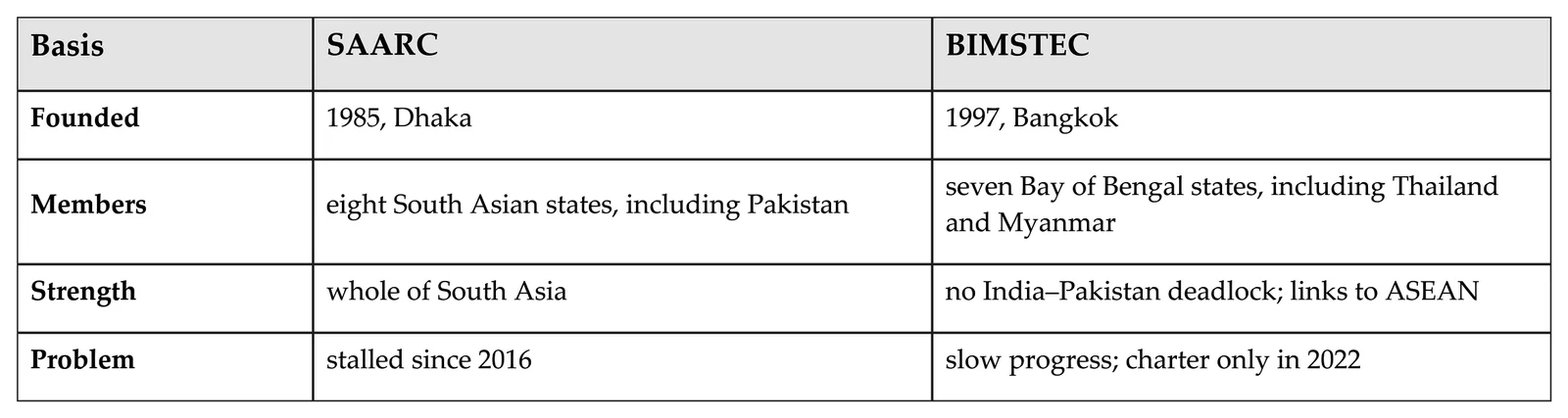
The South Asian Association for Regional Cooperation was founded in 1985 to promote cooperation among South Asian countries. Its progress has been limited by India–Pakistan rivalry, and no summit has been held since 2014, leading India to focus on BIMSTEC and sub-regional cooperation.
Why SAARC Has Struggled
SAARC was founded at Dhaka on 8 December 1985, and Afghanistan joined in 2007. The South Asian Free Trade Area agreement of 2004 came into force in 2006, but trade within South Asia remains only around five per cent of the region’s total trade, among the lowest of any region. The nineteenth summit, due in Islamabad in November 2016, was cancelled after India and several other members withdrew following the terrorist attack at Uri. The SAARC charter excludes bilateral and contentious issues, and decisions require unanimity, so India–Pakistan hostility can block progress. India has therefore promoted sub-regional cooperation, such as the Bangladesh-Bhutan-India-Nepal Motor Vehicles Agreement of 2015, and BIMSTEC, whose charter came into force in 2024, while also using SAARC occasionally, as when it proposed a regional Covid-19 emergency fund in March 2020.
4.4 Important Questions
- Question 1 Discuss India’s role in the Quad.
- Question 2 Discuss India’s relations with ASEAN with reference to Look East and Act East.
- Question 3 Discuss India–European Union relations.
- Question 4 Discuss India’s role in BRICS.
- Question 5 Discuss India’s role in SAARC. Why has SAARC failed to achieve its goals?
DU asks the same idea in different words. So learn one broad answer for each question below; the same answer works for every question joined by OR.
Important Question 1
Discuss India’s role in the Quad.
OR
What is the Quad? Examine its significance for India.
OR
Is the Quad an alliance against China? Discuss.
Model Answer
“We strive for a region that is free, open, inclusive, healthy, anchored by democratic values, and unconstrained by coercion.”
— Quad Leaders’ Joint Statement, The Spirit of the Quad (2021)
Introduction. The Quadrilateral Security Dialogue, known as the Quad, is a grouping of India, the United States, Japan and Australia. It began as a response to a natural disaster, faded, and was revived in 2017 amid concern about China’s growing power. Today it cooperates on a wide range of issues in the Indo-Pacific. India values the Quad but insists it is not a military alliance.
1. Origins
The four countries first worked together as a core group to coordinate relief after the Indian Ocean tsunami of December 2004, showing their combined naval and logistical capacity.
2. The First Quad
In 2007, officials of the four countries met informally, encouraged by Japanese Prime Minister Shinzo Abe, and held a large naval exercise. China protested, and Australia withdrew in 2008, so the first Quad faded.
3. Revival
In November 2017, the Quad was revived at the level of senior officials, as all four countries grew concerned about China’s assertiveness in the South China Sea and the Indian Ocean.
4. Leaders’ Summits
The Quad leaders first met virtually in March 2021 and in person in Washington in September 2021. Summits followed in Tokyo in 2022, Hiroshima in 2023 and Wilmington in 2024, showing high-level commitment.
5. Areas of Cooperation
The Quad cooperates on vaccines, critical and emerging technologies, climate, infrastructure, cyber security, space, maritime domain awareness and humanitarian assistance, offering public goods to the region.
6. Vaccines and Health
In 2021, the Quad launched a vaccine partnership to produce and deliver vaccines to the Indo-Pacific, drawing on India’s manufacturing capacity, Japanese and US finance and Australian logistics.
7. Maritime Domain Awareness
The Indo-Pacific Partnership for Maritime Domain Awareness, launched in 2022, helps regional countries track illegal fishing and other activities in their waters using satellite data.
8. The Malabar Exercise
The Malabar naval exercise, begun by India and the United States in 1992, now includes Japan and, since 2020, Australia, giving the four countries regular military interaction alongside the Quad.
9. Significance for India
The Quad helps India balance China, gain access to technology and investment, strengthen its maritime role and shape the rules of the Indo-Pacific, without giving up its strategic autonomy.
10. Not an Alliance
India insists that the Quad is not a military alliance and has no mutual defence obligation. It presents the Quad as a positive agenda for the region rather than a bloc against any country.
11. China’s Response
China has criticised the Quad as an attempt to contain it and has called it an Asian NATO, while Quad members deny this and stress cooperation on public goods.
12. ASEAN Centrality
The Quad supports ASEAN centrality, recognising Southeast Asian countries’ concern that great-power groupings should not sideline ASEAN in regional affairs.
13. Challenges
Challenges include differences among members on Russia and trade, changes of government in member countries and the risk that the Quad delivers less than it promises.
14. India’s Multi-Alignment
India’s participation in the Quad alongside BRICS and the Shanghai Cooperation Organisation reflects its strategy of multi-alignment, working with different partners on different issues.
15. Critical Technologies and Supply Chains
The Quad has set up working groups on critical and emerging technologies, semiconductors and supply chains, aiming to reduce dependence on China for vital inputs. For India, this cooperation offers access to advanced technology and investment in electronics and clean energy, supporting its goal of becoming a manufacturing hub.
16. Quad and Disaster Relief
The Quad countries have agreed to coordinate humanitarian assistance and disaster relief in the Indo-Pacific, a region frequently hit by cyclones, earthquakes and tsunamis. India, with its navy and experience of relief operations in its neighbourhood, presents itself as a first responder, which strengthens its role as a security provider in the Indian Ocean.
17. Evaluation
The Quad has become an important Indo-Pacific grouping that serves India’s interests, while India keeps it a cooperative rather than military arrangement.
Conclusion. Thus, the Quad of India, the United States, Japan and Australia grew from tsunami relief in 2004, faded in 2008, revived in 2017 and reached leaders’ summits from 2021. It cooperates on vaccines, technology and maritime awareness, helping India balance China and shape the Indo-Pacific while preserving strategic autonomy, though China sees it as containment.
Important Question 2
Discuss India’s relations with ASEAN with reference to Look East and Act East.
OR
Examine the evolution of India’s Look East policy into Act East.
OR
Why did India withdraw from the RCEP? Discuss.
Model Answer
“One Vision, One Identity, One Community.”
— Motto of ASEAN, ASEAN Charter, Article 36
Introduction. The Association of Southeast Asian Nations, founded in 1967, is one of the most successful regional organisations in the developing world. India’s relations with ASEAN grew from limited contact during the Cold War to a comprehensive strategic partnership. The Look East policy of the 1990s and the Act East policy of 2014 placed Southeast Asia at the centre of India’s economic and strategic outreach.
1. ASEAN
ASEAN was founded in 1967 by Indonesia, Malaysia, the Philippines, Singapore and Thailand and later expanded to include Brunei, Vietnam, Laos, Myanmar and Cambodia, with Timor-Leste joining in 2025. It promotes economic integration, regional peace and dialogue.
2. Historical Links
India and Southeast Asia share deep cultural ties through Hinduism, Buddhism, trade and the Ramayana, seen in temples such as Angkor Wat and Borobudur. During the Cold War, however, India’s closeness to the Soviet Union kept it apart from pro-Western ASEAN.
3. Look East
In 1991–92, Prime Minister P.V. Narasimha Rao launched the Look East policy to build economic ties with the fast-growing economies of Southeast and East Asia, as India opened its economy.
4. Growing Partnership
India became a sectoral dialogue partner of ASEAN in 1992, a full dialogue partner in 1996 and a summit-level partner in 2002, and joined the ASEAN Regional Forum and the East Asia Summit.
5. Trade Agreements
India and ASEAN signed a free trade agreement in goods in 2009, in force from 2010, and in services and investment in 2014. Trade has grown greatly, though India runs a trade deficit and has sought a review of the goods agreement.
6. Act East
In 2014, India renamed its policy Act East, stressing action and adding security and strategic dimensions, with a focus on commerce, culture and connectivity.
7. Connectivity
India is building the India–Myanmar–Thailand Trilateral Highway and the Kaladan multimodal project through Myanmar to link its North-east with Southeast Asia, though progress has been slow.
8. Strategic Cooperation
India cooperates with ASEAN countries on maritime security, especially with Vietnam, Indonesia, Singapore and the Philippines, which purchased BrahMos missiles from India in 2022.
9. The 2018 Summit
In January 2018, India hosted all ten ASEAN leaders as chief guests at the Republic Day parade, a unique gesture marking 25 years of partnership.
10. RCEP
In 2019, India withdrew from the Regional Comprehensive Economic Partnership, which includes ASEAN, China, Japan, South Korea, Australia and New Zealand, fearing a flood of Chinese imports and harm to its farmers and industries.
11. Comprehensive Strategic Partnership
India and ASEAN upgraded their relationship to a Comprehensive Strategic Partnership in 2022, covering trade, security, digital cooperation and people-to-people ties.
12. ASEAN Centrality and the Indo-Pacific
India supports ASEAN centrality in the Indo-Pacific and welcomed the ASEAN Outlook on the Indo-Pacific of 2019, which shares India’s emphasis on openness and inclusiveness.
13. The South China Sea
India supports freedom of navigation and peaceful settlement of disputes in the South China Sea under international law, a concern shared with several ASEAN states facing Chinese claims.
14. Challenges
Challenges include India’s trade deficit, its absence from RCEP, slow connectivity projects and ASEAN members’ deep economic dependence on China.
15. Cultural and Educational Ties
India has supported the restoration of ancient temples in Southeast Asia, such as Angkor Wat in Cambodia and My Son in Vietnam, and the revival of Nalanda University, opened in 2014 with support from East Asia Summit countries. Scholarships, tourism and Buddhist pilgrimage circuits strengthen cultural ties between India and ASEAN.
16. Digital Cooperation
India has offered its digital public infrastructure, such as the Unified Payments Interface, to ASEAN countries. Singapore’s PayNow was linked with UPI in 2023, allowing instant cross-border payments, and other ASEAN countries have shown interest, opening a new area of cooperation.
17. Evaluation
ASEAN is central to India’s eastward engagement, and Act East has deepened economic, strategic and cultural ties, though economic integration lags.
Conclusion. Thus, India’s ties with ASEAN grew from Cold War distance to Look East in 1991, dialogue partnership in 1996, the FTA of 2010, Act East in 2014 and a Comprehensive Strategic Partnership in 2022. Connectivity projects and maritime cooperation deepen ties, but the RCEP exit and trade deficits show limits.
Important Question 3
Discuss India–European Union relations.
OR
Examine the India–EU strategic partnership and the free trade negotiations.
OR
Why is the European Union important for India?
Model Answer
“Europe will not be made all at once, or according to a single plan. It will be built through concrete achievements which first create a de facto solidarity.”
— Robert Schuman, Schuman Declaration (1950)
Introduction. The European Union, a union of 27 European states, is one of the world’s largest economies and a major global actor in trade, regulation and climate policy. India was among the first countries to establish relations with the European Economic Community in the early 1960s. The relationship has grown into a strategic partnership, though progress on a trade agreement has been slow.
1. The European Union
The EU grew from the European Coal and Steel Community of 1951, inspired by the Schuman Declaration, and the European Economic Community of 1957 into a political and economic union with a single market and, for many members, a common currency.
2. Early Relations
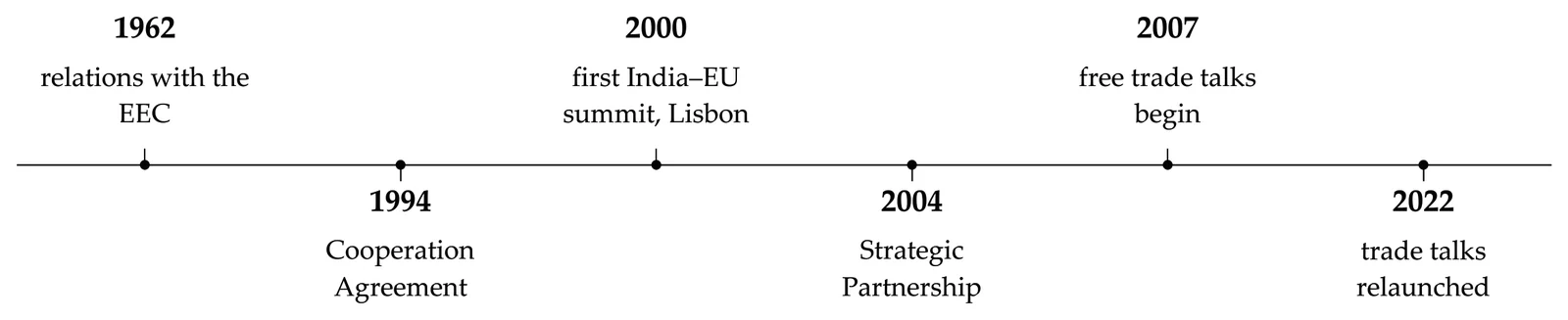
India established diplomatic relations with the European Economic Community in the early 1960s. A cooperation agreement in 1994 widened ties beyond trade to include development and political dialogue.
3. Strategic Partnership
The first India–EU summit was held in Lisbon in 2000, and the two sides declared a strategic partnership in 2004, followed by a Joint Action Plan in 2005, covering trade, security, energy and culture.
4. Trade and Investment
The EU is one of India’s largest trading partners and a major source of foreign investment, technology and development cooperation.
5. Free Trade Negotiations
Negotiations for a Broad-based Trade and Investment Agreement began in 2007 but stalled in 2013 over issues such as tariffs on cars and wine, data security, professionals’ visas and intellectual property. They were relaunched in 2022, along with talks on investment protection and geographical indications.
6. Trade and Technology Council
In 2023, India and the EU launched a Trade and Technology Council, the EU’s second after the one with the United States, to cooperate on digital technologies, clean energy and resilient supply chains.
7. Connectivity
India and the EU support the India–Middle East–Europe Economic Corridor announced at the G20 summit of 2023, linking India to Europe through the Gulf by sea, rail and digital networks.
8. Climate and Energy
The EU and India cooperate on clean energy and climate, including solar power and green hydrogen, though they disagree on some issues, such as the EU’s carbon border tax, which India sees as a trade barrier.
9. Shared Values
Both are democracies committed to multilateralism and the rule of law, but the EU has sometimes criticised India on human rights, and India resents what it sees as lectures.
10. Individual Members
India has strong bilateral ties with EU members such as France, a key defence partner supplying Rafale aircraft, and Germany, a major economic partner, alongside its relations with the EU as a whole.
11. Russia and Ukraine
India’s refusal to condemn Russia over Ukraine and its purchases of Russian oil created friction with the EU, though both sides have kept their partnership on track.
12. Security Cooperation
India and the EU cooperate on counter-terrorism, maritime security, including anti-piracy operations in the Indian Ocean, and cyber security.
13. Education and Migration
Growing numbers of Indian students and professionals go to Europe, and agreements on migration and mobility with countries such as France and Germany support this movement.
14. Challenges
Challenges include the slow pace of trade negotiations, differences on regulation and standards, and the EU’s limited strategic presence in Asia.
15. Standards and Regulation
The EU sets global standards in areas such as data protection, product safety and environmental rules, a power sometimes called the Brussels effect. Indian exporters must meet these standards, and India’s own laws, such as its data protection law of 2023, have been compared with the EU’s General Data Protection Regulation.
16. Green Hydrogen and Clean Technology
India and the EU have agreed to cooperate on green hydrogen, offshore wind and other clean technologies. European investment and technology, combined with India’s large market and renewable energy potential, could help both meet their climate goals while creating jobs.
17. Evaluation
The EU is a key economic and technological partner for India, and a trade agreement would greatly strengthen the relationship.
Conclusion. Thus, India–EU relations grew from early ties with the EEC and the 1994 cooperation agreement to a strategic partnership in 2004. Trade, investment, the Trade and Technology Council and the India–Middle East–Europe corridor deepen ties, but the long-delayed trade agreement, the carbon border tax and differences over Russia remain challenges.
Important Question 4
Discuss India’s role in BRICS.
OR
What is the significance of BRICS for India and the global South?
OR
Examine the challenges facing BRICS after its expansion.
Model Answer
“We underline our support for a more democratic and just multi-polar world order based on the rule of international law, equality, mutual respect, cooperation, coordinated action and collective decision-making of all States.”
— Joint Statement of the BRIC Leaders, Yekaterinburg (2009)
Introduction. BRICS is a grouping of major emerging economies, originally Brazil, Russia, India, China and South Africa. It began as an idea of an investment bank economist and became a forum for cooperation and for demanding reform of global governance. India is a founding member and values BRICS as a platform for the global South, while ensuring it does not become an anti-Western bloc.
1. Origin of the Idea
In 2001, the economist Jim O’Neill coined the term BRIC for Brazil, Russia, India and China, predicting that their economies would become very large by the middle of the century.
2. From Idea to Grouping
The foreign ministers of the four countries began meeting in 2006, and the first BRIC summit was held at Yekaterinburg in Russia in 2009. South Africa joined in 2010, making the grouping BRICS.

3. Goals
BRICS seeks a more democratic and multipolar world order, reform of the IMF, the World Bank and the UN Security Council, and cooperation among emerging economies in trade, finance, health and technology.
4. The New Development Bank
At the Fortaleza summit in 2014, BRICS created the New Development Bank, headquartered in Shanghai, with an Indian, K.V. Kamath, as its first president. It finances infrastructure and sustainable development projects.
5. Contingent Reserve Arrangement
BRICS also set up a Contingent Reserve Arrangement of 100 billion dollars in 2014 to help members facing balance of payments problems, as an alternative source of support to the IMF.
6. Expansion
In 2024, BRICS expanded to include Egypt, Ethiopia, Iran and the United Arab Emirates, and Indonesia joined in 2025, increasing its weight but also its diversity.
7. India’s Interests
India values BRICS as a forum to press for reform of global institutions, to cooperate with other emerging economies and to maintain ties with Russia and China while also partnering with the West.
8. Voice of the Global South
India presents BRICS as a voice of the global South on issues such as development finance, climate justice, food security and fair trade rules.
9. China’s Dominance
China’s economy is larger than those of all other members combined, raising concerns in India that BRICS could become an instrument of Chinese influence.
10. India–China Tensions
Border tensions between India and China, especially after 2020, complicate cooperation within BRICS, though both have continued to participate.
11. De-Dollarisation
Some members have proposed reducing dependence on the US dollar in trade. India supports trade in national currencies but has opposed a common BRICS currency or an anti-dollar agenda.
12. Not Anti-West
India insists that BRICS should be non-Western rather than anti-Western, reflecting its strategy of multi-alignment and its close ties with the United States and Europe.
13. Achievements
BRICS has created new financial institutions, given emerging economies a collective voice and contributed to reforms, such as changes in IMF voting shares agreed in 2010.
14. India’s Chairship
India held the BRICS chair in 2016 and again holds it in 2026, giving it the chance to shape the agenda of the expanded grouping towards development and reform.
15. BRICS and Health
BRICS countries set up a vaccine research and development centre, agreed in 2022, and cooperate on traditional medicine, tuberculosis and pandemic preparedness. India, with its large pharmaceutical industry, plays a leading role in health cooperation within the grouping.
16. Payments and Trade
BRICS members have discussed linking their payment systems and increasing trade in local currencies to reduce costs and exposure to sanctions. India has promoted the use of its UPI system and rupee trade arrangements with partners, while avoiding commitments that would weaken its ties with the West.
17. Expansion and Coherence
The expansion of BRICS has increased its share of world population and output but made agreement harder, since members now include rivals and countries with very different political systems. India has argued for clear criteria for membership and for keeping the grouping focused on development and reform.
18. Evaluation
BRICS gives India a platform for the global South and global reform, but internal differences and China’s weight limit its effectiveness.
Conclusion. Thus, BRICS grew from O’Neill’s BRIC idea of 2001 to summits from 2009, the New Development Bank and Contingent Reserve Arrangement of 2014 and expansion in 2024. India uses it to press for reform and represent the global South, while resisting Chinese dominance and an anti-Western turn.
Important Question 5
Discuss India’s role in SAARC. Why has SAARC failed to achieve its goals?
OR
Examine the achievements and limitations of SAARC.
OR
Why has India shifted its focus from SAARC to BIMSTEC?
Model Answer
“To promote the welfare of the peoples of South Asia and to improve their quality of life.”
— SAARC Charter, Article I (1985)
Introduction. The South Asian Association for Regional Cooperation was founded in Dhaka in December 1985 by India, Pakistan, Bangladesh, Sri Lanka, Nepal, Bhutan and the Maldives, with Afghanistan joining in 2007. It aimed to promote economic, social and cultural cooperation in one of the world’s poorest and least integrated regions. Despite some achievements, SAARC has been largely stalled by India–Pakistan rivalry.
1. Origins
The idea of South Asian cooperation was proposed by Bangladesh’s President Ziaur Rahman in 1980. Smaller states hoped regional cooperation would promote development and moderate India’s dominance.
2. Principles
SAARC’s charter requires decisions by unanimity and excludes bilateral and contentious issues from its deliberations, to avoid disputes such as Kashmir blocking cooperation.
3. Trade Agreements
SAARC adopted a Preferential Trading Arrangement in 1993 and the South Asian Free Trade Area agreement in 2004, in force from 2006, but trade within South Asia remains a small share of the region’s total trade.
4. Other Achievements
SAARC created a Development Fund, a food bank and the South Asian University in New Delhi, which began in 2010. India launched the South Asia Satellite in 2017 for neighbours’ use.
5. India’s Role
As the largest country, India has contributed most resources to SAARC, offering trade concessions and assistance, but smaller neighbours have sometimes seen India as dominant, as Imtiaz Ahmed’s study of India’s role in South Asia discusses.
6. India–Pakistan Rivalry
The main obstacle has been rivalry between India and Pakistan. Pakistan has refused to grant India transit and full trade access, and terrorism has repeatedly derailed cooperation.
7. The Stalled Summit
The last SAARC summit was held in Kathmandu in 2014. The 2016 summit in Islamabad was cancelled after India and other members withdrew following the terrorist attack at Uri.
8. Asymmetry
India’s size, population and economy are larger than all other members combined, creating fears of domination among smaller states and complicating regional cooperation.
9. Low Trade
Intra-regional trade remains low because of tariff and non-tariff barriers, poor connectivity and political distrust, making South Asia one of the least economically integrated regions.
10. Shift to BIMSTEC
India has turned to BIMSTEC, which links Bangladesh, Bhutan, India, Nepal, Sri Lanka, Myanmar and Thailand around the Bay of Bengal and excludes Pakistan. Its charter came into force in 2024.
11. Sub-Regional Cooperation
India also promotes sub-regional cooperation, such as the Bangladesh–Bhutan–India–Nepal motor vehicles agreement of 2015 and energy trade with Nepal and Bhutan.
12. SAARC during Covid-19
In March 2020, India convened a video conference of SAARC leaders and proposed a Covid-19 emergency fund, showing that SAARC could still be used for practical cooperation.
13. Neighbourhood First
India’s Neighbourhood First policy seeks closer ties with neighbours through connectivity, energy, trade and development assistance, largely outside SAARC.
14. Future of SAARC
SAARC’s revival depends on improved India–Pakistan relations. Until then, cooperation is likely to continue through BIMSTEC and bilateral and sub-regional arrangements.
15. Costs of Non-Integration
Studies by the World Bank estimate that trade within South Asia could be several times higher than it is if barriers were removed. The lack of integration means higher costs for consumers and businesses and lost opportunities for growth and jobs across the region.
16. Smaller Neighbours’ Perspective
Smaller South Asian states often seek to balance India by building ties with China and other powers. India’s Neighbourhood First policy tries to address their concerns through generous assistance, connectivity and respect for sovereignty, building on the Gujral Doctrine of non-reciprocity.
17. People-to-People Links
Despite political tensions, South Asians share languages, cultures, religions, films and cricket. Scholars argue that people-to-people links, such as easier visas, student exchanges and tourism, could build support for regional cooperation from below.
18. Evaluation
SAARC has achieved little because of India–Pakistan rivalry, asymmetry and low trade, leading India to pursue regional cooperation through other forums.
Conclusion. Thus, SAARC, founded in 1985 to promote South Asian welfare, created SAFTA, a development fund and the South Asian University, but India–Pakistan rivalry, terrorism, asymmetry and low trade have stalled it since the 2014 summit. India has shifted to BIMSTEC, sub-regional cooperation and Neighbourhood First.
Short Notes
(a) Act East policy
India’s policy, renamed from Look East in 2014, of deepening economic, strategic and cultural ties with Southeast and East Asia.
(b) New Development Bank
The development bank created by BRICS in 2014, headquartered in Shanghai, to finance infrastructure and sustainable development.
(c) BIMSTEC
The Bay of Bengal grouping of Bangladesh, Bhutan, India, Nepal, Sri Lanka, Myanmar and Thailand, increasingly preferred by India over SAARC.
More notes: MDSE-15 India and the World
These notes are prepared by PADHO TO AISE for study help. They are not an official University of Delhi publication.