
Semester VIII MDSE-15 India and the World
Unit 3 · 23 min read · Updated 24 Nov 2026
As per the University of Delhi (DU) BA (Hons) Political Science syllabus
Contents
- 3.1 Latin America and Africa
- India and Latin America in Detail
- India and Africa in Detail
- India and China in Africa
- 3.2 Central Asia
- Milestones in India–Central Asia Relations
- Interests and Obstacles
- Soft Power in Central Asia
- 3.3 Australia
- Milestones of India–Australia Relations
- Pillars of the Partnership
- Strains and New Horizons
- 3.4 Important Questions
- Discuss India’s relations with Latin America and the Caribbean.
- Discuss India’s relations with Africa.
- Discuss India’s relations with Central Asia.
- Discuss India–Australia relations in the Indo-Pacific.
- Short Notes
अफ्रीका हमारी प्राथमिकताओं में सबसे ऊपर रहेगा।
Africa will be at the top of our priorities.
— Narendra Modi, address to the Parliament of Uganda (2018)
BBEYOND its neighbourhood and the major powers, India has built relations with regions across the world. Latin America offers trade, energy and partners in the global South; Africa shares a history of anti-colonial struggle and offers markets, resources and diplomatic support; Central Asia lies in India’s extended neighbourhood, rich in energy but hard to reach; and Australia has become a key partner in the Indo-Pacific. This chapter examines these relationships, drawing on Claude Ake, Paul Nugent, John Harbeson and Donald Rothchild, Dhruva Jaishankar and Malcolm Davis.
3.1 Latin America and Africa
Latin America and the Caribbean are distant from India, but trade, energy, pharmaceuticals and information technology have built strong links, especially with Brazil, Mexico, Argentina and countries with large Indian-origin communities. Africa shares a history of anti-colonial struggle with India. Through development partnership, the India–Africa Forum Summits, trade and peacekeeping, India has become a major partner of Africa.
India and Latin America in Detail
- Brazil. India and Brazil cooperate in IBSA, formed with South Africa by the Brasilia Declaration of 2003, in BRICS, in the G4 seeking permanent Security Council seats and in climate negotiations through BASIC.
- Mercosur. A preferential trade agreement between India and Mercosur, signed in 2004, came into force in 2009.
- Critical minerals. Argentina, Bolivia and Chile, the lithium triangle, are vital for batteries; India’s state company KABIL signed an agreement in 2024 to explore lithium in Argentina.
- The Caribbean. People of Indian origin form large communities in Guyana, Trinidad and Tobago and Suriname, descended from indentured labourers brought from 1838; Prime Minister Modi’s visit to Guyana in 2024 included a summit with Caribbean leaders.
- Trade and health. India exports medicines, vehicles and IT services to the region and imports oil, copper and vegetable oils.
India and Africa in Detail
- Historical bonds. Gandhi developed satyagraha in South Africa between 1893 and 1914, and India supported African liberation movements and opposed apartheid.
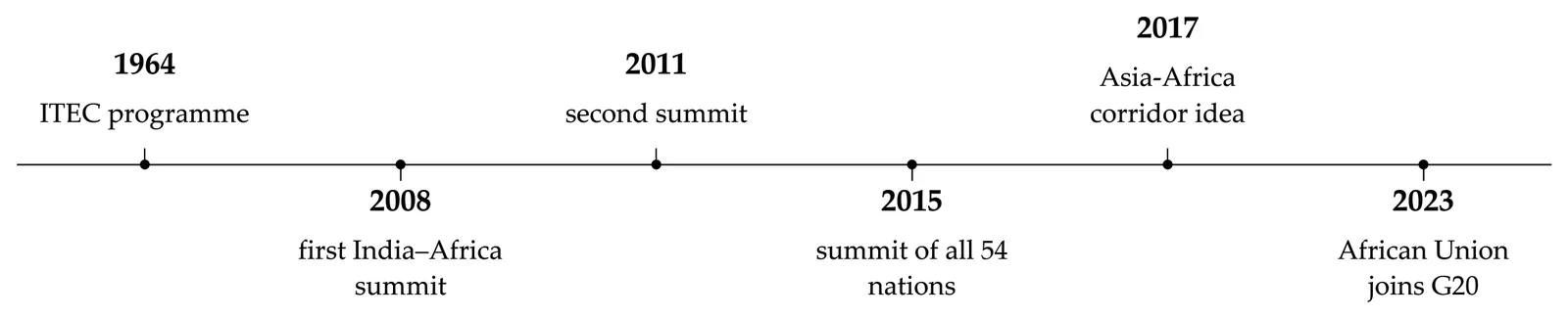
- Development partnership. The Indian Technical and Economic Cooperation programme, launched in 1964, trains African officials, and India has extended many lines of credit for infrastructure.
- Summits. India–Africa Forum Summits were held in 2008, 2011 and 2015; the third, in New Delhi, included all fifty-four African countries.
- Peacekeeping. Indian soldiers have served in many UN missions in Africa, and India sent the first all-female formed police unit to Liberia in 2007.
- Principles. In a speech to Uganda’s Parliament in 2018, Prime Minister Modi set out ten principles for engagement with Africa, stressing African priorities and capacity-building.
- Voice in global governance. During India’s G20 presidency in 2023, the African Union became a permanent member of the G20.
India and China in Africa
India’s engagement with Africa is often compared with China’s, which is larger in trade, loans and infrastructure. Indian officials stress that India’s approach is demand-driven, builds local capacity through training and education and avoids burdening countries with unsustainable debt. India’s strengths include its diaspora, its private companies in sectors such as telecommunications, pharmaceuticals and automobiles, and its democratic and anti-colonial credentials. Its weaknesses include slow implementation of projects and limited resources. Initiatives such as digital education and telemedicine networks and the Asia-Africa Growth Corridor proposed with Japan in 2017 aim to strengthen India’s role.
3.2 Central Asia
The five Central Asian republics, Kazakhstan, Kyrgyzstan, Tajikistan, Turkmenistan and Uzbekistan, are part of India’s extended neighbourhood, linked by history and rich in energy and minerals. India’s access is limited because Pakistan and Afghanistan lie in between, so it has turned to Chabahar port and the North-South Transport Corridor.
Milestones in India–Central Asia Relations
- Historical ties. The Kushan empire linked Central Asia and north India, Buddhism spread along the Silk Road, and Babur, the founder of the Mughal empire, came from the Fergana valley.
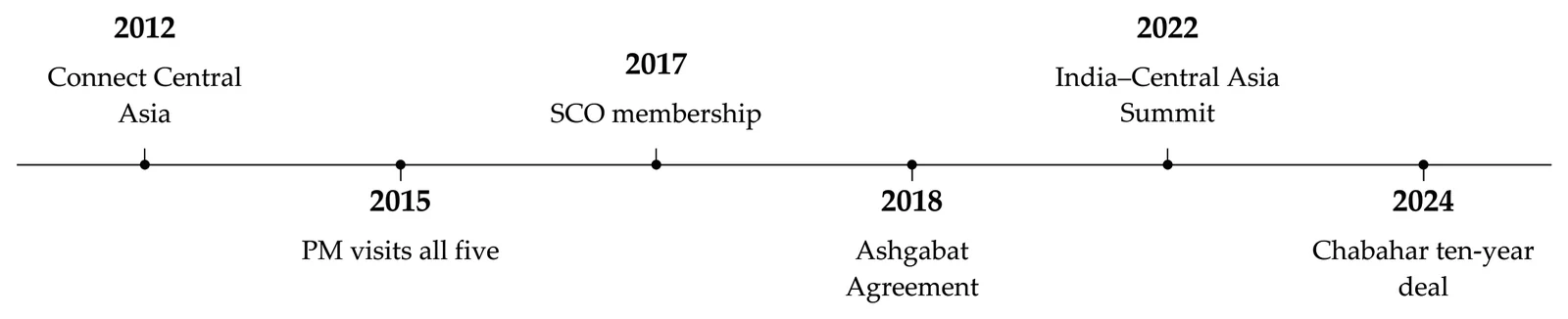
- 2012 → India announced a Connect Central Asia policy, stressing political, economic, security and cultural links.
- 2015 → Prime Minister Modi visited all five Central Asian republics in one journey.
- 2017 → India became a full member of the Shanghai Cooperation Organisation, which includes four Central Asian states.
- 2018 → India joined the Ashgabat Agreement on transport corridors and began operating a terminal at Iran’s Chabahar port.
- 2022 → The first India–Central Asia Summit was held virtually in January.
Interests and Obstacles
India’s interests in Central Asia include energy, through uranium from Kazakhstan, which has supplied India since 2009, and gas through the proposed Turkmenistan-Afghanistan-Pakistan-India (TAPI) pipeline; security, particularly countering terrorism and drug trafficking linked to Afghanistan; and trade and connectivity. The main obstacle is geography: Pakistan denies India land access, and the Taliban’s return to power in Afghanistan in 2021 added uncertainty. India has therefore invested in Chabahar and the International North-South Transport Corridor, agreed with Russia and Iran in 2000, but American sanctions on Iran have repeatedly complicated these projects. China’s Belt and Road Initiative gives it a much larger economic presence in the region.
Soft Power in Central Asia
India enjoys considerable goodwill in Central Asia through films, music, yoga and education. Indian films have been popular since Soviet times, and many Central Asian students study medicine in India, while Indian students study in Central Asian medical universities. Scholarships under the ITEC programme, cultural centres and the celebration of shared heritage, such as the Buddhist sites of the region, help build these links. Scholars suggest that India should combine this soft power with practical connectivity and investment to become a significant partner for the region.
3.3 Australia
India and Australia were distant during the Cold War, but they have become close partners since 2009, with a Comprehensive Strategic Partnership from 2020, cooperation in the Quad, a trade agreement in force from 2022 and a growing Indian community in Australia. Malcolm Davis describes Australia as a rising middle power that values India as a partner.

Milestones of India–Australia Relations
- Cold War distance. Australia was allied with the United States through ANZUS (1951), while India was non-aligned, and Australia condemned India’s nuclear tests of 1998.
- 2009 → The two countries established a strategic partnership.
- 2014 → A civil nuclear cooperation agreement allowed Australian uranium sales to India.
- 2020 → A virtual summit upgraded relations to a Comprehensive Strategic Partnership and produced a mutual logistics support agreement; Australia also rejoined the Malabar naval exercise.
- 2022 → The Economic Cooperation and Trade Agreement came into force in December, and annual summits began.
Pillars of the Partnership
Cooperation now covers defence, trade, education, critical minerals and people-to-people links. The two navies exercise together, and both are members of the Quad. Australia is rich in coal, lithium, rare earths and other critical minerals that India needs for its energy transition, and a critical minerals investment partnership was launched in 2022. Indian-born people are among the largest groups of migrants in Australia, and Indian students form one of the largest groups of international students there. Cricket and shared Commonwealth traditions add to the warmth of relations. Negotiations continue on a wider comprehensive economic cooperation agreement.
Strains and New Horizons
Relations have not always been smooth. A series of attacks on Indian students in Melbourne and Sydney in 2009 caused anger in India and damaged Australia’s image as a place to study, prompting both governments to act on student safety. Disagreements over uranium sales and trade took years to resolve. The two countries now also cooperate in the wider region, including the Pacific islands, where India has engaged small island states through the Forum for India–Pacific Islands Cooperation, launched at Suva in 2014, with summits in Jaipur in 2015 and Port Moresby in 2023. Both countries see a stable, rules-based Indo-Pacific as central to their security and prosperity.
3.4 Important Questions
- Question 1 Discuss India’s relations with Latin America and the Caribbean.
- Question 2 Discuss India’s relations with Africa.
- Question 3 Discuss India’s relations with Central Asia.
- Question 4 Discuss India–Australia relations in the Indo-Pacific.
DU asks the same idea in different words. So learn one broad answer for each question below; the same answer works for every question joined by OR.
Important Question 1
Discuss India’s relations with Latin America and the Caribbean.
OR
Why has Latin America become important for India?
OR
Examine India’s economic and political ties with Brazil, Mexico and Argentina.
Model Answer
“Draw neighbours in, extend the neighbourhood and expand traditional constituencies of support.”
— S. Jaishankar, The India Way (2020)
Introduction. Latin America and the Caribbean were long marginal in India’s foreign policy because of distance and limited trade. Since the 1990s, however, economic growth on both sides, the search for energy and minerals, and cooperation among countries of the global South have built strong links. India’s Focus Latin America and Caribbean programme of 1997 marked this new attention.
1. Historical Links
Indian indentured labourers were taken to the Caribbean in the nineteenth century, and today people of Indian origin form large communities in Guyana, Trinidad and Tobago and Suriname. Rabindranath Tagore visited Argentina in 1924 and formed a lasting friendship with the writer Victoria Ocampo, while the Mexican poet Octavio Paz served as ambassador to India in the 1960s.
2. Cold War Years
During the Cold War, India and many Latin American countries cooperated in the Non-Aligned Movement and the Group of 77 at the United Nations, sharing concerns about development, trade and the international economic order, though direct economic ties remained small.
3. Focus LAC
In 1997, India launched the Focus Latin America and Caribbean programme to promote trade and investment in the region. Since then, trade has grown many times over, reaching tens of billions of dollars a year, and Indian companies have invested in the region.
4. Brazil
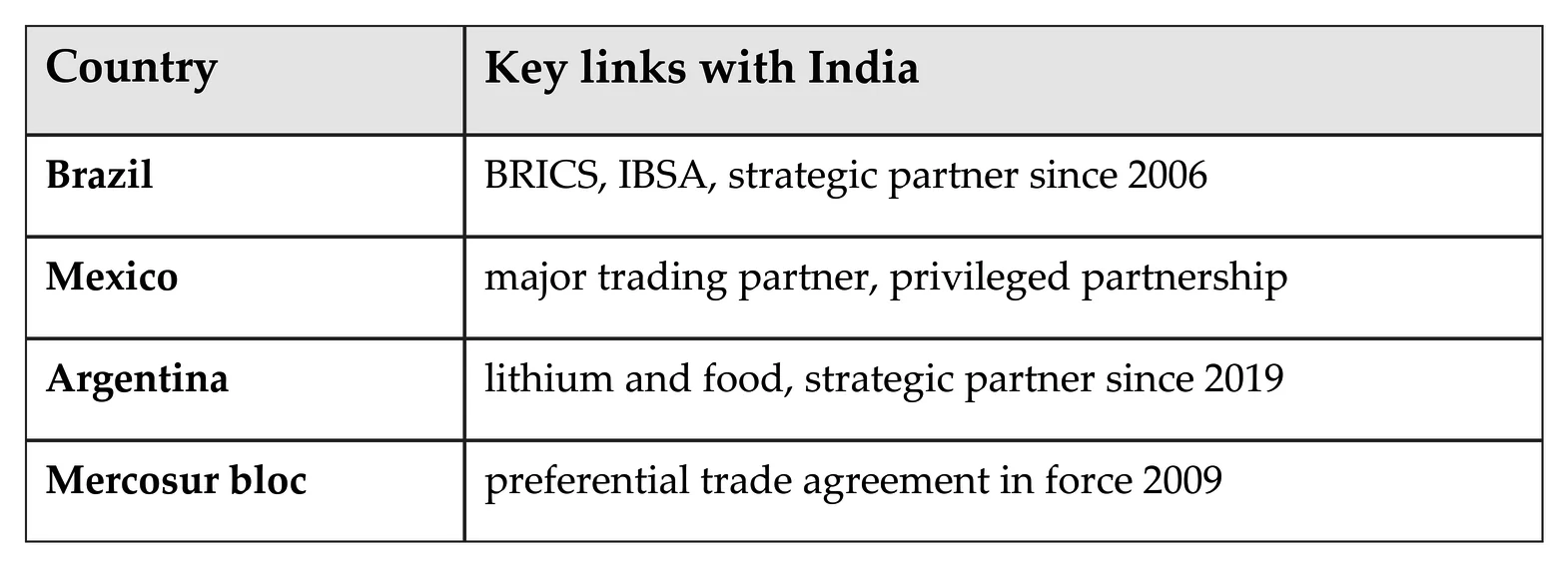
Brazil is India’s most important partner in the region. The two countries became strategic partners in 2006 and work together in BRICS, IBSA and the G4 group seeking permanent seats in the UN Security Council, as well as in trade and climate negotiations.
5. Mexico
Mexico is one of India’s largest trading partners in Latin America, with a privileged partnership since 2007. Indian information technology and pharmaceutical companies operate in Mexico, and Indian car makers export vehicles there.
6. Argentina and Chile
Argentina became a strategic partner of India in 2019 and is important for food and lithium, a mineral needed for batteries. Chile signed a preferential trade agreement with India in 2007 and is also rich in copper and lithium.
7. Energy
Latin America has become a significant source of oil for India, from Venezuela, Mexico, Brazil and Colombia, and Indian state companies such as ONGC Videsh have invested in the region’s oil fields. Guyana’s new oil wealth has also attracted Indian interest.
8. Mercosur
India signed a preferential trade agreement with Mercosur, the South American trade bloc of Brazil, Argentina, Uruguay and Paraguay, in 2004, which came into force in 2009. Both sides have discussed expanding it to cover more goods.
9. Pharmaceuticals and IT
Indian generic medicines are widely used in Latin America, making healthcare more affordable, and Indian IT companies employ thousands of people in the region, creating a strong economic presence.
10. The Caribbean
India has deepened ties with Caribbean countries through development assistance, training, solar energy projects and summits with CARICOM, the Caribbean Community, including a summit in Guyana in 2024.
11. Global South Cooperation
India and Latin American countries cooperate in the global South on climate, trade rules, reform of global institutions and access to medicines, and during the pandemic India supplied vaccines to several countries in the region.
12. Critical Minerals
The search for lithium and other critical minerals for clean energy has given Latin America new importance. In 2024, an Indian state company signed an agreement to explore lithium in Argentina’s Catamarca province.
13. Challenges
Challenges include geographical distance, high transport costs, limited direct flights and shipping links, language barriers and competition from China, which has become the largest trading partner of many Latin American countries.
14. Future Prospects
Expanding trade agreements, investment in minerals and energy, and cooperation in technology and the global South offer strong prospects for the relationship.
15. Evaluation
Latin America has moved from the margins to an important place in India’s foreign policy, driven by trade, energy, minerals and South–South cooperation.
Conclusion. Thus, India’s relations with Latin America and the Caribbean, rooted in diaspora and Non-Aligned cooperation, have grown since the Focus LAC programme of 1997. Brazil, Mexico, Argentina and Chile are key partners, the Mercosur agreement and investments in oil and lithium deepen ties, though distance and Chinese competition remain challenges.
Important Question 2
Discuss India’s relations with Africa.
OR
Examine the India–Africa Forum Summits and India’s development partnership with Africa.
OR
How does India’s approach to Africa differ from China’s?
Model Answer
“An integrated, prosperous and peaceful Africa, driven by its own citizens and representing a dynamic force in the international arena.”
— African Union, Agenda 2063: The Africa We Want
Introduction. India and Africa share long historical ties through trade across the Indian Ocean, the presence of Indian communities and a common struggle against colonialism and racism. Gandhi developed satyagraha in South Africa. Since independence, India has supported African liberation and built a partnership based on development cooperation, trade and solidarity. Scholars such as Claude Ake, Paul Nugent and John Harbeson and Donald Rothchild help explain Africa’s politics and place in the world.
1. Historical Ties
Trade across the Indian Ocean linked India with East Africa for centuries, and Indians settled in East and South Africa in colonial times. Gandhi lived in South Africa from 1893 to 1914, where he developed his method of non-violent resistance against racial discrimination.
2. Anti-Colonial Solidarity
India strongly supported African independence movements and was among the first countries to oppose apartheid, cutting trade with South Africa in 1946 and raising the issue at the United Nations. This solidarity built lasting goodwill in Africa.
3. Africa’s Political Economy
Claude Ake argued that African economies remained dependent on exporting raw materials and importing manufactured goods, a legacy of colonialism. Paul Nugent traces Africa’s political and economic history since independence, showing both problems and progress.
4. Africa in World Politics
John Harbeson and Donald Rothchild show how Africa has been shaped by external powers, from colonial rulers to the superpowers in the Cold War, and how African states have sought greater autonomy and a stronger voice.
5. Development Partnership
Through the Indian Technical and Economic Cooperation programme, started in 1964, India has trained thousands of Africans. It has offered lines of credit for roads, railways, power and water projects, and scholarships for African students to study in India.
6. India–Africa Forum Summits
India held India–Africa Forum Summits in New Delhi in 2008, Addis Ababa in 2011 and New Delhi in 2015, the last bringing together all 54 African nations, and announced credit, grants and scholarships.
7. Trade and Investment
Trade between India and Africa has grown to about a hundred billion dollars a year. India imports oil, gold and minerals and exports medicines, vehicles, machinery and food, and Indian companies have invested in telecom, agriculture and mining.
8. Pharmaceuticals and Health
Indian generic medicines, especially for HIV, have made treatment affordable for millions of Africans. India also provided vaccines to African countries during the pandemic.
9. Peacekeeping and Security
India has contributed large numbers of troops to UN peacekeeping missions in Africa, from the Congo in the 1960s to South Sudan, and cooperates with Indian Ocean island states such as Mauritius and Seychelles on maritime security.
10. Digital and Education Links
The Pan-African e-Network, launched in 2009, connected African institutions with Indian universities and hospitals for tele-education and tele-medicine, later followed by the e-VidyaBharti and e-ArogyaBharti network.
11. The African Union in the G20
During India’s G20 presidency in 2023, the African Union became a permanent member of the G20, a step India strongly supported as a voice of the global South.
12. Diaspora
About three million people of Indian origin live in Africa, especially in South Africa, Mauritius, Kenya and Tanzania, linking India and Africa through business and culture.
13. India and China in Africa
China is Africa’s largest trading partner and lender. India presents its approach as demand-driven, focused on capacity building, training and local ownership, though its resources are smaller than China’s.
14. Challenges
Challenges include slow implementation of Indian projects, limited finance compared with China, attacks on African students in India that have damaged goodwill, and security problems in parts of Africa.
15. Maritime Africa
India has strengthened ties with African Indian Ocean states, helping Mauritius develop facilities on Agaléga island, inaugurated in 2024, and assisting Seychelles, Mozambique and Madagascar with coastal surveillance and naval training. These links reflect India’s interest in the security of the western Indian Ocean and its sea lanes to Africa and the Gulf.
16. Evaluation
India–Africa relations rest on historical solidarity and growing economic partnership, with Africa central to India’s vision of the global South.
Conclusion. Thus, India–Africa relations, rooted in Indian Ocean trade, Gandhi’s South African years and anti-colonial solidarity, have grown through ITEC, the India–Africa Forum Summits, trade, medicines and peacekeeping. Ake and Harbeson and Rothchild explain Africa’s dependence and agency, and the African Union’s entry into the G20 in 2023 shows India’s support for Africa’s voice.
Important Question 3
Discuss India’s relations with Central Asia.
OR
Why is Central Asia important for India? Examine the challenges of connectivity.
OR
Discuss India’s Connect Central Asia policy.
Model Answer
“Who rules East Europe commands the Heartland; who rules the Heartland commands the World-Island; who rules the World-Island commands the world.”
— Halford Mackinder, Democratic Ideals and Reality (1919)
Introduction. Central Asia, made up of Kazakhstan, Kyrgyzstan, Tajikistan, Turkmenistan and Uzbekistan, lies at the heart of Eurasia. India has deep historical links with the region, and it matters to India for energy, security and strategic balance. Since these countries became independent in 1991, India has sought closer ties, though geography has limited its access.
1. Historical Links
Central Asia and India were linked by the Silk Road, the spread of Buddhism and the movement of peoples. The Mughal emperor Babur came from the Fergana valley in present-day Uzbekistan, and Central Asian culture deeply influenced Indian art, architecture and language.
2. Soviet Period
During the Soviet period, Central Asia was part of the Soviet Union, and India’s ties with the region were conducted through Moscow. Indian films were popular there, creating cultural familiarity.
3. The Heartland
Halford Mackinder called the interior of Eurasia the Heartland and saw it as the key to world power. Central Asia’s location between Russia, China, Iran and South Asia gives it great strategic importance.
4. Energy and Minerals
Central Asia is rich in oil, gas, uranium and other minerals. Kazakhstan has been a major supplier of uranium for India’s nuclear power plants, and Turkmenistan has large gas reserves.
5. Security
India and Central Asia share concerns about terrorism, extremism and drug trafficking from Afghanistan, especially after the Taliban returned to power in 2021.
6. Connect Central Asia
In 2012, India announced a Connect Central Asia policy, aimed at strengthening political, economic, security and cultural ties through regular visits, trade, education and connectivity.
7. Visits and Summits
The Prime Minister visited all five Central Asian countries in 2015. An India–Central Asia Dialogue of foreign ministers began in 2019, and the first India–Central Asia Summit was held virtually in January 2022.
8. The Shanghai Cooperation Organisation
India became a full member of the Shanghai Cooperation Organisation in 2017, which includes four Central Asian states, giving it a regular forum for engagement in the region.
9. The Connectivity Problem
India has no direct land access to Central Asia because Pakistan denies transit and Afghanistan is unstable, which makes trade costly and limits India’s presence.
10. Chabahar Port
India has developed the Chabahar port in Iran as a route to Afghanistan and Central Asia, and signed a ten-year agreement to operate a terminal there in 2024, though US sanctions on Iran create difficulties.
11. The North-South Corridor
The International North-South Transport Corridor links India by sea to Iran and then by rail and road to Central Asia and Russia, and India joined the Ashgabat Agreement on transit in 2018.
12. The TAPI Pipeline
The proposed Turkmenistan–Afghanistan–Pakistan–India gas pipeline, agreed in 2010, has made little progress because of security problems and India–Pakistan tensions.
13. Competition
Russia remains influential in Central Asia, and China has become its largest economic partner through the Belt and Road Initiative, so India competes for influence with greater resources elsewhere.
14. Soft Power
Indian films, education, yoga and information technology training give India soft power in Central Asia, where it is seen as a friendly and non-threatening partner.
15. Trade and Investment Gaps
Trade between India and Central Asia remains small compared with the region’s trade with China and Russia, partly because of high transport costs. Proposals to improve it include using the North-South Corridor, direct flights, pharmaceutical and information technology investment, and the India–Central Asia Business Council created to connect companies on both sides.
16. Afghanistan and Regional Stability
Afghanistan links India with Central Asia, so its stability matters greatly. India built roads, dams, schools and the Afghan Parliament building and trained Afghan officials after 2001, earning much goodwill. The Taliban’s return to power in August 2021 forced India to close its embassy for a time, though it later resumed limited engagement through a technical team and humanitarian aid such as wheat and medicines. India and the Central Asian states share concerns about terrorism, radicalisation and drug trafficking from Afghanistan, which gives security cooperation a central place in their relationship.
17. Evaluation
Central Asia is strategically important for India, but connectivity barriers and competition limit its role despite strong goodwill.
Conclusion. Thus, Central Asia, Mackinder’s Heartland, matters to India for history, energy, uranium, security and strategic balance. India’s Connect Central Asia policy, the 2015 visits, SCO membership and the 2022 summit have deepened ties, but the lack of land access, despite Chabahar and the North-South Corridor, and Russian and Chinese influence limit India’s role.
Important Question 4
Discuss India–Australia relations in the Indo-Pacific.
OR
How have India and Australia become close strategic partners?
OR
Examine economic and security cooperation between India and Australia.
Model Answer
“Australia will not be at the periphery of our vision, but at the centre of our thought.”
— Narendra Modi, address to the Australian Parliament (2014)
Introduction. India and Australia share the Indian Ocean, the Commonwealth, democracy, the English language and a love of cricket. Yet for decades their relations were limited, as Australia was a close US ally during the Cold War while India was non-aligned. Since the late 2000s, the two countries have become close partners in the Indo-Pacific, as Dhruva Jaishankar and Malcolm Davis show.
1. Early Relations
India and Australia established diplomatic relations before Indian independence, and both are Commonwealth members. But during the Cold War, Australia’s alliance with the United States and India’s non-alignment kept them apart.
2. Differences
Australia criticised India’s nuclear tests in 1998 and refused to sell uranium to India because it had not signed the NPT, which strained relations for some years.
3. Strategic Partnership
The two countries declared a strategic partnership in 2009 and upgraded it to a Comprehensive Strategic Partnership in 2020, reflecting growing convergence on security and the Indo-Pacific.
4. Uranium and Nuclear Cooperation
Australia lifted its ban on uranium sales to India in 2012, and the two countries signed a civil nuclear cooperation agreement in 2014, removing a major irritant.
5. Security Cooperation
India and Australia hold regular naval exercises, and Australia rejoined the Malabar exercise with India, the United States and Japan in 2020. They signed a mutual logistics support agreement in 2020.
6. Jaishankar on Security Cooperation
Dhruva Jaishankar, in a study for the Lowy Institute in 2020, showed how India–Australia security cooperation accelerated in the Indo-Pacific, driven by shared concerns about China’s assertiveness.
7. Davis on Australia as a Middle Power
Malcolm Davis describes Australia as a rising middle power that seeks partners such as India to maintain a stable balance of power and a rules-based order in the Indo-Pacific.
8. The Quad
India and Australia, with the United States and Japan, are members of the Quad, whose leaders first met in 2021, cooperating on maritime security, critical technologies, health and climate.
9. Trade Agreement
The India–Australia Economic Cooperation and Trade Agreement, signed in 2022 and in force from December 2022, reduced tariffs on many goods, and the two countries are negotiating a more comprehensive agreement.
10. Critical Minerals
Australia is rich in critical minerals such as lithium, cobalt and rare earths, and India signed a critical minerals investment partnership with Australia in 2022 to secure supplies for clean energy.
11. Education and Diaspora
Indian students form one of the largest groups of international students in Australia, and Indian-born people are among the largest migrant communities there, creating strong people-to-people ties.
12. Australia’s India Strategy
An India Economic Strategy prepared for the Australian government in 2018 identified India as a major market and partner, setting goals for trade, investment and education.
13. Indian Ocean Cooperation
Both countries cooperate in the Indian Ocean Rim Association and on maritime domain awareness, disaster relief and protection of sea lanes.
14. Challenges
Challenges include differences on trade liberalisation, agricultural market access, visa issues and occasional incidents affecting Indian students, as well as India’s ties with Russia.
15. Cricket and Culture
Cricket has long been a bridge between India and Australia, creating familiarity and warmth between the two peoples, while Indian festivals, food and films have become part of Australian life. Such cultural ties support the strategic partnership by building public goodwill on both sides.
16. Climate and Clean Energy
India and Australia cooperate on clean energy through partnerships on solar power, green hydrogen and critical minerals. Australia’s mineral resources and India’s growing renewable energy market create complementary interests in the transition away from fossil fuels.
17. Evaluation
India–Australia relations have been transformed into a close strategic and economic partnership in the Indo-Pacific.
Conclusion. Thus, India–Australia relations moved from Cold War distance and the uranium dispute to a strategic partnership in 2009 and a Comprehensive Strategic Partnership in 2020. Civil nuclear cooperation, Malabar, the Quad, the 2022 trade agreement and critical minerals, analysed by Jaishankar and Davis, show a close Indo-Pacific partnership.
Short Notes
(a) ITEC
The Indian Technical and Economic Cooperation programme, started in 1964, which trains officials and professionals from developing countries.
(b) Chabahar
A port in south-eastern Iran developed by India as a route to Afghanistan and Central Asia that avoids Pakistan.
(c) ECTA
The India–Australia Economic Cooperation and Trade Agreement, in force from December 2022, which reduced tariffs on many goods.
More notes: MDSE-15 India and the World
These notes are prepared by PADHO TO AISE for study help. They are not an official University of Delhi publication.