
Semester VIII MDSE-14 Rural-Urban Local Development in India
Unit 4 · 22 min read · Updated 24 Nov 2026
As per the University of Delhi (DU) BA (Hons) Political Science syllabus
Contents
- 4.1 Land and Water
- Recent Initiatives on Land and Water
- 4.2 Housing and Sanitation
- Sanitation: Progress and Problems
- 4.3 Environment
- Tackling Urban Pollution
- 4.4 Important Questions
- Discuss the issue of land in rural and urban development with successful case studies.
- Discuss water issues in rural and urban India with successful case studies.
- Discuss the housing problem in rural and urban India with successful case studies.
- Discuss sanitation in rural and urban India with successful case studies.
- Discuss environmental issues in rural and urban development with successful case studies.
- Short Notes
सुरक्षित और स्वच्छ पेयजल तथा स्वच्छता का अधिकार एक मानवाधिकार है, जो जीवन और सभी मानवाधिकारों के पूर्ण उपभोग के लिए आवश्यक है।
The right to safe and clean drinking water and sanitation is a human right that is essential for the full enjoyment of life and all human rights.
— UN General Assembly, Resolution 64/292 (2010)
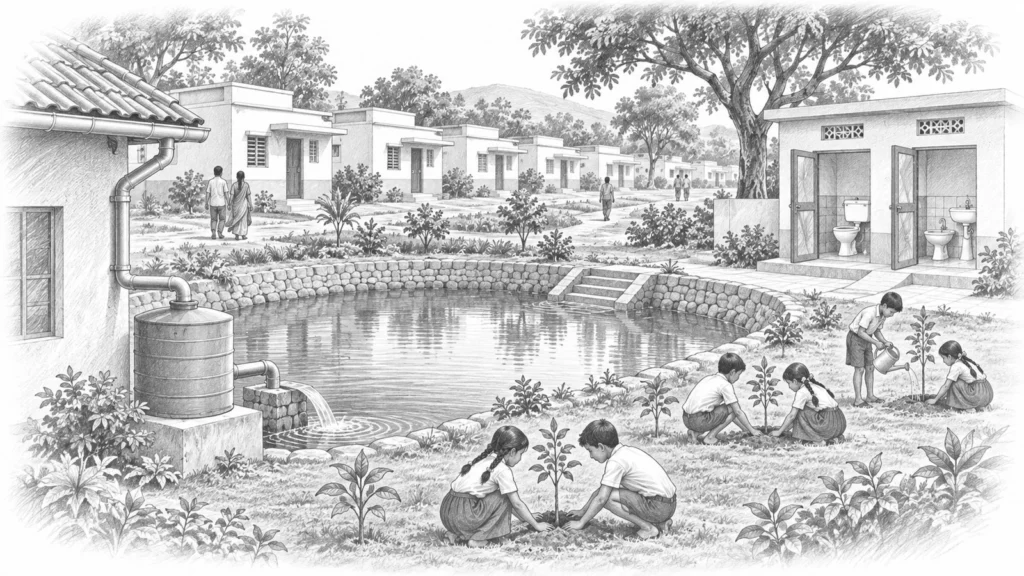
LLOCAL development in India faces major issues of land, water, housing, sanitation and environment. Yet across the country, villages, towns and cities have found successful solutions, often through community action, good local leadership and innovative policy. This chapter examines these issues and case studies from different parts of India, such as Ralegan Siddhi and Hiware Bazar in Maharashtra, Indore and Ambikapur, Kerala’s LIFE Mission and Odisha’s JAGA Mission, drawing on K.C. Sivaramakrishnan, Amitabh Kundu and Isher Ahluwalia.
4.1 Land and Water
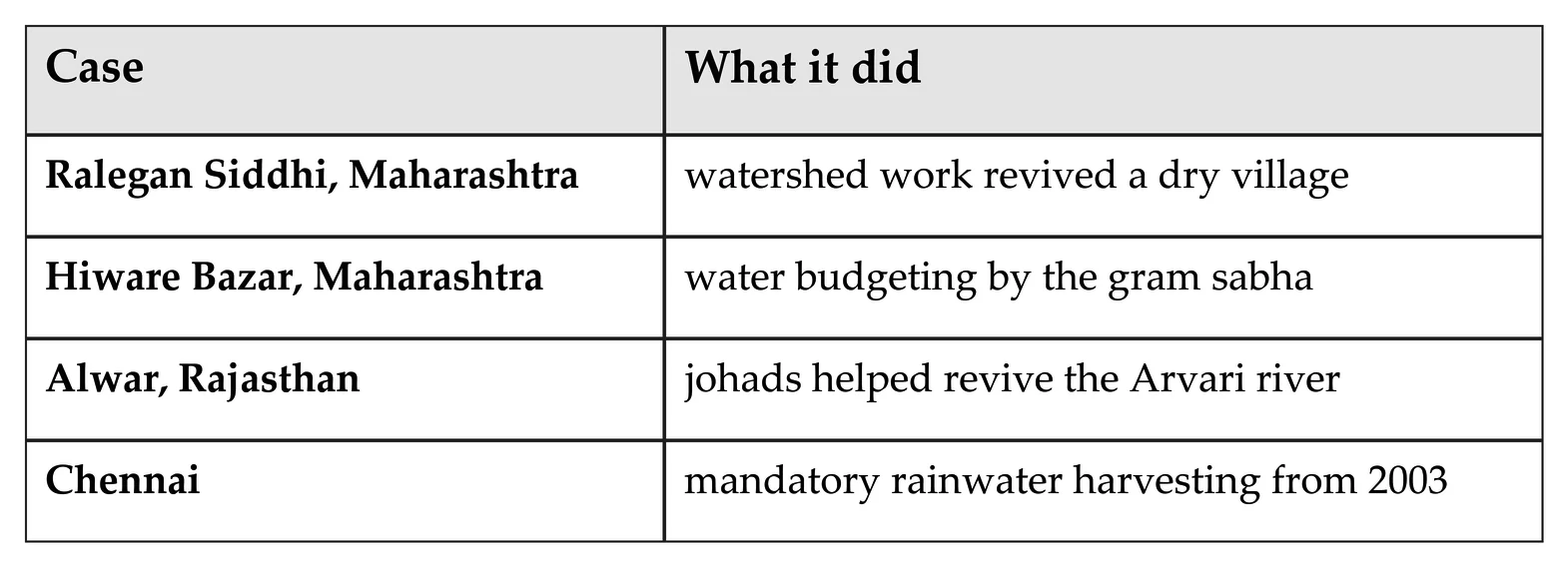
Land is central to livelihoods and urban growth, but India faces outdated land records, disputes, landlessness and conflicts over acquisition. Water is scarce in many regions, with falling groundwater and unequal supply. Successful cases, from West Bengal’s Operation Barga and Karnataka’s Bhoomi to the watershed villages of Ralegan Siddhi and Hiware Bazar, show what local action and good policy can achieve.
Recent Initiatives on Land and Water
- Digital land records. The Digital India Land Records Modernisation Programme, which grew out of a 2008 scheme, computerises records and maps and gives each plot a fourteen-digit Unique Land Parcel Identification Number.
- SVAMITVA. Launched in 2020, it uses drones to map inhabited village land and gives property cards to owners, helping them obtain loans.
- Jal Jeevan Mission. Launched in 2019, it aims to provide tap water to every rural household; coverage rose from about one in six households in 2019 to a large majority by 2025.
- Water heroes. Rajendra Singh of Tarun Bharat Sangh, who revived rivers in Alwar through traditional johads, won the Stockholm Water Prize in 2015.
4.2 Housing and Sanitation
Millions of Indians lack adequate housing, living in kutcha houses or urban slums, and sanitation was long neglected, with widespread open defecation. National programmes such as PMAY and the Swachh Bharat Mission, and local successes such as Kerala’s LIFE Mission, Odisha’s JAGA Mission, Indore and Ambikapur, have improved conditions.
Sanitation: Progress and Problems
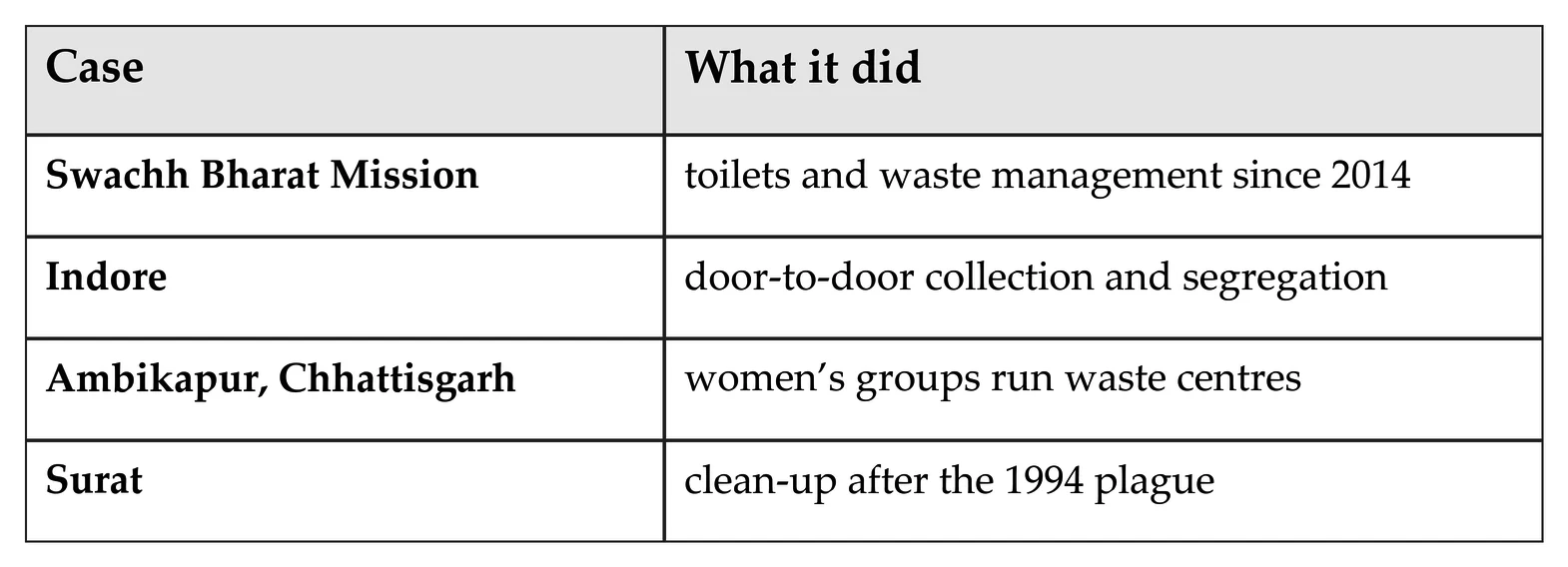
The Swachh Bharat Mission, launched on 2 October 2014, built more than ten crore household toilets, and rural India was declared open defecation free in 2019, though surveys found that some people still lacked or did not use toilets. The urban mission’s second phase from 2021 focuses on waste management and making cities garbage free, and the annual Swachh Survekshan survey has ranked Indore as India’s cleanest city repeatedly since 2017. A grave remaining problem is manual scavenging: despite the Prohibition of Employment as Manual Scavengers Act of 2013, workers, mostly Dalits, still die cleaning sewers and septic tanks, an injustice highlighted by the Safai Karmachari Andolan led by Bezwada Wilson.
4.3 Environment
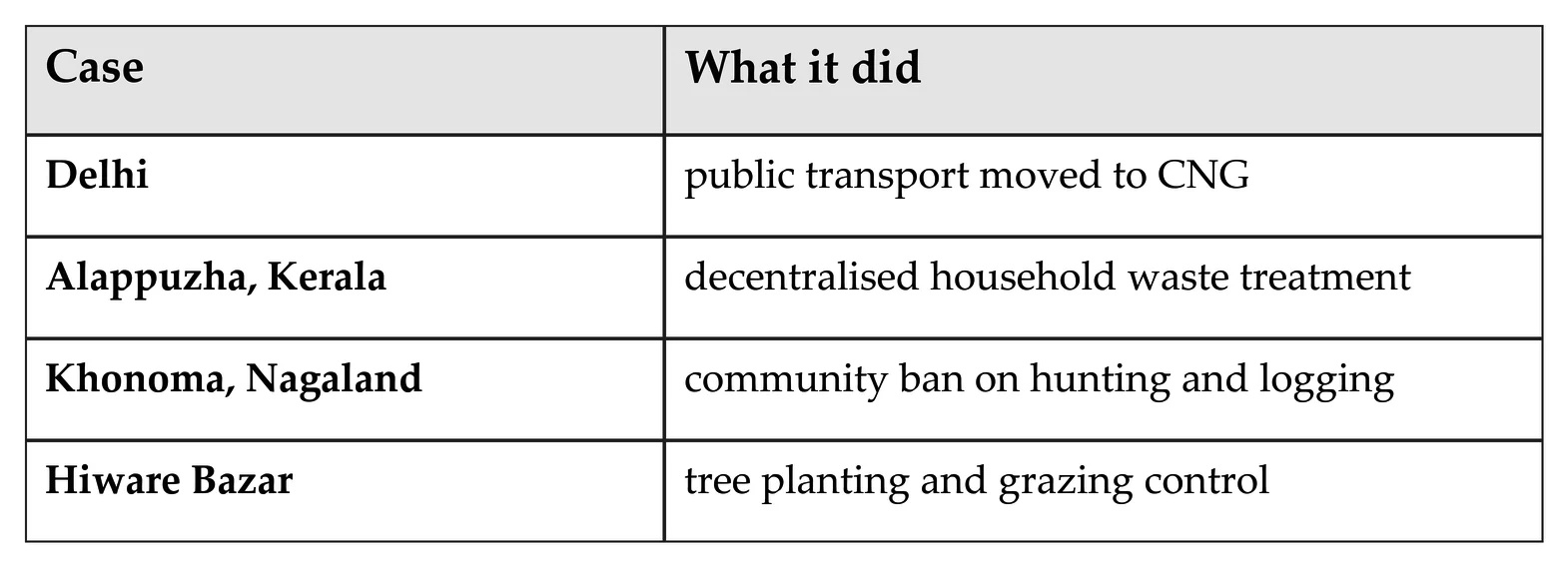
Rapid development has brought air pollution, river pollution, waste and loss of green cover. Cases such as Delhi’s shift to CNG, Alappuzha’s decentralised waste management and community conservation in Khonoma show that environmental problems can be addressed through law, local government and community action.
Tackling Urban Pollution
- Clean air. The National Clean Air Programme of 2019 targets more than a hundred cities that fail air quality standards, aiming to cut particulate pollution significantly.
- Delhi’s CNG shift. In 1998, in a case filed by M.C. Mehta, the Supreme Court ordered Delhi’s buses, taxis and auto-rickshaws to switch to compressed natural gas, completed in the early 2000s.
- Waste rules. The Solid Waste Management Rules of 2016 require segregation at source, and a ban on many single-use plastic items took effect in 2022.
- Decentralised waste management. Alappuzha in Kerala promoted household composting and community biogas plants from 2012, earning international recognition.
4.4 Important Questions
- Question 1 Discuss the issue of land in rural and urban development with successful case studies.
- Question 2 Discuss water issues in rural and urban India with successful case studies.
- Question 3 Discuss the housing problem in rural and urban India with successful case studies.
- Question 4 Discuss sanitation in rural and urban India with successful case studies.
- Question 5 Discuss environmental issues in rural and urban development with successful case studies.
DU asks the same idea in different words. So learn one broad answer for each question below; the same answer works for every question joined by OR.
Important Question 1
Discuss the issue of land in rural and urban development with successful case studies.
OR
Examine land reforms and land records modernisation in India.
OR
How can land be managed for urban growth? Discuss with examples.
Model Answer
“No person shall be deprived of his property save by authority of law.”
— Constitution of India, Article 300A
Introduction. Land is the most important asset in rural India, where most people depend on agriculture, and it is the foundation of urban growth, needed for housing, infrastructure and industry. Problems of land, including inequality of ownership, insecure tenancy, outdated records, disputes and conflicts over acquisition, affect both rural and urban development. Several successful cases show how these problems can be addressed.
1. Land and Livelihood
For rural families, land provides food, income, security and social status. Landlessness and insecure tenure are major causes of poverty, especially for Dalits and Adivasis, who have historically been denied land ownership.
2. Land Reforms
After independence, states passed laws to abolish zamindari, protect tenants and impose ceilings on landholdings. Implementation was uneven, as powerful landowners resisted, but some states, such as Kerala and West Bengal, achieved significant results.
3. Operation Barga
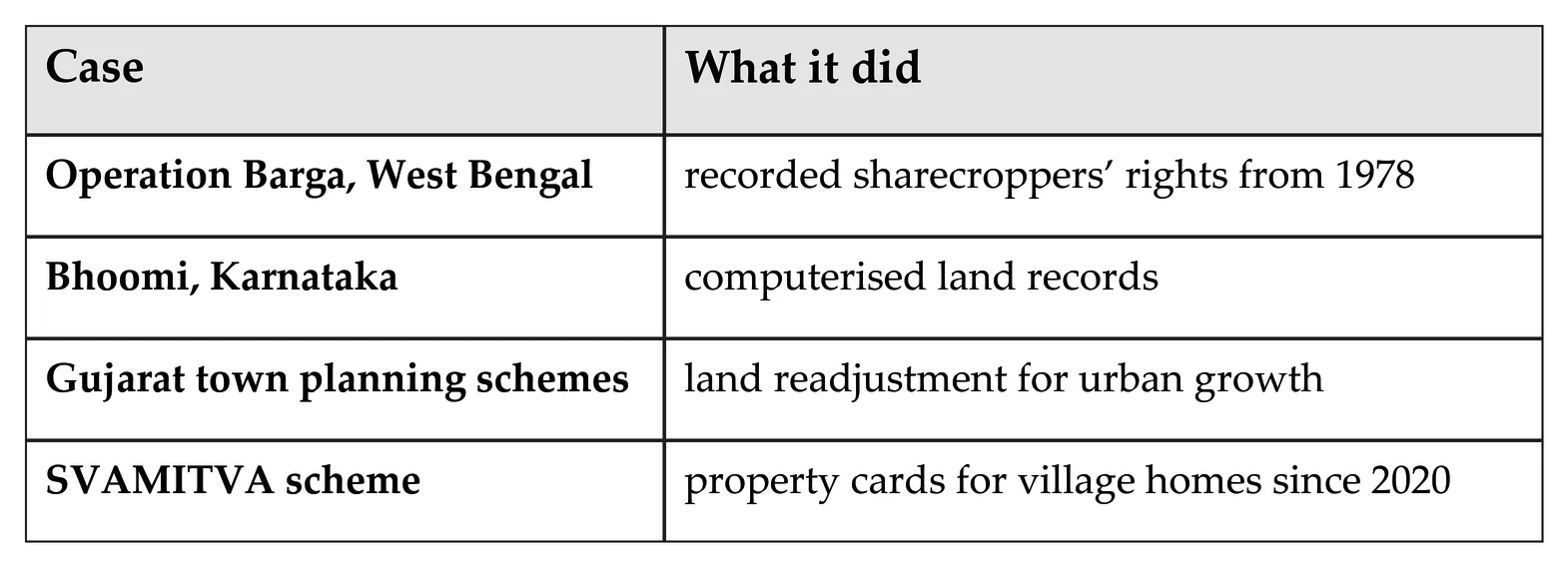
In 1978, the West Bengal government launched Operation Barga to record the names of sharecroppers (bargadars), giving them legal protection against eviction and a fixed share of the crop. More than a million sharecroppers were recorded, improving their security and productivity.
4. Kerala’s Land Reforms
Kerala’s land reforms, implemented mainly from 1970, abolished landlordism and gave ownership of land to tenants and homestead plots to agricultural labourers, contributing to Kerala’s social development.
5. Land Records
Land records in India have often been outdated and inaccurate, leading to disputes that clog the courts. Unclear titles make it hard for farmers to get credit and for governments to plan development.
6. Bhoomi in Karnataka
Karnataka’s Bhoomi project, implemented around 2000, computerised millions of land records and allowed farmers to obtain copies at kiosks, reducing delays, corruption and dependence on village accountants.
7. National Programmes
The Digital India Land Records Modernisation Programme aims to computerise records and maps across India, and the SVAMITVA scheme, launched in 2020, uses drones to map village homes and give owners property cards.
8. Land Acquisition
Acquisition of land for projects has caused conflicts and displacement. The Right to Fair Compensation and Transparency in Land Acquisition, Rehabilitation and Resettlement Act of 2013 requires social impact assessment, consent in some cases and higher compensation.
9. Urban Land
In cities, scarce and expensive land, speculation and unclear titles push the poor into informal settlements. Planned urban growth requires mechanisms to provide land for roads, services and housing.
10. Gujarat’s Town Planning Schemes
Gujarat uses town planning schemes, a form of land readjustment, in which landowners contribute part of their land for roads and public uses and receive back serviced plots. Ahmedabad has used this method to guide urban growth without large-scale acquisition.
11. Land Pooling
Land pooling, as used for Andhra Pradesh’s capital region from 2015, gathers land from owners who receive developed plots in return, though it has faced questions about consent and project delays.
12. Women’s Land Rights
Women own a small share of land in India. Joint titles and inheritance reforms, such as the Hindu Succession (Amendment) Act of 2005, aim to improve women’s land rights.
13. Forest Land
The Forest Rights Act of 2006 recognised the land rights of forest dwellers, giving millions of Adivasis titles to land they had long cultivated.
14. Lessons
Successful cases show the importance of political will, accurate records, transparency, community participation and fair compensation in managing land for development.
15. Land Disputes and Courts
Land and property disputes form a large share of civil cases in Indian courts and can take decades to resolve. Clear titles, updated records and quicker dispute resolution would reduce litigation, free up land for productive use and help farmers obtain credit using their land as security.
16. Evaluation
Land remains a central issue in rural and urban development, and cases such as Operation Barga, Bhoomi and Gujarat’s town planning show workable solutions.
Conclusion. Thus, land shapes livelihoods and urban growth, but India faces unequal ownership, insecure tenancy, poor records and conflicts over acquisition. Operation Barga in West Bengal, Kerala’s land reforms, Bhoomi in Karnataka, SVAMITVA and Gujarat’s town planning schemes show how reforms, technology and land readjustment can address these problems.
Important Question 2
Discuss water issues in rural and urban India with successful case studies.
OR
Examine community-based water management with reference to Ralegan Siddhi and Hiware Bazar.
OR
How can India address water scarcity in villages and cities?
Model Answer
“When the well is dry, we know the worth of water.”
— Benjamin Franklin, Poor Richard’s Almanack (1746)
Introduction. Water is essential for drinking, agriculture, industry and health, but India faces serious water problems: falling groundwater, droughts, floods, polluted rivers and unequal access, especially for women who often carry water long distances. Yet several villages and cities have found successful solutions through community action, traditional methods and good governance.
1. Water Scarcity
India has a large share of the world’s population but a small share of its fresh water. Many regions face water stress, and groundwater is being extracted faster than it is replenished, especially in north-western and southern states.
2. Rural Drinking Water
Many rural households lacked piped water. The Jal Jeevan Mission, launched in 2019, aims to provide a functional tap connection to every rural household and has greatly expanded coverage.
3. Ralegan Siddhi
In Ralegan Siddhi, a drought-prone village in Maharashtra’s Ahmednagar district, Anna Hazare led villagers from 1975 to build check dams, plant trees and conserve water through watershed development. The village became prosperous and is often cited as a model of rural regeneration.
4. Hiware Bazar
Hiware Bazar, also in Ahmednagar, under sarpanch Popatrao Pawar from 1989, adopted watershed development and water budgeting, in which the gram sabha decides how much water can be used and which crops to grow. The village moved from drought and migration to prosperity.
5. Water Budgeting
Water budgeting involves measuring available water and planning its use, restricting water-intensive crops and banning new borewells, an example of Ostrom’s principles of community management of commons.
6. Tarun Bharat Sangh
In Alwar district of Rajasthan, the organisation Tarun Bharat Sangh, led by Rajendra Singh from 1985, helped villages build traditional earthen check dams called johads, reviving the Arvari river and recharging groundwater.
7. Community Governance
Villagers along the Arvari formed a river parliament to manage the river’s use, showing how communities can govern water resources democratically.
8. Chennai’s Rainwater Harvesting
After severe water shortages, Tamil Nadu made rainwater harvesting compulsory for buildings in 2003. In Chennai, this helped raise groundwater levels, showing how regulation can promote conservation in cities.
9. Urban Water Supply
Indian cities face intermittent supply, leakage and unequal access, with the poor often buying water from tankers. Malkapur in Maharashtra became one of the first towns to provide round-the-clock water supply, through metering and good management.
10. Groundwater Management
The Atal Bhujal Yojana, launched in 2019, supports community-led groundwater management in water-stressed areas, building on lessons from successful villages.
11. Women and Water
Women bear most of the burden of fetching water, so improving water supply reduces their drudgery and improves health and education for girls.
12. Water Pollution
Many rivers and groundwater sources are polluted by sewage, industrial waste and chemicals such as arsenic and fluoride, making clean water a health issue as well as one of quantity.
13. Local Government
Drinking water and water management are among the subjects listed for panchayats and municipalities, and successful cases show the importance of empowering local bodies and gram sabhas.
14. Lessons
Successful cases show the value of community participation, local leadership, traditional knowledge, conservation and fair rules for sharing water.
15. Evaluation
Water problems are serious but solvable, as Ralegan Siddhi, Hiware Bazar, Alwar and Chennai demonstrate.
Conclusion. Thus, India faces water scarcity, groundwater depletion, pollution and unequal access. Ralegan Siddhi and Hiware Bazar show the power of watershed development and water budgeting, Tarun Bharat Sangh revived the Arvari, Chennai’s rainwater harvesting and Malkapur’s water supply show urban solutions, and the Jal Jeevan Mission expands rural access.
Important Question 3
Discuss the housing problem in rural and urban India with successful case studies.
OR
Examine government schemes for housing the poor in India.
OR
How have states such as Kerala and Odisha addressed housing needs?
Model Answer
“Shelter for a human being is not a mere protection of his life and limb. It is home where he has opportunities to grow physically, mentally, intellectually and spiritually.”
— Supreme Court of India, Chameli Singh v. State of Uttar Pradesh (1996)
Introduction. Adequate housing is a basic need and, according to the Supreme Court, part of the right to life. Yet millions of Indians live in kutcha houses in villages or in slums and informal settlements in cities. Government schemes and innovative state and city programmes have tried to address this problem, with varying success.
1. The Housing Problem
In rural areas, many families live in kutcha houses of mud and thatch. In cities, the 2011 Census counted about 6.5 crore people living in slums, often without secure tenure, water or sanitation.
2. Housing Shortage
Expert committees estimated an urban housing shortage of nearly two crore units around 2012, mostly among economically weaker sections and low-income groups.
3. Right to Housing
In Olga Tellis (1985), the Supreme Court linked the right to life with livelihood for pavement dwellers, and in Chameli Singh (1996) it recognised the right to shelter. The Delhi High Court in 2019 required due process and rehabilitation before evicting slum dwellers.
4. Early Schemes
The Indira Awas Yojana, launched in 1985, provided grants to rural poor families to build houses, and urban schemes under JNNURM supported housing for the urban poor.
5. PMAY
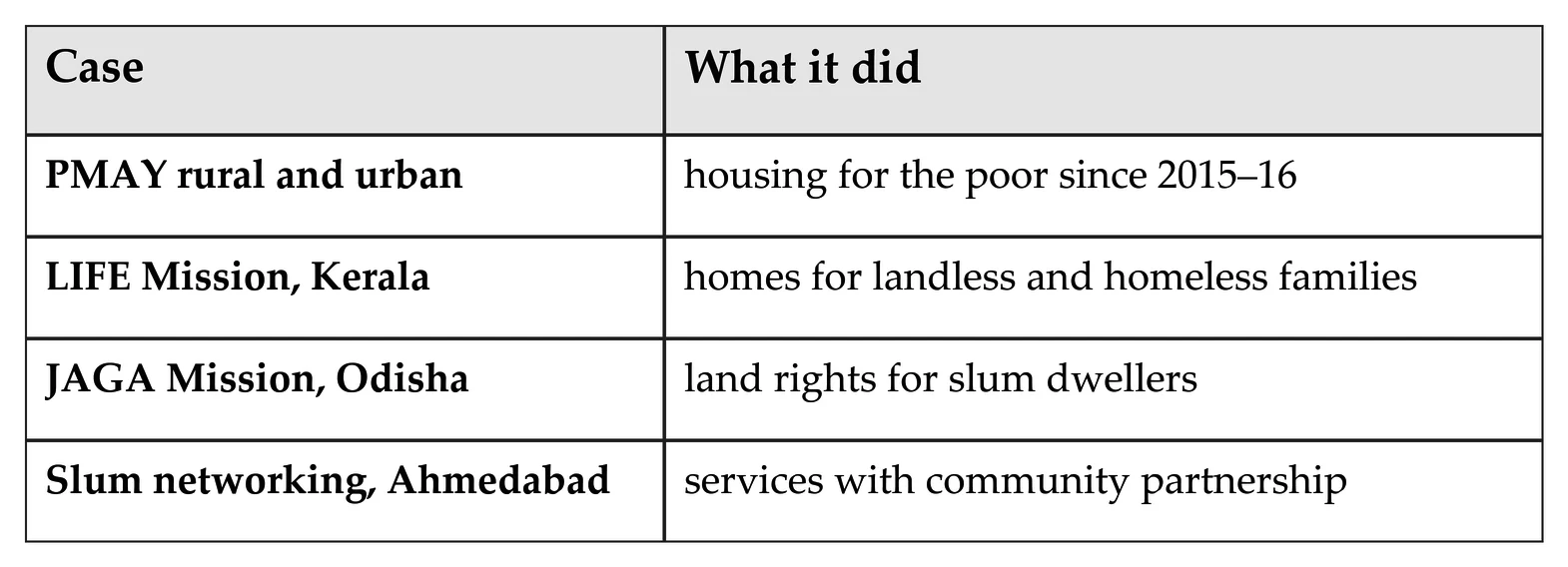
The Pradhan Mantri Awas Yojana, launched for urban areas in 2015 and rural areas in 2016, aims at housing for all, providing grants and interest subsidies, and has supported the construction of crores of houses.
6. Kerala’s LIFE Mission
Kerala’s LIFE Mission, launched in 2016, aims to provide safe homes to all landless and homeless families, working through local governments, which identify beneficiaries and oversee construction.
7. Odisha’s JAGA Mission
Odisha’s JAGA Mission, based on a law of 2017, gives land rights to slum dwellers and upgrades slums with services, with communities participating in planning. It received the World Habitat Award in 2019.
8. In-Situ Upgrading
In-situ upgrading improves slums where they are, providing water, sanitation, roads and secure tenure, instead of relocating people far from their work, which often causes loss of livelihood.
9. Ahmedabad’s Slum Networking
Ahmedabad’s Slum Networking Project, begun in the 1990s, provided water, sewerage, roads and lighting in slums through a partnership of the municipal corporation, NGOs, private sector and residents, who contributed part of the cost.
10. Mumbai’s Slum Rehabilitation
Mumbai’s Slum Rehabilitation Authority, set up in 1995, allowed developers to build free flats for slum dwellers in return for extra building rights, though critics say it favoured developers and produced poor-quality housing.
11. Rental Housing
Migrants need affordable rental housing, and the Affordable Rental Housing Complexes scheme of 2020 aimed to provide it, recognising that ownership is not suitable for all.
12. Role of Local Government
Successful housing programmes, such as LIFE and JAGA, rely on local governments and communities to identify needs, select beneficiaries and monitor quality.
13. Challenges
Challenges include high land costs, poor location of new housing, inadequate services, exclusion of those without documents and evictions without rehabilitation.
14. Lessons
Successful cases show the value of secure land rights, in-situ upgrading, community participation and integration of housing with services and livelihoods.
15. Housing and Livelihood
Studies of resettlement colonies on the edges of cities show that moving slum dwellers far from their workplaces often causes loss of jobs, longer commutes and higher costs, especially for women working as domestic workers. Housing policy must therefore consider access to livelihoods, schools and health care, not only the number of units built.
16. Evaluation
Housing remains a major challenge, but LIFE, JAGA and slum networking show effective approaches.
Conclusion. Thus, India faces a large housing shortage, with kutcha rural houses and urban slums. Courts recognise the right to shelter, and schemes such as PMAY have expanded housing, while Kerala’s LIFE Mission, Odisha’s JAGA Mission and Ahmedabad’s Slum Networking show the value of land rights, in-situ upgrading and community participation.
Important Question 4
Discuss sanitation in rural and urban India with successful case studies.
OR
Examine the achievements and limitations of the Swachh Bharat Mission.
OR
How have cities such as Indore and Ambikapur improved waste management?
Model Answer
“By 2030, achieve access to adequate and equitable sanitation and hygiene for all and end open defecation, paying special attention to the needs of women and girls and those in vulnerable situations.”
— Sustainable Development Goal 6, Target 6.2
Introduction. Sanitation is essential for health, dignity and the environment. India long had the world’s largest number of people practising open defecation, and cities struggled with waste and sewage. The Swachh Bharat Mission launched in 2014 and local innovations in cities such as Indore, Ambikapur and Surat have transformed sanitation in many places.
1. The Sanitation Problem
The 2011 Census found that about two-thirds of rural households had no toilet. Open defecation caused disease, child stunting and particular hardship and insecurity for women.
2. Earlier Programmes
The Central Rural Sanitation Programme of 1986, the Total Sanitation Campaign of 1999 and the Nirmal Bharat Abhiyan of 2012 made limited progress, as toilets were built but often not used.
3. The Swachh Bharat Mission
The Swachh Bharat Mission, launched on 2 October 2014, built about ten crore household toilets in rural areas and promoted behaviour change, and villages declared themselves open defecation free by 2019.
4. Achievements and Questions
The mission greatly increased access to toilets, but independent surveys found that coverage and use were lower than official claims, and that sustaining behaviour change and managing waste remained challenges.
5. Indore
Indore in Madhya Pradesh topped the national cleanliness survey for several years from 2017 by introducing door-to-door collection of segregated waste, composting, recycling and public participation, and later a large bio-CNG plant.
6. Ambikapur
Ambikapur in Chhattisgarh developed a model of solid and liquid resource management centres run by women’s self-help groups, who collect and sort waste, earning incomes while making the town nearly free of landfills.
7. Surat
After an outbreak of plague in 1994, Surat transformed its sanitation through strong municipal leadership, regular cleaning and accountability of officials, becoming one of India’s cleanest cities within a few years.
8. Sulabh
Sulabh International, founded by Bindeshwar Pathak in 1970, promoted low-cost two-pit toilets and public toilets, and worked to free manual scavengers from their degrading work.
9. Manual Scavenging
Manual scavenging, the cleaning of human waste by hand, mostly by Dalits, was banned by laws of 1993 and 2013, but it continues, and deaths in sewers show the need for mechanisation and rehabilitation.
10. Urban Sanitation
Many cities lack sewerage networks, so faecal sludge from septic tanks must be safely collected and treated. Swachh Bharat Mission Urban 2.0, launched in 2021, aims at garbage-free cities and safe sanitation.
11. Role of Women
Women benefit most from improved sanitation through dignity and safety, and women’s groups, as in Ambikapur, play key roles in managing waste.
12. Behaviour Change
Sanitation requires changing habits and attitudes, including beliefs about purity and caste, which is why community-led approaches are important.
13. Role of Local Bodies
Sanitation and solid waste management are municipal and panchayat functions, and successful cases show the importance of local leadership and accountability.
14. Lessons
Success requires infrastructure, behaviour change, segregation of waste, community participation, dignity for sanitation workers and strong local institutions.
15. Faecal Sludge Management
Most Indian towns depend on septic tanks and pits rather than sewers. Towns such as Wai and Sinnar in Maharashtra introduced scheduled emptying of septic tanks and treatment of faecal sludge, offering a low-cost model for small towns that cannot afford full sewerage networks.
16. Evaluation
Sanitation in India has improved greatly, and Indore, Ambikapur and Surat show what local leadership can achieve.
Conclusion. Thus, India has moved from widespread open defecation to near-universal access to toilets through the Swachh Bharat Mission, though use and waste management remain challenges. Indore, Ambikapur and Surat show successful urban sanitation through segregation, women’s groups and accountable municipalities, while manual scavenging must end.
Important Question 5
Discuss environmental issues in rural and urban development with successful case studies.
OR
How can local governments and communities protect the environment? Discuss with examples.
OR
Examine urban environmental problems in India and their solutions.
Model Answer
“Urban forestry, protection of the environment and promotion of ecological aspects.”
— Constitution of India, Twelfth Schedule, item 8
Introduction. Rural and urban development in India has brought serious environmental problems, including air pollution, polluted rivers, solid waste, loss of forests and green spaces, and depletion of water. The Constitution lists environmental protection among the functions of municipalities. Successful cases show how law, local government and communities can protect the environment.
1. Urban Air Pollution
Many Indian cities have among the highest levels of air pollution in the world, caused by vehicles, industry, construction dust, waste burning and crop residue burning, harming the health of millions.
2. Delhi’s CNG Transition
Following Supreme Court orders from 1998, Delhi shifted its buses, auto-rickshaws and taxis to compressed natural gas by around 2002, temporarily improving air quality and showing the role of courts and regulation.
3. National Clean Air Programme
The National Clean Air Programme, launched in 2019, sets targets for reducing particulate pollution in more than a hundred cities through city action plans, though progress has been uneven.
4. Solid Waste
Growing cities produce huge amounts of waste, much of it dumped in landfills that pollute air and water. Segregation at source, composting and recycling are key solutions.
5. Alappuzha
Alappuzha in Kerala adopted decentralised waste management from 2012, with households treating organic waste through biogas plants and compost units, and community facilities, reducing the need for landfills and earning international recognition.
6. Lakes and Wetlands
Urban lakes and wetlands have been encroached and polluted. In Bengaluru, citizens’ groups have revived lakes such as Puttenahalli and Jakkur, working with civic agencies to restore them.
7. Khonoma
Khonoma village in Nagaland, once known for hunting, decided in 1998 to ban hunting and logging in its forests, becoming known as a green village and showing community-led conservation.
8. Sikkim
Sikkim became India’s first fully organic state in 2016, phasing out chemical fertilisers and pesticides, which protected its environment and promoted eco-tourism.
9. Hiware Bazar
Hiware Bazar combined water conservation with tree planting and controls on grazing, regenerating its environment and improving livelihoods.
10. Urban Green Spaces
Urban forestry and parks reduce heat, absorb pollution and improve wellbeing. Cities are encouraged to protect green spaces, though land pressures often lead to their loss.
11. Climate Change
Cities face rising heat, floods and water stress due to climate change, and some, such as Ahmedabad with its heat action plan of 2013, have developed local adaptation plans.
12. Role of Courts and Tribunals
The Supreme Court and the National Green Tribunal have issued orders on pollution, waste and protection of water bodies, pushing local bodies to act.
13. Role of Local Bodies
Municipalities and panchayats are responsible for waste, sanitation, green spaces and local environmental protection, but they need funds, staff and powers to do this effectively.
14. Lessons
Successful cases show that environmental protection works best when it combines regulation, local leadership, community participation and attention to livelihoods.
15. Crop Residue Burning
Burning of paddy straw by farmers in Punjab and Haryana after harvest contributes to severe winter air pollution in north India. Solutions include machines that manage residue in the field, payments to farmers, alternative uses of straw and changes in cropping patterns, showing how rural and urban environmental problems are linked.
16. Evaluation
Environmental problems of development are serious, but cases such as Delhi’s CNG, Alappuzha and Khonoma show workable solutions.
Conclusion. Thus, development has brought air pollution, waste, loss of green spaces and pressure on water. Delhi’s CNG transition, the National Clean Air Programme, Alappuzha’s decentralised waste management, Bengaluru’s lake revival, Khonoma’s conservation and Sikkim’s organic farming show how law, local government and communities can protect the environment.
Short Notes
(a) Operation Barga
West Bengal’s programme from 1978 to record sharecroppers’ names, giving them legal protection against eviction and a fixed share of the crop.
(b) Water budgeting
Community planning of water use based on the water available, as practised by the gram sabha of Hiware Bazar.
(c) JAGA Mission
Odisha’s programme, based on a 2017 law, giving land rights to slum dwellers and upgrading slums with community participation.
More notes: MDSE-14 Rural-Urban Local Development in India
These notes are prepared by PADHO TO AISE for study help. They are not an official University of Delhi publication.