
Semester VIII MDSE-14 Rural-Urban Local Development in India
Unit 3 · 22 min read · Updated 24 Nov 2026
As per the University of Delhi (DU) BA (Hons) Political Science syllabus
Contents
- 3.1 Part IX and Part IXA
- The Eleventh and Twelfth Schedules
- Key Features of PESA
- 3.2 Planning Committees and Cooperatives
- 3.3 Women’s Participation
- Evidence on Women’s Leadership
- Restrictions on Candidates
- 3.4 Important Questions
- Discuss the main provisions of Part IX of the Constitution relating to panchayats.
- Discuss the main provisions of Part IXA of the Constitution relating to municipalities.
- Discuss the role of District Planning Committees and Metropolitan Planning Committees.
- Discuss the role of cooperatives in rural and urban development in India.
- Discuss women’s participation in local governance in India.
- Short Notes
सच्चा लोकतंत्र केंद्र में बैठे बीस लोग नहीं चला सकते। उसे नीचे से, हर गाँव के लोगों द्वारा चलाया जाना चाहिए।
True democracy cannot be worked by twenty men sitting at the Centre. It has to be worked from below by the people of every village.
— M.K. Gandhi, Harijan (1948)
TTHE 73rd and 74th Amendments of 1992 created a constitutional framework for rural and urban local government in Part IX and Part IXA of the Constitution. They provide for panchayats and municipalities, District Planning Committees and Metropolitan Planning Committees, and reservation of seats for women. The 97th Amendment of 2011 added provisions on cooperatives in Part IXB. This chapter explains this framework and its working, drawing on the Constitution, George Mathew, K.C. Sivaramakrishnan and studies of women’s participation.
3.1 Part IX and Part IXA
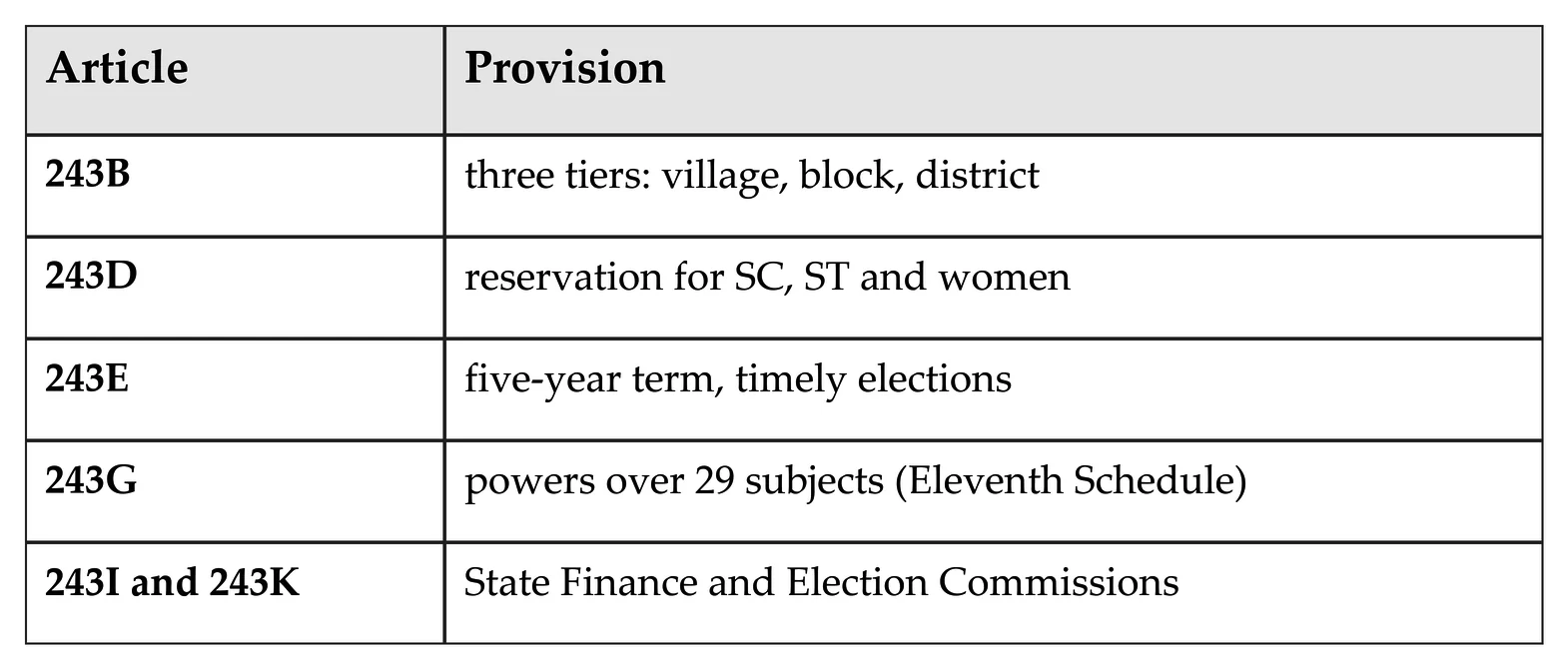
Part IX, added by the 73rd Amendment, provides for a three-tier system of panchayats, the gram sabha, reservation for Scheduled Castes, Scheduled Tribes and women, five-year terms, State Election Commissions and State Finance Commissions. Part IXA, added by the 74th Amendment, provides similar arrangements for municipalities, with ward committees in larger cities.
The Eleventh and Twelfth Schedules
The Eleventh Schedule lists twenty-nine subjects that states may devolve to panchayats, among them agriculture, minor irrigation, animal husbandry, fisheries, rural housing, drinking water, roads, rural electrification, poverty alleviation, primary and secondary education, health and sanitation, women and child development, the public distribution system and the maintenance of community assets. The Twelfth Schedule lists eighteen subjects for municipalities, such as urban planning, regulation of land use, roads and bridges, water supply, public health and solid waste management, fire services, slum improvement, urban poverty alleviation, parks and street lighting. Because devolution depends on state laws, the actual powers of local bodies vary widely; the Ministry of Panchayati Raj’s devolution index regularly places states such as Kerala, Karnataka and Maharashtra near the top.
Key Features of PESA
- Gram sabha at the centre. The gram sabha is competent to safeguard the traditions, customs and community resources of the people.
- Land. It must be consulted before land is acquired for development projects and has powers to prevent alienation of tribal land.
- Forests and minerals. It owns minor forest produce and must be consulted before mining leases for minor minerals are granted.
- Local control. It controls village markets, money-lending and local institutions, and approves development plans and beneficiaries.
3.2 Planning Committees and Cooperatives
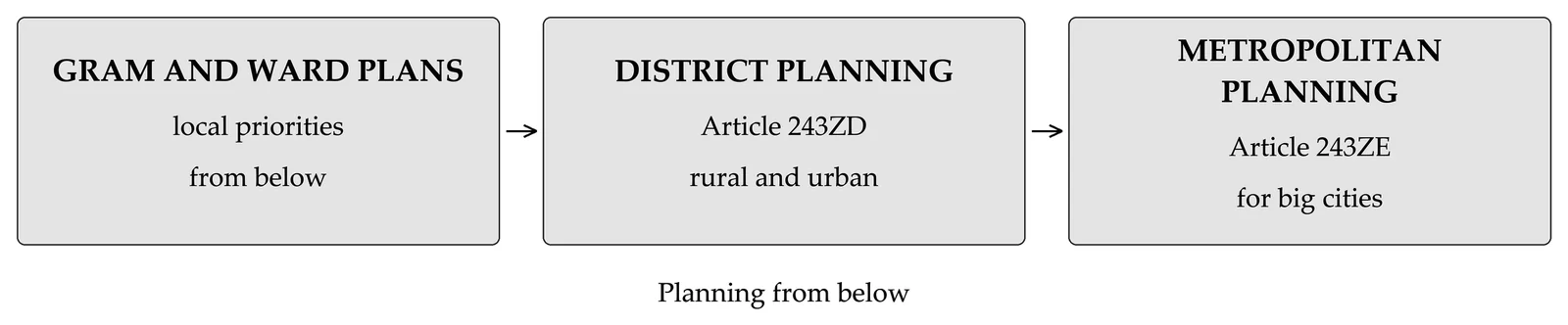
District Planning Committees (Article 243ZD) consolidate the plans of panchayats and municipalities into a district plan, and Metropolitan Planning Committees (Article 243ZE) plan for large cities. Cooperatives, voluntary associations of members working together for common economic goals, received constitutional recognition through the 97th Amendment of 2011.
3.3 Women’s Participation
Articles 243D and 243T reserve at least one-third of seats and chairpersons’ posts in local bodies for women, and many states have raised this to half. This has brought more than a million women into local government, changing priorities, though proxy rule and patriarchy remain challenges.

Evidence on Women’s Leadership
Research shows that women’s reservation has changed local priorities. A well-known study by Raghabendra Chattopadhyay and Esther Duflo, published in 2004, found that women leaders of gram panchayats in West Bengal and Rajasthan invested more in public goods that women had asked for, such as drinking water. Women’s self-help groups, such as Kerala’s Kudumbashree, launched in 1998, have helped prepare women for local leadership. At the same time, the practice of husbands or male relatives ruling through elected women, known as sarpanch pati or proxy representation, persists, and the Ministry of Panchayati Raj set up a committee in 2023 to recommend ways to end it.
Restrictions on Candidates
Some states have placed conditions on who may contest local elections. Several states barred persons with more than two children, a rule the Supreme Court upheld in Javed v. State of Haryana (2003), and Haryana required minimum educational qualifications, upheld in Rajbala v. State of Haryana (2015). Critics argue that such rules hit women, Dalits and the poor hardest, since they are less likely to have formal education, and thus undermine the purpose of reservation.
3.4 Important Questions
- Question 1 Discuss the main provisions of Part IX of the Constitution relating to panchayats.
- Question 2 Discuss the main provisions of Part IXA of the Constitution relating to municipalities.
- Question 3 Discuss the role of District Planning Committees and Metropolitan Planning Committees.
- Question 4 Discuss the role of cooperatives in rural and urban development in India.
- Question 5 Discuss women’s participation in local governance in India.
DU asks the same idea in different words. So learn one broad answer for each question below; the same answer works for every question joined by OR.
Important Question 1
Discuss the main provisions of Part IX of the Constitution relating to panchayats.
OR
Examine the significance of the 73rd Amendment for rural development.
OR
How far have panchayats become institutions of self-government?
Model Answer
“The Legislature of a State may, by law, endow the Panchayats with such powers and authority as may be necessary to enable them to function as institutions of self-government.”
— Constitution of India, Article 243G
Introduction. The 73rd Amendment of 1992 added Part IX to the Constitution, giving panchayats constitutional status for the first time. It aimed to make panchayats institutions of self-government and instruments of economic development and social justice in rural India. Its provisions apply to all states, though their implementation depends on state laws.
1. Background
Before 1992, panchayats depended entirely on state laws, and many states held irregular elections or kept panchayats weak. The amendment sought to give them a secure constitutional foundation.
2. The Gram Sabha
Article 243A recognises the gram sabha, the body of all voters in a village, which exercises powers given by state law, such as approving plans and selecting beneficiaries.
3. Three Tiers
Article 243B provides for panchayats at the village, intermediate (block) and district levels, though states with a population below twenty lakh may omit the intermediate level.
4. Composition
Article 243C provides that members of panchayats are elected directly from territorial constituencies, while state laws decide how chairpersons are elected.
5. Reservations
Article 243D reserves seats for Scheduled Castes and Scheduled Tribes in proportion to their population and at least one-third of seats and chairpersons’ posts for women, including women from these groups.
6. Term and Elections
Article 243E fixes a five-year term and requires elections before the term ends or within six months of dissolution. Article 243K creates State Election Commissions to conduct elections.
7. Powers and Functions
Article 243G allows states to give panchayats powers to prepare and implement plans for economic development and social justice, including the 29 subjects in the Eleventh Schedule, such as agriculture, drinking water, roads, health and education.
8. Finances
Article 243H allows states to authorise panchayats to levy taxes and receive grants, and Article 243I requires a State Finance Commission every five years to review their finances.
9. Central Finance Commissions
The Union Finance Commissions also recommend grants to local bodies. The Fifteenth Finance Commission recommended more than Rs 4 lakh crore for local bodies for 2021–26.
10. Scheduled Areas
Article 243M exempts Fifth and Sixth Schedule areas, but the PESA Act of 1996 extended panchayats to Fifth Schedule areas with special powers for gram sabhas.
11. The Three Fs
Experts stress the need to devolve the three Fs: functions, funds and functionaries. Most states have transferred only some of these, leaving panchayats dependent on state departments.
12. Mathew’s Findings
George Mathew’s studies of panchayati raj in the states showed that implementation varied widely, with Kerala, Karnataka and West Bengal devolving more power than others.
13. Achievements
Part IX has ensured regular elections, brought millions of representatives, including women and disadvantaged groups, into local government and made panchayats channels for development schemes.
14. Problems
Problems include bureaucratic control, inadequate own revenue, elite capture, proxy representation and weak gram sabhas, which limit panchayats’ role as self-governing institutions.
15. Parallel Bodies
Panchayats are often bypassed by parallel bodies, such as user committees, district rural development agencies and scheme-specific societies, which receive funds directly from state or central governments. Experts argue that these bodies weaken panchayats and should be brought under their control to make local self-government real.
16. Evaluation
Part IX has given panchayats constitutional status and democratic legitimacy, but real self-government depends on devolution by the states.
Conclusion. Thus, Part IX provides for gram sabhas, three-tier panchayats, reservations, five-year terms, State Election and Finance Commissions and powers over 29 subjects. It has democratised rural governance, but, as Mathew shows, devolution of functions, funds and functionaries remains uneven across states.
Important Question 2
Discuss the main provisions of Part IXA of the Constitution relating to municipalities.
OR
Examine the significance and working of the 74th Amendment.
OR
Why are urban local bodies in India weak? Discuss.
Model Answer
“The Legislature of a State may, by law, endow the Municipalities with such powers and authority as may be necessary to enable them to function as institutions of self-government.”
— Constitution of India, Article 243W
Introduction. The 74th Amendment of 1992 added Part IXA to the Constitution, giving municipalities constitutional status. It sought to make urban local bodies institutions of self-government and planning, at a time of rapid urbanisation. K.C. Sivaramakrishnan and Isher Ahluwalia have examined its provisions and implementation.
1. Types of Municipalities
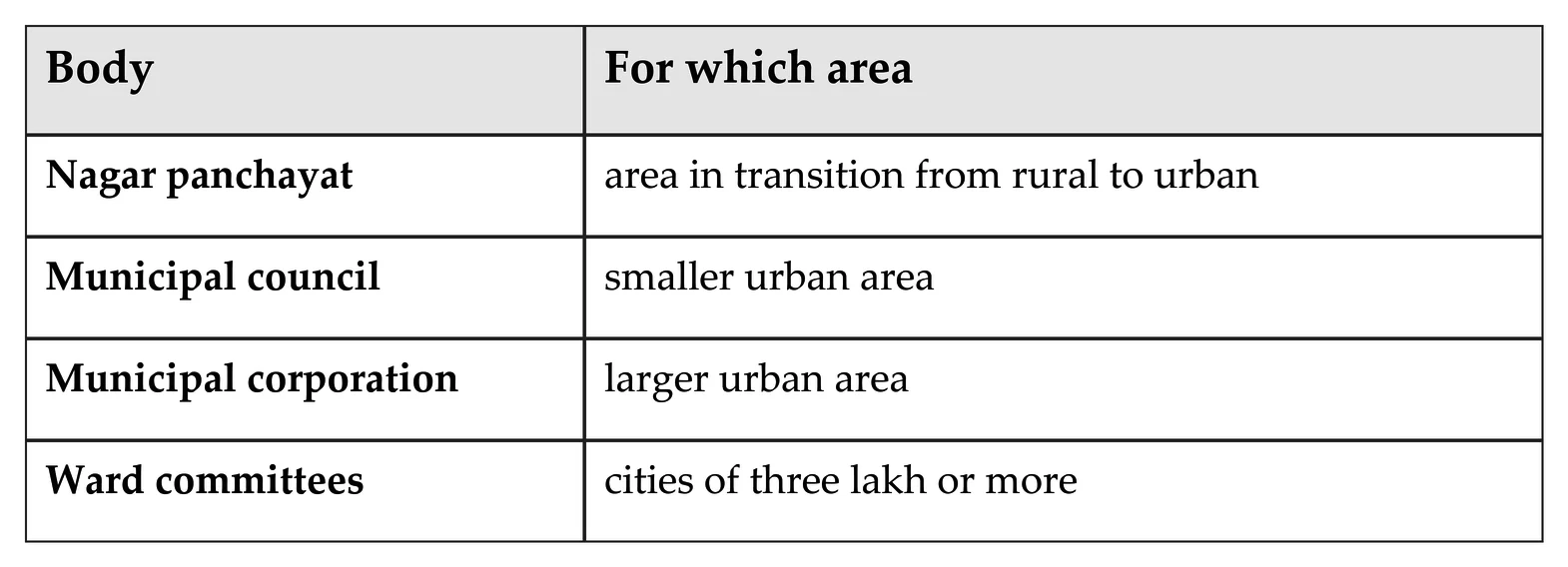
Article 243Q provides for three types of municipalities: nagar panchayats for areas in transition from rural to urban, municipal councils for smaller urban areas and municipal corporations for larger urban areas.
2. Composition
Article 243R provides that members are elected from wards, and state laws may include nominated experts without voting rights and representatives such as MPs and MLAs.
3. Ward Committees
Article 243S requires ward committees in municipalities with a population of three lakh or more, to bring governance closer to citizens.
4. Reservations
Article 243T reserves seats for Scheduled Castes and Scheduled Tribes and at least one-third for women, including the offices of chairpersons.
5. Term and Elections
Article 243U fixes a five-year term, with elections before its expiry or within six months of dissolution, and Article 243ZA gives the State Election Commission responsibility for elections.
6. Functions
Article 243W allows states to devolve the 18 functions of the Twelfth Schedule, including urban planning, regulation of land use, roads, water supply, public health, sanitation, fire services, slum improvement and urban poverty alleviation.
7. Finances
Article 243X allows states to authorise municipalities to levy taxes and receive grants, and Article 243Y requires State Finance Commissions to review municipal finances.
8. Planning Committees
Articles 243ZD and 243ZE provide for District and Metropolitan Planning Committees to integrate urban and rural planning.
9. Sivaramakrishnan’s Critique
K.C. Sivaramakrishnan argued that states implemented the 74th Amendment half-heartedly, keeping key functions with state departments and parastatal agencies such as development authorities and water boards.
10. Weak Finances
Indian municipalities raise very little own revenue, mostly from property tax, and depend on grants. Their total revenue is less than one per cent of GDP, far below cities in other countries.
11. Weak Leadership
Most mayors are indirectly elected for short terms with little power, while state-appointed commissioners control administration, limiting democratic accountability.
12. Ahluwalia’s Proposals
Isher Ahluwalia calls for empowered city governments with directly elected mayors, stronger finances through property tax reform and municipal bonds, and professional staff.
13. Urban Missions
Missions such as JNNURM, AMRUT and Smart Cities linked central funds to reforms, but critics say some, such as special purpose vehicles in Smart Cities, bypassed elected councils.
14. Participation
Ward committees and area sabhas have been formed in few cities, so citizen participation in urban governance remains limited.
15. Municipal Elections
Although Part IXA requires regular elections, many states have delayed municipal elections for long periods, citing delimitation, reservation disputes or other reasons. The Supreme Court has repeatedly directed state election commissions to hold elections on time, stressing that elected local government is a constitutional requirement.
16. Evaluation
Part IXA gave municipalities constitutional status, but weak devolution, finances and leadership keep urban local government weak.
Conclusion. Thus, Part IXA provides for nagar panchayats, municipal councils and corporations, ward committees, reservations, elections, 18 functions and State Finance Commissions. Sivaramakrishnan shows its half-hearted implementation and Ahluwalia calls for empowered, well-financed cities to meet the challenges of urbanisation.
Important Question 3
Discuss the role of District Planning Committees and Metropolitan Planning Committees.
OR
Examine the idea of planning from below in India.
OR
Why have planning committees failed to work effectively?
Model Answer
“There shall be constituted in every State at the district level a District Planning Committee to consolidate the plans prepared by the Panchayats and the Municipalities in the district and to prepare a draft development plan for the district as a whole.”
— Constitution of India, Article 243ZD
Introduction. Development planning in India was long centralised, with plans made in Delhi and state capitals. The 74th Amendment introduced District Planning Committees and Metropolitan Planning Committees to enable planning from below, integrating the plans of rural and urban local bodies. Their record, however, has been disappointing in most states.
1. Planning from Below
Planning from below means that local bodies identify needs and priorities, which are then consolidated at higher levels, so that plans reflect local conditions.
2. The DPC
Article 243ZD requires a District Planning Committee in every district to consolidate the plans of panchayats and municipalities and prepare a draft development plan for the district.
3. Composition of the DPC
At least four-fifths of the members of a DPC are elected by and from the elected members of district panchayats and municipalities, in proportion to the rural and urban population of the district.
4. Functions of the DPC
In preparing the district plan, the DPC must consider matters of common interest, such as spatial planning, sharing of water and natural resources, infrastructure and environmental conservation.
5. The MPC
Article 243ZE requires a Metropolitan Planning Committee for every metropolitan area with a population of ten lakh or more, to prepare a development plan for the whole area.
6. Composition of the MPC
At least two-thirds of the members of an MPC are elected by elected members of municipalities and chairpersons of panchayats in the metropolitan area.
7. Functions of the MPC
The MPC coordinates the plans of different local bodies in a metropolitan area, considering infrastructure, investment, environment and the sharing of resources.
8. Working of DPCs
Most states have formed DPCs, but many meet rarely, lack staff and data, and merely approve plans prepared by state departments, so district planning remains weak.
9. Working of MPCs
Very few metropolitan areas have functioning MPCs. Kolkata formed one in 2001, but most large cities are planned by state development authorities instead.
10. Kerala’s Example
Kerala’s DPCs work better because the state devolved funds and supported local planning through the People’s Plan Campaign.
11. Gram Panchayat Development Plans
Since 2015, gram panchayats prepare Gram Panchayat Development Plans using Finance Commission grants, which could feed into district plans if DPCs functioned well.
12. Reasons for Failure
DPCs and MPCs have failed because states are reluctant to share planning powers, local bodies lack funds and capacity, and parallel agencies and schemes bypass them.
13. Expert Recommendations
An expert group on planning at the grassroots in 2006, and later reports, recommended strengthening DPCs with technical support and linking district plans to state budgets.
14. Integrating Rural and Urban
Well-functioning DPCs and MPCs could integrate rural and urban development, addressing peri-urban growth, water sharing and regional infrastructure.
15. Data and Technical Support
Effective district planning needs data on population, resources, services and needs, as well as planners who can prepare spatial and sectoral plans. Many DPCs lack such support. Tools such as geographic information systems and village-level databases can help, if states provide trained staff and resources to district planning bodies.
16. Planning in Practice
In practice, district plans in many states are compiled from proposals sent by line departments rather than prepared from the plans of panchayats and municipalities. This reverses the idea of planning from below and shows how bureaucratic habits have survived constitutional reform.
17. Metropolitan Regions
India’s large cities have spread far beyond municipal boundaries into surrounding districts and even states, as in the National Capital Region around Delhi. Such metropolitan regions need coordinated planning for transport, water, housing and environment, which fragmented local bodies and state agencies cannot provide without effective metropolitan planning.
18. Evaluation
DPCs and MPCs embody the ideal of planning from below, but they need real powers, resources and political support to work.
Conclusion. Thus, Articles 243ZD and 243ZE created District and Metropolitan Planning Committees to consolidate local plans and integrate rural and urban development. Most remain weak because states retain planning powers and local bodies lack capacity, though Kerala and Gram Panchayat Development Plans show what planning from below can achieve.
Important Question 4
Discuss the role of cooperatives in rural and urban development in India.
OR
Examine the constitutional provisions on cooperatives under the 97th Amendment.
OR
Discuss the achievements and problems of the cooperative movement in India.
Model Answer
“The State shall endeavour to promote voluntary formation, autonomous functioning, democratic control and professional management of co-operative societies.”
— Constitution of India, Article 43B
Introduction. Cooperatives are voluntary associations in which members work together to meet common economic needs, sharing ownership and control. In India, they have played a major role in rural credit, dairy, sugar, fertiliser and housing. The 97th Amendment of 2011 gave cooperatives constitutional recognition, and a Ministry of Cooperation was created in 2021.
1. Meaning
The International Cooperative Alliance defines a cooperative as an autonomous association of persons united voluntarily to meet their common economic, social and cultural needs through a jointly owned and democratically controlled enterprise.
2. Principles
Cooperative principles include voluntary and open membership, democratic control on the basis of one member one vote, member economic participation, autonomy, education, cooperation among cooperatives and concern for community.
3. Early History
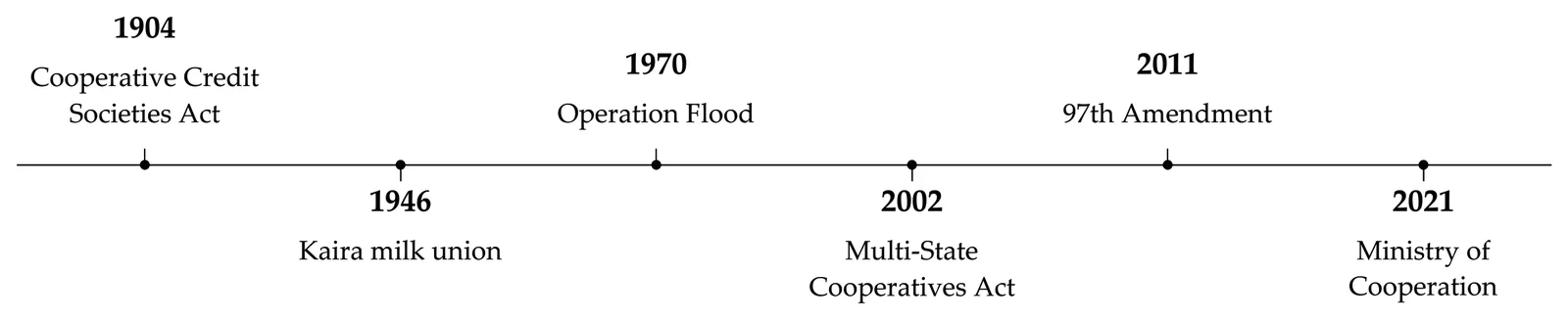
The Cooperative Credit Societies Act of 1904 began the movement in India to free farmers from moneylenders, and the Act of 1912 extended it to other activities. Cooperation became a provincial subject in 1919.
4. Amul and Operation Flood
The Kaira District Cooperative Milk Producers’ Union, formed in 1946 and known as Amul, became a model of farmer-owned enterprise. Operation Flood, led by Verghese Kurien from 1970, spread dairy cooperatives and made India the largest milk producer.
5. Other Sectors
Cooperatives are important in sugar in Maharashtra, fertiliser through IFFCO, agricultural credit through primary agricultural credit societies, and housing and banking in cities.
6. The 97th Amendment
The 97th Amendment of 2011 added the right to form cooperative societies to Article 19(1)(c), added Article 43B to the Directive Principles and inserted Part IXB on the governance of cooperatives.
7. Part IXB
Part IXB provides for a maximum of 21 board members, reservation of seats for Scheduled Castes, Scheduled Tribes and women, a five-year term, regular elections and audit of accounts.
8. Rajendra Shah Judgment
In 2021, the Supreme Court held that Part IXB was invalid for state cooperatives because the amendment had not been ratified by half the states, but upheld it for multi-state cooperatives.
9. Ministry of Cooperation
The Union government created a Ministry of Cooperation in 2021 to strengthen the movement, and the Multi-State Cooperative Societies Act was amended in 2023.
10. Role in Rural Development
Cooperatives provide credit, inputs, marketing and processing to small farmers, increase their bargaining power and keep profits within rural communities.
11. Role in Urban Development
In cities, housing cooperatives provide affordable homes and urban cooperative banks serve small businesses and households, though some have faced crises, such as a bank failure in 2019 that led to stricter regulation.
12. Problems
Problems include political control, elite capture, mismanagement, weak finances and excessive state interference, which have undermined the democratic and voluntary character of many cooperatives.
13. Women and Cooperatives
Women’s cooperatives, such as those promoted by SEWA in Gujarat, have helped informal women workers gain income, credit and bargaining power.
14. Reforms
Reforms needed include autonomy from government, professional management, transparency, computerisation of credit societies and member education.
15. Computerisation of PACS
Primary agricultural credit societies form the base of the rural cooperative credit system. Since 2022, the government has funded the computerisation of tens of thousands of these societies to improve transparency and efficiency, and has allowed them to take up new activities such as running common service centres and storage.
16. Lessons from Amul
Amul’s success rested on a three-tier structure of village societies, district unions and a state federation, professional management, direct payment to farmers and control by producers. Scholars argue that these features, rather than state patronage, explain why some cooperatives succeed while many others fail.
17. Evaluation
Cooperatives are important instruments of inclusive development, but they need autonomy and good governance to fulfil their promise.
Conclusion. Thus, cooperatives are voluntary, democratically controlled enterprises that have transformed dairy, sugar, credit and housing in India, as Amul shows. The 97th Amendment recognised them in Articles 19(1)(c) and 43B and Part IXB, partly struck down in 2021, but politicisation and mismanagement must be overcome.
Important Question 5
Discuss women’s participation in local governance in India.
OR
Has reservation for women in local bodies empowered women? Discuss.
OR
Examine the achievements and challenges of elected women representatives.
Model Answer
“Not less than one-third of the total number of seats to be filled by direct election in every Panchayat shall be reserved for women.”
— Constitution of India, Article 243D
Introduction. The 73rd and 74th Amendments reserved at least one-third of seats and chairpersons’ posts in local bodies for women, a landmark in women’s political participation. Many states have since raised the reservation to half. This has brought more than a million women into local government, changing both women’s lives and local priorities, though serious challenges remain.
1. Constitutional Provisions
Articles 243D and 243T reserve at least one-third of seats and chairpersons’ posts in panchayats and municipalities for women, including women from Scheduled Castes and Scheduled Tribes.
2. Fifty Per Cent Reservation
More than twenty states have raised reservation for women in panchayats to fifty per cent, and women now form about half of all elected panchayat members.
3. Scale of Participation
With more than a million elected women representatives, India has one of the largest numbers of women in elected office in the world, mostly at the local level.
4. Changing Priorities
Raghabendra Chattopadhyay and Esther Duflo found in 2004 that villages with women heads invested more in public goods that women valued, such as drinking water, showing that women’s representation changes policy.
5. Empowerment
Participation has increased women’s confidence, visibility and voice in public life, and many women representatives have later contested higher offices.
6. Role Models
Women leaders such as Chhavi Rajawat, an MBA who became sarpanch of Soda village in Rajasthan in 2010, became role models, showing new possibilities for women in rural politics.
7. Proxy Representation
A major problem is proxy representation, where husbands or male relatives, called sarpanch pati, exercise power in the name of elected women. Governments have discussed measures to curb this practice.
8. Patriarchy and Caste
Women representatives, especially Dalit and Adivasi women, face hostility, violence and exclusion from dominant groups, limiting their ability to exercise power.
9. Rotation of Seats
Reserved seats rotate between elections, so many women serve only one term, which limits experience and continuity.
10. Capacity Building
Training programmes for elected women representatives on law, finance and planning have helped many women perform their roles more confidently.
11. Self-Help Groups
Women’s self-help groups, such as Kerala’s Kudumbashree, have provided a base for women to enter local politics and work with panchayats on development.
12. Urban Bodies
Women also hold reserved seats and mayoral posts in municipalities, though urban women representatives face similar challenges of party control and limited powers.
13. Towards Legislatures
The success of local reservation strengthened the case for reserving seats for women in Parliament and state assemblies, provided for by the 106th Amendment of 2023.
14. Remaining Gaps
Despite reservation, women remain under-represented in decision-making positions in bureaucracy and political parties, and social norms continue to limit their participation.
15. Women and Gram Sabhas
Women’s participation in gram sabhas is often low because meetings are held at inconvenient times or dominated by men. Some states have required separate mahila sabhas before gram sabha meetings, where women can discuss their concerns, such as water, health and alcohol, and bring them to the main meeting.
16. Effect on Other Women
Studies suggest that having women leaders changes how villagers view women’s abilities and raises the aspirations of girls and their parents. Exposure to women leaders may reduce bias against women in later elections and encourage more women to come forward in public life.
17. Kerala and Women’s Leadership
In Kerala, where women hold half the seats in local bodies, the combination of reservation, high literacy and the Kudumbashree network has produced many capable women leaders who manage budgets, plan projects and later move into higher political office, showing how supportive conditions strengthen the effects of reservation.
18. Evaluation
Reservation has transformed women’s participation in local governance, though proxy rule, patriarchy and limited powers must still be overcome.
Conclusion. Thus, Articles 243D and 243T reserved at least one-third of local seats for women, raised to half in many states, bringing over a million women into local government. Studies such as Chattopadhyay and Duflo’s show changed priorities, but proxy representation, caste and patriarchy, and rotation of seats remain challenges.
Short Notes
(a) Gram sabha
The body of all voters in a village, recognised by Article 243A, which approves plans and holds the panchayat accountable.
(b) State Finance Commission
A commission set up every five years under Articles 243I and 243Y to recommend how revenue should be shared between the state and local bodies.
(c) Sarpanch pati
A husband or male relative who exercises power in the name of an elected woman sarpanch, a form of proxy representation.
More notes: MDSE-14 Rural-Urban Local Development in India
These notes are prepared by PADHO TO AISE for study help. They are not an official University of Delhi publication.