
Semester VII DSE-10 Understanding Human Rights
Unit I · 19 min read · Updated 24 Nov 2026
As per the University of Delhi (DU) BA (Hons) Political Science syllabus
Contents
- 1.1 The Meaning of Human Rights
- 1.2 Evolution of Human Rights
- 1.3 Generations of Rights
- 1.4 Human Rights and Citizenship Rights
- 1.5 Important Questions
- Discuss the meaning and evolution of human rights.
- Discuss the ancient Indian concept of human rights.
- Explain the four generations of human rights.
- Distinguish between human rights and citizenship rights.
- Short Notes
सभी मनुष्य जन्म से स्वतंत्र हैं और गरिमा तथा अधिकारों में समान हैं।
All human beings are born free and equal in dignity and rights.
— Universal Declaration of Human Rights, Article 1 (1948)
HUMAN rights are the rights that every person has simply by being human, whatever their nationality, religion, caste, gender or status. The idea grew from ancient ideas of justice and natural law, through charters such as the Magna Carta and the revolutionary declarations of America and France, to the Universal Declaration of Human Rights of 1948. This chapter examines the meaning and evolution of human rights, the ancient Indian ideas related to them, the classification of rights into four generations, and the relationship between human rights and citizenship rights. It draws on Upendra Baxi, John Hoffman and Paul Graham, Darren O’Byrne and readers on human rights edited by Radhanath Tripathy and others.
1.1 The Meaning of Human Rights
Human rights are rights inherent in every human being by virtue of their humanity and dignity. They are universal, belonging to all; inalienable, which means they cannot be taken away or given up; and indivisible, since civil, political, economic, social and cultural rights depend on each other. Theories differ on their basis: natural rights theory grounds them in nature or reason, legal positivists in law, and others in human needs or dignity. Upendra Baxi argues that human rights must be understood from the standpoint of those who suffer violations.
1.2 Evolution of Human Rights
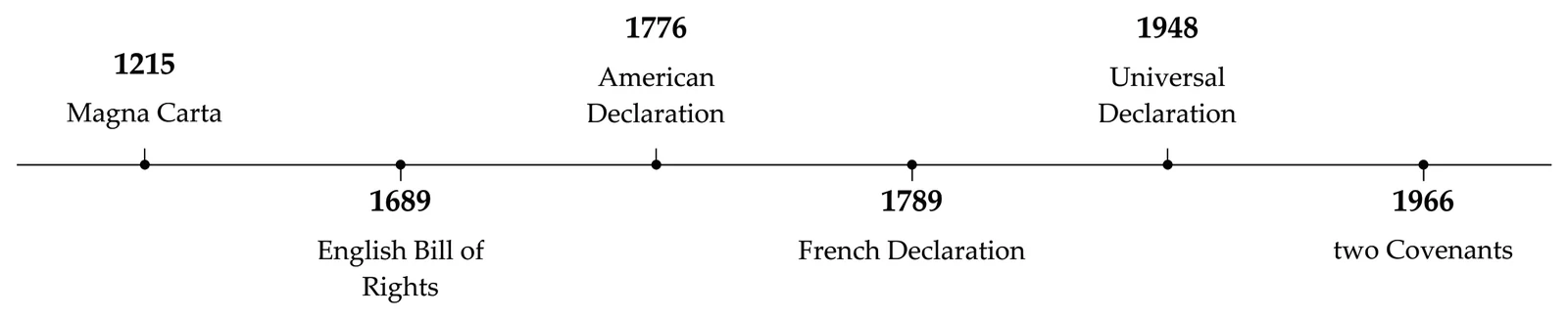
Ideas of justice and dignity are found in many ancient traditions, including ancient India, where dharma, ahimsa and the duties of rulers protected people’s well-being, though within a hierarchical society. In Europe, the Magna Carta (1215) limited royal power, and the English Bill of Rights (1689), the American Declaration of Independence (1776) and the French Declaration of the Rights of Man (1789) proclaimed natural rights. After the horrors of the Second World War, the United Nations adopted the Universal Declaration (1948), making human rights an international concern.
1.3 Generations of Rights
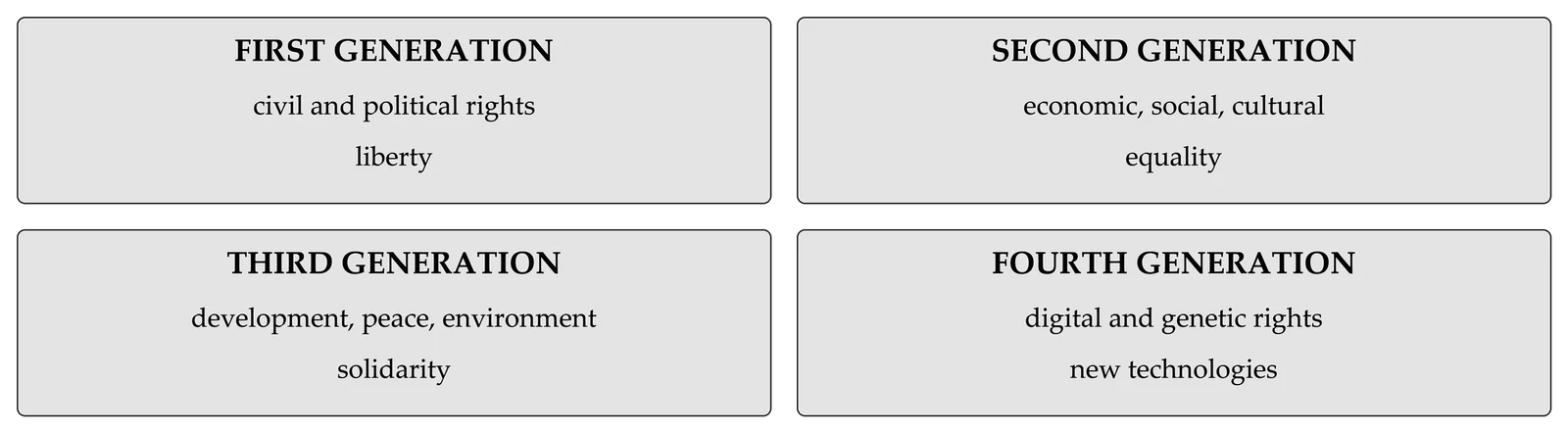
Karel Vasak classified human rights into generations linked to the French revolutionary ideals. First-generation civil and political rights protect liberty; second-generation economic, social and cultural rights promote equality; third-generation solidarity rights, such as development, peace and a healthy environment, express fraternity. Some scholars now speak of a fourth generation of rights arising from new technologies.
1.4 Human Rights and Citizenship Rights
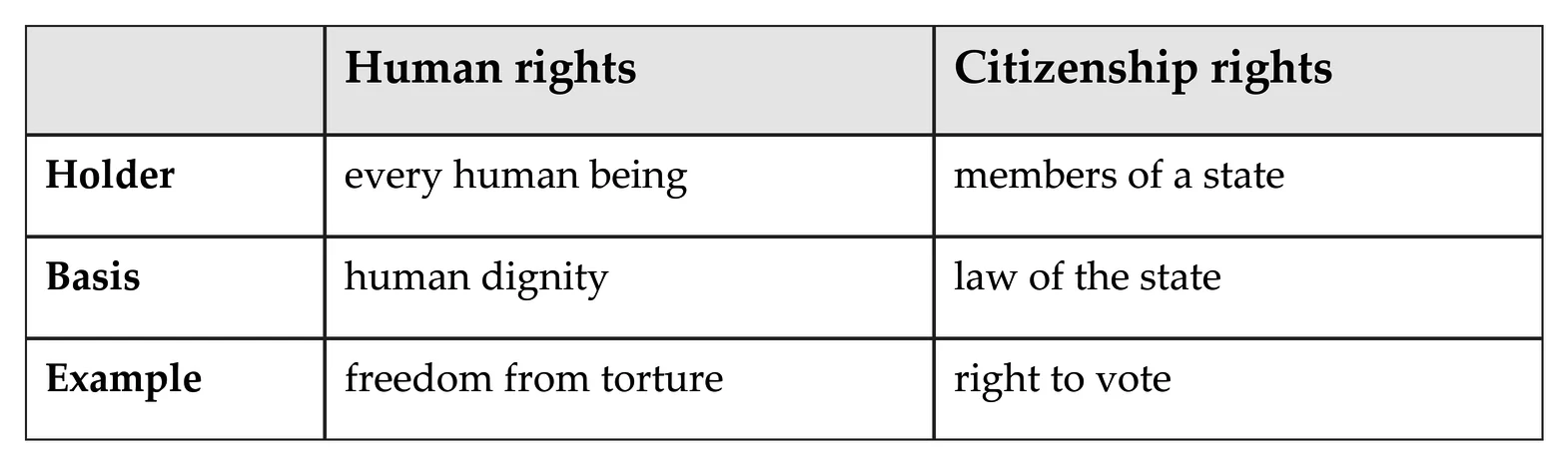
Citizenship rights belong to members of a particular state and are guaranteed by its laws, such as the right to vote. Human rights belong to all people everywhere. In practice, people often depend on citizenship to enjoy their human rights, as Hannah Arendt observed about stateless refugees, who lost the ‘right to have rights’.
1.5 Important Questions
- Question 1 Discuss the meaning and evolution of human rights.
- Question 2 Discuss the ancient Indian concept of human rights.
- Question 3 Explain the four generations of human rights.
- Question 4 Distinguish between human rights and citizenship rights.
DU asks the same idea in different words. So learn one broad answer for each question below; the same answer works for every question joined by OR.
Important Question 1
Discuss the meaning and evolution of human rights.
OR
Trace the historical development of the idea of human rights.
OR
Examine different theories of human rights.
Model Answer
“Whereas recognition of the inherent dignity and of the equal and inalienable rights of all members of the human family is the foundation of freedom, justice and peace in the world.”
— Universal Declaration of Human Rights (1948), Preamble
Introduction. Human rights are the basic rights and freedoms that belong to every person because they are human. The idea developed over centuries, from ancient ideas of justice and natural law to modern declarations and international law. Today, human rights form a global language for claims to dignity, though their foundations and meaning remain debated.
1. Meaning
Human rights are entitlements that protect human dignity, such as the rights to life, liberty, equality, food, education and freedom from torture. They belong to all people equally, regardless of nationality, race, religion, caste, sex or status.
2. Characteristics
Human rights are universal, inalienable and indivisible. The Vienna Declaration of 1993 affirmed that all human rights are universal, indivisible, interdependent and interrelated, rejecting any hierarchy among them.
3. Natural Law
Ancient Stoics and Roman thinkers such as Cicero spoke of a natural law of reason that applies to all humans. Medieval thinkers linked natural law to divine law. These ideas provided early foundations for universal rights.
4. Natural Rights
In the seventeenth century, John Locke argued that people have natural rights to life, liberty and property, and that governments exist to protect them. If a government violates these rights, people may resist.
5. Early Charters
The Magna Carta of 1215 limited the power of the English king, and the English Bill of Rights of 1689 secured rights of Parliament and subjects. These charters established that rulers are bound by law.
6. Revolutionary Declarations
The American Declaration of Independence (1776) proclaimed that all men are created equal with unalienable rights, and the French Declaration of the Rights of Man and of the Citizen (1789) declared that men are born free and equal in rights.
7. The Nineteenth Century
Movements for the abolition of slavery, workers’ rights and women’s suffrage expanded the idea of rights. Britain abolished slavery in its empire in 1833 and the United States in 1865.
8. The Universal Declaration
After the Holocaust and the Second World War, the UN Charter of 1945 committed members to human rights. The Universal Declaration, drafted by a commission chaired by Eleanor Roosevelt, was adopted on 10 December 1948, with no votes against.
9. The Covenants and Beyond
During the Cold War, rights were divided into two covenants of 1966, on civil and political rights and on economic, social and cultural rights. Further conventions protected women, children, minorities and persons with disabilities.
10. Theories: O’Byrne
Darren O’Byrne explains different ways of theorising human rights: as natural rights, as legal rights created by states, as responses to human needs and as products of political struggle. Each gives a different answer to why we have rights.
11. Critiques
Jeremy Bentham called natural rights nonsense upon stilts, insisting that rights come only from law. Marx criticised the rights of man as the rights of egoistic individuals in bourgeois society. Cultural relativists argue that human rights reflect Western values.
12. Hoffman and Graham
John Hoffman and Paul Graham argue that human rights are inherently political: they depend on states for their protection and are shaped by struggles over power, and the tension between universal rights and cultural difference must be addressed through dialogue.
13. Baxi: The Future of Human Rights
Upendra Baxi, in The Future of Human Rights (2002), argues that human rights must be understood from the standpoint of those who suffer violations. He warns that a market-friendly paradigm of rights, serving corporations and trade, threatens to replace the universal paradigm of the Declaration.
14. Evaluation
Human rights have evolved from limited charters for some to universal claims for all. Their meaning continues to be shaped by struggles of the oppressed and debates about their foundations.
Conclusion. Thus, human rights are universal, inalienable and indivisible rights that protect human dignity. They evolved from natural law and natural rights through the Magna Carta and revolutionary declarations to the Universal Declaration of 1948. As O’Byrne, Hoffman and Graham and Baxi show, their foundations and future remain debated and political.
Important Question 2
Discuss the ancient Indian concept of human rights.
OR
Did ancient India have a concept of human rights? Discuss.
OR
Examine the relationship between dharma, duties and rights in Indian tradition.
Model Answer
“This is mine, that is his, say the small-minded; for the large-hearted, the whole world is a family.”
— Maha Upanishad 6.71–72
Introduction. The language of human rights developed in modern Europe, but ideas of human dignity, justice and protection of the weak are found in many traditions, including ancient India. Scholars debate whether ancient Indian thought contained a concept of human rights. It emphasised duties rather than rights, and it also accepted deep hierarchies of caste and gender, which reformers later challenged.
1. The Debate
Some scholars argue that ancient India had rich ideas of justice, compassion and welfare that correspond to human rights. Others argue that its hierarchical social order, based on caste, is incompatible with the idea of equal rights for all human beings.
2. Dharma and Duties
Indian thought focused on dharma, the duties appropriate to each person. Rights were implied by the duties of others: if a king has a duty to protect, subjects can expect protection. The emphasis on duties rather than rights reflects a different moral framework.
3. Rajadharma
The duty of the ruler, rajadharma, was to protect the people, punish wrongdoers, ensure justice and promote welfare. Kautilya wrote that the king’s happiness lies in the happiness of his subjects. A king who failed in his duty could lose legitimacy.
4. Ahimsa and Compassion
Jain and Buddhist traditions taught ahimsa, non-violence towards all living beings, and compassion for those who suffer. These values express respect for life that underlies modern human rights.
5. Ashoka’s Edicts
Ashoka’s edicts urged tolerance of all sects, humane treatment of servants and prisoners, care for the sick and welfare for people and animals. One edict granted condemned prisoners three days’ respite before execution. They show an early concern for humane governance.
6. Buddhist Equality
The Buddha criticised the claim that birth determines worth, arguing that a person becomes noble or base by their actions. The Buddhist sangha admitted people of all castes, offering a vision of spiritual equality.
7. Bhakti and Sufi Traditions
Medieval bhakti saints such as Kabir and Ravidas, and Sufi teachers, preached the equality of all devotees before God, challenging caste hierarchy and religious exclusion.
8. Sikh Traditions
Guru Nanak and the Sikh gurus rejected caste distinctions, and the institution of langar, the community kitchen where all sit together to eat, expressed equality in practice.
9. Limits of the Tradition
Ancient law books such as the Manusmriti defended caste hierarchy and the subordination of women and Shudras. Untouchability denied basic dignity to millions. Any account of human rights in ancient India must recognise these exclusions.
10. Ambedkar’s Critique
B.R. Ambedkar argued that Hindu social order, based on graded inequality, denied human rights to the untouchables. He drew instead on Buddhist ideas of equality and on modern constitutionalism.
11. Gandhi on Duties and Rights
Gandhi, writing to UNESCO in 1947, said he had learned from his mother that all rights to be deserved and preserved came from duty well done, linking rights to responsibilities in the Indian tradition.
12. Human Rights, Gender and Environment
Readers edited by Radhanath Tripathy, by Priyam, Banerjee and Menon, and by Motilal and Nanda link human rights with gender and the environment, showing how Indian traditions and modern movements interpret rights in these areas.
13. Relevance
The Indian tradition’s emphasis on duties, harmony, compassion and the welfare of all, expressed in vasudhaiva kutumbakam, can enrich modern human rights, which the Constitution reflects in its fundamental duties.
14. Evaluation
Ancient India had important ideas of justice, compassion and protection, though not a modern concept of equal rights. Its egalitarian strands were developed by reformers and the Constitution.
Conclusion. Thus, ancient Indian thought emphasised dharma, rajadharma, ahimsa and the welfare of all rather than individual rights. Ashoka, the Buddha, bhakti saints and Sikh gurus expressed ideas of dignity and equality, but caste and gender hierarchies denied rights to many, as Ambedkar showed. The tradition offers both resources and lessons for human rights.
Important Question 3
Explain the four generations of human rights.
OR
Distinguish between civil and political rights and economic, social and cultural rights.
OR
Discuss the idea of solidarity or third-generation rights.
Model Answer
“The right to development is an inalienable human right by virtue of which every human person and all peoples are entitled to participate in, contribute to, and enjoy economic, social, cultural and political development, in which all human rights and fundamental freedoms can be fully realized.”
— UN Declaration on the Right to Development (1986), Article 1
Introduction. Human rights have expanded over time to include new kinds of claims. In 1977, the jurist Karel Vasak classified human rights into three generations, linked to the French revolutionary ideals of liberty, equality and fraternity. Scholars now speak of a fourth generation of rights arising from new technologies. This classification helps understand the development and variety of human rights.
1. Vasak’s Classification
Karel Vasak, a Czech-French jurist, proposed that human rights developed in three generations: civil and political rights, economic, social and cultural rights, and solidarity rights. Each corresponds to one of the ideals of the French Revolution.
2. First Generation: Liberty
First-generation rights are civil and political rights, such as the rights to life, liberty, free speech, religion, fair trial and voting. They mainly require the state not to interfere with individuals, so they are often called negative rights.
3. Second Generation: Equality
Second-generation rights are economic, social and cultural rights, such as the rights to work, fair wages, social security, health, education and an adequate standard of living. They require positive action by the state.
4. The Justiciability Debate
Critics argued that social rights depend on resources and cannot be enforced by courts like civil rights. Supporters reply that all rights require resources and that courts can enforce minimum standards, as Indian courts have done.
5. Third Generation: Solidarity
Third-generation rights are collective rights of peoples, such as the rights to development, peace, a healthy environment and self-determination. The UN Declaration on the Right to Development of 1986 is an example.
6. The Right to a Healthy Environment
In 2022, the UN General Assembly recognised the right to a clean, healthy and sustainable environment as a human right, an important development of solidarity rights.
7. Fourth Generation
Some scholars speak of fourth-generation rights arising from new technologies, such as rights to privacy and data protection in the digital age, rights concerning genetic engineering and the rights of future generations.
8. SAHRDC on Generations
The South Asia Human Rights Documentation Centre’s Introducing Human Rights provides an overview of the first, second and third generations of rights and their place in international law and South Asian contexts.
9. Generations in the Indian Constitution
The Indian Constitution places civil and political rights in Part III as enforceable Fundamental Rights and many social and economic rights in Part IV as Directive Principles, reflecting the distinction between the first and second generations.
10. Judicial Expansion
The Supreme Court has read many second- and third-generation rights into the right to life under Article 21, including the rights to food, shelter, health, education, a clean environment and privacy. Education became a fundamental right through Article 21A in 2002.
11. Mohanty on Changing Rights
Manoranjan Mohanty shows that the definition of rights in India has expanded through people’s struggles, from civil liberties to rights to livelihood, environment and identity, illustrating how new generations of rights emerge.
12. Criticisms of the Generational Model
Critics argue that the generational model wrongly suggests a hierarchy or historical sequence, since social rights appeared in early constitutions such as Mexico’s in 1917, and that all rights are interdependent.
13. Indivisibility
The principle of indivisibility holds that rights cannot be separated: the right to vote means little without education, and the right to life means little without food and health.
14. Evaluation
The generational classification is a useful way to understand the expansion of human rights, as long as it does not imply that some rights matter more than others.
Conclusion. Thus, Karel Vasak classified human rights into first-generation civil and political rights, second-generation economic, social and cultural rights and third-generation solidarity rights, to which a fourth generation of technological rights is now added. In India, courts have expanded rights through Article 21, though the classification should not obscure the indivisibility of all rights.
Important Question 4
Distinguish between human rights and citizenship rights.
OR
Examine the relationship between human rights and citizenship.
OR
‘The right to have rights.’ Discuss with reference to Hannah Arendt.
Model Answer
“We became aware of the existence of a right to have rights and a right to belong to some kind of organized community, only when millions of people emerged who had lost and could not regain these rights because of the new global political situation.”
— Hannah Arendt, The Origins of Totalitarianism (1951)
Introduction. Human rights belong to all people because they are human, while citizenship rights belong to members of a particular state. In theory, human rights are universal; in practice, people usually enjoy their rights through the state of which they are citizens. The relationship between the two raises important questions about refugees, migrants and stateless people.
1. Citizenship Rights
Citizenship rights are rights that a state guarantees to its members, such as the rights to vote, hold public office, enter and live in the country and receive certain benefits. They depend on the law of the state.
2. Human Rights
Human rights belong to every person regardless of nationality. They include the rights to life, freedom from torture, fair trial and basic necessities, and are recognised in international law.
3. Key Differences
Human rights are universal and based on human dignity, while citizenship rights are particular and based on membership. Human rights are protected by international law, while citizenship rights are protected by national law and courts.
4. Overlap
Many rights are both human rights and citizenship rights. National constitutions often incorporate human rights, and states are the main bodies responsible for protecting them.
5. Marshall on Citizenship
T.H. Marshall described citizenship as including civil, political and social rights. Citizenship rights have historically been the main means through which people secured human rights within states.
6. Arendt’s Paradox
Hannah Arendt observed that refugees and stateless people after the World Wars, who were supposed to have human rights simply as humans, in fact lost all rights when they lost their citizenship. She concluded that the most basic right is the right to have rights, to belong to a political community.
7. Refugees and Migrants
Today, refugees, asylum seekers and undocumented migrants often lack citizenship in the places they live, making them vulnerable to abuse even though they are entitled to human rights.
8. The Indian Constitution
The Indian Constitution gives some fundamental rights to all persons, such as equality before the law (Article 14), protection of life and liberty (Article 21) and freedom of religion (Article 25), and others only to citizens, such as freedom of speech (Article 19) and equal opportunity in public employment (Article 16).
9. Statelessness
Millions of people in the world are stateless, lacking any citizenship. Exercises such as the National Register of Citizens in Assam have raised fears of statelessness for those excluded.
10. Hoffman and Graham
Hoffman and Graham note that human rights depend on states for their realisation, which creates a tension: states are both the protectors and the main violators of human rights.
11. Cosmopolitan Citizenship
Cosmopolitan thinkers, following Kant’s idea of a right to hospitality, argue for forms of global citizenship that would protect people regardless of nationality, through international institutions.
12. Sovereignty and Rights
The principle of state sovereignty can conflict with universal rights. In 2005, the UN endorsed the Responsibility to Protect, under which the international community may act when states fail to protect their populations from atrocities.
13. Extending Rights
Human rights movements and courts have extended protections to non-citizens, such as refugees and migrant workers, narrowing the gap between human rights and citizenship rights.
14. Diaspora and Partial Citizenship
India does not allow dual citizenship, but it created Overseas Citizenship of India for people of Indian origin who hold foreign citizenship. They enjoy a lifelong visa and some economic rights but cannot vote or hold constitutional office. Such arrangements show that citizenship is increasingly graded, with different bundles of rights for different categories of people.
15. Evaluation
Human rights and citizenship rights overlap but are not the same. As Arendt showed, without membership in a political community, human rights can become empty.
Conclusion. Thus, human rights belong to all people as human beings, while citizenship rights belong to members of a state. In practice, people depend on citizenship to enjoy their rights, as Hannah Arendt’s idea of the right to have rights shows. Protecting refugees, migrants and stateless people requires extending rights beyond citizenship.
Short Notes
(a) Universal Declaration of Human Rights
Adopted by the UN General Assembly on 10 December 1948, it sets out thirty articles of civil, political, economic, social and cultural rights as a common standard for all peoples and nations.
(b) Indivisibility of rights
The principle, affirmed at Vienna in 1993, that all human rights are interdependent and equally important, so that civil and political rights cannot be separated from economic, social and cultural rights.
(c) Right to have rights
Hannah Arendt’s phrase for the basic right to belong to a political community, without which, as stateless refugees discovered, human rights cannot be effectively enjoyed.
More notes: DSE-10 Understanding Human Rights
These notes are prepared by PADHO TO AISE for study help. They are not an official University of Delhi publication.