
Semester VIII DSE-15 Power Dilemmas in International Relations
Unit III · 23 min read · Updated 24 Nov 2026
As per the University of Delhi (DU) BA (Hons) Political Science syllabus
Contents
- 3.1 Regionalism and Multilateralism
- Defining Multilateralism
- Old and New Regionalism
- Trade Creation, Trade Diversion and the Spaghetti Bowl
- 3.2 Power at the WTO
- How the WTO Works
- Coalitions of Developing Countries
- Key Moments at the WTO
- 3.3 Power at the UNFCCC
- Milestones of Climate Negotiations
- Coalitions and Bargaining Power
- India in Climate Negotiations
- 3.4 Important Questions
- Discuss the shifting of power between regionalism and multilateralism.
- Discuss the power conundrums at the World Trade Organization.
- Discuss power negotiations at the UNFCCC.
- How do international institutions reflect and reproduce power? Discuss.
- Short Notes
संरचनात्मक शक्ति यह तय करने की शक्ति देती है कि काम कैसे होंगे, यानी उन ढाँचों को आकार देने की शक्ति जिनमें राज्य एक-दूसरे से संबंध रखते हैं।
Structural power, in short, confers the power to decide how things shall be done, the power to shape frameworks within which states relate to each other.
— Susan Strange, States and Markets (1988)
INTERNATIONAL institutions, such as the World Trade Organization and the UN climate convention, are often seen as neutral forums for cooperation. In reality, they are arenas of power. Powerful states shape their rules, while weaker states form coalitions to resist. Power also shifts between regional groupings and multilateral institutions. This chapter examines regionalism and multilateralism, the power conundrums at the WTO, power negotiations at the UNFCCC and the different forms of power in global governance, drawing on Barry Buzan and Ole Wæver, Jagdish Bhagwati, Gregory Shaffer, Kristen Hopewell, John Vogler, Andrew Hurrell and Michael Barnett and Raymond Duvall.
3.1 Regionalism and Multilateralism
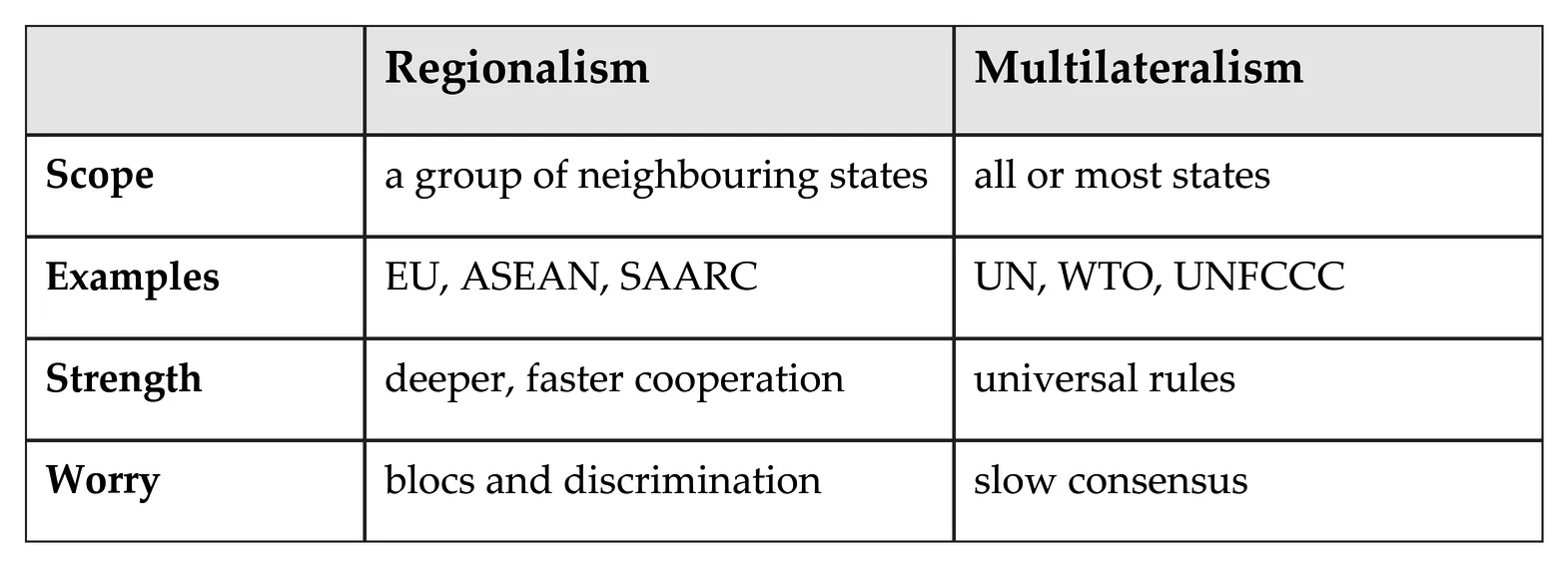
Multilateralism means cooperation among many states under common rules, as in the UN and the WTO. Regionalism means cooperation among states of a region, as in the European Union and ASEAN. Buzan and Wæver argue that much of international security is organised in regional security complexes, while Jagdish Bhagwati debated whether regional trade agreements are building blocks or stumbling blocks for global free trade.
Defining Multilateralism
John Gerard Ruggie, in Multilateralism: The Anatomy of an Institution (1992), defined multilateralism as coordinating relations among three or more states on the basis of generalised principles of conduct, such as most-favoured-nation treatment or collective security. He identified two corollaries: indivisibility, meaning that the members treat a threat to one as a concern of all, and diffuse reciprocity, meaning that members expect to benefit over time rather than in each transaction. Robert Keohane gave a simpler definition in 1990 as the practice of coordinating policies in groups of three or more states.
Old and New Regionalism
- Old regionalism. The first wave in the 1950s and 1960s included the European Economic Community, created by the Treaty of Rome in 1957, and ASEAN, founded by the Bangkok Declaration of 1967; it was shaped by the Cold War and inward-looking economic strategies.
- New regionalism. From the late 1980s, regional agreements such as Mercosur (1991), NAFTA (1994) and SAFTA (2004) were more open, linked to globalisation and included non-economic issues.
- Mega-regionals. The Comprehensive and Progressive Agreement for Trans-Pacific Partnership (2018) and the Regional Comprehensive Economic Partnership, signed in November 2020, cover large shares of world trade; India withdrew from RCEP negotiations in 2019.
- South Asia. SAARC, founded in Dhaka in 1985, has not held a summit since 2014, so India has turned to BIMSTEC (1997) and sub-regional groupings.
Trade Creation, Trade Diversion and the Spaghetti Bowl
Jacob Viner, in The Customs Union Issue (1950), showed that regional trade agreements can cause trade creation, when members buy from efficient partners instead of producing at home, or trade diversion, when members buy from less efficient partners because of preferences, losing cheaper imports from outsiders. Jagdish Bhagwati used the phrase spaghetti bowl in 1995 to describe the tangle of overlapping agreements with different rules of origin, which raise costs for business. He saw regional agreements as stumbling blocks, while others saw them as building blocks towards wider liberalisation. Moisés Naím later argued for minilateralism, bringing together the smallest number of countries needed for real impact.
3.2 Power at the WTO
The WTO formally works by consensus, with one vote per member, but powerful members have dominated its agenda through informal meetings and greater legal and economic resources. Since the 2000s, emerging powers such as India, Brazil and China have joined the inner circle and blocked deals they saw as unfair, contributing to the deadlock of the Doha Round.

How the WTO Works
- Ministerial Conference. The highest body meets at least once every two years.
- General Council. Ambassadors in Geneva manage day-to-day work and also meet as the Dispute Settlement Body.
- Consensus. Decisions are normally taken by consensus, which formally gives every member a veto.
- Dispute settlement. Panels hear disputes, and an Appellate Body of seven members heard appeals until December 2019, when the United States blocked new appointments.
- Green Room meetings. Informal meetings of a small group of key members, named after the colour of the Director-General’s conference room, have long been used to broker deals, often excluding smaller countries.
Coalitions of Developing Countries
At the Cancún ministerial of 2003, Brazil, India, China and South Africa led a coalition of developing countries, the G20 of the WTO, which rejected a deal on agriculture proposed by the United States and the European Union. In 2004, the core negotiating group became the Five Interested Parties, which included Brazil and India alongside the United States, the European Union and Australia, showing how emerging powers had entered the inner circle. The G33 coalition, which includes India, defended the right to protect special products and food security. Kristen Hopewell, in Breaking the WTO (2016), argues that the rise of emerging powers contributed to the deadlock of the Doha Round.
Key Moments at the WTO
- 2001 → The Doha Declaration on TRIPS and Public Health affirmed that patent rules should not prevent countries from protecting public health, for example through compulsory licences.
- 2008 → Talks in Geneva collapsed over the special safeguard mechanism for farmers, with India and the United States on opposite sides.
- 2013 → At Bali, a peace clause protected India’s public stockholding programmes for food security from legal challenge.
- 2015 → At Nairobi, members agreed to eliminate agricultural export subsidies.
- 2022 → At Geneva, members agreed on curbing harmful fisheries subsidies and a limited TRIPS waiver for Covid-19 vaccines.
3.3 Power at the UNFCCC
Climate negotiations under the UNFCCC reflect struggles over who should cut emissions and who should pay. The principle of common but differentiated responsibilities divided developed and developing countries, coalitions such as BASIC and the small island states pressed their interests, and the Paris Agreement of 2015 moved to voluntary national pledges.

Milestones of Climate Negotiations
- 1992 → The UNFCCC divided countries into Annex I (developed countries and economies in transition) and others, and recognised common but differentiated responsibilities and respective capabilities.
- 1997 → The Kyoto Protocol set binding targets for developed countries to cut emissions by about five per cent below 1990 levels in 2008 to 2012; the United States never ratified it.
- 2009 → The Copenhagen summit failed to agree a binding treaty, producing only a political accord negotiated by the United States and the BASIC countries.
- 2015 → The Paris Agreement set the aim of keeping warming well below 2°C and pursuing 1.5°C, through nationally determined contributions reviewed by a global stocktake every five years.
- 2021 and 2022 → The Glasgow Pact called for a phase-down of unabated coal, and the Sharm el-Sheikh conference agreed to set up a loss and damage fund.
- 2023 and 2024 → The first global stocktake at Dubai called for transitioning away from fossil fuels, and Baku agreed a new finance goal.
Coalitions and Bargaining Power
Climate negotiations are shaped by coalitions. The G77 and China, formed in 1964, speaks for developing countries; the Alliance of Small Island States, founded in 1990, uses moral authority as states threatened by rising seas; the Least Developed Countries group seeks adaptation finance; and the BASIC group of Brazil, South Africa, India and China, formed in 2009, defends the right of large emerging economies to develop. The United States withdrew from the Paris Agreement in 2017, rejoined in 2021 and announced withdrawal again in 2025, showing how domestic politics in a major power affects the regime.
India in Climate Negotiations
India has defended equity and historical responsibility, pointing out that its emissions per person are far below those of developed countries. Its updated nationally determined contribution of 2022 commits it to reducing the emissions intensity of GDP by 45 per cent from 2005 levels by 2030 and to obtaining about half of its installed electricity capacity from non-fossil sources by 2030. At Glasgow in 2021, Prime Minister Modi announced a target of net-zero emissions by 2070. India co-founded the International Solar Alliance with France in 2015 and launched Mission LiFE (Lifestyle for Environment) in 2022, presenting itself as a bridge between developed and developing countries.
3.4 Important Questions
- Question 1 Discuss the shifting of power between regionalism and multilateralism.
- Question 2 Discuss the power conundrums at the World Trade Organization.
- Question 3 Discuss power negotiations at the UNFCCC.
- Question 4 How do international institutions reflect and reproduce power? Discuss.
DU asks the same idea in different words. So learn one broad answer for each question below; the same answer works for every question joined by OR.
Important Question 1
Discuss the shifting of power between regionalism and multilateralism.
OR
Are regional trade agreements building blocks or stumbling blocks for multilateralism? Discuss.
OR
Examine Buzan and Wæver’s theory of regional security complexes.
Model Answer
“A regional security complex is a set of units whose major processes of securitisation, desecuritisation, or both, are so interlinked that their security problems cannot reasonably be analysed or resolved apart from one another.”
— Barry Buzan and Ole Wæver, Regions and Powers (2003)
Introduction. After 1945, the world built multilateral institutions such as the UN, the IMF and the GATT, based on universal rules. At the same time, regional groupings grew, from the European Communities to ASEAN and regional trade agreements. The relationship between regionalism and multilateralism shapes how power is distributed and exercised in world politics.
1. Meaning of Multilateralism
Multilateralism is the coordination of policy among three or more states on the basis of general principles that apply to all, such as non-discrimination in trade or collective security.
2. Meaning of Regionalism
Regionalism is cooperation and integration among states in a geographical region, through trade agreements, security arrangements or political unions.
3. Buzan and Wæver’s Levels
Barry Buzan and Ole Wæver distinguish domestic, regional, interregional and global levels of security, and argue that after the Cold War the regional level became more important, as most security threats travel more easily over short distances.
4. Regional Security Complexes
A regional security complex is a group of states whose security problems are so interlinked that they cannot be analysed separately. South Asia, centred on India and Pakistan, and the Middle East are examples.
5. Global and Regional Powers
Buzan and Wæver distinguish superpowers and great powers, which act across regions, from regional powers, which shape their own region. This helps explain India’s role as a regional power with global ambitions.
6. Bhagwati on Trade Regionalism
Jagdish Bhagwati described a first wave of regionalism in the 1960s, which largely failed, and a second wave from the 1980s, driven by the United States’ turn to free trade agreements such as NAFTA.
7. Building Blocks or Stumbling Blocks
Bhagwati warned that regional trade agreements may divert trade from efficient producers outside the bloc and create a tangle of overlapping rules, which he later called a spaghetti bowl, weakening multilateral free trade.
8. The Case for Regionalism
Supporters argue that regional agreements can go deeper and faster than global negotiations, act as laboratories for new rules and eventually support multilateral liberalisation.
9. Katzenstein on Regions
Peter Katzenstein argues that the world is a world of regions, shaped by different paths of modernity and by the influence of the United States, so that regionalism and globalism coexist in a polyvalent order.
10. Patriota on Cooperative Multipolarity
Antonio Patriota asks whether the world is ready for cooperative multipolarity, in which rising and established powers work together through multilateral institutions rather than rival blocs.
11. Examples
The European Union represents deep regional integration, ASEAN a looser model, and the African Union a growing regional organisation, while SAARC has been largely stalled by India–Pakistan tensions since 2014.
12. Mega-Regional Agreements
Large agreements such as the Regional Comprehensive Economic Partnership of 2020, from which India withdrew in 2019, and the Comprehensive and Progressive Agreement for Trans-Pacific Partnership show a shift of trade rule-making to regional forums.
13. Power Implications
Regionalism can increase the power of regional leaders and allow weaker states to bargain collectively, while multilateralism gives small states a seat at the table but can be dominated by great powers.
14. India’s Approach
India supports multilateralism in the UN and WTO, while building regional and sub-regional links through BIMSTEC, the Indian Ocean Rim Association and bilateral trade agreements.
15. Open Regionalism
Asia-Pacific states developed the idea of open regionalism through APEC, created in 1989, in which regional cooperation lowers barriers without discriminating against outsiders. This approach was meant to make regionalism compatible with multilateralism, though critics say APEC achieved little binding liberalisation.
16. Evaluation
Regionalism and multilateralism are both important channels of power, and their relationship shapes the global order.
Conclusion. Thus, power has shifted between multilateral institutions and regional groupings. Buzan and Wæver show that security is organised in regional complexes, Bhagwati warns that regional trade deals may undermine multilateralism, and Katzenstein and Patriota point to a world of regions and cooperative multipolarity.
Important Question 2
Discuss the power conundrums at the World Trade Organization.
OR
How have emerging powers changed the distribution of power at the WTO?
OR
Is the WTO a neutral institution? Discuss.
Model Answer
“The WTO shall continue the practice of decision-making by consensus followed under GATT 1947.”
— Marrakesh Agreement Establishing the WTO, Article IX (1994)
Introduction. The World Trade Organization, created in 1995, governs international trade through rules and dispute settlement. Formally, all members are equal and decisions are taken by consensus. In practice, power shapes the WTO’s rules and processes, as Gregory Shaffer, Richard Peet and Kristen Hopewell show, and the rise of emerging powers has transformed its politics.
1. From GATT to WTO
The General Agreement on Tariffs and Trade of 1947 reduced tariffs through rounds of negotiation. The Uruguay Round (1986–94) created the WTO, extending rules to services, intellectual property and agriculture, with a stronger dispute settlement system.
2. Formal Equality
The WTO gives each member one vote and works by consensus, which in theory allows any member to block decisions and gives developing countries, who are the majority, a voice.
3. Informal Power
In practice, key decisions were made in informal Green Room meetings among a few powerful members, especially the Quad of the United States, the European Union, Japan and Canada, before being presented to others.
4. Shaffer’s Comparative Approach
Gregory Shaffer argues that power at the WTO works through institutional processes, such as negotiation and adjudication. Rich members have greater legal and technical resources to use dispute settlement, so formal rules can favour the powerful.
5. Peet’s Unholy Trinity
Richard Peet argues that the IMF, the World Bank and the WTO form an unholy trinity that spreads neoliberal policies serving Western governments and corporations, with WTO agreements such as TRIPS protecting rich-country interests.
6. TRIPS and Public Health
The TRIPS agreement on intellectual property raised medicine prices in developing countries. After pressure from India, Brazil and African states, the Doha Declaration of 2001 affirmed the right to protect public health.
7. The Doha Round
The Doha Development Round, launched in 2001, aimed to address developing countries’ concerns, especially in agriculture, but it stalled over disputes between rich and emerging countries.
8. Cancún, 2003
At the Cancún ministerial meeting in 2003, a coalition of developing countries led by Brazil and India, the G20 of the WTO, blocked a deal on agriculture that they considered unfair, showing new collective power.
9. Hopewell on Emerging Powers
Kristen Hopewell argues that Brazil, India and China broke into the inner circle of the WTO and disrupted the dominance of the United States and Europe, but that they largely accepted neoliberal trade rules while seeking a fairer share.
10. The 2008 Collapse
In July 2008, negotiations collapsed over a special safeguard mechanism to protect poor farmers, with India and the United States disagreeing, showing how emerging powers could block deals.
11. India and Food Security
At the Bali ministerial meeting in 2013, India secured a peace clause protecting its public stockholding of food grains from challenge, defending food security against subsidy rules.
12. Dispute Settlement Crisis
Since December 2019, the United States has blocked appointments to the Appellate Body, leaving the WTO without a functioning appeals stage, a major blow to the rules-based system.
13. Public Participation
Yves Bonzon examines efforts to involve the public and NGOs in WTO decision-making, such as amicus briefs and open hearings, but notes conceptual hurdles in a member-driven organisation.
14. The Conundrum
The WTO faces a conundrum: consensus gives every member a veto, which protects the weak but makes agreement difficult as power becomes more diffuse.
15. Plurilateral Agreements
Because consensus among all members is hard to reach, groups of willing members have negotiated plurilateral agreements on issues such as investment facilitation and e-commerce. India has opposed some of these, arguing that they bypass the multilateral process and allow powerful members to set rules that others must later accept.
16. China’s Accession
China joined the WTO in 2001 and became the world’s largest exporter, transforming trade politics. Western members later complained that its state-led economy and subsidies were not adequately covered by WTO rules, while China argued that it had kept its commitments. These disputes contributed to the trade conflicts of the late 2010s and the weakening of the WTO.
17. Evaluation
The WTO is not neutral: its rules and processes reflect power, which has shifted from the old Quad to emerging powers, leading to deadlock.
Conclusion. Thus, the WTO is formally equal but shaped by power, as Shaffer and Peet show, through Green Room meetings, legal resources and agreements such as TRIPS. Hopewell shows that emerging powers broke into the inner circle at Cancún and after, leading to deadlock in the Doha Round, while the Appellate Body crisis threatens the system.
Important Question 3
Discuss power negotiations at the UNFCCC.
OR
Examine the role of coalitions and the principle of common but differentiated responsibilities in climate negotiations.
OR
How has power shaped the climate change regime from Kyoto to Paris?
Model Answer
“The developed country Parties should take the lead in combating climate change and the adverse effects thereof.”
— UN Framework Convention on Climate Change, Article 3.1 (1992)
Introduction. Climate change is a global problem that requires cooperation among all states, but it also involves sharp conflicts over responsibility and costs. The UN Framework Convention on Climate Change, adopted in 1992, is the main forum for these negotiations. John Vogler explains the UNFCCC regime, while Andrew Hurrell and others show how power and inequality shape it.
1. The UNFCCC
The UNFCCC, adopted at the Rio Earth Summit in 1992, set the goal of preventing dangerous interference with the climate system. Its parties meet each year at the Conference of the Parties.
2. Common but Differentiated Responsibilities
The convention recognised common but differentiated responsibilities and respective capabilities, asking developed countries, listed in Annex I, to take the lead because of their historical emissions and greater resources.
3. The Kyoto Protocol
The Kyoto Protocol of 1997 set binding emission targets for developed countries only. The United States refused to ratify it, arguing that major developing emitters such as China and India had no obligations.
4. Vogler on the Regime
John Vogler describes the UNFCCC regime as built on norms, rules and procedures that have evolved through bargaining, with the division between developed and developing countries as its central fault line.
5. Coalitions
Negotiations are shaped by coalitions: the G77 and China representing developing countries, the European Union, the Umbrella Group of non-EU developed countries, the Alliance of Small Island States and the Least Developed Countries.
6. BASIC
Brazil, South Africa, India and China formed the BASIC group in 2009. At Copenhagen that year, the BASIC leaders and the United States negotiated the Copenhagen Accord, showing the new power of emerging economies.
7. The Paris Agreement
The Paris Agreement of 2015 replaced top-down targets with nationally determined contributions from all countries, reviewed every five years, a compromise that brought in all major emitters.
8. Small States’ Power
Small island states, though weak in material terms, used moral authority and coalition diplomacy to push the goal of limiting warming to 1.5°C into the Paris Agreement.
9. Finance and Loss and Damage
Developing countries pressed rich countries for climate finance and compensation. A fund for loss and damage was agreed in 2022, and at Baku in 2024 a goal of 300 billion dollars a year by 2035 was set, far below what developing countries demanded.
10. Hurrell on Inequality
Andrew Hurrell argues that international institutions reflect existing power and can reproduce inequality, as climate rules shaped by powerful states may shift burdens to the weak.
11. Iskander and Lowe on Work
Natasha Iskander and Nichola Lowe show that climate change is also about work and labour, as the transition to clean energy affects jobs, workers’ power and the distribution of costs within societies.
12. US Withdrawals
The United States withdrew from the Paris Agreement under President Trump, rejoined in 2021 and announced another withdrawal in 2025, showing how domestic politics in a powerful state can weaken the regime.
13. India’s Position
India stresses equity, historical responsibility and its low per capita emissions, while pledging net zero by 2070 and large expansion of renewable energy, and leading the International Solar Alliance.
14. Critical Voices
Critics, such as contributors to Vijay Prashad’s volume on capitalist climate change, argue that the regime does not challenge the economic system that causes emissions.
15. The Global Stocktake
The first global stocktake under the Paris Agreement, concluded at COP28 in Dubai in 2023, found that the world was far off track and called for transitioning away from fossil fuels in energy systems. The negotiations over this language showed the power of oil-producing states and the pressure from vulnerable countries and civil society.
16. Evaluation
UNFCCC negotiations show how power, coalitions and principles of equity interact in tackling a shared global problem.
Conclusion. Thus, UNFCCC negotiations revolve around common but differentiated responsibilities, from Kyoto’s targets for rich countries to Paris’s universal pledges. Coalitions such as BASIC and AOSIS reshaped bargaining, Vogler explains the regime and Hurrell shows how institutions can reproduce inequality, while finance and US withdrawals remain flashpoints.
Important Question 4
How do international institutions reflect and reproduce power? Discuss.
OR
Examine Barnett and Duvall’s typology of power in global governance.
OR
Who governs the globe? Discuss with reference to power and institutions.
Model Answer
“Power is the production, in and through social relations, of effects that shape the capacities of actors to determine their circumstances and fate.”
— Michael Barnett and Raymond Duvall, Power in Global Governance (2005)
Introduction. Liberal theories present international institutions as tools of cooperation that benefit all members. Critics argue that institutions also embody and reproduce power. Michael Barnett and Raymond Duvall offer a typology of power in global governance, while Andrew Hurrell, Susan Strange and Deborah Avant, Martha Finnemore and Susan Sell show how institutions shape who governs the globe.
1. Institutions and Cooperation
Liberal institutionalists, such as Robert Keohane, argue that institutions reduce uncertainty, lower transaction costs and help states cooperate for mutual benefit.
2. Institutions and Power
Realists and critical scholars argue that institutions are created by powerful states to serve their interests and that they distribute benefits unequally.
3. Barnett and Duvall’s Definition
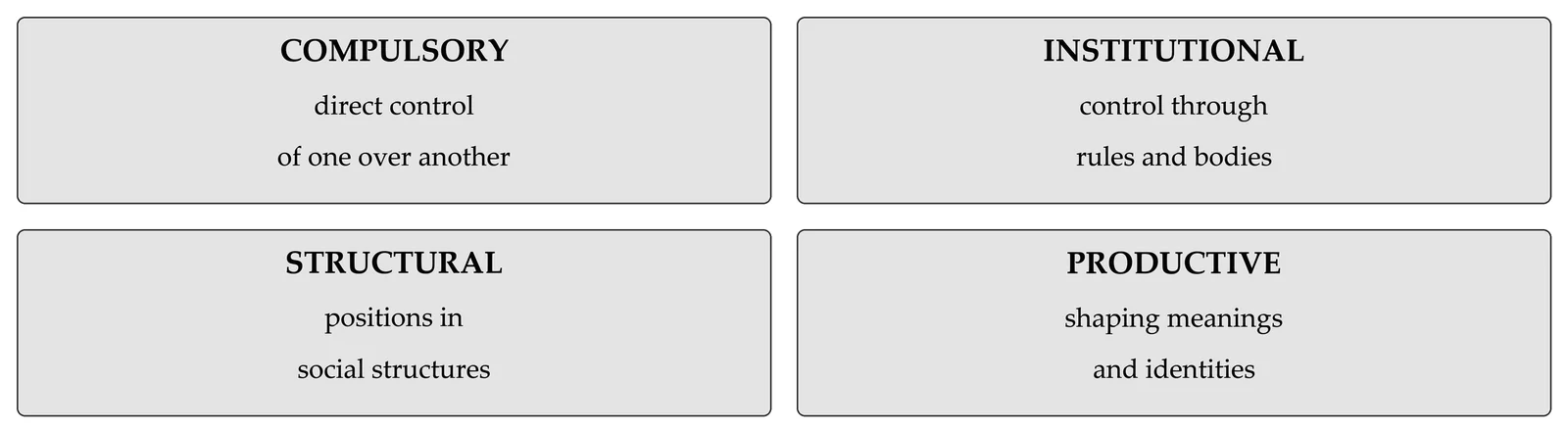
Barnett and Duvall define power as the production, through social relations, of effects that shape actors’ capacities to determine their circumstances, and distinguish four kinds of power.
4. Compulsory Power
Compulsory power is the direct control of one actor over another, as when a powerful state uses sanctions or threats to change another’s behaviour.
5. Institutional Power
Institutional power is control exercised indirectly through institutions. For example, weighted voting in the IMF gives the United States enough votes to block major decisions that need an 85 per cent majority.
6. Structural Power
Structural power works through the social positions actors occupy, such as creditor and debtor or developed and developing country, which define their capacities and interests.
7. Productive Power
Productive power works through discourses and knowledge that create categories such as failed state, emerging market or civilised nation, shaping how actors are seen and treated.
8. Strange’s Structural Power
Susan Strange argued that structural power, the power to shape the frameworks of security, production, finance and knowledge, matters more than relational power in the global political economy.
9. Hurrell on Inequality
Andrew Hurrell argues that global institutions are part of the production of inequality, as their rules, membership and procedures reflect the interests of powerful states.
10. Who Governs the Globe
Deborah Avant, Martha Finnemore and Susan Sell show that global governors include not only states but also international organisations, NGOs, firms and experts, each drawing authority from expertise, legitimacy or capacity.
11. The Security Council
The UN Security Council gives five permanent members a veto, reflecting the power distribution of 1945 and protecting their interests, which many states see as outdated and unfair.
12. Institutions Constrain the Powerful
Institutions can also constrain powerful states by binding them to rules, giving weaker states a forum to voice demands and legitimising collective action.
13. Reform Demands
Rising powers and developing countries demand reform of institutions, such as Security Council expansion and greater voting shares in the IMF and World Bank, and create alternatives such as the New Development Bank.
14. India’s View
India seeks a permanent seat in the Security Council and reformed multilateralism, arguing that institutions must reflect current realities to remain legitimate.
15. Bretton Woods Institutions
The IMF and the World Bank, created at Bretton Woods in 1944, give voting power according to financial contributions. By convention, an American heads the World Bank and a European heads the IMF. Structural adjustment programmes imposed by these institutions in the 1980s and 1990s were criticised for forcing market reforms on developing countries.
16. Expertise as Power
International organisations exercise power through expertise, defining problems and solutions, as Michael Barnett and Martha Finnemore showed. The World Bank’s definitions of poverty and good governance, or the IMF’s economic models, shape what governments see as possible, illustrating productive power through knowledge.
17. Evaluation
International institutions both reflect and reproduce power, though they also offer weaker states opportunities to constrain the powerful.
Conclusion. Thus, institutions are not neutral. Barnett and Duvall distinguish compulsory, institutional, structural and productive power, Strange stresses structural power and Hurrell shows how institutions produce inequality. Yet institutions also constrain the powerful, and reform demands by India and others seek to make them more representative.
Short Notes
(a) Regional security complex
Buzan and Wæver’s term for a group of states whose security problems are so interlinked that they must be analysed together, such as South Asia.
(b) Green Room
Informal WTO meetings of a small group of powerful members where key deals were shaped before being presented to all members.
(c) BASIC
The climate negotiating group of Brazil, South Africa, India and China, formed in 2009, which helped shape the Copenhagen Accord.
More notes: DSE-15 Power Dilemmas in International Relations
These notes are prepared by PADHO TO AISE for study help. They are not an official University of Delhi publication.