
Semester VIII DSE-15 Power Dilemmas in International Relations
Unit II · 24 min read · Updated 24 Nov 2026
As per the University of Delhi (DU) BA (Hons) Political Science syllabus
Contents
- 2.1 Measuring State Power
- Composite Indices of Power
- Polarity and the Distribution of Power
- Power Transition Theory
- 2.2 Great, Major, Middle and Rising Powers
- Features of Middle Power Diplomacy
- Emerging Middle Powers
- The Rise of New Powers
- 2.3 Hegemony
- Features of Hegemony
- The American Order after 1945
- Is American Hegemony Declining
- 2.4 Important Questions
- Can state power be measured? Discuss with reference to great powers and superpowers.
- What is a middle power? Discuss its role in international relations.
- Discuss the rise of emerging powers and its implications for the global order.
- What is hegemony? Discuss different approaches to hegemony in international relations.
- Short Notes
विश्व मामलों में प्रमुख राष्ट्रों की सापेक्ष शक्ति कभी स्थिर नहीं रहती।
The relative strengths of the leading nations in world affairs never remain constant.
— Paul Kennedy, The Rise and Fall of the Great Powers (1987)
STATES differ greatly in power, and international relations has long sorted them into categories: great powers, major powers, middle powers and emerging or rising powers. But can power really be measured? Indices count population, economy and military strength, yet power also depends on skill, alliances and legitimacy. At the top of the system, hegemony combines dominance with leadership and consent. This chapter examines these categories and the problem of measurement, drawing on Eric Erickson, Adam Chapnick, Andrew Hurrell, Sreeram Chaulia, Kishore Mahbubani and Andreas Antoniades.
2.1 Measuring State Power
Scholars measure state power through indicators such as population, territory, economic output, military spending, technology and energy use. Kenneth Waltz listed population and territory, resources, economic capability, military strength and political stability and competence. Composite indices, such as the Correlates of War index and China’s idea of comprehensive national power, combine these, but they cannot capture leadership, alliances or legitimacy.
Composite Indices of Power
- The CINC. The Correlates of War project, begun by J. David Singer in 1963, combines six indicators: total population, urban population, iron and steel production, primary energy consumption, military expenditure and military personnel.
- Cline’s formula. Ray Cline, in World Power Assessment (1975), proposed that perceived power equals critical mass (population and territory) plus economic and military capability, multiplied by strategic purpose and national will.
- Comprehensive national power. Chinese scholars developed indices of zonghe guoli that include economic, military, scientific, social and diplomatic strength.
- The Asia Power Index. The Lowy Institute of Australia has ranked Asian states since 2018 on resources, such as economic and military capability, and on influence, such as diplomatic networks and cultural reach.
Polarity and the Distribution of Power
Scholars describe the international system by its polarity, the number of great powers. The nineteenth-century European system was multipolar, with five great powers coordinated in the Concert of Europe after the Congress of Vienna of 1815. The Cold War was bipolar, which Waltz argued was more stable because each superpower clearly knew its rival. After the Soviet collapse in 1991, Charles Krauthammer described a unipolar moment of American dominance. Many now speak of an emerging multipolar or bipolar order shaped by the rise of China. Paul Kennedy, in The Rise and Fall of the Great Powers (1987), argued that great powers decline when military commitments outrun economic strength, a condition he called imperial overstretch.
Power Transition Theory
A.F.K. Organski, in World Politics (1958), proposed power transition theory: war is most likely when a rising challenger, dissatisfied with the existing order, approaches the power of the dominant state. Graham Allison, in Destined for War (2017), called this the Thucydides Trap and found that in twelve of sixteen cases over five hundred years a rising power’s challenge to a ruling power ended in war. The theory is widely used to discuss relations between the United States and China, though critics argue that nuclear weapons and economic interdependence make war less likely.
2.2 Great, Major, Middle and Rising Powers
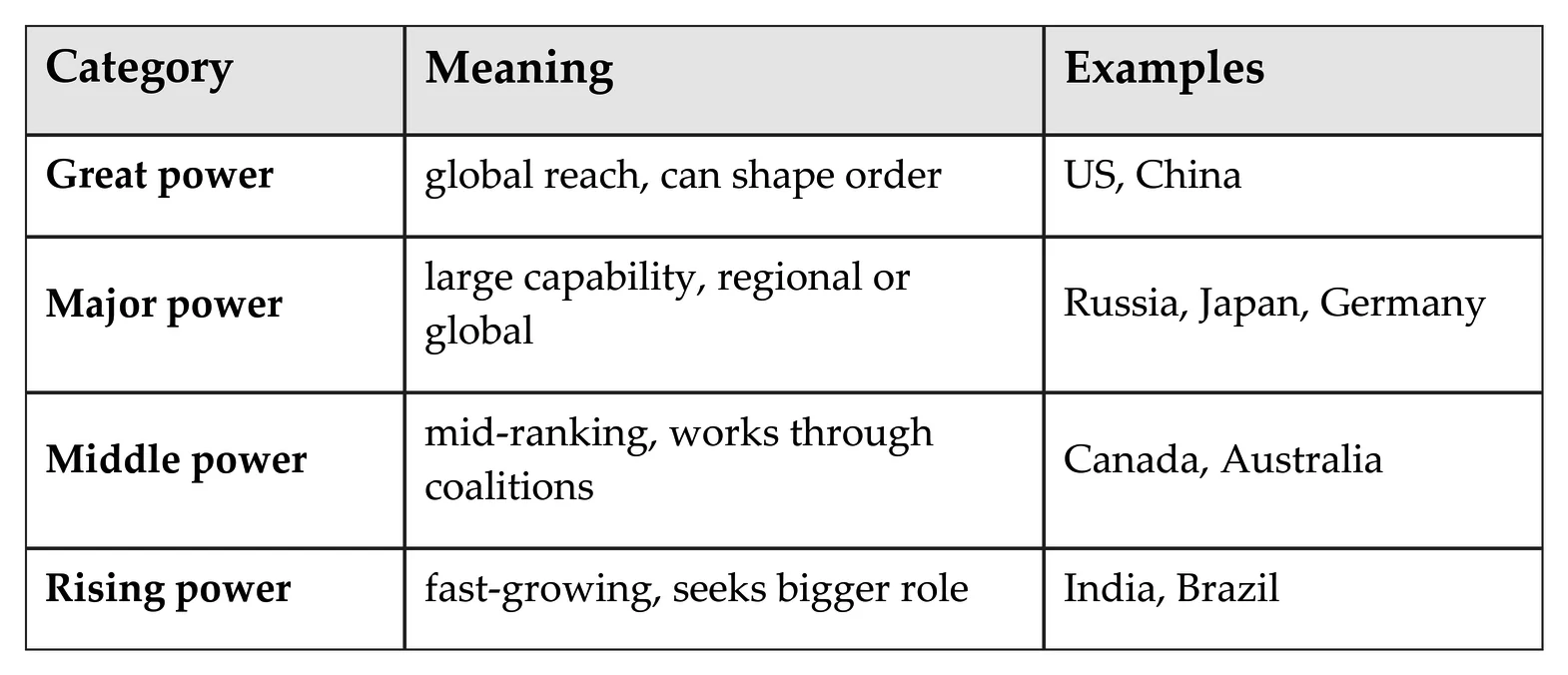
Great powers can shape the international order and fight a major war; superpowers have global reach. Middle powers, such as Canada and Australia, work through coalitions and institutions. Rising powers, such as China, India and Brazil, are growing quickly and seek a larger voice, while major powers form the wider circle of significant states. These labels are contested and change over time.

Features of Middle Power Diplomacy
- Multilateralism. Middle powers prefer working through international institutions, which give them more influence than they would have alone.
- Coalition-building. They build coalitions of like-minded states, as Canada did for the Ottawa Treaty banning landmines in 1997.
- Niche diplomacy. Gareth Evans, as Australia’s foreign minister, urged concentrating resources on areas where a middle power can make a difference, such as arms control or trade.
- Good international citizenship. Middle powers often support peacekeeping, mediation and humanitarian causes; Canada’s Lester Pearson won the Nobel Peace Prize in 1957 for proposing the UN Emergency Force in the Suez crisis.
- Roles. Andrew Cooper, Richard Higgott and Kim Nossal, in Relocating Middle Powers (1993), described middle powers as catalysts, facilitators and managers of international cooperation.
Emerging Middle Powers
Since the 2000s, scholars have distinguished traditional middle powers, such as Canada, Australia, Norway and the Netherlands, which are wealthy, stable and supportive of the liberal order, from emerging middle powers, such as Brazil, South Africa, Turkey, Indonesia and Mexico, which are regionally influential but more critical of Western dominance. In 2013, Mexico, Indonesia, South Korea, Turkey and Australia formed MIKTA, an informal partnership of middle powers. The concept is debated because it mixes material size with behaviour, and some states, such as India, are too large to fit easily into the category.
The Rise of New Powers
In 2001, Jim O’Neill of Goldman Sachs coined the term BRIC for Brazil, Russia, India and China, predicting that their economies would grow rapidly. The four began holding summits in 2009, South Africa joined in 2010, and BRICS expanded from 2024 to include Egypt, Ethiopia, Iran and the United Arab Emirates, and Indonesia in 2025. BRICS created the New Development Bank, agreed in 2014. The G20 became a leaders’ forum during the financial crisis of 2008, and during India’s presidency in 2023 the African Union became a permanent member. These changes show rising powers seeking a larger voice in global governance.
2.3 Hegemony
Hegemony means the leadership or dominance of one state over the international system. Realists see it as preponderant power, hegemonic stability theorists as leadership that provides public goods, and Gramscian scholars as rule by consent as well as coercion, through institutions and ideas. The United States has been the hegemon since 1945, but its position is now debated.

Features of Hegemony
- Preponderant power. The hegemon has the largest economy and military and can shape the rules of the system.
- Provision of public goods. Charles Kindleberger, in The World in Depression 1929–1939 (1973), argued that the Depression was so severe because Britain could no longer lead and the United States would not, so no one provided an open market, stable currency and lending in crisis.
- Order-building. Robert Gilpin, in War and Change in World Politics (1981), showed how hegemonic wars create new orders led by the victor.
- Consent and coercion. Following Antonio Gramsci’s Prison Notebooks, Robert Cox argued that hegemony combines force with consent produced by institutions and ideas that present the hegemon’s interests as universal.
- Institutions. G. John Ikenberry, in After Victory (2001), argued that the United States after 1945 bound itself within institutions, which made its power more acceptable to others.
The American Order after 1945
After the Second World War, the United States built a liberal international order. The Bretton Woods conference of 1944 created the IMF and World Bank, the GATT of 1947 promoted freer trade, the Marshall Plan of 1947 helped rebuild Europe and NATO was founded in 1949. The dollar became the world’s reserve currency. After 1991, the United States stood without a rival, intervening in the Gulf War, the Balkans and later Afghanistan and Iraq. Ikenberry, in Liberal Leviathan (2011), describes this as a hierarchical but rule-based order in which other states accepted American leadership in return for security and access to markets.
Is American Hegemony Declining
Scholars debate whether American hegemony is ending. Fareed Zakaria, in The Post-American World (2008), described the rise of the rest rather than the decline of America. Amitav Acharya, in The End of American World Order (2014), argues that the world is becoming a multiplex order, like a cinema with many films showing at once, in which no single power dominates. Others point to the financial crisis of 2008, the costs of the Iraq war, the rise of China and the United States’ own retreat from multilateral agreements. Defenders of the continuing hegemony thesis point to American military reach, technological leadership and the dominance of the dollar.
2.4 Important Questions
- Question 1 Can state power be measured? Discuss with reference to great powers and superpowers.
- Question 2 What is a middle power? Discuss its role in international relations.
- Question 3 Discuss the rise of emerging powers and its implications for the global order.
- Question 4 What is hegemony? Discuss different approaches to hegemony in international relations.
DU asks the same idea in different words. So learn one broad answer for each question below; the same answer works for every question joined by OR.
Important Question 1
Can state power be measured? Discuss with reference to great powers and superpowers.
OR
What is meant by a great power? How is it different from a superpower?
OR
Examine the problems in measuring the power of states.
Model Answer
“Their rank depends on how they score on all of the following items: size of population and territory, resource endowment, economic capability, military strength, political stability and competence.”
— Kenneth Waltz, Theory of International Politics (1979)
Introduction. International relations has always ranked states by their power, speaking of great powers, superpowers and lesser states. But measuring power is difficult, because it depends not only on resources but also on how they are used and in what context. Eric Erickson and Matteo Cesa discuss what is meant by great power and superpower, while scholars have developed indices to measure national capability.
1. Why Measure Power
Measuring power helps explain the structure of the international system, predict which states can shape outcomes and understand changes such as the rise and decline of powers.
2. Waltz’s Components
Kenneth Waltz said that a state’s rank depends on its population and territory, resources, economic capability, military strength and political stability and competence, taken together rather than separately.
3. Indices of Power
The Correlates of War project created a Composite Index of National Capability based on military spending and personnel, energy use, iron and steel production, and urban and total population. Newer indices, such as the Lowy Institute’s Asia Power Index, add diplomacy, culture and networks.
4. Comprehensive National Power
Chinese strategists developed the idea of comprehensive national power, combining economic, military, technological, cultural and diplomatic strength, an idea some trace back to Kautilya’s seven elements of the state.
5. Meaning of Great Power
A great power is a state able to contend with the strongest states in a general war and to shape the international order. Since the Congress of Vienna in 1815, great powers have been recognised as having special rights and responsibilities.
6. Erickson on Great Power and Superpower
Eric Erickson explains that a superpower has global reach in military, economic and political terms, while a great power’s influence is more limited. William T.R. Fox coined the term superpower in 1944 for the United States, the Soviet Union and Britain.
7. Cesa on Great Powers
Matteo Cesa shows that great powers are defined not only by capabilities but also by recognition from other states and by their role in managing international order, as Hedley Bull argued.
8. The Security Council
The five permanent members of the UN Security Council, the United States, Russia, China, Britain and France, were recognised as great powers in 1945, though their relative power has changed greatly since then.
9. Problems of Measurement
Measures of resources ignore how efficiently they are used, the quality of leadership and strategy, alliances, morale and legitimacy. The United States in Vietnam and the Soviet Union in Afghanistan failed despite superior resources.
10. Context Matters
Power varies with the issue: a state may be strong in military terms but weak in technology or culture. Nuclear weapons, for example, deter attack but cannot win trade disputes.
11. Polarity
The distribution of power among great powers defines the polarity of the system: multipolar before 1945, bipolar during the Cold War, unipolar after 1991, and increasingly multipolar today.
12. The Rise and Fall of Great Powers
Paul Kennedy showed that great powers rise and fall as their economic base grows or declines, and that overextension of military commitments can weaken them.
13. India’s Position
India has the world’s largest population, one of the largest economies, nuclear weapons and a large military, but it faces poverty and limited capacity, so scholars debate whether it is a great power, a rising power or both.
14. Beyond Material Measures
Many scholars now stress soft power, network position and institutional influence, which are harder to measure but increasingly important.
15. Evaluation
State power can be roughly measured through capabilities, but real power depends on context, strategy and recognition, so no index is complete.
Conclusion. Thus, state power is measured through capabilities such as population, economy and military strength, as Waltz and the Correlates of War index suggest. Erickson and Cesa distinguish great powers from superpowers and stress recognition and responsibility. Yet failures such as Vietnam show that resources do not guarantee outcomes, so power can be measured only partly.
Important Question 2
What is a middle power? Discuss its role in international relations.
OR
Examine Chapnick’s models of middle power.
OR
Discuss the role of emerging middle powers in the liberal international order.
Model Answer
“A middle power is a state whose leaders consider that it cannot act alone effectively but may be able to have a systemic impact in a small group or through an international institution.”
— Robert O. Keohane, Lilliputians’ Dilemmas (1969)
Introduction. Between the great powers and small states lie the middle powers, states with significant but limited capabilities that play distinctive roles in international relations. The concept was developed in Canada after the Second World War and later applied to Australia, South Korea and others. Adam Chapnick identified three models of middle power, and Umut Aydin has studied emerging middle powers.
1. Meaning
A middle power is a state that is neither a great power nor a small state. It has enough capability and influence to matter in international affairs but cannot shape the system alone.
2. Origin of the Idea
After 1945, Canada argued that states which contributed significantly to the war effort deserved a role in international institutions according to their capacity, an idea known as the functional principle.
3. The Hierarchical Model
The hierarchical model defines middle powers by their position in a ranking of capabilities, such as economic size, population and military strength, placing them below great powers and above small states.
4. The Functional Model
The functional model defines middle powers by their influence in particular issue areas where they have special capacity or interest, such as Canada in peacekeeping or Norway in peace mediation.
5. The Behavioural Model
The behavioural model defines middle powers by their behaviour: they prefer multilateral solutions, act as mediators and bridge-builders, and practise good international citizenship. Andrew Cooper, Richard Higgott and Kim Nossal developed this view.
6. Chapnick’s Assessment
Adam Chapnick argues that each model has weaknesses: the hierarchical model is too broad, the functional model too narrow and the behavioural model too idealistic, so the concept must be used carefully.
7. Traditional Middle Powers
Canada, Australia, the Netherlands, Norway and Sweden are often called traditional middle powers. They have supported the United Nations, peacekeeping, development aid and arms control.
8. Middle Power Diplomacy
Middle powers have led initiatives such as the Ottawa Treaty banning landmines in 1997 and the creation of the International Criminal Court, working with like-minded states and civil society.
9. Emerging Middle Powers
Umut Aydin examines emerging middle powers such as Mexico, Indonesia, South Korea, Turkey and Brazil, which grew in the 2000s. Some formed the MIKTA group in 2013 with Australia.
10. Middle Powers and the Liberal Order
Aydin shows that emerging middle powers support parts of the liberal international order, such as trade and multilateralism, but contest others, such as Western dominance of institutions, seeking reform rather than overthrow.
11. Regional Leadership
Many middle powers act as regional leaders, such as Indonesia in ASEAN, South Africa in Africa and Brazil in South America, combining regional influence with global diplomacy.
12. Is India a Middle Power
India has sometimes been called a middle power, but its size, nuclear status and ambitions make many scholars see it as a rising great power that also uses middle power methods, such as coalition-building in the G20 and BRICS.
13. Middle Powers in a Multipolar World
As great power rivalry grows, middle powers try to avoid choosing sides, hedge between powers and strengthen institutions that protect their interests.
14. Criticisms
Critics say the term is vague, that middle powers often follow great powers rather than act independently, and that good international citizenship can mask national interest.
15. Australia and Canada as Examples
Australia led the Cairns Group of agricultural exporters in trade talks from 1986 and helped create APEC in 1989, while Canada played a central role in peacekeeping and in the human security agenda of the 1990s. These examples show how middle powers use niche diplomacy, focusing on particular issues where they have expertise and credibility.
16. South Korea and Indonesia
South Korea hosted the G20 summit in 2010 and presents itself as a bridge between developed and developing countries, while Indonesia uses its leadership in ASEAN and its democratic transition to play a larger role. Both illustrate how emerging middle powers combine economic growth with active multilateral diplomacy.
17. Evaluation
Middle powers play important roles as mediators, coalition-builders and supporters of institutions, though the concept remains contested.
Conclusion. Thus, middle powers are states between great and small powers that, as Keohane noted, act through groups and institutions. Chapnick’s hierarchical, functional and behavioural models define them differently, and Aydin shows that emerging middle powers such as Indonesia, Turkey and South Korea both support and contest the liberal order.
Important Question 3
Discuss the rise of emerging powers and its implications for the global order.
OR
Examine India’s power attributes as a rising power.
OR
Is power shifting from the West to the East? Discuss.
Model Answer
“No power on earth can stop an idea whose time has come.”
— Victor Hugo, quoted by Manmohan Singh in the Union Budget speech (24 July 1991)
Introduction. Since the late twentieth century, the rapid growth of China, India, Brazil and other countries has changed the distribution of power in the world. These emerging or rising powers seek a greater voice in global institutions and challenge Western dominance. Andrew Hurrell, Jeremy Black, Sreeram Chaulia and Kishore Mahbubani examine this shift and its implications.
1. Meaning of Rising Powers
Rising or emerging powers are states whose economic, military and diplomatic capabilities are growing rapidly, giving them increasing influence and ambitions to shape the international order.
2. The Major Powers
Major powers form a wider circle of significant states, including Russia, Japan, Germany, France and Britain. Jeremy Black argues that rivalry among major powers is returning as a central feature of world politics.

3. Hurrell on Rising Powers
Andrew Hurrell argues that rising powers seek greater status and voice, demand reform of institutions such as the IMF and the Security Council, and form new coalitions, but they also differ among themselves and depend on the existing order.
4. BRICS
The idea of BRIC was coined in 2001, the first summit was held in 2009 and South Africa joined in 2010. BRICS created the New Development Bank in 2014 and expanded its membership in 2024.
5. Other Coalitions
Rising powers have also formed IBSA (India, Brazil, South Africa) in 2003, the BASIC group in climate talks in 2009 and coalitions at the WTO, using collective bargaining to increase their influence.
6. China’s Rise
China has become the world’s second largest economy and a major military power, launched the Belt and Road Initiative in 2013 and created the Asian Infrastructure Investment Bank, challenging US leadership.
7. Chaulia on India’s Power
Sreeram Chaulia identifies India’s power attributes, such as its large economy, population, military, nuclear capability, democracy, diaspora and culture, while noting constraints such as poverty, weak state capacity and a difficult neighbourhood.
8. India’s Rise
Since the reforms of 1991, India’s economy has grown rapidly, making it one of the largest in the world. It hosted the G20 in 2023 and seeks permanent membership of the Security Council.
9. Mahbubani’s Asian Hemisphere
Kishore Mahbubani argues that global power is shifting irresistibly to Asia, as Asian societies adopt modern education, markets and technology, and that the West must share power in global institutions.
10. Power Transition Theory
A.F.K. Organski’s power transition theory holds that the risk of war is greatest when a rising challenger approaches the strength of a dissatisfied dominant power. Graham Allison called this risk the Thucydides Trap.
11. Revisionism and the Status Quo
Oliver Turner and Nicola Nymalm show that Western narratives often present rising powers as revisionist threats and established powers as defenders of progress, a framing that rising powers reject.
12. Reform of Institutions
Rising powers have won some reforms, such as changes in IMF voting shares agreed in 2010, but Security Council reform has stalled, fuelling frustration.
13. Limits of Rising Powers
Rising powers face domestic problems, rivalries among themselves, such as between India and China, and dependence on Western markets and technology, which limit their ability to reshape the order.
14. A Multipolar Order
Many scholars expect a multipolar or multiplex world, with several centres of power, regional orders and overlapping institutions rather than a single hegemon.
15. Russia as a Resurgent Power
Russia, though economically smaller than China, has used military power, energy exports and its Security Council veto to reassert itself, as in Georgia in 2008, Crimea in 2014 and the war in Ukraine from 2022. Its conduct shows that a state may challenge the existing order through force even without rising economic strength.
16. India and Strategic Autonomy
As a rising power, India pursues strategic autonomy, building partnerships with the United States, Japan and Australia through the Quad while maintaining ties with Russia and taking part in BRICS and the Shanghai Cooperation Organisation. This multi-alignment reflects India’s wish to rise without becoming dependent on any single power.
17. Evaluation
The rise of emerging powers is shifting power towards Asia and the global South, but the future order will depend on how established and rising powers manage their rivalry.
Conclusion. Thus, rising powers such as China, India and Brazil are changing the global order, forming BRICS, IBSA and BASIC and demanding institutional reform, as Hurrell shows. Chaulia outlines India’s attributes and constraints, Mahbubani sees a shift to Asia, and power transition theory warns of rivalry, making the management of change crucial.
Important Question 4
What is hegemony? Discuss different approaches to hegemony in international relations.
OR
Examine the theory of hegemonic stability.
OR
Discuss the Gramscian understanding of hegemony in international relations.
Model Answer
“The normal exercise of hegemony is characterised by the combination of force and consent, which balance each other reciprocally, without force predominating excessively over consent.”
— Antonio Gramsci, Prison Notebooks
Introduction. Hegemony refers to the predominance of one state or group in the international system. It is one of the most important concepts for understanding world order, but it has several meanings. Andreas Antoniades distinguishes approaches that see hegemony as domination, as leadership and as consent, while Ian Clark, G. John Ikenberry and Charles Kupchan offer further insights.
1. Meaning
The word hegemony comes from the Greek hegemonia, meaning leadership. In international relations, it refers to a situation in which one state is powerful enough to shape the rules and order of the system.
2. Antoniades’s Three Meanings
Andreas Antoniades shows that hegemony is understood in different ways: as dominance based on material preponderance, as leadership that provides order and public goods, and as a form of rule based on consent and shared ideas.
3. Realist View
Realists see hegemony as the preponderance of power of one state. Mearsheimer argues that great powers seek regional hegemony and that global hegemony is almost impossible because of the difficulty of projecting power across oceans.
4. Hegemonic Stability Theory
Charles Kindleberger argued that the Great Depression of the 1930s worsened because no state was willing to lead the world economy. Hegemonic stability theory holds that an open world economy needs a hegemon to provide stability, as Britain did in the nineteenth century and the United States after 1945.
5. Gilpin and Keohane
Robert Gilpin linked hegemony with cycles of rise and decline, while Robert Keohane, in After Hegemony (1984), argued that institutions can sustain cooperation even after a hegemon declines.
6. Gramscian Hegemony
Antonio Gramsci described hegemony as rule through a combination of force and consent, in which the ruling class’s ideas become common sense. Robert Cox applied this idea to world order, showing how dominant states and classes shape global institutions.
7. Institutions and Ideas
In the Gramscian view, US hegemony after 1945 rested not only on military power but also on institutions such as the UN, the IMF and the World Bank, and on ideas of free trade and liberal democracy accepted by elites elsewhere.
8. Ikenberry and Kupchan on Socialisation
G. John Ikenberry and Charles Kupchan argued that hegemonic power works most effectively when elites in other states internalise the hegemon’s norms, a process of socialisation that often follows wars or crises.
9. Clark on Hegemony in International Society
Ian Clark, from the English School, argues that hegemony can be an institution of international society when the hegemon’s leadership is recognised as legitimate by other states, not merely imposed.
10. US Hegemony
After the Cold War ended in 1991, the United States enjoyed what Charles Krauthammer called a unipolar moment, with unmatched military, economic and cultural power.
11. Decline Debate
Wars in Iraq and Afghanistan, the financial crisis of 2008 and the rise of China have led many to argue that US hegemony is declining, while others stress its continuing strength in technology, finance and alliances.
12. Counter-Hegemony
Gramscian scholars speak of counter-hegemony, the efforts of social movements and states of the global South to challenge dominant ideas and institutions and build alternatives.
13. Chinese Hegemony
Some fear that China seeks regional hegemony in Asia, while China presents its rise as peaceful and its initiatives as cooperative, illustrating the struggle over the meaning and legitimacy of hegemony.
14. India’s View
India has generally opposed hegemony by any single power, favouring a multipolar world and strategic autonomy, though it has deepened ties with the United States.
15. Benevolent and Coercive Hegemony
Scholars distinguish benevolent hegemony, in which the leader bears costs to provide public goods such as open markets and security, from coercive hegemony, in which it extracts benefits from others. US leadership after 1945, with the Marshall Plan and open markets, is often called benevolent, though critics stress its interventions and support for authoritarian allies.
16. Regional Hegemony
Hegemony also exists at the regional level. The United States has been the dominant power in the Western Hemisphere since the Monroe Doctrine of 1823, and India’s size gives it a predominant position in South Asia. Smaller neighbours often fear regional hegemons and seek outside partners to balance them.
17. Evaluation
Hegemony combines material dominance with leadership and consent, and its future depends on legitimacy as much as on power.
Conclusion. Thus, hegemony may mean domination, as realists argue, leadership providing public goods, as in hegemonic stability theory, or rule by consent, as Gramsci and Cox show. Antoniades distinguishes these meanings, while Ikenberry and Kupchan stress socialisation and Clark legitimacy. US hegemony since 1945 now faces debate over its decline.
Short Notes
(a) Superpower
A state with global military, economic and political reach, a term coined by William T.R. Fox in 1944.
(b) Behavioural model of middle power
The view that middle powers are defined by their preference for multilateralism, mediation and good international citizenship.
(c) Hegemonic stability theory
The theory that an open and stable world economy requires a dominant state willing to provide leadership and public goods.
More notes: DSE-15 Power Dilemmas in International Relations
These notes are prepared by PADHO TO AISE for study help. They are not an official University of Delhi publication.