
Semester VII DSE-9 Contemporary Political Economy
Unit II · 18 min read · Updated 24 Nov 2026
As per the University of Delhi (DU) BA (Hons) Political Science syllabus
Contents
- 2.1 From Feudalism to Capitalism
- 2.2 Capitalism in the Global South
- 2.3 Globalisation: TNCs, the WTO and INGOs
- 2.4 Important Questions
- Discuss the transition from feudalism to capitalism in Europe.
- Discuss the nature of capitalism in the global South.
- Discuss globalisation and the role of transnational corporations.
- Discuss the role of the World Trade Organization and international non-governmental organisations in globalisation.
- Short Notes
जो कुछ भी ठोस है, वह हवा में घुल जाता है।
All that is solid melts into air.
— Karl Marx and Friedrich Engels, The Communist Manifesto (1848)
CAPITALISM did not always exist. It emerged in Europe from the decline of feudalism, through changes in agriculture, trade, cities and class relations, and then spread across the world through colonialism, trade and investment. In the global South, capitalism took distinct forms shaped by colonial rule and dependence. Today, globalisation links economies through transnational corporations, the World Trade Organization and international non-governmental organisations. This chapter traces this transformation, drawing on Meenaxi Phukan, Robert Gilpin, Paul Kennedy, Kamta Prasad and Julie Fisher.

2.1 From Feudalism to Capitalism
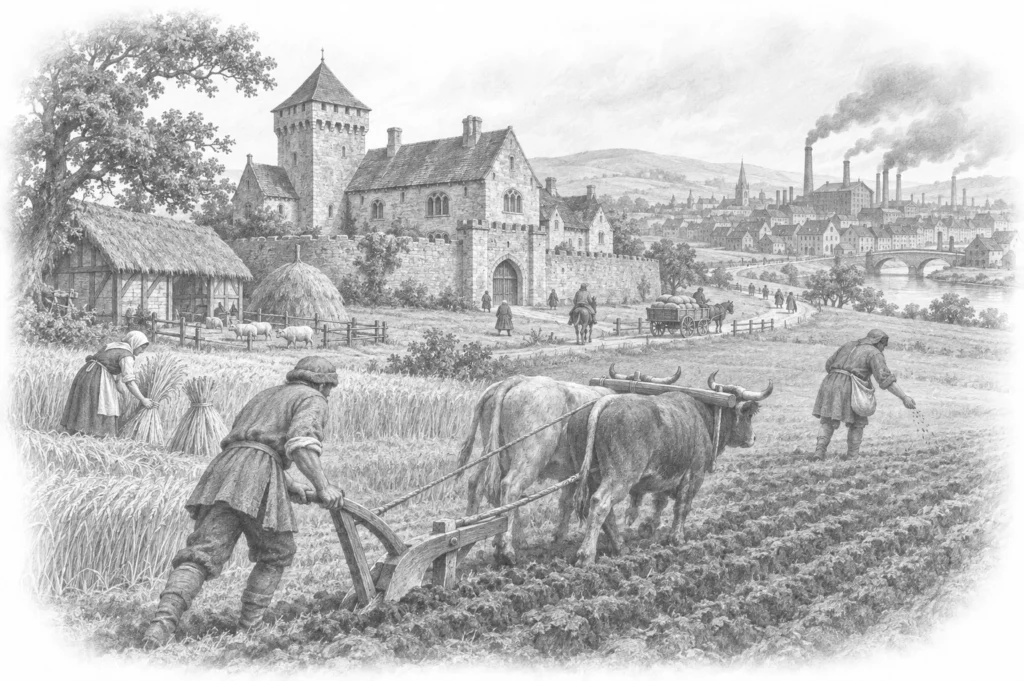
Feudalism in medieval Europe was a system in which lords controlled land and extracted labour, produce or rent from serfs bound to the land. From the fourteenth century, plague, peasant revolts, the growth of trade and towns, the enclosure of common land and the influx of American silver transformed this system. Peasants lost access to land and became wage labourers, while merchants and landowners accumulated capital. By the eighteenth century, capitalism, production for profit using wage labour, had emerged, leading to the industrial revolution. Meenaxi Phukan traces this social and economic history of early modern Europe.
2.2 Capitalism in the Global South
In Asia, Africa and Latin America, capitalism arrived largely through colonialism, which turned colonies into suppliers of raw materials and markets for manufactures. Dependency theorists argued that this created underdevelopment, and Immanuel Wallerstein described a world-system divided into core, semi-periphery and periphery. After independence, countries tried import substitution, and East Asian developmental states achieved rapid growth through state-guided exports. Robert Gilpin analyses how power shapes the global economy.

2.3 Globalisation: TNCs, the WTO and INGOs
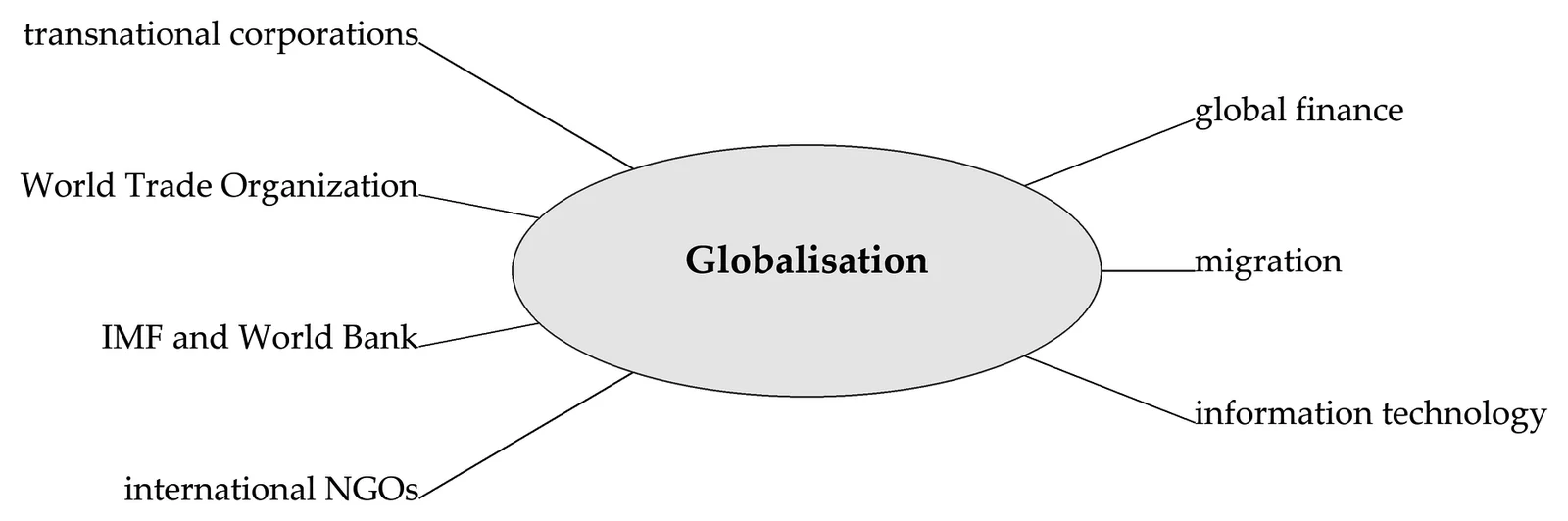
Globalisation is the growing interconnection of economies and societies through trade, investment, finance, migration and communication. Transnational corporations organise production across countries through global value chains, as Paul Kennedy describes. The World Trade Organization, created in 1995, sets rules for international trade. International non-governmental organisations, studied by Kamta Prasad and Julie Fisher, campaign, deliver services and shape global norms.
2.4 Important Questions
- Question 1 Discuss the transition from feudalism to capitalism in Europe.
- Question 2 Discuss the nature of capitalism in the global South.
- Question 3 Discuss globalisation and the role of transnational corporations.
- Question 4 Discuss the role of the World Trade Organization and international non-governmental organisations in globalisation.
DU asks the same idea in different words. So learn one broad answer for each question below; the same answer works for every question joined by OR.
Important Question 1
Discuss the transition from feudalism to capitalism in Europe.
OR
Examine the main features of European feudalism and the causes of its decline.
OR
Discuss the debates on the origins of capitalism.
Model Answer
“If money comes into the world with a congenital blood-stain on one cheek, capital comes dripping from head to foot, from every pore, with blood and dirt.”
— Karl Marx, Capital, Volume I (1867)
Introduction. The transition from feudalism to capitalism in Europe between the fourteenth and eighteenth centuries was one of the most important transformations in human history. It changed how people worked, how wealth was produced and how societies were governed. Historians and political economists have debated its causes, from internal class struggles to the expansion of trade and colonialism.
1. Features of Feudalism
Feudalism was based on land. Lords held estates, or manors, granted by superior lords or kings in return for military service. Serfs were bound to the land and owed labour, produce or rent to their lords, who held judicial and political power over them. The Church was a major landowner.
2. Phukan on Early Modern Europe
Meenaxi Phukan, in The Rise of the Modern West (1998), traces the social and economic history of early modern Europe: agrarian change, the growth of commerce and towns, the price revolution, the rise of a bourgeoisie and the formation of states, which together produced capitalism.
3. The Crisis of Feudalism
The Black Death of 1347–51 killed perhaps a third of Europe’s population, creating labour shortages that strengthened peasants against lords. Peasant revolts, such as the English rising of 1381, and the decline of serfdom in western Europe followed.
4. Trade and Towns
The revival of long-distance trade and the growth of towns created a class of merchants and artisans outside feudal relations. Towns won charters of self-government, and markets expanded.
5. The Dobb–Sweezy Debate
In the 1950s, Maurice Dobb argued that feudalism declined because of internal class struggle between lords and peasants, while Paul Sweezy emphasised the external force of trade and markets. This debate shaped later historical research.
6. The Brenner Debate
Robert Brenner argued in 1976 that the different outcomes of feudal crisis in England and France depended on class relations in agriculture. In England, landlords and tenant farmers produced for the market, laying the basis for agrarian capitalism.
7. Enclosure and Primitive Accumulation
The enclosure of common land in England drove peasants off the land, creating a class of propertyless workers who had to sell their labour. Marx called this primitive accumulation, the violent separation of producers from the means of production.
8. The Price Revolution and Colonies
The flow of silver from Spanish America in the sixteenth century caused rising prices, weakening landlords on fixed rents and enriching merchants. Colonial trade in sugar, spices and slaves generated vast profits.
9. Weber and the Protestant Ethic
Max Weber, in The Protestant Ethic and the Spirit of Capitalism (1905), argued that Calvinist ideas of disciplined work and saving encouraged the rational accumulation of capital, linking culture to economic change.
10. The Industrial Revolution
From the late eighteenth century, Britain’s industrial revolution, based on factories, steam power and wage labour, completed the transition to industrial capitalism and spread to other countries.
11. The State and Capitalism
Absolutist states and mercantilist policies helped capitalism by creating national markets, protecting trade and building colonial empires, while later liberal states protected private property and contracts.
12. Capitalism and Slavery
Eric Williams, in Capitalism and Slavery (1944), argued that profits from the Atlantic slave trade and plantations helped finance British industrialisation, showing that capitalism’s rise was linked to colonial exploitation.
13. Polanyi’s Great Transformation
Karl Polanyi, in The Great Transformation (1944), argued that the market society of the nineteenth century disembedded the economy from social relations, turning land, labour and money into commodities, and provoked a counter-movement for social protection.
14. The Putting-Out System
Before factories, merchants organised rural households to spin and weave at home, supplying raw materials and selling the finished cloth. This putting-out system, sometimes called proto-industrialisation, spread wage work into the countryside, gave merchants control over production and prepared the way for the factory system of the industrial revolution.
15. The Second Serfdom
The transition was not uniform. While serfdom declined in western Europe, in eastern Europe, in Poland, Prussia and later Russia, lords tightened control over peasants from the sixteenth century to produce grain for western markets. This second serfdom shows that the growth of trade could strengthen unfree labour as well as weaken it, depending on class power.
16. Evaluation
The transition to capitalism resulted from internal class changes, trade, state policies and colonialism. Its history explains both the dynamism and the inequalities of the modern world.
Conclusion. Thus, European feudalism, based on lords, serfs and manors, declined through plague, peasant struggles, trade, enclosures and colonial wealth, as Phukan and others show. Debated by Dobb, Sweezy and Brenner, the transition produced wage labour and production for profit, culminating in industrial capitalism.
Important Question 2
Discuss the nature of capitalism in the global South.
OR
Examine dependency and world-systems theories of underdevelopment.
OR
How did colonialism shape capitalist development in the global South?
Model Answer
“The essence of neo-colonialism is that the State which is subject to it is, in theory, independent and has all the outward trappings of international sovereignty. In reality its economic system and thus its political policy is directed from outside.”
— Kwame Nkrumah, Neo-Colonialism (1965)
Introduction. Capitalism developed differently in the global South, the former colonies of Asia, Africa and Latin America. It arrived largely through colonial rule, which integrated these regions into the world economy as suppliers of raw materials and markets for manufactures. Scholars have debated whether capitalism brings development or underdevelopment to the South, and how states can promote growth.
1. Colonial Incorporation
Colonial powers reorganised colonial economies to serve their own needs: plantations, mines and cash crops for export, with infrastructure built to move raw materials to ports rather than to develop local industry.
2. Deindustrialisation and Drain
In India, cheap British textiles destroyed much of the handloom industry, and Dadabhai Naoroji’s drain theory argued that British rule transferred wealth from India to Britain through salaries, profits and charges.
3. Modernisation Theory
After decolonisation, modernisation theorists such as W.W. Rostow, in The Stages of Economic Growth (1960), argued that all countries pass through stages from traditional society to mass consumption, and that the South could develop by following the path of the West.
4. Dependency Theory
Dependency theorists, such as Raúl Prebisch and Andre Gunder Frank, argued that the South was underdeveloped because of its dependent position in the world economy. Declining terms of trade for primary products and the outflow of profits kept it poor, a process Frank called the development of underdevelopment.
5. World-Systems Theory
Immanuel Wallerstein described a capitalist world-system divided into a core of rich industrial states, a periphery supplying raw materials and cheap labour, and a semi-periphery in between. Countries can move between these zones, but the system reproduces inequality.
6. Neo-colonialism
Kwame Nkrumah argued that formally independent states remained economically controlled by former colonial powers and multinational firms, a condition he called neo-colonialism.
7. Import Substitution
Many countries, including India, pursued import-substituting industrialisation, protecting domestic industry and building public sectors. This created industrial bases but often led to inefficiency and slow growth.
8. East Asian Developmental States
Japan, South Korea and Taiwan achieved rapid growth through developmental states that guided investment, protected infant industries and promoted exports. Chalmers Johnson described Japan’s Ministry of International Trade and Industry as a model.
9. Debt Crisis and Adjustment
In the 1980s, many Latin American and African countries faced debt crises and adopted structural adjustment programmes, which liberalised economies but often increased poverty in the short term.
10. Gilpin’s Global Political Economy
Robert Gilpin, in Global Political Economy (2001), argues that markets operate within a political framework set by powerful states. The uneven growth of national economies changes the distribution of power, and developing countries must manage their integration carefully.
11. The Rise of China and India
China and India became major economies through different paths: China through state-guided export manufacturing and India through services and gradual liberalisation. The BRICS grouping, which held its first summit in 2009, reflects the South’s growing weight.
12. Persistent Problems
Capitalism in the South is marked by large informal sectors, inequality, dependence on commodity exports in many countries and vulnerability to global financial shocks.
13. Debates
Critics of dependency theory point to the success of East Asia as evidence that integration can bring development, while dependency theorists note that few countries have escaped the periphery.
14. Commodity Dependence in Africa
Many African economies still depend on exports of a few primary commodities, such as oil, copper, cocoa or coffee, a pattern inherited from colonial rule. When world prices fall, government revenues and incomes collapse. This commodity dependence, along with weak industrial bases and heavy debts, illustrates the continuing relevance of dependency arguments about the unequal structure of the world economy.
15. Evaluation
Capitalism in the global South was shaped by colonialism and dependence, but state strategies have produced different outcomes, from stagnation to rapid growth.
Conclusion. Thus, capitalism came to the global South through colonialism, which produced dependent, export-oriented economies. Dependency and world-systems theories explain underdevelopment, while East Asian developmental states and the rise of China and India show that state strategies matter, as Gilpin argues.
Important Question 3
Discuss globalisation and the role of transnational corporations.
OR
Examine the impact of transnational corporations on developing countries.
OR
Discuss Paul Kennedy’s account of the rise of the multinational corporation.
Model Answer
“Globalisation can thus be defined as the intensification of worldwide social relations which link distant localities in such a way that local happenings are shaped by events occurring many miles away and vice versa.”
— Anthony Giddens, The Consequences of Modernity (1990)
Introduction. Globalisation refers to the growing interconnection of economies and societies across the world. Transnational corporations, firms that produce and sell in many countries, are among its most powerful agents. They bring investment, technology and jobs, but also raise concerns about exploitation, tax avoidance and the erosion of state sovereignty.
1. Meaning of Globalisation
Globalisation involves the expansion of trade, investment, finance, migration, communication and culture across borders. Anthony Giddens describes it as the intensification of worldwide social relations linking distant places.
2. Drivers
Advances in transport and information technology, the liberalisation of trade and investment, the end of the Cold War and the growth of global finance drove globalisation from the 1980s.
3. Transnational Corporations
Transnational corporations have headquarters in one country and operations in many others. They organise global value chains in which different stages of production, design, manufacturing and assembly take place in different countries.
4. Kennedy on Multinationals
Paul Kennedy, in Preparing for the Twenty-First Century (1993), describes how the global financial and communications revolution allowed multinational corporations to move capital and production across borders rapidly, reducing the control of national governments over their economies.
5. Size and Power
The revenues of the largest corporations exceed the national income of many countries. Their economic power gives them influence over governments, which compete to attract their investment.
6. Benefits for Host Countries
Foreign direct investment brings capital, technology, management skills, jobs and access to export markets. Many developing countries, including India, have used it to build industries and services.
7. Costs
Critics argue that corporations repatriate profits, avoid taxes through transfer pricing, crowd out local firms and exploit cheap labour. The collapse of the Rana Plaza garment factory in Bangladesh in 2013, which killed over a thousand workers, exposed conditions in global supply chains.
8. Environmental and Human Rights Harms
The Bhopal gas tragedy of 1984 at a Union Carbide plant, which killed thousands, became a symbol of corporate irresponsibility. Mining and oil companies have been accused of environmental damage and abuses.
9. Corporations and Sovereignty
Competition for investment can produce a race to the bottom in wages, taxes and regulation. Corporations can also influence policy through lobbying and investment treaties.
10. Regulation
The UN Guiding Principles on Business and Human Rights (2011) set out corporate responsibilities, and in 2021 over 130 countries agreed through the OECD on a global minimum corporate tax rate of 15 per cent.
11. Indian Corporations
Indian firms such as Tata, Infosys and Reliance have become transnational, investing abroad and acquiring foreign companies, showing that the South also produces global corporations.
12. Debates on Globalisation
David Held and Anthony McGrew distinguish hyperglobalists, who see a borderless world; sceptics, who see continued national control; and transformationalists, who see a complex reshaping of state power.
13. Resistance
Protests against the WTO meeting in Seattle in 1999 and the World Social Forum, first held in Porto Alegre in 2001, expressed opposition to corporate globalisation and called for alternatives.
14. Financial Globalisation
Alongside trade and production, finance has become globalised. Capital flows rapidly across borders through banks, investment funds and currency markets. This brings investment but also instability: the Asian financial crisis of 1997 and the global financial crisis of 2008 showed how sudden capital flight and financial speculation can damage economies far from their origin.
15. Evaluation
Transnational corporations drive globalisation, bringing both opportunities and serious costs. Effective regulation is needed to ensure that they serve development and human rights.
Conclusion. Thus, globalisation has intensified worldwide connections, with transnational corporations as key agents organising global production, as Paul Kennedy describes. They bring investment and technology but also exploitation, tax avoidance and threats to sovereignty, making regulation and accountability essential.
Important Question 4
Discuss the role of the World Trade Organization and international non-governmental organisations in globalisation.
OR
Critically examine the role of the WTO in the global economy.
OR
Examine the role of international NGOs in development, with reference to Prasad and Fisher.
Model Answer
“Relations in the field of trade and economic endeavour should be conducted with a view to raising standards of living, ensuring full employment and a large and steadily growing volume of real income and effective demand.”
— Marrakesh Agreement Establishing the World Trade Organization (1994), Preamble
Introduction. Globalisation is governed not only by markets and corporations but also by international institutions and civil society. The World Trade Organization sets the rules of international trade, while international non-governmental organisations campaign on development, human rights and the environment and deliver services. Both shape the global political economy, though in very different ways.
1. Bretton Woods
At Bretton Woods in 1944, the Allied powers created the International Monetary Fund and the World Bank. A planned International Trade Organization failed, and instead the General Agreement on Tariffs and Trade was signed in 1947.
2. GATT Rounds
Under GATT, successive rounds of negotiations reduced tariffs on manufactured goods. The Uruguay Round of 1986–94 extended rules to services, intellectual property and agriculture and created the WTO.

3. The WTO
The WTO was established on 1 January 1995. Its principles include most-favoured-nation treatment, under which concessions to one member apply to all, and national treatment, under which imported goods are treated like domestic ones.
4. Agreements
WTO agreements cover trade in goods, services (GATS), intellectual property (TRIPS) and agriculture, along with a binding dispute settlement system that makes the WTO stronger than GATT.
5. Dispute Settlement Crisis
The WTO’s Appellate Body ceased to function in December 2019, after the United States blocked the appointment of new members, weakening the enforcement of trade rules.
6. Developing Countries
The Doha Development Round, launched in 2001, aimed to address developing countries’ concerns but stalled over agricultural subsidies in rich countries. India has defended its public stockholding of food grains for food security.
7. TRIPS and Medicines
The TRIPS agreement required strong patent protection, raising fears about access to medicines. The Doha Declaration of 2001 affirmed countries’ right to protect public health. In 2013, India’s Supreme Court upheld Section 3(d) of the Patents Act in the Novartis case, preventing evergreening of patents.
8. Criticisms of the WTO
Critics argue that the WTO favours rich countries and corporations, that negotiations are dominated by major powers and that trade rules limit developing countries’ policy space.
9. International NGOs
International non-governmental organisations are non-profit, non-state bodies that operate across borders, such as Oxfam (1942), Amnesty International (1961), Greenpeace (1971) and Médecins Sans Frontières (1971).
10. Roles of INGOs
INGOs advocate for policy change, deliver relief and development services, monitor governments and corporations and help create international norms on human rights and the environment.
11. Prasad and Fisher on NGOs
Kamta Prasad examines the role of NGOs in socio-economic development, while Julie Fisher, in Nongovernments (1998), shows how grassroots organisations and the support organisations that serve them strengthen civil society and democracy in the Third World.
12. INGOs and Global Governance
The International Campaign to Ban Landmines helped bring about the Ottawa Treaty of 1997 and won the Nobel Peace Prize, showing how INGOs can shape international law.
13. Criticisms of INGOs
INGOs are criticised for limited accountability, Northern bias and dependence on donors. Some governments, including India through amendments to its foreign contribution law in 2020, have restricted foreign funding of NGOs.
14. India and the WTO
India has used the WTO to defend developing countries’ interests, especially on agriculture, food security and access to medicines, often leading coalitions of developing countries. At the ministerial conference of 2022, members agreed on rules to curb harmful fisheries subsidies, and India has resisted binding rules on e-commerce that it fears would limit its digital policy space.
15. Evaluation
The WTO and INGOs represent two sides of global governance: rule-making for markets and civil society advocacy. Both shape globalisation and face questions of fairness and accountability.
Conclusion. Thus, the WTO, created in 1995, governs world trade through binding rules and dispute settlement, though it is criticised for favouring rich countries and now faces crisis. International NGOs, as Prasad and Fisher show, promote development, rights and civil society, while facing questions of accountability and state restrictions.
Short Notes
(a) Primitive accumulation
Marx’s term for the historical process, such as the enclosure of common land, through which producers were separated from the means of production, creating a class of wage labourers and concentrating wealth in the hands of capitalists.
(b) World-system
Immanuel Wallerstein’s concept of a single capitalist world economy divided into core, semi-periphery and periphery, in which unequal exchange reproduces inequality between regions.
(c) Most-favoured-nation principle
A core WTO rule under which any trade advantage given by a member to one country must be extended to all other members, preventing discrimination among trading partners.
More notes: DSE-9 Contemporary Political Economy
These notes are prepared by PADHO TO AISE for study help. They are not an official University of Delhi publication.