
Semester VII DSE-9 Contemporary Political Economy
Unit I · 22 min read · Updated 24 Nov 2026
As per the University of Delhi (DU) BA (Hons) Political Science syllabus
Contents
- 1.1 The Meaning of Political Economy
- 1.2 Classical Liberalism and Marxism
- 1.3 Welfarism and Neo-liberalism
- 1.4 The Gandhian Approach
- 1.5 Important Questions
- Discuss the classical liberal approach to political economy.
- Discuss the Marxist approach to political economy.
- Discuss the welfarist approach to political economy and the rise of the welfare state.
- Discuss neo-liberalism as an approach to political economy.
- Discuss the Gandhian approach to political economy.
- Short Notes
हम अपने भोजन की आशा कसाई, शराब बनाने वाले या नानबाई की उदारता से नहीं, बल्कि उनके अपने हित की चिंता से करते हैं।
It is not from the benevolence of the butcher, the brewer, or the baker that we expect our dinner, but from their regard to their own interest.
— Adam Smith, The Wealth of Nations (1776)
POLITICAL economy studies how politics and economics shape each other: how states, markets and classes interact, and who gets what. Over three centuries, thinkers have offered rival approaches. Classical liberalism trusted free markets; Marxism exposed capitalist exploitation; welfarism gave the state responsibility for citizens’ well-being; neo-liberalism revived faith in markets after the 1970s; and the Gandhian approach proposed a moral economy of self-reliant villages. This chapter explains these approaches, drawing on Anthony Arblaster and Deepak Lal, Ernest Mandel, Kees van Kersbergen and Philip Manow, David Harvey and B.N. Ghosh.
1.1 The Meaning of Political Economy
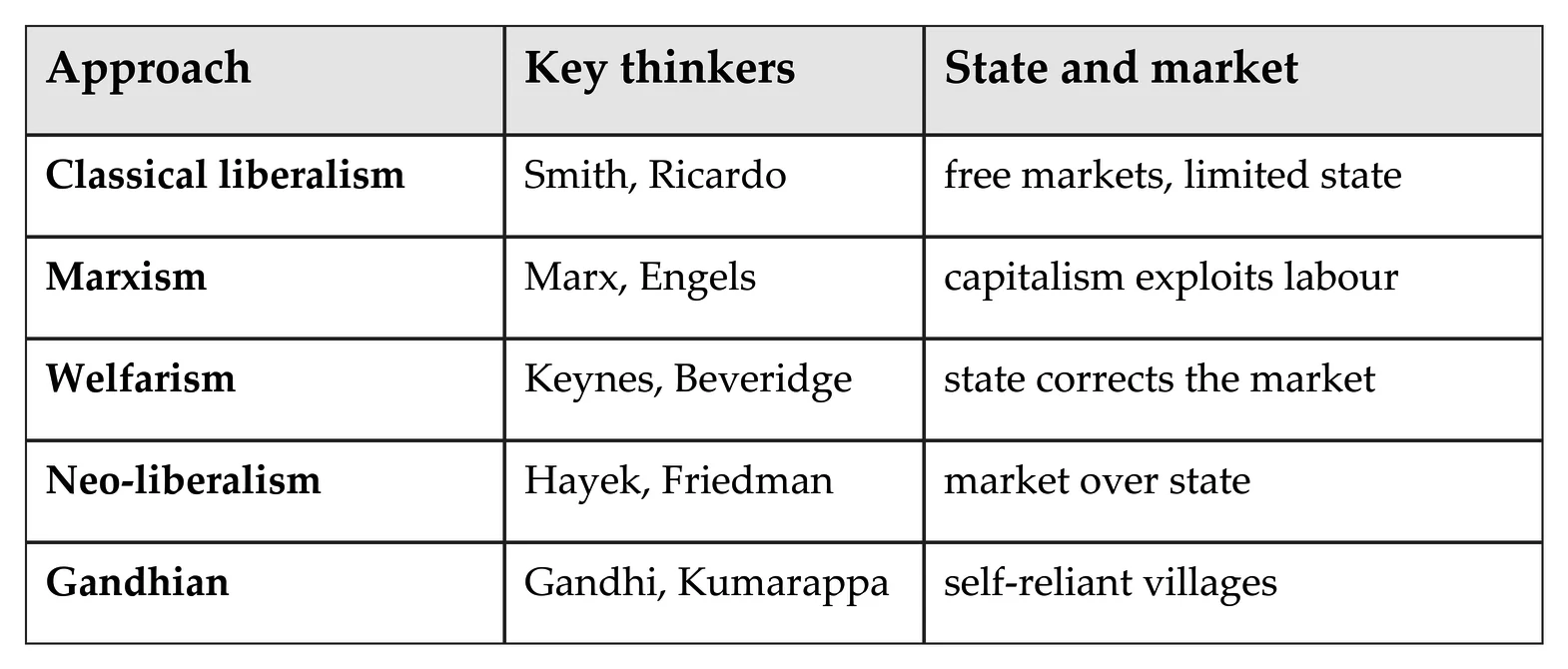
Political economy examines the relationship between the state and the market, between power and wealth. It asks how economic arrangements shape politics, how governments shape economies and how resources and power are distributed among classes, groups and countries. Each approach to political economy rests on a different view of human nature, the market and the role of the state.
1.2 Classical Liberalism and Marxism
Classical liberalism, founded by Adam Smith and David Ricardo, argued that free markets, guided by self-interest and competition, produce prosperity, and that the state should be limited to defence, justice and public works. Marxism argued that capitalism is based on the exploitation of labour, produces class conflict and crises, and will be replaced by socialism. Ernest Mandel gives a clear introduction to Marxist economic theory.
1.3 Welfarism and Neo-liberalism
Welfarism holds that the state must protect citizens from poverty, unemployment, sickness and old age. Inspired by Keynes and the Beveridge Report, welfare states expanded after 1945, taking different forms that Gøsta Esping-Andersen called three worlds of welfare capitalism. From the 1970s, neo-liberalism, inspired by Hayek and Friedman, sought to roll back the state through privatisation, deregulation and free trade. David Harvey sees it as a project to restore the power of economic elites.
1.4 The Gandhian Approach
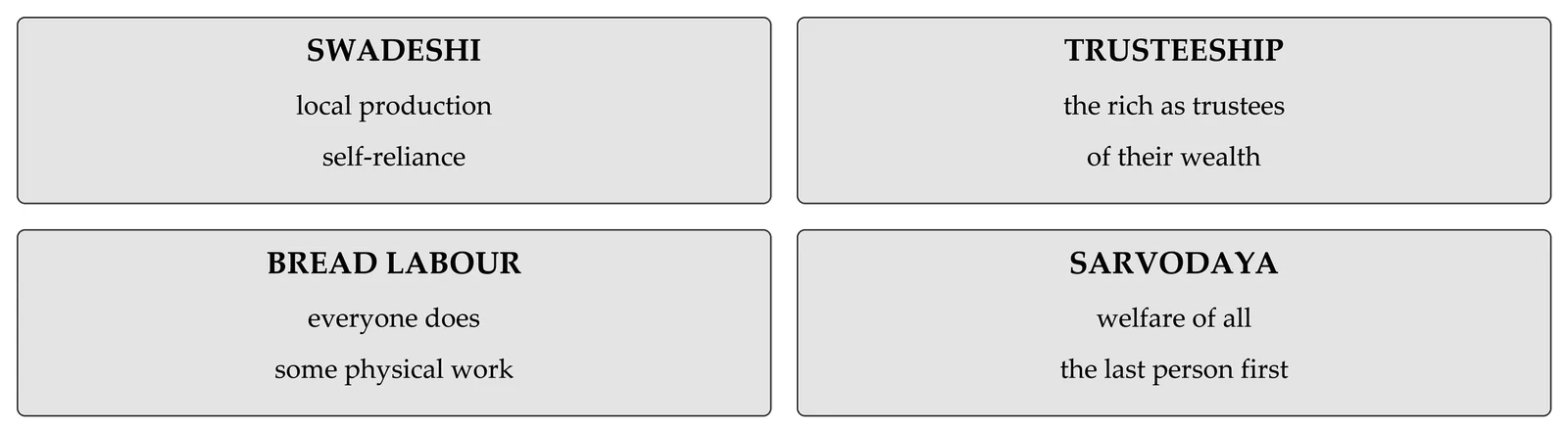
The Gandhian approach rejects both capitalism and state socialism. Gandhi criticised modern industrial civilisation for multiplying wants and destroying village life, and proposed swadeshi, decentralised production, trusteeship, bread labour and sarvodaya, the welfare of all. B.N. Ghosh sets out the principles of Gandhian political economy and their relevance to contemporary problems of inequality and environmental destruction.
1.5 Important Questions
- Question 1 Discuss the classical liberal approach to political economy.
- Question 2 Discuss the Marxist approach to political economy.
- Question 3 Discuss the welfarist approach to political economy and the rise of the welfare state.
- Question 4 Discuss neo-liberalism as an approach to political economy.
- Question 5 Discuss the Gandhian approach to political economy.
DU asks the same idea in different words. So learn one broad answer for each question below; the same answer works for every question joined by OR.
Important Question 1
Discuss the classical liberal approach to political economy.
OR
Examine Adam Smith’s idea of the invisible hand and the minimal state.
OR
Critically evaluate classical liberalism as an approach to political economy.
Model Answer
“He intends only his own gain, and he is in this, as in many other cases, led by an invisible hand to promote an end which was no part of his intention.”
— Adam Smith, The Wealth of Nations (1776)
Introduction. Classical liberalism is the earliest modern approach to political economy. Developed by Adam Smith, David Ricardo and others in the late eighteenth and early nineteenth centuries, it argued that free markets, guided by individual self-interest and competition, produce wealth and harmony, and that the state should interfere as little as possible in economic life. It shaped the rise of industrial capitalism and remains influential today.
1. Meaning of Political Economy
Political economy studies the relationship between politics and economics, state and market. Classical political economists asked how wealth is produced and distributed and what role the state should play.
2. Against Mercantilism
Classical liberalism arose as a critique of mercantilism, which held that national wealth lay in accumulating gold through trade surpluses, protected by state regulation and monopolies. French physiocrats coined the phrase laissez-faire, let things be.
3. Smith and the Division of Labour
In The Wealth of Nations (1776), Adam Smith argued that wealth comes from productive labour, increased by the division of labour. His example of a pin factory showed how specialisation multiplies output.
4. Self-Interest and the Invisible Hand
Smith argued that individuals pursuing their own interest in competitive markets are led, as if by an invisible hand, to promote the general good. The baker sells bread not out of kindness but self-interest, yet society is fed.
5. The Duties of the State
Smith limited the state to three duties: defence against foreign attack, administration of justice and the provision of certain public works and institutions that markets would not supply, such as roads and education.
6. Ricardo and Free Trade
David Ricardo, in 1817, developed the theory of comparative advantage: countries gain by specialising in goods they produce relatively efficiently and trading for others, as in his example of English cloth and Portuguese wine. This became the basis of free trade.
7. Laissez-Faire in Practice
Britain’s repeal of the Corn Laws in 1846, ending tariffs on imported grain, symbolised the triumph of free trade. Classical liberals opposed state regulation of wages, prices and trade.
8. Liberty and Property
Classical liberalism links economic freedom with political freedom. Following Locke, it treats private property as a natural right and the market as a sphere of individual liberty protected from the state.
9. Lal and Arblaster
Deepak Lal, in Reviving the Invisible Hand (2006), argues that classical liberalism, with free trade and limited government, remains the best path to prosperity in the twenty-first century. Anthony Arblaster, by contrast, traces the rise and decline of Western liberalism, showing its links with the interests of a rising capitalist class.
10. Colonialism and Free Trade
Critics note that free trade served imperial interests. In India, Dadabhai Naoroji’s Poverty and Un-British Rule in India (1901) argued that British rule drained wealth from India, while British manufactures destroyed Indian handicrafts.
11. Achievements
Classical liberal ideas accompanied the industrial revolution, expanded trade and production and promoted individual economic freedom, contributing to unprecedented growth in wealth.
12. Criticisms
Critics argued that unregulated markets produced poverty, child labour, inequality and recurring crises. Marx saw them as exploitative, and Keynes showed that markets do not automatically ensure full employment.
13. Legacy
Classical liberalism declined in the twentieth century with the rise of welfare states, but revived from the 1970s as neo-liberalism, which drew on Smith and Hayek.
14. Evaluation
Classical liberalism provided a powerful theory of markets and liberty but neglected inequality, power and market failures.
Conclusion. Thus, classical liberalism, founded by Smith and Ricardo, argued that self-interest in free markets, guided by an invisible hand, produces prosperity, and that the state should be limited to defence, justice and public works. Defended by Lal and criticised by Arblaster and Marx, it shaped industrial capitalism and inspired later neo-liberalism.
Important Question 2
Discuss the Marxist approach to political economy.
OR
Examine Ernest Mandel’s introduction to Marxist economic theory.
OR
How does Marxism explain exploitation and crisis under capitalism?
Model Answer
“The bourgeoisie, during its rule of scarce one hundred years, has created more massive and more colossal productive forces than have all preceding generations together.”
— Karl Marx and Friedrich Engels, The Communist Manifesto (1848)
Introduction. Marxism offers a radical critique of capitalist political economy. Karl Marx, in Capital (1867), subtitled A Critique of Political Economy, argued that capitalism is a historical system based on the exploitation of wage labour, driven by accumulation and prone to crises. Ernest Mandel’s An Introduction to Marxist Economic Theory presents these ideas in accessible form.
1. Critique of Political Economy
Marx accepted much of classical economics, including the labour theory of value, but argued that classical economists treated capitalism as natural and eternal. For Marx, it was a historical stage with its own contradictions.
2. Historical Materialism
Marx held that the economic base, the forces and relations of production, shapes the political and legal superstructure. History moves through modes of production, from slavery and feudalism to capitalism and, eventually, socialism.
3. Value and Surplus Value
Marx argued that the value of commodities comes from the labour needed to produce them. Workers sell their labour power for a wage but produce more value than they receive. The difference, surplus value, is appropriated by capitalists as profit.
4. Mandel’s Introduction
Ernest Mandel explains how human societies produce a social surplus, how this surplus is appropriated by ruling classes, and how under capitalism it takes the form of surplus value. He shows how commodities, money and capital develop historically.
5. Accumulation and Competition
Competition forces capitalists to reinvest profits, introduce machinery and expand production. This drive for accumulation makes capitalism dynamic but also concentrates wealth and creates a reserve army of unemployed workers.
6. Class Struggle
Capitalism divides society into the bourgeoisie, who own the means of production, and the proletariat, who sell their labour. Their conflict over wages, hours and control of production drives political struggle.
7. Crises
Marx argued that capitalism is prone to crises of overproduction, as workers cannot buy all that is produced, and to a tendency of the rate of profit to fall. Crises destroy capital and jobs and intensify class conflict.
8. The State
For Marx, the state in capitalist society serves the interests of the bourgeoisie, protecting private property and maintaining order, though later Marxists recognised its relative autonomy.
9. Imperialism
Lenin, in Imperialism, the Highest Stage of Capitalism (1916), argued that capitalism had developed into monopoly capitalism dominated by finance capital, exporting capital to colonies and dividing the world among great powers.
10. Dependency and World-Systems
Later Marxist-influenced scholars, such as Andre Gunder Frank and Immanuel Wallerstein, argued that the global capitalist economy creates development in the core and underdevelopment in the periphery.
11. Marxism Today
Marxist political economy continues to analyse inequality, financialisation, global supply chains and crises such as that of 2008, which renewed interest in Marx’s ideas.
12. Socialist Experiments
Marxist ideas inspired planned economies in the Soviet Union, China and elsewhere, which industrialised rapidly but suffered from inefficiency, authoritarianism and, in many cases, collapse or market reform.
13. Criticisms
Critics argue that the labour theory of value is flawed, that Marx’s predictions of proletarian revolution failed in advanced countries and that capitalism adapted through reforms and welfare states.
14. Commodity Fetishism
Marx argued that under capitalism, social relations between people appear as relations between things. The value of a commodity seems to belong to the object itself, hiding the labour and exploitation that produced it. He called this commodity fetishism, and it explains why market outcomes appear natural and inevitable rather than the result of power and social relations.
15. Evaluation
Marxism remains a powerful critical approach, revealing exploitation, class power and crisis tendencies in capitalism, though its political prescriptions are contested.
Conclusion. Thus, the Marxist approach sees capitalism as a historical system in which surplus value is extracted from labour, driving accumulation, class struggle and crises. Explained clearly by Mandel and extended by Lenin and world-systems theorists, it remains a key critical lens on political economy.
Important Question 3
Discuss the welfarist approach to political economy and the rise of the welfare state.
OR
Examine the different types of welfare states.
OR
Discuss Keynes and Beveridge’s contribution to the welfare state.
Model Answer
“Want is one only of five giants on the road of reconstruction and in some ways the easiest to attack. The others are Disease, Ignorance, Squalor and Idleness.”
— William Beveridge, Social Insurance and Allied Services (1942)
Introduction. Welfarism holds that the state has a responsibility to secure the basic welfare of its citizens and to correct the failures of the market. The welfare state developed from the late nineteenth century and expanded greatly after the Second World War, inspired by John Maynard Keynes and William Beveridge. It took different forms in different countries and remains central to debates on political economy.
1. Meaning of Welfarism
Welfarism holds that the state should protect citizens against poverty, unemployment, sickness and old age, and provide education, health and housing. It accepts the market but argues that it must be regulated and supplemented.
2. Bismarck’s Social Insurance
Germany under Otto von Bismarck introduced the first social insurance schemes: health insurance in 1883, accident insurance in 1884 and old-age pensions in 1889, partly to win workers away from socialism.

3. New Liberalism
In Britain, new liberals such as T.H. Green and L.T. Hobhouse argued that freedom requires positive conditions, and the Liberal government introduced old-age pensions in 1908 and national insurance in 1911.
4. Keynes
The Great Depression showed that markets could leave millions unemployed. John Maynard Keynes, in The General Theory (1936), argued that governments should manage aggregate demand through spending and taxation to maintain full employment.
5. The Beveridge Report
William Beveridge’s report of 1942 identified five giants, want, disease, ignorance, squalor and idleness, and proposed comprehensive social insurance. It led to Britain’s post-war welfare state, including the National Health Service in 1948.
6. The Golden Age
From 1945 to the mid-1970s, Western countries combined mixed economies, Keynesian demand management, full employment and expanding welfare states, a period of high growth and declining inequality.
7. Three Worlds of Welfare
Gøsta Esping-Andersen (1990) identified three types: liberal welfare states with means-tested benefits, as in the United States; conservative ones based on status-linked insurance, as in Germany; and social democratic ones with universal benefits, as in Sweden.
8. Religion and Class Coalitions
Kees van Kersbergen and Philip Manow show that religion and class coalitions shaped welfare states. Christian democratic parties in Catholic countries built conservative welfare states, while cross-class coalitions in Protestant Scandinavia supported universal welfare.
9. Impact of Welfare Policies
Jørgen Goul Andersen examines how public policies affect outcomes. Welfare states reduce poverty and inequality, though their effects vary by regime, with universal systems generally achieving the greatest redistribution.
10. Crisis of the Welfare State
From the 1970s, stagflation, fiscal pressures and ageing populations created a crisis. The New Right argued that welfare states created dependency and burdened the economy, leading to cuts and reforms.
11. Welfare in India
India’s Directive Principles commit the state to welfare. Rights-based laws on employment (2005), education (2009) and food (2013) and targeted schemes for housing, sanitation and cooking gas reflect a distinct Indian welfarism.
12. Universal or Targeted
Debates continue over whether welfare should be universal or targeted to the poor. India’s Economic Survey of 2016–17 discussed a universal basic income as an alternative to many schemes.
13. Criticisms
Critics on the right fault welfare states for cost and dependency. Feminists criticise their assumption of a male breadwinner, and others note bureaucratic inefficiency.
14. Welfare and Social Citizenship
T.H. Marshall, in Citizenship and Social Class (1950), argued that the welfare state completed the development of citizenship by adding social rights, such as education, health care and social security, to civil and political rights. Welfare thus became not charity but an entitlement of citizens, reducing the impact of class inequality on equal membership of society.
15. Evaluation
Welfarism made the state responsible for citizens’ basic security and reduced poverty and inequality, though it faces fiscal and political challenges.
Conclusion. Thus, welfarism holds that the state must secure citizens’ welfare and correct market failures. From Bismarck’s insurance to Keynes and Beveridge, welfare states expanded after 1945 in the three forms identified by Esping-Andersen, shaped by religion and class coalitions, though they have faced crisis and reform since the 1970s.
Important Question 4
Discuss neo-liberalism as an approach to political economy.
OR
Examine David Harvey’s analysis of neo-liberalism.
OR
Critically evaluate the impact of neo-liberalism on developing countries.
Model Answer
“Neoliberalism is in the first instance a theory of political economic practices that proposes that human well-being can best be advanced by liberating individual entrepreneurial freedoms and skills within an institutional framework characterized by strong private property rights, free markets, and free trade.”
— David Harvey, A Brief History of Neoliberalism (2005)
Introduction. Neo-liberalism is the revival of free-market ideas that has dominated global political economy since the late 1970s. It calls for privatisation, deregulation, free trade and a reduced role for the state in the economy. David Harvey, in A Brief History of Neoliberalism (2005), traces its rise and argues that it has been a political project to restore the power of economic elites.
1. Meaning
Harvey defines neo-liberalism as a theory that human well-being is best advanced by liberating entrepreneurial freedom within a framework of strong private property, free markets and free trade, with the state’s role limited to creating and protecting this framework.
2. Intellectual Roots
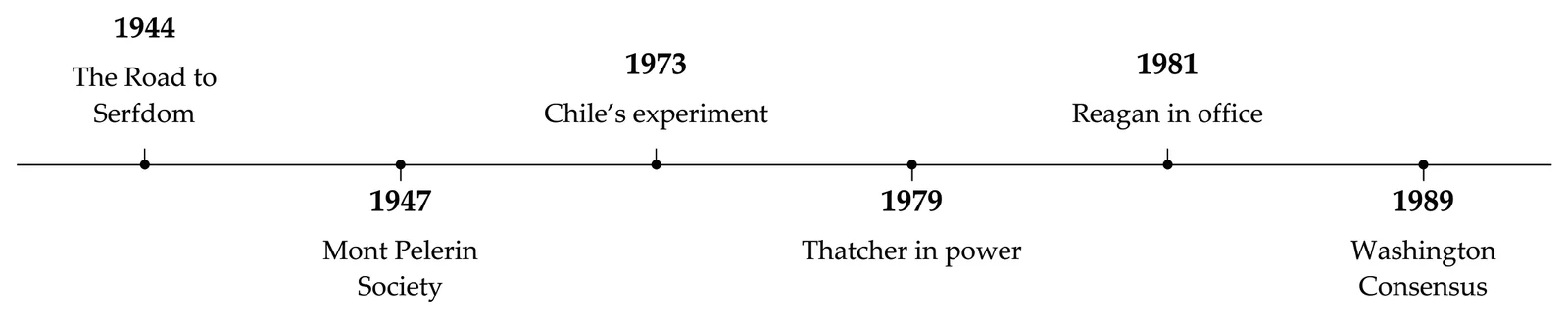
Friedrich Hayek, in The Road to Serfdom (1944), warned that planning leads to tyranny. He founded the Mont Pelerin Society in 1947. Milton Friedman, in Capitalism and Freedom (1962), and the Chicago School championed free markets and monetarism.
3. The Crisis of Keynesianism
In the 1970s, oil shocks, inflation combined with unemployment and declining profits undermined Keynesian policies, opening the way for neo-liberal ideas.
4. Chile
Harvey notes that the first neo-liberal experiment took place in Chile after the military coup of 1973, when economists trained in Chicago privatised assets and opened the economy under the Pinochet dictatorship.
5. Thatcher and Reagan
Margaret Thatcher, Prime Minister of Britain from 1979, and Ronald Reagan, President of the United States from 1981, privatised state enterprises, curbed trade unions, cut taxes and deregulated finance.
6. The Washington Consensus
In 1989, John Williamson summarised the policies recommended to developing countries by Washington-based institutions: fiscal discipline, trade liberalisation, privatisation, deregulation, openness to foreign investment and secure property rights.
7. Structural Adjustment
During the debt crisis of the 1980s, the IMF and World Bank required indebted countries to adopt such policies as conditions for loans, spreading neo-liberalism across Latin America, Africa and Asia.
8. Harvey’s Critique
Harvey argues that neo-liberalism has been a project to restore the class power of economic elites. It increased inequality, shifted wealth upwards and relied on accumulation by dispossession through privatisation and financialisation.
9. The Neo-liberal State
Paradoxically, neo-liberalism requires a strong state to enforce property rights, discipline labour and rescue financial institutions in crises, while retreating from welfare.
10. Neo-liberalism in India
India’s reforms of 1991 adopted elements of neo-liberalism, such as deregulation, privatisation and openness to trade. Critics such as Prabhat Patnaik argue that they increased inequality and agrarian distress.
11. China
Harvey describes China’s reforms since 1978 as neo-liberalism with Chinese characteristics, combining markets with a strong party-state, producing rapid growth and rising inequality.
12. Crises and Backlash
Financial crises, such as the Asian crisis of 1997 and the global crisis of 2008, damaged neo-liberalism’s credibility. Since then, many governments have returned to industrial policy, protectionism and stronger state roles.
13. Defence
Supporters argue that market reforms increased growth, efficiency and innovation and lifted millions out of poverty, especially in Asia.
14. Neo-liberalism and Inequality
Thomas Piketty, in Capital in the Twenty-First Century (2013), showed that the share of national income going to the richest one per cent rose sharply in the United States and Britain from around 1980, the period of neo-liberal reforms. Lower top tax rates, weaker unions and financial deregulation contributed to this concentration of income and wealth, supporting Harvey’s argument.
15. Evaluation
Neo-liberalism transformed the world economy, increasing growth in some places but also inequality and instability. Harvey’s critique highlights its class character.
Conclusion. Thus, neo-liberalism, rooted in Hayek and Friedman, spread from Chile, Thatcher and Reagan to the Washington Consensus and structural adjustment. As David Harvey argues, it restored the power of economic elites and increased inequality, though its defenders credit it with growth, and crises since 2008 have challenged its dominance.
Important Question 5
Discuss the Gandhian approach to political economy.
OR
Examine the principles of Gandhian political economy with reference to B.N. Ghosh.
OR
Discuss the relevance of Gandhi’s ideas of swadeshi and trusteeship today.
Model Answer
“Machinery is the chief symbol of modern civilization; it represents a great sin.”
— M.K. Gandhi, Hind Swaraj (1909)
Introduction. Gandhi offered a distinctive approach to political economy that rejected both Western capitalism and state socialism. Rooted in moral values of truth, non-violence and simplicity, it proposed decentralised, self-reliant village economies, limits on wants and the moral use of wealth. B.N. Ghosh, in Gandhian Political Economy (2007), sets out its principles, practice and policy relevance.
1. A Moral Economy
For Gandhi, economics could not be separated from ethics. An economy that harms the poor, encourages greed or destroys nature is wrong, however efficient it may be.
2. Critique of Modern Civilisation
In Hind Swaraj (1909), Gandhi criticised modern industrial civilisation for multiplying wants, concentrating wealth and making people slaves to machines. He saw machinery as a symbol of this civilisation.
3. Ghosh’s Principles
B.N. Ghosh identifies the principles of Gandhian political economy as non-violence, truth, decentralisation, self-sufficiency, needs-based production, trusteeship and the welfare of all, and examines how they can guide policy.
4. Swadeshi
Swadeshi meant relying on local production and serving one’s neighbours first. Gandhi promoted khadi and the spinning wheel to revive village industries and give work to the rural poor.
5. Village Self-Sufficiency
Gandhi envisioned India as a federation of self-reliant villages producing their own food, cloth and necessities, with surplus exchanged with other villages, avoiding exploitation by distant markets.
6. Trusteeship
Gandhi proposed that the rich should regard their wealth as held in trust for society, keeping only what they need and using the rest for the common good. This would transform capitalism non-violently.
7. Bread Labour
Inspired by Tolstoy, Gandhi argued that everyone should do some physical labour to earn their bread, ending the division between those who work with their hands and those who live off others.
8. Sarvodaya
Sarvodaya, the welfare of all, meant that the good of the individual lies in the good of all, and that economic policy should be judged by its effect on the poorest.
9. Kumarappa’s Economy of Permanence
J.C. Kumarappa, Gandhi’s economist associate, in Economy of Permanence (1945), argued for an economy based on renewable resources and decentralised production that would last, anticipating ecological economics.
10. Limiting Wants
Gandhi valued aparigraha, non-possession, and simple living. Prosperity, he believed, lies not in multiplying wants but in satisfying genuine needs.
11. Influence
Gandhian ideas inspired the Khadi and Village Industries Commission, the Bhoodan movement and the Directive Principle on cottage industries. E.F. Schumacher’s Small Is Beautiful (1973) drew on similar ideas.
12. Relevance Today
In an age of climate change and inequality, Gandhian ideas of local economies, sustainable consumption and ethical wealth have renewed relevance.
13. Criticisms
Critics argue that Gandhian economics is anti-modern and impractical for a large nation, that trusteeship relies naively on the goodwill of the rich, and, as Ambedkar argued, that idealised villages hide caste oppression.
14. Gandhi and Nehru
In letters exchanged in 1945, Gandhi defended his vision of village-based India, while Nehru argued that India needed modern industry, science and planning to end poverty. After Independence, Nehru’s model of heavy industrialisation prevailed, and Gandhian ideas survived mainly in programmes for khadi, village industries and panchayats.
15. Swadeshi Today
The idea of swadeshi has returned in new forms, such as calls for economic self-reliance and support for local products. But Gandhi’s swadeshi was about decentralised, small-scale production serving local needs and protecting the dignity of labour, not simply national industrial strength, so contemporary uses of the term often differ from his meaning.
16. Evaluation
The Gandhian approach offers a moral and ecological critique of modern political economy, valuable as a vision even if hard to implement fully.
Conclusion. Thus, Gandhian political economy proposes a moral economy of swadeshi, self-reliant villages, trusteeship, bread labour and sarvodaya, opposed to both capitalism and centralised socialism. As B.N. Ghosh shows, its principles of non-violence and limited wants remain relevant to inequality and environmental crisis, though critics question its practicality.
Short Notes
(a) Comparative advantage
David Ricardo’s principle (1817) that countries gain from trade by specialising in goods they produce relatively more efficiently, even if one country is more efficient in all goods. It is the basis of the case for free trade.
(b) Washington Consensus
John Williamson’s 1989 summary of the market-oriented policies recommended to developing countries by the IMF, World Bank and US Treasury, including fiscal discipline, trade liberalisation, privatisation and deregulation.
(c) Trusteeship
Gandhi’s idea that the wealthy should treat their property as held in trust for society, taking only what they need and using the rest for the common good, as a non-violent alternative to class struggle.
More notes: DSE-9 Contemporary Political Economy
These notes are prepared by PADHO TO AISE for study help. They are not an official University of Delhi publication.