
Semester VIII DSE-14 Democracy and Governance
Unit III · 25 min read · Updated 24 Nov 2026
As per the University of Delhi (DU) BA (Hons) Political Science syllabus
Contents
- 3.1 Legislature: The Changing Nature of Representation
- Theories of Representation
- Changing Social Profile of Parliament
- Concerns about Parliament Today
- 3.2 Executive: The President and the Prime Minister
- Constitutional Provisions on the Executive
- The President in Practice
- The Changing Office of Prime Minister
- 3.3 Judiciary: PIL and Judicial Appointments
- Milestones of Public Interest Litigation
- Debates on PIL
- Constitutional Provisions on Appointments
- After the NJAC Judgment
- 3.4 Important Questions
- Discuss the changing nature of representation in the Indian legislature.
- Discuss the relationship between the President and the Prime Minister in India.
- What is public interest litigation? Discuss its role in Indian democracy.
- Discuss the debate on judicial appointments in India.
- Short Notes
राष्ट्रपति राज्य का प्रमुख है, पर कार्यपालिका का नहीं। वह राष्ट्र का प्रतिनिधित्व करता है, पर राष्ट्र पर शासन नहीं करता।
He is the head of the State but not of the Executive. He represents the Nation but does not rule the Nation.
— B.R. Ambedkar, Constituent Assembly (4 November 1948)
THE three organs of government, the legislature, the executive and the judiciary, are the institutions through which democracy is practised. In India, each has changed in important ways since 1950. Representation in Parliament has changed as new social groups and parties have risen. The relationship between the President and the Prime Minister has been shaped by constitutional amendments and conventions. The judiciary has expanded access to justice through public interest litigation and has taken control of judicial appointments. This chapter examines these changes, drawing on Jugdep Chima, Michael Saward, C.S. Venkatachar, Harshan Kumarasingham, S.P. Sathe and Prashant Bhushan.
3.1 Legislature: The Changing Nature of Representation
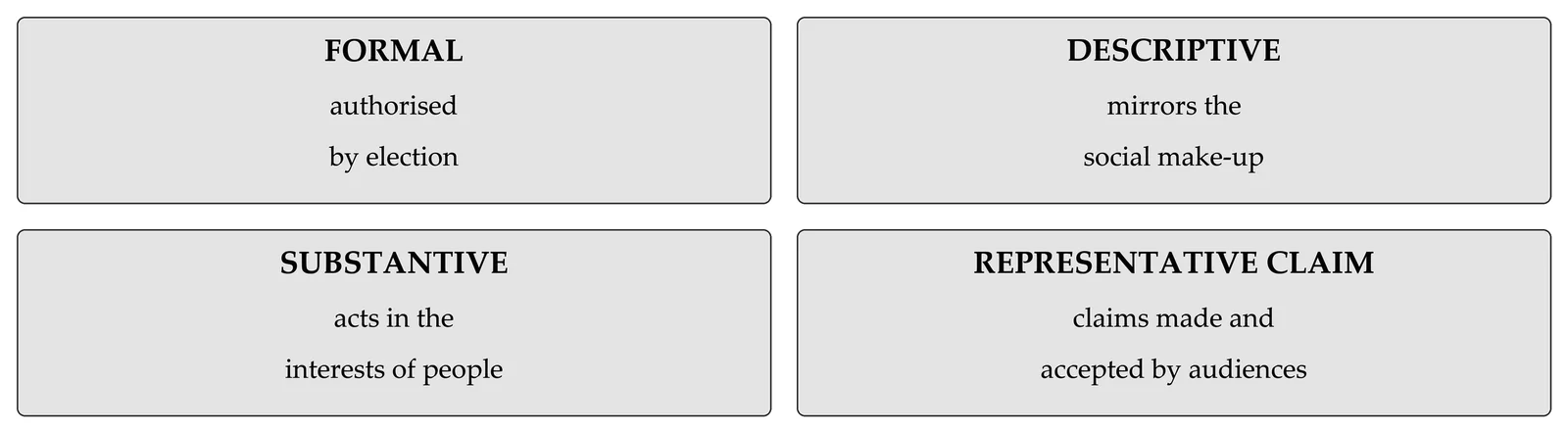
Representation means making the people present in government through those who act for them. Hanna Pitkin distinguished formal, descriptive, symbolic and substantive representation, and Michael Saward describes representation as a set of claims made by representatives and accepted or rejected by audiences. In India, Parliament has become more socially diverse as backward classes, Dalits, farmers and regional parties gained seats, though women remain under-represented.
Theories of Representation
- Trustee and delegate. Edmund Burke, in his Speech to the Electors of Bristol (1774), argued that a representative should use his own judgment for the good of the nation rather than follow constituents’ instructions.
- Pitkin’s four views. Hanna Pitkin, in The Concept of Representation (1967), distinguished formal (authorisation and accountability), descriptive (resemblance), symbolic (standing for) and substantive (acting for) representation.
- The politics of presence. Anne Phillips (1995) argued that the presence of women and minorities in legislatures matters in itself, since ideas alone cannot be fully represented by others.
- Mansbridge’s forms. Jane Mansbridge (2003) added promissory, anticipatory, gyroscopic and surrogate representation, showing that representation works in several ways at once.
- The representative claim. Michael Saward (2010) treats representation as claims made by politicians, activists and even celebrities, which audiences accept or reject.
Changing Social Profile of Parliament
In the first Lok Sabhas, members were mostly upper-caste, educated professionals and landowners, many of them lawyers who had taken part in the freedom movement. From the late 1960s and especially the 1990s, the rise of backward-caste and regional parties changed the profile of legislatures. Christophe Jaffrelot, in India’s Silent Revolution (2003), described the rise of the lower castes in north Indian politics, and Yogendra Yadav called this the second democratic upsurge. Reserved constituencies, which go back to the Poona Pact of 1932, guarantee 84 Lok Sabha seats for Scheduled Castes and 47 for Scheduled Tribes. Women remain under-represented, but the 106th Amendment of 2023 provides for one-third reservation for women after the next delimitation.
Concerns about Parliament Today
- Fewer sittings. The Lok Sabha sat for more than a hundred days a year in the 1950s, but recent Lok Sabhas have met far less, and the 17th Lok Sabha (2019 to 2024) sat for the fewest days of any full term.
- Less committee scrutiny. The share of bills referred to parliamentary committees has fallen sharply since the 15th Lok Sabha.
- Money and crime. Reports by the Association for Democratic Reforms show that most MPs are crorepatis and a large share declare criminal cases.
- Party control. The anti-defection law of 1985, upheld in Kihoto Hollohan (1992) and tightened by the 91st Amendment of 2003, binds members to the party whip and reduces independent judgment.
3.2 Executive: The President and the Prime Minister
India has a parliamentary executive: the President is the formal head of state, while real power lies with the Prime Minister and the Council of Ministers. Under Article 74, as amended in 1976 and 1978, the President must act on ministerial advice but may return it once for reconsideration. The relationship has been shaped by personalities and conventions, from Rajendra Prasad and Nehru to later Presidents.
Constitutional Provisions on the Executive
- Article 53 vests the executive power of the Union in the President, to be exercised directly or through subordinate officers.
- Article 54 provides for election of the President by an electoral college of the elected members of both Houses of Parliament and of the state legislative assemblies.
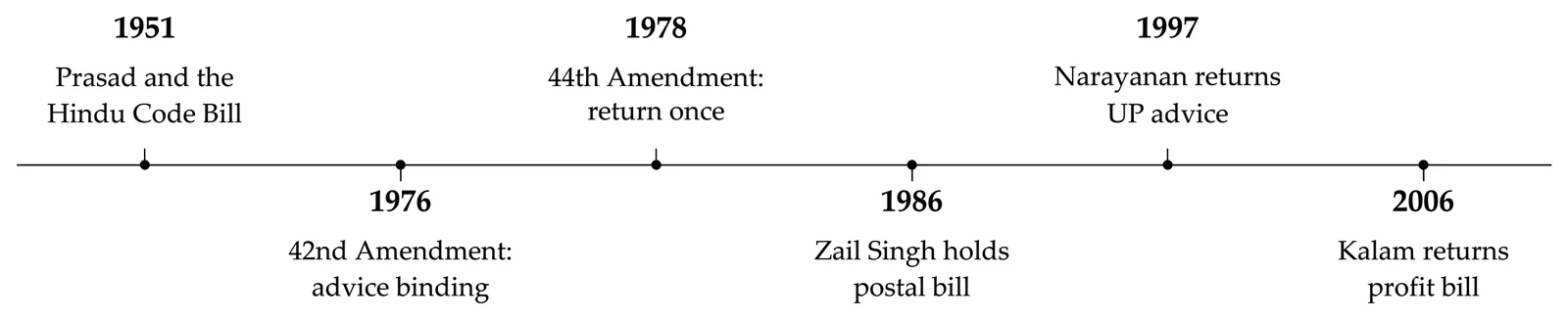
- Article 74 provides a Council of Ministers headed by the Prime Minister to aid and advise the President, whose advice is binding since the 42nd Amendment of 1976, subject to one return for reconsideration added by the 44th Amendment of 1978.
- Article 75 provides that the President appoints the Prime Minister and that the Council of Ministers is collectively responsible to the Lok Sabha.
- Article 78 makes it the duty of the Prime Minister to keep the President informed of all decisions and proposals for legislation.
- Article 123 empowers the President to issue ordinances when Parliament is not in session, on ministerial advice.
The President in Practice
B.R. Ambedkar told the Constituent Assembly on 4 November 1948 that the President occupies the same position as the King under the English Constitution, a head of state but not the executive. Yet Presidents have sometimes used their limited discretion. Rajendra Prasad disagreed with Nehru over the Hindu Code Bill in 1951. Giani Zail Singh used a pocket veto on the Indian Post Office (Amendment) Bill in 1986 by simply not acting on it. K.R. Narayanan returned cabinet recommendations for President’s Rule in Uttar Pradesh in 1997 and Bihar in 1998, and in 1998 he asked for letters of support before appointing Atal Bihari Vajpayee Prime Minister. A.P.J. Abdul Kalam returned the Office of Profit Bill in 2006. The Supreme Court, in Shamsher Singh (1974), confirmed that the President must act on ministerial advice.
The Changing Office of Prime Minister
Under Nehru, the Prime Minister dominated a cabinet of strong leaders through his prestige and the Congress organisation. Indira Gandhi centralised power in her Secretariat, renamed the Prime Minister’s Office in 1977, and weakened party institutions. From 1989 to 2014, coalition governments made Prime Ministers depend on allies, as V.P. Singh, Deve Gowda, Vajpayee and Manmohan Singh found, and Manmohan Singh’s position was further shaped by the party leadership and the National Advisory Council. Since 2014, single-party majorities have restored a dominant Prime Minister. James Manor’s edited volume Nehru to the Nineties (1994) shows how the office has changed with personalities and party systems.
3.3 Judiciary: PIL and Judicial Appointments
After the Emergency, the Supreme Court opened its doors to the poor through public interest litigation, relaxing rules of standing and treating letters as petitions. From 1993, the Court also took control of judicial appointments through the collegium, and in 2015 it struck down the National Judicial Appointments Commission, sparking a continuing debate on independence and accountability.
Milestones of Public Interest Litigation
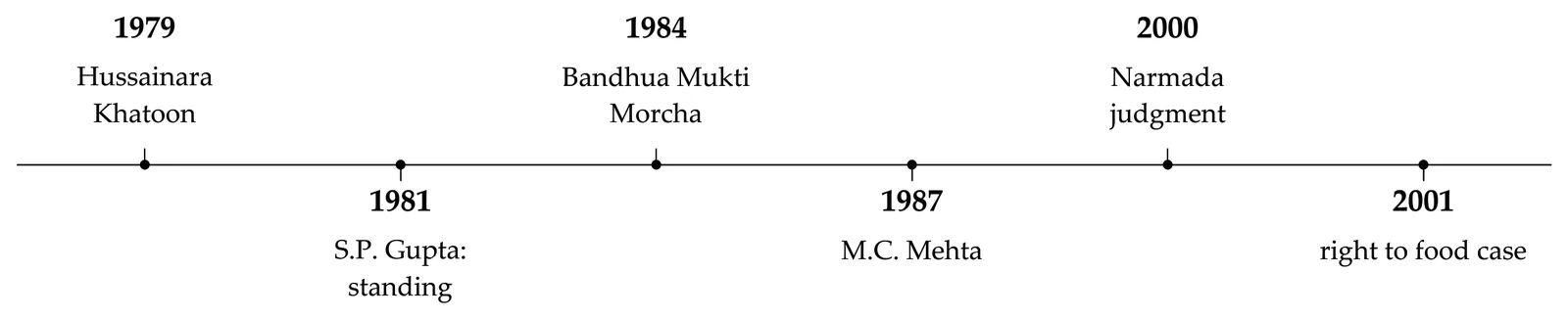
- 1979 → Hussainara Khatoon exposed the plight of thousands of undertrial prisoners in Bihar and recognised the right to a speedy trial.
- 1981 → In S.P. Gupta, Justice P.N. Bhagwati relaxed the rule of standing so that any public-spirited person could approach the Court for those unable to do so.
- 1984 → Bandhua Mukti Morcha dealt with bonded labour in stone quarries near Delhi.
- 1985 → Olga Tellis linked the right to livelihood with the right to life of pavement dwellers in Bombay.
- 1997 and 1998 → Vishaka laid down guidelines on sexual harassment, and Vineet Narain used continuing mandamus to supervise corruption investigations.
- 2001 onwards → In the right to food case, the Court ordered cooked mid-day meals in schools and monitored food schemes through commissioners.
Debates on PIL
Upendra Baxi preferred the term social action litigation, stressing that the Indian innovation was about bringing the suffering of the poor before the courts. Supporters argue that PIL filled gaps left by an unresponsive executive and legislature. Critics such as Prashant Bhushan, writing in 2004, argued that after liberalisation the Court increasingly decided cases against workers, slum dwellers and the environment and in favour of development projects. Others warn of judicial overreach into policy, a flood of frivolous petitions and weak implementation. In State of Uttaranchal v. Balwant Singh Chaufal (2010), the Supreme Court itself laid down guidelines to prevent abuse of PIL.
Constitutional Provisions on Appointments
Article 124(2) provides that Supreme Court judges are appointed by the President after consultation with such judges as the President considers necessary, and that the Chief Justice of India is always to be consulted for appointments other than the Chief Justice. Article 217 provides a similar process for High Court judges. The meaning of consultation has been at the heart of the debate: in the First Judges case (1981), the Court held that it did not mean concurrence; in the Second Judges case (1993), it held that the opinion of the Chief Justice, formed with senior colleagues, has primacy; and in the Third Judges case (1998), it fixed the collegium as the Chief Justice and the four senior-most judges for Supreme Court appointments.
After the NJAC Judgment
The 99th Amendment of 2014 created the National Judicial Appointments Commission, made up of the Chief Justice, two senior judges, the Law Minister and two eminent persons. In October 2015, a five-judge bench struck it down by four to one, with Justice J. Chelameswar dissenting, holding that executive participation threatened judicial independence. The Court asked for suggestions to improve the collegium, and from 2017 the collegium began publishing its resolutions online. Tensions continued over delays in government approval of recommended names and over the Memorandum of Procedure. Scholars such as S.P. Sathe argue for a transparent process that balances independence with accountability.
3.4 Important Questions
- Question 1 Discuss the changing nature of representation in the Indian legislature.
- Question 2 Discuss the relationship between the President and the Prime Minister in India.
- Question 3 What is public interest litigation? Discuss its role in Indian democracy.
- Question 4 Discuss the debate on judicial appointments in India.
DU asks the same idea in different words. So learn one broad answer for each question below; the same answer works for every question joined by OR.
Important Question 1
Discuss the changing nature of representation in the Indian legislature.
OR
Examine theories of representation with reference to Pitkin and Saward.
OR
How has the social composition of Parliament changed since 1952?
Model Answer
“Parliament is not a congress of ambassadors from different and hostile interests; but Parliament is a deliberative assembly of one nation, with one interest, that of the whole.”
— Edmund Burke, Speech to the Electors of Bristol (1774)
Introduction. In a representative democracy, the legislature is where the people are represented. But what representation means, and who is represented, has changed over time. In India, the composition of Parliament and state legislatures has been transformed by the rise of new social groups and parties, while concerns have grown about criminalisation, wealth and the declining role of debate.
1. Meaning of Representation
Representation means making present in some sense what is not literally present: the people, who cannot all govern directly, are made present in government through representatives who speak and act for them.
2. Burke: Trustee or Delegate
Edmund Burke argued that a representative is a trustee who uses his own judgement for the good of the whole nation, not a delegate bound by voters’ instructions. The debate between the trustee and delegate models continues.
3. Pitkin’s Types
Hanna Pitkin, in The Concept of Representation (1967), distinguished formalistic representation, based on authorisation and accountability; descriptive representation, in which representatives resemble the represented; symbolic representation; and substantive representation, acting in the interests of the represented.
4. Saward’s Representative Claim
Michael Saward argues that representation is a dynamic process of claims: representatives claim to speak for groups, and audiences accept or reject these claims. In ‘Shape-Shifting Representation’ (2014), he shows how representatives shift between roles, such as delegate, trustee or expert, to win support.
5. Early Lok Sabhas
The early Lok Sabhas were dominated by the Congress party and by upper-caste, educated, urban professionals, especially lawyers, reflecting the leadership of the national movement.
6. The Democratic Upsurge
From the late 1960s and especially after 1989, backward classes, Dalits and farmers entered legislatures in larger numbers. Christophe Jaffrelot called the rise of the backward classes in north India a silent revolution.
7. Chima on Changing Patterns
Jugdep Chima describes changing patterns of democracy and representation in India: the decline of the Congress system, the rise of regional and caste-based parties, coalition governments from 1989 to 2014 and the return of single-party majorities.
8. Regionalisation
Regional parties gained strength in many states and became partners in coalition governments at the Centre, giving regional interests a stronger voice in national politics.
9. Women’s Representation
Women formed about five per cent of the first Lok Sabha and about 14 per cent of the Lok Sabhas elected in 2019 and 2024. The 106th Amendment of 2023 provides for one-third reservation after the next delimitation.
10. Reserved Constituencies
Seats reserved for Scheduled Castes and Scheduled Tribes ensure descriptive representation, though critics note that joint electorates mean these representatives must also appeal to other groups.
11. Criminalisation and Wealth
Studies by the Association for Democratic Reforms show that a large and growing share of MPs declare criminal cases and that most are crorepatis, raising concerns about the quality of representation.
12. Anti-Defection Law
The anti-defection law of 1985 strengthened party discipline and stability, but critics argue it reduced individual MPs to followers of the party whip, weakening independent representation of constituents.
13. Declining Deliberation
The number of sittings of Parliament has fallen sharply, from more than 600 in the first Lok Sabha to fewer than 300 in the seventeenth, and many bills are passed with little debate or committee scrutiny.
14. New Forms of Representation
Civil society groups, social movements and the media also make representative claims on behalf of citizens, showing, as Saward suggests, that representation is not limited to elected legislators.
15. Evaluation
Representation in India has become more socially inclusive, but its quality is weakened by criminalisation, money power and declining deliberation.
Conclusion. Thus, representation has been understood through Burke’s trustee model, Pitkin’s types and Saward’s representative claims. In India, Parliament has changed from an elite, Congress-dominated body to a more diverse one with backward classes, Dalits and regional parties, as Chima shows, though women’s under-representation, criminalisation and declining debate remain concerns.
Important Question 2
Discuss the relationship between the President and the Prime Minister in India.
OR
Is the President of India a mere rubber stamp? Discuss.
OR
Examine the constitutional position and discretionary powers of the President.
Model Answer
“He is the head of the State but not of the Executive. He represents the Nation but does not rule the Nation.”
— B.R. Ambedkar, Constituent Assembly (4 November 1948)
Introduction. India adopted a parliamentary system in which the President is the constitutional head of state and the Prime Minister heads the real executive. The relationship between them is governed by the Constitution, amendments, judicial decisions and conventions. Although the President normally acts on ministerial advice, history shows moments of tension and a limited sphere of discretion.
1. Constitutional Provisions
Article 53 vests the executive power of the Union in the President, but Article 74 provides a Council of Ministers headed by the Prime Minister to aid and advise the President. Article 75 provides that the President appoints the Prime Minister.
2. The Model of Britain
The framers intended the President to occupy a position similar to the British monarch, as Ambedkar explained: head of the state but not of the executive, a symbol of the nation rather than its ruler.
3. The 42nd and 44th Amendments
The 42nd Amendment of 1976 made it clear that the President shall act in accordance with ministerial advice. The 44th Amendment of 1978 allowed the President to return advice once for reconsideration, after which he must accept it.
4. Duty to Inform
Article 78 requires the Prime Minister to communicate decisions of the Council of Ministers to the President and to provide information the President asks for, giving the President a right to be informed and to advise.
5. Prasad and Nehru
The first President, Rajendra Prasad, differed with Jawaharlal Nehru over the Hindu Code Bill in 1951 and questioned whether the President was bound by advice. Nehru insisted on the parliamentary convention, which prevailed.
6. Venkatachar’s Analysis
C.S. Venkatachar examined these early tensions and argued that the President’s role rests on conventions of cabinet government, under which he must act on advice, while retaining influence through consultation, advice and warning.
7. Kumarasingham on Nehru
Harshan Kumarasingham shows that in the first decade of independence, Nehru became more than first among equals in the cabinet, dominating the executive and shaping the conventions that reduced the President to a constitutional head.
8. Discretion in Appointing the PM
When no party has a majority, the President has discretion in inviting a leader to form the government. Presidents have invited the leader of the largest party or coalition and asked for proof of support, as in 1979, 1989, 1996 and 1998.
9. Zail Singh and the Pocket Veto
In 1986, President Zail Singh withheld assent to the Indian Post Office (Amendment) Bill, which allowed interception of mail, by neither signing nor returning it, a use of the so-called pocket veto during tensions with Prime Minister Rajiv Gandhi.
10. Narayanan’s Activism
President K.R. Narayanan returned the recommendation for President’s Rule in Uttar Pradesh in 1997 and in Bihar in 1998, showing that the power to seek reconsideration could act as a check.
11. Kalam and the Profit Bill
In 2006, President A.P.J. Abdul Kalam returned the bill exempting certain offices from disqualification for holding an office of profit, though he signed it when Parliament passed it again.
12. Judicial View
In Shamsher Singh v. State of Punjab (1974), the Supreme Court held that the President and Governors act on the advice of ministers except in matters where the Constitution gives discretion.
13. Coalition Era
During the coalition era from 1989 to 2014, the President’s role in government formation became more important, while the Prime Minister’s authority depended on coalition partners.
14. Strong Prime Ministers
Under strong Prime Ministers with single-party majorities, such as Nehru, Indira Gandhi and Narendra Modi, power has concentrated in the Prime Minister’s Office, and the President’s role has remained largely formal.
15. Ordinances and Assent
The President promulgates ordinances under Article 123 on ministerial advice when Parliament is not in session. In Krishna Kumar Singh (2017), the Supreme Court held that re-promulgating ordinances without placing them before the legislature is a fraud on the Constitution. Presidents have occasionally questioned ordinances, but generally sign them, showing the limits of their discretion.
16. Moral Authority
Beyond formal powers, Presidents can use moral authority through speeches, advice in private meetings and messages to Parliament. Presidents such as K.R. Narayanan used addresses to draw attention to issues such as the condition of Dalits and the values of the Constitution, showing that the office can influence public debate even without executive power.
17. Evaluation
The President is a constitutional head bound by advice, but retains influence, limited discretion and a moral role as guardian of the Constitution.
Conclusion. Thus, the President of India is head of state, not of the executive, and acts on the advice of the Prime Minister and the Council of Ministers under Article 74. Early tensions between Prasad and Nehru, analysed by Venkatachar and Kumarasingham, settled the convention, while Zail Singh, Narayanan and Kalam showed the President’s limited power to delay and seek reconsideration.
Important Question 3
What is public interest litigation? Discuss its role in Indian democracy.
OR
Examine the changing perspectives on PIL under liberalisation.
OR
Has PIL strengthened or weakened the separation of powers in India?
Model Answer
“Public interest litigation is a co-operative or collaborative effort on the part of the petitioner, the State or public authority and the Court to secure observance of the constitutional or legal rights, benefits and privileges conferred upon the vulnerable sections of the community.”
— Justice P.N. Bhagwati, People’s Union for Democratic Rights v. Union of India (1982)
Introduction. Public interest litigation (PIL) is one of the most distinctive features of Indian democracy. Developed by the Supreme Court in the late 1970s and early 1980s, it allowed any public-spirited person to approach the courts on behalf of those unable to do so themselves. It transformed the role of the judiciary, but its direction changed with economic liberalisation, as Prashant Bhushan argues.
1. Meaning
PIL is litigation filed in a court to protect the public interest or the rights of disadvantaged groups, rather than the personal interest of the petitioner. It relaxes the traditional rule that only a person directly affected can approach the court.
2. Origins
PIL emerged after the Emergency, as judges such as V.R. Krishna Iyer and P.N. Bhagwati sought to restore the Court’s legitimacy and make justice accessible to the poor, who could not afford litigation.
3. Relaxed Standing
In S.P. Gupta v. Union of India (1981), the Court held that any member of the public acting in good faith could seek remedies for people who, because of poverty or disability, could not approach the court themselves.
4. Epistolary Jurisdiction
The Court began treating letters and newspaper reports as petitions, so that prisoners and others could seek justice by writing to judges. This became known as epistolary jurisdiction.
5. Early Landmark Cases
In Hussainara Khatoon (1979), the Court ordered the release of thousands of undertrial prisoners held for years. In Bandhua Mukti Morcha (1984), it acted against bonded labour, and in Olga Tellis (1985) it linked the right to life with livelihood.
6. Expansion
PIL expanded to environmental protection through the M.C. Mehta cases, sexual harassment through Vishaka (1997), independence of investigating agencies through Vineet Narain (1998) and the right to food, with orders on mid-day meals in 2001.
7. New Remedies
Courts developed new remedies, such as appointing commissioners to investigate, issuing continuing mandamus to supervise implementation and framing guidelines where laws were absent.
8. Bhushan on Liberalisation
Prashant Bhushan argues that after economic liberalisation, the Court’s approach to PIL changed. It became more sympathetic to development projects and privatisation, as in the Narmada dam case (2000) and the BALCO disinvestment case (2002), and less sympathetic to the poor.
9. PIL against the Poor
Bhushan and others note that PILs were increasingly used by middle-class petitioners to remove slums, hawkers and polluting industries in the name of cleanliness and environment, often displacing the poor without adequate rehabilitation.
10. Separation of Powers
Critics argue that PIL has led to judicial overreach, with courts making policy and supervising administration, which belongs to the legislature and executive.
11. Frivolous Petitions
The flood of PILs, some filed for publicity or private motives, burdens courts. In 2010, the Supreme Court laid down guidelines to check frivolous PILs in the Balwant Singh Chaufal case.
12. Defence of PIL
Supporters argue that PIL fills gaps left by executive failure and legislative inaction and gives a voice to those excluded from ordinary politics, strengthening democracy.
13. Social Action Litigation
Upendra Baxi called it social action litigation, stressing its role in bringing the struggles of the oppressed into the courtroom.
14. A Balanced Role
Many scholars call for a balanced approach, in which courts protect rights and push for accountability while respecting the roles of elected institutions and ensuring that the poor benefit.
15. Prison Reform and Custodial Rights
PIL brought major changes in the treatment of prisoners and suspects. In Sunil Batra (1978 and 1980), the Court acted on a letter from a prisoner against torture, and in D.K. Basu (1997) it laid down guidelines for arrest and detention to prevent custodial violence, such as informing relatives and preparing an arrest memo.
16. PIL and Elections
PIL has also improved electoral democracy. In Union of India v. Association for Democratic Reforms (2002), the Court required candidates to declare criminal cases, assets and education, and in 2013 it allowed voters the option of None of the Above. These judgments strengthened voters’ right to information.
17. Evaluation
PIL has greatly expanded access to justice in India, though its use has changed and raises questions about the limits of judicial power.
Conclusion. Thus, PIL relaxed standing, admitted letters as petitions and created new remedies, protecting undertrials, bonded labourers, the environment and the right to food. Bhushan shows that after liberalisation it was often used against the poor, and critics warn of judicial overreach, but PIL remains a vital tool of Indian democracy.
Important Question 4
Discuss the debate on judicial appointments in India.
OR
Examine the evolution of the collegium system and the NJAC judgment.
OR
How can judicial independence be balanced with accountability in appointments?
Model Answer
“To allow the Chief Justice practically a veto upon the appointment of judges is really to transfer the authority to the Chief Justice which we are not prepared to vest in the President or the Government of the day.”
— B.R. Ambedkar, Constituent Assembly (24 May 1949)
Introduction. The independence of the judiciary depends greatly on how judges are appointed. In India, the method has changed from executive primacy to judicial primacy through the collegium system, created by the Supreme Court itself. Attempts to replace it with a National Judicial Appointments Commission failed in 2015, and the debate between independence and accountability continues, as S.P. Sathe and N.B. Rakshit show.
1. Constitutional Provisions
Articles 124 and 217 provide that the President appoints judges of the Supreme Court and High Courts after consultation with the Chief Justice of India and other judges. The framers rejected giving either the executive or the Chief Justice a free hand.
2. Executive Primacy
In the early decades, the government in practice had the final say, though it usually followed the Chief Justice’s advice. During the 1970s, the supersession of senior judges in 1973 and 1977 raised fears about executive interference.

3. First Judges Case, 1981
In S.P. Gupta v. Union of India (1981), the Court held that consultation did not mean concurrence, so the executive had primacy in appointments.
4. Second Judges Case, 1993
In Supreme Court Advocates-on-Record Association v. Union of India (1993), the Court overruled S.P. Gupta and held that the Chief Justice’s opinion, formed with senior judges, would have primacy. This created the collegium system.
5. Third Judges Case, 1998
On a presidential reference in 1998, the Court clarified that the collegium for Supreme Court appointments would consist of the Chief Justice and the four senior-most judges, whose collective opinion would prevail.
6. Criticisms of the Collegium
The collegium has been criticised for opacity, lack of written criteria, nepotism, insufficient diversity of caste, gender and region, and delays in filling vacancies. Critics say judges appointing judges is unique among democracies.
7. Sathe on the Issues
S.P. Sathe examined the issues in judicial appointments in 1998, arguing that independence does not require judges alone to appoint judges, and that a broad-based process could protect both independence and accountability.
8. Rakshit’s View
N.B. Rakshit, writing in 2004, criticised the secrecy of the collegium and supported a broader body for appointments, as recommended by the National Commission to Review the Working of the Constitution in 2002.
9. The NJAC
The 99th Amendment and the NJAC Act of 2014 created a National Judicial Appointments Commission of the Chief Justice, two senior judges, the Law Minister and two eminent persons, with a veto for any two members.
10. The NJAC Judgment, 2015
In 2015, the Supreme Court struck down the NJAC by four to one, holding that it violated judicial independence, part of the basic structure, because judges could be outvoted. Justice Chelameswar dissented, criticising the collegium’s lack of transparency.
11. Reforms after 2015
The Court promised to improve the collegium. From 2017, collegium resolutions were published online, and a revised memorandum of procedure was discussed, though disagreements with the government continued.
12. Executive–Judiciary Tensions
The government has delayed notifying names recommended by the collegium, and ministers have publicly criticised the system, leading to tensions and vacancies in courts.
13. Comparative Models
Other democracies use different models: the United States uses presidential nomination with Senate confirmation, while Britain created a Judicial Appointments Commission in 2006 with lay and judicial members.
14. Balancing Independence and Accountability
Reform proposals include clear criteria, a transparent process, a broad-based commission with judicial majority, consideration of diversity and time limits for the government to act on recommendations.
15. Diversity on the Bench
A major concern is the lack of diversity in the higher judiciary. Women, Dalits, Adivasis, backward classes and religious minorities remain under-represented, and the first woman judge of the Supreme Court, Justice Fathima Beevi, was appointed only in 1989. Reformers argue that a more transparent process with stated criteria would help widen the social base of the judiciary.
16. Evaluation
Judicial appointments in India reflect a struggle to protect independence while ensuring transparency and accountability.
Conclusion. Thus, judicial appointments moved from executive primacy under S.P. Gupta (1981) to the collegium created in 1993 and 1998. The NJAC of 2014 was struck down in 2015 to protect independence, but critics such as Sathe and Rakshit call for transparency and broader participation. Balancing independence with accountability remains a central challenge.
Short Notes
(a) Representative claim
Michael Saward’s idea that representation consists of claims to speak for others, which audiences accept or reject.
(b) Pocket veto
The President’s power to delay a bill by neither signing nor returning it, as Zail Singh did with the Indian Post Office (Amendment) Bill in 1986.
(c) Collegium
The body of the Chief Justice and senior judges that recommends appointments to the higher judiciary, created by the Second and Third Judges cases.
(d) Epistolary jurisdiction
The Supreme Court’s practice, from the late 1970s, of treating letters and newspaper reports as petitions so that prisoners and the poor could seek justice.
More notes: DSE-14 Democracy and Governance
These notes are prepared by PADHO TO AISE for study help. They are not an official University of Delhi publication.