
Semester VII DSE-8 Feminism: Theory and Practice
Unit IV · 18 min read · Updated 24 Nov 2026
As per the University of Delhi (DU) BA (Hons) Political Science syllabus
Contents
- 4.1 Women and Society: Family, Property and Personal Laws
- 4.2 Women and Labour
- 4.3 Women and Politics
- 4.4 Important Questions
- Discuss the position of women in the family and the debate on personal laws in India.
- Discuss women’s property rights in India.
- Discuss the feminisation of labour and the gender and development approach.
- Discuss women’s representation and participation in democratic institutions in India.
- Short Notes
मानवाधिकार ही महिला अधिकार हैं, और महिला अधिकार ही मानवाधिकार हैं।
Human rights are women’s rights and women’s rights are human rights.
— Hillary Rodham Clinton, Speech at the Fourth World Conference on Women, Beijing (1995)
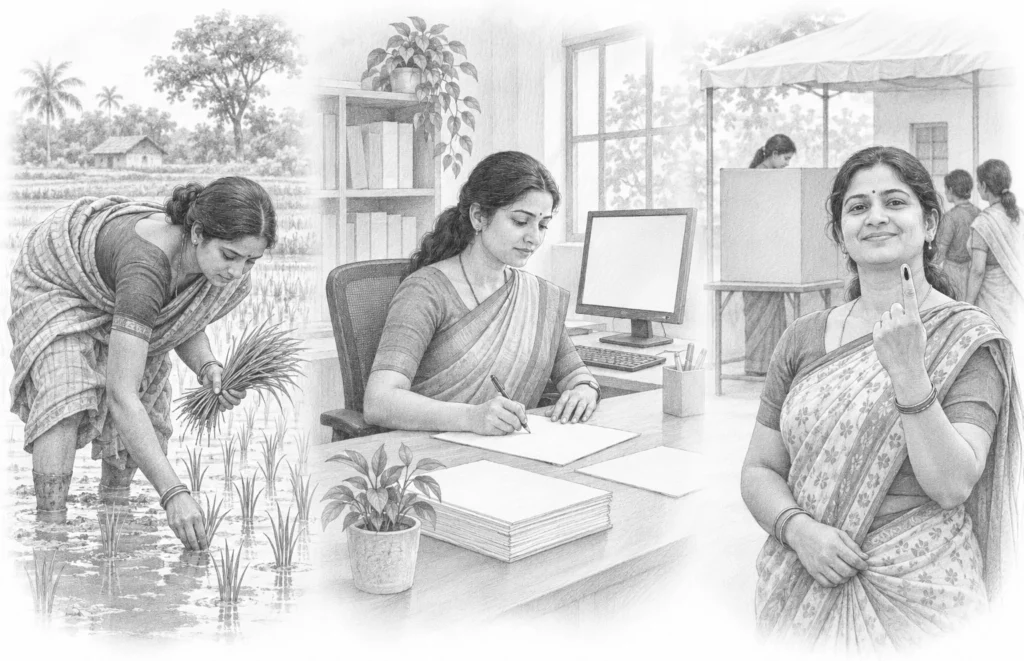
WOMEN’s lives in India are shaped by three arenas: the family and society, where marriage, property and personal laws define their rights; the world of labour, where they do much of the country’s work, often unpaid or underpaid; and politics, where they vote in large numbers but remain under-represented. This chapter examines these issues: family, property rights and personal laws; the feminisation of labour and gender and development; and women’s representation and participation in democratic institutions. It draws on Neera Desai and Usha Thakkar, Nirmala Banerjee, Amrita Basu and Bina Agarwal.
4.1 Women and Society: Family, Property and Personal Laws
The family is the first site of gender inequality: son preference, early marriage, dowry and an unequal division of housework shape women’s lives. Family matters are governed by personal laws based on religion, which have long discriminated against women in marriage, divorce, maintenance and inheritance. Reforms such as the Hindu Code, the 2005 amendment giving daughters equal rights in joint family property and the end of instant triple talaq have advanced equality, while the debate on a uniform civil code continues. Neera Desai and Usha Thakkar describe how these institutions shape women’s status.
4.2 Women and Labour
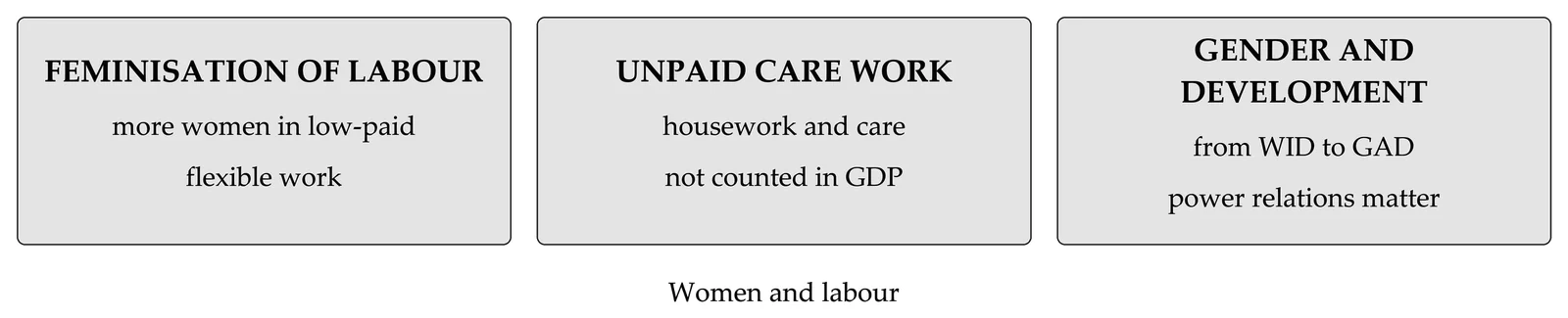
Women do a large share of India’s work, much of it unpaid care and domestic work or low-paid informal work. Nirmala Banerjee shows how patriarchy shapes the kinds of work women do and how it is valued. Globalisation has produced a feminisation of labour, drawing women into flexible, insecure jobs. Development thinking has moved from Women in Development to Gender and Development, which examines power relations between women and men.
4.3 Women and Politics
Women vote in large numbers, and in 2019 their turnout slightly exceeded men’s, but they hold only about 14 per cent of seats in the Lok Sabha. Reservation in local bodies since 1992 has brought lakhs of women into politics, and the Women’s Reservation Act of 2023 will reserve one-third of seats in Parliament and state assemblies after delimitation. Amrita Basu examines how parties, movements and families shape women’s political participation.

4.4 Important Questions
- Question 1 Discuss the position of women in the family and the debate on personal laws in India.
- Question 2 Discuss women’s property rights in India.
- Question 3 Discuss the feminisation of labour and the gender and development approach.
- Question 4 Discuss women’s representation and participation in democratic institutions in India.
DU asks the same idea in different words. So learn one broad answer for each question below; the same answer works for every question joined by OR.
Important Question 1
Discuss the position of women in the family and the debate on personal laws in India.
OR
Examine the impact of personal laws on women’s rights in India.
OR
Discuss the debate on the uniform civil code from a gender perspective.
Model Answer
“The State shall endeavour to secure for the citizens a uniform civil code throughout the territory of India.”
— Constitution of India, Article 44
Introduction. The family is the basic institution through which gender roles are learned and enforced. In India, family relations are governed by personal laws based on religion, which have historically disadvantaged women. Reforms of personal law and the debate on a uniform civil code have therefore been central to the struggle for women’s equality, raising questions about gender justice, religious freedom and minority rights.
1. The Family and Gender
Indian families are mostly patrilineal and patrilocal: descent passes through men, and women move to their husbands’ homes after marriage. This makes daughters seem temporary members of their birth families and reinforces son preference.
2. Desai and Thakkar
Neera Desai and Usha Thakkar, in Women in Indian Society (2001), describe how women’s status is shaped through socialisation, marriage, the division of labour and restrictions on mobility, and how education and movements are changing these patterns.
3. Marriage and Dowry
Most marriages are arranged, and dowry persists despite the Dowry Prohibition Act of 1961. According to NFHS-5, about 23 per cent of women aged 20–24 were married before 18, despite the Prohibition of Child Marriage Act of 2006. Thousands of dowry deaths are recorded each year.
4. Personal Laws
India has separate personal laws for different religious communities. Hindu law was codified in 1955–56; Muslim law rests on the Shariat Application Act of 1937; Christians and Parsis have their own laws; and the Special Marriage Act of 1954 provides a secular option.
5. The Hindu Code
The Hindu Code laws introduced monogamy, the right to divorce, adoption rights for women and inheritance rights for daughters and widows. They were a major advance, though they retained the male coparcenary until 2005.
6. Muslim Personal Law
Debates on Muslim personal law have focused on polygamy, unilateral divorce and maintenance. In Shayara Bano (2017), the Supreme Court struck down instant triple talaq, and a 2019 law made it a criminal offence. In 2024, the Court held that Muslim women can claim maintenance under the secular criminal law.
7. Christian Law Reform
Christian women once had to prove adultery along with another ground to obtain divorce. The Indian Divorce (Amendment) Act of 2001 removed this discrimination after long campaigns by Christian women’s groups.
8. The Uniform Civil Code Debate
Article 44 directs the state to secure a uniform civil code. Supporters argue it would ensure equality and national integration. Critics fear it would impose majority norms on minorities. In 2018, the Law Commission said a uniform code was neither necessary nor desirable at that stage and recommended reforming each personal law.
9. Recent Developments
Goa has had a common civil code since the Portuguese period. In 2024, Uttarakhand passed India’s first state uniform civil code law, which came into force in 2025, reviving national debate.
10. Feminist Positions
Feminists are divided. Some support a uniform code for gender justice, while others prefer gender-just reform within each community, fearing that the demand has been used to target minorities. Many Muslim women’s groups seek reform from within.
11. Domestic Violence
The family can be a site of violence. The Protection of Women from Domestic Violence Act of 2005 recognised physical, emotional, sexual and economic abuse and gave women the right to live in the shared household.
12. Unpaid Domestic Work
The Time Use Survey of 2019 found that women spent about five hours a day on unpaid domestic work, compared with about one and a half hours for men. This burden limits women’s education, employment and leisure.
13. Changing Families
Education, urbanisation and employment are changing families: nuclear families, later marriages, single women and live-in relationships are increasing, and courts have extended some legal protections to women in such relationships.
14. Criticisms
Critics argue that legal reforms alone cannot change deep-rooted family norms, and that enforcement remains weak, especially for poor and rural women.
15. Evaluation
The family and personal laws remain central to women’s rights in India. Reforms have advanced equality, but the balance between gender justice and religious diversity remains contested.
Conclusion. Thus, the patrilineal family and religion-based personal laws have long shaped women’s subordination in India. Reforms such as the Hindu Code, the end of instant triple talaq and Christian divorce reform have advanced equality, while the debate on a uniform civil code reflects tension between gender justice and minority rights.
Important Question 2
Discuss women’s property rights in India.
OR
Examine the significance of land and property rights for women’s empowerment.
OR
Discuss the reforms in Hindu succession law and their impact on women.
Model Answer
“Once a daughter, always a daughter. A son is a son till he is married.”
— Supreme Court of India, Vineeta Sharma v Rakesh Sharma (2020)
Introduction. Property rights are a key source of economic security, bargaining power and social status. Yet women in India have historically been denied equal rights to inherit and own property, especially land. Legal reforms have gradually expanded women’s rights, culminating in the 2005 amendment to the Hindu Succession Act, but the gap between law and practice remains wide.
1. Why Property Matters
Bina Agarwal, in A Field of One’s Own (1994), argued that land rights are the single most important factor affecting women’s economic and social position in rural South Asia. Owning property gives women security, bargaining power within the family and protection from violence.
2. Traditional Systems
Under the Mitakshara system followed in most of India, sons acquired a share in joint family property by birth, while daughters did not. Women had limited rights over stridhan, gifts given to them, but rarely over land.
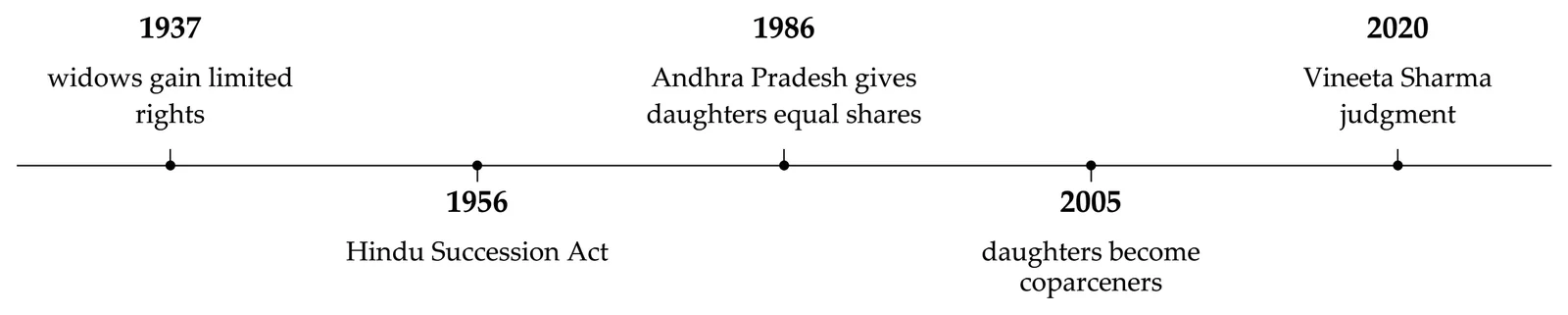
3. The Act of 1937
The Hindu Women’s Right to Property Act of 1937 gave widows a limited interest in their husbands’ property, a small first step towards women’s inheritance rights.
4. The Hindu Succession Act, 1956
The Hindu Succession Act gave daughters an equal share with sons in their father’s separate property but excluded them from the coparcenary in joint family property. Agricultural land was often governed by state tenure laws that favoured men.
5. State Reforms
Some states acted earlier. Kerala abolished the joint family system in 1975, and Andhra Pradesh (1986), Tamil Nadu (1989) and Maharashtra and Karnataka (1994) made daughters coparceners by state amendments.
6. The 2005 Amendment
The Hindu Succession (Amendment) Act of 2005 made daughters coparceners by birth, with the same rights and liabilities as sons, and removed the exemption for agricultural land that had allowed discriminatory state laws.
7. Vineeta Sharma
In Vineeta Sharma v Rakesh Sharma (2020), the Supreme Court held that daughters have coparcenary rights regardless of whether their father was alive when the 2005 amendment came into force, settling conflicting judgments.
8. Muslim Law
Under Muslim personal law, daughters inherit, but usually half the share of sons, and widows receive a fixed fraction. Some states applied customary law to agricultural land, further limiting women’s rights.
9. Christian Women
In Mary Roy v State of Kerala (1986), the Supreme Court struck down a Travancore law that gave Christian daughters only a small share, extending the Indian Succession Act of 1925 to Syrian Christians in Kerala.
10. Tribal Women
The Hindu Succession Act does not apply to Scheduled Tribes, whose customary laws often exclude women from inheriting land. In 2022, the Supreme Court urged the government to consider amending the law to protect tribal women.
11. Law and Practice
Despite legal rights, few women actually inherit land. The Agriculture Census of 2015–16 found that women held only about 14 per cent of operational holdings. Social pressure leads many daughters to give up their shares to brothers.
12. Policy Measures
Governments encourage women’s ownership through lower stamp duty on property registered in women’s names and by registering houses under rural housing schemes in the names of women or jointly.
13. Matrilineal Communities
Among the Khasis of Meghalaya, property passes to the youngest daughter, and the Nairs of Kerala followed matrilineal inheritance until the twentieth century, showing alternative arrangements.
14. Debates
Some argue that daughters receive dowry instead of inheritance, but feminists reply that dowry goes to the husband’s family and does not give women control over property.
15. Evaluation
Legal reforms have established women’s equal property rights in principle, but social norms and weak enforcement keep most property in men’s hands.
Conclusion. Thus, women’s property rights in India have expanded from the limited rights of 1937 to equal coparcenary rights under the 2005 amendment, confirmed in Vineeta Sharma (2020). As Bina Agarwal argues, land rights are crucial for women’s empowerment, but the gap between law and practice remains wide.
Important Question 3
Discuss the feminisation of labour and the gender and development approach.
OR
Examine the nature of women’s work in India with reference to Nirmala Banerjee.
OR
Distinguish between the Women in Development and Gender and Development approaches.
Model Answer
“That there is equal pay for equal work for both men and women.”
— Constitution of India, Article 39(d)
Introduction. Women perform a vast amount of work in India, both paid and unpaid, yet much of it is invisible, undervalued and insecure. Globalisation has drawn more women into flexible, low-paid jobs, a process called the feminisation of labour. Development thinking has also changed, from integrating women into development to examining the gender relations that shape it.
1. Women’s Work
Women’s work includes paid employment, unpaid work on family farms and enterprises, and unpaid domestic and care work. Statistics have often undercounted it, because much of it is done at home or classified as household duties.
2. Participation Trends
Women’s labour force participation fell to about 23 per cent in 2017–18 and rose to about 42 per cent by 2023–24, according to the Periodic Labour Force Survey. Much of the increase was in self-employment and unpaid work in family farms rather than regular jobs.
3. Banerjee: Work under Patriarchy
Nirmala Banerjee argues that patriarchy shapes women’s work: women are confined to tasks seen as extensions of domestic duties, are paid less, are concentrated in home-based and informal work and carry a double burden of paid and unpaid labour.
4. Feminisation of Labour
Guy Standing argued in 1989 that globalisation was producing a feminisation of labour: more women were drawn into flexible, low-paid, insecure jobs, while many men’s jobs also became more like women’s, without security or benefits.
5. Informal and Home-Based Work
Most women workers are in the informal sector, as agricultural labourers, home-based workers in beedi rolling, garment making and food processing, domestic workers and construction workers, without social security.
6. Feminisation of Agriculture
As men migrate to cities, women increasingly do agricultural work. Yet they rarely own land or receive credit, training and recognition as farmers.
7. The Wage Gap
Women earn less than men for similar work. The Equal Remuneration Act of 1976, now part of the Code on Wages, mandates equal pay, but occupational segregation and discrimination keep the gap wide.
8. Unpaid Care Work
The Time Use Survey of 2019 showed that women spend much more time than men on unpaid domestic and care work. This work sustains families and the economy but is not counted in national income.
9. Maternity and Child Care
The Maternity Benefit (Amendment) Act of 2017 increased paid maternity leave to 26 weeks and required creches in larger establishments, but it covers mainly the formal sector.
10. Women in Development
Ester Boserup’s Woman’s Role in Economic Development (1970) showed that development often marginalised women. The Women in Development approach of the 1970s sought to integrate women into development through projects for them.
11. Women and Development
The Women and Development approach, influenced by Marxist feminism, argued that women had always been part of development, but on unequal terms shaped by class and global capitalism.
12. Gender and Development
From the 1980s, the Gender and Development approach focused on power relations between women and men. Maxine Molyneux and Caroline Moser distinguished practical gender needs, such as water, from strategic gender needs, such as equal rights and control over resources.
13. Policy Responses
India introduced gender budgeting in 2005–06. Women make up a majority of workers under the rural employment guarantee, and self-help groups under the National Rural Livelihoods Mission have organised about ten crore women.
14. Persistent Barriers
Safety concerns, restrictions on mobility, lack of child care and social norms limit women’s employment. Few women reach senior positions, though company law now requires at least one woman director on many boards.
15. Evaluation
Women’s labour is central to India’s economy but remains undervalued. The Gender and Development approach shows that changing power relations is essential for real empowerment.
Conclusion. Thus, women’s work in India is extensive but largely unpaid, informal and undervalued, shaped by patriarchy, as Nirmala Banerjee shows. Globalisation has produced a feminisation of labour, and development thinking has moved from Women in Development to Gender and Development, which addresses the power relations underlying women’s disadvantage.
Important Question 4
Discuss women’s representation and participation in democratic institutions in India.
OR
Examine the impact of women’s reservation in local bodies.
OR
Discuss the Women’s Reservation Act, 2023, and the debate on women’s representation.
Model Answer
“Not less than one-third (including the number of seats reserved for women belonging to the Scheduled Castes and the Scheduled Tribes) of the total number of seats to be filled by direct election in every Panchayat shall be reserved for women.”
— Constitution of India, Article 243D(3)
Introduction. Women in India have voted since 1950, and their participation in elections has grown steadily. Yet their representation in legislatures remains low. Reservation in local bodies since 1992 brought lakhs of women into politics, and the Women’s Reservation Act of 2023 promises similar change in Parliament and the state assemblies. Amrita Basu examines the forces shaping women’s political participation.
1. Participation and Representation
Political participation includes voting, campaigning and protest, while representation refers to holding office. Hanna Pitkin distinguished descriptive representation, having women in office, from substantive representation, acting for women’s interests.
2. Women as Voters
Women gained universal suffrage under the Constitution. Their turnout has risen steadily, and in the general election of 2019, women’s turnout slightly exceeded men’s for the first time.
3. Women as a Constituency
Parties increasingly target women with schemes such as cash transfers, cooking gas connections and prohibition of alcohol, recognising women as an independent voting bloc rather than following male family members.
4. Women in Parliament
Women formed under five per cent of the first Lok Sabha. Their share rose to 78 members, about 14 per cent, in 2019, and was 74 in 2024. In state assemblies, the average is around ten per cent.
5. Basu on Gender and Politics
Amrita Basu shows that women’s political participation in India is shaped by parties, social movements and families. Many women leaders come from political families, parties are reluctant to nominate women, and women have been mobilised by movements of both the left and the right.
6. Reservation in Local Bodies
The 73rd and 74th Amendments of 1992 reserved one-third of seats and chairperson posts in panchayats and municipalities for women. More than twenty states have raised this to half, and about 14 lakh women are elected representatives in panchayats.
7. Impact of Local Reservation
Studies such as that of Raghabendra Chattopadhyay and Esther Duflo (2004) found that women heads of panchayats invested more in public goods that women value, such as drinking water. Reservation has increased women’s confidence and visibility.
8. Proxy Leadership
In some places, male relatives exercise power on behalf of elected women, a practice called sarpanch pati. Training, support and social change are needed for elected women to exercise real authority.
9. The Women’s Reservation Act, 2023
The Constitution (One Hundred and Sixth Amendment) Act, 2023, reserves one-third of seats in the Lok Sabha and state assemblies for women, including within seats reserved for Scheduled Castes and Scheduled Tribes, for fifteen years. It will take effect after the next census and delimitation.
10. The Quota-within-Quota Debate
Some parties demanded separate quotas for women from backward classes and minorities, fearing that upper-caste women would dominate. This debate delayed the bill for decades and remains unresolved.
11. Women Leaders
India has had women as Prime Minister, Indira Gandhi; President, Pratibha Patil and Droupadi Murmu, the first tribal President; and Chief Ministers such as Mayawati, Jayalalithaa and Mamata Banerjee.
12. Barriers
Women face barriers such as patriarchal attitudes, the cost of elections, violence and online abuse, party gatekeeping and the double burden of household work.
13. Beyond Formal Politics
Women participate actively in movements, protests and civil society, from the Chipko movement to the farmers’ protests and Shaheen Bagh, shaping politics outside legislatures.
14. Critical Mass
Scholars argue that women need a critical mass, often put at about 30 per cent, to change the culture and agenda of institutions, which is the rationale for one-third reservation.
15. Evaluation
Women’s political participation has grown, but representation lags. Reservation in local bodies has shown its value, and implementing reservation in legislatures is the next step.
Conclusion. Thus, women in India vote in large numbers but remain under-represented in legislatures. Reservation in local bodies since 1992 brought lakhs of women into politics with positive effects, and the Women’s Reservation Act of 2023 promises one-third representation in Parliament and the assemblies, though debates on quotas within quotas and real empowerment continue.
Short Notes
(a) Coparcenary
Under Hindu Mitakshara law, the group of family members who acquire a share in joint family property by birth. Until 2005 only sons were coparceners; the 2005 amendment made daughters equal coparceners.
(b) Feminisation of labour
Guy Standing’s term (1989) for the increasing share of women in flexible, low-paid, insecure jobs under globalisation, and the spread of such insecure conditions to men’s jobs.
(c) Practical and strategic gender needs
A distinction made by Maxine Molyneux and Caroline Moser. Practical needs arise from women’s existing roles, such as water and health care; strategic needs aim to change gender relations, such as equal rights and control over resources.
More notes: DSE-8 Feminism: Theory and Practice
These notes are prepared by PADHO TO AISE for study help. They are not an official University of Delhi publication.