
Semester VI MDSE-4a Gender in International Relations
Unit IV · 22 min read · Updated 24 Nov 2026
As per the University of Delhi (DU) BA (Hons) Political Science syllabus
Contents
- 4.1 Gender and Foreign Policy
- Hoganson: What Has Gender Got to Do with It
- Feminist Foreign Policy
- Rajagopalan: Feminism and Indian Foreign Policy
- Women in Diplomacy and Peace Processes
- 4.2 Gender and International Institutions
- Snyder: The UN as Unlikely Godmother
- Shepherd: The Women, Peace and Security Agenda
- Global Women’s Movement Milestones
- 4.3 Gender, War and Conflicts
- Militarism as Gendered
- Sexual Violence in Conflict
- Men and Boys in War
- Women in Combat and Violent Women
- Prosecuting Sexual Violence
- 4.4 Important Questions
- Discuss the relationship between gender and foreign policy with reference to feminist foreign policy.
- Discuss the role of international institutions in advancing gender equality with reference to the UN and the Women, Peace and Security agenda.
- Discuss sexual and gender-based violence in conflict situations.
- Discuss the debates on women in combat and on women as agents of political violence.
- Short Notes
आख़िरकार सार्वभौमिक मानवाधिकार कहाँ से शुरू होते हैं? छोटी जगहों से, घर के पास।
Where, after all, do universal human rights begin? In small places, close to home.
— Eleanor Roosevelt, Address at the United Nations, New York (27 March 1958)
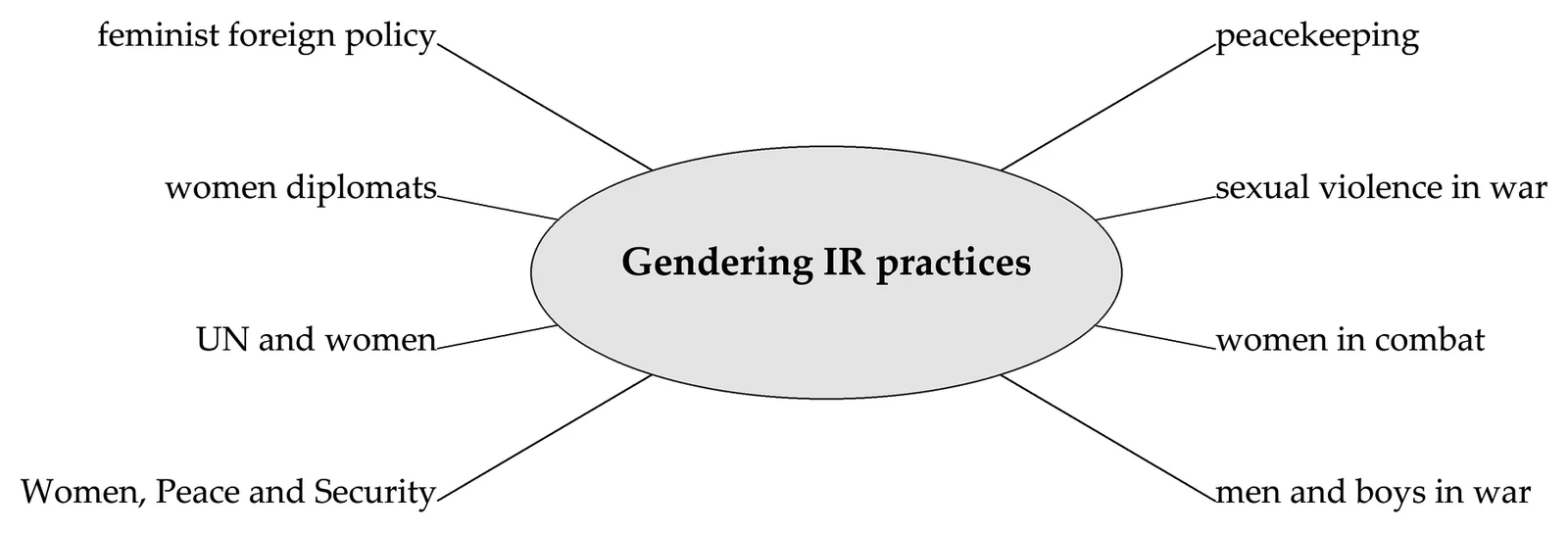
GGENDER is not only a matter of theory; it shapes the practice of international politics. Some states now declare a feminist foreign policy. The United Nations has been called the unlikely godmother of the global women’s movement, and its Women, Peace and Security agenda tries to bring women into peace processes and to address sexual violence in war. Wars themselves are fought through gendered practices, from the targeting of men and boys in massacres to the use of sexual violence and the debates on women in combat. This chapter studies Unit IV of the syllabus: gender and foreign policy, gender and international institutions, and gender, war and conflicts.
4.1 Gender and Foreign Policy
Hoganson: What Has Gender Got to Do with It
Kristin Hoganson, in What’s Gender Got to Do with It? Women and Foreign Relations History (2005), shows that gender has always shaped foreign policy, even when women were excluded from it. Ideas of manliness influenced decisions for war, as in her study of the United States’ wars of 1898, when politicians urged war to prove American manhood. Women influenced foreign relations as missionaries, activists, consumers and wives of diplomats. Studying gender therefore reveals motives and actors that traditional diplomatic history overlooked.
Feminist Foreign Policy
In 2014 Sweden, under Foreign Minister Margot Wallström, became the first country to declare a feminist foreign policy, focused on the rights, representation and resources of women and girls. Others followed, including Canada (Feminist International Assistance Policy, 2017), France (2019), Mexico (2020), Spain (2021) and Germany (2023). Victoria Scheyer and Marina Kumskova, in Feminist Foreign Policy: A Fine Line Between Adding Women and Pursuing a Feminist Agenda (2019), distinguish two approaches. One simply adds women, increasing their numbers in diplomacy and including women’s issues, without changing the underlying priorities. The other pursues a feminist agenda, questioning militarism, arms sales and hierarchies of power, and putting human security, peace and intersectional equality at the centre. They argue that many declared feminist foreign policies remain closer to the first approach, for example when states continue large arms exports.
Rajagopalan: Feminism and Indian Foreign Policy
Swarna Rajagopalan, in Reflections on Feminism and Foreign Policy (2012), argues that Indian foreign policy has rarely considered gender, either in who makes it or in what it addresses. She suggests that a feminist lens would ask about the security of women in India’s neighbourhood, about women’s participation in peace processes and diplomacy, and about how foreign policy choices, such as trade or defence, affect women. The Council on Foreign Relations report Advancing Gender Equality in Foreign Policy (2020) similarly argues that gender equality strengthens security and prosperity, citing evidence that peace agreements are more likely to last when women participate.
- Women diplomats. India’s first woman Foreign Service officer, C. B. Muthamma, joined in 1949; women now serve as ambassadors and Foreign Secretaries.
- G20 presidency. During its G20 presidency in 2023, India promoted women-led development as a priority.
- Peacekeeping. India deployed the first all-women formed police unit in UN peacekeeping, in Liberia in 2007.

Women in Diplomacy and Peace Processes
- Peace agreements. UN Women has reported that peace agreements are more likely to last when women participate in their negotiation.
- Liberia. In 2003, the Women of Liberia Mass Action for Peace, led by Leymah Gbowee, pressed warring parties to reach a peace agreement; Gbowee shared the Nobel Peace Prize in 2011.
- Northern Ireland. The Northern Ireland Women’s Coalition took part in the talks that produced the Good Friday Agreement of 1998.
- Colombia. The peace agreement of 2016 included a gender sub-commission, often cited as a model.
4.2 Gender and International Institutions
Snyder: The UN as Unlikely Godmother
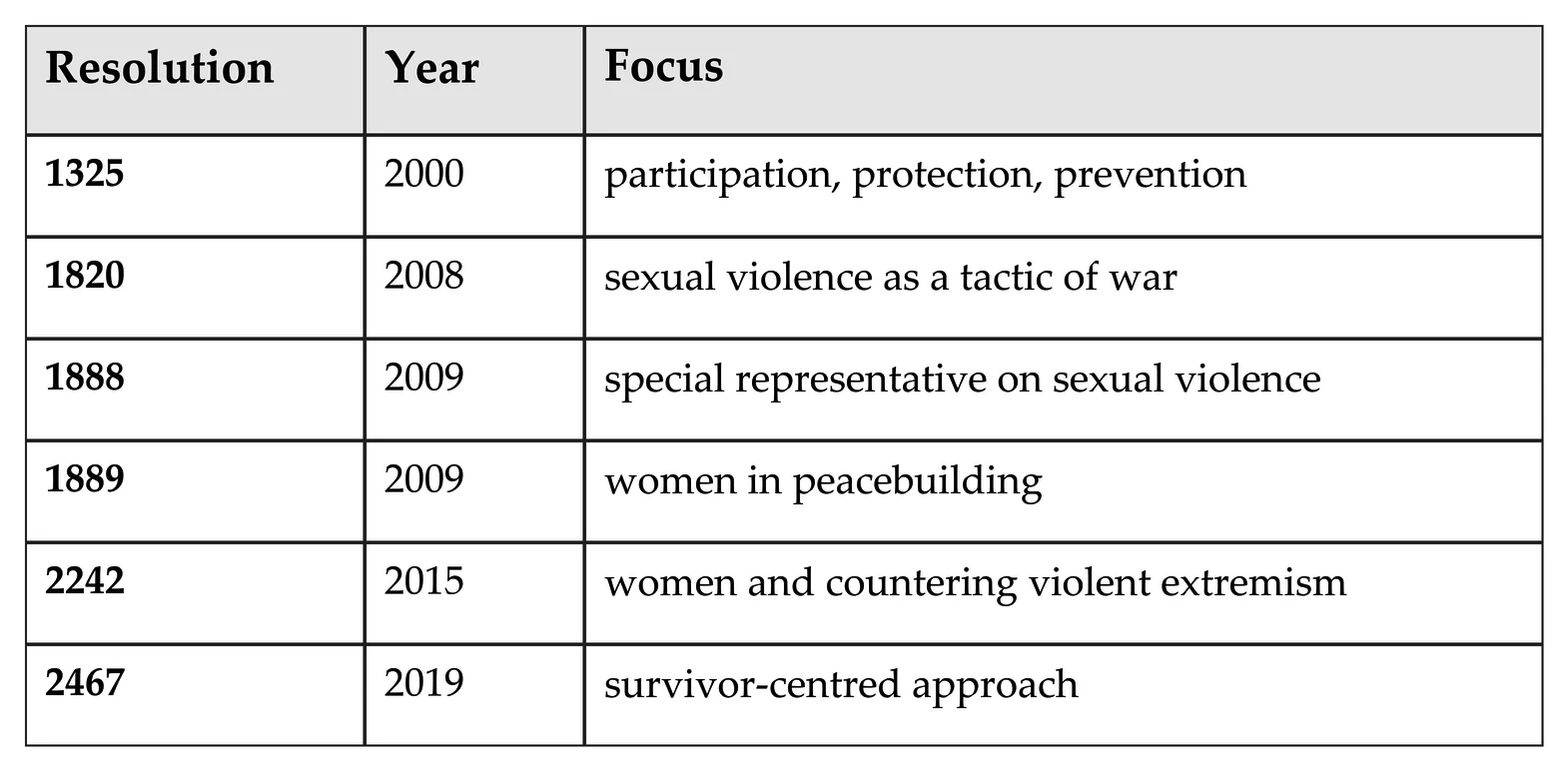
Margaret Snyder, the founding director of the UN Development Fund for Women (UNIFEM), in Unlikely Godmother: The UN and the Global Women’s Movement (2006), argues that the United Nations, though created and run largely by men, became a key supporter of the global women’s movement. It created the Commission on the Status of Women (1946), declared 1975 International Women’s Year with a world conference in Mexico City, launched the UN Decade for Women (1976–85), adopted CEDAW (1979), and held further conferences at Copenhagen (1980), Nairobi (1985) and Beijing (1995). These meetings brought together women activists from across the world, helped build transnational networks and placed issues such as violence against women and women’s role in development on the global agenda. In 2010 four UN bodies were merged to create UN Women.

Shepherd: The Women, Peace and Security Agenda
Laura Shepherd, in Power and Authority in the Production of United Nations Security Council Resolution 1325 (2008), analyses how Resolution 1325 (2000) constructed women, gender and security. Pushed by an NGO Working Group, it called for women’s participation in peace processes, their protection from gender-based violence and the prevention of conflict. Shepherd shows that the resolution treats women both as victims needing protection and as agents of peace, and that its meaning depends on how institutions interpret it. In Sex, Security and Superhero(in)es: From 1325 to 1820 and Beyond (2011), she examines later resolutions, especially Resolution 1820 (2008) on sexual violence as a tactic of war, and argues that the agenda increasingly focused on sexual violence, casting women mainly as victims and peacekeepers as heroic protectors, while participation received less attention.
- Gender mainstreaming. Adopted at Beijing in 1995, it requires institutions to assess the effects of all policies on women and men.
- Peacekeeping. Audrey Reeves (2012) shows how feminist knowledge entered UN peacekeeping through gender advisers and training, but became a technical form of governance.
- The World Bank. Kate Bedford (2007) shows how the Bank’s gender policy came to stress the inclusion of men, promoting a model of cooperative heterosexual couples shaped by its institutional priorities.
Global Women’s Movement Milestones
- 1946: the Commission on the Status of Women is created.
- 1975: International Women’s Year and the first world conference on women at Mexico City.
- 1979: CEDAW is adopted; India ratified it in 1993.
- 1993: the Vienna Declaration affirms that women’s rights are human rights, and the UN adopts a declaration on violence against women.
- 1995: the Beijing Declaration and Platform for Action set out twelve critical areas of concern.
- 2010: UN Women is created.
4.3 Gender, War and Conflicts
Militarism as Gendered
Laura Sjoberg and Sandra Via, in Gender, War and Militarism: Feminist Perspectives (2010), argue that militarism, i.e. the belief that military values and force are central to society, is a gendered ideology that glorifies masculine strength and relies on feminised support, from wives and nurses to workers in defence industries. War both depends on and reshapes gender relations.
Sexual Violence in Conflict
Megan Gerecke, in Explaining Sexual Violence in Conflict Situations (2010), reviews explanations. Some see it as opportunistic, resulting from the breakdown of order; others as strategic, a weapon of war used to terrorise communities or carry out ethnic cleansing, as in Bosnia and Rwanda; and feminist explanations stress gender norms and militarised masculinities that make women’s bodies symbols of the enemy community. International law has responded: the ICTR’s Akayesu judgment (1998) recognised rape as an act of genocide, the Rome Statute (1998) lists rape and sexual slavery as war crimes and crimes against humanity, and Resolution 1820 (2008) treated sexual violence as a threat to peace. Roxanne Krystalli (2014) warns that debates over statistics on wartime sexual violence shape which narratives and policies dominate.
Men and Boys in War
Charli Carpenter, in Recognizing Gender-Based Violence Against Civilian Men and Boys in Conflict Situations (2006), argues that gender-based violence also targets men. Sex-selective massacres of men and boys of fighting age, as at Srebrenica in 1995, forced conscription and sexual violence against men are often ignored because humanitarian agencies see women and children as the only vulnerable civilians. Recognising this does not reduce attention to women but shows how gender norms shape violence against everyone.
Women in Combat and Violent Women
Megan MacKenzie, in Women in Combat: Beyond Can They or Should They (2013), argues that the debate on women in combat should move beyond questions of physical ability to examine how militaries construct gender and exclude women. The United States lifted its ban on women in ground combat in 2013. In India, the first women fighter pilots were commissioned in 2016, the Supreme Court ordered permanent commission for women officers in 2020, and women joined the National Defence Academy from 2022. Laura Sjoberg and Caron Gentry, in Reduced to Bad Sex (2008), show that women who commit political violence are often explained away as mothers, monsters or whores, denying them political agency. Cynthia Enloe, in her essay titled All the Men Are in the Militias, All the Women Are Victims (2004), criticises such simple stories of war.

Prosecuting Sexual Violence
International courts have changed how sexual violence in war is treated. The International Criminal Tribunal for Rwanda, in the Akayesu case (1998), held that rape could constitute genocide. The International Criminal Tribunal for the former Yugoslavia convicted commanders for rape as a crime against humanity in the Foča case (2001). The Rome Statute of the International Criminal Court (1998) lists rape, sexual slavery, enforced prostitution and forced pregnancy as war crimes and crimes against humanity. These developments, pushed by feminist lawyers and activists, ended the long treatment of wartime rape as an unavoidable side effect of war.
4.4 Important Questions
- Question 1 Discuss the relationship between gender and foreign policy with reference to feminist foreign policy.
- Question 2 Discuss the role of international institutions in advancing gender equality with reference to the UN and the Women, Peace and Security agenda.
- Question 3 Discuss sexual and gender-based violence in conflict situations.
- Question 4 Discuss the debates on women in combat and on women as agents of political violence.
DU asks the same idea in different words. So learn one broad answer for each question below; the same answer works for every question joined by OR.
Important Question 1
Discuss the relationship between gender and foreign policy with reference to feminist foreign policy.
OR
Examine Scheyer and Kumskova’s distinction between adding women and pursuing a feminist agenda.
OR
Discuss Swarna Rajagopalan’s reflections on feminism and Indian foreign policy.
Model Answer
“States Parties shall take all appropriate measures to ensure to women, on equal terms with men and without any discrimination, the opportunity to represent their Governments at the international level and to participate in the work of international organizations.”
— CEDAW (1979), Article 8
Introduction. Gender has always shaped foreign policy, through ideas of manliness, the roles of women behind the scenes and the exclusion of women from diplomacy. Since 2014, several states have declared feminist foreign policies. Scheyer and Kumskova distinguish policies that merely add women from those that pursue a transformative feminist agenda, while Swarna Rajagopalan reflects on what feminism could mean for Indian foreign policy.
1. Gender in Foreign Policy History
Hoganson shows that ideas of manliness influenced decisions for war, as in the US wars of 1898.
2. Women behind the Scenes
Women shaped foreign relations as missionaries, activists, consumers and wives of diplomats.
3. Exclusion from Diplomacy
Women were long excluded from diplomatic services, and CEDAW (1979) called for their equal representation abroad.
4. Sweden’s Initiative
In 2014 Sweden declared the first feminist foreign policy, focusing on women’s rights, representation and resources. Its framework was summed up as the three Rs: rights, representation and resources for women and girls.
5. Other Adopters
Canada, France, Mexico, Spain and Germany adopted feminist foreign or aid policies between 2017 and 2023.
6. Adding Women
Scheyer and Kumskova describe one approach that simply increases women’s numbers and includes women’s issues.
7. A Feminist Agenda
The other approach questions militarism, arms sales and power hierarchies, putting human security and equality at the centre. This approach also asks how foreign policy affects women in other countries, not only at home.
8. Gap between Words and Deeds
They argue that many declared feminist foreign policies remain closer to adding women, as when states keep large arms exports.
9. Sweden’s Reversal
Sweden’s new government dropped the label in 2022, showing the policy’s political fragility.
10. Evidence on Peace
The CFR report notes that peace agreements are more likely to last when women participate.
11. Rajagopalan on India
Rajagopalan argues that Indian foreign policy has rarely considered gender, in its makers or its concerns.
12. A Feminist Lens for India
She suggests attention to women’s security in the neighbourhood, women in peace processes and gendered effects of trade and defence.
13. Indian Practice
India’s women peacekeepers and its G20 focus on women-led development show steps in this direction.
14. Women Diplomats in India
From C. B. Muthamma in 1949 to women Foreign Secretaries, women have gradually entered Indian diplomacy.
15. Criticism
Critics argue that feminist foreign policy can become branding, or impose Western values on other societies.
16. Defence
Supporters reply that gender equality is a universal goal and improves security and development.
17. Arms Exports and Feminism
Critics noted that Sweden continued arms exports while pursuing a feminist foreign policy, illustrating the gap Scheyer and Kumskova describe.
18. Global South Perspectives
Mexico’s adoption of a feminist foreign policy in 2020 showed that the idea is not limited to Western states.
19. Evaluation
Feminist foreign policy is an important innovation, but its value depends on whether it changes priorities, not just numbers.
Conclusion. Thus, gender has always shaped foreign policy, and CEDAW calls for women’s equal role in international representation. Scheyer and Kumskova show the difference between adding women and pursuing a feminist agenda, and Rajagopalan suggests how such ideas could reshape Indian foreign policy.
Important Question 2
Discuss the role of international institutions in advancing gender equality with reference to the UN and the Women, Peace and Security agenda.
OR
Examine Margaret Snyder’s view of the UN as the unlikely godmother of the global women’s movement.
OR
Critically examine the Women, Peace and Security agenda from Resolution 1325 to 1820.
Model Answer
“The United Nations shall place no restrictions on the eligibility of men and women to participate in any capacity and under conditions of equality in its principal and subsidiary organs.”
— Charter of the United Nations, Article 8
Introduction. International institutions, especially the United Nations, have played a major role in advancing gender equality. Margaret Snyder calls the UN the unlikely godmother of the global women’s movement, while Laura Shepherd analyses how the Women, Peace and Security agenda, from Resolution 1325 to 1820, constructs women, gender and security.
1. The UN Charter
Article 8 of the Charter declared equal eligibility of men and women in UN bodies.
2. Commission on the Status of Women
The UN created the Commission on the Status of Women in 1946 to promote women’s rights.
3. Snyder’s Unlikely Godmother
Snyder argues that the UN, though run largely by men, became a key supporter of the global women’s movement.
4. World Conferences
Conferences at Mexico City (1975), Copenhagen, Nairobi and Beijing (1995) built transnational women’s networks. The Beijing conference alone brought together about 17,000 delegates and some 30,000 activists at a parallel NGO forum.
5. CEDAW
CEDAW (1979), often called the international bill of rights for women, commits states to end discrimination. States that ratify it must report regularly to a committee of experts that reviews their progress.
6. UNIFEM and UN Women
UNIFEM, which Snyder led, supported women’s development; UN Women was created in 2010.
7. Gender Mainstreaming
Adopted at Beijing in 1995, gender mainstreaming requires assessing the effects of all policies on women and men.
8. Resolution 1325
Resolution 1325 (2000) called for women’s participation in peace processes, protection and prevention of conflict. It was the first Security Council resolution to link women’s experiences of conflict with international peace and security.
9. Shepherd on 1325
Shepherd shows that 1325 treats women both as victims and as agents of peace, its meaning depending on interpretation.
10. The NGO Role
An NGO Working Group pushed for 1325, showing the influence of civil society on the Security Council.
11. Resolution 1820
Resolution 1820 (2008) recognised sexual violence as a tactic of war and a threat to peace.
12. Shepherd’s Critique
Shepherd argues that later resolutions focus on sexual violence, casting women as victims and peacekeepers as heroes. She argues that this shift narrows the agenda, since participation and prevention receive less attention than protection.
13. Peacekeeping
Reeves shows that feminist knowledge entered peacekeeping but became a technical form of governance.
14. The World Bank
Bedford shows how the World Bank’s gender policy came to stress male inclusion and cooperative couples.
15. India and WPS
India has contributed women peacekeepers but has not adopted a national action plan on Resolution 1325.
16. Criticism
Critics argue that institutions often adopt gender language without changing power structures.
17. Beijing Platform
The Beijing Platform for Action (1995) identified twelve critical areas of concern, including women and armed conflict, guiding later UN work.
18. Vienna 1993
The Vienna Declaration of 1993 affirmed that women’s rights are human rights and called for action against violence against women.
19. Evaluation
International institutions have advanced gender equality significantly, though their approaches have limits.
Conclusion. Thus, from Article 8 of the Charter to UN Women, the UN has supported the global women’s movement, as Snyder shows. Shepherd’s analysis of Resolutions 1325 and 1820 reveals both the achievements and the limits of the Women, Peace and Security agenda.
Important Question 3
Discuss sexual and gender-based violence in conflict situations.
OR
Examine the explanations of sexual violence in conflict.
OR
Discuss Charli Carpenter’s argument on gender-based violence against civilian men and boys.
Model Answer
“Sexual violence, when used or commissioned as a tactic of war in order to deliberately target civilians or as a part of a widespread or systematic attack against civilian populations, can significantly exacerbate situations of armed conflict and may impede the restoration of international peace and security.”
— UN Security Council Resolution 1820 (2008), paragraph 1
Introduction. Sexual and gender-based violence has been a feature of many conflicts, from Bosnia and Rwanda to the Democratic Republic of Congo. Megan Gerecke reviews explanations of sexual violence in war, international law has recognised it as a serious crime, and Charli Carpenter shows that gender-based violence also targets civilian men and boys.
1. A Feature of War
Sexual violence has occurred in many conflicts, often on a massive scale. For centuries it was treated as an unavoidable by-product of war rather than as a crime.
2. Bosnia and Rwanda
In the 1990s, mass rape in Bosnia and Rwanda drew global attention to sexual violence as a strategy. In Bosnia, rape camps were used as part of ethnic cleansing, and in Rwanda sexual violence was part of the genocide of 1994.
3. Gerecke’s Review
Gerecke reviews opportunistic, strategic and feminist explanations of sexual violence.
4. Opportunistic Explanation
Some see it as the result of the breakdown of order and discipline in war.
5. Strategic Explanation
Others see it as a weapon of war used to terrorise communities or carry out ethnic cleansing. In this view, commanders order or permit sexual violence because it humiliates the enemy and drives communities away.
6. Feminist Explanation
Feminists stress gender norms and militarised masculinities that make women’s bodies symbols of the enemy. Feminists argue that militarised masculinity and the idea of women as bearers of community honour make such violence possible.
7. The Akayesu Judgment
The ICTR’s Akayesu judgment (1998) recognised rape as an act of genocide. It was the first time an international court convicted a person of rape as a crime of genocide.
8. The Rome Statute
The Rome Statute (1998) lists rape and sexual slavery as war crimes and crimes against humanity.
9. Resolution 1820
Resolution 1820 (2008) treated sexual violence as a tactic of war and a threat to peace.
10. Krystalli on Narratives
Krystalli warns that debates over statistics shape which narratives and policies dominate.
11. Carpenter on Men and Boys
Carpenter argues that gender-based violence also targets civilian men and boys. She shows that the assumption that men are combatants makes civilian men targets of killing and forced recruitment.
12. Sex-Selective Massacres
At Srebrenica in 1995, men and boys of fighting age were massacred, a gender-based atrocity.
13. Neglect by Agencies
Humanitarian agencies often see only women and children as vulnerable, neglecting men’s gendered risks. Evacuation programmes in some conflicts rescued women and children while leaving men behind, exposing them to massacre.
14. Sexual Violence against Men
Sexual violence against men is widely under-reported because of stigma.
15. Recognition
The Nobel Peace Prize of 2018 to Denis Mukwege and Nadia Murad honoured efforts against sexual violence in war. Nadia Murad, a Yazidi survivor of Islamic State captivity, became a global advocate for survivors.
16. Criticism
Some argue that focusing on sexual violence can overshadow other harms and women’s agency.
17. The Foča Case
The Yugoslavia tribunal’s Foča judgment (2001) convicted commanders for rape and enslavement as crimes against humanity.
18. Survivor-Centred Approach
Resolution 2467 (2019) called for a survivor-centred approach, focusing on the needs and rights of those who suffered sexual violence.
19. Evaluation
Understanding sexual and gender-based violence requires attention to gender norms affecting both women and men.
Conclusion. Thus, Resolution 1820 recognised sexual violence as a tactic of war that threatens peace. Gerecke’s explanations and Carpenter’s focus on men and boys show that gender shapes violence in conflict in complex ways.
Important Question 4
Discuss the debates on women in combat and on women as agents of political violence.
OR
Examine Megan MacKenzie’s argument on women in combat.
OR
Discuss Sjoberg and Gentry’s analysis of narratives of violent women.
Model Answer
“All the men are in the militias, all the women are victims.”
— Cynthia Enloe, chapter title in The Curious Feminist (2004)
Introduction. War has traditionally been seen as men’s business, with women as victims or supporters. Feminist scholars challenge this. Megan MacKenzie argues that the debate on women in combat must go beyond whether women can or should fight, while Laura Sjoberg and Caron Gentry show how narratives deny violent women political agency. Cynthia Enloe criticises simple stories in which all men fight and all women are victims.
1. War as Men’s Business
Militaries have long excluded women from combat, linking soldiering with masculinity. Women nevertheless served in wars as nurses, spies, workers and, in some armies, as soldiers.
2. Enloe’s Critique
Enloe criticises stories in which all men are fighters and all women victims, hiding complex realities.

3. Sjoberg and Via on Militarism
Sjoberg and Via show that militarism is a gendered ideology glorifying masculine strength.
4. MacKenzie’s Argument
MacKenzie argues that the debate should move beyond whether women can or should fight. She notes that arguments about strength or unit cohesion have been used to exclude women regardless of evidence.
5. Constructing Exclusion
She examines how militaries construct gender to exclude women, rather than accepting exclusion as natural.
6. The US Decision
The United States lifted its ban on women in ground combat in 2013. Women had already served in Iraq and Afghanistan in roles that often exposed them to combat, which made the ban hard to justify.
7. India’s Women Fighter Pilots
India commissioned its first women fighter pilots in 2016.
8. Permanent Commission
In 2020 the Supreme Court ordered permanent commission for women officers in the Army. In the Babita Puniya case, the Court rejected the argument that physical limitations justified denying women command roles.
9. Women in the NDA
Women joined the National Defence Academy from 2022 after a Supreme Court order.
10. Violent Women
Women have also taken part in insurgencies and terrorism, challenging the image of peaceful women.
11. Mothers, Monsters, Whores
Sjoberg and Gentry show that violent women are explained as mothers, monsters or whores. These stereotypes appear in media accounts of women in terrorist groups and in cases such as the women guards of Abu Ghraib.
12. Denying Agency
Such narratives deny women political agency, treating their violence as personal or sexual.
13. Bloom’s Evidence
Bloom’s study of female suicide bombers shows a mix of personal and political motives.
14. Equality and Militarism
Some feminists welcome women in combat as equality; others worry that it legitimises militarism. This debate reflects a wider tension between liberal feminism, which seeks equal access, and anti-militarist feminism.
15. Women in Peace
Women also play leading roles in peace movements, such as Liberia’s women’s peace campaign of 2003.
16. Criticism
Critics argue that combat integration may change little if military culture remains hyper-masculine.
17. Liberia’s Women for Peace
Leymah Gbowee and the women of Liberia pressed warring parties into a peace agreement in 2003, showing women as peacemakers.
18. Women in Indian Armed Forces
Women now serve in many branches of the Indian armed forces, though full combat roles in some arms remain under debate.
19. Evaluation
These debates show that women are combatants, peacemakers and victims, and that gender shapes all these roles.
Conclusion. Thus, Enloe’s critique of the idea that all men are in the militias and all women are victims captures the feminist challenge. MacKenzie on combat and Sjoberg and Gentry on violent women show that women’s roles in war are complex and political.
Short Notes
(a) Feminist foreign policy
A foreign policy that puts gender equality and the rights of women and girls at its centre, first declared by Sweden in 2014.
(b) Gender mainstreaming
The strategy adopted at Beijing in 1995 of assessing the effects of all policies and programmes on women and men.
(c) Resolution 1820
The UN Security Council resolution of 2008 recognising sexual violence used as a tactic of war as a threat to international peace and security.
(d) CEDAW
The Convention on the Elimination of All Forms of Discrimination against Women, adopted by the UN General Assembly in 1979 and ratified by India in 1993, often called an international bill of rights for women.
More notes: MDSE-4a Gender in International Relations
These notes are prepared by PADHO TO AISE for study help. They are not an official University of Delhi publication.