
Semester VII DSE-7 Public Policy
Unit IV · 19 min read · Updated 24 Nov 2026
As per the University of Delhi (DU) BA (Hons) Political Science syllabus
Contents
- 4.1 Tools of Policy Decision-Making
- 4.2 Cost-Benefit Analysis
- 4.3 Simulation and Gaming
- 4.4 Knowledge Management
- 4.5 Supply Chain Management
- 4.6 Important Questions
- Discuss cost-benefit analysis as a tool of policy decision-making.
- Discuss simulation and gaming as techniques of policy decision-making.
- Discuss knowledge management as a tool of public policy.
- Discuss the role of supply chain management in public policy.
- Short Notes
ज्ञान ही शक्ति है।
Knowledge itself is power.
— Francis Bacon, Meditationes Sacrae (1597)
GOOD intentions are not enough to make good policy; decision-makers also need tools to compare options, foresee consequences, use knowledge and deliver goods and services. This chapter studies four tools and techniques of policy decision-making named in the syllabus. Cost-benefit analysis compares the gains and losses of policies in money terms. Simulation and gaming test policies on models before trying them in reality. Knowledge management helps organisations create, share and use knowledge. Supply chain management ensures that food, medicines and other goods reach citizens. The chapter draws on Matthew Adler and Eric Posner, Anthony Boardman and colleagues, and Reetika Khera.

4.1 Tools of Policy Decision-Making
Decision-makers use a range of tools and techniques to make policy more rational, efficient and effective. Some, such as cost-benefit analysis, help compare alternatives. Others, such as simulation and gaming, help foresee consequences. Knowledge management helps organisations learn, and supply chain management helps them deliver. These tools reflect the rational approach to policy, but their use is shaped by politics, values and the limits of information.
4.2 Cost-Benefit Analysis
Cost-benefit analysis (CBA) identifies all the costs and benefits of a policy, expresses them in money, discounts future values to the present and recommends the policy if its net present value is positive. Adler and Posner defend CBA as a useful decision procedure for promoting overall well-being, while critics question putting prices on life, health and the environment and ignoring who gains and who loses. Reetika Khera’s critique of a cost-benefit study of Aadhaar shows how assumptions can shape results.
4.3 Simulation and Gaming
Simulation represents a real system through a model and runs it under different conditions to see what might happen. Gaming adds human players who take on roles and make decisions. These techniques allow policy-makers to test options safely, from economic forecasting and epidemic modelling to disaster drills and war games.

4.4 Knowledge Management
Knowledge management is the process of creating, capturing, sharing and using knowledge in organisations. It distinguishes tacit knowledge, held in people’s experience, from explicit knowledge in documents and data. In government, it supports evidence-based policy, institutional memory and e-governance.
4.5 Supply Chain Management
Supply chain management coordinates the flow of goods, information and money from suppliers to final users. In public policy, it is essential for delivering food grains through the public distribution system, vaccines, medicines and disaster relief. Reforms such as computerisation, tracking and e-procurement aim to make these chains efficient and transparent.
4.6 Important Questions
- Question 1 Discuss cost-benefit analysis as a tool of policy decision-making.
- Question 2 Discuss simulation and gaming as techniques of policy decision-making.
- Question 3 Discuss knowledge management as a tool of public policy.
- Question 4 Discuss the role of supply chain management in public policy.
DU asks the same idea in different words. So learn one broad answer for each question below; the same answer works for every question joined by OR.
Important Question 1
Discuss cost-benefit analysis as a tool of policy decision-making.
OR
Critically examine the strengths and limitations of cost-benefit analysis.
OR
Examine Adler and Posner’s justification of cost-benefit analysis.
Model Answer
“If the benefits to whomsoever they may accrue are in excess of the estimated costs.”
— United States Flood Control Act (1936)
Introduction. Cost-benefit analysis is a technique for evaluating policies and projects by comparing their total expected benefits with their total expected costs, both expressed in money. It is one of the most widely used tools of rational policy analysis. Yet it raises difficult questions about how to value non-market goods, how to treat the future and how to account for the distribution of gains and losses.
1. Meaning
Cost-benefit analysis asks whether a policy makes society better off on balance. It lists all the effects of a policy on everyone affected, converts them into money values and recommends the policy if benefits exceed costs. It is used for roads, dams, health programmes and regulations.
2. Origins
The French engineer Jules Dupuit analysed the benefits of public works such as bridges in 1844. The United States Flood Control Act of 1936 required that benefits exceed costs, and in the 1960s the Planning-Programming-Budgeting System spread such analysis across government.
3. Steps
Boardman and his co-authors describe the steps: specify alternatives, decide whose costs and benefits count, identify and measure impacts, value them in money, discount future values, calculate net present value, perform sensitivity analysis and make a recommendation.
4. Valuation
Where market prices exist, they are used, sometimes adjusted as shadow prices to reflect true social value. Where no market exists, analysts estimate willingness to pay through surveys or by observing behaviour, for example to value clean air or time saved.
5. Discounting
Benefits and costs that occur in the future are discounted, because people value present benefits more than future ones. The choice of discount rate matters greatly for long-term projects such as climate policy, where a high rate makes future damages seem small.
6. Decision Rules
A policy passes the test if its net present value is positive, or its benefit-cost ratio is greater than one. Among alternatives, the one with the highest net present value is preferred. Analysts also calculate the internal rate of return.
7. Kaldor-Hicks Efficiency
CBA rests on the Kaldor-Hicks criterion: a policy is efficient if the winners could, in principle, compensate the losers and still be better off, even if compensation is not actually paid. This is called a potential Pareto improvement.
8. Adler and Posner’s Justification
Matthew Adler and Eric Posner argue that CBA should not be seen as a moral criterion in itself but as a decision procedure that helps agencies promote overall well-being. It is justified because it usually tracks well-being better than alternatives, and it can be corrected for distributive and other concerns.
9. CBA in India
India used social cost-benefit analysis for project appraisal in the planning era, guided by the UNIDO Guidelines of 1972, written by Partha Dasgupta, Stephen Marglin and Amartya Sen. Environmental impact assessment became mandatory for major projects from 1994.
10. Khera on Aadhaar
In 2013, Reetika Khera criticised a cost-benefit study of Aadhaar that projected very high returns. She argued that it overestimated benefits by assuming that leakages came from identity fraud and underestimated costs, including the burden on excluded beneficiaries.
11. Strengths
CBA makes decisions systematic and transparent, forces analysts to consider all effects, allows comparison across very different options and helps avoid wasteful projects.
12. Valuing the Priceless
Critics argue that it is wrong or impossible to put money values on human life, health, culture, biodiversity or sacred places. Methods such as the value of a statistical life remain controversial.
13. Distribution and Equity
CBA adds up gains and losses regardless of who receives them, so a project that harms the poor but benefits the rich more can pass the test. Distributional weights and social impact assessment are used to correct this.
14. Uncertainty and Manipulation
Estimates of future costs and benefits are uncertain and can be manipulated to justify decisions already taken. Large projects often have cost overruns and overstated benefits.
15. Evaluation
CBA is a powerful tool for rational policy-making, but it must be used with care, transparency and attention to equity and values that money cannot capture.
Conclusion. Thus, cost-benefit analysis compares the discounted money value of a policy’s benefits and costs, recommending it if net benefits are positive. Adler and Posner defend it as a useful decision procedure, but critiques such as Khera’s show how assumptions shape results, and concerns about valuation and equity limit its use.
Important Question 2
Discuss simulation and gaming as techniques of policy decision-making.
OR
How can models and simulations help policy-makers?
OR
Examine the uses and limitations of simulation in public policy.
Model Answer
“All models are wrong, but some are useful.”
— George E.P. Box (1979)
Introduction. Policy-makers often cannot experiment directly with society, because experiments may be costly, dangerous or impossible to reverse. Simulation and gaming allow them to explore the possible consequences of policies on models before acting in the real world. These techniques have become important in economics, public health, disaster management, defence and urban planning.
1. Meaning of Simulation
A simulation is an imitation of a real system over time using a model. The model represents the key elements of the system and the relationships among them, and running it under different assumptions shows how the system might behave.
2. Meaning of Gaming
Gaming is a form of simulation in which human participants play roles, such as ministers, officials, firms or citizens, and make decisions within rules. It reveals how people respond to situations and how decisions interact.
3. Why Simulate
Social systems are complex, with many interacting variables and feedback effects. Simulation helps identify unintended consequences, compare scenarios, test policies safely and prepare for rare events such as disasters.
4. Types of Models
Models include mathematical models, such as macroeconomic forecasting models; Monte Carlo simulations, developed in the 1940s, which use random sampling to estimate risks; system dynamics models; and agent-based models that simulate many individual actors.
5. System Dynamics
Jay Forrester developed system dynamics in the 1950s and 1960s to model feedback loops in organisations and cities. His methods underlay the World3 model of The Limits to Growth (1972), which simulated population, resources and pollution.
6. Agent-Based Models
Thomas Schelling’s model of segregation (1971) showed that mild preferences of individuals for similar neighbours can produce strong segregation. Agent-based models are now used to study traffic, epidemics and markets.
7. War Games and Policy Games
War games originated in the Prussian army in the early nineteenth century and are still used by defence planners. Policy games are used to train officials and explore crises, such as pandemics or financial shocks, by having participants play roles.
8. Scenario Planning
Scenario planning develops several plausible futures to test strategies. The oil company Shell used scenarios in the early 1970s that helped it prepare for the oil price shock of 1973, and governments use scenarios for long-term planning.
9. Uses in Public Policy
Simulations are used for economic forecasting, climate projections, epidemic modelling during COVID-19, traffic and urban planning, and disaster preparedness. In India, the Reserve Bank and the India Meteorological Department rely on models for forecasting.
10. Gaming for Participation and Training
Participatory games with communities help explore shared problems such as water management, and simulation exercises are used to train civil servants in crisis management and negotiation.
11. Advantages
Simulation and gaming allow safe experimentation, encourage learning, reveal hidden assumptions, improve preparedness and bring stakeholders together to understand complex problems.
12. Limitations
Models are simplifications whose results depend on their assumptions and data. Poor data produces poor results, a problem summed up as garbage in, garbage out. As George Box said, all models are wrong, but some are useful.
13. Uncertainty and False Precision
Models can give an appearance of precision that hides deep uncertainty. Policy-makers must understand their limits and avoid treating projections as certainties, as the varied COVID-19 forecasts showed.
14. Politics of Models
Models can be used to legitimise decisions already taken. Transparency about assumptions and independent review are needed to ensure that simulations inform rather than manipulate policy.
15. Modelling Epidemics
Epidemic models divide a population into those susceptible, infected and recovered, an approach developed by Kermack and McKendrick in 1927. During COVID-19, such models were used worldwide to project infections and test the effects of lockdowns, testing and vaccination. In India, a committee of experts appointed by the Department of Science and Technology produced a national model in 2020, and its projections influenced public debate.
16. Evaluation
Simulation and gaming are valuable tools for exploring the consequences of policy in complex systems, provided their assumptions and limits are clearly understood.
Conclusion. Thus, simulation imitates real systems through models, and gaming adds human decision-makers playing roles. From system dynamics and agent-based models to war games and scenario planning, these techniques help test policies safely and prepare for crises, though, as Box warned, all models are simplifications.
Important Question 3
Discuss knowledge management as a tool of public policy.
OR
Explain the distinction between tacit and explicit knowledge and its significance for organisations.
OR
How can knowledge management improve governance in India?
Model Answer
“We can know more than we can tell.”
— Michael Polanyi, The Tacit Dimension (1966)
Introduction. Knowledge is a key resource for good policy. Knowledge management is the process of creating, capturing, sharing and applying knowledge to improve decisions and performance. Developed first in business, it has become important in government, where policies depend on evidence, experience and institutional memory.
1. Meaning
Knowledge management involves systematically identifying what an organisation knows, capturing it, storing it, making it available to those who need it and using it to improve decisions. It treats knowledge as an asset to be managed.
2. Data, Information and Knowledge
Russell Ackoff described a hierarchy of data, information, knowledge and wisdom. Data are raw facts, information is organised data, knowledge is understanding of how to use information, and wisdom is the judgement to apply it well.
3. Tacit and Explicit Knowledge
Michael Polanyi observed that we can know more than we can tell. Tacit knowledge is personal and based on experience, such as an official’s understanding of how a district works. Explicit knowledge is written in documents, manuals and databases.
4. The SECI Model
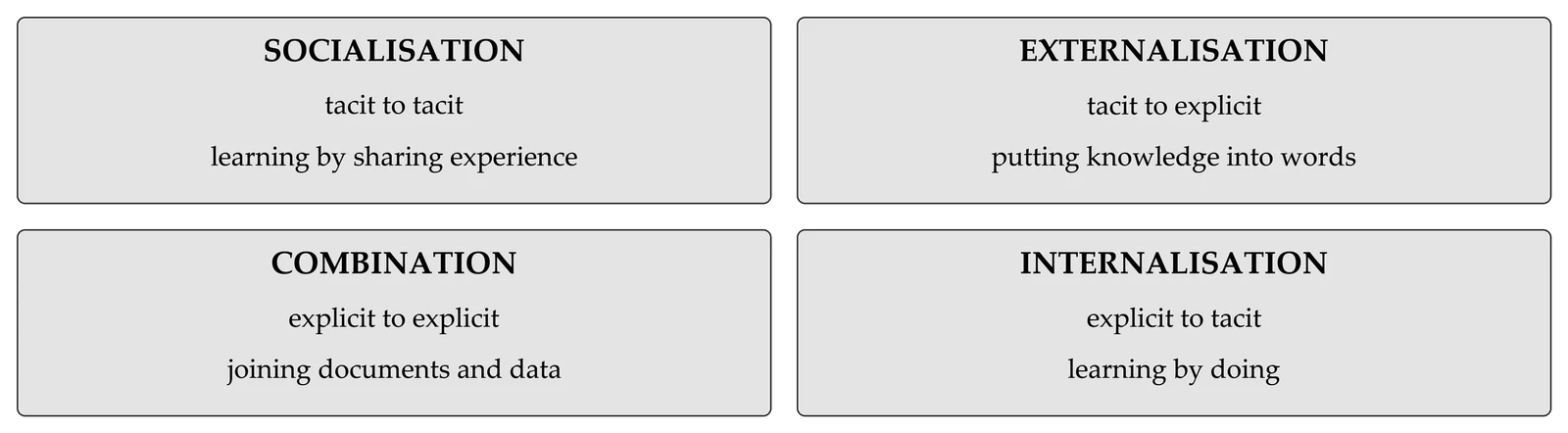
Ikujiro Nonaka and Hirotaka Takeuchi, in The Knowledge-Creating Company (1995), described four processes: socialisation (tacit to tacit), externalisation (tacit to explicit), combination (explicit to explicit) and internalisation (explicit to tacit). Knowledge grows as it moves through this spiral.
5. The Knowledge Cycle
Knowledge management involves a cycle of creating knowledge, capturing and storing it, sharing it, applying it in decisions and reviewing the results to create new knowledge.
6. Knowledge in Government
Governments generate vast knowledge through records, surveys and experience. Frequent transfers of officials can lead to loss of institutional memory, so capturing lessons and good practices is essential for continuity.
7. Research Utilisation
Carol Weiss described several ways research is used in policy: instrumentally, to solve specific problems; conceptually, by enlightening thinking; and symbolically, to justify decisions already made. Knowledge management aims to increase meaningful use.
8. Tools
Tools include databases, intranets, knowledge portals, document management systems, communities of practice where professionals share experience, and dashboards that present data for decisions.
9. The National Knowledge Commission
India set up the National Knowledge Commission in 2005, chaired by Sam Pitroda, to recommend reforms in education, libraries and knowledge institutions. Its recommendations led to the National Knowledge Network, launched in 2010 to connect research and education institutions.
10. E-Governance and Open Data
The National e-Governance Plan of 2006 and Digital India, launched in 2015, digitised government services and records. The open government data platform, data.gov.in, launched in 2012, makes government datasets available to the public.
11. Monitoring Systems
Digital platforms such as PRAGATI, launched in 2015 to review major projects and grievances, and outcome-based monitoring frameworks of the Development Monitoring and Evaluation Office help use knowledge for decision-making.
12. The Administrative Reforms Commission
The Second Administrative Reforms Commission, in its report on e-governance (2008), recommended using information technology and knowledge management to make administration more efficient, transparent and citizen-centred.
13. Benefits
Good knowledge management improves decisions, avoids repeating mistakes, spreads good practices, supports innovation and helps new officials learn quickly.
14. Challenges
Hierarchical cultures, secrecy, departmental silos, poor data quality, the digital divide and concerns about privacy limit knowledge sharing in government. Tacit knowledge is also hard to capture.
15. Evaluation
Knowledge management can make governance more informed and adaptive, but it requires a culture of sharing and learning as well as technology.
Conclusion. Thus, knowledge management is the process of creating, capturing, sharing and using knowledge. Building on Polanyi’s insight into tacit knowledge and Nonaka and Takeuchi’s SECI model, it helps governments use evidence and experience. In India, the National Knowledge Commission, e-governance and open data have advanced it, though cultural barriers remain.
Important Question 4
Discuss the role of supply chain management in public policy.
OR
Examine supply chain management with reference to the public distribution system in India.
OR
How can supply chain management improve the delivery of public services?
Model Answer
“Starvation is the characteristic of some people not having enough food to eat. It is not the characteristic of there being not enough food to eat.”
— Amartya Sen, Poverty and Famines (1981)
Introduction. Supply chain management is the coordination of the flow of goods, services, information and money from suppliers to final users. In public policy, many programmes depend on supply chains: food must reach ration shops, vaccines must stay cold until they reach clinics, and relief must reach disaster zones quickly. Effective supply chains turn policy promises into real benefits.
1. Meaning
A supply chain includes all the steps needed to deliver a product or service: planning, procurement of inputs, production, storage, transport and distribution to users. Supply chain management coordinates these steps to reduce cost, delay and waste.
2. Relevance to Public Policy
Implementation often fails not because policies are wrong but because goods and services do not reach people. Supply chain management is therefore a key tool for effective delivery of public goods, from food and medicines to textbooks and relief.
3. Components
The widely used SCOR model, developed in the 1990s, describes supply chains through the processes of planning, sourcing, making, delivering and handling returns. Each stage must be coordinated with the others.
4. Public Procurement
Government buying is a large part of the economy. India’s General Financial Rules govern procurement, and the Government e-Marketplace, launched in 2016, allows departments to buy goods and services online, improving transparency and competition.
5. The Public Distribution System
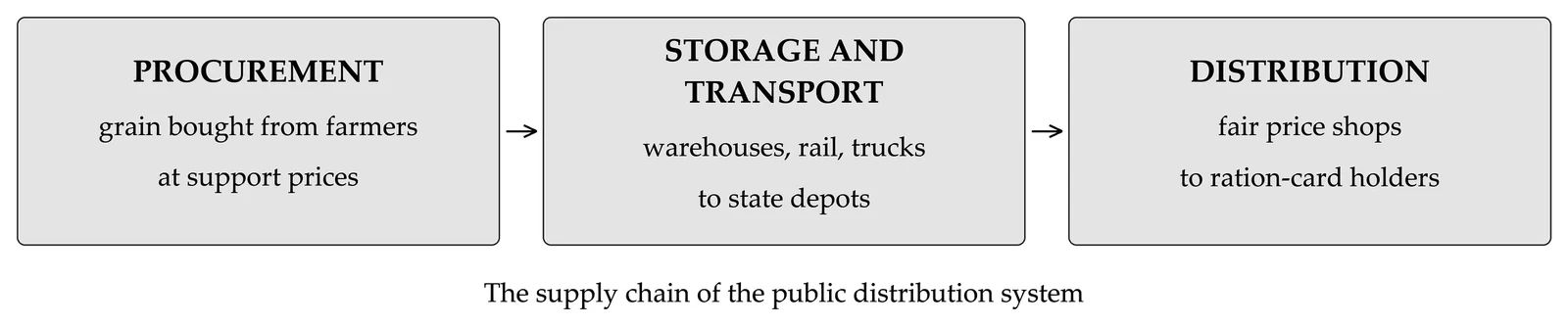
India’s public distribution system is one of the largest supply chains in the world. The Food Corporation of India, set up in 1965, procures grain from farmers, stores it and transports it to states, which distribute it through fair price shops. The National Food Security Act of 2013 covers up to 75 per cent of the rural and 50 per cent of the urban population.
6. Leakages and Reforms
The PDS long suffered from diversion of grain to the open market and ghost ration cards. States such as Chhattisgarh reformed it in the 2000s through computerisation and tracking. Point-of-sale machines and One Nation One Ration Card have improved access and accountability.
7. Sen on Entitlements
Amartya Sen showed that famines, such as the Bengal famine of 1943, often occur not because food is scarce but because people lose the entitlement to obtain it. Supply chains and access, not just production, determine whether people eat.
8. Vaccine Supply Chains
Vaccines require a cold chain from manufacturer to clinic. India’s Electronic Vaccine Intelligence Network, launched in 2015, tracks vaccine stocks and temperatures, and the CoWIN platform supported the COVID-19 vaccination campaign, in which over 220 crore doses were given.
9. Medicines
Tamil Nadu Medical Services Corporation, established in 1994, pioneered pooled procurement and efficient distribution of essential medicines to public health facilities, a model copied by other states.
10. Disaster Logistics
Effective disaster response depends on prepositioned supplies, transport and coordination. Odisha’s evacuation of over a million people before Cyclone Fani in 2019 showed the value of planning and logistics.
11. Infrastructure and Logistics Policy
The PM Gati Shakti National Master Plan of 2021 and the National Logistics Policy of 2022 aim to integrate infrastructure planning and reduce the cost and time of moving goods across India.
12. Technology
Technologies such as GPS tracking, barcodes, data analytics and digital payments make supply chains more transparent and efficient, allowing real-time monitoring of stocks and deliveries.
13. Challenges
Public supply chains face fragmentation among agencies, corruption, poor storage that leads to losses, weak last-mile delivery and coordination problems between the Union and the states.
14. Resilience
The COVID-19 pandemic exposed the fragility of supply chains and dependence on imports, such as pharmaceutical ingredients. India introduced production-linked incentives in 2020 to build domestic capacity.
15. Evaluation
Supply chain management is essential for turning policy into delivery. Reforms in the PDS, vaccines and procurement show how it can improve public services.
Conclusion. Thus, supply chain management coordinates the procurement, storage, transport and distribution of goods, and is vital for public programmes such as the public distribution system and vaccination. As Sen’s work on entitlements shows, access matters as much as production, and reforms in technology and procurement have made India’s public supply chains more effective.
Short Notes
(a) Net present value
The difference between the discounted value of a policy’s future benefits and costs. In cost-benefit analysis, a positive net present value means the policy is expected to make society better off.
(b) SECI model
Nonaka and Takeuchi’s model of knowledge creation through socialisation, externalisation, combination and internalisation, describing how knowledge moves between tacit and explicit forms in organisations.
(c) Government e-Marketplace
An online platform launched in 2016 for public procurement of goods and services by government departments, aimed at increasing transparency, competition and efficiency in government buying.
More notes: DSE-7 Public Policy
These notes are prepared by PADHO TO AISE for study help. They are not an official University of Delhi publication.