
Semester VI MDSE-4a Gender in International Relations
Unit I · 21 min read · Updated 24 Nov 2026
As per the University of Delhi (DU) BA (Hons) Political Science syllabus
Contents
- 1.1 Why Study Gender in IR
- A Man’s World
- Where Are the Women
- Sex and Gender
- Gender Gaps in World Politics
- 1.2 How Gender and IR Mutually Constitute Each Other
- Youngs: Feminist IR Is Not a Contradiction in Terms
- Strands of Feminism in IR
- 1.3 Early Feminist Engagements with IR
- Tickner: Engendered Insecurities
- Keohane: Contributions of a Feminist Standpoint
- Hooper and Jones: Men and Masculinities
- India, Gender and Diplomacy
- 1.4 Important Questions
- Discuss why we should study gender in International Relations.
- Explain how gender and International Relations mutually constitute each other.
- Discuss the contributions of feminist perspectives to IR theory with reference to Tickner and Keohane.
- Distinguish between sex and gender and explain why gender matters in global politics.
- Short Notes
कोई स्त्री पैदा नहीं होती, बल्कि स्त्री बनती है।
One is not born, but rather becomes, a woman.
— Simone de Beauvoir, The Second Sex (1949)
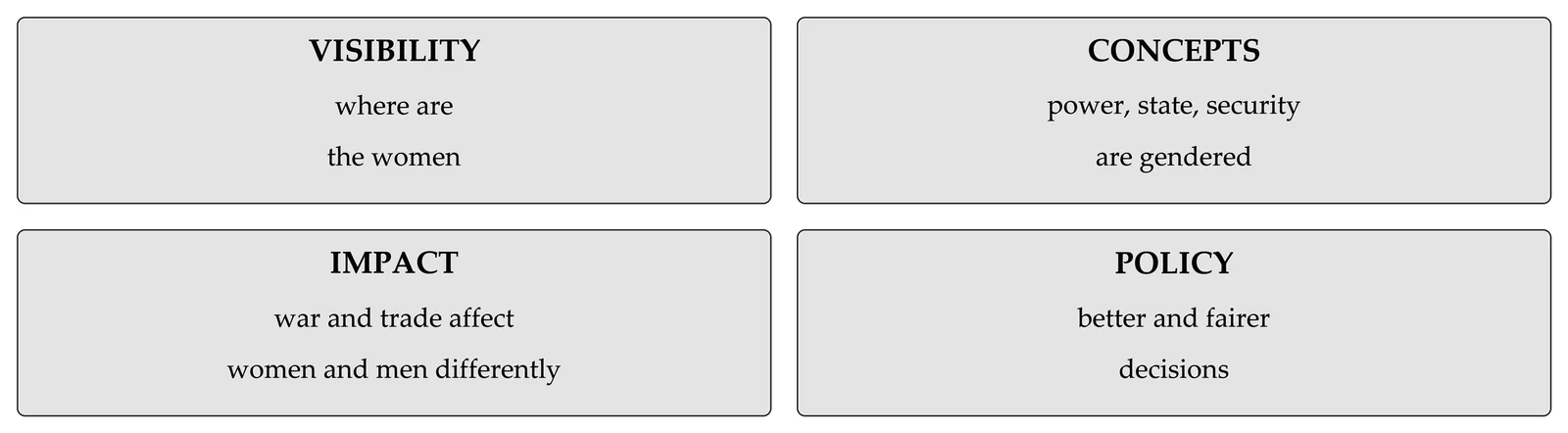
FFOR most of the twentieth century, the study of International Relations (IR) focused on states, wars, diplomats and soldiers, and it rarely asked where women were or how ideas about men and women shaped world politics. From the late 1980s, feminist scholars such as Cynthia Enloe, J. Ann Tickner and Gillian Youngs challenged this silence. They showed that gender, i.e. socially constructed ideas about masculinity and femininity, shapes concepts such as power, the state and security, and that international processes such as war, trade and migration in turn shape gender relations. This chapter studies Unit I of the syllabus: why study gender in IR, and how gender and IR mutually constitute each other.
1.1 Why Study Gender in IR
A Man’s World
Traditional IR theories, especially realism, describe a world of sovereign states pursuing power and security, where war is the central event. The leaders, diplomats, soldiers and theorists of this world were almost all men, and the experiences of women were treated as private matters outside international politics. Feminist scholars argue that this is not a neutral picture. It reflects the experiences and values of a particular group of men and hides the ways in which international politics depends on, and affects, women. J. Ann Tickner began her book Gender in International Relations (1992) by describing international politics as a man’s world of power and conflict, in which warfare is a privileged activity.
Where Are the Women
Cynthia Enloe, in Bananas, Beaches and Bases (1989), asked a simple question: where are the women in international politics? She found them everywhere: as workers on banana plantations and in export factories, as nurses and domestic workers who migrate abroad, as wives of diplomats who entertain and network, as women living near military bases, and as tourists and sex workers. International politics, she showed, depends on these women’s labour and on ideas about femininity, yet they are invisible in mainstream theory. Her phrase that the personal is international captured the link between everyday life and world politics.
Sex and Gender
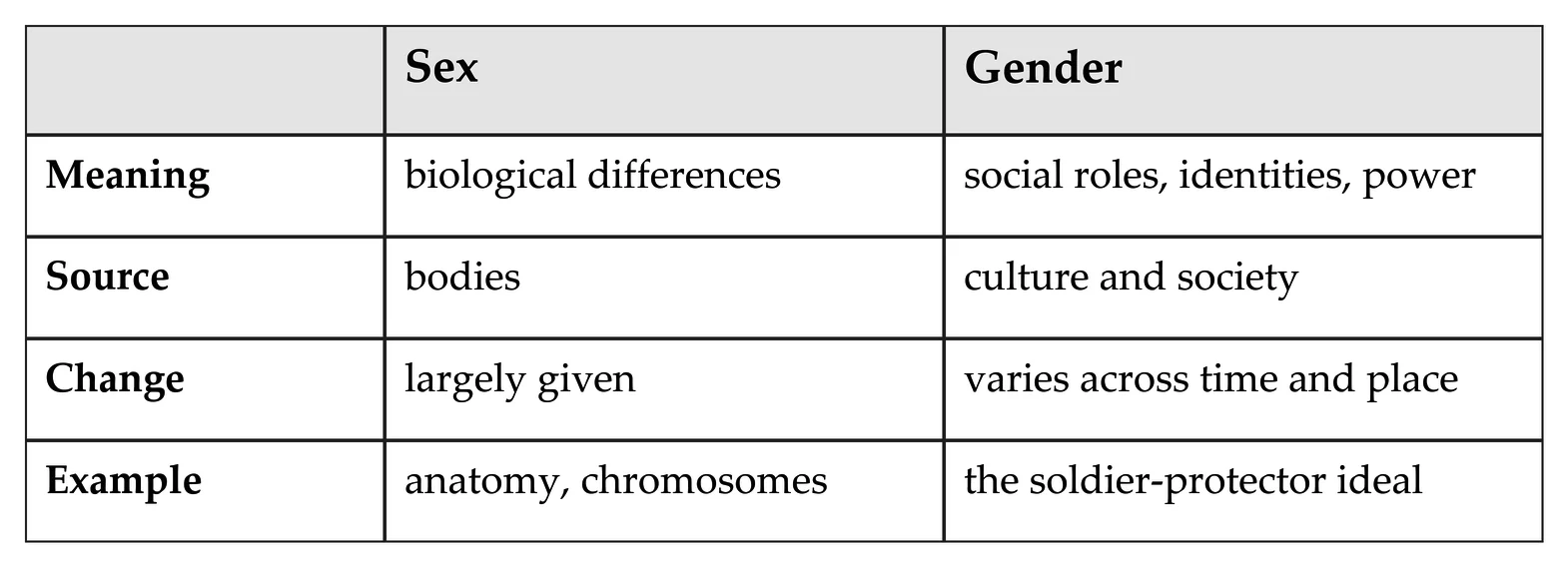
Laura Shepherd, in Sex or Gender? Bodies in World Politics and Why Gender Matters (2010), explains the distinction between sex, usually understood as biological differences between bodies, and gender, the social meanings, roles, identities and power relations attached to being a man or a woman. Gender is not fixed; it varies across societies and changes over time. Following thinkers such as Simone de Beauvoir and Judith Butler, many feminists argue that gender is something people do and perform, not simply something they are. Shepherd also notes that the line between sex and gender is itself debated, since ideas about bodies are shaped by society. For IR, the key point is that gender is a relation of power that organises political life.
- Representation. Women hold only about a quarter of the world’s parliamentary seats and remain under-represented in diplomacy, defence and peace negotiations.
- Differential impact. War, sanctions, trade and climate change affect women and men differently, for example through sexual violence or loss of livelihoods.
- Concepts. Core IR concepts such as power, sovereignty and security carry masculine assumptions about strength, autonomy and protection.
- Better knowledge. Including gender gives a fuller and more accurate understanding of world politics.
Gender Gaps in World Politics
- Parliaments. Women hold only around a quarter of seats in national parliaments worldwide, according to the Inter-Parliamentary Union.
- India. The Lok Sabha elected in 2024 has 74 women members, about 14 per cent; the 106th Amendment (2023) provides for one-third reservation for women after a future delimitation.
- Leaders. Sirimavo Bandaranaike of Sri Lanka became the world’s first woman prime minister in 1960, and Indira Gandhi became India’s prime minister in 1966.
- The UN. No woman has yet served as UN Secretary-General.
- Peace processes. Women remain a small minority of negotiators, mediators and signatories in peace agreements.
1.2 How Gender and IR Mutually Constitute Each Other
Youngs: Feminist IR Is Not a Contradiction in Terms
Gillian Youngs, in Feminist International Relations: A Contradiction in Terms? Or: Why Women and Gender Are Essential to Understanding the World We Live In (2004), answers critics who claim that feminism belongs to domestic politics and has nothing to say about international relations. She argues that the opposite is true: gender is essential to understanding international relations, because the two mutually constitute each other.
- Gender shapes IR. The concepts and practices of IR, such as the state, sovereignty, power, security and war, have been built on masculine ideas of strength, rationality, autonomy and protection, while qualities seen as feminine, such as care and interdependence, have been devalued.
- IR shapes gender. International processes, such as war, colonialism, globalisation, migration and development policy, reshape gender roles, for example by drawing women into factory work, migration or armed struggle.
- Social relations of power. Youngs argues that IR must study the social relations of power that link the household, the state and the global economy, not only the interactions of states.
- Who is the we. The title’s question about the world we live in asks whose experience mainstream IR describes, and whose it leaves out.
Youngs criticises the narrow ontology of mainstream IR, i.e. its assumptions about what exists and matters in world politics. By treating states as the only important actors and military power as the main form of power, mainstream theory makes gender seem irrelevant. Feminist IR broadens the ontology to include people, households, bodies and social relations, showing that the international is present in everyday life and that everyday life sustains the international.

Strands of Feminism in IR
- Liberal feminism seeks equal rights and opportunities for women within existing institutions, i.e. adding women to diplomacy, armies and leadership.
- Radical feminism sees patriarchy, male domination, as the root of oppression and of militarism.
- Marxist and socialist feminism link women’s oppression with capitalism and the global division of labour.
- Postcolonial feminism, as in Chandra Talpade Mohanty’s Under Western Eyes (1984), criticises Western feminists for portraying Third World women as passive victims.
- Poststructural feminism, drawing on Butler and others, studies how language and discourse construct gender and international politics.
1.3 Early Feminist Engagements with IR
Tickner: Engendered Insecurities
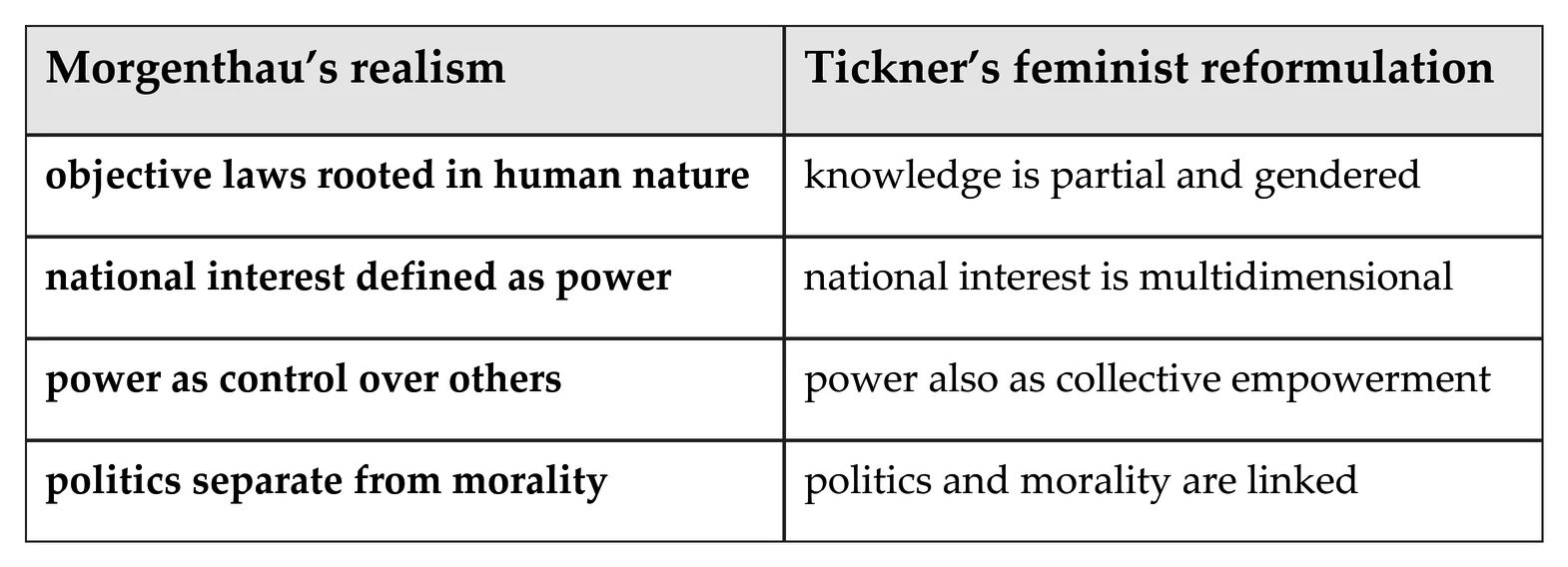
In the first chapter of Gender in International Relations: Feminist Perspectives on Achieving Global Security (1992), titled Engendered Insecurities, J. Ann Tickner argued that the dominant definitions of security, built around the military defence of the state, reflect masculine values and leave many people, especially women, insecure. Earlier, in an article of 1988, she had offered a feminist reformulation of Hans Morgenthau’s six principles of political realism, arguing for example that objectivity is partial, that the national interest is multidimensional and that power can also mean collective empowerment rather than only domination. Tickner called for a multidimensional idea of security covering political, economic and ecological threats, and for seeing the world from the standpoint of those at the margins.
Keohane: Contributions of a Feminist Standpoint
Robert Keohane, a leading liberal institutionalist, responded in International Relations Theory: Contributions of a Feminist Standpoint (1989). He welcomed feminist standpoint theory, associated with Sandra Harding and Nancy Hartsock, which argues that knowledge gained from women’s experience of subordination can reveal what dominant perspectives hide. He suggested that a feminist emphasis on connectedness, reciprocity and relationships could enrich IR theory and fit well with institutionalist ideas of cooperation. But he was sceptical of postmodern feminism and urged feminists to produce testable hypotheses. This began a long dialogue, examined in Chapter 2.
Hooper and Jones: Men and Masculinities
Charlotte Hooper, in Manly States: Masculinities, International Relations and Gender Politics (2001), argued that gender in IR is not only about women. IR is also a site where masculinities are produced and performed, as in the images of the statesman, the soldier and the rational strategist. Adam Jones, in Does Gender Make the World Go Round? (1996), criticised feminist IR for equating gender with women and for neglecting the ways in which men are also vulnerable, for example as targets of mass killing in war. His critique provoked debate, but it helped broaden gender analysis to include men and masculinities.
India, Gender and Diplomacy
India has its own history of women in international politics. Hansa Mehta, a member of the UN Commission on Human Rights, is credited with changing the draft of Article 1 of the Universal Declaration of Human Rights (1948) from all men to all human beings are born free and equal. Vijaya Lakshmi Pandit became the first woman President of the UN General Assembly in 1953. C. B. Muthamma, the first woman in the Indian Foreign Service (1949), challenged discriminatory service rules, and in 1979 the Supreme Court struck down rules that required women officers to seek permission to marry. These episodes show both women’s contributions and the barriers they faced.
1.4 Important Questions
- Question 1 Discuss why we should study gender in International Relations.
- Question 2 Explain how gender and International Relations mutually constitute each other.
- Question 3 Discuss the contributions of feminist perspectives to IR theory with reference to Tickner and Keohane.
- Question 4 Distinguish between sex and gender and explain why gender matters in global politics.
DU asks the same idea in different words. So learn one broad answer for each question below; the same answer works for every question joined by OR.
Important Question 1
Discuss why we should study gender in International Relations.
OR
Examine the significance of Cynthia Enloe’s question, where are the women.
OR
Discuss the importance of the gender perspective for understanding world politics.
Model Answer
“Human rights are women’s rights and women’s rights are human rights, once and for all.”
— Hillary Rodham Clinton, Fourth World Conference on Women, Beijing (5 September 1995)
Introduction. Mainstream IR long ignored women and gender, treating world politics as the activity of states, diplomats and soldiers. Feminist scholars argue that studying gender reveals the hidden foundations of international politics, the differential impact of global processes on women and men, and the masculine assumptions in core concepts. Cynthia Enloe’s question, where are the women, opened this field.
1. A Man’s World
Traditional IR described a world of states and wars, led and studied almost entirely by men. Women’s experiences were treated as private and irrelevant.
2. Not a Neutral Picture
Feminists argue that this picture reflects the experiences and values of particular men. It hides the role of women and of gender.
3. Enloe’s Question
Enloe asked where the women are in international politics. She found them as workers, migrants, wives and residents near military bases.
4. Hidden Labour
International politics depends on women’s paid and unpaid labour, from plantations to diplomatic households. This labour is invisible in mainstream theory.
5. The Personal Is International
Enloe’s phrase shows that everyday life and world politics are linked. Private relations sustain international power.
6. Gender as Power
Gender is a relation of power that organises political life, not just a description of men and women.
7. Under-Representation
Women hold only about a quarter of parliamentary seats worldwide and are few among diplomats, generals and negotiators.
8. Differential Impact
War, sanctions, trade and climate change affect women and men differently, as in wartime sexual violence.
9. Gendered Concepts
Concepts such as power, sovereignty and security carry masculine assumptions about strength and protection.
10. Women’s Rights as Human Rights
The Beijing conference of 1995 declared that women’s rights are human rights, making gender a global issue.
11. Tickner’s Contribution
Tickner showed that dominant ideas of security leave many people, especially women, insecure.
12. Including Men
Studying gender also reveals how ideas of masculinity shape soldiers, leaders and states.
13. Policy Relevance
Resolution 1325 (2000) and feminist foreign policies show the practical importance of gender.
14. Indian Examples
India’s women peacekeepers in Liberia and debates on women in combat show gender in Indian security practice.
15. Better Knowledge
Including gender gives a fuller and more accurate understanding of world politics.
16. Criticism
Sceptics argue that gender is marginal to core questions of war and peace, which feminists dispute.
17. Women in Peace Processes
Studies by the Council on Foreign Relations found that between 1992 and 2019 women made up only about 13 per cent of negotiators and 6 per cent of mediators in major peace processes.
18. Gender and Climate
Women in poor rural areas often bear the burden of climate change, collecting water and fuel, which shows how global problems have gendered effects.
19. Evaluation
Gender analysis is now an established part of IR and has transformed its understanding of power and security.
Conclusion. Thus, studying gender in IR reveals the women hidden in world politics, the gendered nature of its concepts and the different impacts of global processes. The recognition in Beijing that women’s rights are human rights shows how far this perspective has shaped international politics.
Important Question 2
Explain how gender and International Relations mutually constitute each other.
OR
Examine Gillian Youngs’s argument that feminist IR is not a contradiction in terms.
OR
Discuss the relationship between gender and international politics.
Model Answer
“To reaffirm faith in fundamental human rights, in the dignity and worth of the human person, in the equal rights of men and women and of nations large and small.”
— Charter of the United Nations, Preamble (1945)
Introduction. Gillian Youngs answers critics who think feminism has nothing to say about international relations. She argues that gender and IR mutually constitute each other: the concepts and practices of IR are built on gendered ideas, and international processes reshape gender relations. Feminist IR is therefore essential to understanding the world we live in.
1. The Critics’ Claim
Some scholars claimed that feminism belongs to domestic politics and that IR is about states, not gender.
2. Youngs’s Answer
Youngs argues that gender is essential to understanding international relations, not a contradiction in terms.
3. Mutual Constitution
Gender shapes IR and IR shapes gender; each helps to make the other.
4. Gendered Concepts
The state, sovereignty, power and security are built on masculine ideas of strength, rationality and protection.
5. Devalued Qualities
Qualities seen as feminine, such as care and interdependence, have been devalued in IR theory and practice.
6. International Processes Shape Gender
War, colonialism, globalisation and migration reshape gender roles, drawing women into new forms of work and struggle.
7. Globalisation and Women’s Labour
Export factories and global care chains rely heavily on women’s labour, changing gender relations in households.
8. War and Gender
Wars change gender roles, as women take up new work or join armed movements, and also expose them to violence.
9. Development Policy
International development programmes shape gender relations, for example through microcredit aimed at women.
10. Narrow Ontology
Youngs criticises mainstream IR for assuming that only states and military power matter.
11. Broader Ontology
Feminist IR includes people, households, bodies and social relations in what counts as international politics.
12. Who Is the We
Her title asks whose world mainstream IR describes and whose experience it leaves out.
13. International Norms
The UN Charter’s affirmation of the equal rights of men and women shows how international institutions shape gender norms.
14. Indian Illustrations
Migration of Indian nurses to the Gulf and women’s work in export garment factories show global processes reshaping gender.
15. Link to Enloe
Youngs builds on Enloe’s insight that the personal is international.
16. Criticism
Critics argue that feminist IR is too broad; Youngs replies that the breadth reflects reality.
17. Colonialism and Gender
Colonial rule reshaped gender relations, for example through laws on marriage and property, showing how international power affects intimate life.
18. Nationalism and Women
Nationalist movements often mobilised women while defining them as symbols of the nation, another sign of the link between gender and politics.
19. Militarisation and Gender
Militarisation shapes ideas of manhood and womanhood, valuing soldiers’ courage while expecting women to support and wait, as Enloe showed.
20. Human Rights Language
Hansa Mehta’s change of the UDHR from all men to all human beings shows how international norms and gender equality shaped each other.
21. Global Economy
Structural adjustment and trade agreements have reshaped women’s work and family life across the Global South.
22. Evaluation
Youngs shows that feminist IR is central, not marginal, to understanding international relations.
Conclusion. Thus, Youngs shows that gender and IR mutually constitute each other: IR’s concepts are gendered and international processes reshape gender. The UN Charter’s commitment to the equal rights of men and women reflects how international politics and gender are intertwined.
Important Question 3
Discuss the contributions of feminist perspectives to IR theory with reference to Tickner and Keohane.
OR
Examine J. Ann Tickner’s idea of engendered insecurities.
OR
Examine Robert Keohane’s view of the contributions of a feminist standpoint to IR theory.
Model Answer
“International politics is a man’s world, a world of power and conflict in which warfare is a privileged activity.”
— J. Ann Tickner, Gender in International Relations (1992)
Introduction. In the late 1980s and early 1990s, feminist scholars began to challenge IR theory directly. J. Ann Tickner reformulated realism and argued that dominant ideas of security produce engendered insecurities. Robert Keohane, a leading liberal theorist, welcomed a feminist standpoint as a possible contribution to IR, while urging feminists to produce testable claims. Their exchange shaped the feminist debate in IR.
1. The Early Debate
A special issue of Millennium in 1988 launched feminist IR as a field of study.
2. Tickner’s Starting Point
Tickner described international politics as a man’s world in which warfare is privileged.
3. Reformulating Morgenthau
In 1988 Tickner offered a feminist reformulation of Morgenthau’s six principles of realism.
4. Partial Objectivity
She argued that what realists call objective laws reflect a masculine viewpoint and are therefore partial.
5. Multidimensional Interest
She argued that the national interest is multidimensional, not defined by power alone.
6. Power as Empowerment
She proposed seeing power also as collective empowerment, not only as domination.
7. Engendered Insecurities
Tickner argued that security defined as military defence of the state leaves many, especially women, insecure.
8. Multidimensional Security
She called for a security covering political, economic and ecological threats, seen from the margins.
9. Keohane’s Response
Keohane, in 1989, welcomed feminist standpoint theory as a possible contribution to IR.
10. Feminist Standpoint
Standpoint theory, associated with Harding and Hartsock, holds that women’s experience reveals what dominant views hide.
11. Connectedness and Reciprocity
Keohane suggested that feminist emphasis on connectedness and reciprocity could enrich theories of cooperation.
12. Scepticism of Postmodernism
He was sceptical of postmodern feminism and urged testable hypotheses.
13. Feminist Reaction
Feminists welcomed his interest but worried that he wanted feminism to fit mainstream methods.
14. A Continuing Dialogue
The exchange led to Tickner’s 1997 article and Keohane’s 1998 reply, discussed in Chapter 2.
15. Lasting Impact
Tickner’s work made gender central to security studies and influenced policy debates.
16. Criticism
Some feminists argued that both Tickner’s and Keohane’s early positions risked essentialising women.
17. The Millennium Special Issue
The 1988 special issue of the LSE journal Millennium on women and international relations marked the arrival of feminist IR as a field.
18. Influence on Policy
Feminist ideas about security fed into the human security agenda and the Women, Peace and Security resolutions of the UN.
19. Postcolonial Feminism
Chandra Talpade Mohanty warned Western feminists against portraying Third World women as passive victims, enriching feminist IR.
20. Evaluation
Tickner and Keohane opened a dialogue that brought feminist ideas into the core of IR theory.
Conclusion. Thus, Tickner showed that international politics as a man’s world produces engendered insecurities, while Keohane welcomed a feminist standpoint but sought testable claims. Their exchange marked feminism’s entry into the heart of IR theory.
Important Question 4
Distinguish between sex and gender and explain why gender matters in global politics.
OR
Examine Laura Shepherd’s argument on bodies in world politics.
OR
Discuss Adam Jones’s critique of feminist IR and the study of masculinities.
Model Answer
“There is no gender identity behind the expressions of gender; that identity is performatively constituted by the very expressions that are said to be its results.”
— Judith Butler, Gender Trouble (1990)
Introduction. The distinction between sex and gender is basic to feminist IR. Sex usually refers to biological differences, while gender refers to the social meanings, roles and power relations attached to being a man or a woman. Laura Shepherd explains why gender matters in global politics, while Charlotte Hooper and Adam Jones show that gender analysis must include men and masculinities.
1. Meaning of Sex
Sex usually refers to biological differences between male and female bodies.
2. Meaning of Gender
Gender refers to the social roles, identities and power relations attached to being a man or a woman.
3. Beauvoir’s Insight
Beauvoir argued that one becomes a woman, showing that femininity is socially made.
4. Butler’s Performativity
Butler argued that gender is performed through repeated acts rather than expressing a fixed inner identity.
5. Shepherd on Bodies
Shepherd explains that ideas about bodies in world politics are shaped by society, so the sex-gender line is debated.
6. Gender as Power
For IR, gender matters because it is a relation of power that organises political life.
7. Gender in Global Politics
Gender shapes who fights, who negotiates, who migrates and who cares, in every region.
8. Variation
Gender roles vary across societies and change over time, as women’s entry into armies shows.
9. Hooper’s Manly States
Hooper shows that IR produces masculinities, such as the statesman and the soldier.
10. Jones’s Critique
Jones argued that feminist IR equated gender with women and neglected men’s vulnerabilities.
11. Men as Victims
Jones pointed out that men are often targets of mass killing in war, a gendered vulnerability.
12. Feminist Response
Feminists replied that they study gender relations as a whole and that patriarchy harms men too.
13. Broadening Gender Analysis
The debate helped broaden gender analysis to include men, masculinities and sexualities.
14. Indian Example
Debates on women in combat roles in the Indian armed forces show how gender ideas shape policy.
15. Transgender Recognition
The Supreme Court’s NALSA judgment of 2014 recognised transgender persons as a third gender, challenging binary ideas.
16. Criticism
Some argue that the sex-gender distinction itself reflects Western thought and may not fit all cultures.
17. Intersectionality
Gender combines with race, class, caste and nationality, so women and men experience world politics in very different ways.
18. Queer Perspectives
Queer theory questions the binary of male and female itself, as Chapter 2 explains.
19. Gender and Leadership
Studies of leaders such as Indira Gandhi and Margaret Thatcher show how women leaders are judged against masculine standards of toughness.
20. Gender Norms Change
The entry of women into combat roles and peace negotiations shows that gender norms in world politics can change.
21. Gender in Law
International law now recognises gender-based persecution and sexual violence as serious crimes, reflecting the influence of gender analysis.
22. Evaluation
Distinguishing sex and gender helps show that inequalities in world politics are social and can change.
Conclusion. Thus, sex refers to bodies and gender to social roles and power, and as Butler argued, gender is performed rather than given. Shepherd, Hooper and Jones show why gender, including masculinities, matters in global politics.
Short Notes
(a) Gender
The social roles, identities and power relations attached to being a man or a woman, which vary across societies and change over time, as distinct from biological sex.
(b) Feminist standpoint
The view, associated with Sandra Harding and Nancy Hartsock, that knowledge from women’s experience of subordination can reveal what dominant perspectives hide.
(c) Mutual constitution
Gillian Youngs’s argument that gender shapes the concepts and practices of IR, while international processes reshape gender relations.
(d) The personal is international
Cynthia Enloe’s phrase (1989) for the idea that international politics depends on, and shapes, everyday relationships and the work of women, from plantations and factories to diplomatic households and military bases.
More notes: MDSE-4a Gender in International Relations
These notes are prepared by PADHO TO AISE for study help. They are not an official University of Delhi publication.