
Semester VIII DSE-12 Comparative Constitutionalism
Unit III · 26 min read · Updated 24 Nov 2026
As per the University of Delhi (DU) BA (Hons) Political Science syllabus
Contents
- 3.1 The Idea of Transformative Constitutionalism
- Origins of the Idea
- Main Features of Transformative Constitutionalism
- Transformation and Legal Culture
- Liberal and Transformative Constitutionalism Compared
- 3.2 Transformative Constitutions across the World
- South Africa in Detail
- Colombia and Latin America
- Hailbronner and the Global North
- 3.3 Transformative Constitutionalism in India
- The Constituent Assembly’s Transformative Vision
- Bhatia’s Transformative Constitution
- Constitutional Morality
- Citizens and Constitutional Insurgencies
- Criticisms and Limits of Transformative Constitutionalism
- 3.4 Important Questions
- What is transformative constitutionalism? Discuss its main features.
- Is transformative constitutionalism only a feature of the global South? Discuss.
- Discuss transformative constitutionalism with reference to India.
- Discuss the idea of constitutional insurgencies and the role of citizens in transformative constitutionalism.
- Short Notes
यदि नया संविधान सत्ता की संस्कृति से दूर ले जाने वाला पुल है, तो उसे औचित्य की संस्कृति तक ले जाना चाहिए।
If the new Constitution is a bridge away from a culture of authority, it is clear what it must be a bridge to. It must lead to a culture of justification.
— Etienne Mureinik, A Bridge to Where? (1994)
TRANSFORMATIVE constitutionalism is the idea that a constitution should not only limit government but also change society, dismantling old hierarchies of race, caste, gender and class. The term was made famous by Karl Klare in post-apartheid South Africa and explained by its Chief Justice Pius Langa. Michaela Hailbronner shows that it is not limited to the global South, while Gautam Bhatia reads India’s Constitution as a radical break with its colonial and caste-bound past, and Anupama Roy shows how citizens use the Constitution to press new claims. This chapter explains these ideas.

3.1 The Idea of Transformative Constitutionalism
Transformative constitutionalism sees the constitution as a long-term project to transform a country’s political and social institutions and power relationships in a democratic, participatory and egalitarian direction. Traditional liberal constitutionalism focuses on limiting the state; transformative constitutionalism also asks the state, and sometimes private actors, to act to secure equality, dignity and social justice.
Origins of the Idea
The phrase transformative constitutionalism became famous through an article by the American legal scholar Karl Klare in 1998, written soon after South Africa adopted its final Constitution of 1996. South Africa had just ended apartheid through negotiation: an Interim Constitution of 1993 guided the transition, the first democratic elections were held in 1994 and a new Constitutional Court began work the same year. Klare argued that this Constitution was not a conservative document that merely protected existing rights, but a programme for changing society through law. Pius Langa, a judge who rose to become Chief Justice of South Africa, developed the idea in a lecture at Stellenbosch University in 2006.
Main Features of Transformative Constitutionalism
- Commitment to social change. Klare (1998) saw the Constitution as a long-term project to change political and social institutions and power relationships in a democratic, participatory and egalitarian direction, not a one-time settlement.
- Substantive equality. Langa (2006) stressed that equality must address real disadvantage, so the South African Constitution (Section 9) and India’s Article 15(4) permit measures to uplift groups harmed by past discrimination.
- Justiciable social and economic rights. South Africa’s Constitution guarantees rights to housing, health care, food and water (Sections 26 and 27), which the Constitutional Court enforced in Grootboom (2000), where Justice Zak Yacoob required a reasonable housing programme for people in desperate need.
- Horizontal application. Section 8(2) of the South African Constitution allows rights to bind private persons, and India’s Articles 15(2), 17 and 23 apply against private discrimination, untouchability and forced labour, because oppression often lies in society, not only in the state.
- A culture of justification. Etienne Mureinik (1994) described the Constitution as a bridge from a culture of authority to a culture of justification, in which every exercise of power must be backed by reasons.
- Participatory democracy. In Doctors for Life (2006), the South African Constitutional Court struck down laws passed without adequate public participation, showing that transformation includes citizens’ voice in law-making.
- Dignity as a foundational value. Following Article 1 of the German Basic Law (1949), transformative constitutions place human dignity at the centre, so that laws are judged by whether they respect each person’s worth.
Transformation and Legal Culture
Klare argued that South African lawyers had been trained in a formalist legal culture, which treated law as neutral rules applied mechanically. Such a culture, he said, would quietly preserve apartheid’s inequalities. Transformative constitutionalism requires judges to recognise that interpretation involves choices about values and to make those choices openly in favour of the Constitution’s goals. Langa added that legal education must change too, teaching students to think about justice and not only about rules.
Liberal and Transformative Constitutionalism Compared
Students often find it useful to compare the two models point by point:
- Aim. Liberal constitutionalism, in the tradition of Locke and Madison, mainly limits government to protect liberty; transformative constitutionalism also directs government to change unjust social structures.
- Rights. The liberal model stresses civil and political rights, i.e. negative freedoms from state interference; the transformative model adds social and economic rights and positive duties on the state.
- Reach. Liberal rights bind mainly the state; transformative rights also reach private actors, such as employers, landlords and caste communities.
- Role of courts. The liberal judge is a neutral umpire; the transformative judge openly interprets the constitution in the light of its egalitarian purpose.
- Attitude to the past. The liberal constitution often preserves an existing order; the transformative constitution is written as a break with an unjust past, such as apartheid, colonialism or caste.
3.2 Transformative Constitutions across the World
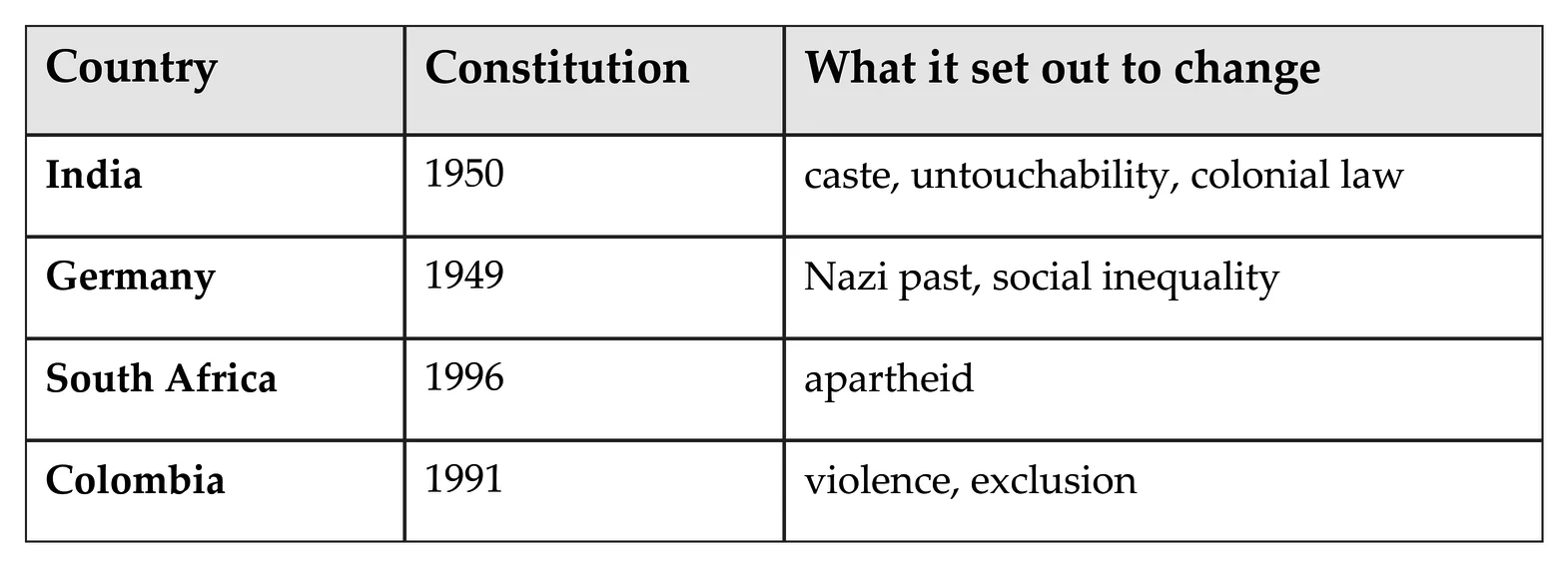
The constitutions of India (1950), South Africa (1996) and Colombia (1991) are often described as transformative because they were written to overcome caste, apartheid and exclusion. Michaela Hailbronner argues that Germany’s Basic Law of 1949, with its commitment to human dignity and the social state, is also transformative, so the idea is not limited to the global South.
South Africa in Detail
South Africa remains the leading example. The Truth and Reconciliation Commission, set up in 1995 under Archbishop Desmond Tutu, sought to heal the wounds of apartheid. The Constitutional Court gave life to the new Constitution in landmark cases: S v. Makwanyane (1995) abolished the death penalty, drawing on the African value of ubuntu, i.e. humanity towards others; Soobramoney (1997) recognised the limits of health resources; Grootboom (2000) and Treatment Action Campaign (2002) enforced housing and health rights; and Fourie (2005) recognised same-sex marriage. Yet South Africa remains one of the most unequal societies in the world, and protests over poor services show that constitutional promises are only partly fulfilled.
Colombia and Latin America
Colombia’s Constitution of 1991 created a powerful Constitutional Court and the tutela, a simple procedure allowing any person to seek urgent protection of fundamental rights. In decision T-025 of 2004, the Court declared an unconstitutional state of affairs concerning millions of people displaced by armed conflict and supervised government policy for years, and in T-760 of 2008 it ordered reform of the health system. Later constitutions in Ecuador (2008) and Bolivia (2009) went further, recognising plurinational states, indigenous self-government and the rights of nature, showing new forms of transformative constitutionalism in the global South.
Hailbronner and the Global North
Michaela Hailbronner argues that transformation is not only a Southern idea. Germany’s Basic Law of 1949 was written to break with Nazism; the Federal Constitutional Court treated basic rights as an objective order of values in the Lüth case of 1958, applying them to private law, and the social state principle supported welfare. After 1989, constitutional courts in post-communist Europe, such as Hungary’s court under László Sólyom, also played transformative roles. The lesson is that transformative constitutionalism appears wherever a society uses its constitution to break with an unjust past.
3.3 Transformative Constitutionalism in India
Gautam Bhatia argues that India’s Constitution was a radical break with the colonial state and with social hierarchies, which is why it abolished untouchability and applied some rights against private actors. The Supreme Court invoked transformative constitutionalism in judgments on privacy, sexuality and gender from 2017, and Anupama Roy shows how marginalised citizens use the Constitution to make new claims.

The Constituent Assembly’s Transformative Vision
The transformative purpose of India’s Constitution was clear from the beginning. Jawaharlal Nehru’s Objectives Resolution of 13 December 1946 promised to all the people of India justice, social, economic and political, equality of status and opportunity, and adequate safeguards for minorities and backward classes. Granville Austin described the Constitution as first and foremost a social document. Early laws abolishing zamindari and the First Amendment of 1951, which protected land reform and allowed special provisions for backward classes, show how the new republic used constitutional means to change the social order.
Bhatia’s Transformative Constitution
Gautam Bhatia, in The Transformative Constitution: A Radical Biography in Nine Acts (2019), develops his argument through a series of acts, each built around major constitutional controversies on equality, untouchability, free speech, privacy and the relationship between the individual and the community. His central claims are that the Constitution was a rupture with colonial and caste hierarchies rather than a continuation of them; that its rights were meant to transform relations among citizens, not only between citizens and the state; and that courts should read it radically, in the light of the struggles that produced it.
Constitutional Morality
B.R. Ambedkar, quoting the historian George Grote, told the Constituent Assembly on 4 November 1948 that constitutional morality is not a natural sentiment and has to be cultivated. In recent judgments such as Navtej Singh Johar (2018) and the Sabarimala case (2018), the Supreme Court contrasted constitutional morality, i.e. the values of liberty, equality, dignity and fraternity, with popular or social morality that may support discrimination. Critics argue that the idea gives judges too much discretion, while supporters see it as the heart of transformative constitutionalism.
Citizens and Constitutional Insurgencies
Anupama Roy reminds us that transformation also comes from below. Women, Dalits, Adivasis and other marginal groups have invoked the Constitution to claim rights against established hierarchies, in what she connects with constitutional insurgencies. James Holston’s idea of insurgent citizenship, developed in Brazil in 2008, describes a similar process. The public reading of the Preamble during the protests of 2019–20 showed how the Constitution itself can become a language of popular struggle.
Criticisms and Limits of Transformative Constitutionalism
- Juristocracy. Ran Hirschl, in Towards Juristocracy (2004), studied Canada, Israel, New Zealand and South Africa and argued that elites often hand power to courts to protect their interests from democratic majorities, so constitutional rights may preserve rather than transform the social order.
- Democratic legitimacy. Critics in the tradition of Jeremy Waldron ask why unelected judges should decide large questions of social policy, such as housing budgets or health priorities.
- Capacity and enforcement. Courts lack the expertise and the means to run welfare programmes, and many South African and Indian orders on housing, hunger and pollution have been poorly implemented.
- Elite capture of litigation. Public interest litigation in India began as a tool for the poor, but scholars such as Anuj Bhuwania, in Courting the People (2017), argue that it has sometimes been used against slum dwellers and street vendors.
- Liberal nationalism of the founders. Madhav Khosla, in India’s Founding Moment (2020), reads the Constitution as a project to create citizens capable of self-rule through codification, centralisation and representative government, a reading that is transformative but less radical than Bhatia’s.
Defenders reply that these problems call for better institutions, such as dialogue between courts and governments, structural remedies with monitoring and stronger public participation, rather than a return to a narrow, purely liberal constitution.
3.4 Important Questions
- Question 1 What is transformative constitutionalism? Discuss its main features.
- Question 2 Is transformative constitutionalism only a feature of the global South? Discuss.
- Question 3 Discuss transformative constitutionalism with reference to India.
- Question 4 Discuss the idea of constitutional insurgencies and the role of citizens in transformative constitutionalism.
DU asks the same idea in different words. So learn one broad answer for each question below; the same answer works for every question joined by OR.
Important Question 1
What is transformative constitutionalism? Discuss its main features.
OR
Examine Pius Langa’s understanding of transformative constitutionalism.
OR
How does transformative constitutionalism differ from liberal constitutionalism?
Model Answer
“A long-term project of constitutional enactment, interpretation, and enforcement committed to transforming a country’s political and social institutions and power relationships in a democratic, participatory, and egalitarian direction.”
— Karl Klare, Legal Culture and Transformative Constitutionalism (1998)
Introduction. Classical liberal constitutionalism sees the constitution mainly as a set of limits on government. In many post-colonial and post-authoritarian societies, however, constitutions were written to overcome deep injustices such as apartheid, caste and colonial rule. Transformative constitutionalism, a term coined by Karl Klare and developed by Pius Langa, sees the constitution as an instrument of social change.
1. Klare’s Definition
Karl Klare, writing in 1998 about South Africa’s new Constitution, defined transformative constitutionalism as a long-term project of enacting, interpreting and enforcing a constitution to transform political and social institutions and power relationships in a democratic, participatory and egalitarian direction.
2. Change through Law
Klare argued that the transformation should be achieved through law, not violent revolution, but that it requires large-scale social change. He called for a new legal culture in which judges recognise that interpreting the constitution involves choices about values.
3. Liberal and Transformative Constitutionalism
Liberal constitutionalism mainly restrains the state through negative rights and separation of powers. Transformative constitutionalism also imposes positive duties on the state to provide housing, health, education and equality, and may apply rights to private actors.
4. Langa’s View
Pius Langa, Chief Justice of South Africa, argued that transformation is not a temporary process that ends once apartheid’s laws are repealed, but a permanent ideal and a way of looking at the world that keeps open the space for dialogue and contestation.
5. Substantive Equality
Langa stressed that transformation requires substantive equality, not merely formal equality. Treating everyone the same in a deeply unequal society would preserve injustice, so the law must address the real disadvantages that people face.
6. Changing Legal Culture
Langa argued that transformation requires changing legal culture and legal education, so that judges and lawyers move beyond narrow, formal reading of texts and engage with the Constitution’s values of dignity, equality and freedom.
7. Culture of Justification
Etienne Mureinik described South Africa’s Constitution as a bridge from a culture of authority, in which the state commands, to a culture of justification, in which every exercise of power must be justified by reasons.
8. Social and Economic Rights
Transformative constitutions often include social and economic rights. South Africa’s Constitutional Court enforced the right to housing in Grootboom (2000) and the right to health care in the Treatment Action Campaign case (2002).
9. Horizontal Application
Transformative constitutionalism may apply rights not only against the state but also against private individuals and institutions, since oppression often operates through social practices, families, workplaces and markets.
10. The Role of Courts
Courts play a central role as interpreters of transformative constitutions, but they must work with legislatures and executives. Judges must balance boldness in protecting rights with respect for democratic decision-making.
11. Participation
Klare stressed that transformation should be democratic and participatory. Citizens, social movements and civil society must take part in shaping and claiming constitutional values, not leave it to courts alone.
12. Ambedkar’s Social Democracy
B.R. Ambedkar argued that political democracy cannot last unless it rests on social democracy, a way of life based on liberty, equality and fraternity. This idea anticipates transformative constitutionalism in India.
13. Criticisms
Critics argue that transformative constitutionalism gives too much power to unelected judges, that courts lack the resources to transform society, and that the term is vague enough to justify almost any outcome.
14. Defence
Supporters reply that constitutions in deeply unequal societies cannot be neutral, and that judges who refuse to engage with injustice are making a choice in favour of the status quo.
15. Evaluation
Transformative constitutionalism widens the purpose of constitutions from limiting power to achieving justice, though it raises questions about the role of courts.
Conclusion. Thus, transformative constitutionalism, as Klare defined it, is a long-term project to transform institutions and power relations in a democratic and egalitarian direction. Langa saw it as a permanent ideal requiring substantive equality and a new legal culture, and Mureinik as a move to a culture of justification. It differs from liberal constitutionalism by imposing positive duties on the state.
Important Question 2
Is transformative constitutionalism only a feature of the global South? Discuss.
OR
Examine transformative constitutionalism in South Africa, Colombia and Germany.
OR
Discuss Hailbronner’s argument on transformative constitutionalism.
Model Answer
“Political democracy cannot last unless there lies at the base of it social democracy.”
— B.R. Ambedkar, Constituent Assembly (25 November 1949)
Introduction. Transformative constitutionalism is often associated with the global South, especially South Africa, India and Latin America, where constitutions were written to overcome apartheid, caste and exclusion. Michaela Hailbronner argues, however, that the idea also fits post-war Germany, suggesting that transformative constitutionalism is a broader phenomenon found wherever constitutions are designed to break with an unjust past.
1. South Africa
South Africa’s interim Constitution of 1993 described itself as a historic bridge between a deeply divided past and a future based on human rights. The final Constitution of 1996 included equality, dignity and justiciable social and economic rights.
2. The South African Court
The Constitutional Court struck down the death penalty in 1995, required the state to provide emergency housing in Grootboom (2000) and ordered provision of an anti-HIV drug in the Treatment Action Campaign case (2002), giving life to transformative goals.
3. Colombia
Colombia’s Constitution of 1991 created a strong Constitutional Court and the tutela, a quick procedure for citizens to protect rights. The Court has declared states of unconstitutional affairs, as in 2004 for millions of internally displaced persons, and ordered wide reforms.
4. India
India’s Constitution of 1950 was written to transform a society marked by colonial rule, caste and poverty. It abolished untouchability, provided for reservations and included directive principles for social and economic justice.
5. Hailbronner’s Argument
Michaela Hailbronner argues that transformative constitutionalism is not only a phenomenon of the global South. Germany’s Basic Law of 1949 was also written to break with the Nazi past and committed the state to human dignity and social justice.
6. Germany’s Basic Law
Article 1 of the Basic Law declares human dignity inviolable, and Article 20 describes Germany as a democratic and social federal state. The Federal Constitutional Court has treated basic rights as an objective order of values that shapes all areas of law.
7. Rights in Private Relations
In the Lüth case of 1958, the German Court held that basic rights radiate into private law, so that civil courts must interpret private relations in the light of constitutional values. This is a form of horizontal effect, also important in transformative constitutionalism.
8. Common Features
Transformative constitutions share a break with an unjust past, commitment to dignity and equality, social and economic rights, active courts and a vision of the constitution as a guide to building a new society.
9. Differences
Hailbronner notes that Germany’s transformation was supported by a strong economy and established institutions, while in the global South, poverty and weak state capacity make transformation harder and courts carry heavier burdens.
10. Latin American Constitutionalism
New constitutions in Ecuador (2008) and Bolivia (2009) went further, recognising indigenous rights, plurinational states and the rights of nature, showing new forms of transformative constitutionalism.
11. Global South Perspectives
Scholars of the global South, such as Upendra Baxi, argue that their constitutions are not copies of Western models but original responses to colonialism, poverty and social hierarchy.
12. Limits of Transformation
In all these countries, deep inequalities persist. South Africa remains one of the most unequal societies, and caste discrimination continues in India, showing that constitutions alone cannot transform society.
13. Courts and Politics
The success of transformative constitutionalism depends on politics: governments must implement court orders, and social movements must keep constitutional promises alive.
14. A Broader Concept
Hailbronner’s argument suggests that transformative constitutionalism should be understood broadly, as any constitutional project that seeks to change society in the light of constitutional values.
15. Evaluation
Transformative constitutionalism is strongest in the global South but, as Hailbronner shows, it is a wider phenomenon wherever constitutions break with an unjust past.
Conclusion. Thus, transformative constitutionalism is prominent in South Africa, Colombia and India, where constitutions were written to overcome apartheid, exclusion and caste. Hailbronner argues that Germany’s Basic Law, with dignity, the social state and radiating rights, is also transformative, so the idea is not limited to the global South, though poverty makes transformation harder there.
Important Question 3
Discuss transformative constitutionalism with reference to India.
OR
Examine Gautam Bhatia’s idea of the transformative Constitution.
OR
How has the Supreme Court of India used the idea of transformative constitutionalism?
Model Answer
“On the 26th of January 1950, we are going to enter into a life of contradictions. In politics we will have equality and in social and economic life we will have inequality.”
— B.R. Ambedkar, Constituent Assembly (25 November 1949)
Introduction. India’s Constitution was framed to transform a society shaped by colonial rule, caste hierarchy, gender inequality and poverty. Gautam Bhatia, in The Transformative Constitution (2019), argues that it was a radical document that broke with the past, and the Supreme Court has invoked transformative constitutionalism in several landmark judgments since 2017.
1. A Society to Transform
At independence, India was marked by untouchability, caste discrimination, the subordination of women, mass poverty and illiteracy. The framers saw the Constitution as an instrument to change these conditions, not merely to organise government.
2. Transformative Provisions
The Constitution abolished untouchability (Article 17), prohibited forced labour (Article 23), allowed reservations for backward classes and Scheduled Castes and Tribes, and listed directive principles for social and economic justice.
3. Bhatia’s Argument
Gautam Bhatia argues that the Constitution was a radical break with the colonial state and with social hierarchies. In his prologue, ‘The Past is a Foreign Country’, he stresses that the Constitution should be read as a rupture with the past, not as a continuation of colonial law.
4. Rights against Private Power
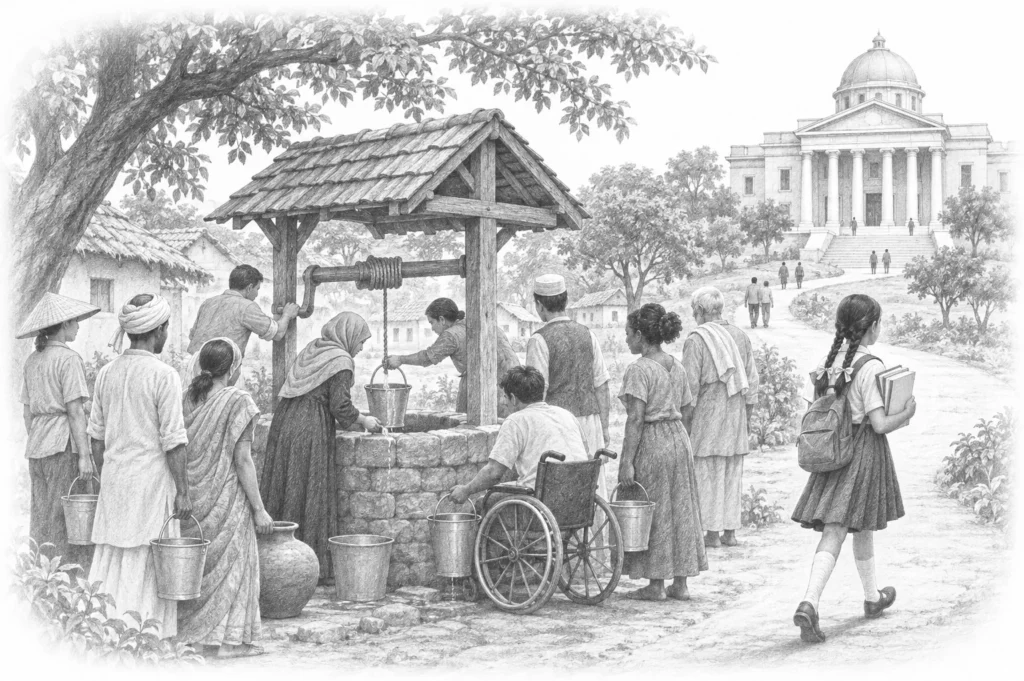
Bhatia emphasises that some rights apply against private actors: Article 15(2) bars discrimination in access to shops, wells and public places, and Article 17 abolishes untouchability in all forms. These provisions aim to transform social relations, not only state action.
5. Colonial Continuities
Bhatia criticises the continuation of colonial laws, such as sedition and Section 377, which conflicted with the Constitution’s transformative vision. Courts and legislatures have gradually removed some of these.
6. Puttaswamy, 2017
In Justice K.S. Puttaswamy v. Union of India (2017), a nine-judge bench recognised privacy as a fundamental right, linked with dignity and autonomy, and overruled ADM Jabalpur.
7. Navtej Singh Johar, 2018
In Navtej Singh Johar v. Union of India (2018), the Court decriminalised consensual same-sex relations, holding that Section 377 violated equality, dignity and privacy. The judges expressly invoked transformative constitutionalism.
8. Joseph Shine and Sabarimala, 2018
In Joseph Shine (2018), the Court struck down the adultery law as treating women as property. In Indian Young Lawyers Association (2018), it allowed women of all ages to enter the Sabarimala temple, though this was referred to a larger bench.
9. Constitutional Morality
In these cases, the Court relied on constitutional morality, meaning the values of the Constitution, such as dignity and equality, as opposed to popular or social morality that may support discrimination.
10. Supriyo, 2023
In Supriyo Chakraborty v. Union of India (2023), the Court declined to recognise same-sex marriage, leaving it to Parliament. This showed the limits of judicial transformation and the role of democratic institutions.
11. Electoral Bonds, 2024
In February 2024, the Court struck down the electoral bonds scheme for violating voters’ right to information, showing how transformative reasoning extends to transparency in democracy.
12. Public Interest Litigation
Public interest litigation since the late 1970s allowed courts to address bonded labour, prison conditions, environmental harm and the right to food, which Upendra Baxi called social action litigation, an important part of India’s transformative constitutionalism.
13. Criticisms
Critics argue that the Court has been inconsistent, bold in some cases and restrained in others, and that judicial transformation may lack democratic legitimacy and be difficult to implement.
14. Beyond the Courts
Transformation in India has also come through legislation, such as land reforms, reservations and rights-based laws, and through social movements of Dalits, women and workers.
15. The Constituent Assembly’s Vision
Members of the Constituent Assembly saw the Constitution as a social document. Jawaharlal Nehru’s Objectives Resolution of December 1946 promised justice, social, economic and political, to all the people of India, and Granville Austin later described the Constitution as first and foremost a social document, most of whose provisions aimed directly or indirectly at furthering the goals of the social revolution.
16. Reservations and Substantive Equality
In State of Kerala v. N.M. Thomas (1975) and Indra Sawhney (1992), the Supreme Court held that reservations are not exceptions to equality but means of achieving it, since equal treatment of unequal groups preserves inequality. This understanding of substantive equality is central to transformative constitutionalism in India and has guided later decisions on caste, gender and disability.
17. Evaluation
India’s Constitution is deeply transformative in purpose, and courts, legislatures and citizens share the task of realising it.
Conclusion. Thus, India’s Constitution was framed to transform a society of caste, colonial rule and inequality. Bhatia reads it as a radical break with the past, with rights against private power, and the Supreme Court invoked transformative constitutionalism in Puttaswamy, Navtej Johar and Joseph Shine, though Supriyo shows its limits.
Important Question 4
Discuss the idea of constitutional insurgencies and the role of citizens in transformative constitutionalism.
OR
Examine Anupama Roy’s view of transformative constitutionalism and constitutional insurgencies.
OR
How do marginalised groups use the Constitution to claim rights?
Model Answer
“Sanctity of life and liberty was not something new when the Constitution was drafted.”
— Justice H.R. Khanna, dissent in ADM Jabalpur v. Shivkant Shukla (1976)
Introduction. Transformative constitutionalism is often discussed in terms of courts, but constitutions are also brought to life by citizens. Anupama Roy, in Gendered Citizenship (2013), discusses how marginalised groups invoke the Constitution’s promises to make claims that challenge existing hierarchies, which she connects with the idea of constitutional insurgencies. This view places citizens at the centre of constitutional change.
1. Citizens and the Constitution
A constitution is not only a legal text interpreted by judges; it is also a shared language that citizens use to understand their rights and make demands on the state and society.
2. Roy on Citizenship
Anupama Roy studies citizenship as a status, a set of rights and a field of struggle. She shows that women, Dalits, Adivasis and other marginal groups have had to fight to make the formal promise of equal citizenship real.

3. Constitutional Insurgencies
Roy discusses how claims made in the name of the Constitution can unsettle established meanings of rights and citizenship. Such constitutional insurgencies use the Constitution’s own words to push for a more inclusive and egalitarian order.
4. Insurgent Citizenship
The idea draws on James Holston’s concept of insurgent citizenship, developed in Brazil, where the urban poor asserted rights to housing and services, challenging a system of differentiated citizenship.
5. The Women’s Movement
The women’s movement in India has used constitutional rights to challenge dowry, rape laws, sexual harassment and discriminatory personal laws. The Vishaka guidelines of 1997 arose from a petition by women’s groups after the gang rape of a social worker in Rajasthan.
6. Dalit Assertion
Dalit movements, inspired by Ambedkar, have invoked the Constitution to fight untouchability and caste violence and to defend reservations. The Constitution itself has become a symbol of Dalit dignity.
7. Adivasi Claims
Adivasi communities have invoked the Fifth and Sixth Schedules, the Panchayats (Extension to Scheduled Areas) Act and the Forest Rights Act to defend their land and resources, as in Niyamgiri in 2013.
8. Reading the Preamble
During the protests against the Citizenship (Amendment) Act in 2019–20, protesters across India read the Preamble aloud, using its promise of justice, liberty, equality and fraternity to challenge a law they saw as discriminatory.
9. Public Interest Litigation
Public interest litigation allowed citizens and groups to approach courts on behalf of the poor. Upendra Baxi called it social action litigation, through which the voices of the oppressed entered constitutional interpretation.
10. Rights-Based Movements
Movements for the right to information, food, work and education used constitutional values to win laws such as the RTI Act of 2005, MGNREGA of 2005 and the Right to Education Act of 2009.
11. Transforming Meaning
Through such struggles, the meaning of constitutional rights expands. Equality comes to include substantive equality, and liberty includes privacy and sexual autonomy.
12. Tension with the State
Constitutional insurgencies often bring citizens into conflict with governments, which may see protest as disorder. The Constitution provides both the language of protest and the limits on state response.
13. Limits
Not all claims succeed, and powerful groups may also invoke the Constitution to defend their interests. Constitutional insurgencies depend on organisation, public support and responsive institutions.
14. Citizens and Courts
Courts and citizens are partners in transformation: courts respond to claims brought by citizens, and judgments in turn give citizens new tools to claim rights.
15. Transgender Rights
In NALSA v. Union of India (2014), petitions by transgender persons led the Supreme Court to recognise their right to self-identify their gender and to be treated as a socially and educationally backward class. Activists then pressed Parliament, which passed the Transgender Persons (Protection of Rights) Act in 2019, though many in the community criticised its provisions on certification.
16. Evaluation
Roy’s idea shows that transformative constitutionalism is driven from below by citizens who claim the Constitution’s promises, not only from above by courts.
Conclusion. Thus, Anupama Roy shows that marginalised citizens use the Constitution’s promises to challenge hierarchies, in what she connects with constitutional insurgencies. Women’s, Dalit and Adivasi movements, public interest litigation and readings of the Preamble show that transformative constitutionalism is shaped from below as well as by courts.
Short Notes
(a) Culture of justification
Etienne Mureinik’s description (1994) of a constitutional order in which every exercise of public power must be justified by reasons, replacing a culture of authority.
(b) Constitutional morality
The values of the Constitution, such as dignity, equality and liberty, which courts apply even when they conflict with popular or social morality.
(c) Social action litigation
Upendra Baxi’s term for public interest litigation in India, through which courts addressed the rights of the poor and marginalised.
(d) Horizontal application of rights
The application of constitutional rights against private persons and institutions, not only the state, as in Articles 15(2) and 17 of the Indian Constitution.
More notes: DSE-12 Comparative Constitutionalism
These notes are prepared by PADHO TO AISE for study help. They are not an official University of Delhi publication.