
Semester VIII DSE-12 Comparative Constitutionalism
Unit II · 27 min read · Updated 24 Nov 2026
As per the University of Delhi (DU) BA (Hons) Political Science syllabus
Contents
- 2.1 Democracy and Constitutionalism
- Two Ideas in Tension
- Ways of Reconciling Democracy and Constitutionalism
- Frankenberg on Constitutional Democracy
- The Debate in India
- 2.2 Emergency Powers
- Historical Models of Emergency Power
- Safeguards in Modern Constitutions
- Emergency Provisions of the Indian Constitution
- Ackerman’s Supermajoritarian Escalator
- 2.3 Emergencies in India and Beyond
- The Emergency of 1975–77 in Detail
- Comparing India and Pakistan
- Emergencies and International Law
- The Covid-19 Experience
- 2.4 Important Questions
- Discuss the relationship between democracy and constitutionalism.
- Discuss the relationship between emergency powers and constitutionalism.
- Examine the provisions and experience of emergency in India.
- Discuss states of emergency in international law and the response to Covid-19.
- Short Notes
संप्रभु वह है जो अपवाद की स्थिति पर निर्णय करता है।
Sovereign is he who decides on the exception.
— Carl Schmitt, Political Theology (1922)
DEMOCRACY means rule by the people, usually through majorities, while constitutionalism places limits on what even a majority may do. The two can pull in different directions, as when courts strike down laws passed by elected legislatures. The tension is sharpest in an emergency, when governments claim extraordinary powers to deal with war, rebellion or a pandemic. This chapter examines how democracy and constitutionalism can be reconciled and how constitutions handle emergencies, drawing on Jon Elster, Ronald Dworkin, Richard Bellamy, John Ferejohn, Venkat Iyer, Anil Kalhan and the experience of India, Pakistan and the Covid-19 pandemic.

2.1 Democracy and Constitutionalism
Democracy gives power to the people and their majorities, while constitutionalism sets limits on that power through rights, separation of powers and judicial review. Critics see a tension, since unelected judges can overrule elected legislatures. Thinkers such as Dworkin argue that the two are compatible, because democracy itself requires that every citizen be treated as an equal, which constitutional rights protect.
Two Ideas in Tension
Democracy and constitutionalism grew up together but rest on different ideas. Democracy rests on popular sovereignty, i.e. the right of the people to rule themselves. Constitutionalism rests on limitation, i.e. the idea that even the people’s representatives must act within rules. Thomas Jefferson, writing to James Madison in 1789, argued that the earth belongs to the living and that no generation should bind the next, while Madison defended a stable constitution that would check the passions of temporary majorities. This old debate still shapes arguments about judicial review and constitutional amendment.
Ways of Reconciling Democracy and Constitutionalism
- Precommitment. Jon Elster, in Ulysses and the Sirens (1979), argued that a people may rationally bind itself in advance, as Ulysses tied himself to the mast, to protect its long-term interests from short-term passions.
- The constitutional conception of democracy. Ronald Dworkin, in Freedom’s Law (1996), argued that democracy means government that treats all citizens with equal concern and respect, so rights enforced by judges are part of democracy, not against it.
- Dualist democracy. Bruce Ackerman, in We the People (1991), distinguished normal politics from rare constitutional moments, such as the American Founding or the New Deal, when the people speak directly and change the constitution.
- Political constitutionalism. Jeremy Waldron, in Law and Disagreement (1999), and Richard Bellamy, in Political Constitutionalism (2007), argued that rights should be settled mainly by elected legislatures, which give every citizen an equal voice.
- Weak-form review. Some democracies let courts declare laws incompatible with rights while leaving the final word to parliament, as with Canada’s notwithstanding clause of 1982 and Britain’s Human Rights Act of 1998.
- Dialogue theory. Peter Hogg and Allison Bushell argued in 1997 that courts and legislatures engage in a dialogue, with legislatures responding to judgments by amending laws rather than simply obeying or defying courts.
In India, this debate appeared in the struggle between Parliament and the Supreme Court from Golaknath (1967) to Kesavananda Bharati (1973) and Minerva Mills (1980). The basic structure doctrine allows Parliament to amend the Constitution widely but protects its core, a distinctively Indian way of balancing democracy and constitutionalism.
Frankenberg on Constitutional Democracy
Günter Frankenberg shows that constitutions do not simply limit democracy; they also create and shape it. A constitution decides who the people are through citizenship rules, how they speak through elections and representation, and which questions they may decide by majority. Different constitutions adopt different forms of democracy: representative, participatory, direct through referendums, or consensual through power-sharing. In every case, constitutional democracy is a balance between the power of the people and protections for individuals and minorities.
The Debate in India
India has seen sharp debates on the counter-majoritarian role of courts. In I.R. Coelho (2007), the Supreme Court held that laws placed in the Ninth Schedule after 1973 could be tested against the basic structure, limiting a device that Parliament had used to shield laws from review. In 2015, the Court struck down the National Judicial Appointments Commission, although the constitutional amendment creating it had been passed almost unanimously, holding that judicial independence was part of the basic structure. Supporters saw this as protecting constitutionalism, while critics saw it as judges overruling the people’s representatives.
2.2 Emergency Powers
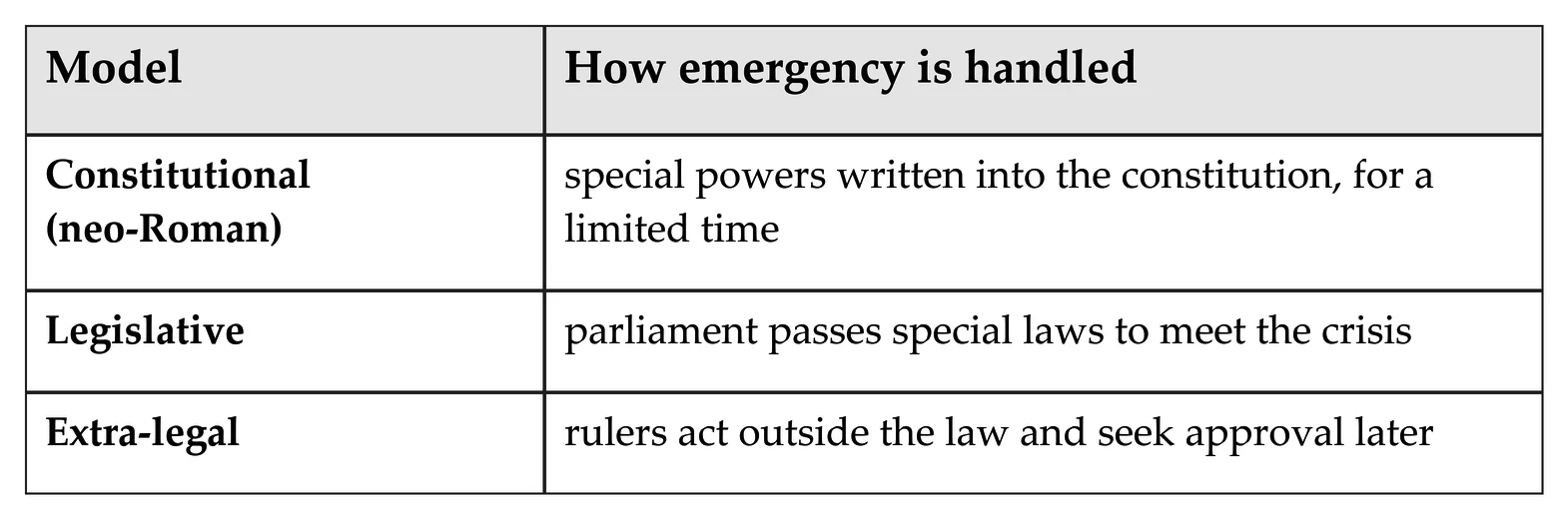
An emergency is a grave threat, such as war, rebellion, natural disaster or epidemic, that ordinary procedures may be too slow to meet. Constitutions handle emergencies in different ways: some write special powers into the constitution for a limited time, others leave the response to ordinary legislation, and some rulers act outside the law altogether. Carl Schmitt argued that whoever decides on the exception is sovereign, which is why emergency powers are so dangerous for constitutionalism.
Historical Models of Emergency Power
- The Roman dictatorship. The Roman Republic allowed a dictator to be appointed for a maximum of six months to meet war or rebellion; the legend of Cincinnatus, who returned to his farm after saving Rome, became a symbol of temporary emergency rule.
- Locke’s prerogative. Locke’s Second Treatise (1690) allowed the executive to act for the public good without, and even against, the law when the legislature could not foresee events, but left the final judgement to the people.
- Rousseau on dictatorship. In The Social Contract (1762), Book IV, Rousseau accepted a temporary dictatorship in grave danger but insisted that it be very short, so that it could not become permanent.
- Schmitt’s exception. Carl Schmitt, in Dictatorship (1921) and Political Theology (1922), written during the crises of the Weimar Republic, distinguished a commissarial dictatorship that restores order from a sovereign dictatorship that creates a new order.
- Rossiter’s constitutional dictatorship. Clinton Rossiter, in Constitutional Dictatorship (1948), studying Rome, Weimar, Britain and the United States, set criteria such as necessity, temporary duration and restoration of normal government.
- Agamben’s warning. Giorgio Agamben, in State of Exception (2003), written after the War on Terror began, argued that modern states increasingly govern through permanent emergency, so the exception becomes the rule.
Safeguards in Modern Constitutions
Learning from Weimar, many modern constitutions surround emergency powers with safeguards. Germany’s Basic Law, amended in 1968, keeps parliament and the constitutional court functioning during an emergency. South Africa’s Constitution of 1996 (Section 37) limits a state of emergency to twenty-one days unless parliament extends it, and lists rights that can never be suspended. India’s 44th Amendment of 1978 required a written Cabinet decision, parliamentary approval by special majority within one month and renewal every six months, and made Articles 20 and 21 non-suspendable. Courts also review whether emergency measures are necessary and proportionate.
Emergency Provisions of the Indian Constitution
Part XVIII of the Constitution (Articles 352 to 360) contains the emergency provisions. Students should know them article by article:
- Article 352 allows a national emergency on grounds of war, external aggression or armed rebellion, on the written advice of the Cabinet. It must be approved by both Houses by a special majority within one month and renewed every six months.
- Article 353 lets the Union give directions to states and lets Parliament make laws on State List subjects during a national emergency.
- Article 355 places a duty on the Union to protect states against external aggression and internal disturbance and to ensure that they are governed according to the Constitution.
- Article 356 provides for President’s Rule when the constitutional machinery in a state fails, approved by Parliament within two months, for up to three years in total.
- Articles 358 and 359 suspend the freedoms of Article 19 during a war emergency and allow the enforcement of other rights to be suspended, except Articles 20 and 21.
- Article 360 provides for a financial emergency if the financial stability or credit of India is threatened; it has never been used.
Ackerman’s Supermajoritarian Escalator
Bruce Ackerman, writing after the September 2001 attacks, proposed that emergency powers should last only a few weeks and be renewed by ever larger legislative majorities, for example sixty, then seventy, then eighty per cent. This supermajoritarian escalator would let a determined majority respond to a real crisis while making it very hard to keep an emergency going without broad agreement. He also proposed compensation for people wrongly detained, so that the state bears the cost of its mistakes.
2.3 Emergencies in India and Beyond
India’s Constitution provides for national emergency (Article 352), President’s Rule (Article 356) and financial emergency (Article 360). The emergency of 1975–77 suspended rights and saw the Supreme Court’s ADM Jabalpur judgment, after which the 44th Amendment added safeguards. Anil Kalhan compares India and Pakistan, and the Covid-19 pandemic showed how democracies use emergency powers today.

The Emergency of 1975–77 in Detail
- 12 June 1975 → The Allahabad High Court, in a petition by Raj Narain, set aside Indira Gandhi’s election to the Lok Sabha for electoral malpractice.
- 25 June 1975 → A national emergency was proclaimed on the ground of internal disturbance; opposition leaders such as Jayaprakash Narayan were arrested, and the press was censored.
- 1975 → The 39th Amendment tried to place the election of the Prime Minister beyond judicial review, but in Indira Nehru Gandhi v. Raj Narain (1975) the Supreme Court struck down this part as violating the basic structure.
- 1976 → The 42nd Amendment, called a mini-constitution, added socialist and secular to the Preamble, added Fundamental Duties and curtailed judicial review.
- 1977 → Elections were held in March, the Janata Party won, and the Shah Commission later examined the excesses of the emergency.
Comparing India and Pakistan
Anil Kalhan compares how India and Pakistan dealt with the emergency powers they inherited from the Government of India Act of 1935. In Pakistan, the constitutional order was repeatedly suspended by military rule in 1958, 1969, 1977 and 1999, and courts validated these takeovers through the doctrine of necessity, from Maulvi Tamizuddin Khan (1955) and State v. Dosso (1958) to Begum Nusrat Bhutto (1977) and Zafar Ali Shah (2000). In India, constitutional government survived, but Kalhan argues that emergency-like powers were absorbed into ordinary law through preventive detention, special security laws and President’s Rule, creating what he calls an extraconstitution.
Thus the experience of South Asia shows that emergency powers are dangerous not only when they are formally declared, but also when they become a normal part of governance. The test of constitutionalism is whether courts, legislatures, the press and citizens can keep such powers temporary and accountable.
Emergencies and International Law
Venkat Iyer shows that international law developed detailed standards for emergencies after the abuses of the twentieth century. A study for the UN by Nicole Questiaux in 1982 found that many states used emergencies to suppress opponents. The International Law Association’s Paris Minimum Standards and the Siracusa Principles, both of 1984, set out that emergencies must be officially proclaimed, temporary, necessary and proportionate, and must never touch non-derogable rights such as the right to life and freedom from torture.
The Covid-19 Experience
The pandemic of 2020 showed that emergencies today often arise from health crises rather than war. The Melbourne Forum on Constitution-building compared how countries responded. Some declared constitutional emergencies, as Spain did with its state of alarm; others used public health and disaster laws, as India did with the Epidemic Diseases Act of 1897 and the Disaster Management Act of 2005; and some, such as Hungary, gave governments open-ended powers to rule by decree. The main lesson is that even statutory emergency powers need time limits, legislative scrutiny, judicial review and attention to vulnerable groups, such as the migrant workers who suffered during India’s sudden lockdown.
2.4 Important Questions
- Question 1 Discuss the relationship between democracy and constitutionalism.
- Question 2 Discuss the relationship between emergency powers and constitutionalism.
- Question 3 Examine the provisions and experience of emergency in India.
- Question 4 Discuss states of emergency in international law and the response to Covid-19.
DU asks the same idea in different words. So learn one broad answer for each question below; the same answer works for every question joined by OR.
Important Question 1
Discuss the relationship between democracy and constitutionalism.
OR
Is constitutionalism undemocratic? Discuss with reference to judicial review.
OR
Examine the views of Elster, Dworkin and Bellamy on constitutionalism and democracy.
Model Answer
“The root difficulty is that judicial review is a counter-majoritarian force in our system.”
— Alexander Bickel, The Least Dangerous Branch (1962)
Introduction. Modern states call themselves constitutional democracies, combining rule by the people with limits on power. Yet democracy and constitutionalism can conflict: democracy values the will of the majority, while constitutionalism protects rights and procedures even against majorities. Political theorists such as Jon Elster, Ronald Dworkin and Richard Bellamy have debated whether and how the two can be reconciled.
1. Meaning of Democracy
Democracy means government by the people, usually through elected representatives and majority decisions. Its core values are popular sovereignty, political equality and the right of citizens to decide the laws under which they live.
2. Meaning of Constitutionalism
Constitutionalism means that government is limited by a higher law, which protects rights, separates powers and can only be changed by special procedures. It places some questions beyond the reach of ordinary majorities.
3. The Tension
If the people are sovereign, why should a constitution written long ago limit what today’s majority may do? And why should unelected judges be able to strike down laws passed by elected legislatures? This is the central tension between democracy and constitutionalism.
4. Bickel’s Counter-Majoritarian Difficulty
Alexander Bickel, in 1962, described judicial review as a counter-majoritarian force, since judges who are not accountable to voters can overrule the decisions of the people’s representatives. This counter-majoritarian difficulty has shaped constitutional debate ever since.
5. Elster and Precommitment
Jon Elster and Rune Slagstad describe the paradox that each generation wants to be free to bind its successors but not to be bound by its predecessors. Elster explains constitutions as precommitments, by which a people binds itself against future passions, like Ulysses tied to the mast.
6. Dworkin’s Constitutional Democracy
Ronald Dworkin rejects the majoritarian view that democracy simply means majority rule. He argues that democracy means government in which all citizens are treated as equal partners, so rights that secure equal concern and respect are conditions of democracy, not limits on it.
7. Judicial Review in Dworkin’s View
For Dworkin, when judges protect rights such as free speech and equality, they protect the conditions that make democratic self-government possible. Judicial review can therefore strengthen rather than weaken democracy.
8. Waldron’s Objection
Jeremy Waldron objects that in a society with reasonable disagreement about rights, there is no reason why judges’ views should prevail over those of elected legislators. He argues that legislatures can and should decide rights questions democratically.
9. Bellamy and Castiglione
Richard Bellamy and Dario Castiglione argue for a political constitutionalism, in which the constitution is not a fixed legal code enforced by judges but an ongoing framework of democratic debate and balance among institutions.
10. Frankenberg on Democracy
Günter Frankenberg shows that constitutions adopt different models of democracy, representative, participatory and direct, and that constitutional democracy always involves balancing popular power with protections for minorities and procedures.
11. Constitutions Enable Democracy
Constitutions also make democracy possible by establishing elections, protecting free speech and association, and creating institutions such as election commissions. Without these rules, majorities could silence opponents and end democracy itself.
12. India’s Experience
In India, the conflict appeared in the struggle between Parliament and the Supreme Court over property rights and constitutional amendments, which led to the basic structure doctrine in Kesavananda Bharati (1973) and the clash over the 42nd Amendment.
13. Democratic Backsliding
Recent experience in several countries shows that elected leaders can use majorities to weaken courts, the press and elections. Constitutional limits help protect democracy from such abuse by majorities.
14. Balancing the Two
Most constitutional democracies seek balance through amendment procedures, judicial restraint, dialogue between courts and legislatures, and independent institutions that protect both rights and popular rule.
15. Evaluation
Democracy and constitutionalism are in tension but also depend on each other, since rights and rules make genuine self-government possible.
Conclusion. Thus, democracy values majority rule, while constitutionalism limits it, giving rise to Bickel’s counter-majoritarian difficulty. Elster sees constitutions as precommitments, Dworkin argues that rights are conditions of democracy, and Bellamy and Waldron favour political constitutionalism. Constitutional democracy seeks a balance in which limits protect self-government.
Important Question 2
Discuss the relationship between emergency powers and constitutionalism.
OR
Examine the different models of emergency powers.
OR
Can constitutions provide for emergencies without destroying constitutionalism?
Model Answer
“This power to act according to discretion, for the public good, without the prescription of the law, and sometimes even against it, is that which is called prerogative.”
— John Locke, Second Treatise of Government, Section 160 (1690)
Introduction. Every state faces emergencies, such as war, rebellion, natural disasters and epidemics, when quick action is needed. But emergency powers allow governments to suspend rights and concentrate power, which threatens constitutionalism. The question is how constitutions can provide for emergencies while keeping power limited, a question examined by John Ferejohn, Clement Fatovic and Bruce Ackerman.
1. Meaning of Emergency
An emergency is a sudden and serious threat to the life of a nation or the safety of its people that cannot be met by ordinary procedures. It may arise from war, armed rebellion, terrorism, economic collapse, natural disaster or disease.
2. The Dilemma
Emergencies create a dilemma: if the government is bound by normal rules, it may fail to protect the nation; if it is freed from them, it may abuse power and never return to normal. Constitutionalism must find ways to allow necessary action while preventing abuse.
3. The Roman Dictatorship
The Roman Republic allowed the Senate to appoint a dictator with wide powers for a maximum of six months to meet a crisis, after which normal government returned. This is the model of a temporary, constitutionally regulated emergency.
4. Locke’s Prerogative
John Locke argued that the executive must have a prerogative to act for the public good without, and sometimes against, the law when the legislature cannot foresee every situation. But this power is judged by the people and must serve the public good.
5. Schmitt’s Challenge
Carl Schmitt argued that the sovereign is the one who decides on the exception, and that no legal rule can fully govern emergencies. His view suggests that emergencies reveal the limits of constitutionalism, and it was used to justify the collapse of the Weimar Republic.
6. Ferejohn’s Models
John Ferejohn and Pasquale Pasquino distinguish a constitutional or neo-Roman model, in which the constitution provides temporary emergency powers, from a legislative model, in which parliament passes special laws to meet a crisis. Others add an extra-legal model, in which officials act outside the law and seek approval afterwards.
7. Fatovic on Jefferson and Hamilton
Clement Fatovic contrasts Thomas Jefferson’s view that in real necessity the executive may act outside the law but must then submit to the judgement of the people, with Alexander Hamilton’s view of an energetic executive with broad powers within the Constitution.
8. Ackerman’s Emergency Constitution
Bruce Ackerman proposed an emergency constitution in which emergency powers are short and can only be renewed by ever larger majorities in the legislature, a supermajoritarian escalator, so that emergencies cannot last indefinitely.
9. Safeguards
Common safeguards include clear grounds for declaring an emergency, time limits, legislative approval and review, judicial oversight, rights that cannot be suspended, and a requirement to return to normal government as soon as possible.
10. Normalisation of Emergency
A major danger is that emergency measures become permanent, as special laws on detention and security remain after the crisis. Scholars warn that the exception can become the rule.
11. International Law
Article 4 of the International Covenant on Civil and Political Rights allows states to derogate from some rights in an officially proclaimed emergency that threatens the life of the nation, but only as strictly required and never from rights such as the right to life and freedom from torture.
12. India’s Constitutional Model
India follows the constitutional model, with Articles 352, 356 and 360 setting out national, state and financial emergencies, and Articles 358 and 359 dealing with suspension of rights.
13. Lessons of Abuse
History shows emergency powers being misused to silence opponents, as in Weimar Germany and India in 1975–77. These experiences have led to stronger safeguards in many constitutions.
14. Emergencies and Courts
Courts often defer to governments in emergencies, but they can insist that measures be necessary, proportionate and temporary, protecting rights even in a crisis.
15. Emergencies in Weimar Germany
Article 48 of the Weimar Constitution of 1919 allowed the German President to take emergency measures and suspend rights. It was used repeatedly in the early 1930s to govern by decree, and after the Reichstag fire of 1933 it helped Hitler destroy the republic. This experience led the framers of the German Basic Law of 1949 to restrict emergency powers severely.
16. Evaluation
Emergency powers are necessary but dangerous; constitutionalism survives emergencies only through clear limits, time limits and effective oversight.
Conclusion. Thus, emergencies create a dilemma between effective action and limited government. From the Roman dictatorship and Locke’s prerogative to Ferejohn’s models, Fatovic’s comparison of Jefferson and Hamilton and Ackerman’s emergency constitution, thinkers have sought ways to provide emergency powers with safeguards, against Schmitt’s warning that the exception defines the sovereign.
Important Question 3
Examine the provisions and experience of emergency in India.
OR
Discuss emergency powers in post-colonial India and Pakistan.
OR
What lessons did India learn from the emergency of 1975–77?
Model Answer
“Sanctity of life and liberty was not something new when the Constitution was drafted.”
— Justice H.R. Khanna, dissent in ADM Jabalpur v. Shivkant Shukla (1976)
Introduction. India’s Constitution gives the Union wide emergency powers, inherited partly from the colonial Government of India Act, 1935. These powers have been used three times for national emergencies and more than a hundred times for President’s Rule. The emergency of 1975–77 showed how such powers can threaten democracy, and led to important safeguards. Anil Kalhan compares this experience with Pakistan’s.
1. Colonial Roots
The emergency provisions drew on the Government of India Act, 1935, which gave the colonial Governor-General wide powers. Critics in the Constituent Assembly, such as H.V. Kamath, warned that these provisions could be used to establish dictatorship.
2. National Emergency
Article 352 allows the President to declare a national emergency on grounds of war, external aggression or, after 1978, armed rebellion. During an emergency, the Union can legislate on state subjects and direct state governments.
3. Suspension of Rights
Article 358 suspends the freedoms of Article 19 during an emergency due to war or external aggression, and Article 359 allows the President to suspend the enforcement of other fundamental rights. Since 1978, Articles 20 and 21 cannot be suspended.
4. President’s Rule
Article 356 allows the Union to take over a state’s government if its constitutional machinery fails. It has been used more than a hundred times, often to dismiss opposition governments for political reasons.
5. Financial Emergency
Article 360 provides for a financial emergency if the financial stability or credit of India is threatened. It has never been used.
6. The Emergencies of 1962 and 1971
National emergencies were declared during the war with China in 1962 and the war with Pakistan in 1971. These lasted for years after the fighting ended, showing how emergencies tend to continue.
7. The Emergency of 1975–77
On 25 June 1975, after the Allahabad High Court set aside Prime Minister Indira Gandhi’s election, an internal emergency was declared on the ground of internal disturbance. Opposition leaders were jailed, the press was censored and the 42nd Amendment of 1976 weakened the courts.
8. ADM Jabalpur
In ADM Jabalpur v. Shivkant Shukla (1976), the Supreme Court held by four to one that detained persons could not approach courts for habeas corpus during the emergency. Justice H.R. Khanna dissented. The judgment was overruled in the Puttaswamy case of 2017.
9. The 44th Amendment
After the Janata government came to power in 1977, the 44th Amendment of 1978 replaced internal disturbance with armed rebellion, required written advice of the Cabinet, required parliamentary approval by special majority within one month, and protected Articles 20 and 21.
10. S.R. Bommai
In S.R. Bommai v. Union of India (1994), the Supreme Court held that the imposition of President’s Rule is subject to judicial review and that a government’s majority must be tested on the floor of the House, sharply reducing misuse of Article 356.
11. Kalhan’s Extraconstitution
Anil Kalhan argues that India and Pakistan inherited a colonial emergency regime. In India, emergency-like powers were absorbed into ordinary law through preventive detention and special security laws, creating an extraconstitution that operates alongside the Constitution.
12. Pakistan’s Experience
In Pakistan, emergencies and martial law repeatedly displaced the constitution, as in 1958, 1977 and 1999. Courts often validated military takeovers through the doctrine of necessity, starting with State v. Dosso (1958).
13. Special Laws
Laws such as the Armed Forces (Special Powers) Act of 1958 and anti-terror laws give security forces wide powers in disturbed areas, which critics argue amount to permanent emergencies in parts of India.
14. Lessons
The emergency of 1975–77 taught India the importance of an independent judiciary, a free press, strong safeguards and an alert citizenry. Voters rejected the emergency in the 1977 election.
15. Constituent Assembly Debates
In the Constituent Assembly, members such as H.V. Kamath and K.T. Shah feared that the emergency provisions would allow the Union to destroy federalism and rights. B.R. Ambedkar replied that he hoped Article 356 would remain a dead letter and be used only as a last resort. Its frequent political use later showed that these fears were justified.
16. Evaluation
India’s emergency provisions have been tamed by amendment and judicial review, but special security laws keep the problem of normalised emergency alive.
Conclusion. Thus, India’s Constitution provides for national, state and financial emergencies, rooted in the 1935 Act. The 1975–77 emergency and ADM Jabalpur showed their danger, leading to the 44th Amendment and S.R. Bommai. Kalhan shows how emergency powers persist in ordinary law in India and repeatedly displaced Pakistan’s constitution.
Important Question 4
Discuss states of emergency in international law and the response to Covid-19.
OR
How did constitutional democracies use emergency powers during the Covid-19 pandemic?
OR
Examine the safeguards on emergency powers under international law.
Model Answer
“In time of public emergency which threatens the life of the nation and the existence of which is officially proclaimed, the States Parties to the present Covenant may take measures derogating from their obligations under the present Covenant to the extent strictly required by the exigencies of the situation.”
— International Covenant on Civil and Political Rights, Article 4 (1966)
Introduction. Emergencies are not only a matter of national constitutions. International human rights law sets standards for how states may limit rights in a crisis. The Covid-19 pandemic from 2020 tested these standards worldwide, as governments imposed lockdowns, closed borders and restricted gatherings. Venkat Iyer explains the international law of emergencies, and the Melbourne Forum compared legal responses to the pandemic.
1. Emergencies in International Law
International law accepts that states may face emergencies requiring special measures, but it seeks to prevent abuse. Venkat Iyer shows how standards developed through treaties, United Nations bodies and expert principles.
2. Article 4 of the ICCPR
Article 4 of the International Covenant on Civil and Political Rights allows derogation from rights only in a public emergency that threatens the life of the nation, that is officially proclaimed, and only to the extent strictly required. Measures must not discriminate on grounds such as race, sex or religion.

3. Non-Derogable Rights
Some rights can never be suspended, including the right to life, freedom from torture and slavery, freedom from retroactive criminal laws, recognition as a person before the law and freedom of thought, conscience and religion.
4. Siracusa and Paris Principles
The Siracusa Principles and the Paris Minimum Standards of 1984 set out further guidance: emergency measures must be necessary, proportionate, temporary, subject to review and notified to other states.
5. Regional Systems
The European Convention on Human Rights and the American Convention on Human Rights contain similar derogation clauses, and regional courts have reviewed whether states’ emergency measures were justified.
6. The Pandemic Challenge
Covid-19 was a global emergency that required restrictions on movement, assembly, work and education. Governments had to act quickly on uncertain scientific evidence, creating risks to rights and democratic oversight.
7. Three Legal Approaches
The Melbourne Forum identified different approaches: declaring a constitutional state of emergency, as Spain did with its state of alarm; using statutory emergency powers under public health or disaster laws; or relying on ordinary legal powers adapted to the crisis.
8. India’s Approach
India did not declare a constitutional emergency. It used the Epidemic Diseases Act of 1897 and the Disaster Management Act of 2005 to impose a nationwide lockdown from 24 March 2020, with orders issued by the National Disaster Management Authority.
9. Concerns in India
The sudden lockdown caused great hardship to migrant workers, many of whom walked home. Critics noted limited parliamentary scrutiny and the Supreme Court’s initial deference, though the Court later took up the migrants’ crisis on its own motion.
10. Hungary
In Hungary, a law of March 2020 allowed the government to rule by decree without a fixed end date, which critics saw as using the pandemic to concentrate power, showing the risk of emergency abuse.
11. Sunset Clauses and Oversight
Many democracies, such as Britain with its Coronavirus Act of 2020, included sunset clauses and periodic parliamentary review, so that emergency powers would lapse unless renewed.
12. Courts in the Pandemic
Courts in many countries reviewed lockdown measures for proportionality, striking down some restrictions on worship, protest or movement while upholding others as necessary for public health.
13. Lessons
The pandemic showed that statutory and constitutional emergency powers need clear limits, legislative oversight, judicial review, transparency and attention to vulnerable groups.
14. Emergencies and Democracy
Emergencies test whether constitutional democracies can protect both public safety and rights. Strong institutions and an active civil society help ensure that emergency powers end when the crisis does.
15. Evaluation
International standards and the pandemic experience show that emergencies must be governed by necessity, proportionality, time limits and oversight.
Conclusion. Thus, international law, through Article 4 of the ICCPR and the Siracusa Principles, allows limited derogation in emergencies but protects non-derogable rights. During Covid-19, states used constitutional, statutory or ordinary powers, as the Melbourne Forum shows; India relied on the Epidemic Diseases and Disaster Management Acts, while Hungary showed the dangers of open-ended emergency rule.
Short Notes
(a) Counter-majoritarian difficulty
Alexander Bickel’s term (1962) for the problem that unelected judges can strike down laws made by elected representatives.
(b) ADM Jabalpur case
The 1976 judgment holding that habeas corpus could not be sought during the emergency, with Justice H.R. Khanna dissenting; it was overruled in 2017.
(c) Non-derogable rights
Rights that cannot be suspended even in an emergency under international law, such as the right to life and freedom from torture and slavery.
More notes: DSE-12 Comparative Constitutionalism
These notes are prepared by PADHO TO AISE for study help. They are not an official University of Delhi publication.