

Semester VI DSE-4a Understanding Security
Unit IV · 21 min read · Updated 24 Nov 2026
As per the University of Delhi (DU) BA (Hons) Political Science syllabus
Contents
- 4.1 The Third World Security Predicament
- Ayoob: State-Making and Insecurity
- Acharya and Thomas: The Third World and Security Studies
- Bandung and Non-Alignment
- 4.2 The Postcolonial Moment and Western-Centrism
- Barkawi and Laffey: The Postcolonial Moment
- Bilgin: Western-Centrism as Blind Spot or Constitutive Practice
- Asian Conceptions of Security
- 4.3 Alternative Conceptions of Security in South Asia
- Behera: The Security Problematique in South Asia
- Barthwal-Datta and Basu: Rethinking Regional Security
- Peace Initiatives in South Asia
- Why Non-Western Perspectives Matter
- 4.4 Important Questions
- Discuss Mohammed Ayoob’s analysis of the Third World security predicament.
- Discuss Barkawi and Laffey’s argument about the postcolonial moment in security studies.
- Examine Pinar Bilgin’s argument on the Western-centrism of security studies.
- Discuss alternative conceptions of security in South Asia.
- Short Notes
किसी भी बड़ी शक्ति के विशेष हितों की पूर्ति के लिए सामूहिक रक्षा की व्यवस्थाओं के उपयोग से परहेज़।
Abstention from the use of arrangements of collective defence to serve the particular interests of any of the big powers.
— Final Communiqué of the Asian-African Conference, Bandung, 24 April 1955
SSECURITY studies grew up in the United States and Europe during the Cold War, focused on nuclear deterrence and great-power rivalry. Yet most of the world’s states are postcolonial, and most of the wars since 1945 have been fought in Asia, Africa and Latin America, often within states. Scholars from and of the Global South argue that security studies has been Western-centric, treating Western experience as universal and the rest of the world as a passive object. This chapter studies Unit IV of the syllabus, non-Western perspectives, through Mohammed Ayoob’s Third World security predicament, Barkawi and Laffey’s postcolonial moment, Pinar Bilgin’s analysis of Western-centrism, and alternative conceptions of security in South Asia.
4.1 The Third World Security Predicament
Ayoob: State-Making and Insecurity
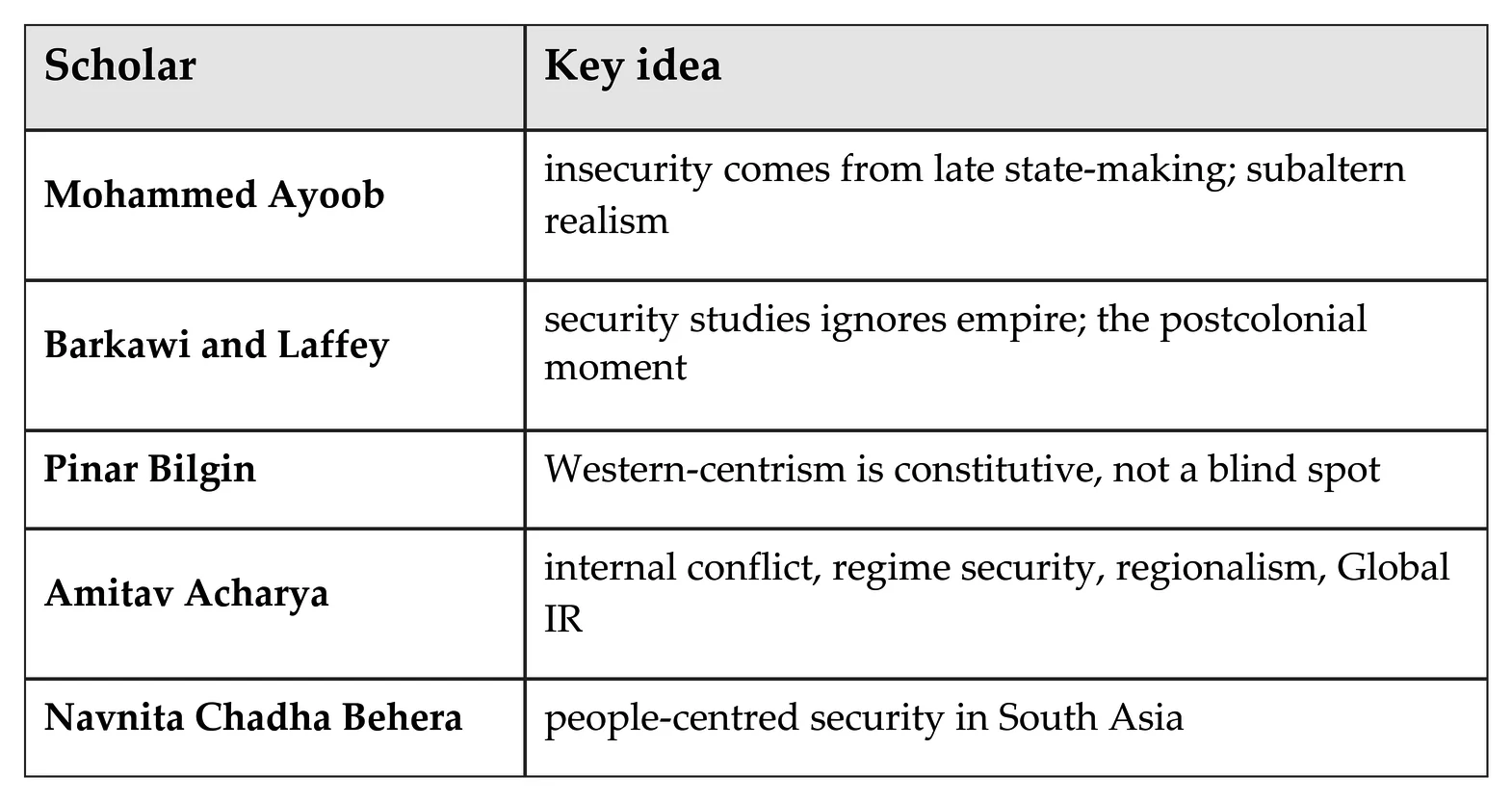
Mohammed Ayoob, in The Third World Security Predicament: State Making, Regional Conflict, and the International System (1995), argues that the security problems of Third World states cannot be understood through Western theories built on the experience of strong, consolidated states. Third World states are at an early stage of state-making: their borders were often drawn by colonial powers, their institutions are weak, their legitimacy is contested, and many groups within them do not accept the state’s authority. European states went through similar processes over centuries, often violently, as Charles Tilly showed, but Third World states must complete them quickly, under the watchful eye of an international system that expects them to respect human rights and existing borders.
- Internal threats first. The main threats to Third World states come from within: insurgencies, separatism, ethnic conflict and challenges to regimes.
- Regime security. Security often means the survival of the ruling regime rather than of the state or its people; Brian Job (1992) called this the insecurity dilemma.
- Regional conflict. Internal conflicts spill across borders and become regional conflicts, as in South Asia, the Middle East and the Horn of Africa.
- Great-power intrusion. During the Cold War, superpowers intervened in and armed Third World conflicts, deepening them.
- Subaltern realism. Ayoob later called his approach subaltern realism (2002): it accepts realism’s focus on states and power but adapts it to the weak states of the international system.
Acharya and Thomas: The Third World and Security Studies
Amitav Acharya, in The Third World and Security Studies (2011), shows that most conflicts after 1945 occurred in the Third World and were internal or regional rather than great-power wars. He argues that Third World security includes economic development, regime legitimacy and the protection of sovereignty against intervention, and that regionalism and norms such as non-intervention have helped some regions manage conflict. Caroline Thomas (1987) had earlier argued that for Third World states, security includes access to food, health, money and trade, not only military defence.

Bandung and Non-Alignment
The Asian-African Conference at Bandung in April 1955 brought together 29 newly independent and colonised states. Its ten principles, which included the Panchsheel principles of mutual respect and non-aggression, called for respect for sovereignty, non-interference and the peaceful settlement of disputes, and warned against military pacts serving the interests of big powers, such as SEATO (1954) and the Baghdad Pact (1955). The Non-Aligned Movement, founded at Belgrade in 1961, turned this into a security strategy: newly independent states would avoid Cold War alliances, oppose colonialism and seek disarmament.
- Edward Azar and Chung-in Moon (1988) argued that Third World security depends on the software of the state, i.e. legitimacy, national integration and policy capacity, as much as on military hardware.
- Caroline Thomas (1987) widened Third World security to include food, health, money and trade.
- Brian Job (1992) described the insecurity dilemma of regimes and groups threatening each other within weak states.
4.2 The Postcolonial Moment and Western-Centrism
Barkawi and Laffey: The Postcolonial Moment
Tarak Barkawi and Mark Laffey, in The Postcolonial Moment in Security Studies (2006), argue that security studies is Eurocentric: it takes the experience of European and North American great powers as the basis of theory and treats the Global South as a place where things happen rather than as a source of agency and knowledge. Mainstream theory assumes a world of separate sovereign states, but the modern world was made through empire: colonial wars, imperial policing and the incorporation of the South into Western-led orders. Security studies has focused on wars between great powers while ignoring the many small wars of empire and decolonisation, from the Indian Mutiny of 1857 to Algeria and Vietnam. They argue that the war on terror also cannot be understood without this imperial history. A postcolonial approach places the relations between North and South, and the agency of the colonised, at the centre.
Bilgin: Western-Centrism as Blind Spot or Constitutive Practice
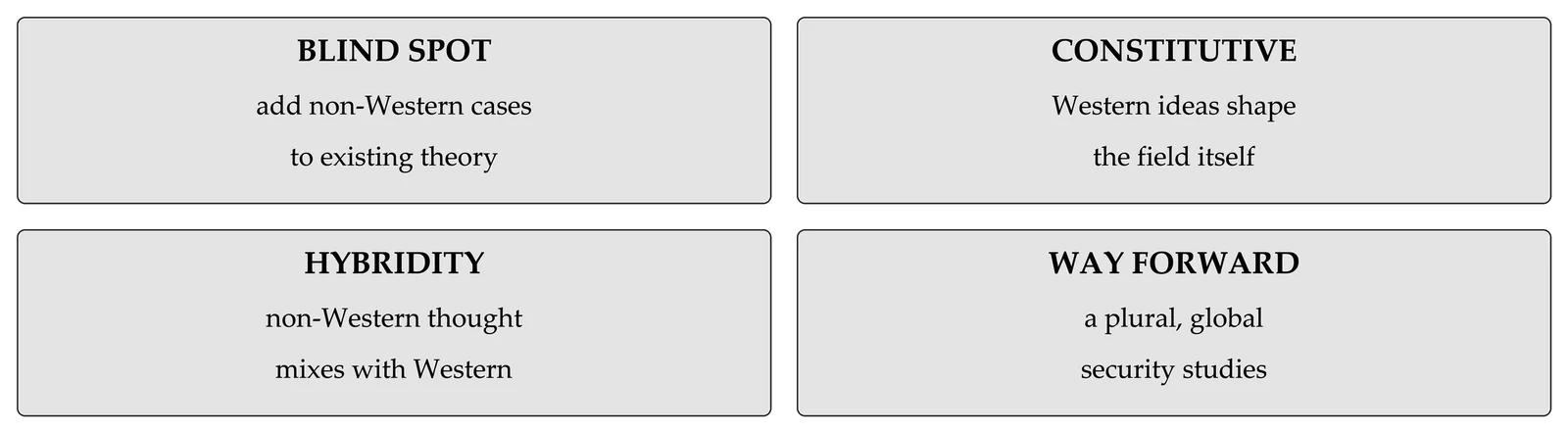
Pinar Bilgin, in The Western-Centrism of Security Studies: Blind Spot or Constitutive Practice? (2010), asks whether Western-centrism is a mere blind spot that can be corrected by adding non-Western cases, or a constitutive practice that shapes the field itself. She argues it is the latter: the concepts, questions and methods of security studies were formed through Western experience and power, and even non-Western actors often think about security in terms borrowed from the West. Simply adding case studies from Asia or Africa is not enough. Bilgin calls for examining how non-Western thinking has been shaped by engagement with the West, and for opening security studies to different experiences and ideas of security.
- Persaud (2018) shows how race, culture and colonial hierarchies shaped the field and its treatment of the Third World.
- Behera, Hinds and Tickner (2021) call for an antiracist critical security studies.
- Global IR. Amitav Acharya’s call for a Global IR (2014) seeks a discipline that draws on the histories and ideas of all regions.

Asian Conceptions of Security
- Comprehensive security (Japan). A study group set up under Prime Minister Ohira in 1980 argued that security includes economic, energy and food security, not only defence.
- National resilience (Indonesia). The idea of ketahanan nasional links security with internal stability, development and national unity.
- New Security Concept (China). China promoted, from the late 1990s, a concept based on mutual trust, mutual benefit, equality and coordination.
- Panchsheel (India and China, 1954). Five principles of peaceful coexistence that became a basis of postcolonial diplomacy.
4.3 Alternative Conceptions of Security in South Asia
Behera: The Security Problematique in South Asia
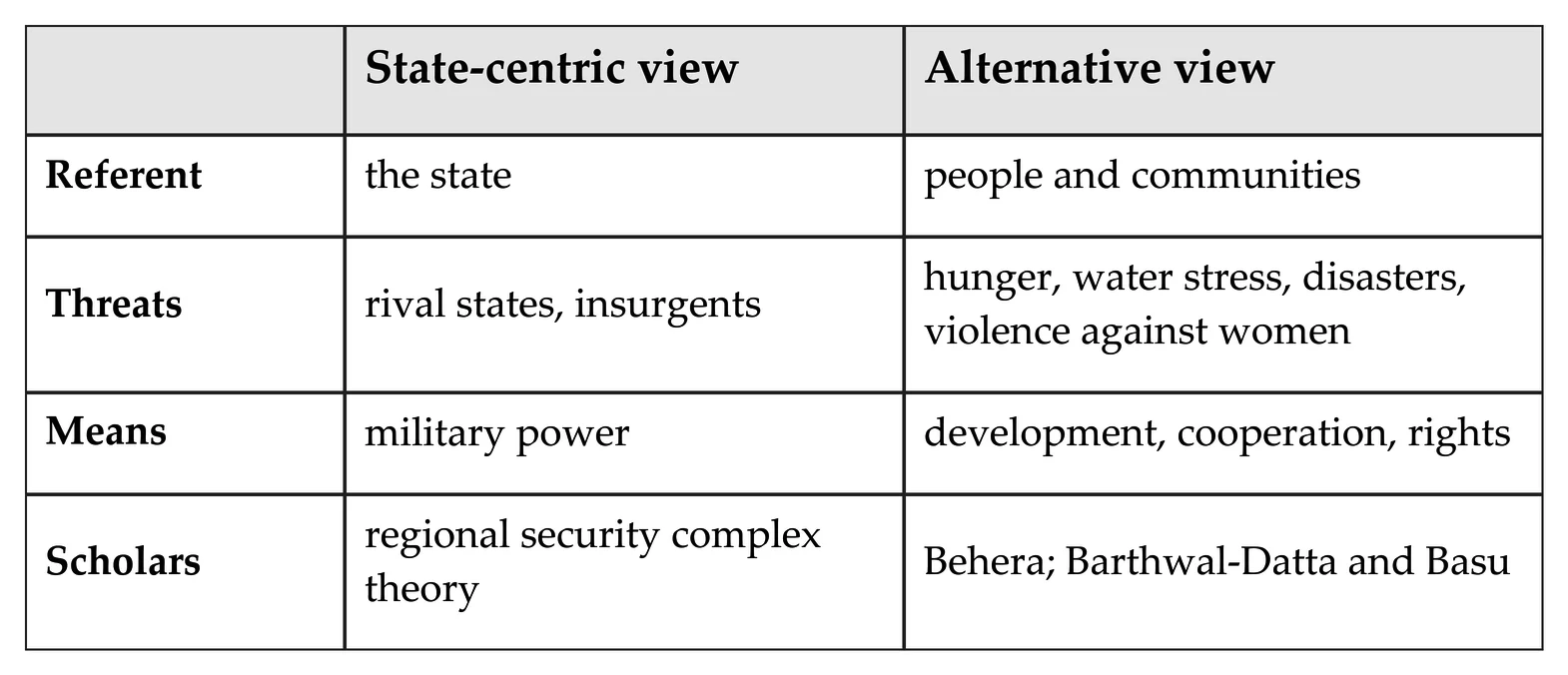
Navnita Chadha Behera, in The Security Problematique in South Asia: Alternative Conceptualizations (2008), argues that the dominant state-centric idea of national security in South Asia has produced arms races, nuclear rivalry and repression of minorities, while leaving people insecure from poverty, hunger, communal violence and environmental degradation. She draws on alternative traditions, including Gandhian non-violence, feminist and people-centred approaches, to propose a comprehensive and human-centred conception of security that treats people and communities as referents and values cooperation across borders.
Barthwal-Datta and Basu: Rethinking Regional Security
Monika Barthwal-Datta and Soumita Basu, in Reconceptualizing Regional Security in South Asia: A Critical Security Approach (2017), argue that the regional security complex approach, which sees South Asia mainly through India-Pakistan rivalry, misses the everyday insecurities of the region’s people. A critical approach focuses on threats such as food and water insecurity, health, disasters, displacement and violence against women, which cross borders and require regional cooperation. They show that civil society networks and regional initiatives on such issues can build a different kind of regional security.
- Human development. Pakistani economist Mahbub ul Haq led the first Human Development Report (1990), which put people at the centre of development and inspired human security thinking.
- Regional cooperation. SAARC’s Food Bank (2007) and disaster management cooperation reflect non-traditional security cooperation, though limited by politics.
- Nizamani (2008) argues that critical security studies can help South Asians see beyond state-centric theories made elsewhere.
- Indian traditions. Kautilya, Ashoka and Gandhi offer different Indian resources for thinking about security, from statecraft to non-violence.
Peace Initiatives in South Asia
- Indus Waters Treaty (1960). A rare example of India-Pakistan cooperation that lasted through several wars until it was placed in abeyance in 2025.
- Lahore Declaration (1999). India and Pakistan committed to confidence-building measures after their nuclear tests.
- Ganga Water Treaty (1996). An agreement with Bangladesh on sharing the Ganga.
- Kartarpur Corridor (2019). Visa-free access for Indian pilgrims to a Sikh shrine in Pakistan.
- People-to-people. The Pakistan-India People’s Forum for Peace and Democracy (1994) shows civil society efforts to build security from below.
Why Non-Western Perspectives Matter
Non-Western perspectives matter not only for fairness but for accuracy. Most of the world’s people live in Asia, Africa and Latin America, and most wars since 1945 have been fought there. Theories that ignore these experiences misread the causes of conflict, such as contested borders, weak institutions and the legacies of empire, and may recommend policies that fail. As India and other countries of the Global South gain influence, their ideas about sovereignty, development and security increasingly shape global debates, for example at the G20 and in negotiations on climate and health.
4.4 Important Questions
- Question 1 Discuss Mohammed Ayoob’s analysis of the Third World security predicament.
- Question 2 Discuss Barkawi and Laffey’s argument about the postcolonial moment in security studies.
- Question 3 Examine Pinar Bilgin’s argument on the Western-centrism of security studies.
- Question 4 Discuss alternative conceptions of security in South Asia.
DU asks the same idea in different words. So learn one broad answer for each question below; the same answer works for every question joined by OR.
Important Question 1
Discuss Mohammed Ayoob’s analysis of the Third World security predicament.
OR
Examine Ayoob’s idea of subaltern realism.
OR
Discuss the security problems of Third World states.
Model Answer
“War made the state, and the state made war.”
— Charles Tilly, The Formation of National States in Western Europe (1975)
Introduction. Mohammed Ayoob argues that Western security theories, built on the experience of strong states, cannot explain the insecurity of Third World states. These states are at an early stage of state-making, with weak institutions, contested borders and internal challenges. Their main threats come from within, and regional conflicts and great-power intervention deepen their insecurity. Ayoob called his approach subaltern realism.
1. Limits of Western Theory
Western theories assume consolidated states facing external threats. Most Third World states do not fit this model.
2. Late State-Making
Third World states are at an early stage of state-making, with borders often drawn by colonial powers.
3. Tilly’s Lesson
Tilly showed that European states were built through war and coercion over centuries. Third World states face similar pressures.
4. Compressed Time
Third World states must build states quickly, under international norms that limit the use of force against citizens.
5. Internal Threats
Their main threats come from within: insurgency, separatism, ethnic conflict and challenges to regimes.
6. Weak Legitimacy
Many groups do not accept the authority of the state, which weakens its capacity to govern.
7. Regime Security
Security often means the survival of the ruling regime rather than of the state or its people.
8. Insecurity Dilemma
Brian Job described the insecurity dilemma, in which regimes and groups threaten each other within the state.
9. Regional Spillover
Internal conflicts spill across borders, creating regional conflicts as in South Asia and the Middle East.
10. Great-Power Intrusion
During the Cold War, superpowers armed and intervened in Third World conflicts, deepening them.
11. Subaltern Realism
Ayoob’s subaltern realism accepts realism’s focus on states but adapts it to weak states in an unequal system.
12. Critique of Human Rights Pressure
Ayoob argued that international pressure on human rights can weaken states still in the process of state-making.
13. Acharya’s Support
Acharya shows that most post-1945 conflicts were internal or regional, supporting Ayoob’s focus.
14. Thomas on Wider Security
Caroline Thomas argued that Third World security includes food, health, money and trade.
15. South Asian Examples
Conflicts in Sri Lanka, Pakistan’s tribal areas and India’s Northeast illustrate the predicament.
16. Criticism
Critics argue that Ayoob privileges state-building over people’s rights and may justify repression.
17. Arbitrary Borders
Colonial borders often divided ethnic groups and joined rivals, as in Africa and South Asia, creating disputes and separatist movements after independence.
18. Non-Alignment as Response
Many Third World states adopted non-alignment to avoid being drawn into great-power rivalry, which Ayoob saw as a response to their security predicament.
19. Software of Security
Azar and Moon argued that legitimacy, integration and policy capacity, the software of the state, matter as much as military hardware for Third World security.
20. Arms Races in the South
Regional rivalries led many Third World states to spend heavily on arms, often bought from great powers, diverting resources from development.
21. Relevance after the Cold War
Civil wars in the 1990s in Somalia, Rwanda and the former Yugoslavia confirmed Ayoob’s view that state weakness and internal conflict are central security problems.
22. Evaluation
Ayoob’s work showed that security theory must account for the distinct position of postcolonial states.
Conclusion. Thus, Ayoob, drawing on Tilly’s insight that war made the state, shows that Third World states face insecurity from incomplete state-making, internal challenges and great-power intrusion. His subaltern realism adapted security theory to the realities of the postcolonial world.
Important Question 2
Discuss Barkawi and Laffey’s argument about the postcolonial moment in security studies.
OR
Examine the postcolonial critique of security studies.
OR
Discuss the importance of empire for understanding security.
Model Answer
“The Orient was almost a European invention, and had been since antiquity a place of romance, exotic beings, haunting memories and landscapes, remarkable experiences.”
— Edward W. Said, Orientalism (1978)
Introduction. Tarak Barkawi and Mark Laffey argue that security studies is Eurocentric, treating the experience of Western great powers as universal and the Global South as a passive object. They argue that the modern world was made through empire and that security studies must place North-South relations and the agency of the colonised at the centre. They call this the postcolonial moment.
1. Eurocentrism
Security studies takes European and North American experience as the basis of theory.
2. Said’s Orientalism
Edward Said showed how the West represented the East as exotic and backward, shaping knowledge and power.
3. The South as Object
Mainstream theory treats the Global South as a place where things happen, not as a source of agency.
4. A World Made by Empire
The modern international system was made through empire, not only through relations among sovereign states.
5. Small Wars
Security studies focused on great-power war but ignored colonial wars, from 1857 in India to Algeria and Vietnam.
6. Imperial Policing
Colonial powers used force to control populations, practices that shaped later counter-insurgency.
7. Decolonisation
Wars of decolonisation were central to twentieth-century security but marginal in theory.
8. The War on Terror
Barkawi and Laffey argue that the war on terror cannot be understood without the history of empire.
9. Agency of the Colonised
A postcolonial approach recognises the colonised as actors who resisted and reshaped world order.
10. North-South Relations
Security should be studied through relations between North and South, not only among great powers.
11. Race
Racial hierarchies shaped empire and still influence how threats are perceived, as Persaud shows.
12. Indian Experience
India’s history of colonial rule, partition and the 1857 revolt shows the importance of empire for security.
13. Link to Critical Security Studies
The postcolonial approach joins critical security studies in asking whose security is protected.
14. Global IR
It supports calls for a Global IR that draws on the histories and ideas of all regions.
15. Contribution
It has made empire, race and the Global South central topics in security studies.
16. Criticism
Critics say postcolonial approaches can be abstract and offer limited guidance for policy.
17. Colonial Armies
Colonial powers relied on soldiers from the colonies, such as over a million Indians in the First World War, a fact often missing from Western accounts of war.
18. Mutual Constitution
Barkawi and Laffey stress that metropole and colony shaped each other, so European security cannot be understood apart from empire.
19. Counter-Insurgency Legacies
Techniques of colonial counter-insurgency, such as population control and emergency laws, were often inherited by postcolonial states.
20. Evaluation
The postcolonial moment broadens security studies to include the majority of the world’s people and history.
Conclusion. Thus, Barkawi and Laffey, building on Said’s insight that the Orient was a European invention, show that security studies has ignored empire and the agency of the colonised. Their postcolonial moment calls for placing North-South relations at the heart of the field.
Important Question 3
Examine Pinar Bilgin’s argument on the Western-centrism of security studies.
OR
Discuss whether the Western-centrism of security studies is a blind spot or a constitutive practice.
OR
Examine the case for non-Western perspectives on security.
Model Answer
“Until the lions have their own historians, the history of the hunt will always glorify the hunter.”
— African proverb cited by Chinua Achebe (1994)
Introduction. Pinar Bilgin asks whether the Western-centrism of security studies is a blind spot that can be fixed by adding non-Western cases or a constitutive practice that shapes the field itself. She argues that it is constitutive, since the concepts and questions of security studies were formed through Western experience. Her work supports the search for more plural, global approaches to security.
1. The Problem
Security studies has been dominated by Western scholars, concepts and cases.
2. Blind Spot View
One view sees Western-centrism as a blind spot that can be corrected by adding cases from Asia and Africa.
3. Bilgin’s Answer
Bilgin argues that Western-centrism is a constitutive practice that shapes the concepts and questions of the field.
4. Concepts Shaped by Power
Ideas such as national security and deterrence developed from Western experience and power.
5. Adding Cases Is Not Enough
Simply studying non-Western cases with Western concepts does not change the field.
6. Non-Western Thinking Shaped by the West
Non-Western actors often think about security in terms borrowed from or shaped by engagement with the West.
7. Hybridity
Bilgin suggests examining how non-Western security thinking mixes Western and local ideas.
8. Achebe’s Proverb
The proverb that the hunt is glorified until lions have their own historians captures the problem of perspective.
9. Ayoob and Thomas
Ayoob and Thomas showed that Third World security differs from Western experience, supporting Bilgin.
10. Barkawi and Laffey
Their postcolonial critique complements Bilgin’s argument by highlighting empire.
11. Global IR
Acharya’s Global IR calls for a discipline drawing on all regions’ histories and ideas.
12. Indian Resources
Kautilya, Ashoka and Gandhi show that Indian thought offers distinct ideas about security and order.
13. Risks of Nativism
Bilgin warns against simply replacing Western ideas with national myths; the goal is dialogue, not closure.
14. Institutional Inequality
Journals, funding and universities remain concentrated in the West, reinforcing Western-centrism.
15. Way Forward
A more global security studies would combine many experiences and engage critically with all traditions.
16. Criticism
Some argue that Western concepts have universal value and that the critique exaggerates their limits.
17. Knowledge and Power
Following Said, Bilgin shows that knowledge about other regions was produced within relations of power, which shaped what counted as security.
18. Non-Western IR Theory
Projects asking why there is no non-Western IR theory, such as Acharya and Buzan’s (2010), seek to recover ideas from Asian and other traditions.
19. Asian Concepts
Concepts such as Japan’s comprehensive security and Indonesia’s national resilience show that non-Western states have developed their own ideas of security.
20. Teaching and Curriculum
Bilgin’s argument implies that curricula, including in India, should teach non-Western ideas alongside Western theories, not as footnotes.
21. Evaluation
Bilgin’s argument shows that making security studies global requires rethinking its foundations, not only adding cases.
Conclusion. Thus, Bilgin argues that the Western-centrism of security studies is a constitutive practice rather than a blind spot. As the proverb cited by Achebe suggests, until all peoples tell their own stories of security, the field will glorify the perspective of the powerful.
Important Question 4
Discuss alternative conceptions of security in South Asia.
OR
Examine Navnita Chadha Behera’s view of the security problematique in South Asia.
OR
Discuss the critical approach to regional security in South Asia.
Model Answer
“The real wealth of a nation is its people.”
— UNDP, Human Development Report (1990), prepared under Mahbub ul Haq
Introduction. In South Asia, the dominant idea of security has been state-centric, focused on India-Pakistan rivalry, nuclear weapons and internal insurgencies. Scholars such as Navnita Chadha Behera, Monika Barthwal-Datta and Soumita Basu argue that this approach leaves people insecure from poverty, hunger, disasters and violence. They propose people-centred, comprehensive conceptions of security drawing on South Asian traditions.
1. The Dominant View
South Asian states have defined security mainly as the defence of the state against rivals and insurgents.
2. Costs of State-Centrism
Behera shows that this view produced arms races, nuclear rivalry and repression of minorities.
3. People’s Insecurity
Meanwhile, people remained insecure from poverty, hunger, communal violence and environmental damage.
4. Behera’s Alternatives
Behera proposes a comprehensive, human-centred conception of security, treating people and communities as referents.
5. Gandhian Resources
She draws on Gandhian non-violence as a South Asian resource for rethinking security.
6. Feminist Perspectives
Feminist approaches reveal violence against women and women’s roles in peace-building in the region.
7. Limits of RSCT
Barthwal-Datta and Basu argue that the regional security complex approach reduces South Asia to India-Pakistan rivalry.
8. Everyday Insecurities
They focus on food and water insecurity, health, disasters, displacement and gendered violence.
9. Transboundary Threats
These threats cross borders, such as floods in the Ganga-Brahmaputra basin, requiring regional cooperation.
10. Civil Society
Civil society networks across borders can build a different kind of regional security from below.
11. Mahbub ul Haq
Haq’s Human Development Report of 1990 put people at the centre, inspiring human security thinking.
12. Regional Initiatives
SAARC’s Food Bank and disaster cooperation reflect non-traditional security, though politics limits them.
13. Nizamani’s Case
Nizamani argues that critical security studies helps South Asians see beyond theories made elsewhere.
14. Indian Traditions
Kautilya, Ashoka and Gandhi offer varied Indian ideas, from statecraft to non-violence.
15. Challenges
Persistent rivalries, terrorism and mistrust make it hard for states to adopt people-centred approaches.
16. Criticism
Realists argue that hard security threats remain real and cannot be wished away by redefining security.
17. Water and Security
Shared rivers such as the Indus, Ganga and Brahmaputra make water a key regional issue, where cooperation could build trust across borders.
18. Women and Peace in South Asia
Women’s groups, such as cross-border initiatives between Indian and Pakistani women, have promoted dialogue and peace from below.
19. Disasters and Cooperation
Shared hazards such as floods, cyclones and earthquakes make disaster cooperation a practical way to build regional security.
20. Evaluation
Alternative conceptions enrich South Asian security thinking by putting people and cooperation at the centre.
Conclusion. Thus, South Asian scholars argue that the real wealth, and the real security, of nations lies in their people. Behera and Barthwal-Datta and Basu call for people-centred, comprehensive and cooperative conceptions of security beyond state-centric rivalry.
Short Notes
(a) Subaltern realism
Mohammed Ayoob’s approach, which accepts realism’s focus on states and power but adapts it to the weak, postcolonial states of the international system.
(b) Insecurity dilemma
Brian Job’s term (1992) for the situation in weak states where regimes and groups within the state threaten each other, so that internal security is the main problem.
(c) Global IR
Amitav Acharya’s call (2014) for an international relations discipline that draws on the histories, ideas and experiences of all regions, not only the West.
(d) Bandung Conference
The Asian-African Conference held at Bandung, Indonesia, in April 1955, where 29 states adopted ten principles of peaceful coexistence and warned against military pacts serving big powers, laying the foundation of the Non-Aligned Movement.
More notes: DSE-4a Understanding Security
These notes are prepared by PADHO TO AISE for study help. They are not an official University of Delhi publication.