

Semester VI DSE-4a Understanding Security
Unit I · 22 min read · Updated 24 Nov 2026
As per the University of Delhi (DU) BA (Hons) Political Science syllabus
Contents
- 1.1 Security and Core Concepts in IR: Power, Peace and Identity
- What Is Security
- Buzan: Power, Peace and Security
- Identity and Security
- Booth: Security and Emancipation
- Security for Whom
- 1.2 Sectors of Security: Traditional and Non-Traditional
- Buzan and Hansen: Defining International Security Studies
- Buzan’s Five Sectors
- Broadening and Deepening
- Non-Traditional Security in Asia
- 1.3 Levels of Security Referents and the Indian Understanding
- From the Individual to the Globe
- The Indian Understanding of Security
- India and Human Security
- 1.4 Important Questions
- Discuss the concept of security and its relationship with power, peace and identity.
- Distinguish between traditional and non-traditional security.
- Discuss the levels of security referents from the individual to the globe.
- Discuss the Indian understanding of security with reference to Kautilya.
- Short Notes
वस्तुनिष्ठ अर्थ में सुरक्षा अर्जित मूल्यों के लिए खतरों के अभाव को मापती है; व्यक्तिपरक अर्थ में, इस भय के अभाव को कि उन मूल्यों पर हमला होगा।
Security, in an objective sense, measures the absence of threats to acquired values, in a subjective sense, the absence of fear that such values will be attacked.
— Arnold Wolfers, “National Security” as an Ambiguous Symbol (1952)
WWHAT does it mean to be secure, and whose security matters? For much of the twentieth century, security meant the military defence of the state against other states. Since the 1980s, scholars have broadened the idea to include economic, societal and environmental threats, and deepened it to include individuals, communities, regions and the whole planet. This chapter studies Unit I of the syllabus: the relationship of security with power, peace and identity; the sectors of security, traditional and non-traditional; the levels at which security is sought, from the individual to the globe; and the Indian understanding of security, especially in Kautilya’s Arthashastra.
1.1 Security and Core Concepts in IR: Power, Peace and Identity
What Is Security
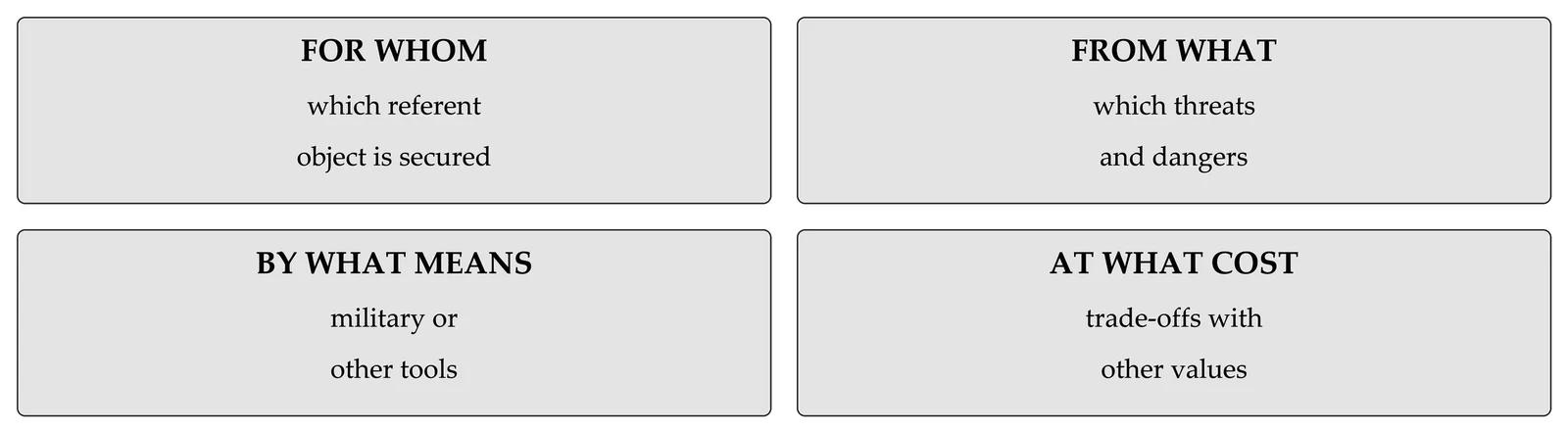
Paul D. Williams, introducing Security Studies (2008), explains that security is usually understood as the alleviation of threats to cherished values, especially threats to the survival of a referent object. Arnold Wolfers (1952) warned that national security is an ambiguous symbol that can mean different things to different people; objectively it means the absence of threats to acquired values, subjectively the absence of fear. David Baldwin, in The Concept of Security (1997), argued that security should be specified by answering several questions: security for whom, for which values, how much security, from what threats, by what means, at what cost and in what time period. Different answers produce different policies.
Buzan: Power, Peace and Security
Barry Buzan, in Peace, Power and Security: Contending Concepts in the Study of International Relations (1984), argued that IR had long been dominated by two concepts. Realists organised their thinking around power, seeing world politics as a struggle in which states seek capabilities to survive. Idealists organised theirs around peace, seeking to abolish war through law, institutions and cooperation. Both concepts, he said, had weaknesses: power ignored the shared nature of threats, and peace was too utopian. Buzan proposed security as a better organising concept that sits between them. Security is relational: the security of one state depends on others, which brings out the security dilemma, in which measures that make one state feel safer make others feel less safe. This links realist concerns with power and idealist hopes for cooperation.

Identity and Security
Pinar Bilgin, in Identity/Security (2010), shows that identity and security are closely linked. Who we think we are shapes what we see as a threat, and security practices in turn shape identities, by defining an inside to be protected and an outside to be feared. David Campbell’s Writing Security (1992) argued that US foreign policy constantly reproduced American identity by naming dangers. For many groups, the main threat is not invasion but the loss of their identity, i.e. their language, religion or culture, which is the basis of the idea of societal security.
Booth: Security and Emancipation
Ken Booth, in Security and Emancipation (1991), argued that traditional security studies focused on states and military power, often making people less secure. He defined emancipation as freeing people from the physical and human constraints, such as war, poverty, oppression and poor education, that stop them from doing what they would freely choose. For Booth, security and emancipation are two sides of the same coin, and true security comes from emancipation rather than from power or order. His work founded the Welsh or Aberystwyth School of critical security studies.
Security for Whom
The question security for whom is the starting point of every debate in security studies. When the state is the referent, its survival may justify policies that harm citizens, such as surveillance or the suppression of dissent. When people are the referent, the same policies may appear as threats. In simple words, choosing the referent object is itself a political choice, which is why critical scholars insist on asking whose security a policy really serves.
1.2 Sectors of Security: Traditional and Non-Traditional
Buzan and Hansen: Defining International Security Studies
Barry Buzan and Lene Hansen, in The Evolution of International Security Studies (2009), explain that the field can be defined by four questions: what is the referent object to be secured (the state or something else); should threats be seen as internal as well as external; should security be broadened beyond the military sector; and how should we think about the politics of threat and danger. The answers divide traditional from wider approaches. Traditional security studies, dominant during the Cold War, focused on the state, external military threats and the use of force, especially nuclear deterrence.
Buzan’s Five Sectors
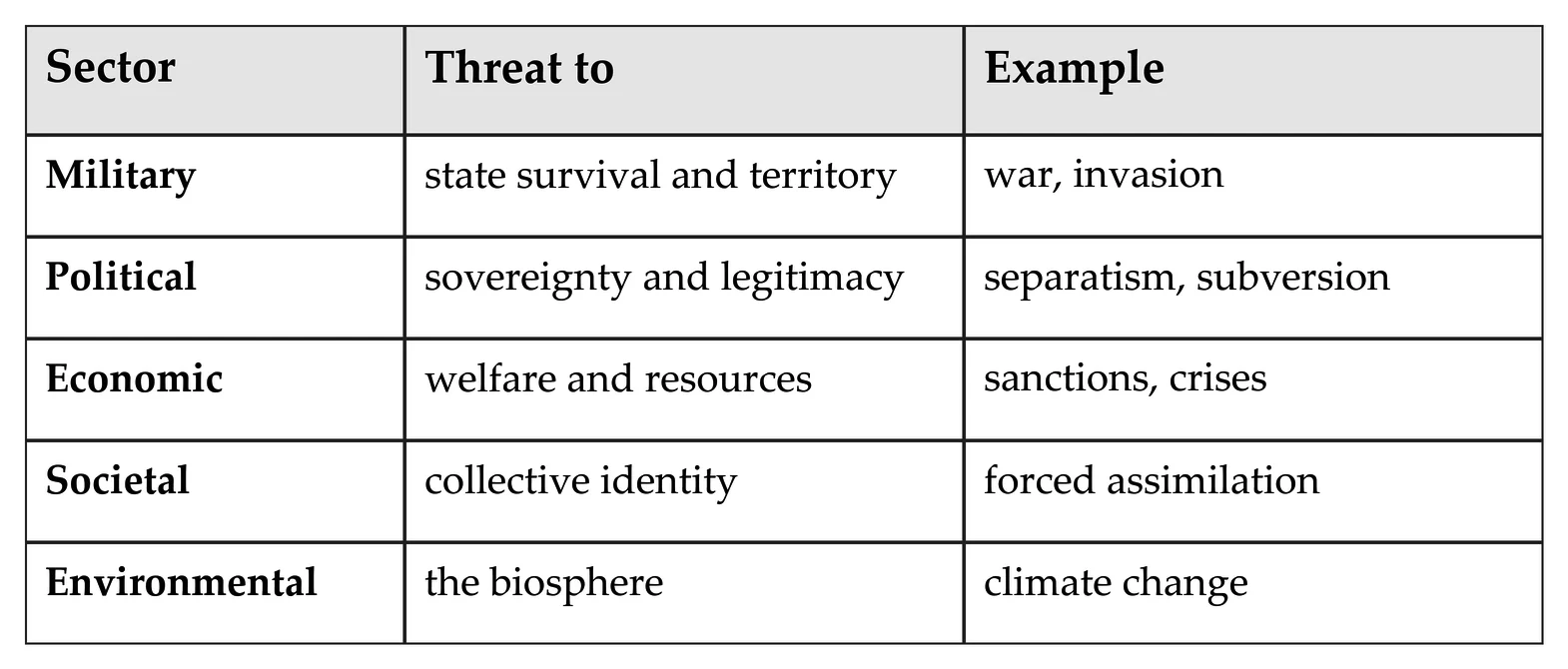
In People, States and Fear (1983; second edition 1991), Buzan argued that national security cannot be understood through the military sector alone. He identified five sectors of security:
- Military. Threats to the state’s survival and territory from armed force.
- Political. Threats to the state’s sovereignty, legitimacy and organisational stability, such as separatism or subversion.
- Economic. Threats to welfare, resources and access to markets and finance, such as sanctions or crises.
- Societal. Threats to collective identities, such as language, religion and culture, from migration or forced assimilation.
- Environmental. Threats to the biosphere on which human life depends, such as climate change and loss of biodiversity.
Broadening and Deepening
Jessica Tuchman Mathews, in Redefining Security (1989), argued that environmental degradation, resource depletion and population growth had become security issues as serious as military threats. Scholars speak of broadening security to new sectors and deepening it to new referents below and above the state. Siddharth Mallavarappu (2008), writing for WISCOMP, shows how IR theory has engaged with non-traditional security, arguing that South Asian experiences of poverty, ethnic conflict, displacement and threats to women demand a wider understanding. Ole Wæver (2011) warns, however, that calling everything a security issue can be dangerous, since security language justifies emergency measures and secrecy.
- Traditional security. State-centric, military, external threats, power and deterrence.
- Non-traditional security. Threats such as terrorism, pandemics, climate change, migration, food and water scarcity, cyber attacks and organised crime, often transnational and non-military.
- Debate. Supporters say broadening reflects real dangers to people; critics say it makes the concept too wide and militarises social problems.
Non-Traditional Security in Asia
Asian scholars have developed the idea of non-traditional security (NTS). The Consortium of Non-Traditional Security Studies in Asia, based at the S. Rajaratnam School of International Studies in Singapore, defines NTS challenges as threats to the survival and well-being of peoples and states that arise mainly from non-military sources, such as climate change, resource scarcity, infectious diseases, natural disasters, irregular migration, food shortages, drug trafficking and transnational crime. Such threats are usually transnational and require cooperation rather than military force.
1.3 Levels of Security Referents and the Indian Understanding
From the Individual to the Globe
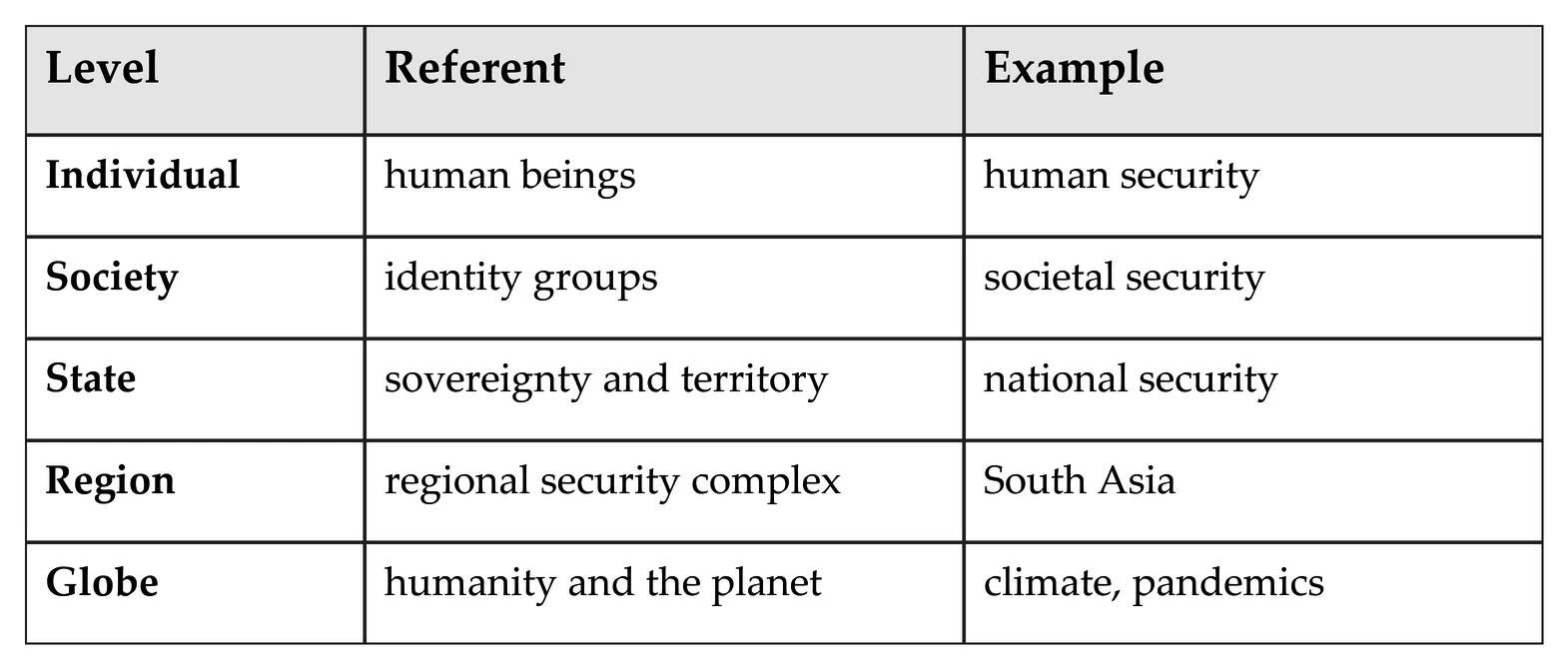
- Individual: human security. The UNDP’s Human Development Report (1994) shifted the focus from states to people, listing seven dimensions: economic, food, health, environmental, personal, community and political security. Shahrbanou Tadjbakhsh and Anuradha Chenoy, in Human Security: Concepts and Implications (2007), explain the debate between a narrow view focused on freedom from fear (violence) and a broad view including freedom from want (poverty, disease). Amitav Acharya (2001) contrasts a Western emphasis on freedom from fear with an Asian emphasis on development and freedom from want.
- Society: societal security. The Copenhagen School defines societal security as a society’s ability to persist in its essential character, i.e. its identity; Paul Roe (2007) shows how threats to identity can produce a societal security dilemma between groups.
- State: national security. The traditional referent, concerned with sovereignty and territory.
- Region: regional security complexes. Buzan and Wæver, in Regions and Powers (2003), argue that most security interactions occur within regions, forming regional security complexes whose members’ security problems cannot be analysed apart from one another; South Asia, centred on India-Pakistan rivalry, is a classic example.
- Globe: global security. Buzan (1991) described new patterns of global security after the Cold War, while threats such as climate change and pandemics affect humanity as a whole.
Pinar Bilgin (2003) shows that individual and societal dimensions are interlinked, and Haider Nizamani (2008) makes a case for critical security studies in South Asia, arguing that state-centric theories developed in the West do not capture the insecurities of the region’s people.
The Indian Understanding of Security
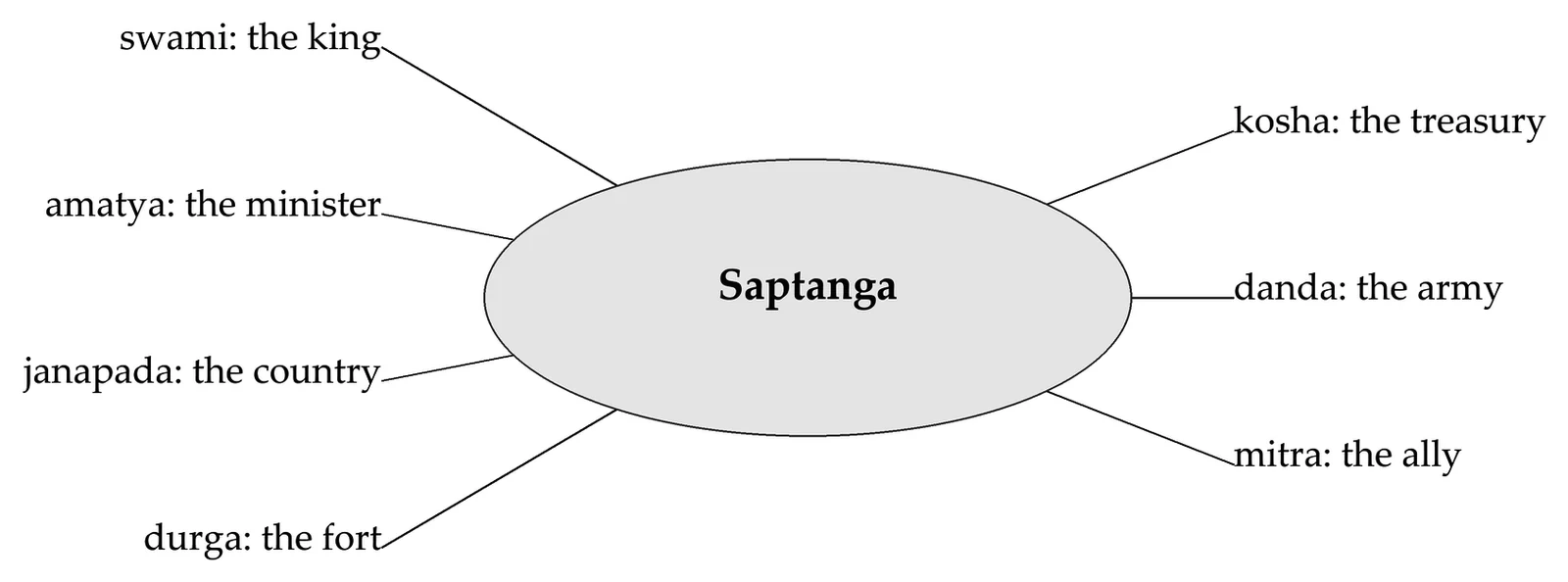
Ancient Indian thought, especially Kautilya’s Arthashastra, offers a rich understanding of security. Kautilya described the state through the saptanga theory of seven elements: the king, the minister, the countryside, the fort, the treasury, the army and the ally. Security means the health of all seven. Sachin More, in Kautilya on State Fragility in Contemporary Security Environment (2015), argues that Kautilya’s analysis of the calamities (vyasanas) that can afflict each element offers a framework for understanding state fragility today: a state weakened internally, by a corrupt administration, an empty treasury or a disaffected population, becomes vulnerable to external enemies. Kautilya also distinguished dangers from within and without and regarded internal revolt as especially dangerous.
Patrick Olivelle, in Economy, Ecology, and National Defence in Kautilya’s Arthashastra (2016), shows that Kautilya linked security with the economy and the environment: the treasury and agriculture were the basis of military power, forests supplied elephants and timber, and frontier forts and forest peoples were part of national defence. S. Jaishankar, in Krishna’s Choice in The India Way (2020), draws on the Mahabharata to discuss strategic choices, and M. S. Pratibha (2017) compares Kautilya with the Chinese strategist Sun Zi, noting that both valued intelligence, deception and winning with minimal fighting, though they rested on different philosophical traditions.
India and Human Security
India has been cautious about the language of human security, fearing that it could justify outside intervention in the internal affairs of developing countries. It has preferred to frame such concerns in terms of development and sovereignty, supporting the Millennium and Sustainable Development Goals. At the same time, India has built institutions for non-traditional threats, such as the National Disaster Management Authority (2005), and has acted as a first responder in regional disasters.
1.4 Important Questions
- Question 1 Discuss the concept of security and its relationship with power, peace and identity.
- Question 2 Distinguish between traditional and non-traditional security.
- Question 3 Discuss the levels of security referents from the individual to the globe.
- Question 4 Discuss the Indian understanding of security with reference to Kautilya.
DU asks the same idea in different words. So learn one broad answer for each question below; the same answer works for every question joined by OR.
Important Question 1
Discuss the concept of security and its relationship with power, peace and identity.
OR
Examine Barry Buzan’s argument on power, peace and security.
OR
Discuss Ken Booth’s idea of security as emancipation.
Model Answer
“Emancipation, not power or order, produces true security.”
— Ken Booth, Security and Emancipation (1991)
Introduction. Security is one of the central concepts of international relations, but its meaning is contested. Arnold Wolfers called it an ambiguous symbol, and David Baldwin showed that it must be specified by asking security for whom and from what. Barry Buzan argued that security is a better organising concept than power or peace, while Ken Booth linked security with emancipation and Pinar Bilgin showed its close relationship with identity.
1. Meaning of Security
Security usually means the alleviation of threats to cherished values. It concerns the survival and well-being of a referent object.
2. Wolfers’s Ambiguous Symbol
Wolfers argued that national security is an ambiguous symbol. Objectively it means the absence of threats, and subjectively the absence of fear.
3. Baldwin’s Questions
Baldwin said security must be specified: for whom, for which values, from what threats, by what means and at what cost. Different answers produce different policies.
4. Power in Realism
Realists organise their thinking around power, seeing world politics as a struggle for survival. Security comes from capabilities.
5. Peace in Idealism
Idealists organise their thinking around peace, hoping to abolish war through law and institutions. Security comes from cooperation.
6. Buzan’s Middle Concept
Buzan argued that security sits between power and peace and is more useful than either. It captures both competition and interdependence.
7. Security as Relational
The security of one state depends on the actions of others. No state can be secure in isolation.
8. The Security Dilemma
Measures that make one state feel safer can make others feel threatened, leading to arms races. This links power with the search for peace.
9. Identity and Security
Bilgin shows that identity shapes what we see as threats, and security practices shape identity. Each constitutes the other.
10. Writing Security
David Campbell argued that foreign policy reproduces national identity by naming dangers. Security is partly about who we are.
11. Societal Security
For many groups, the main threat is to their language, religion or culture. This is the basis of societal security.
12. Booth’s Emancipation
Booth defined emancipation as freeing people from constraints such as war, poverty and oppression. Security and emancipation are two sides of one coin.
13. Critique of State-Centrism
Booth argued that traditional security often made people less secure by putting the state first. People should be the ultimate referent.
14. The Welsh School
Booth’s work founded the Welsh or Aberystwyth School of critical security studies. It links security with human freedom.
15. Indian Relevance
In India, communal riots, caste violence and poverty show that people may be insecure even when the state is secure.
16. Criticism
Realists argue that emancipation makes security too broad and that state survival remains the precondition of all other values.
17. Security as a Contested Concept
Buzan described security as an essentially contested concept, meaning that people will always disagree about its meaning because it involves values as well as facts.
18. Objective and Subjective Security
A state may be objectively safe yet feel insecure, or feel safe while facing real danger; perceptions therefore shape security policy as much as actual threats.
19. Evaluation
Security is best understood as a relational concept linking power, peace and identity, with people as well as states as referents.
Conclusion. Thus, security is a contested concept that Buzan placed between power and peace and Bilgin linked with identity. Booth’s view that emancipation, not power or order, produces true security shows how far the concept has moved beyond the defence of the state.
Important Question 2
Distinguish between traditional and non-traditional security.
OR
Explain Barry Buzan’s five sectors of security.
OR
Discuss the broadening and deepening of the concept of security.
Model Answer
“The 1990s will demand a redefinition of what constitutes national security.”
— Jessica Tuchman Mathews, Redefining Security (1989)
Introduction. Traditional security studies, dominant during the Cold War, focused on states, military threats and the use of force. Since the 1980s, scholars such as Barry Buzan and Jessica Mathews have broadened security to include political, economic, societal and environmental sectors, and deepened it to include individuals and groups. Non-traditional security covers threats such as terrorism, pandemics, climate change and migration.
1. Traditional Security
Traditional security is state-centric and military, focusing on external threats and deterrence. It dominated during the Cold War.
2. Buzan and Hansen’s Four Questions
They define the field by asking about the referent object, internal and external threats, broadening beyond the military, and the politics of threat.
3. Limits of the Traditional View
The traditional view ignored threats that do not come from foreign armies. Many states faced greater dangers from within.
4. Buzan’s Five Sectors
In People, States and Fear, Buzan identified military, political, economic, societal and environmental sectors of security.
5. Military and Political Sectors
The military sector concerns armed threats, while the political sector concerns sovereignty and legitimacy. Separatism is a political threat.
6. Economic Sector
The economic sector concerns welfare, resources and markets. Sanctions, crises and resource shortages are economic threats.
7. Societal Sector
The societal sector concerns collective identities such as language and religion. Migration or assimilation can threaten them.
8. Environmental Sector
The environmental sector concerns the biosphere, threatened by climate change and loss of biodiversity.
9. Mathews’s Redefinition
Mathews argued in 1989 that environmental degradation and population growth had become security issues. Security had to be redefined.
10. Broadening
Broadening means adding new sectors beyond the military. Security now includes health, energy and the environment.
11. Deepening
Deepening means adding new referents below and above the state, from individuals to humanity as a whole.
12. Non-Traditional Threats
Terrorism, pandemics, climate change, migration, cyber attacks and organised crime are often transnational and non-military.
13. Mallavarappu on South Asia
Mallavarappu argues that South Asian experiences of poverty, ethnic conflict and threats to women demand a wider idea of security.
14. Wæver’s Warning
Wæver warns that calling everything security can justify emergency measures and secrecy. Broadening has costs.
15. Indian Examples
COVID-19, floods, cyber attacks and Maoist violence show how non-traditional threats shape India’s security agenda.
16. Criticism
Traditionalists argue that broadening makes security incoherent and distracts from military threats that remain real.
17. Cold War Context
During the Cold War, nuclear deterrence and superpower rivalry made military security the overwhelming concern, which explains the narrow traditional focus.
18. After the Cold War
The end of the Cold War, ethnic conflicts, globalisation and new transnational threats encouraged scholars to widen the security agenda in the 1990s.
19. Evaluation
Both traditional and non-traditional threats matter; a balanced approach recognises military danger and new human threats.
Conclusion. Thus, traditional security focused on states and military force, while non-traditional security, foreseen when Mathews said the 1990s would demand a redefinition of security, covers many sectors and referents. Buzan’s five sectors provide the classic framework for this wider view.
Important Question 3
Discuss the levels of security referents from the individual to the globe.
OR
Examine the concept of human security.
OR
Explain the Regional Security Complex Theory of Buzan and Wæver.
Model Answer
“To protect the vital core of all human lives in ways that enhance human freedoms and human fulfilment.”
— Commission on Human Security, Human Security Now (2003)
Introduction. Security can be sought for different referent objects: individuals, societies, states, regions and the whole globe. Traditional studies focused on the state, but human security turned attention to people, the Copenhagen School to societies and regions, and global threats to humanity. Each level reveals different threats and calls for different responses.
1. Meaning of Referent Object
A referent object is that which is to be secured. Choosing the referent shapes what counts as a threat.
2. The State
The state was the traditional referent, with security meaning the protection of sovereignty and territory.
3. Human Security
The UNDP report of 1994 shifted the focus to people, listing seven dimensions from economic to political security.
4. Freedom from Fear and Want
Tadjbakhsh and Chenoy explain the debate between a narrow focus on violence and a broad focus including poverty and disease.
5. East and West
Acharya contrasts a Western emphasis on freedom from fear with an Asian emphasis on development and freedom from want.
6. Human Security in Practice
The landmines treaty of 1997 and the Responsibility to Protect of 2005 reflected human security ideas.
7. Societal Security
The Copenhagen School defines societal security as a society’s ability to keep its identity. Language and religion are key.
8. Societal Security Dilemma
Roe shows that when one group’s efforts to protect its identity threaten another’s, a societal security dilemma arises.
9. Bilgin on Individual and Society
Bilgin shows that individual and societal dimensions of security are interlinked and cannot be separated.
10. Regional Security Complexes
Buzan and Wæver argue that most security interactions occur within regions, whose members’ security is closely interlinked.
11. South Asia as a Complex
South Asia, centred on India-Pakistan rivalry, is a classic regional security complex.
12. Global Security
Climate change, pandemics and nuclear weapons threaten humanity as a whole, making the globe a referent.
13. Buzan’s Global Patterns
Buzan (1991) described new patterns of global security after the Cold War, including centre-periphery relations.
14. Nizamani on South Asia
Nizamani argues for critical security studies in South Asia, since Western state-centric theories miss people’s insecurities.
15. Tensions between Levels
State security can conflict with human security, as when governments suppress citizens in the name of national security.
16. Criticism
Critics say human security is too vague to guide policy, while supporters say it puts people at the centre.
17. Canada and Japan
Canada promoted a narrow human security agenda focused on violence, while Japan promoted a broad agenda including development, showing different national interpretations.
18. SAARC and Regional Cooperation
The weakness of SAARC shows how India-Pakistan rivalry shapes the South Asian security complex and limits regional cooperation.
19. Evaluation
Studying security at several levels gives a fuller picture of threats than a focus on the state alone.
Conclusion. Thus, security can be sought for individuals, societies, states, regions and the globe. Human security seeks to protect the vital core of all human lives, while regional security complexes and global threats show that security must be analysed at many levels.
Important Question 4
Discuss the Indian understanding of security with reference to Kautilya.
OR
Examine Kautilya’s ideas on state fragility and security.
OR
Discuss the relevance of Kautilya’s Arthashastra for understanding security today.
Model Answer
“The king, the minister, the country, the fort, the treasury, the army and the friend, are the elements of sovereignty.”
— Kautilya, Arthashastra, Book VI (tr. R. Shamasastry)
Introduction. Indian thought offers a rich understanding of security, especially in Kautilya’s Arthashastra. Kautilya saw security as the health of all seven elements of the state and linked it with the economy, administration and the environment. Scholars such as Sachin More and Patrick Olivelle show how his ideas illuminate state fragility and the links between economy, ecology and defence.
1. The Arthashastra
The Arthashastra is an ancient Indian treatise on statecraft, economy and law attributed to Kautilya. It treats security comprehensively.
2. The Saptanga Theory
Kautilya described the state through seven elements: king, minister, countryside, fort, treasury, army and ally.
3. Security as Health of All Elements
Security depends on the strength of all seven elements, not only the army. Weakness in one endangers the whole.
4. Calamities of the Elements
Kautilya analysed the calamities that can afflict each element, such as a corrupt minister or an empty treasury.
5. More on State Fragility
Sachin More argues that this analysis offers a framework for understanding fragile states today.
6. Internal and External Dangers
Kautilya distinguished dangers from within and without and saw internal revolt as especially dangerous.
7. Intelligence
He gave great importance to spies and intelligence to detect internal and external threats early.
8. Economy and Defence
Olivelle shows that Kautilya saw the treasury and agriculture as the basis of military power.
9. Ecology and Security
Forests supplied elephants and timber, so protecting them was part of national defence, according to Olivelle.
10. Frontiers and Forest Peoples
Frontier forts and relations with forest peoples were part of Kautilya’s security planning.
11. Welfare and Legitimacy
Kautilya held that the king’s happiness lies in the happiness of his subjects, linking security with welfare.
12. Mandala and Foreign Policy
His mandala theory and six measures guided relations with neighbours, allies and enemies.
13. Kautilya and Sun Zi
Pratibha shows that both valued intelligence, deception and winning with minimal fighting, from different philosophical bases.
14. Jaishankar’s Krishna’s Choice
Jaishankar draws on the Mahabharata to discuss strategic choices, showing the continuing use of Indian traditions.
15. Comprehensive Security
Kautilya’s holistic view anticipates modern ideas of comprehensive and non-traditional security.
16. Criticism
Critics warn against applying ancient texts directly to modern conditions and against treating them as uniquely Indian realism.
17. Kautilya’s Four Kinds of Danger
Kautilya classified dangers as arising from within and abetted from within, from within and abetted from outside, from outside and abetted from within, and from outside and abetted from outside.
18. Kautilyan Terms Today
Indian strategic writing increasingly uses Kautilyan terms, as in the Indigenous Historical Knowledge project of the Institute for Defence Studies and Analyses.
19. Evaluation
Kautilya offers a holistic understanding of security that links state strength, economy, ecology and welfare.
Conclusion. Thus, Kautilya saw the king, minister, country, fort, treasury, army and friend as the elements of sovereignty, and security as the health of all of them. As More and Olivelle show, his ideas on fragility and on the economic and ecological bases of defence remain relevant today.
Short Notes
(a) Security dilemma
A situation in which measures one state takes to increase its own security, such as building arms, make other states feel less secure, leading to arms races and tension.
(b) Human security
An approach, launched by the UNDP in 1994, that makes the individual rather than the state the referent of security, covering freedom from fear and freedom from want.
(c) Regional security complex
Buzan and Wæver’s term for a group of states whose security problems are so interlinked that they cannot be analysed apart, as in South Asia.
More notes: DSE-4a Understanding Security
These notes are prepared by PADHO TO AISE for study help. They are not an official University of Delhi publication.