
Semester VI DSC-18 India’s Foreign Policy: Challenges and Strategies
Unit II · 17 min read · Updated 24 Nov 2026
As per the University of Delhi (DU) BA (Hons) Political Science syllabus
Contents
- 2.1 The Changing Global Power Equations
- 2.2 India and the USA
- 2.3 India and Russia
- 2.4 India and China
- 2.5 Important Questions
- Trace the evolution of India–US relations and assess their significance.
- Examine the continuity and change in India–Russia relations.
- Discuss the main issues in India–China relations.
- Short Notes
भारत और अमेरिका इक्कीसवीं सदी में विश्व के बेहतर भविष्य की खोज में स्वाभाविक सहयोगी हैं।
India and the United States are natural allies in the quest for a better future for the world in the twenty-first century.
— Atal Bihari Vajpayee, address to the Asia Society, New York (1998)
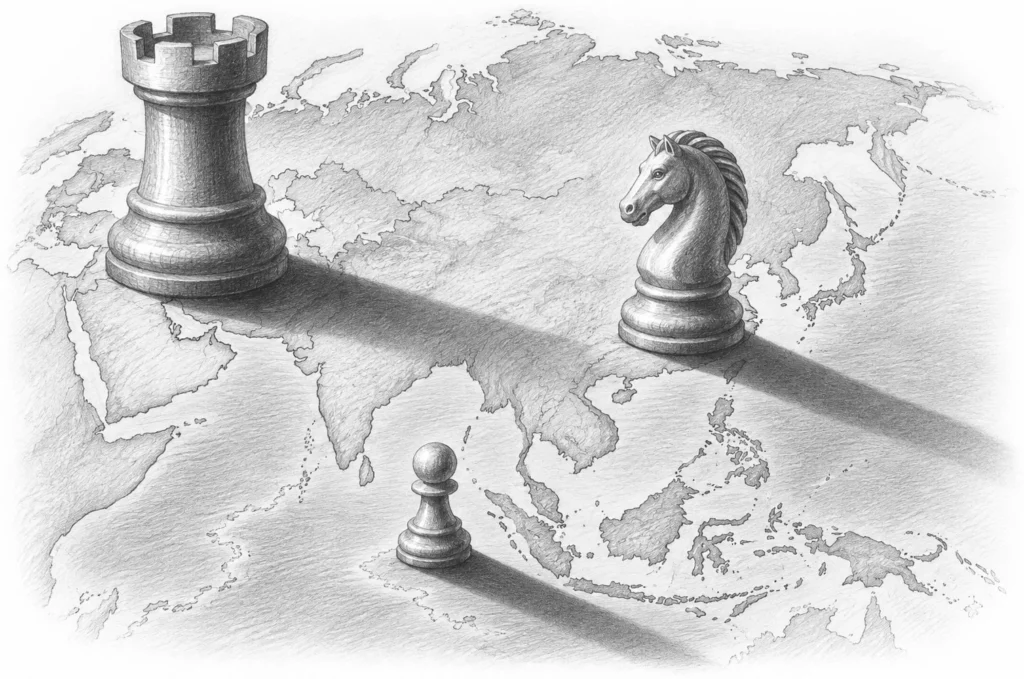
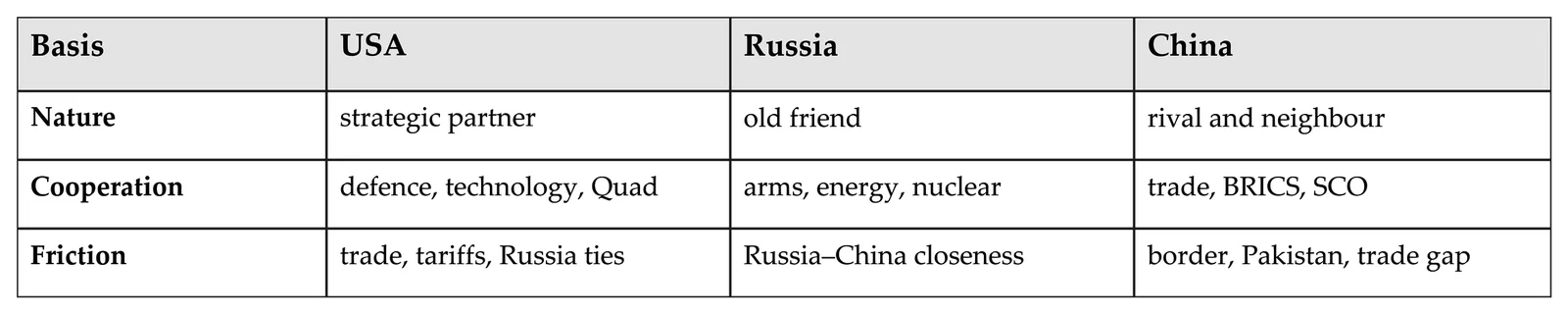
THE global balance of power is changing. The unipolar moment of American dominance after the Cold War has given way to a more multipolar world marked by the rise of China, a resurgent and isolated Russia, and new middle powers such as India. India’s relations with the three major powers, the United States, Russia and China, are central to its foreign policy. The US has become a key strategic partner, Russia remains an old friend and defence supplier, and China is both a major economic partner and India’s principal strategic rival. This unit studies these three relationships, drawing on Ashley Tellis, Aparna Pande, Tanvi Madan, Achal Malhotra, Vijay Gokhale, Surjit Mansingh and Manjeet Pardesi.
2.1 The Changing Global Power Equations
During the Cold War, India followed non-alignment but drew close to the Soviet Union, while the United States allied with Pakistan. After 1991, the US became the sole superpower, India liberalised its economy, and relations with Washington improved steadily. In the twenty-first century, China’s rapid rise has transformed Asia, Russia has drawn closer to China while confronting the West, and the US has sought partners to balance China. India’s strategy of multi-alignment seeks to gain from all three relationships while preserving its autonomy.
2.2 India and the USA
India–US relations were difficult during the Cold War because of US support for Pakistan, differences over non-alignment and US opposition in the 1971 war. Tanvi Madan shows in Fateful Triangle (2020) that China shaped the relationship throughout. After India’s nuclear tests of 1998 and the resulting sanctions, a strategic dialogue began. The civil nuclear agreement (2005–08) transformed relations, followed by defence agreements, recognition of India as a Major Defence Partner (2016) and cooperation in the Quad.

Ashley Tellis argues that supporting India’s rise serves American interests by strengthening a democratic counterweight to China. Aparna Pande emphasises shared democratic values and the role of the Indian-American diaspora, calling the two countries natural allies. The US is India’s largest trading partner, but differences remain over trade, India’s ties with Russia, and immigration; tariffs imposed by the US in 2025 strained relations.
2.3 India and Russia
The Soviet Union supported India with aid for heavy industry, such as the Bhilai steel plant, vetoes on Kashmir in the UN Security Council and weapons, culminating in the 1971 Treaty of Friendship. After 1991, relations declined but were revived through the Strategic Partnership of 2000, upgraded in 2010 to a Special and Privileged Strategic Partnership. Achal Malhotra identifies convergences in defence, energy, nuclear power and support for a multipolar world, and divergences over Russia’s closeness to China and India’s ties with the US.

Russia remains India’s largest arms supplier, though its share has fallen. After Russia invaded Ukraine in 2022, India abstained on UN resolutions condemning it, called for dialogue and sharply increased its imports of discounted Russian oil. Ashley Tellis explains India’s position as driven by its own interests, including dependence on Russian arms and the need to prevent a closer Russia–China alliance. Prime Minister Modi told President Putin in 2022 that today’s era is not an era of war.
2.4 India and China
India was among the first countries to recognise the People’s Republic, and in 1954 the two signed an agreement embodying the five principles of Panchsheel. But disputes over Tibet and the border led to the 1962 war, which India lost. Relations were normalised after Rajiv Gandhi’s visit in 1988, and agreements in 1993, 1996 and 2005 sought to maintain peace along the Line of Actual Control while trade grew rapidly. Manjeet Pardesi describes India’s China policy as combining engagement and balancing.
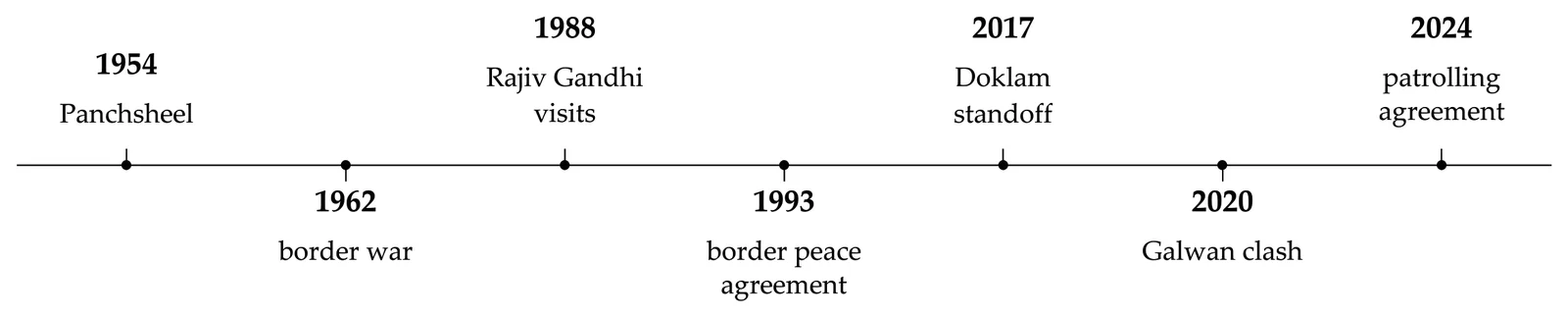
Tensions rose with standoffs at Depsang (2013), Doklam (2017) and the deadly clash at Galwan in June 2020, the first fatal clash in decades. Vijay Gokhale argues that India must prepare for long-term competition. Other issues include China’s support for Pakistan, the China–Pakistan Economic Corridor, its growing presence in the Indian Ocean and a large trade deficit. An agreement on patrolling in October 2024 eased tensions, but rivalry remains, and Surjit Mansingh asks whether the two Asian giants will be friends or rivals.
2.5 Important Questions
- Question 1 Trace the evolution of India–US relations and assess their significance.
- Question 2 Examine the continuity and change in India–Russia relations.
- Question 3 Discuss the main issues in India–China relations.
DU asks the same idea in different words. So learn one broad answer for each question below; the same answer works for every question joined by OR.
Important Question 1
Trace the evolution of India–US relations and assess their significance.
OR
Discuss the transformation of India–US relations since the end of the Cold War.
OR
‘India and the US are natural allies.’ Discuss.
Model Answer
“The President told the Prime Minister that he will work to achieve full civil nuclear energy cooperation with India.”
— India–US Joint Statement (18 July 2005)
Introduction. India and the United States, the world’s largest and oldest democracies, had a difficult relationship during the Cold War. Since the 1990s, and especially since the civil nuclear agreement, they have become close strategic partners. Ashley Tellis, Aparna Pande, Tanvi Madan and Dennis Kux study this transformation and its significance.
1. Early Years
After independence, the US welcomed India’s democracy but disliked non-alignment. Nehru visited the US in 1949, and America provided food aid in the 1950s and 1960s, but the two differed over the Cold War, China and colonialism.
2. The Pakistan Factor
The US allied with Pakistan through military pacts in 1954, supplying arms that India feared would be used against it. This alignment remained a source of mistrust for decades.
3. The 1962 and 1971 Wars
The US helped India during the 1962 war with China, but in 1971, as it opened ties with China through Pakistan, it sent the aircraft carrier USS Enterprise into the Bay of Bengal during the Bangladesh war, a move India saw as intimidation.
4. Madan’s Fateful Triangle
Tanvi Madan argues that China shaped India–US relations during the Cold War: when both feared China, they came closer, as in 1962; when the US courted China, as in 1971, relations deteriorated.
5. Nuclear Disputes
India’s 1974 test and its refusal to sign the NPT led to restrictions on nuclear supplies. After India’s 1998 tests, the US imposed sanctions, but the Jaswant Singh–Strobe Talbott dialogue began a new understanding.
6. Improving Ties
President Clinton’s visit in 2000 marked a new phase. Prime Minister Vajpayee described the two countries as natural allies. The end of the Cold War and India’s economic reforms created common interests.
7. The Nuclear Deal
In July 2005, Prime Minister Manmohan Singh and President George W. Bush agreed on civil nuclear cooperation. After the 123 Agreement and the Nuclear Suppliers Group waiver in 2008, India could trade in civilian nuclear technology despite not signing the NPT, ending its nuclear isolation.
8. Defence Partnership
Defence frameworks in 2005 and 2015, recognition as a Major Defence Partner in 2016 and foundational agreements on logistics (2016), communications (2018) and geospatial cooperation (2020) made the US a major defence partner, with joint exercises and arms purchases.
9. Strategic Convergence
Tellis argues that the US supports India’s rise because a strong, democratic India helps balance China and supports a stable Asian order. India, in turn, benefits from American technology, investment and support in multilateral forums.
10. The Quad and Indo-Pacific
India, the US, Japan and Australia revived the Quad in 2017 and held the first leaders’ summit in 2021, cooperating on maritime security, vaccines, technology and infrastructure in the Indo-Pacific.
11. Economy, Technology and Diaspora
The US is India’s largest trading partner and a major investor. Technology cooperation expanded through the Initiative on Critical and Emerging Technology (2023). The Indian-American diaspora, wealthy and politically active, strengthens ties.
12. Natural Allies
Aparna Pande argues that the two democracies share values, interests and people-to-people ties that make them natural allies, though India prefers partnership to formal alliance.
13. Differences
Differences remain over trade barriers and tariffs, immigration and visas, India’s relations with Russia and Iran, and American criticism of human rights in India. In 2025, steep US tariffs on Indian goods strained relations.
14. Strategic Autonomy
India values its partnership with the US but avoids becoming a formal ally, preserving its strategic autonomy and its ties with Russia and the Global South.
15. Entente or Friends with Benefits
Devin Hagerty asks whether India–US ties amount to a committed relationship or friends with benefits. He describes an entente: a close understanding based on shared interests, especially regarding China, but without the binding commitments of an alliance. Each side cooperates where interests align and differs openly elsewhere, which makes the partnership flexible but also vulnerable to disputes over trade and Russia.
16. Evaluation
India–US relations have been transformed from estrangement to strategic partnership, driven by shared concerns about China, economic ties and democracy. The relationship is deep but not without friction, and it remains a partnership rather than an alliance.
Conclusion. Thus, India–US relations moved from Cold War estrangement, shaped by Pakistan and China, to a strategic partnership built on the nuclear deal, defence cooperation, the Quad and economic ties. As Tellis and Pande argue, the two are natural partners, though differences and India’s autonomy limit the relationship.
Important Question 2
Examine the continuity and change in India–Russia relations.
OR
Discuss the convergences and divergences in India–Russia relations.
OR
How has the Ukraine war affected India–Russia relations? Discuss.
Model Answer
“I know that today’s era is not an era of war.”
— Narendra Modi to Vladimir Putin, Samarkand (16 September 2022)
Introduction. Russia, and before it the Soviet Union, has been one of India’s most reliable partners, supplying weapons, supporting India diplomatically and helping its industrialisation. Since the end of the Cold War, the relationship has changed with India’s ties to the US and Russia’s ties to China, and the Ukraine war has tested it. Achal Malhotra, Ashley Tellis and others analyse these continuities and changes.
1. The Soviet Partnership
From the mid-1950s, the Soviet Union supported India with economic aid for steel plants such as Bhilai, and with arms on favourable terms. Khrushchev’s visit in 1955 declared Soviet support for India’s position on Kashmir.
2. Diplomatic Support
The Soviet Union vetoed Security Council resolutions on Kashmir that India opposed and mediated the Tashkent Declaration after the 1965 India–Pakistan war.
3. The 1971 Treaty
The Indo-Soviet Treaty of Peace, Friendship and Cooperation (August 1971) assured India of Soviet support before the Bangladesh war, deterring China and the US. It marked the high point of the relationship.
4. After the Soviet Collapse
The Soviet collapse in 1991 weakened ties: Russia turned towards the West, trade collapsed and arms supplies were disrupted. A new treaty of friendship was signed in 1993.
5. Strategic Partnership
President Putin’s visit in 2000 produced a Declaration on Strategic Partnership and annual summits. In 2010 the relationship was upgraded to a Special and Privileged Strategic Partnership.
6. Defence
Russia remains India’s largest arms supplier, though its share has declined as India diversified. Joint projects include the BrahMos missile, licensed production of aircraft and tanks, the aircraft carrier Vikramaditya and the S-400 air defence system agreed in 2018.
7. Energy and Nuclear Power
Russia built the Kudankulam nuclear power plant, and Indian companies invested in Russian oil and gas fields. Energy has become a major element of the relationship.
8. Convergences
Malhotra identifies convergences: both favour a multipolar world, cooperate in BRICS and the Shanghai Cooperation Organisation, and have historically supported each other’s core interests, with Russia backing India’s bid for a permanent Security Council seat.
9. Divergences
Divergences include Russia’s growing closeness to China, its outreach to Pakistan, India’s strategic partnership with the US and weak trade ties before 2022. Some Russian officials criticised the Indo-Pacific concept.
10. The Ukraine War
After Russia’s invasion of Ukraine in February 2022, India abstained on UN resolutions condemning Russia, called for dialogue and diplomacy, and declined to join Western sanctions. Modi’s remark that this is not an era of war signalled India’s concern.
11. Oil and Trade
India sharply increased imports of discounted Russian oil, making Russia its largest crude supplier and raising bilateral trade to record levels, though with a large deficit for India and payment difficulties.
12. Tellis on India’s Interest
Ashley Tellis argues that India’s position on the Ukraine war reflects its interests: dependence on Russian weapons, the need for cheap energy and the wish to prevent Russia from becoming China’s junior partner.
13. The China Factor
Russia’s dependence on China after Western sanctions worries India, since China is India’s main rival. India seeks to keep Russia engaged to limit this dependence.
14. Future Prospects
Connectivity projects such as the International North–South Transport Corridor, nuclear cooperation and the Arctic offer opportunities, but Western sanctions and Russia’s isolation create constraints.
15. Space and Science
Cooperation in space and science has been a lasting strength. India’s first astronaut, Rakesh Sharma, flew on a Soviet spacecraft in 1984, and Russia helped train Indian astronauts for the Gaganyaan human spaceflight programme. Such cooperation, along with education and cultural ties, gives the relationship a depth beyond defence and energy.
16. Evaluation
India–Russia relations show strong continuity rooted in trust and defence ties, but they are now shaped by India’s diversification and Russia’s alignment with China. India manages the relationship pragmatically to protect its interests.
Conclusion. Thus, India–Russia relations evolved from the Soviet partnership and the 1971 treaty to a special and privileged strategic partnership based on defence, energy and multipolarity. The Ukraine war and Russia’s closeness to China have introduced new challenges, which India manages pragmatically, as Malhotra and Tellis show.
Important Question 3
Discuss the main issues in India–China relations.
OR
‘India and China: friends or rivals?’ Discuss.
OR
Examine the impact of the Galwan clash on India–China relations.
Model Answer
“Mutual respect for each other’s territorial integrity and sovereignty, mutual non-aggression, mutual non-interference in each other’s internal affairs, equality and mutual benefit, and peaceful co-existence.”
— India–China Agreement (29 April 1954), the five principles of Panchsheel
Introduction. India and China, the two most populous countries and ancient civilisations, are neighbours with a long, disputed border. Their relationship combines cooperation, especially in trade and multilateral forums, with rivalry over territory, influence and status. Manjeet Pardesi, Vijay Gokhale, Surjit Mansingh and Ashley Tellis analyse this complex relationship.
1. Early Friendship
India recognised the People’s Republic soon after 1949 and supported its seat in the UN. The 1954 agreement on Tibet set out the five principles of Panchsheel, and the slogan Hindi–Chini bhai bhai expressed hopes of Asian solidarity.
2. Tibet and the Border
China’s control of Tibet in 1950 made the two countries direct neighbours. China rejected the McMahon Line in the east and built a road through Aksai Chin in the west. The Dalai Lama’s flight to India in 1959 increased tensions.
3. The 1962 War
In October–November 1962, China defeated India in a short border war, then withdrew in the east but kept Aksai Chin. The war deeply affected Indian thinking about China and security.
4. Normalisation
Ambassadors returned in 1976, and Rajiv Gandhi’s visit in 1988 began normalisation. Agreements in 1993 and 1996 committed both to peace and confidence-building along the Line of Actual Control, and in 2003 special representatives were appointed to negotiate the boundary.
5. Economic Ties
Trade grew rapidly, making China one of India’s largest trading partners. But India runs a very large trade deficit and depends on Chinese inputs for electronics, pharmaceuticals and solar equipment.
6. Multilateral Cooperation
India and China cooperate in BRICS, the Shanghai Cooperation Organisation and climate negotiations, where both defend the interests of developing countries.
7. The Pakistan Factor
China’s close partnership with Pakistan, including arms supplies, nuclear cooperation and the China–Pakistan Economic Corridor through territory India claims, is a major source of tension. China long blocked the UN listing of Pakistan-based terrorist leaders.
8. Indian Ocean and Neighbourhood
China’s growing presence in South Asia and the Indian Ocean, through ports such as Hambantota in Sri Lanka, infrastructure projects and naval visits, is seen in India as encirclement, sometimes called the string of pearls.
9. Border Standoffs
Standoffs at Depsang (2013), Chumar (2014) and Doklam (2017), where Indian troops blocked Chinese road-building on territory claimed by Bhutan, showed rising friction. Informal summits at Wuhan (2018) and Mamallapuram (2019) tried to manage it.
10. Galwan
In June 2020, a clash in the Galwan valley killed twenty Indian soldiers and an undisclosed number of Chinese soldiers, the first deadly clash since 1975. India responded with troop deployments, bans on Chinese apps and restrictions on Chinese investment.
11. Gokhale’s Assessment
Former foreign secretary Vijay Gokhale argues that after Galwan India must prepare for long-term competition with China, strengthen its capabilities and partnerships, and avoid illusions about Chinese intentions.
12. Pardesi on India’s Strategy
Manjeet Pardesi describes India’s China policy as a mix of engagement, to benefit from trade and avoid conflict, and balancing, through military modernisation and partnerships with the US, Japan and others.
13. Easing Tensions
An agreement in October 2024 on patrolling at Depsang and Demchok, followed by a meeting between Modi and Xi Jinping, eased tensions and began a cautious thaw, though the boundary remains unresolved.
14. Friends or Rivals
Surjit Mansingh asks whether the two rising Asian powers will be friends or rivals. Tellis and Mirski see their relationship as the crux of Asia, with competition likely to persist alongside economic interdependence.
15. Evaluation
India–China relations combine cooperation and competition. The boundary dispute, the Pakistan factor and regional rivalry make China India’s principal strategic challenge, while trade and multilateral cooperation create incentives to manage differences.
Conclusion. Thus, India–China relations moved from the Panchsheel friendship of the 1950s through the 1962 war and normalisation to renewed rivalry after Doklam and Galwan. Boundary disputes, China’s support for Pakistan and competition in the region make the relationship one of managed rivalry, as Gokhale and Pardesi argue.
Short Notes
(a) Civil nuclear agreement
The India–US agreement announced in July 2005 and completed in 2008 through the 123 Agreement and a waiver from the Nuclear Suppliers Group. It allowed India to engage in civilian nuclear trade despite not signing the NPT, after separating its civilian and military facilities, and transformed India–US relations.
(b) Quad
The Quadrilateral Security Dialogue of India, the United States, Japan and Australia. First proposed in 2007 and revived in 2017, it held its first leaders’ summit in 2021. It cooperates on maritime security, critical technologies, vaccines and infrastructure for a free and open Indo-Pacific.
(c) Panchsheel
The five principles of peaceful coexistence set out in the India–China agreement of 1954: mutual respect for territorial integrity and sovereignty, non-aggression, non-interference, equality and mutual benefit, and peaceful coexistence. They became a basis of the Non-Aligned Movement but did not prevent the 1962 war.
(d) Line of Actual Control
The de facto boundary between Indian and Chinese controlled territory, about 3,488 kilometres long by Indian count, divided into western, middle and eastern sectors. It is not clearly demarcated, and differing perceptions of its alignment have led to standoffs and clashes.
More notes: DSC-18 India’s Foreign Policy: Challenges and Strategies
These notes are prepared by PADHO TO AISE for study help. They are not an official University of Delhi publication.